


Fate is not merely fickle. It is frequently comical.
How else shall we note the irony that Democrats and Republicans both have their Senate races roiled by someone named “Graham”?
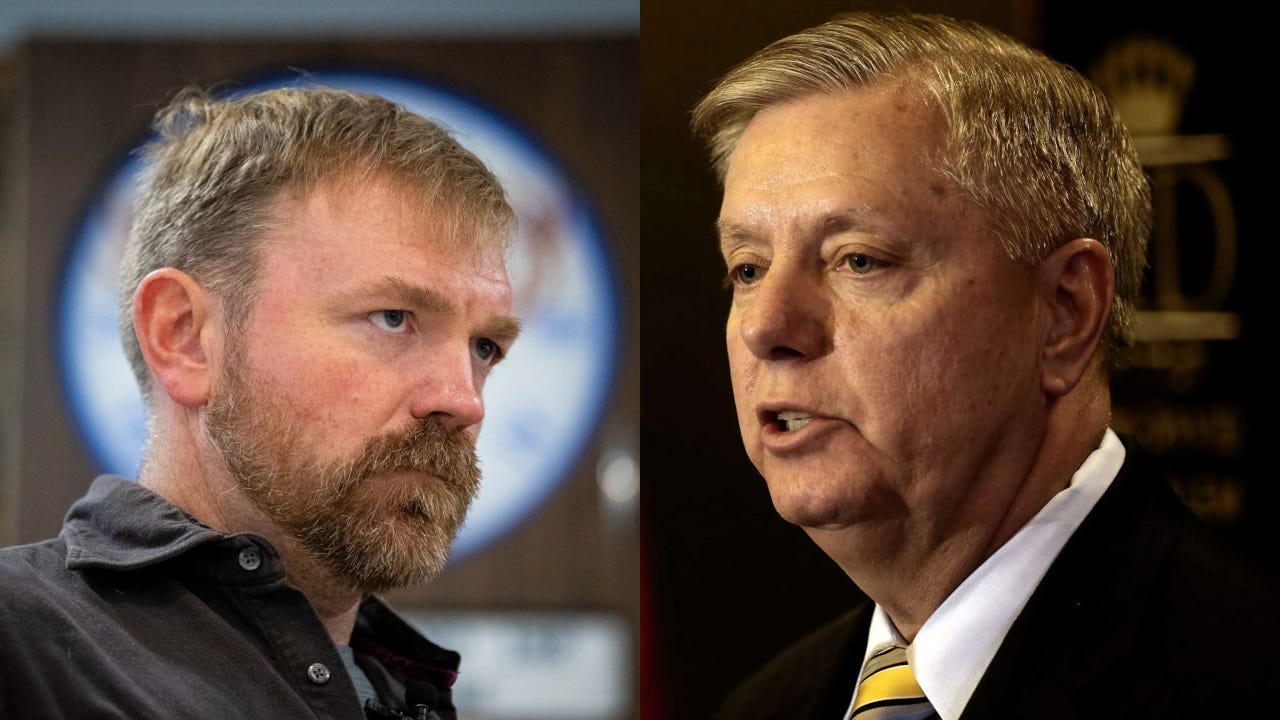
The Democrats’ Graham is, of course, none other than Maine’s latest favorite son, Nazi, and accused rapist Graham Platner, who, after winning the Senate Democratic Primary with some 72% of the vote, was obliged to withdraw after the weight of sexual assault accusations became to great even for Democrats to ignore.
Platner, in keeping with the smarmy reputation he had acquired over his short political career, bowed out as put-upon victim of lies and power politics.
“What comes next needs to come from the people, needs to come from the people of Maine,” Platner said. “It needs to be open, transparent and democratic. It needs to be reflecting the will and the values of the people that built this movement.”
“We believe that for the movement to continue, it can’t be me. And for that reason, we are suspending campaign operations,” Platner continued. “We’re not doing it because of the allegations; we’re doing it because of the structures that are being taken away from us by those in power.”
The Republicans Graham is Lindsey Graham, the long-time Senator, war hawk, and reliable shill for the Military Industrial Complex from South Carolina who had recently won his state’s primary election and was preparing to seek a fifth term in the Senate when he abruptly came down with a sudden case of death.
Emergency personnel responded to a call for “cardiac arrest” at Graham’s Capitol Hill home on Saturday night, according to police scanner audio obtained by NBC News.
Photographs reviewed by NBC News show that paramedics carried a person on a stretcher from Graham’s home to an awaiting ambulance. Police cars and fire trucks were also on site.
Full disclosure: I have nothing good to say about either man.
As the general election phase of the mid-term election cycle begins to heat up, the fates which have befallen both Grahams leave Maine Democrats and South Carolina Republicans without a candidate, in an election year when Democrats sense GOP vulnerability and hope to capture both the Senate and the House.
Both Maine Democrats and South Carolina Republicans must now quickly replace their candidates. Tellingly, only the South Carolina Republicans are respecting voters in so doing.
South Carolina: Special Election Required By Law
We must make one clear distinction between the Maine and South Carolina processes for replacing candidates prior to the general election: South Carolina’s process is more clearly governed by statute than Maine’s, and clearly calls for a special election1.
If a party nominee dies, becomes disqualified after his nomination, or resigns his candidacy for a legitimate nonpolitical reason as defined in Section 7-11-50 and was selected through a party primary election, the vacancy must be filled in a special primary election to be conducted as provided in this section. The filing period for this special primary election opens the second Tuesday after the death, disqualification, or approval of the resignation for one week. The special primary election then must be conducted on the second Tuesday immediately following the close of the filing period. A runoff, if necessary, must be held two weeks after the first primary. The nomination must be certified not less than two weeks before the date of the general election. If the nomination is certified two weeks or more before the date of the general election, that office is to be filled at the general election.
Based on Senator Graham’s death on Saturday, July 11, the filing period for the special election begins on July 21, and the special election held on August 11. If a runoff election is necessary, that will be held on August 25.
For South Carolina Republicans, the precision of the law is arguably a blessing. There can be no controversy about how to replace Lindsey Graham on the ballot. The GOP merely has to stick to the letter of the law.
The letter of the law says hold an election, and so South Carolina will hold an election.
For the remainder of 2026 and until the next Session of Congress commences next January 3, by law South Carolina Governor Henry McMaster will appoint someone to temporarily fill Graham’s Senate seat2.
In case of a vacancy in the office of United States Senator from death, resignation or otherwise, the Governor may fill the place by appointment which shall be for the period of time intervening between the date of such appointment and January third following the next succeeding general election. But in the event any such vacancy shall occur less than one hundred days prior to any general election, the appointment shall be for the period of time intervening between the date of such appointment and January third following the second general election next succeeding. The Governor shall within five days after any such appointment order an election to be held in connection with and at the time of the general election immediately preceding the expiration date of such appointment if at the expiration of such appointment an unexpired term shall remain.
The only guesswork in South Carolina is who will stand in the special primary election and who will take Lindsey Graham’s seat in the Senate for the remainder of this Session of Congress.
Maine: The Rule Is The Are No Rules
As much as South Carolina’s process is determined by law and thus lacks the Kabuki theatrics that are the hallmark of modern party politics, Maine’s process is by law designed to be more of a “Hunger Games” scenario defined mainly by the absence of specific process3.
1. Vacancy and replacement of nominees. The Secretary of State shall declare the vacancy as provided in section 362‑A and a political committee may make a replacement nomination for the general election only if a person nominated for an office at a primary election or by a political committee:
A. Withdraws on or before 5 p.m. of the 2nd Monday in July preceding the general election in accordance with section 367;
B. Withdraws because of a catastrophic illness, condition or injury that has permanently and continuously incapacitated the candidate and would prevent performance of the duties of the office sought, as long as the candidate or a member of the candidate’s immediate family files with the Secretary of State a certificate accompanying the withdrawal request that describes the illness, condition or injury and is signed by a licensed physician; or
C. Dies prior to the general election.
2. Deadline for replacement of nominee. A political committee may make a replacement nomination for the general election:
A. No later than 5 p.m. of the 4th Monday in July preceding the general election for a candidate who has withdrawn in accordance with subsection 1, paragraph A; or
B. As soon as practicable for a candidate who withdraws or is withdrawn in accordance with subsection 1, paragraph B or C.
In Maine, the main rule for how to select an alternative nominee is simply that there are no rules. The Maine Democratic Party has carte blanche to select a nominee however the party so chooses, provided it does so by July 27.
Presumably mindful of the “coup” fiasco from 2024, when Biden bowed out at the last minute and Kamala Harris was anointed as his successor, the Maine Democratic Party has made considerable noise about having a “transparent” process via a special nominating convention, according to Party Chairman Charlie Dingman:
The Maine Democratic party’s call to convention provides the most inclusive, representative, and transparent process possible under these unprecedented circumstances. Today, we are announcing that we will hold our nominating convention on Saturday, July 25, where 601 delegates, from each of Maine’s 16 counties, will vote to choose our new nominee. The convention will be fair, representative, and as transparent as possible as we all come together in service of our ultimate goal: defeat Susan Collins and win this Senate seat.
To that end the party has already put out the call for the convention, including a call for candidates to replace Graham Platner.
What the Maine Democratic Party has not done is put out a call for a special primary election.
We should note that Maine election law provides a much smaller window for replacing a candidate than South Carolina. Where South Carolina has very close to two months at this point, Maine affords the Democrats barely two weeks.
Still, it is instructive that Maine is not holding a special primary election, but rather a convention.
Is there legitimately enough time for a fair election to be held? Possibly not—and yet the logistics of organizing a convention are hardly less daunting, given the compressed time frame.
By the end of this week Maine Democrats are expected to meet in their respective counties to select delegates for the convention:
Maine Democrats across the state are coming together in a Special Nomination Process to select our next Democratic U.S. Senate nominee — and defeat Susan Collins in November. We have a short window to complete this process, with all steps concluding by July 27th at 5 PM. Here’s how it works:
Candidate Filing: Senate candidates will submit their intent to run and collect signatures to qualify for the ballot.
County Nominating Meetings (July 18–19): All 16 Maine counties will convene special nomination meetings where participants will vote to elect delegates. Maine Democrats can register to be a delegate and to participate and vote in their county’s meeting.
Nominating Convention (Saturday, July 25 at 9 AM at the Bangor Cross Insurance Center): 601 delegates will vote to select our new nominee.
We have worked hard to create a fair process that is inclusive of varying viewpoints and diverse backgrounds of Democrats across the state of Maine, as we all come together in service of our ultimate goal: defeat Susan Collins and win this Senate seat.
On Saturday (July 11) the MDP further clarified that the county nominating meetings will be announced this Wednesday (July 15).
In the space of a week, Maine Democrats are expected to choose delegates for a convention, and by the end of next week, said delegates will have selected (but not elected) Graham Platner’s replacement.
Is a convention process this rushed somehow more fair and more transparent than a special election?
Why is a convention preferable to a special election held on July 25? While elections in this country are traditionally held on a Tuesday, Maine election law merely requires special elections be published and conducted in as much the same manner as regular elections “as practicable”4. A Saturday election is perfectly permissible under Maine law, but don’t tell the Democrats that.
If there is time enough to announce a slew of county-level convention delgate “mini-elections”, how is there not time enough to announce a full special election by July 25, to give ample time for party bosses to stuff the ballot boxes count the votes ahead of the July 27 statutory deadline?
The Democrats, unlike the Republicans, had the option to choose how to deal with their ballot crisis, and chose not to involve voters.
Democrats Refuse To Address How Platner Became Their Nominee
There is one aspect of the Maine Democratic Party’s election dumpster fire that is an almost exact parallel to 2024: no recognition the party made a mistake even recruiting Platner.
The special nominating convention and all the nauseating political melodrama that has led up to it should not be happening, because Planter should never have been recruited in the first place.
Lindsey Graham put South Carolina Republicans on the spot purely by accident—dying in the middle of an election year has that effect. Platner not only chose to run for the Senate, he was also chosen to run for the Senate by Democratic Socialists of America political strategist Daniel Moraff.
That is a mistake so glaringly obvious even corporate media is scrambling for some semblance of moral high ground with a conveniently timed “Whisky Tango Foxtrot” pose. Last Thursday, CBS News’ Tony Dokoupil sought to excoriate the Democrats over the Platner affair, and in doing so said more than he realized.
Presumably, Platner’s currency was that he was “real people” rather than a groomed politician.
Many Democrats knew Platner had character issues. The theory, from Daniel Moraff, the political strategist who plucked Platner from obscurity, and made him into a star, was that the voters wouldn’t care. That they wanted, quote, “real people who have lived real lives.”
In other words, Graham Platner was recruited because he wasn’t Gavin Newsom.
What Dokoupil, corporate media, and the Democrats do not grasp is that a man’s character is revealed in the life he has lived. As Jesus teaches us in the Gospels, we may know a man by the fruit he bears in life.
Graham Platner’s “real life” was exactly what destroyed his campaign.
He claimed to be an oyster farmer—who sold oysters only to his mother.
His primary income was from claiming to be 100% disabled—even as he was “abled” enough to run for elective office.
He highlighted his military service—and insulted other veterans for their service.
He went above and beyond to earn the title “misogynist”.
Democrats defending Graham Platner loved to point out Donald Trump’s numerous character issues.
Yes, Donald Trump has a history and a reputation as a ladies’ man.
Yes, Donald Trump has a shoot from the lip verbal style and is frequently guilty of incontinent rhetoric.
Yes, Donald Trump is arguably a narcissist to at least some degree.
Donald Trump is also the builder who led New York City back from the brink in the 1970s.
Donald Trump built a legitimate real estate empire. He actually built things and put people to work.
Outside of politics, Donald Trump has done quite a lot with his life. We can see the fruits of his life just as we can see the fruits of Graham Platner’s.
The fruits of Donald Trump’s life propelled him into the Presidency. The fruits of Graham Platner’s life relegate him to irrelevance.
The Democrats are ideologically incapable of assessing the fruits of a man’s life. If there was any doubt about that before, Graham Platner is absolute proof of this. Remember, this is the party that inflicted Barack Obama and his “you didn’t build that” disparaging of individual effort on the country.
They certainly are no more likely to assess the life of whomever takes Platner’s place on the ballot than they did Platner’s life. The life of whomever replaces Graham Platner, and what they have made of their life, is no more likely to be a relevant factor at the nominating convention than it was when recruiting Platner. By the time it does become relevant to Democrats, it will once again be too late.
At most the Democrats are likely to want to avoid candidates with a history of assaulting women, but is there any good reason to believe they will consider character more deeply than that?
Equally left unaddressed is the reality that Democrat voters voted for Graham Platner in the primary. Platner’s failings as a human being and vulnerabilities as a candidate were known, yet he still managed to attract 154,058 votes—71.9% of the total—compared to the Establishmentarian alternative Janet Mills’ 41,301.
For all of Platner’s ugliness as a human being, he was the candidate elected by Maine Democrat voters to be their nominee, and the party bosses still opted to “unelect” him. Those same party bosses are opting to not elect his replacement, but to select them. Tammany Hall and the ghost of “Boss” Tweed have returned to haunt the Democrats yet again.
The Democrats are proving once again they are a party that fundamentally hates people. They despise the individual, and detest notions of individual effort, individual success, and individual achievement. They detest individual prosperity.
They detest individual votes cast by individual voters.
Their policies are always doomed to failure because their political beliefs are predicated on people always failing, never succeeding.
In that regard, Graham Platner is the perfect representation of all for which the Democratic Party stands. When Democrats look in the mirror today, Graham Platner is staring back at them.
I realize how cynical this may sound, but I’m fairly confident that the Maine process will remain open and transparent only so long as it aligns with national party wishes. The moment it starts to look precarious it’ll go full Kamala.
Maine has swung significantly since 2020, blue swarms during Covid fleeing NY and MA and bought up land and homes and now friends and family can barely afford to live there. They are also harming the economy with laws that hinder their jobs and pleasures - lobstering, hunting etc. it’s unrecognizable not just in thousands of new homes but in values and character. So Platner’s success doesn’t surprise me, the votes were probably all from residents less than 5y.