


On the surface, the April Job Openings and Labor Turnover Summary Report confirmed the broadly good news of the April Employment Situation Summary. Although net hiring cooled from March to April, net hiring remained positive. Job openings surged, a data point which naturally enthused corporate media.

The number of job openings increased to 7.6 million in April, the U.S. Bureau of Labor Statistics reported today. Over the month, hires and total separations decreased to 5.1 million and 5.0 million, respectively. Within separations, both quits (3.0 million) and layoffs and discharges (1.7 million) were little changed.
The 7.6 million job openings figure easily surpassed Wall Street’s projection as well as the Trading Economics forecast, both of which were 6.8 million.

The better than expected job openings number excited corporate media outlets, as it put the number of available job openings above the reported number of unemployed individuals.
Yet even just delving into to the levels of hires and separations, it is clear that the optimism corporate media infers from the job openings numbers does not extend very far. Employers and employees alike are still showing uncertainty about the current economic state of affairs.
Still, several sectors showed job growth in the JOLTS report, even when they reported job loss in the Employment Situation Summary.
Is the April JOLTS report a good jobs report? Maddeningly, the answer is ultimately “it depends”. For some sectors it is a good report. For others...not so much.
Hiring And Separations Are Down
While the Bureau of Labor Statistics still found a way to inject its favorite jobs formulation of “little changed”, the devil in the detail is that overall hiring fell in April, with overall separations falling even more.
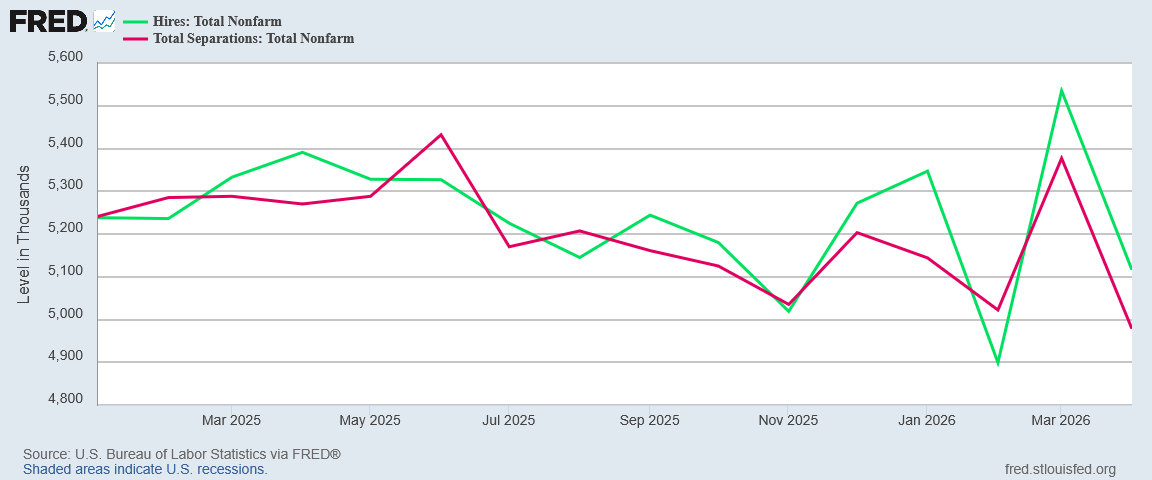
The corporate media assessment of these numbers is to impute a lack of overall confidence among both employers and employees.
The department’s Job Openings and Labor Turnover Survey (JOLTS) showed that layoffs fell but so did the number of Americans quitting their jobs - a sign of confidence in their prospects. And the report’s measure of gross hiring also dropped in April, suggesting that companies remain reluctant to add new workers even as they hold on to the ones they have.
Despite the apparent unease, employers presumably are also showing signs of optimism, given that reported job openings surged to a three-year high.
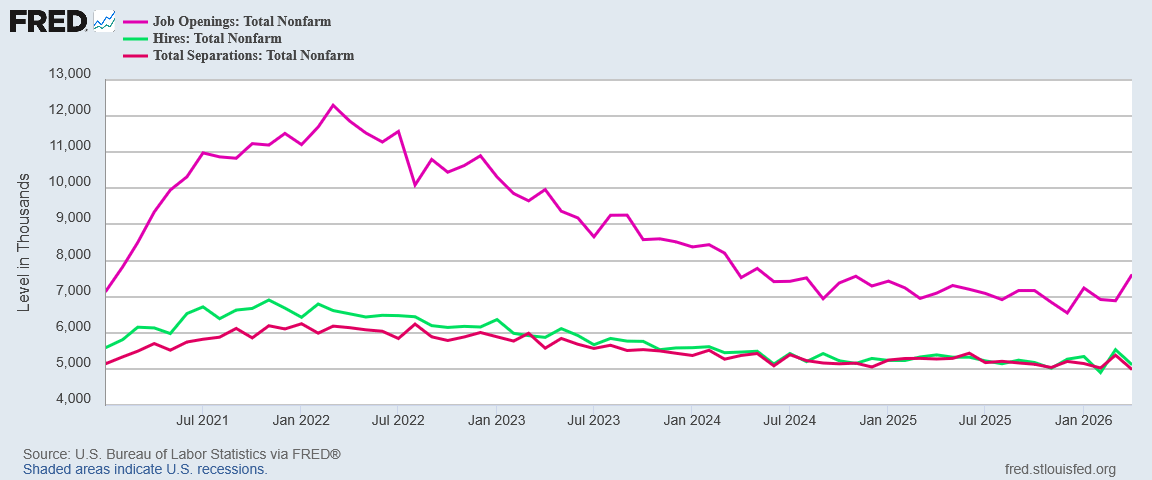
The jump in job openings certainly appears to be an optimistic signal, given that it pushed job openings above the number of unemployed.
The jump in openings put the available jobs above the total of unemployed workers. The rate of openings compared to the size of the labor force rose 0.4 percentage point to 4.6%.
As the top level data shows, however, the surge in job openings was met with a drop in overall net hiring.
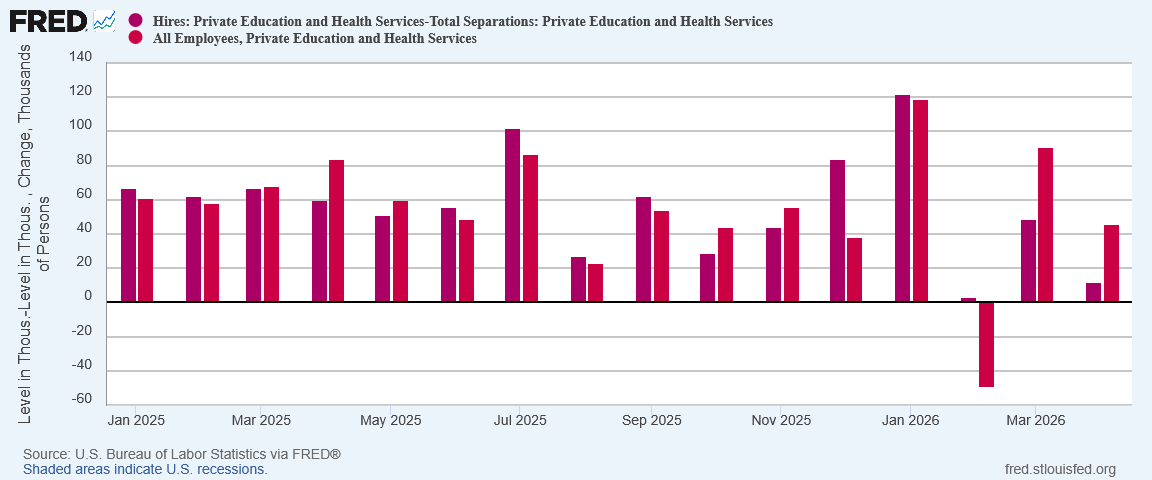
Still, the net hiring trend among private employers was still positive, and following the same movements as the Employment Situation Summary’s All Employees data set.
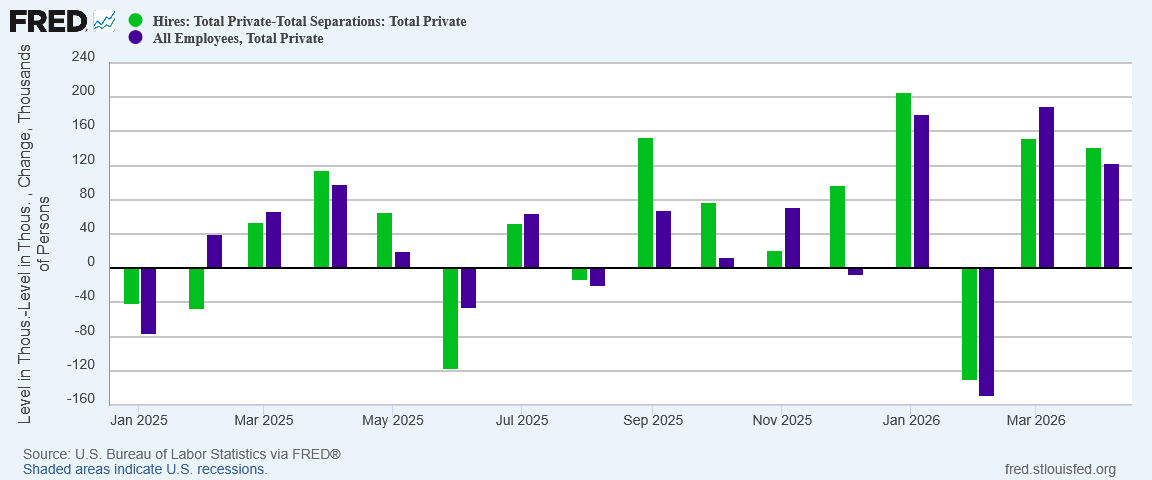
While still positive on the month, indicating real job growth, that the net hiring data cooled in April is a subtle reminder that jobs markets in the US have quite a ways to go before a recovery can be said to be in full swing.
Manufacturing Jobs Rose
One encouraging note within the jobs report is that net hiring rose in the manufacturing sector.
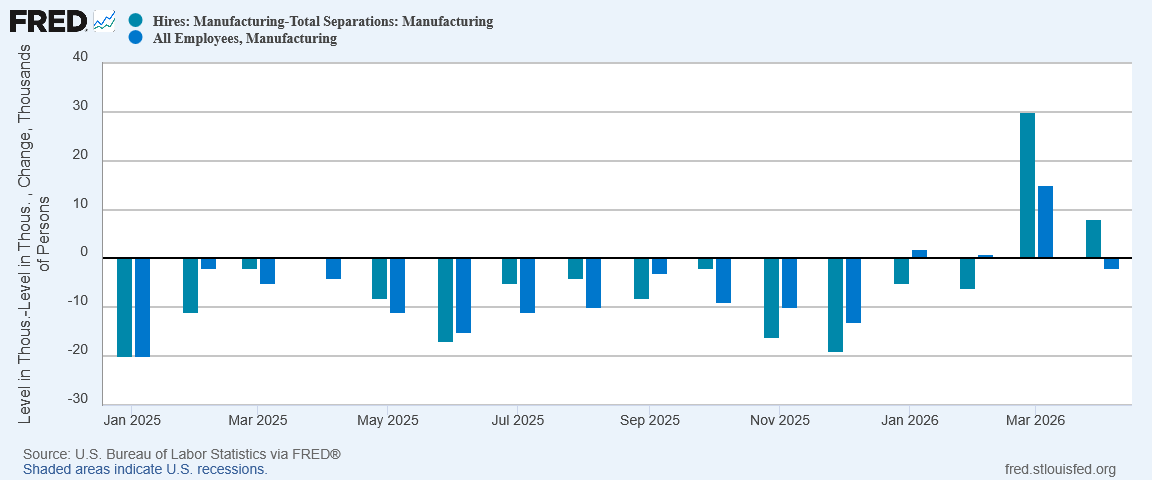
Manufacturing is one sector where the JOLTS data diverged from the Employment Situation Summary, which showed job loss in manufacturing for April.
Construction was another sector where the JOLTS data was markedly better than the ESS data.
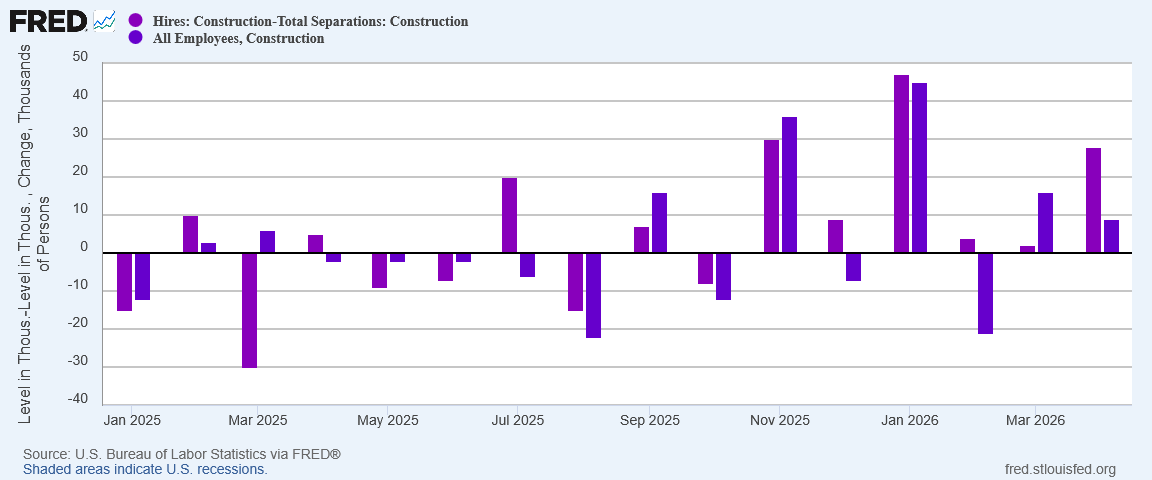
Net hiring in construction strengthened in April, even though the ESS data showed job growth in construction cooling.
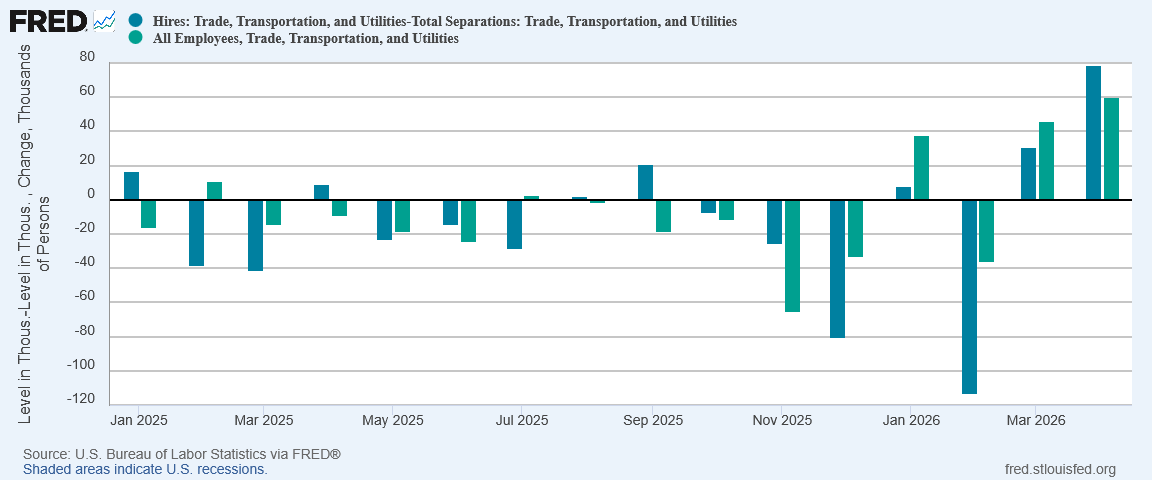
Trade, Transportation, and Utilities, a mainstay of service providing jobs, printed especially strong net hiring numbers.
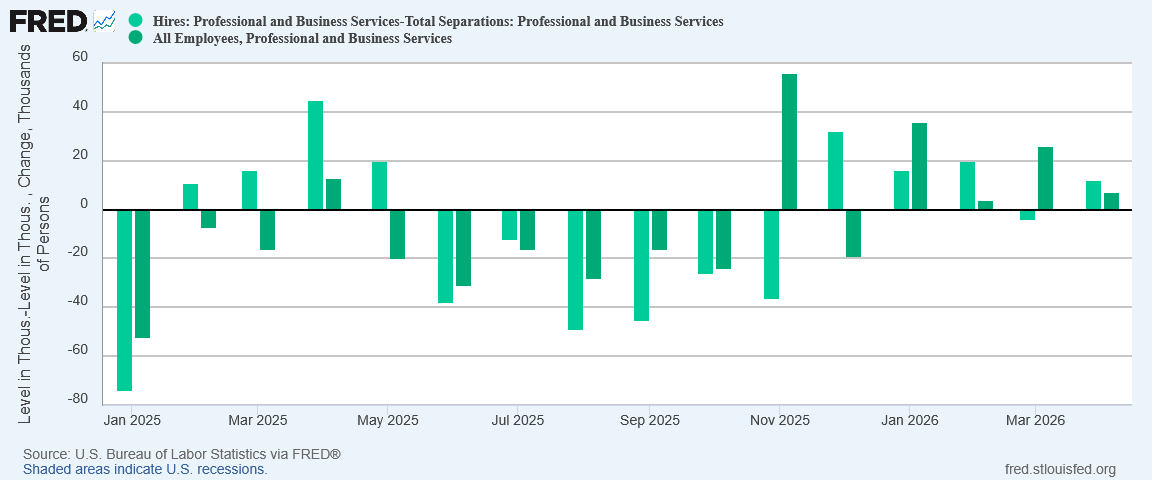
Other service sectors showed net hiring cooling off, although professional and business services did show improvement over March, when net hiring was negative.
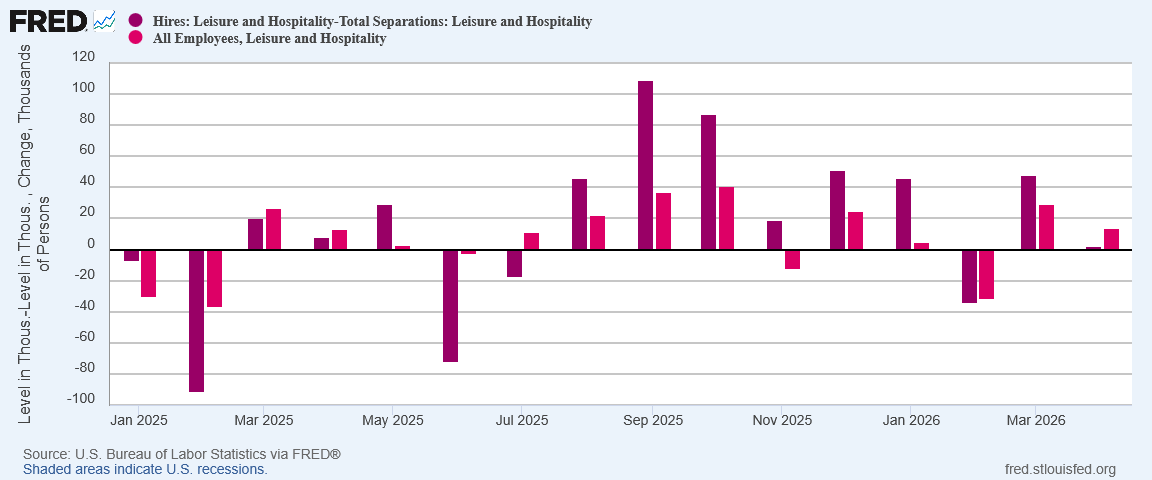
Leisure showed a marked cooling in net hiring, printing almost no job growth in April.
Healthcare, which has been the major source of jobs since the start of 2025, had the second weakest net hiring numbers over that time frame.
In what might be an encouraging note for the May ESS report due out on Friday, in most sectors net hiring outpaced job growth per the ESS, a notable shift from the March data.
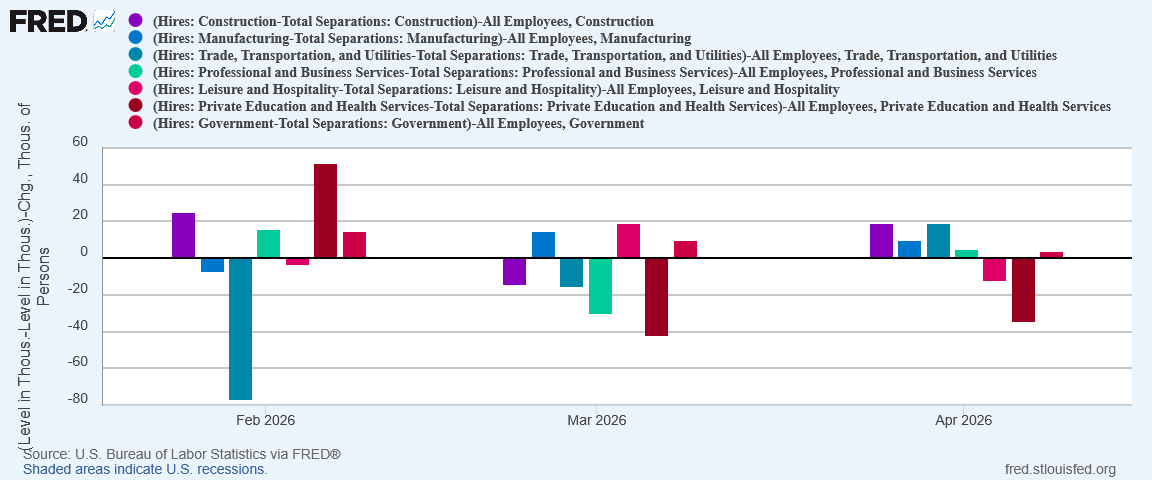
While overall private-sector net hiring was in line with private-sector job growth from the ESS, the sector-level numbers invite greater skepticism and unease about what’s up next for US jobs markets.
Was the April JOLTS report a good report? It depends on the sector under scrutiny. Some had a good month, others had a less good month.
ISM Data Invites Skepticism
The PMI data for April from the Institute of Supply Management provides further encouragement for skepticism.
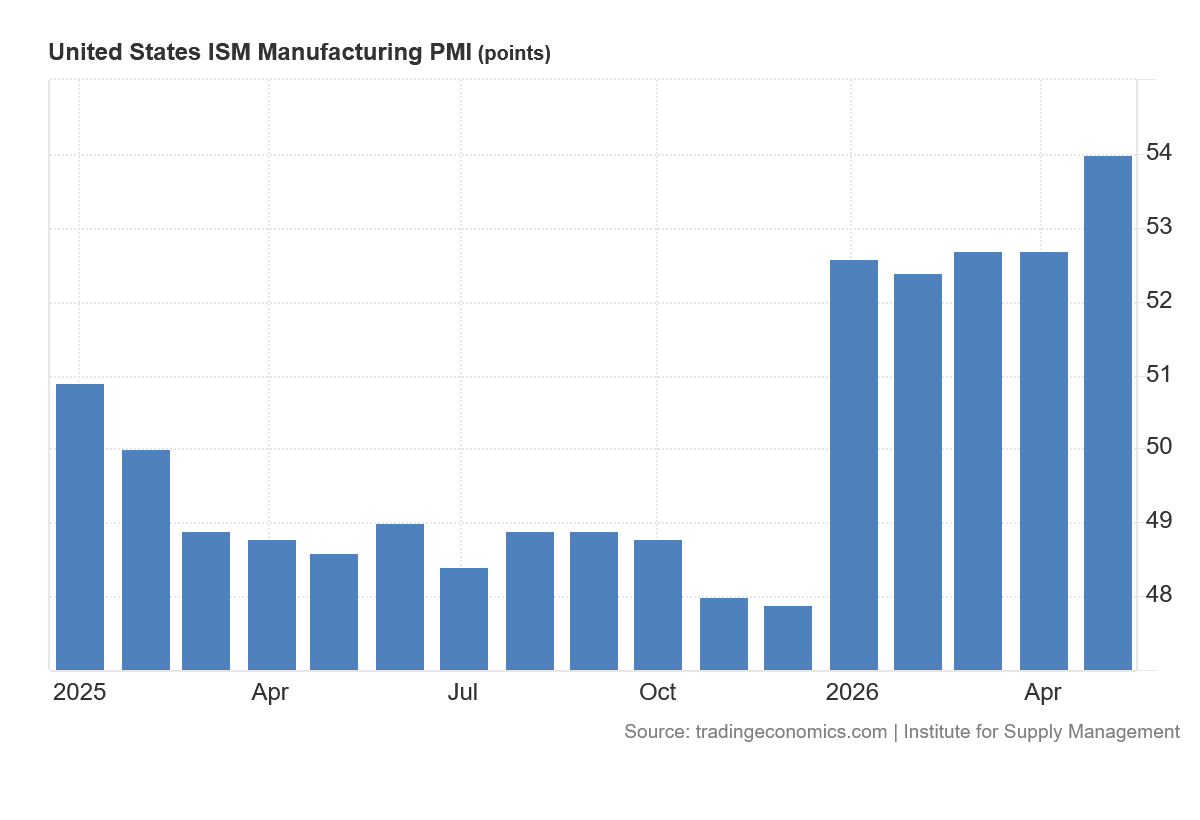
The April Manufacturing PMI print showed Manufacturing continuing to expand in 2026.
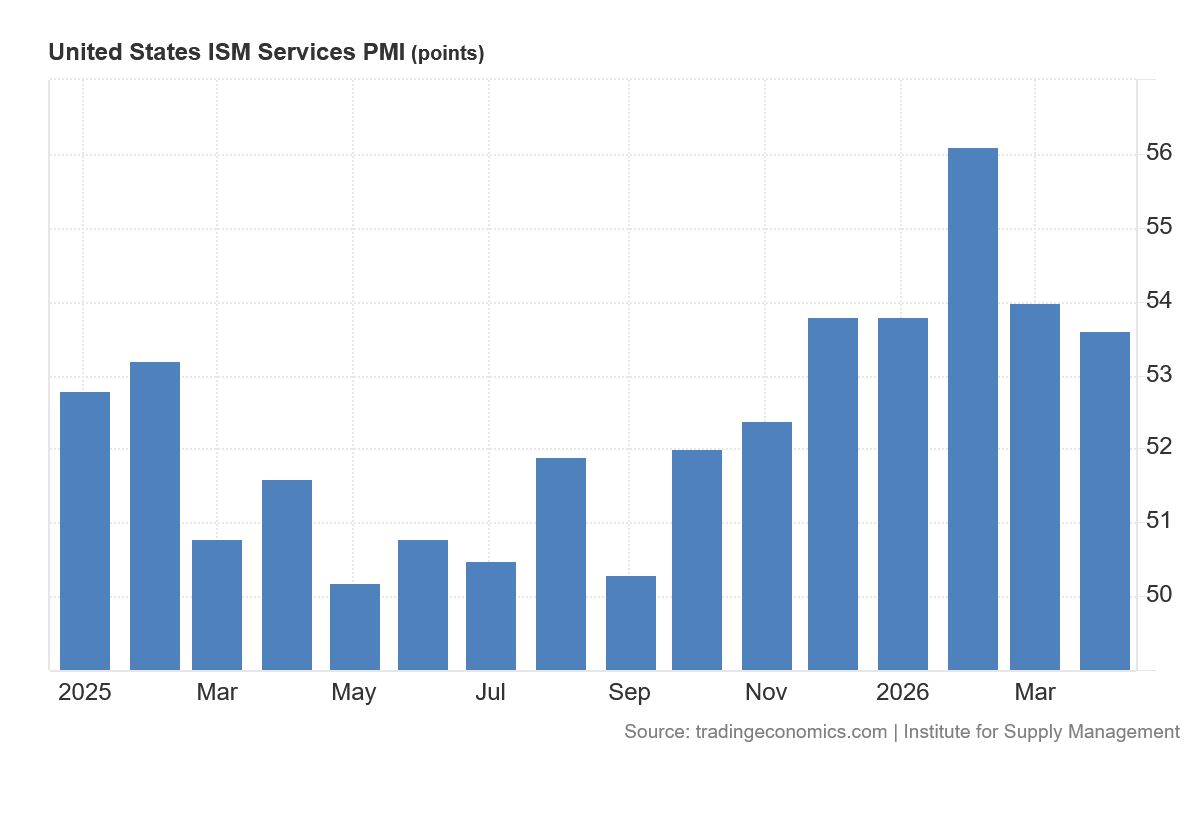
The Services PMI print for April also showed expansion, although it also cooled for the second month in a row.
However, in contrast to the JOLTS net hiring data for Manufacturing, the ISM data showed Manufacturing employment contracted in April.
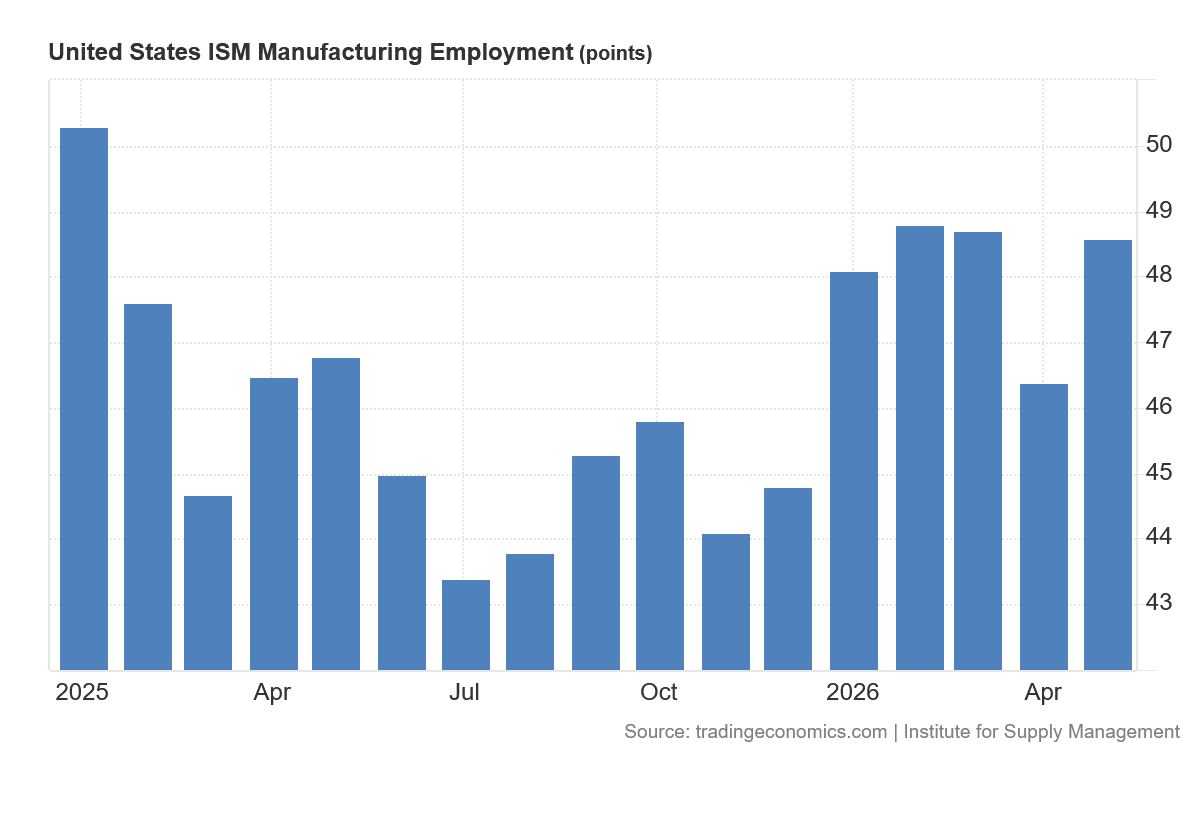
The ISM data has not shown manufacturing employment expanding since January of 2025, a trend which confirms that manufacturing employment has been shedding jobs for quite some time.
The ISM print also showed Services employment contracting, in marked contrast to the overall JOLTS data.
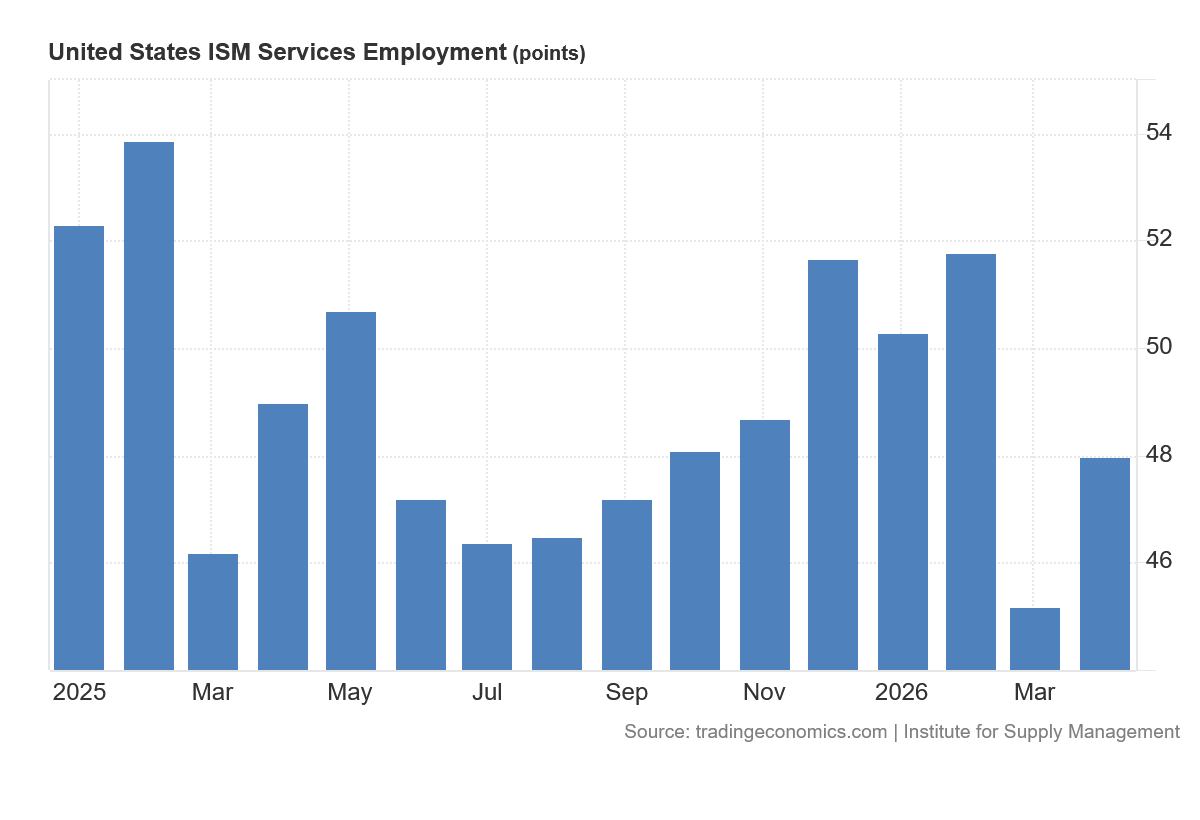
While the overall PMI data set is showing broad economic expansion, the PMI data does not show that expansion percolating through to increased employment.
How much actual job growth was there in April? Arguably, less than the government data sets are showing, and potentially none at all.
What is the state of jobs markets in the US? It depends on the report being examined, as well as the sector.
No Obvious Energy Shock Impact
One encouraging aspect of the April JOLTS data is that it confirms that the energy shock from Iran’s illegal closure of the Strait of Hormuz and consequent disruption of global oil flows has not yet had any obvious effect on US jobs markets.
While the decline in both hiring and separations arguably shows a broad lack of confidence across jobs markets, the recent volatility in hiring and separations, as well as the longer term downward trend in both, indicates that jobs markets have been nothing if not skittish. Confidence is not a primary feature of US jobs markets at the moment, and has not been for quite some time.
Are jobs markets in the US improving? Broadly, the data shows that they are, although the improvement is uneven. However, some sectors, such as healthcare, may be showing signs of deterioration.
Certainly the JOLTS data gives a more optimistic portrayal of job growth for April, printing greater job growth in most sectors than than the ESS data. Whether that tells us anything about what sort of prior months’ revisions to expect on the upcoming May Employment Situation Summary remains to be seen.
Even though the JOLTS data shows uneven and somewhat problematic job growth, that events in the Middle East have not yet had a negative impact on US jobs markets augurs well for how well the US will be able to withstand the economic attritional battle currently being waged between the US and Iran.
As is the case in all attritional warfare, the longer the conflict goes before we start seeing the eventual signs of demand destruction, including broad based job loss, the better the US position is overall.
Against the backdrop of the war with Iran, is the JOLTS report for April a good jobs report? Arguably, yes.
Does the JOLTS data show the jobs recession in this country ending? Overall, the report certainly leans in that direction. If we continue to see sustained high levels of net hiring, especially if those levels are reflected in other jobs reports such as the Employment Situation Summary, then we definitely have to consider if the jobs recession is coming to an end.
The individual sector data is not quite as optimistic as the headline figures, however, and for that reason we should not leap to the conclusion that the jobs recession has completely ended. We can and should acknowledge that, for many sectors, there is confirmed job growth.
Whether one likes or dislikes the April JOLTS report ultimately comes down to the particular portion of the data one wishes to scrutinize.
Is the April JOLTS report a good report? It depends.
Could be worse. What’s excellent are the data points that Trump enthusiasts can spin to fundraiser for the upcoming midterms. The economic disasters projected by those with TDS have not (yet) happened.
Thanks for objective and factual reporting, Peter!