


The BLS penchant for anodyne press releases makes the August Job Openings and Labor Turnover Summary report seem less significant than it really is.

The number of job openings was little changed at 7.1 million in August, the U.S. Bureau of Labor Statistics reported today. Hires changed little at 5.2 million, while total separations were unchanged at 5.1 million. Within separations, quits (3.1 million) were unchanged, while layoffs and discharges (1.6 million) were essentially unchanged.
What that lead paragraph did not say was that total Nonfarm Net Hiring was 122,000 in August, and total Private Net Hiring was 85,000.
While smaller job increase numbers than the the August Employment Situation Summary, those numbers nevertheless bolster the jobs recovery narrative of the earlier jobs print.
Manufacturing showed strong job gains. Construction Net Hiring cooled somewhat but still printed an impressive figure.
Nonfarm Net Hiring and Private Net Hiring were not as strong as on the August ESS, but strong enough to allay concerns about Lou Costello Labor Math for at least the month. We may still see significant job corrections, and should probably anticipate reductions, but even with corrections August looks to remain a month of solid job growth across the board.
The JOLTS report is unquestionably a good report, and makes the case for solid job growth in August. Can the job growth continue into September?
Openings Down, Separations Down, Hiring Up
According to the JOLTS report, total Nonfarm Net Hiring rose by 122,000 jobs in August.
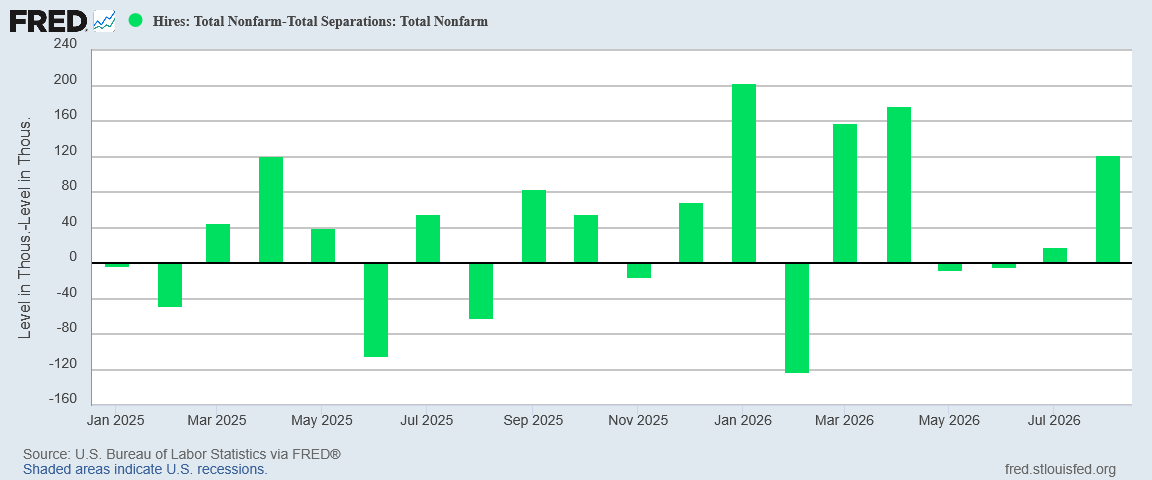
What was even better about the job growth was that it came from an increase in hiring and a decrease in separations.
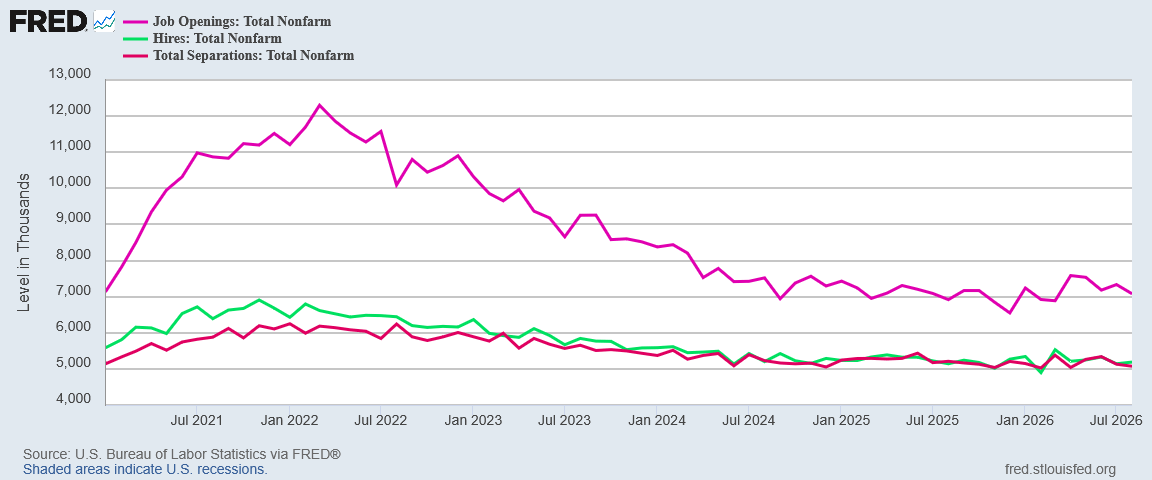
Job openings also ticked down in August, but the number of openings still exceeds total hires by so much that the number still is not a realistic depiction of the economy. If there were genuinely that many job openings needing to be filled in the economy, we would see far more hiring than we do, and more wage growth than we do.
Private Net Hiring was cooler than Nonfarm Net Hiring, with only 85,000 jobs added in August.
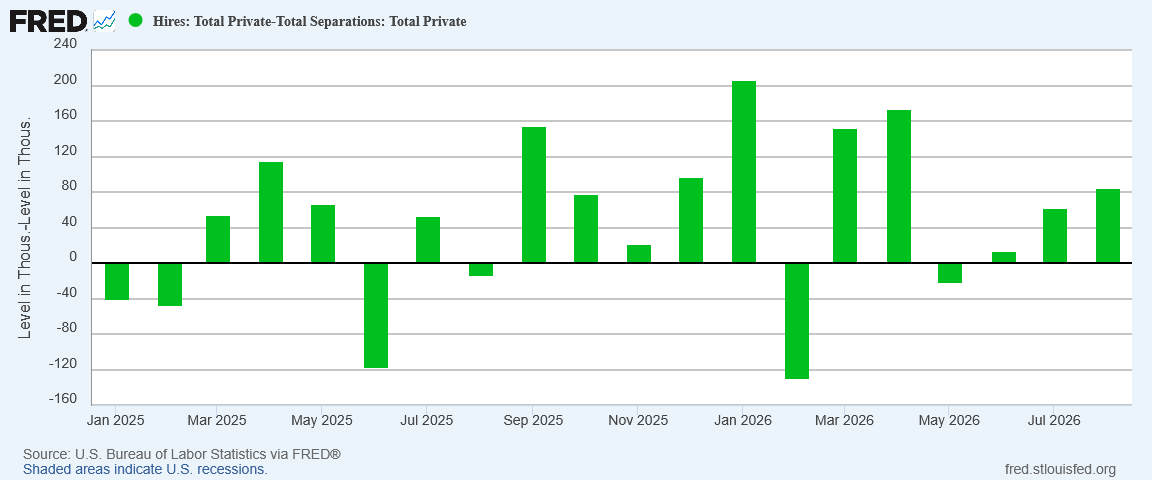
That amount of jobs growth was still enough to make August the fourth best job growth month on the year, and the seventh best since the start of President Trump’s second Administration.
Private Net Hiring was some 42,000 jobs below where the August ESS put private payrolls, indicating we may see sizable corrections to the August numbers in the September and October job prints.
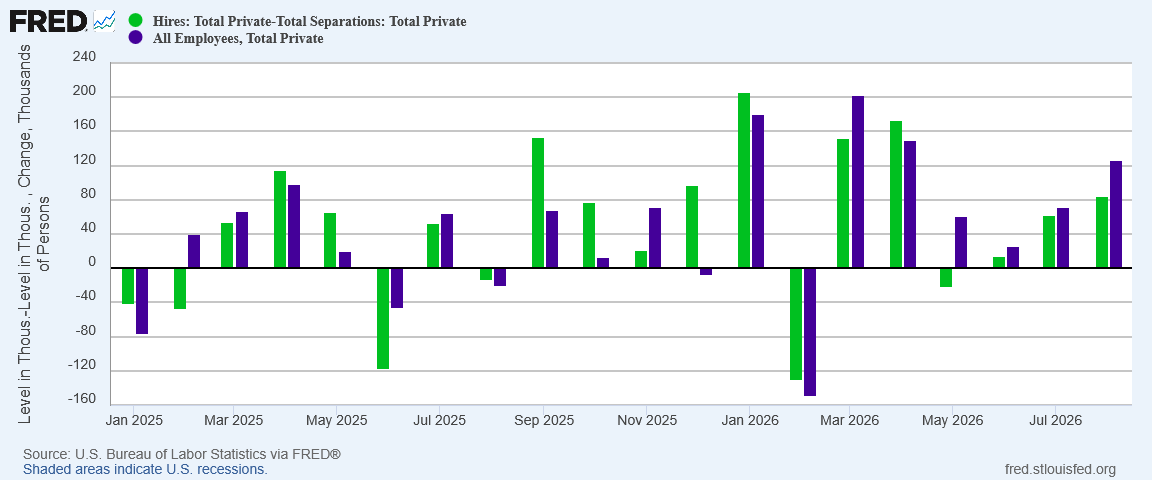
Also pointing towards sizable corrections to the ESS data are the sector-level variances between the JOLTS and ESS data.
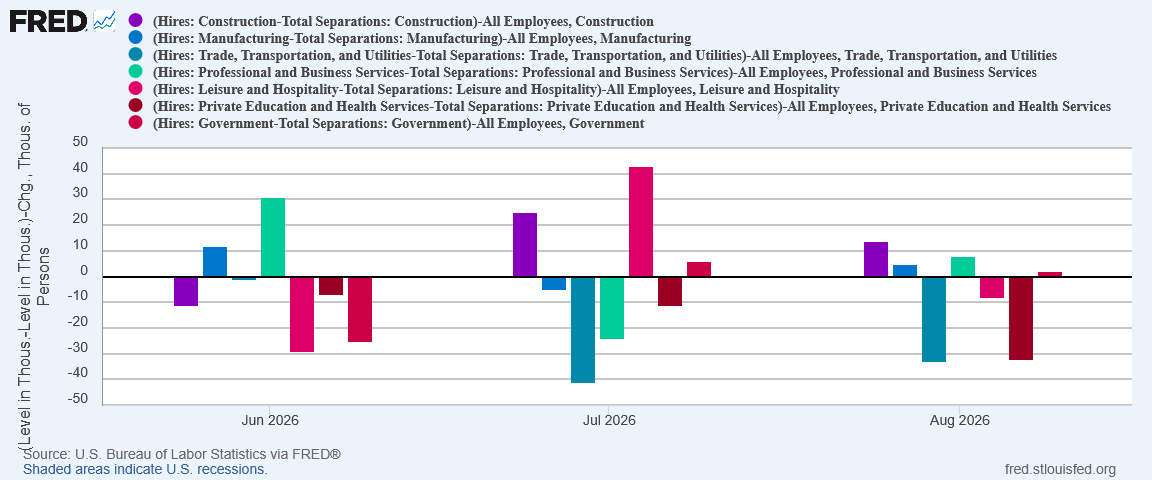
For Trade Transportation and Utilities as well as Healthcare, the JOLTS data printed well below what job growth reports on the ESS. The sectors where the JOLTS data came in larger than the ESS data had significantly smaller variances.
When the September ESS comes out, we should anticipate substantial downward revisions, particularly in TTU and Healthcare. However, it is possible we could see some upward revisions in Manufacturing and Construction especially.
Most Sectors Showed Job Growth
Manufacturing turned in a nice 21,000 job growth metric for August, beating the ESS data by 5,000 jobs.
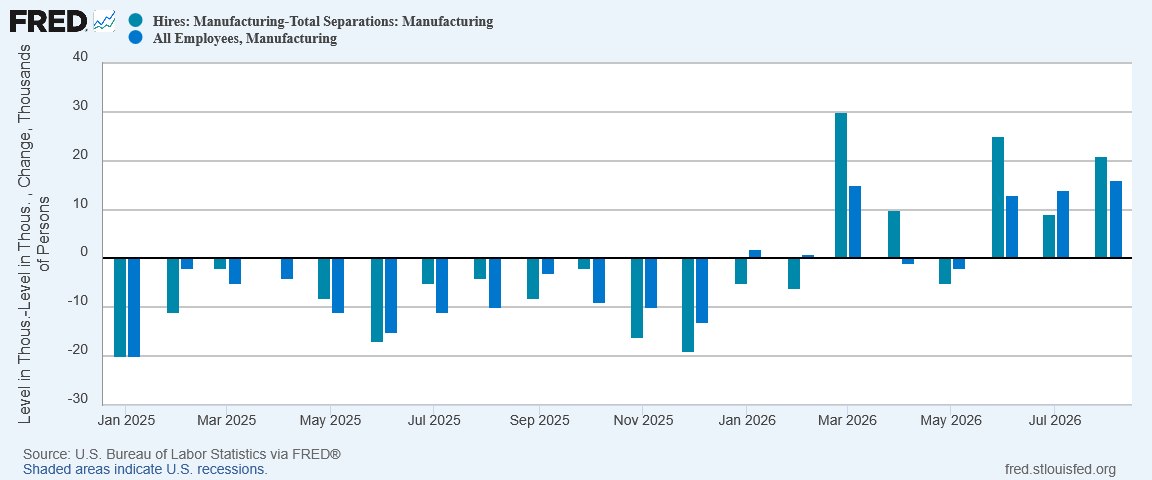
This marked the third month that manufacturing has shown job growth, a welcome change from the hemorrhage of manufacturing jobs we saw in 2025.
Nor was Manufacturing alone, as August was one of the more balanced months for job growth across all sectors this year.
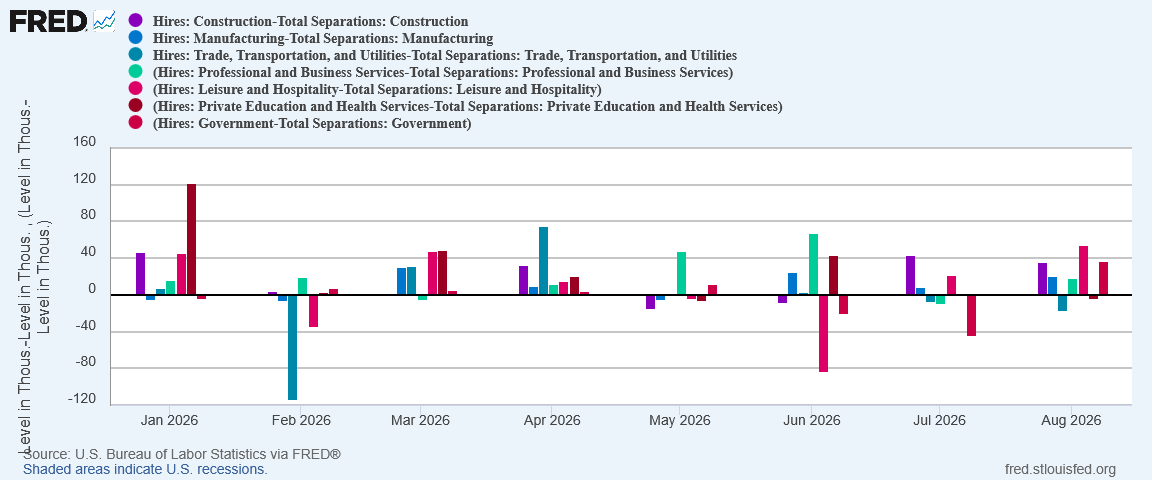
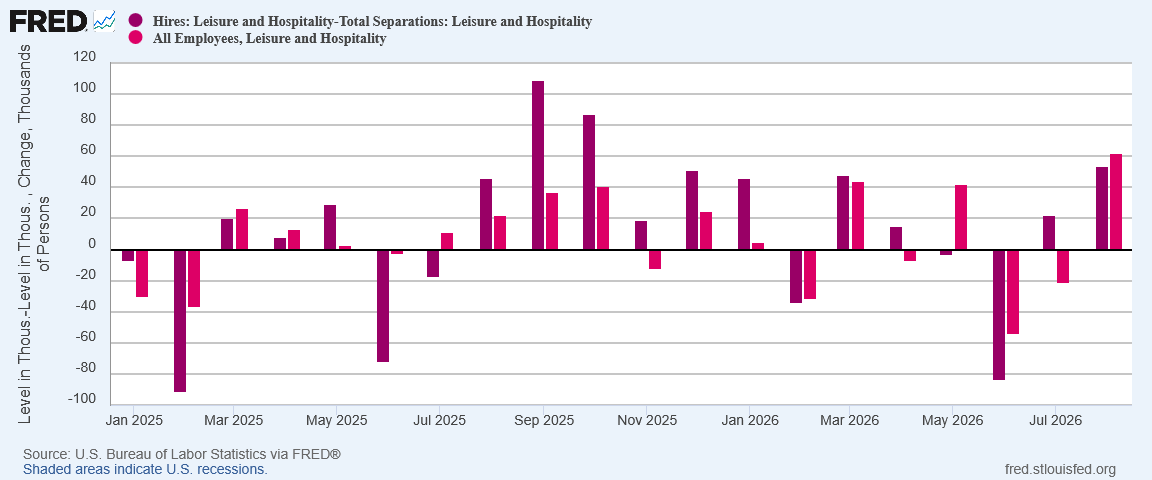
Perhaps unsurprisingly, Leisure was the big jobs producer, with 54,000 jobs according to the JOLTS data.
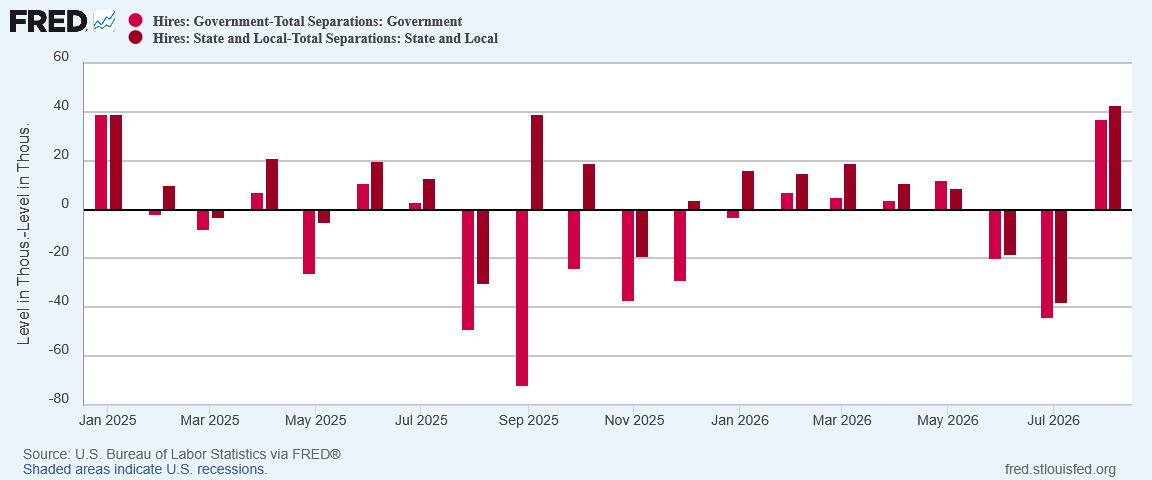
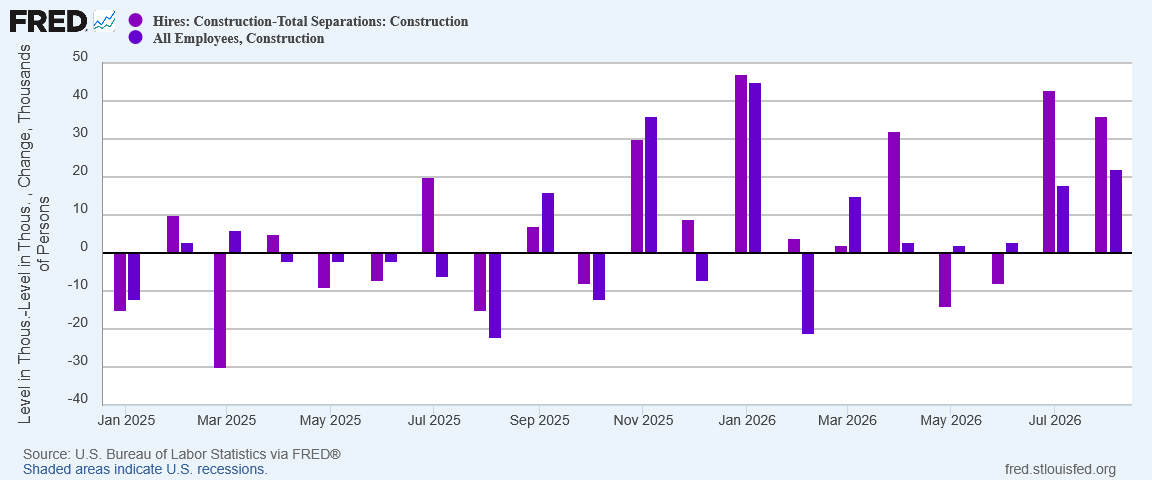
Government hiring came next, at 37,000 jobs—which was actually 43,000 state and local government jobs less 6,000 jobs lost at the federal level—with Construction right behind at 36,000 jobs.
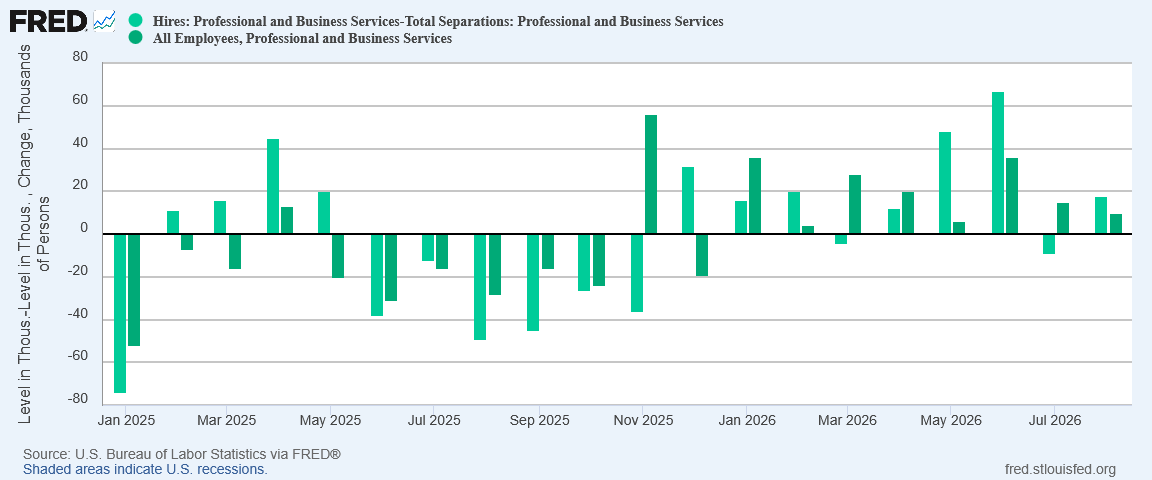
Professional Services rebounded from a dismal July to produce 18,000 jobs in August.
The two job losers on the month were Trade Transportation and Utilities at 17,000 jobs lost, and and Healthcare, down 3,000 jobs.
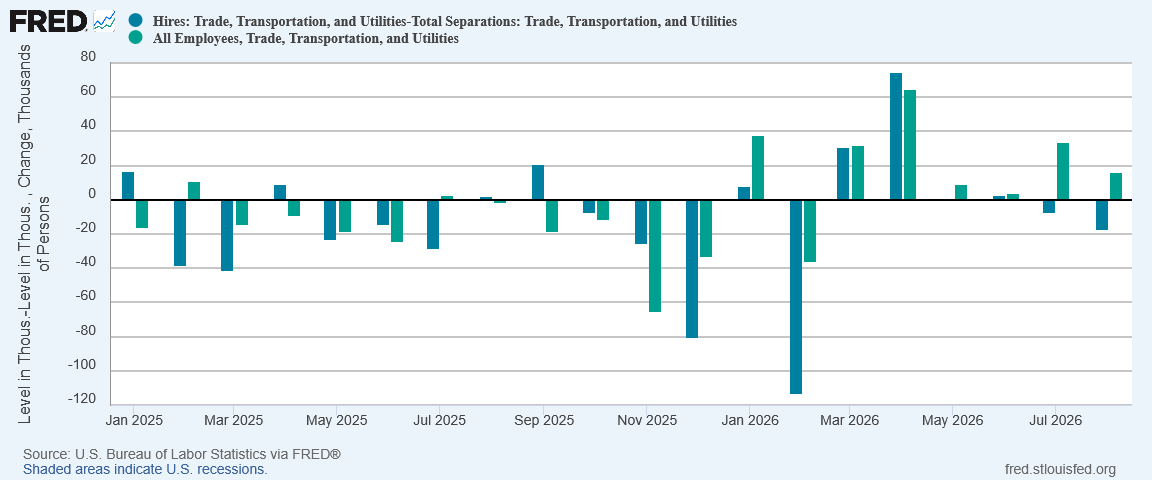
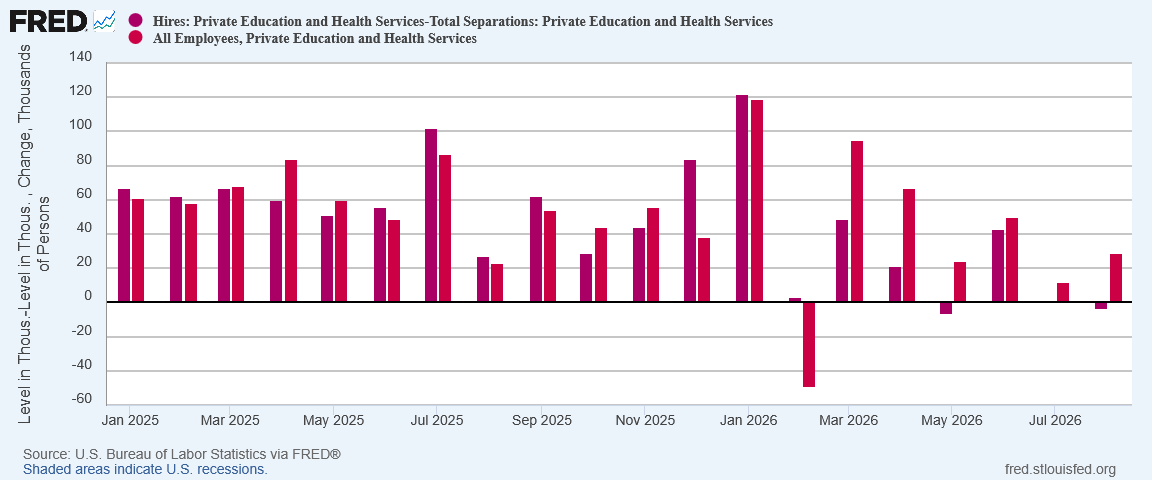
While Trade Transportation and Utilities is typically a mainstay of job growth within jobs, that it was the only significant source of job loss highlights that job growth in August was real and broad.
That TTU had another month of job loss—months which are uncomfortably aligned with the escalations in the war with Iran and consequence surges in fuel costs—could also be a signal of where that war is hitting America. While we may not be seeing broad surges of consumer price inflation, energy price inflation may be costing Americans jobs. If that is the case, August’s surge in job creation may not be as long-lived as anyone would like.
PMIs Agreed For A Change
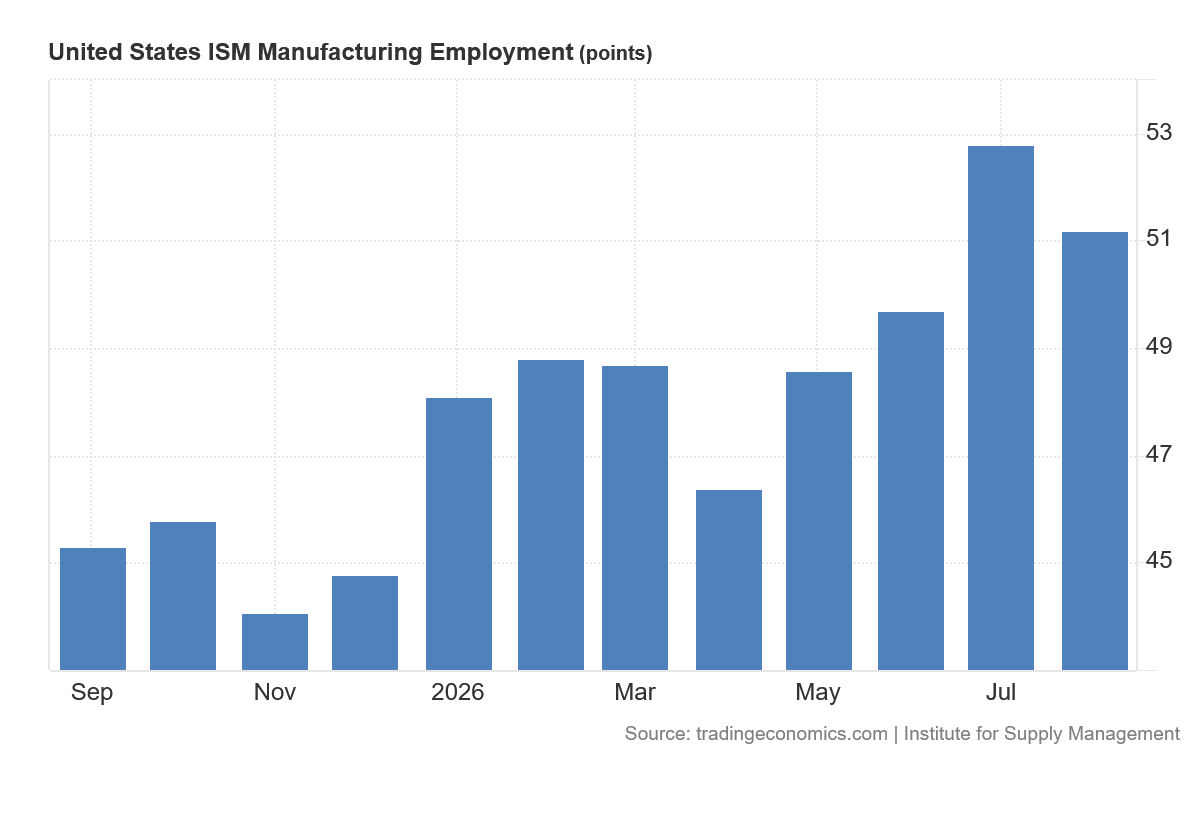
Bolstering the JOLTS report for August has been the August Purchasing Manager Index data from the Institute for Supply Management. While the PMI for Manufacturing Employment cooled in August, it still showed job growth for the month.
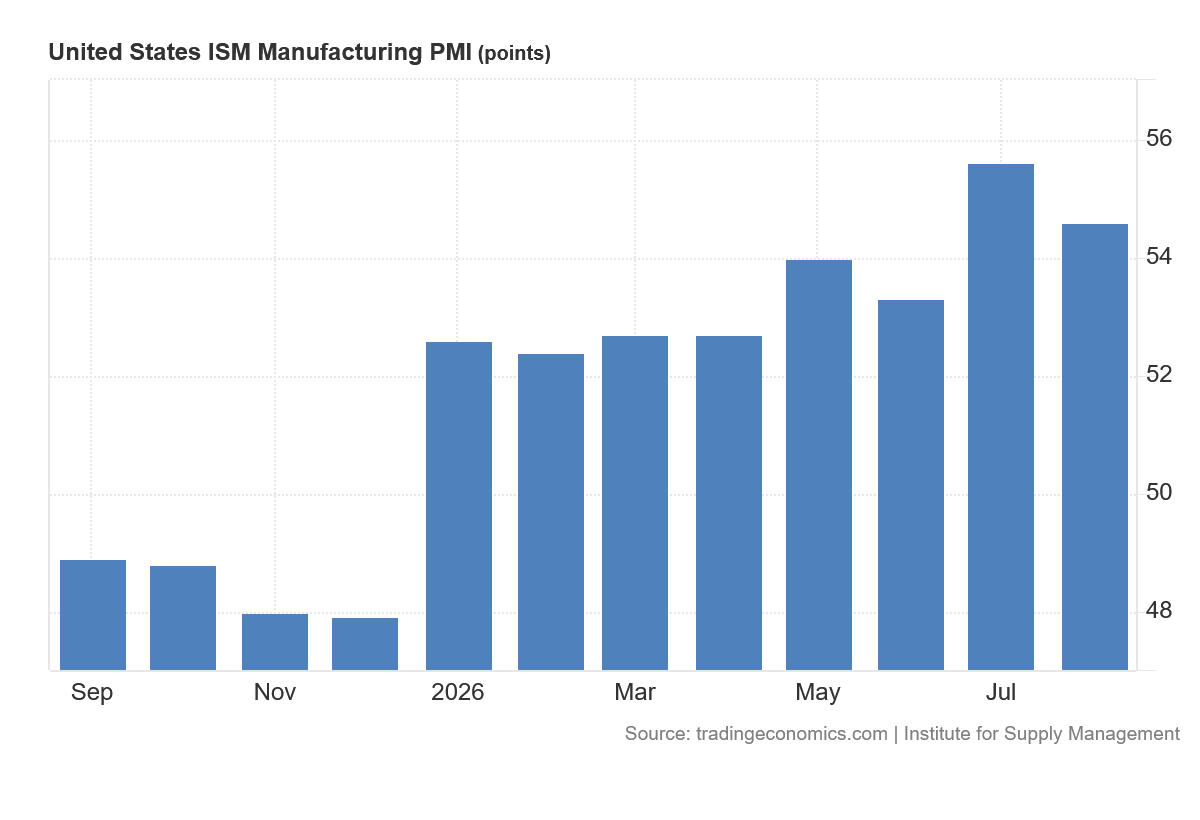
The overall Manufacturing PMI also showed some cooling, but still strong expansion.
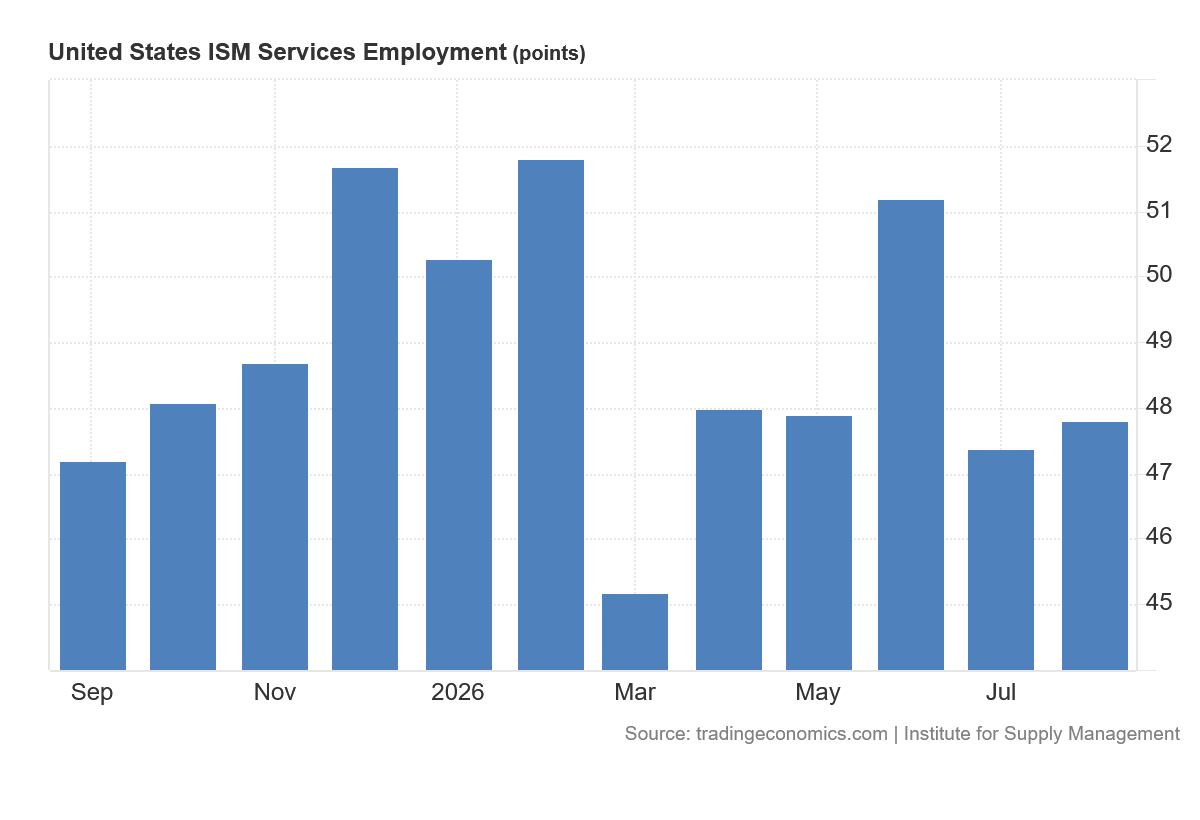
Services were not quite as robust, with the ISM Services Employment PMI printing contraction for August.
However, the overall Services PMI strengthened in August.
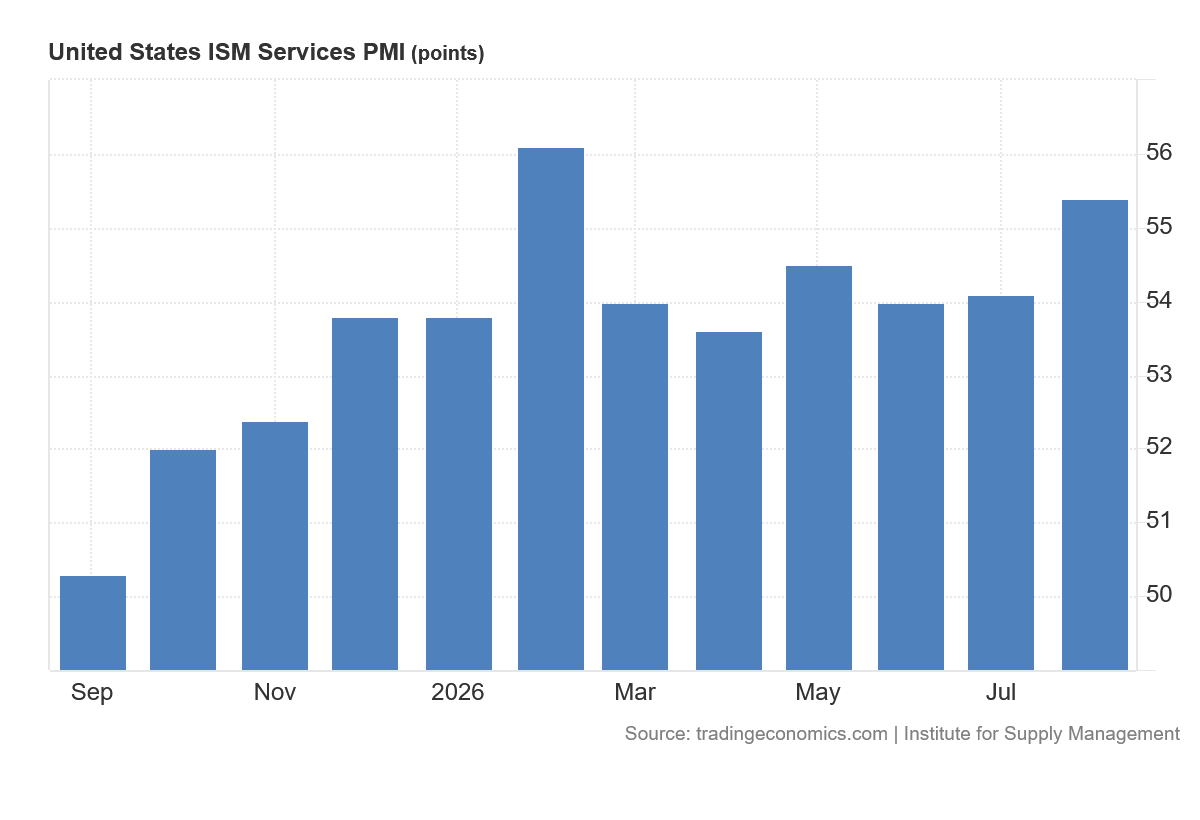
According to the ISM, August was a very good month for the US economy. The August JOLTS report happens to agree.
Industrial Production Rising
Even the Federal Reserve’s own Industrial Production data points to an expanding economy and expanding employment.
Overall Industrial Production rose 1.4% year on year.
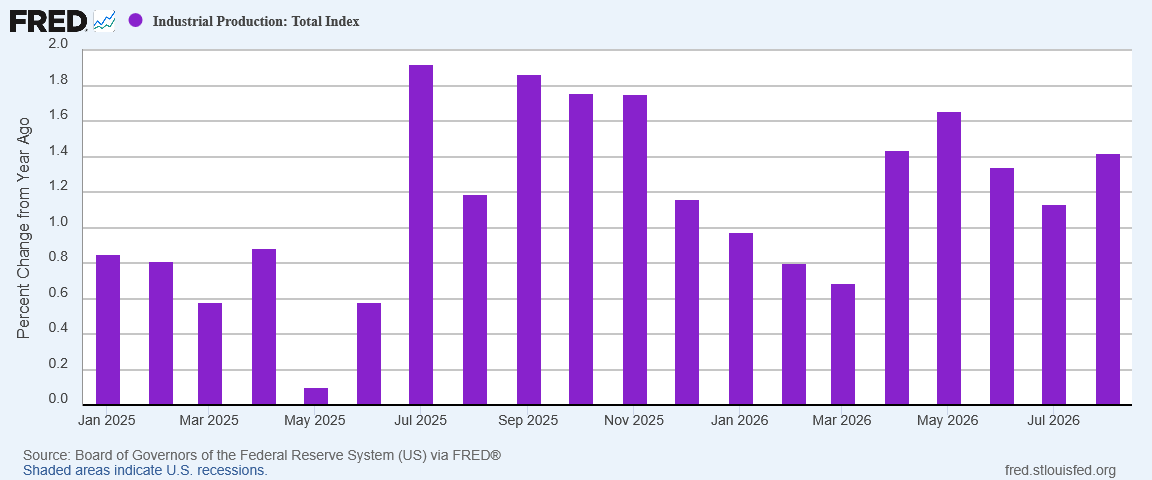
Since July of last year, Industrial Production has been charting increasing growth and expansion—exactly what needs to happen in order to sustain job growth in manufacturing.
Intriguingly, within goods production, Consumer Goods languished yet again, while Business Equipment production rose 7% year on year.
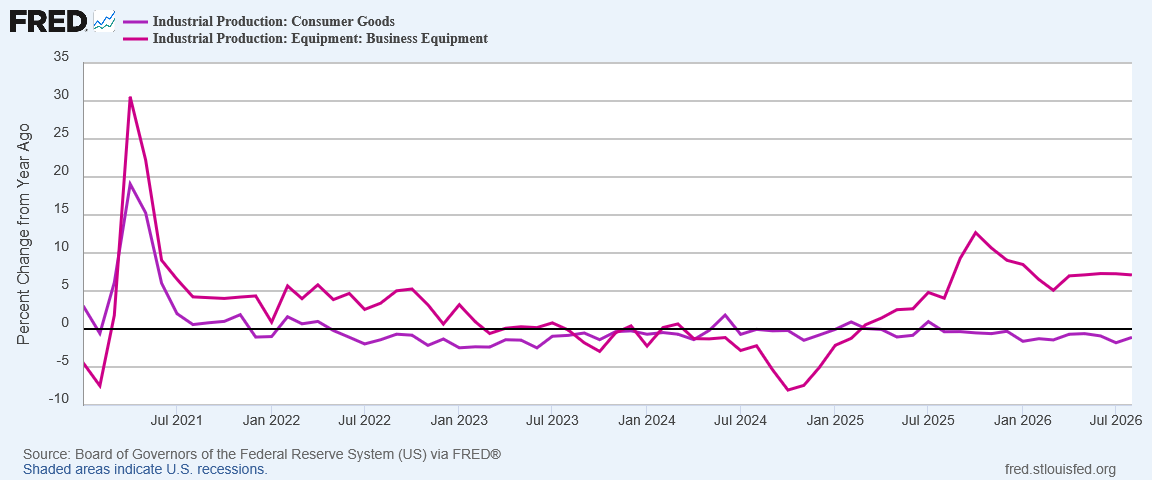
With the mid-term elections drawing closer, it is worth noting that equipment production has come on strong during President Trump’s Second Administration, even as Consumer Goods has not improved from the Biden Reign of Error. Arguably in keeping with President Trump’s campaign pledge to turn the US into a “manufacturing superpower”, the growth in business equipment production indicates an industrial shift in the US economy.
Will It Last?
There is no denying that the August JOLTS report is a good report. There is also no denying that the report is bolstered by other metrics as well, not the least of which are the Federal Reserve’s own Industrial Production data. We are looking at something more substantive than the statistical employment phantoms sometimes offered up by the BLS.
The ISM PMI data sets are another confirmation that the August JOLTS report is a solid and reliable metric of job growth in the United States. Government and private sector sources broadly agree that August was a good month for jobs.
After the grim job numbers for June and July, August was a welcome turnaround.
August’s strong job numbers naturally gives rise to the question “Will it last?” We will begin to see an answer to that question with the ADP National Employment Report (which will be released just as this publishes). Certainly Wall Street is anticipating a continuation of job growth, with an expectation of 70,000 jobs on the ADP jobs print.

The PMI data suggests that manufacturing especially has some growth momentum going for it, and that augurs well for the future of manufacturing employment. After years of abysmal manufacturing job loss, 2026 has become a year of solid manufacturing job gains in particular.
Service Employment PMIs are more problematic (a consequence of ongoing job loss in Trade Transportation and Utilities, perhaps?), but the broader Service PMI data suggests ongoing economic expansion, something which can only increase pressure on businesses to hire and create jobs.
The broader array of metrics and signals indicates August’s strong job numbers are not just a flash in the pan. At present, the reasoned expectation is that we will see strong job growth for at least the next month or two.
If the jobs recovery does continue, President Trump is likely to deliver at least in part on his campaign pledge to make the United States a “manufacturing superpower.” This would be particularly beneficial to working America. Not only are more jobs always welcome, but growth in manufacturing employment means more workers are securing higher-paying manufacturing jobs. While all job growth is welcome, manufacturing job growth will do the most to boost worker incomes.
Right now, the economy is on course to produce more manufacturing job growth.
There are warning signs, however, and they should not be ignored. Trade Transportation and Utilities has languished and even lost jobs over the summer. Given the surge in diesel and fuel costs, and the prospect for continued high diesel and fuel costs, are those price pressures being expressed more in job markets than in consumer price inflation? That is a possibility, and one which does not augur well for the future. War prospects have a nasty habit of shifting suddenly, and a shift in the war with Iran could very quickly end this jobs recovery. If nothing else, the jobs desert that is TTU should warn us of that much.
Will it last? Nothing lasts forever, especially jobs recoveries. This jobs recovery will eventually end. However, the current indications of continued job growth point to at least another month of jobs recovery. Wall Street certainly expects continued jobs recovery.
Given that in July the question was whether or not the jobs recession had resumed, closing out August with solid evidence that the jobs recovery is continuing is welcome news indeed!
Best news of the day, because the midterms are just a few weeks away, and this data gives the Left very little ammunition against the Trump agenda! Republican candidates will have fresh, optimistic figures to include in their campaign speeches, and votes will be won. Thank you, Peter, for a realistic analysis of the latest data. You’re reliable, factual, and so intelligent!
Sure, there will likely be downward revisions, and the truly alarming structural problems within the economy remain. But just get us through the elections without the damaging socialists gaining control, and then we can work on fixing the deep problems. The mislead younger generations need to learn that creeping socialism has caused much of our country’s problems, and more socialism will only make things much worse!