


Two hundred and fifty years ago, the Second Continental Congress declared the thirteen colonies were free and independent states, released from any obligation to or subjugation by the British monarch. In their written Declaration of Independence, they penned what was then the remarkable statement “that all men are created equal.”
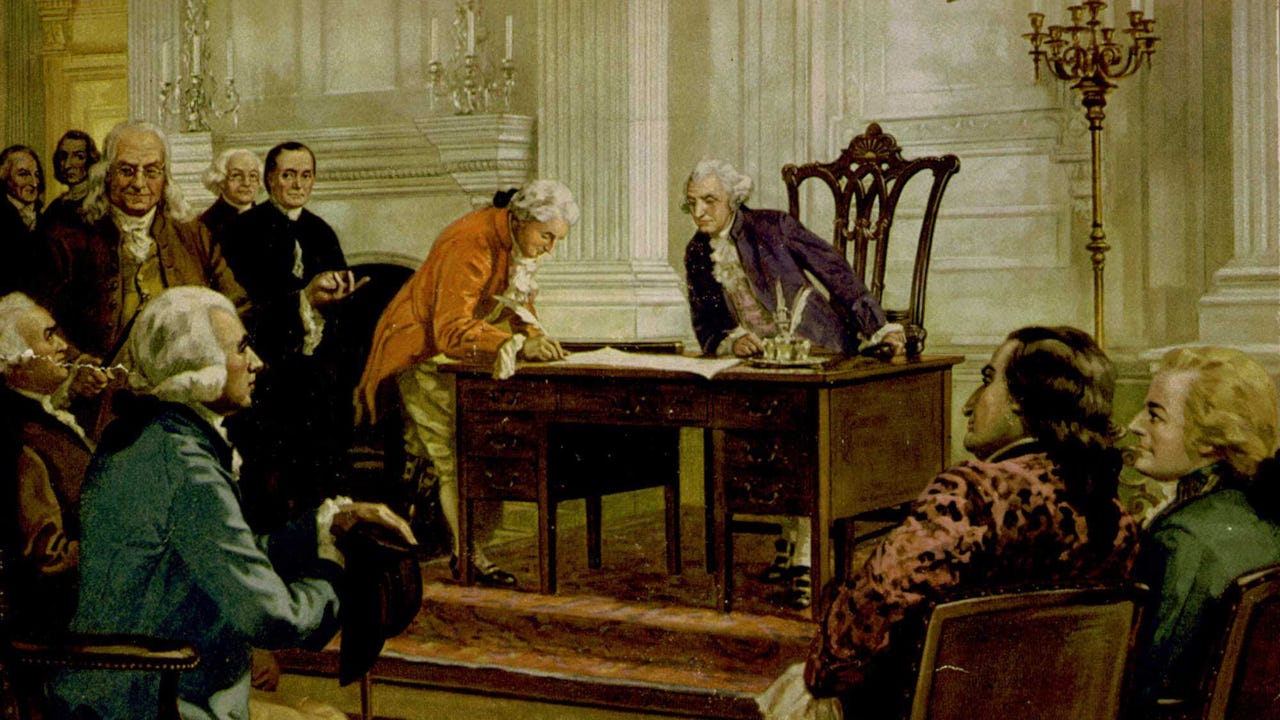
In defense of that statement, as well as the premise “that all men are endowed by their Creator with certain inalienable rights,” the signers of the Declaration pledged their lives, their fortunes, and their sacred honor.
From the Declaration of Independence, and the years of warfare which followed, came the United States of America. We quite naturally celebrate the Declaration of Independence every July Fourth as the “birthday” of this most remarkable republic.
Some argue that this nation's founding is no cause for celebration. Some argue that ours is a nation founded on slavery and birthed in corruption. Some denounce Thomas Jefferson and the rest of the Founding Fathers for owning slaves, and argue we should disown them, rejecting them and all their works—including, apparently, the Declaration of Independence.
Have any of them considered what that alternative means?
We should acknowledge one important truth straight away: our Founding Fathers were flawed and imperfect men to say the very least.
Thomas Jefferson not only owned slaves, he carried on an extended sexual liaison with his slave Sally Hemmings, a relationship that is charitably described as exploitative. In the modern era his conduct would almost certainly result in criminal charges, and could any of us honestly say such charges would not be warranted?
George Washington owned slaves as well. He was also quite the opportunist, and a social climber who had anger management issues. A good deal of his antipathy towards Great Britain almost certainly stems from being denied a commission in the regular British Army and the social status it would have conferred. There is no small irony that the leader of a rebellion premised on human equality longed to be numbered among the elites in an aristocratic society patterned on prevailing presumptions of human inequality.
John Adams did not own slaves, but he was intelligent and irritating in very nearly equal measure. He was blunt, frequently tactless, and notoriously prickly and thin-skinned. He was frequently impatient with his fellow delegates. He was often abrasive and obnoxious. To say his was not the temperament of a politician would be an understatement!
John Hancock made his fortune in colonial shipping. In other words, he was a smuggler who was quite successful at evading British taxes and customs duties. In the 1760s he was even charged with smuggling. He likely would have been convicted but for the lawyerly brilliance of none other than John Adams.
Ben Franklin was renowned in his day as a ladies man. His son William was born out of wedlock. Some modern moralists would denounce him as a womanizer and misogynist.
These are the historical realities of the men who authored the Declaration of Independence and then fought for the freedom they claimed as theirs.
Were our Founding Fathers “good men”? Again, modern moralists frequently argue that they were not, and that their negative traits warrant excising them from our historical memory, along with all their works.
We can honestly acknowledge the sins of the Founding Fathers. We can honestly acknowledge that Thomas Jefferson's conduct with Sally Hemmings was indefensible. We certainly should not pretend that our Founding Fathers were perfect when they so clearly were not.
Yet if we do as some would suggest and reject all these flawed and imperfect men did with their lives, where does that leave the Declaration of Independence and its pronouncements of human equality and human liberty?
If we reject the Declaration of Independence, including its statement that all men are created equal, are we also rejecting the premise that all men are created equal? If we cast out the Declaration of Independence, are we saying Man does not have inalienable rights?
Is that really an argument we want to make?
Some will argue that Thomas Jefferson especially was a hypocrite, that he did not actually believe what he wrote. Even if we assume that to be true for the sake of argument, does his lack of belief invalidate the premise that all men are created equal?
Do we conclude from Jefferson's presumed hypocrisy that men are not created equal?
Do we conclude from Jefferson's presumed hypocrisy that we do not possess the inalienable rights of “Life, Liberty, and the Pursuit of Happiness“?
We do well to consider the world that would leave us.
Do we want to live in a world where all men are created equal, or do we desire a world with aristocratic inequality?
Do we want to live in a world where freedom is an inalienable right, or do we desire a world where freedom is given or taken at the whimsy of government?
Do we desire society in which rights and liberties come from the hand of God, or a society where rights and liberties are defined by the problematic generosity of government?
Do we desire a society which aspires to universal human equality, or a society where a person's worth is defined by the arbitrary accidents of birth?
The Founding Fathers were not saints, and we would do violence to their legacy to pretend that they were. Yet we would do greater violence to their legacy to pretend that their human failings somehow render the truth of the Declaration of Independence false.
We would do great violence to ourselves to take seriously the proposition that the Declaration of Independence, along with its declarations of human worth and human liberty, should be discarded simply because its authors were flawed and imperfect human beings.
We do well to remember we are all flawed and imperfect. Our Founding Fathers were certainly no better than we are, but it strains credulity to seriously suggest they were somehow worse.
We do not need to debate whether the premise that all men are created equal is true. All men are indisputably created equal.
We do not need to debate whether the premise that all men are endowed by their Creator with certain inalienable rights is true. All men are indisputably endowed by their Creator with certain inalienable rights.
What we also cannot debate is that the Declaration of Independence was the first time human equality and the inalienable rights of men were proposed as the foundation for an actual government. The Declaration of Independence was never just a statement of political theory; it has always been a statement putting political theory into political practice.
Despite the flaws and failings of this nation’s Founding Fathers, the Declaration of Independence marks the first time these self-evident truths were put forward as the aspirational basis for human government. The Declaration of Independence stands as a powerful and historic declaration of what government should strive to be.
For 250 years, the Declaration of Independence has been this country’s highest aspiration, and our fondest hope.
Despite the flaws and failings of this nation’s Founding Fathers, the aspiration that is the Declaration of Independence warrants celebration, not just on the Fourth of July, but on every day throughout the year.
There is a modern educational trend today of looking at history in a skewed context. For example, Thomas Jefferson and his wife each inherited slaves, making them the largest slave owners in their county. But Jefferson repeatedly wrote and spoke against slavery, and very much wanted to free them. Modern educators call him a hypocrite. Why didn’t he free his slaves? Because in the gentleman’s code of his day, you couldn’t just set them free - a slave was a valuable commodity, and would be immediately captured by someone else and sold back into slavery. It was like setting a hundred-dollar bill on the sidewalk - of COURSE someone will pick it up! No, a gentlemen was expected to teach his slaves to read and write, teach them a trade - such as tanning or blacksmithing skills - and give them the tools by which they could set themselves up in business. It was the only way to prevent them from becoming sold as slaves once again. This required MONEY, and Jefferson was broke. While he was off writing the founding documents for a new kind of country, his plantation fell deeper into debt. He wasn’t a big hypocrite, he just didn’t have the means to do what he would have preferred to do - just like most of us today.
As for his relationship with Sally, there is considerable historical evidence that he did indeed care for her, and had a meaningful relationship with her. That doesn’t excuse his conduct, but much of the history of the world has been about men being unable to control their sexual desires, isn’t it? As you say, Peter, Jefferson was HUMAN.
Today’s schools need to return to teaching the full picture of history, not just cherry-picking facts to support a political agenda! They need to be more even-handed, like you are, Peter. Thanks for all you do!
Happy 250th Birthday to all Americans!
Flawed men who gave us a creed to live and govern by; and the only successful revolution in history that we can celebrate in freedom 250 years later. I’m grateful for them and my country 🇺🇸