


Congressman Thomas Massie has been unceremoniously retired by his constituents. In the May 19, 2026 GOP primary in Kentucky, Massie lost by more than 10,000 votes to his opponent, Ed Gallrein.

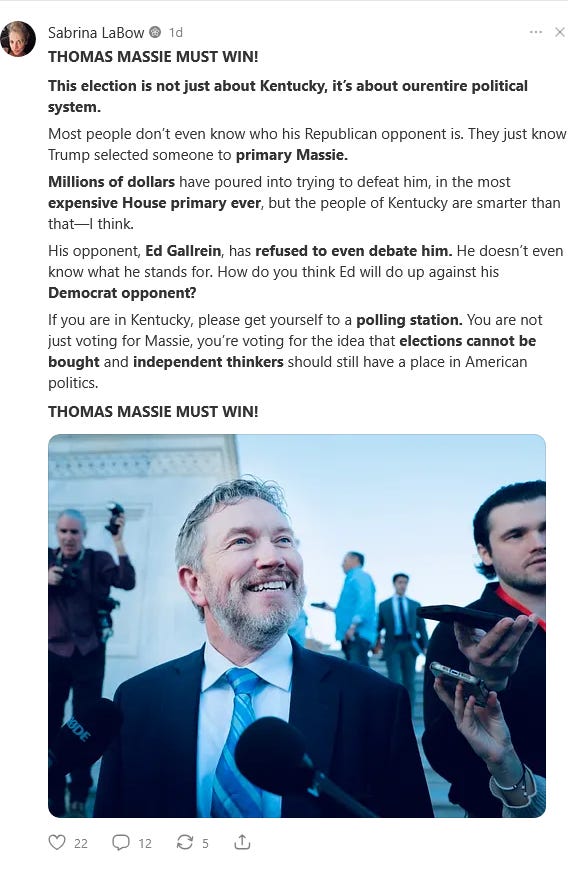
It is noteworthy that his defeat had reverberations far beyond the Kentucky Fourth Congressional District, with a number of notable voices here on Substack arguing passionately for his re-election. Several sought to use their publications to help mobilize support on his behalf.
For them, Massie’s re-election was of almost existential importance.
At the same time, several alternative media outlets were quite opposed to his re-election. John Nolte, Senior Editor at Breitbart, was positively celebratory about his defeat.
While it’s glorious that this self-regarding narcissist lost, even more glorious is that he got himself humiliated by a ten-point margin — ten points — 55 to 45 percent, with 99 percent of the vote counted.
President Trump was dead set against Massie’s re-election, urging Kentucky to elect Massie’s opponent, Ed Gallrein, as the GOP standard bearer in this year’s mid-term elections.
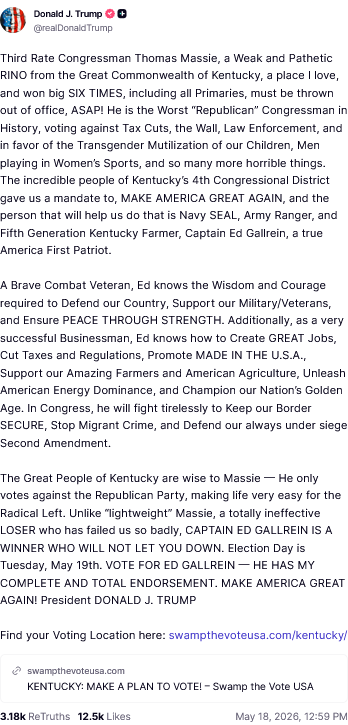
To say that Thomas Massie provokes a wide range of responses is an understatement!
Full disclosure: I am no fan of Thomas Massie, as readers and followers can attest. When I have had occasion to mention him on Substack Notes, I have generally derogated him as “Cranky Thomas Massie”, a snarky play on his social media handle “Classy Thomas Massie.”
Yet was his defeat truly so surprising?
Why would Republican voters in his district turn on him after having elected him to Congress for seven consecutive terms?
One possible reason might have been that Massie was a demonstrably poor legislator. A search of Congressional records shows that not one single bill he introduced ever became law. In fact, Massie gained more notoriety for his tendency to vote “no” on all sorts of legislation, so much so that corporate media dubbed him “Mr. No.”
It was his penchant for casting “no” votes that earned him President Trump’s enmity. Last year Massie was one of two Republican congressmen to vote against President Trump’s “One Big Beautiful Bill” omnibus spending package. Massie was a reliably contrarian vote opposing many of Trump’s initiatives and tax cuts.
Was Massie “wrong” for voting against the President’s agenda so often? As with so many political questions, that’s debatable. I certainly cannot fault Massie for voting against the One Big Beautiful Bill, given that I described it at the time of its passage as “One Big Ugly Failure.”

Yet while votes against legislative behemoths such as the One Big Beautiful Bill might have some political and ideological justification, many of Massie’s “no” votes could be seen as frivolous and event cantankerous. Perhaps most notably, in 2022 he voted against a non-binding House Resolution condemning rising antisemitism in the United States. His stated rationale on X at the time was that the resolution “promoted censorship”.
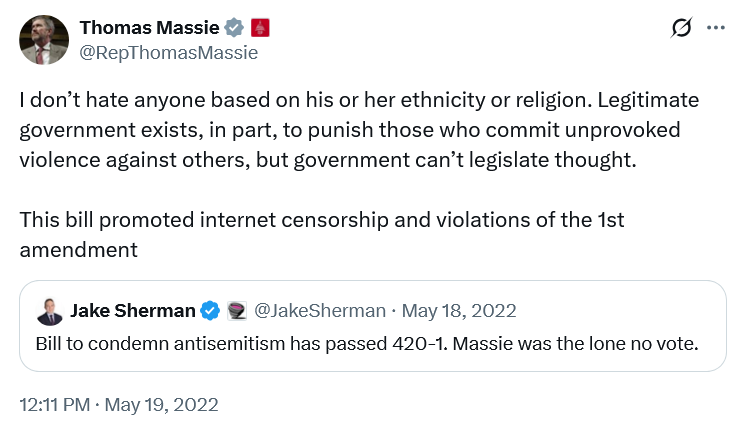
That explanation, offered without any substantiation, is extremely thin gruel, as the text of the resolution does not argue for any new restrictions on speech, but merely declares that the House of Representatives is as a body opposed to antisemitic speech.
The paucity of his explanations and ideological defenses for even his own pet pieces of legislation highlights another of Thomas Massie’s legislative weaknesses: a conspicuous lack of advocacy for his own legislative agenda (to the extent he even had one). The most notable example of this is his curious failure to build out a political argument for his perennial one-sentence bill to eliminate the Department of Education. While Massie would say simply that the Department of Education was unconstitutional, you will not find any op-ed articles or other long-form writings arguing the how and why of the Department of Education’s unconstitutionality.
In yet another bit of irony, when Massie resubmitted the bill in 2023, I did explore the ins and outs of the Department of Education’s inefficacy and unconstitutionality.

The bill to eliminate the Department of Education was legislation I supported, and for all the same reasons Thomas Massie articulated. Yet the reality is that my own article in support of Massie’s bill was a far more comprehensive attempt to lay a Constitutional foundation for dismantling the Department than anything Massie himself ever put forward.
That lack of ideological illumination for a piece of proposed legislation indisputably important to Thomas Massie revealed a lack of political or ideological depth on his part. The relative shallowness of his convictions arguably is what led to such cringeworthy postings on X such as this one challenging the legitimacy of Joe Biden’s “ghost gun” regulations.
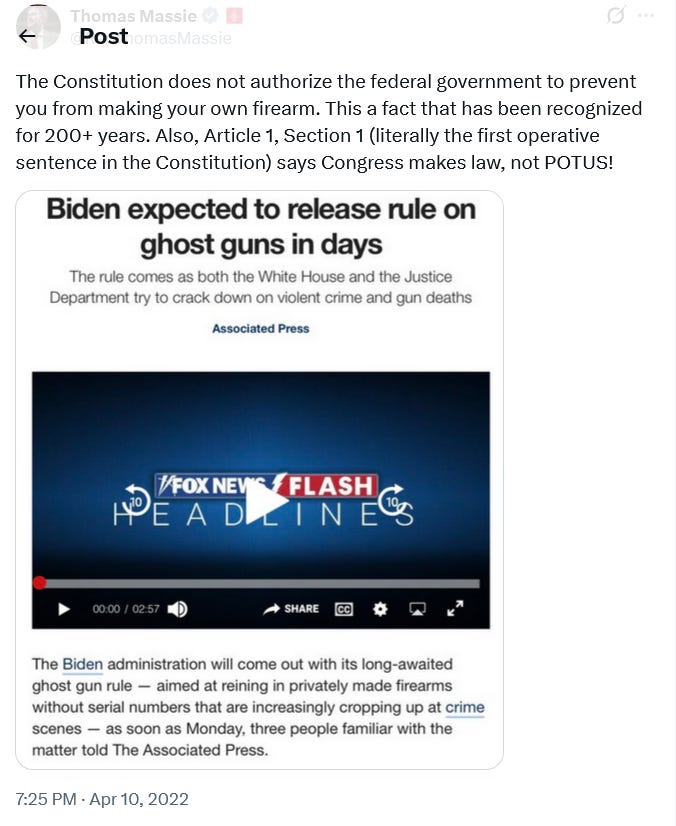
While Massie was broadly correct on the particular Constitutional merits of Biden’s proposed “ghost gun” regulations, the argument he made was simply absurd, as it ignored both the entirety of the Second Amendment and a President’s clear Constitutional obligation to ensure the laws are faithfully executed (which is the source of the President’s regulatory authority).
Arguably, Thomas Massie’s demonstrated legislative shortcomings as well as what must be acknowledged as mainly performative “no” votes were what left him vulnerable to attack by President Trump—whom voters in Massie’s district supported even more strongly than they had Massie. He had not been instrumental in bringing any Congressional funding home to his district. He had no clear legislative successes to which he could point to make a case that he had genuine political clout, able to deliver tangible benefits to the Kentucky Fourth Congressional District. His politics have proven to be performative rather than practical or pragmatic.
Simply put, Thomas Massie was not just an insignificant legislator on Capitol Hill, he was for the most part an irrelevant one. He did not reach out to build legislative coalitions to pass bills he thought were important. He was not willing to engage with other political coalitions, preferring instead to strike a “lone wolf” pose with a contrarian and usually ineffective “no” vote.
His penchant for contrarian votes, while a delight to many libertarian-minded and small government people, coupled with a conspicuous lack of a unifying political philosophy, ended up making his tenure in Congress more a performance piece than a serious legislative career. When contrarian votes demanded substance, a clear and thorough explication of the “why” behind such votes, Thomas Massie offered little more than snark, such as his gratuitously ad hominem post on X implying that President Trump’s war with Iran was intended as a distraction from the Epstein files.

Such commentary ignores the very real and very serious security and geopolitical issues that are at the heart of the conflict between the US and Iran. One need not agree that those issues justified Operation Epic Fury to acknowledge that those issues exist. At a moment when so many more relevant and substantive objections to the war could be raised, Massie provided merely a performative posting that reads more like the clickbait we get from social media influencer types and pretend journalist/commenator types like Tucker Carlson and Megyn Kelly.
Politics is, in the words of Prussia’s famous Chancellor Otto von Bismarck, “the art of the possible.” Politics is indisputably a team sport. Alas for Thomas Massie, he never showed much interest in being a team player. Had he been willing to be more engaging with other political interests and causes, he may very well have notched some significant legislative accomplishments. Had he been more forthcoming with a fully articulated political and legislative philosophy, he might have established a more ideologically committed base to stand with him when President Trump decided Massie’s contrarian stances were an irritant that needed to be removed from Congress.
This is not idle speculation. Great Britain’s decision to ultimately ban the transatlantic slave trade and emancipate its former slaves owes much to the tireless campaigning of one man—William Wilberforce. Between 1787 and 1823, Wilberforce by degrees moved the political needle in the British Parliament from supporting slavery because Britain’s monied interests liked it to banning the slave trade entirely in 1807 and emancipating former slaves in 1823. His position was not a popular one, yet by degrees, and through much political struggle and opposition, he ultimately succeeded where lesser men had failed. By focusing on what he wanted to accomplish, accepting compromise legislation when necessary, Wilberforce almost singlehandedly reshaped the British Empire.
Ultimately, Thomas Massie’s exit from the political stage should serve as an object lesson for all who would engage in politics at any level: the greatest impact, and the greatest durability, will always go to those who choose accomplishment over performative posturing.
If there is a moral to Thomas Massie’s Congressional career, it is that legacies are built on substance rather than snark.
Excellent post!
Myself, I liked most of what Thomas Massie did. Not every representative can be influential. Most have to be backbenchers. His is a libertarian voice that's good to hear even if he doesn't have much sway.
But the Epstein files fiasco killed his reputation for me. He should not have fallen for that scam. Making the government review and post all its investigative files was an expensive and harmful effort. Many innocent people suffered for it, to no purpose.