


Wall Street was unimpressed by Kevin “Completely Wrong” Warsh at Jackson Hole.
Judging by market reactions to his latest post-FOMC press conference, Wall Street remains unimpressed. So do I. So should you.
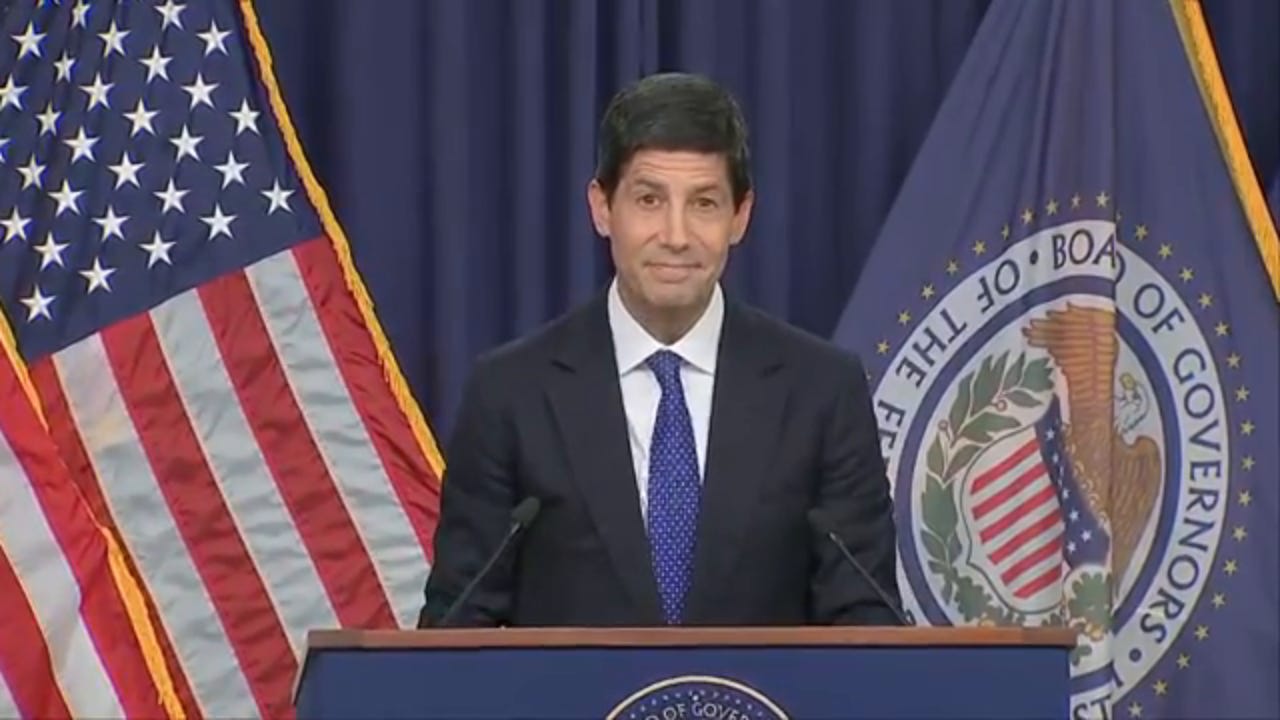
In spite of all of the data which practically screams “stand pat”, the FOMC followed Warsh off the proverbial policy error cliff with a unanimous decision to raise the federal funds rate 25bps.
The Committee decided to raise the target range for the federal funds rate by 1/4 percentage point to 3-3/4 to 4 percent, in support of the Federal Reserve’s dual mandate. The Committee is continuing its policy of maintaining ample reserves in the banking system.
Regular readers already know that my assessment of the economic data, particularly the employment data, is that now is not the time for pushing interest rates higher.
Even though Wall Street had priced in the rate hike, between the FOMC announcement and the end of Warsh’ press conference, stocks tanked, gold tanked, and Treasury yields soared.
In a performance worthy of—or perhaps worse than?—Jerome “Too Late” Powell, “Completely Wrong” completely screwed the pooch.
Warsh Did Not Wow Wall Street
Wall Street sentiment is easy to read. Simply follow the charts.
When Kevin Warsh opened his mouth was when stocks started heading south.
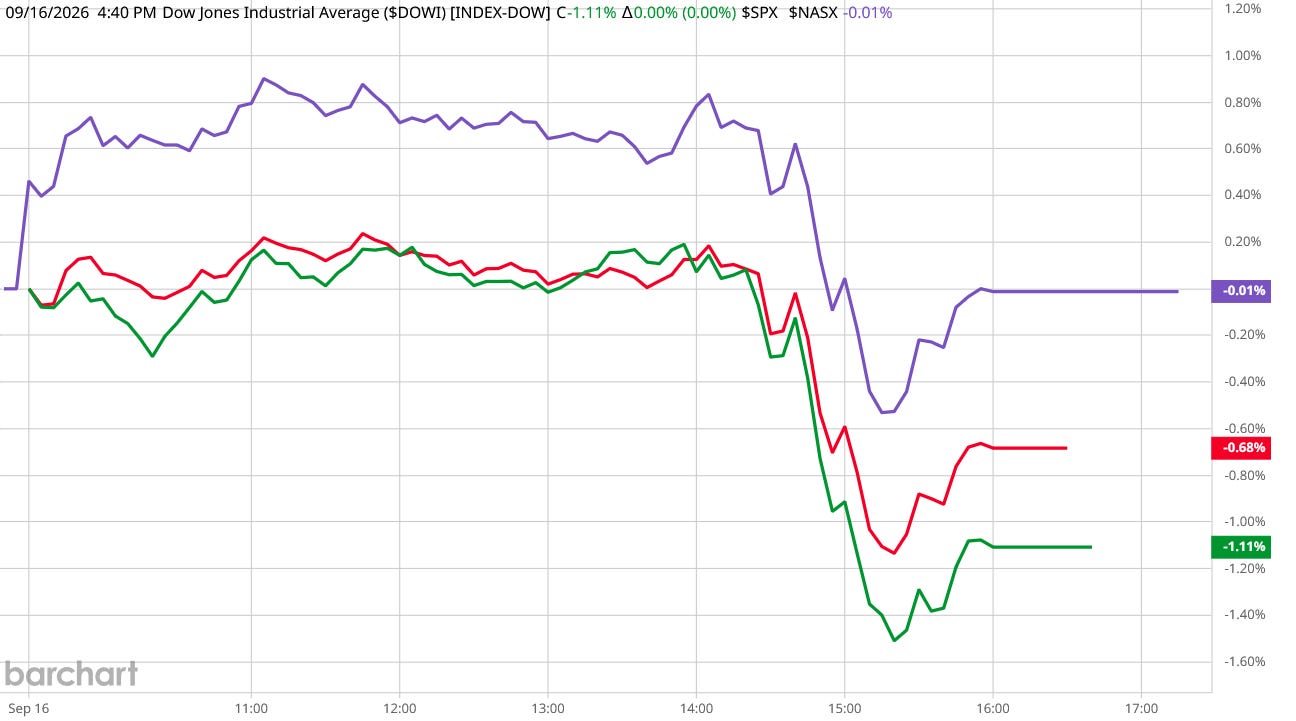
The Dow dropped 631 points. The S&P 500 dropped 34. The NASDAQ fared better, with the NASDAQ Composite breaking even.
If Warsh was aiming to tamp down fears about inflation, he failed miserably. Gold—which trends down when inflation and inflation fears trend up—also tanked during the post-FOMC presser.
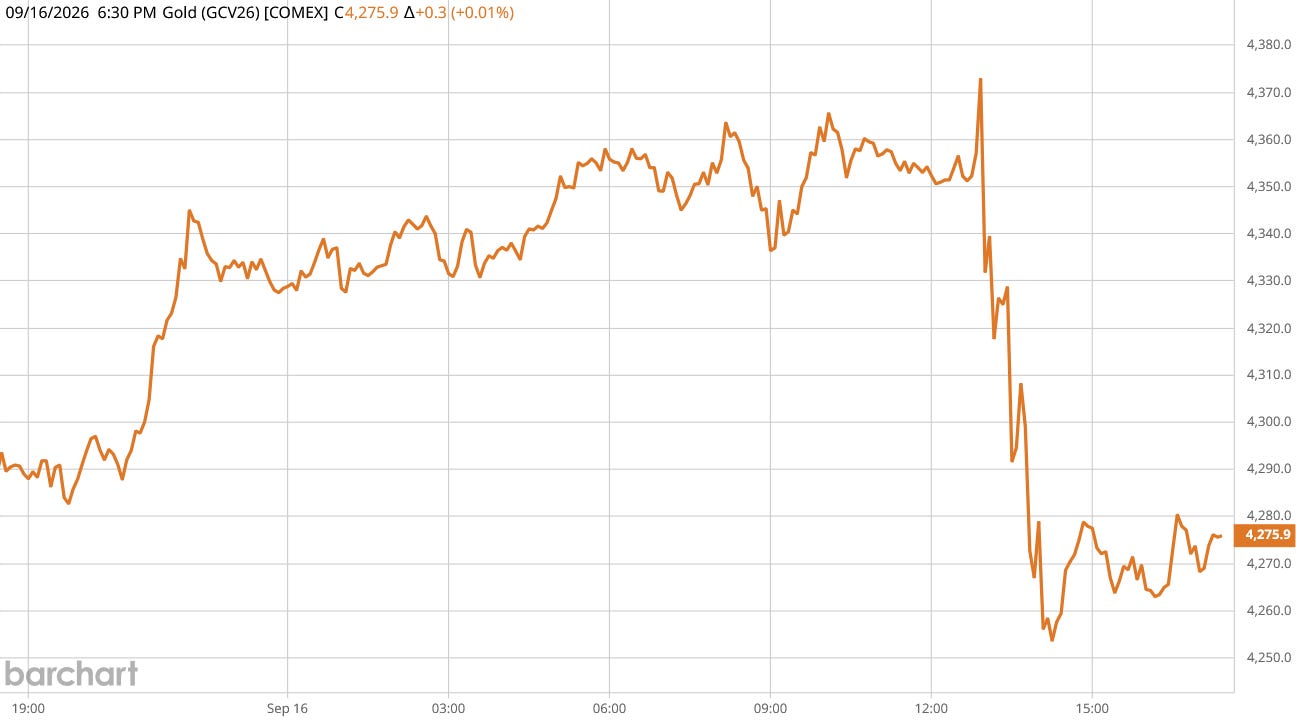
Given the established behavior of gold, it’s safe to say the gold bugs got spooked by what Warsh had to say.
The 10-Year Treasury yield spiked during the press conference, moving back above 5% after having dropped to start the day.
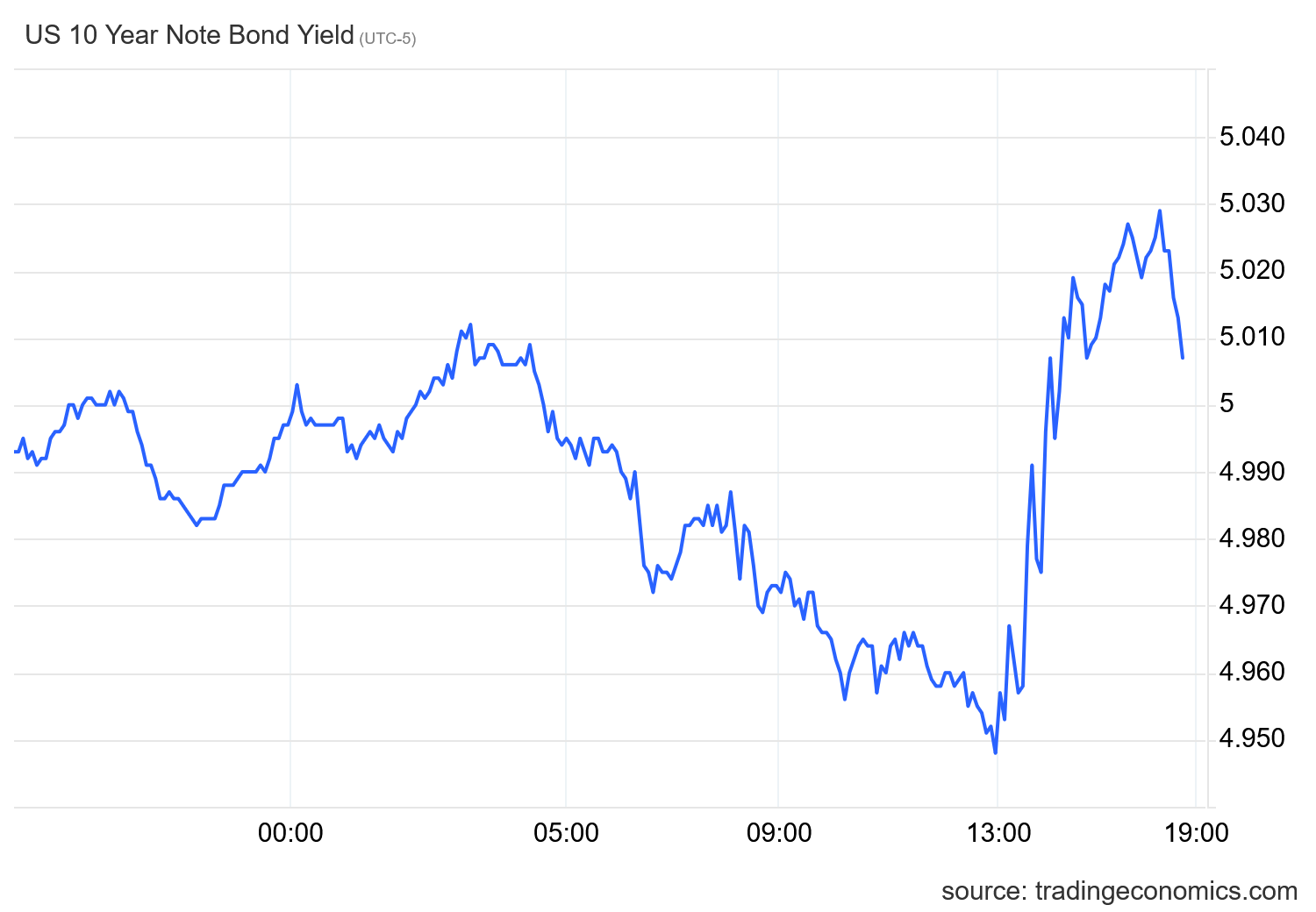
These are not signals of Wall Street showing any confidence in Kevin Warsh.
Part of why Wall Street failed to give Warsh kudos after the rate hike is that Wall Street itself presents divergent views on interest rates and inflation. We can see that just in how long-dated Treasuries and equities have shifted since the war with Iran began.
Before Operation Epic Fury commenced, yields for the 10-Year, 20-Year, and 30-Year Treasuries had begun a downward trend to start the year.
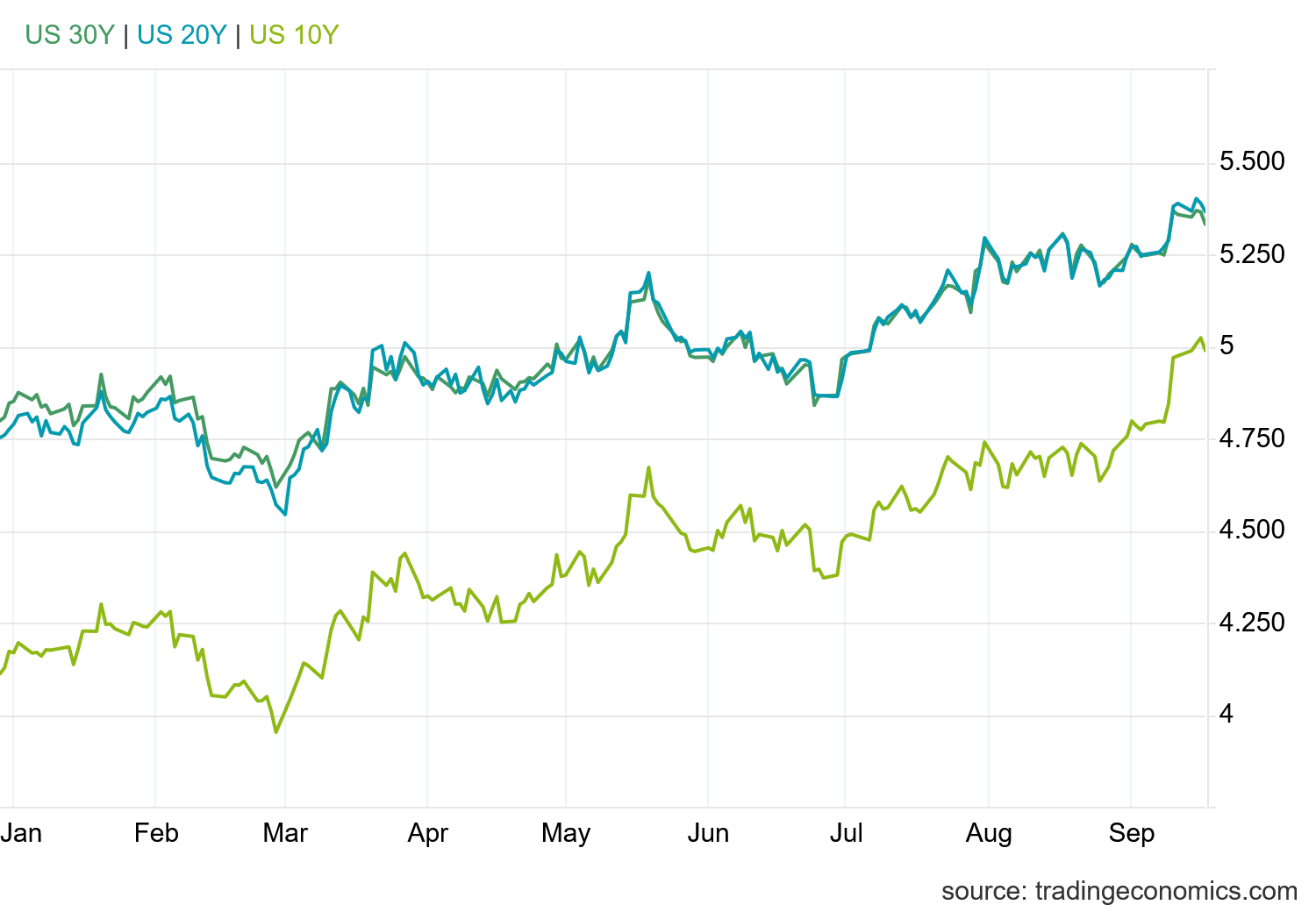
At first glance, the reversal in Treasury yields when the war began seems reasonable. A massive increase in government spending is going to push yields higher. This is the traditional interpretation of yield movements, but it is challenged by the reality that since the third quarter of 2024, the pace at which government spending has grown has actually slowed.
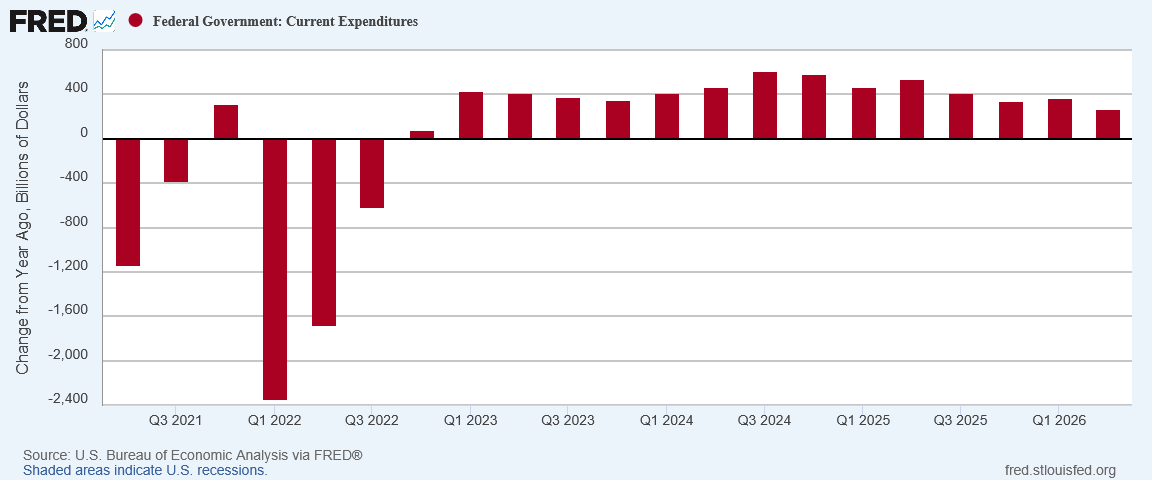
Year on year, the increase in government spending during the second quarter of the year is less than at any time since the 2022 hyperinflation cycle. If slowing the rate of increase in government spending was sufficient to move Treasury yields lower during the first quarter, the surge in Treasury yields is a contrarian move.
Equities, perhaps naturally, have responded well to the war with Iran, with all three of the major indices shaking off an early year decline to soar to new highs.
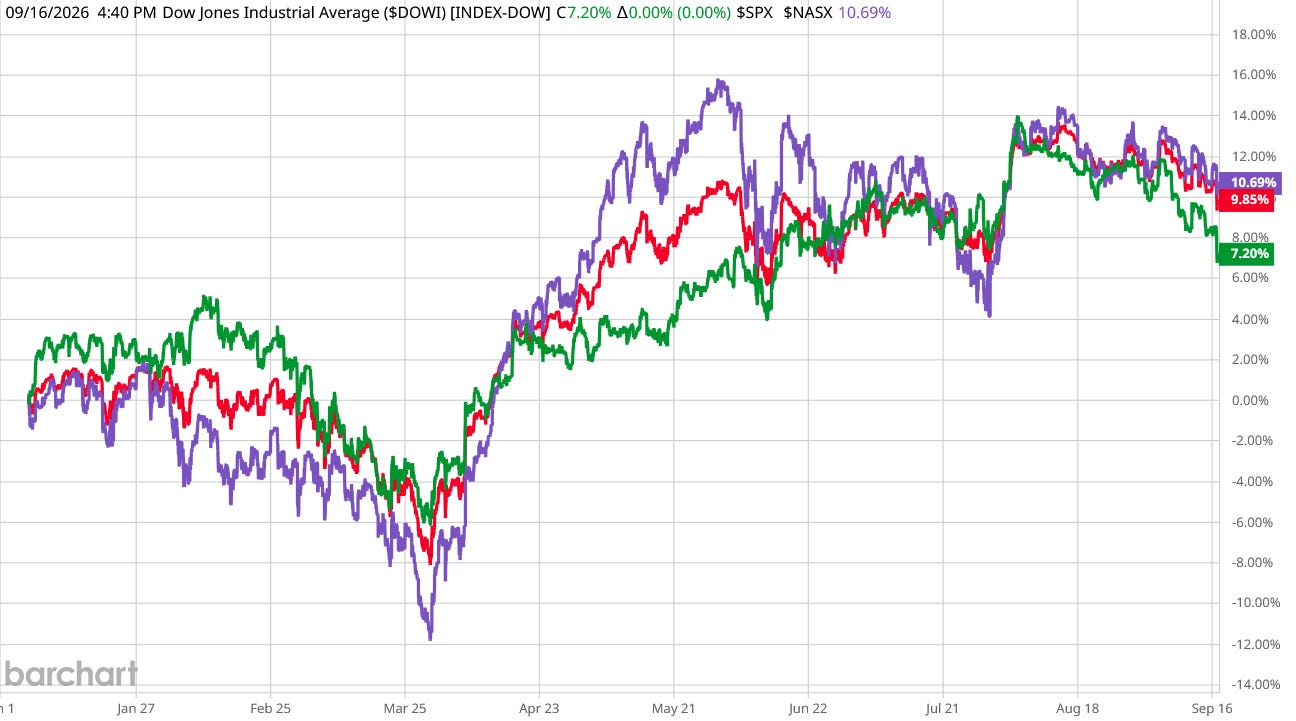
Why yields are rising is attributed in the financial media to the “bond vigilantes”—investors who take a dim view of government spending growth, and deficit growth especially. There has been considerable deficit growth in the US budget, just has there has been across most major economies in the world, and the bond vigilantes are not happy.
The bond vigilante contribution to these movements is clear enough. Bond investors across the developed world have become increasingly disturbed by government budget trends. In the United States, for instance, projections of the federal deficit have increased in just the last few months. Originally, the Congressional Budget Office (CBO) set the deficit figure for fiscal 2026 at $1.9 trillion, already slightly higher than the $1.8 trillion recorded in fiscal 2025. Now the CBO says that this year’s deficit will likely be closer to $2.1 trillion, a 10.5% jump from the original estimate and an 18% jump over the actual deficit for 2025. This budget shortfall adds to an outstanding debt load that is already 125% of the nation’s gross domestic product (GDP), up from 106% before the pandemic and dramatically from 54% at the turn of the century.
Presented in this light, the bond vigilantes are seen by the same financial punditry as demanding the Federal Reserve take more assertive action on inflation.
The bond market is in charge. Bring inflation down and yields will rally. Curb government spending and yields will fall and curve might flatten. The bond market knows what it wants and currently seems to be in charge. Also, this is all coming just at the moment when everyone seemed to have forgotten about Iran. That might turn out to be a massive deal as it’s pushed inflation up and, with it, rates. So, the bond market might have trumped Trump somewhat too? Right now, it feels like the bond market is ‘The House’, more so than Warsh, Bessent and Trump.
In this view of the market, the bond vigilantes strong-armed Warsh into raising rates, even though many market economists, such as those at Goldman Sachs, see the case for a rate hike as “weak”
Before the Fed decision, some prominent economists were already on its case.
Goldman Sachs economists suggested in a note to clients this week that the case for a rate hike was “weak,” based on the state of the US economy. They argued the economy wasn’t overheating, demand wasn’t excessive, and the supply shocks fueling inflation – namely high oil and fuel prices – would correct themselves once the war ended.
It’s not that the Iran war and Ukraine’s attacks on Russian diesel refineries are part of the problem; they are the problem – all of it, Goldman’s economists said.
That inflation spiked right after Operation Epic Fury began lends a certain credibility to this perspective (yes, this means I’m agreeing with the Vampire Squid; irony abounds).
More significantly, as I have stated repeatedly, nearly all the inflation uptick we have seen comes from energy, with little contagion—and interest rates are not going to bring the market price of crude oil down.
The Fed typically “looks through” supply shocks because they’re temporary and rate hikes are ineffective at combatting them. And once they fix themselves, the Fed may find that interest rates now are too high, artificially raising borrowing costs for businesses and consumers without actually tackling inflation.
“The Fed cannot control energy prices,” said Michael Pearce, chief US economist at Oxford Economics. “The economy is solid and can withstand a few rate hikes, but the risk is higher interest rates begin to weaken the labor market.”
Warsh admitted as much during his press conference, effectively undermining his own case for the rate hike.
Given the movements of Treasury yields and equities during Warsh’ post-FOMC press briefing, Wall Street as a whole is unimpressed by someone who shoots themself in the foot voluntarily ("Too Late” Powell was a master of this, and Wall Street took him to the woodshed repeatedly during his post-FOMC pressers).
Warsh As Firmly Anti-Prosperity As Powell
One thing certainly hasn’t changed at the Federal Reserve: The brain trust at the top is still determined to choke off American prosperity and economic growth because inflation.
Warsh uses more word salad than Powell did, but he still says that quiet part out loud.
At the start of the press conference Warsh praised the “resilience” of the US economy.
As noted in the policy statement released just a short while ago, economic activity is expanding at a solid pace. While uncertainty remains elevated, owing in part to geopolitical developments, domestic spending has been resilient, productivity growth strong, and capital investment is robust. Job gains have kept pace with the workforce, and the unemployment rate has changed little.
According to Kevin Warsh, things are going good in the US economy. Naturally, that means the Fed should hike interest rates because inflation is not cooperating and moving to the arbitrary Holy Grail target of 2% year on year.
Yet for more than five years, inflation has been running above target. So our predominant focus is on the price stability side of our mandate. The plain fact is that inflation is too high and has been for too long. This summer’s inflation readings do not tell me that underlying trends have meaningfully improved. Based on the most recent CPI and PPI data, the 12-month change in total PCE prices likely was around 3.6% in August. Core PCE and CPI prices running at about 3.2% and 2.4% respectively. Too many categories are still posting increases above 3% on both a 6- and 12-month basis.
Chew on the sentence in boldface for a moment.
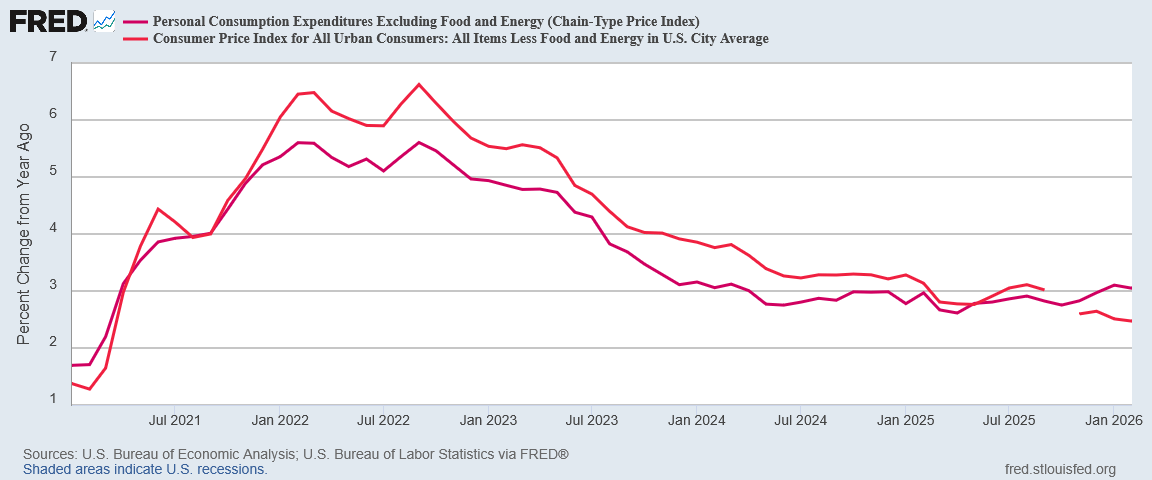
The empirical fact of consumer price inflation per the Core PCE Price Index is that it has been rising since October of last year, while the trend in the Core CPI data over that same period has been to decline.
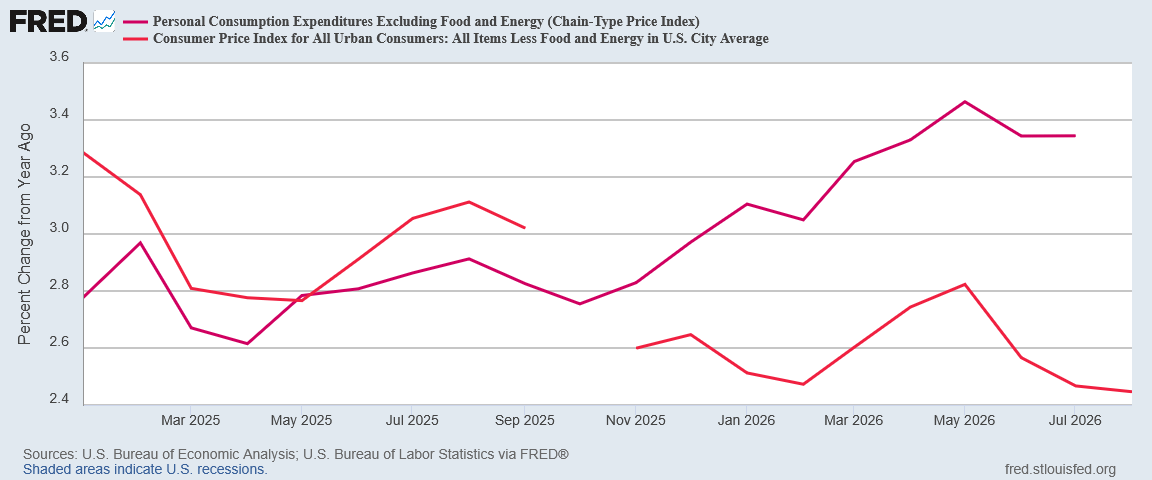
Warsh is worried about a rise in core inflation per the PCEPI of 0.6pp over 10 months. Warsh is ignoring the decline in core inflation per the CPI of 0.7pp over the past 12 months.
If core price index data is the deciding factor for whether or not to raise interest rates, that the core PCEPI is deviating from the core CPI should have been a compelling argument to stand pat.
Notionally, the two indices are measuring substantially the same pricing data over the same time frame. While it is reasonable for one to have a more conservative estimate of inflation than the other, the expectation on both is that they will follow the same macro trends. Up until last summer, that was very much what happened, even throughout the 2022 hyperinflation cycle.
At the headline level, the divergence between the PCEPI and CPI data also began last summer.
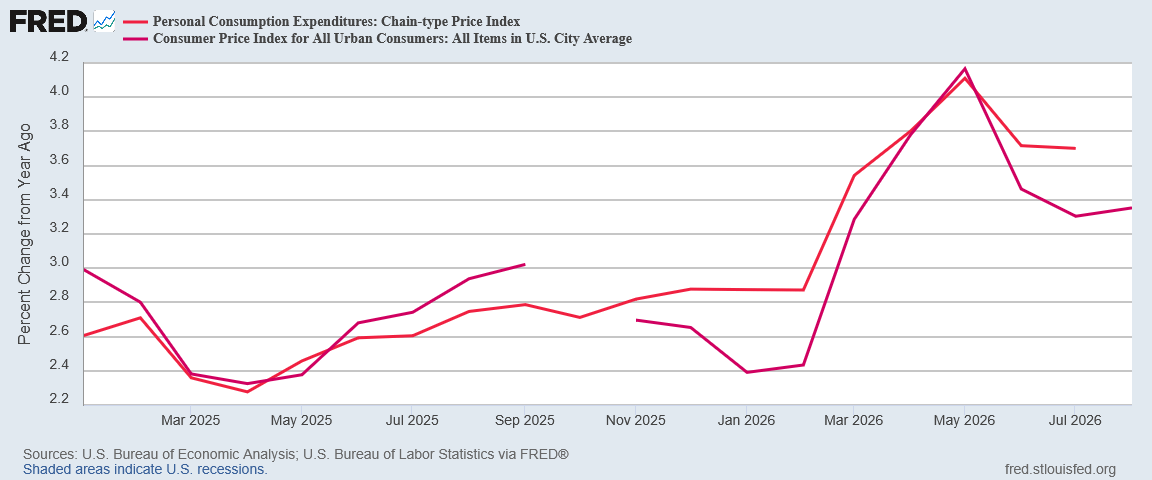
The surge of energy price inflation caused the two indices to converge again, but after this past May, they diverged once more.
A more curious Federal Reserve Chairman would have made mention of the recent divergence, and a more cautious Federal Reserve Chair would have put a freeze on rate movements up or down until the forces behind that divergence revealed themselves. When two trends that shouldn’t diverge end up diverging, the reason why stands a better than even chance of being something significant.
“Completely Wrong” Warsh completely missed that part of the data.
Warsh Whiffed On Jobs
Warsh also wants people to believe all is well on the jobs front.
One basic sign of strength is the state of America’s labor markets. The jobless rate remains low at around 4.1 percent, and both job openings and weekly hours have been increasing. Unemployment claims on a four-week moving average are running at levels consistent with full employment, so the labor side of the Fed’s congressional remit is in good shape.
Let us take those claims in order.
The official U-3 unemployment rate for August is 4.1%. The real unemployment rate—the U-3 rate combined with the number of persons not in the labor force who nevertheless want a job now—is at 7.2%.
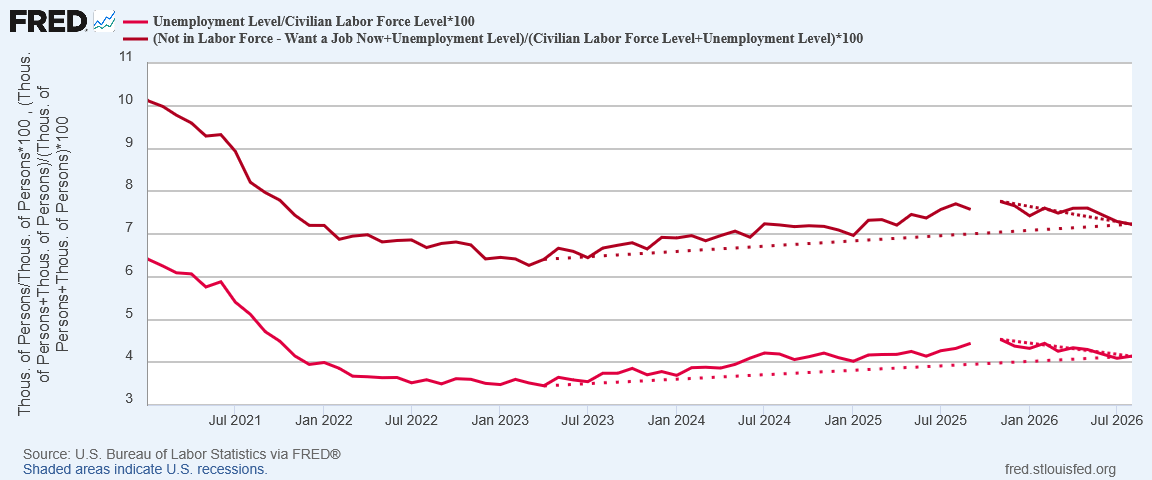
Both the real unemployment rate and the U-3 unemployment rate have been trending down since November of last year. Before that, both had been rising since April of 2023. Arguably, that is when the jobs recession from which US labor markets only recently emerged began.
As longtime readers may remember, I place no significance at all on the job openings data. A job opening has no economic significance until someone fills the job. With hirings and separations running well below job openings per the JOLTS data, I see no reason to treat the job openings data with any significance.
As for weekly hours rising, since the start of 2025 the average number of hours worked per week has risen 1.5% for goods producing jobs, 0.6% for service providing jobs, and 0.9% across all private sector jobs. For goods producing jobs, that’s an increase in hours worked of approximately 36 minutes.
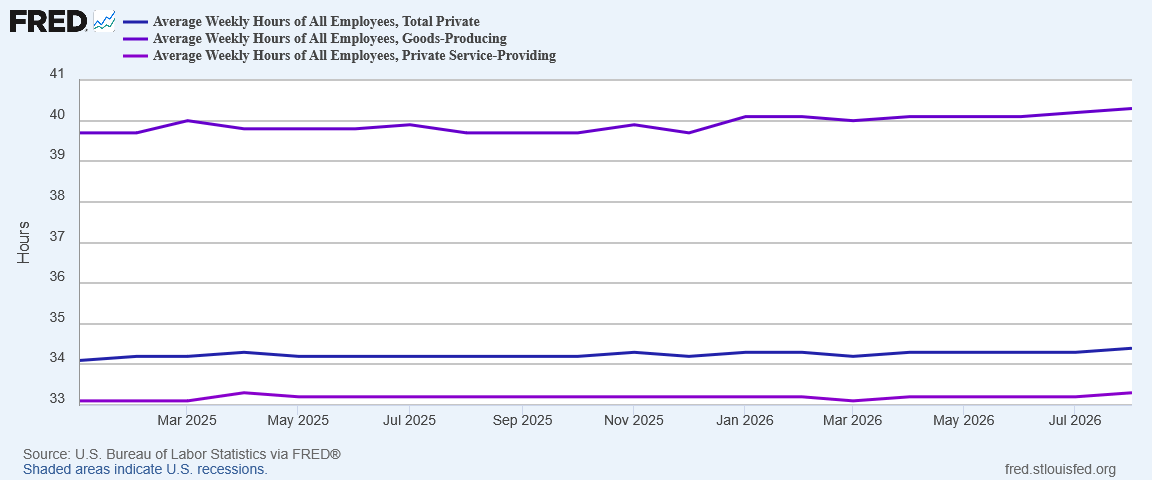
In the strict technical sense, yes, the work week is increasing for most people. However, even with those increases all that does is bring the workweek almost back to the level it was at in January of 2019, before COVID and hyperinflation put the economy topsy-turvy.
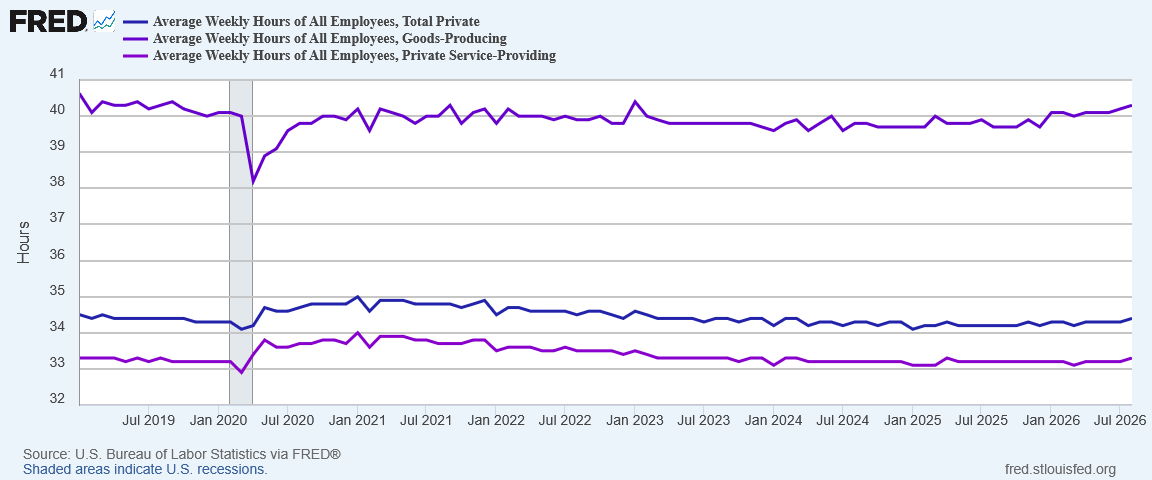
Given that “Too Late” Powell’s interest rate hikes helped suppress job growth, before sacrificing jobs to the Holy Grail of 2% year on year inflation, we probably should insist on a greater gain in hours worked.
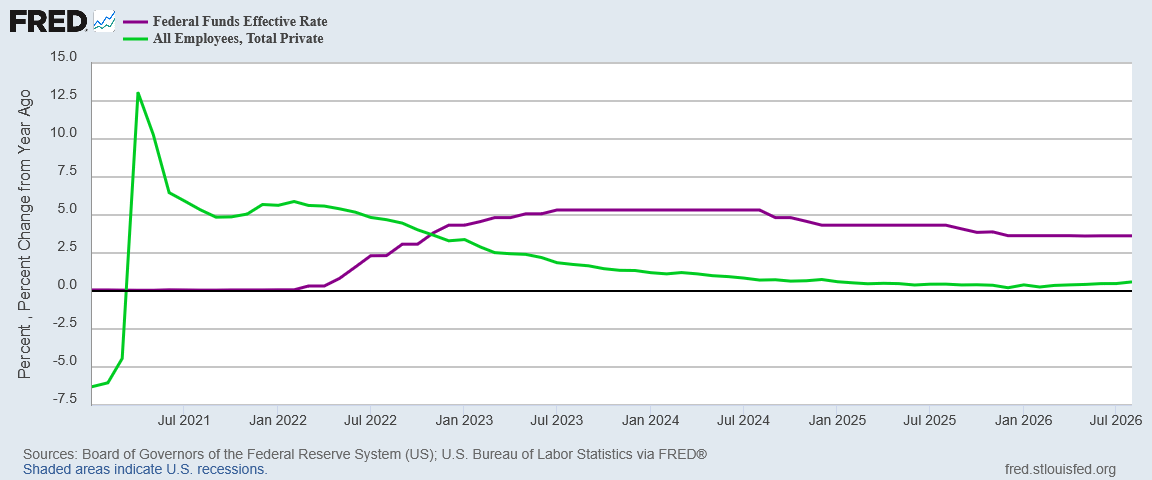
“Completely Wrong” Warsh completely missed the jobs data as well.
“Completely Wrong” Is Completely Clueless
To appreciate just how disconnected from the data Warsh really is, consider this artless response to a question on the efficacy of incremental rate hikes:
We cannot affect any individual price, whether it be oil prices, whether it be foodstuffs at the grocery store. But what we can do and will do is ensure that any change in relative prices don’t broaden out, don’t have second and third order effects in the economy. That’s what we’re tasked to do, and that’s what we will do.
Let me repeat that first sentence: “We cannot affect any individual price, whether it be oil prices, whether it be foodstuffs at the grocery store.”
We need to understand that if the objective is to lower inflation, by definition every measure taken in pursuit of that objective categorically must affect at least some individual prices. That’s what it means to lower inflation.
Moreover, as I have noted in every month’s inflation reports since the start of the war with Iran, there has been a conspicuous lack of second and third order inflation effects from energy price inflation. If that is all Warsh wants to achieve, at the moment he’s already achieved it just by doing nothing.
Hiking interest rates unquestionably threatens to squelch job growth. With the US only just beginning to see serious jobs growth after enduring a jobs recession that lasted roughly three years, how is that wise policy?
Warsh is admitting the obvious: this increase to the federal funds rate will not impact prices—which is to say it won’t halt rising crude oil prices or diesel crack spreads. The most it will achieve is combating a possible contagion effect where rising energy price inflation results in rising inflation in other parts of the price index, even though there has to be be any contagion effect registered. For that Warsh is willing to risk America’s nascent and still uncertain jobs recovery.
As the bond vigilantes proved by spiking yields during his press briefing, Warsh’ 25bps rate hike in the federal funds rate is not a persuasive move against government spending (which is going to be influenced by the market-set yields on Treasuries in any event), but as Powell proved during his post-COVID tenure, the added pressure can be quite effective in suppressing job markets.
No restraint on government spending. No appreciable influence on consumer prices. Elevated risk of weakening the job market. That is what the FOMC has accomplished with this latest rate hike, and even the bond vigilantes on Wall Street realize this.
Kevin Warsh is completely wrong about this increase to the federal funds rate. He is completely wrong about the practical severity of inflation currently. He is completely wrong about the state of US job markets. He is completely wrong about the likely impact of this rate hike on the US economy, and especially on US job markets.
That seems to be the best way to summarize Kevin Warsh: “Completely Wrong.”
Thanks. At this point I just can’t process everything going on. I do believe a huge civilizational change is happening that is spiritual and physical. All I can do is pray for discernment. As they say, it’s going to be a bumpy ride.