


As Day 4 of what may fairly be called the Iran-Israeli war concludes, a rhythm of sorts has developed between Israel conducting aerial assaults at will on Iran and Iran launching ballistic missile salvos in retaliation. How long this will continue is for the moment an unknown.
How long can this war last? One hopes the answer is “not long”, although at present neither side is easing up on the bellicose rhetoric.
Iran’s Tasnim News Agency has reported the Islamic Revolution Guard Corps vowing “national revenge” on Israel for their attacks.
Highlighting the IRGC’s severe and decisive response to the Israeli attack shortly after the act of aggression, the statement said, “This is just the beginning of the course of ‘national revenge’. The Zionist regime must bear in mind that the era of unpunished crimes has ended.”
The IRGC stated that the fake and occupying Zionist regime is doomed to destruction and downfall.
Earlier, Israeli officials stated that assassinating Iranian Supreme Leader Ayatollah Ali Khamenei was not “off limits.”
With Days 5, 6, and 7 at least of this war seemingly inevitable, an assessment of how matters stand currently seems very much in order. Is either side “winning”? Can either side hope to win?
Contents
Casualties Are Mounting
War is brutal and bloody, and this war is no exception. Civilians are getting killed on both sides. Whether civilian areas in either Iran or Israel are being deliberately targeted, civilians are dying nevertheless.
In Israel, as of this writing approximately 13 people have been killed, according to estimates made by Magen David Adom, Israel’s Emergency Medical Service. Well over 100 people have been injured by Iranian missile strikes.
The Iranian casualty count is much larger. Although Iran has not published official updated casualty counts since the opening phases of the war, Washington-based Human Rights Activists has assessed total Iranian casualties thus far of at least 406 people killed and 654 people injured.
These numbers are sure to climb on both sides, as both sides are continuing to press their respective attacks.
Iran is continuing to launch missile salvos at Israel, and some of those missiles are penetrating Israel’s defenses.
Israel, for its part, has concluded yet another wave of attacks, targeting IRGC and Quds Force infrastructures. More attacks will be forthcoming.
Within the Iranian casualties have been several senior military commanders and a number of Iran’s top nuclear scientists. At least 8 Iranian generals are reported as having been killed thus far, including:
Major General Mohammad Baqeri, chief of staff for the Iranian Armed Forces.
Major General Hossein Salami, head of the Islamic Revolutionary Guard Corps.
Major General Gholam Ali Rashid, deputy commander-in-chief of the Iranian Armed Forces.
Brigadier General Amir Ali Hajizadeh, commander of the IRGC Aerospace Force (Iran’s strategic missile command).
Brigadier General Mehdi Rabani, deputy head of operations for the Iranian Armed Forces general staff.
Brigadier General Gholamreza Mehrabi, deputy director for intelligence for the general staff.
Brigadier General Davud Sheikhiyan, commander of the Air Defense Division of the IRGC Aerospace Force.
General Masud Shane’i, chief of staff to General Salami.
Additionally, on Sunday, the Iranian News Agency confirmed that Mohammad Kazemi, the IRGC Intelligence Organization, along with Hassan Mohaqeq and Mohsen Baqeri, two high-ranking members of that intelligence apparatus, had been killed.
At least six of Iran’s top nuclear scientists were also killed: Fereydoun Abbasi-Davani, Mohammad Mehdi Tehranchi, Abdolhamid Manouchehr, Ahmad Reza Zolfaghari, Amirhossein Feghi and Motalibizadeh.
All war death is horrific death by definition, yet it is clear from the publicly reported casualties that Iran has had by far the worst of it.
Iran’s Nuclear Sites Have Been Damaged
Iran’s various nuclear sites for uranium enrichment and weapons development were primary targets when Israel commenced Operation Rising Lion. Israel has inflicted some damage on several of the sites, although it remains to be seen how impactful the damage will be.
Based on the available reporting, Iran’s primary uranium enrichment facility at Natanz has been severely damaged.
Initial assessments indicate that Israel’s strikes on Iran’s Natanz nuclear facility were extremely effective, going far beyond superficial damage to exterior structures and knocking out the electricity on the lower levels where the centrifuges used to enrich uranium are stored, two US officials told CNN.
Long considered “the center” of Iran’s nuclear weapons program, the facility at Isfahan has been damaged, although it is unclear to what extent.
The extent of damage at the Isfahan nuclear site in central Iran was more difficult to parse in the hours after it was struck, with conflicting claims over the attack’s impact emerging in Israel and Iran.
However, the IAEA said later Saturday that four critical buildings at the site were damaged.
The one site that has likely not been severely damaged has been the Fordow Fuel Enrichment Plant, which Iran built inside a mountain near Qom.
Israel targeted the site during its Friday attacks, but the IAEA said it was not impacted and the IDF has not claimed any significant damage there. Iranian air defenses shot down an Israeli drone in the vicinity of the plant, Iranian state media outlet Press TV reported Friday evening.
It is worth noting that the Fordow site was where the IAEA confirmed in 2023 the presence of uranium enriched to 83.7%—very close to the 90% needed for “weapons grade” fissile material. Iran’s claims that it is not pursuing nuclear weapons are for this reason properly rejected as baldfaced lies.
These three sites are the core of Iran’s uranium enrichment efforts, and, as I have noted before, without uranium enrichment, no country can effectively pursue nuclear weapons.
Natanz may very well be complete destroyed. With Isfahan having suffered at least some damage, Iran’s uranium enrichment efforts are effectively reduced at least temporarily to just the Fordow facility. The extent to which Iran’s uranium enrichment capabilities have been degraded is thus at least somewhat uncertain.
Also uncertain is the status of Iran’s stockpile of enriched uranium, assessed in mid-May at 9,247.6 kilograms by the IAEA. With 408.6 kilograms enriched up to 60%, Iran is theoretically close to possessing enough fissile material for as many as 10 nuclear devices, according to the IAEA estimates.
Has Iran’s nuclear weapons program been dealt a significant setback by Israel? Definitely.
Has Iran’s nuclear weapons program been definitively halted? Definitely not. The mullahs are certainly not likely to cease pursuing enrichment as a result of this war.
As I touched on briefly on Thursday, Iran’s insistence on enrichment is a likely catalyst which persuaded Israeli Prime Minister Benjamin Netanyahu to launch Operation Rising Lion.

While the attack has undoubtedly been long in preparation, the apparent catalyst appears to have been the International Atomic Energy Agency’s decision to censure Iran yet again over its non-compliance with the Nuclear Non-Proliferation Treaty.
The attack comes as tensions have reached new heights over Tehran’s rapidly advancing nuclear program. The Board of Governors at the International Atomic Energy Agency for the first time in 20 years on Thursday censured Iran over it not working with its inspectors. Iran immediately announced it would establish a third enrichment site in the country and swap out some centrifuges for more-advanced ones.
The statement released earlier by Iran’s Foreign Ministry made it clear that it was expanding enrichment specifically in response to the IAEA censure.
As previously announced, the Islamic Republic of Iran sees no option but to respond to this political resolution, it said.
Accordingly, Iran’s atomic chief has issued orders to establish a new enrichment center in a secure location.
Advanced IR-6 centrifuges will replace the older first-generation centrifuges at the Shahid Dr. Alimohammadi (Fordow) site.
Israel has stated that it was specifically targeting those same nuclear sites.
Disabling these facilities is thus crucial to assessing whether or not Operation Rising Lion may be considered a “success.”
Given the reported damage to Natanz and Isfahan, the Israelis have achieved at least partial success already.
Iran Is Defenseless
Operation Rising Lion has driven home for Iran one very grim reality: the country cannot protect itself from aerial assault.
Israel has been able to launch daylight bombing raids on Iran with impunity, a reality that is sure to sow at least as much chaos as the the bombing raids themselves.
The current confrontation follows a pattern of tit-for-tat attacks that have occurred since the start of the Gaza war. But the scope and depth of Israel's latest operation have further shattered previous assumptions about Iran's defense capabilities.
The Israeli strikes have opened a fierce debate among Iranians about Iran's vulnerabilities. Widely described as the most extensive assault on Iran since the Iran-Iraq war, the intensity of the Israeli operation has shaken the nation's confidence in its military deterrence.
Yet public reaction has been far from uniform. While many condemned the attack as a violation of sovereignty, others viewed the killing of high-ranking military figures as a moment of reckoning.
Iranian state news media has carried repeated assurances that it will make Israel pay dearly for its attacks—but none at all that the attacks themselves will be halted. That telling omission is tantalizingly close to confirming that the mullahs already know they cannot protect the Islamic Republic from Israeli bombing runs.
Iran also has to contend with the reality that the Mossad has been able to thoroughly penetrate Iran with a variety of assets able to compromise Iran’s defenses from within.
In an incredibly rare move, the Mossad released video from some of its operations, showing drones attacking what appear to be unsuspecting missile launchers.
It is the latest operation to show how deeply Israel’s intelligence services, including the Mossad, have penetrated some of Iran’s most closely guarded secrets. The operations have made the Mossad appear a nearly unstoppable force in Iran, capable of hitting at some of its highest-ranking officials and most sensitive sites.
“Mossad has treated Iran like its playground for years now,” said Holly Dagres, a senior fellow at the Washington Institute and curator of the Iranist newsletter.
It is no exaggeration to say that Iran has at present no capacity to defend itself.
How that realization will impact the Tehran government’s ability to maintain control over the broader population is one of many questions as yet unanswered and unanswerable.
The US Is (Mostly) On The Sidelines
Officially, the United States is not a part of Operation Rising Lion. President Trump made that clear on Saturday.

However, President Trump is apparently not ruling out getting involved, based on statements he’s made to the media.
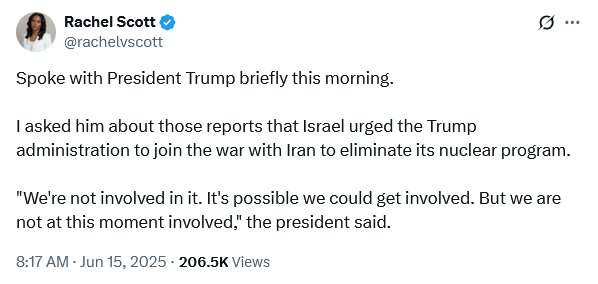
Nor has the US been reluctant about assisting Israel with shooting down Iranian missiles and drones. Indeed, the US has been relatively transparent about its involvement thus far in this war.
This transparency takes on an ironic aspect given claims in Iranian state media that it has “firm evidence” of US support of Operation Rising Lion.
Iran has hard evidence that the American forces have been supporting the Israeli regime’s military attacks against the Islamic Republic, Foreign Minister Abbas Araqchi said, warning the US to step away.
Presumably, this evidence involves materials other than what has been publicly reported within even the corporate media, including statements by US officials that the US had provided Israel “exquisite intel” to help with preparations for Operation Rising Lion.
Do such activities make the US “involved” in ISrael’s attacks? Certainly Iran wants everyone to think so, just as the US insists that it is not involved.
Interestingly, one of Iran’s more powerful proxy terror militias, the Kataib Hezbollah (no relation to Hezbollah, which is based in Lebanon), apparently accepts US declarations of non-involvement, as it has issued threats that it would attack US assets in the region if the US were intervene.
The powerful Iran-linked Iraqi militia Kataib Hezbollah on Sunday warned it will target U.S. interests and bases in the region if Washington intervenes in the hostilities between Israel and Iran.
The group said in a statement that it is “closely monitoring the movements of the American enemy’s military in the region” and “should the United States intervene in the war (between Israel and Iran), we will directly target its interests and bases spread throughout the region without hesitation.”
As US forces in Iraq have not (yet) been attacked, the US narrative that it is not involved in Operation Rising Lion appears to be broadly accepted even by the Iranians.
Oil Prices Surged But Are Stabilizing
When a major conflagration begins in the MIddle East, oil prices always shoot upward, and the Iran-Israeli war is no exception.
When news of Israel’s attacks on Iran first broke, oil price futures for both Brent Crude and West Texas Intermediate surged.
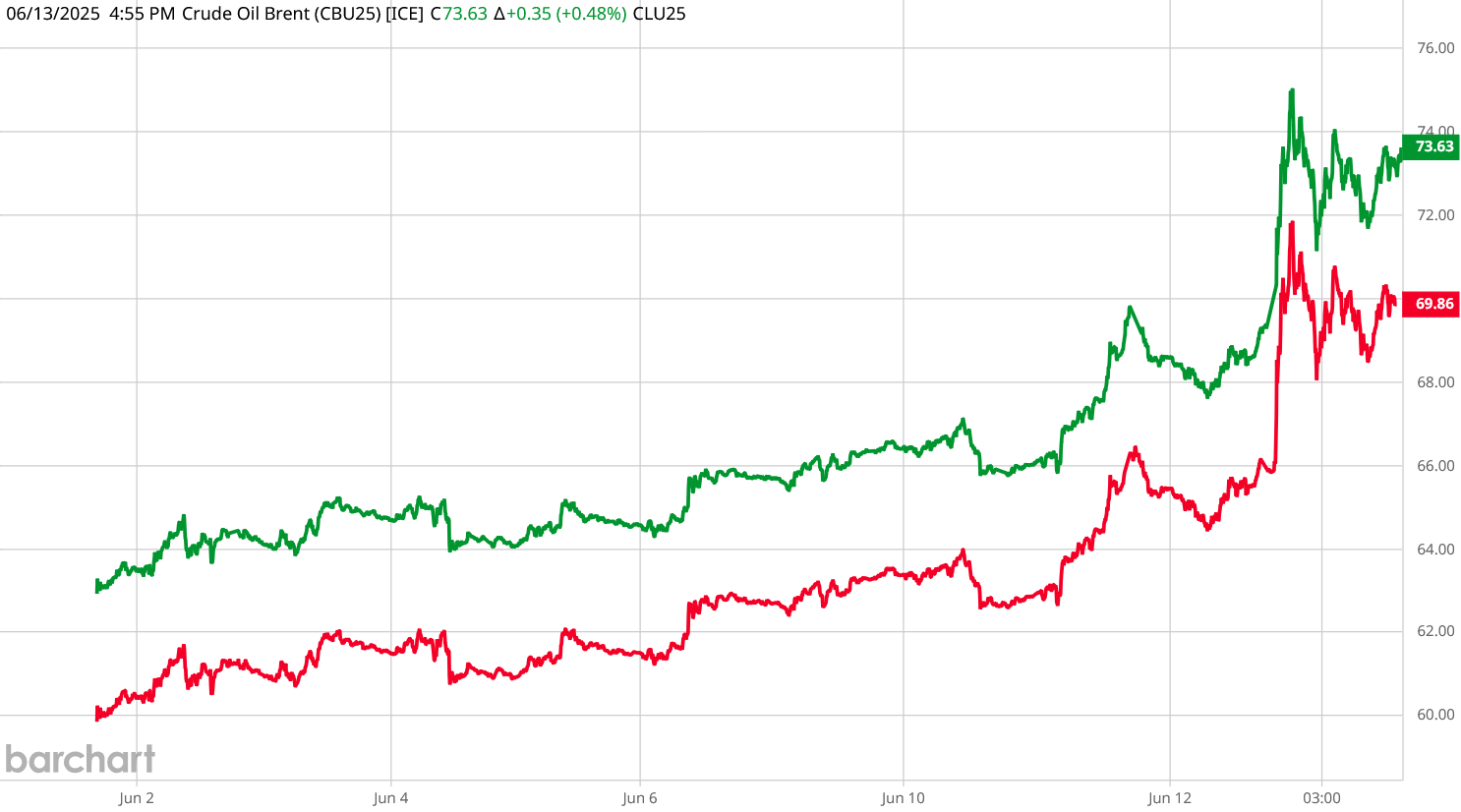
While oil prices had already begin trending up since hitting a market bottom at the end of May, news of Operation Rising Lion sent oil prices surging as much as $6/bbl almost immediately.
However, just as immediately, oil prices retreated from that initial surge. Instead of returning to pre-war levels, however, Brent Crude is showing signs of stabilizing in between $72/bbl and $74/bbl, while West Texas Intermediate may finding a new equilibrium around $69/bbl.
Similar patterns can be seen in commodity prices overall as well.
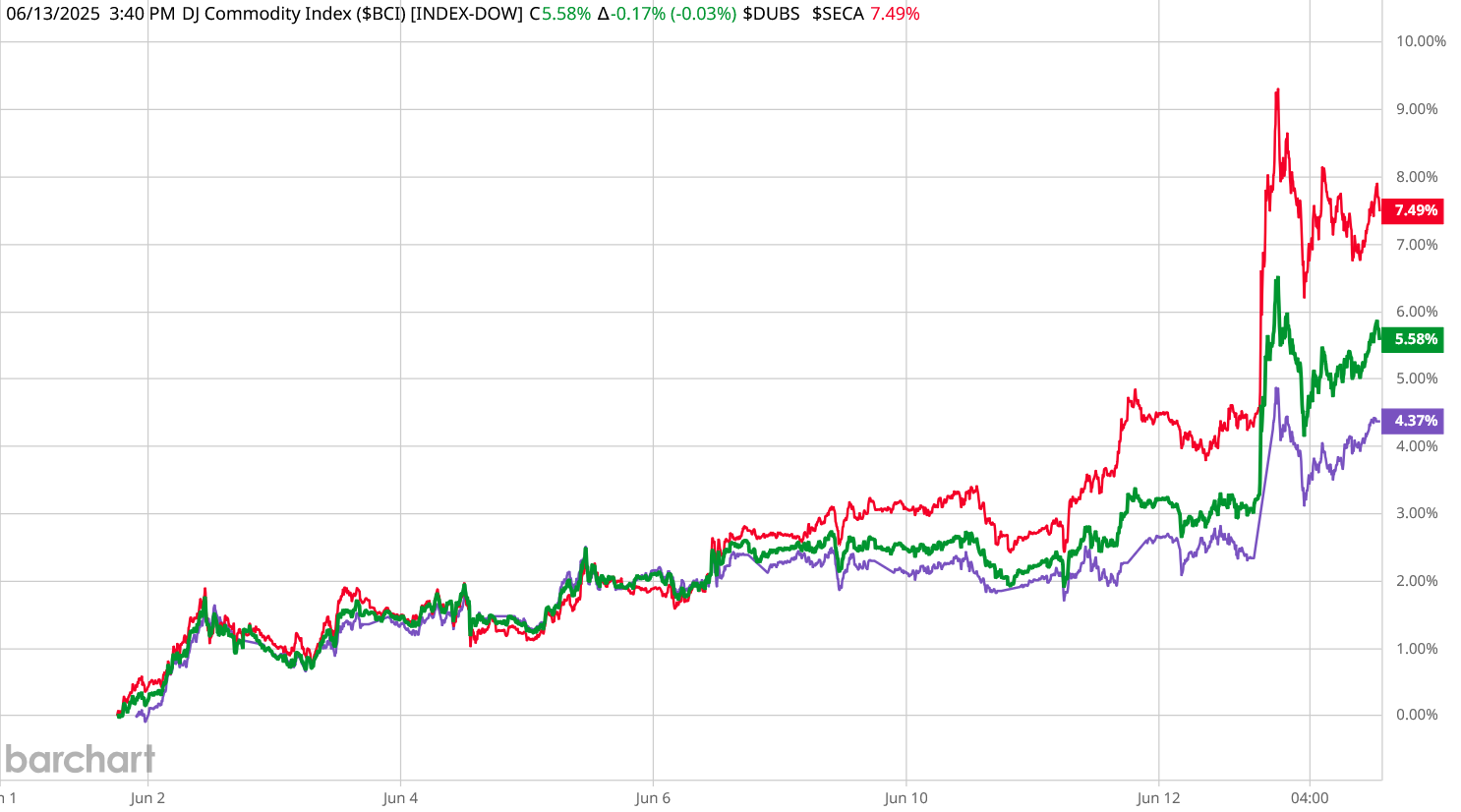
Much as with oil prices, a general rising price trend had already set in from the beginning of the month. Even with that rising price trend, however, news of the first Israeli attacks catalyzed a pronounced upward surge, after which prices almost immediately began to stabilize around a higher equilibrium price.
While markets are clearly remaining concerned about energy flows through the Middle East, that concern at present is largely contained. What energy markets are not pricing in at the moment is the likelihood that this war between Israel and Iran somehow metastasizes into World War 3.
How Long Will This War Last?
With around a thousand kilometers and a couple of Arab states in between Israel and Iran, there is almost no chance this war will include the deployment of ground troops by either side. Israel is unlikely to attempt an invasion of Iran, and Iran is equally unlikely to attempt a ground assault on Israel.
Given these logistical ramifications of geography, this Iran-Israeli War is likely to continue to unfold in a dynamic of Israel bombing Iran and Iran lobbing missiles back at Israel in retaliation. Since Friday we have already seen the war’s tempo settle into the tit-for-tat, back and forth rhythm which seems almost inherent in a war limited to various modalities of aerial assault.
How long will that tempo persist?
From Israel’s perspective, the war will continue until either Iran seeks peace or Israel’s complete list of potential targets has been addressed. In his initial televised address regarding the war with Iran, Prime Minister Netanyahu stated the IDF was prepared for the strikes on Iran to last for “many days.”
From Iran’s perspective, the war will continue as long as Iran has missiles to launch against Israel. Even with Israel targeting missile launch sites and known missile stockpiles, with an estimated 3,000 ballistic missiles in its arsenal, Iran very likely can continue to launch missile salvos against Israel for some days to come even at the present pace of attacks.
These dynamics suggest this war will come to a natural conclusion relatively quickly. There is no chance of a grinding attritional war emerging such as has been dragging on between Russia and Ukraine since 2022. The attacks could cease as early as tomorrow, or perhaps will continue for another week, or perhaps two.
Past that point, Israel is likely to run out of targets to strike, and Iran is likely to run out of missiles to launch.
Who will emerge as the war’s putative “victor”? While Israel’s initial attacks were, in terms of operational objectives achieved, an unqualified success, the likelihood Israel can completely dismantle Iran’s nuclear weapons program by an air war alone is at best remote, and no war can eliminate Iran’s desire to possess nuclear weapons.
At the same time, Iran’s missile arsenal has not succeeded in inflicting damage on Israel at all proportional to the damage Israel has inflicted on Iran. Barring a collapse in Israel’s layered air defense systems, it seems unlikely at this juncture that Iran will be able to make good on its threats of “national revenge”.
What Israel may have already achieved is delivering a substantial setback to Iran’s nuclear weapons program.
If the Natanz facility has been completely destroyed, as some reporting as indicated, a significant portion of Iran’s uranium enrichment capacity has been eliminated. Even partial damage to Isfahan can only compound that loss of capacity, leaving the underground Fordow plant as Iran’s sole enrichment facility. Israel lacks the “bunker buster” bombs needed to do serious damage to the Fordow site, but even with regular munitions Israel can collapse the entrance to the facility, making it inaccessible for however long it takes to clear and restore that entrance.
Even more damaging for Iran’s nuclear weapons ambitions is the loss of scientific and technical knowledge represented by the nuclear scientists known to have been killed, as well as the institutional military and strategic knowledge of the generals Israel successfully eliminated. Those are resources far more difficult and time-consuming to replace.
Iran can still rebuild its nuclear program once Israel is done with its attacks, but without the skills of the six killed nuclear scientists, that rebuilding will take longer than it might have otherwise.
Whether Iran can restore any semblance of military efficacy to its conventional armed forces is another matter entirely. For Iran there is no escaping the reality that its military has been thoroughly humiliated by Israel. With or without nuclear weapons, Iran is simply not a country any nation needs fear militarily.
While it is highly questionable whether Israel can realistically “win” this war, it seems fairly conclusive that, militarily and geopolitically, Iran has already lost.
"While it is highly questionable whether Israel can realistically “win” this war..."
If the war ends with minimal Israeli casualties and Iran's nuclear program is pushed back 20 years then Israel won. That's probably the best they can hope for.
They are psychopaths who want to plunge their populations into misery...
A society that systematically refuses to recognize that its physical survival is
physical survival is immediately in question and which does not take any steps
to save itself cannot be described as mentally healthy.