


If it’s August, then the Federal Reserve must be gathered in Jackson Hole, Wyoming for their annual Economic Symposium.
One of the keynote addresses is always by the Federal Reserve Chair, which means this was Kevin Warsh' turn to pontificate on Federal Reserve policy amid the Grand Tetons.
This is his address. The full text of his remarks are below (autotranscription by Substack transcription engine).
The Speech
The full text of Kevin Warsh’ speech:
Good morning, Kristin. Thank you for that super kind introduction.
It was 25 years ago that we were colleagues. It’s an honor to share the stage with you. It’s great to be back here in the Valley again. I see so many familiar faces from academia, from my last tour of service, and from my first 100 days, which is just this weekend. I’ve been looking forward to this weekend.
And before I go further, I want to thank Jeff Schmidt and his team for the incredible hospitality. Everybody here is in debt to you and to your colleagues here at the Federal Reserve Bank of Kansas City. Jeff, our thanks to you and your team.
Now he and the other planners here have some recreation options lined up for later today. I’d advise you to be very careful with your choices. As I learned years ago, you can take two different kinds of hikes on the trails around Jackson. I can sum up my hikes with former Vice Chairman Don Cohn with two words, I survived.
These steely marathon death marches reveal the side of Don that I was not ready for.
But there’s another kind of hike. This one was with former Chairman Ben Bernanke, another dear old colleague. With Ben, it was a much more leisurely pace. Easy stroll along the wandering trails of the Rockefeller Preserve.
So before setting out today, my recommendation is do a wellness check. Ask yourself, is this a Cohn Day or a Bernanke Day?
The best thing about this gathering is that it helps us all get out here to the mountains and clear our minds and think straight about our world and our time. For me, it feels like the right place and the right audience for real engagement with the ideas that matter most. Innovation, as Kristin mentioned, is the conference theme. And I believe the public and the markets understand that innovations in the conduct of Fed policy will help deliver price stability alongside full employment. So here’s a quick overview of what I’ll cover in my remarks this morning. You can call it an outline. Call it a trail map, but please just don’t call it forward guidance.
First, I’ll touch on a few of the longer term questions we’re asking at the Fed about the latest general purpose technology AI and where it might take the economy.
Then I’ll reflect a bit on the practice of forward guidance and the interaction between the central bank and financial markets.
Next, I’ll present some of the key principles That I believe should guide the conduct of monetary policy.
And finally, I’ll give you my assessment of what’s happening in the economy.
So first, I think we should try to prepare a bit for future policy conjunctures. With the unchanging picture of the Tetons as our backdrop, we are here to survey an economic landscape that is anything but static.
It wasn’t so long ago, including in rooms like this, in the run-up to the crisis of 2008 and over the decade that followed, when economists and policymakers were speaking of secular stagnation, speaking of a global savings glut, it was a widely held view that an excess of capital would sit on the sidelines for a very long, long time because there just wouldn’t be enough compelling investment opportunities.
All the good stuff, you’ll recall, had been invented, so growth would be low and slow.
Well, times sure have changed. We’ve come to a hinge point in history, to borrow a phrase, a framing from my former mentor, George Shultz.
To cite the clearest example, progress in AI, the 80-year-old name for the newest technology, has been faster even than its evangelists predicted just a couple of years ago. The potential for substantially higher growth is on the rise. Ever expanding pools of capital pouring into AI related infrastructure of all sorts.
A kind of super Moore’s Law seems to be playing out.
Scaling laws too are changing both the method and speed of innovation. Capital and labor have combined to create large language models at the heart of AI. Users buy tokens to gain access to these models. Reports put annualized token sales for the two leading labs alone at more than $100 billion, an increase of 500% from just 12 months ago.
We at the Fed, we watch all this attentively. We recognize that AI is a new variable, potentially a new factor of production that will have consequences both for the economy and for the conduct of monetary policy. It opens up some major lines of inquiry.
Will the application of AI cause a significant sustained rise in productivity across the economy? If so, when?
Will token usage be complementary or competitive to labor?
Will the next generation of AI models demand even greater capital intensity too? Or will the models themselves help devise a capital light solution?
Among the other yet unknowns is the resulting market structure. Who gets to make the money? It’s not obvious where the returns on capital will land or on what time scale.
Early on, how much of the surplus goes to owners of scarce assets, the AI labs or chip makers or energy producers or cloud providers?
Over time, how much of that value accrues to businesses and consumers? And importantly, what are the implications for workers and for the employment side of the Fed’s mandate?
Likewise, we don’t yet know the equilibrium price of the tokens that give access to these models. Might there be a heterogeneity of tokens such that growing sums will be paid for the access to the best models, those at the frontier? Will token prices for older models fall to the level of their marginal cost?
Well, we’ll be thinking through these matters with the help of a task force on productivity and jobs.
My early check-ins with the leaders of that task force and the rest have been very encouraging. To be clear, though, their recommendations will come later and have no bearing on decisions we make in the current policy conjunction.
But I believe that for future policy challenges, this intellectual investment today will leave us much better prepared for tomorrow. Next, let me say a word about forward guidance and its substitutes. As our task forces go about their work, as you might know, I’m not waiting to introduce innovations at the Fed to help make us fit for purpose.
To highlight one example, I’ve set out to change the form and function of the Fed Chairman’s so-called forward guidance.
You might know about my long-time discomfort With early pronouncements of future policy decisions, I much prefer another path, and now will make the case for it.
Transparency in communications about future policy decisions is not an end unto itself. Communications must be in service to the Fed’s paramount responsibility. And what is that that’s getting policy right?
Forward guidance as a regular practice was adopted by my colleagues and me during the global financial crisis. It was essential at the time, and we introduced it with much fanfare. But as with other legacies of crises past, I believe the practice has outstayed its welcome.
In normal times, the role of forward guidance should be limited and circumscribed. Otherwise, it risks creating ambiguity In the name of clarity, oversharing policy deliberations and overcommitting to future decisions can lead markets, businesses, and households astray.
And I believe when policymakers make quasi-commitments on interest rates throughout the cycle, we inhibit our own freedom to make the right calls when it’s time to decide.
To get policy right, we also need to get the relationship right Between the central bank and financial markets, the Fed needs clear market signals as unfiltered as possible.
From market internals, from the level and change in asset prices across sectors, the prices and trading volumes of Treasury securities, the foreign exchange value of the dollar, the cost and availability of credit, Broad set of commodity prices.
These and other indicators should inform the Fed’s near-term outlook on economic activity and inflation throughout the business cycle. They should also reveal the state of broader financial conditions and the risks and uncertainties of the financial cycle.
At the same time, market participants themselves Should be tracking real information about the real economy. They should draw their own conclusions, form their own expectations on things like output and employment and inflation. And they too should stay sharply attuned to risks.
In my view, the Fed should be humble and never naive. The Fed plays an essential role in the economy and markets. Our tools are powerful. We determine the path of short-term interest rates. And market participants will always try to anticipate what we will do next. But we should not indulge a regime in which market participants are looking primarily to the Fed for their next trade.
The economic literature has long described the distorting effects, what it called the Hall of Mirrors problem. If markets rely materially on the Fed’s guidance and the Fed relies on market prices, we’re more likely to be blinded to new developments, more likely to be caught unprepared, and more likely to commit errors in policymaking.
Now perversely, market participants are unlikely to bear the biggest costs of the Hall of Mirrors problem. The most serious harm is likely to befall those without any financial assets.
If the Fed gets inflation wrong and judges the economy wrong, who gets the worst of it? Not the financial high flyers. Hard-working Americans are the ones left to deal with inflation that’s too high or jobs that suddenly appear less secure.
So, if forward guidance is ill-suited to normal times, How about the new Fed chief commits at a meeting just like this to some explicit reaction function? Surely he could tell us his interest rate path if, say, the data were to come in hot or cold.
Well, I wish our understanding of the economy were so precise as to provide a mechanical tried and true answer that some simple function, like a Taylor rule, could be rigorously relied upon.
But our knowledge just does not extend that far, at least not yet. And other factors most relevant to the proper conduct of monetary policy, they change over time. Providing forecasts to illustrate the Fed’s reaction function works better in theory than in practice, better in the lab than in the field.
I am not alone in noticing that forward guidance in 2021 To cite just one example, might well have slowed the policy response to high inflation. In my term as chairman, my colleagues and I will endeavor to construct more reliable models, more robust rules, and we’ll do this knowing that accuracy in forecasting is still just an aspiration.
With so much changing so fast in our geopolitics, global supply chains, technology, it’s wise to be modest about what we can and cannot know as we sit here today.
In the same spirit, we should receive the full range of ideas on matters that may inform the Fed’s monetary policy discussions.
If the aim is optimal decision making, and it should be, we should not crowd out views on the economy.
How then to chart a better path to policy?
In the balance of my remarks, I will share with you some key principles that guide my thinking on the appropriate conduct of monetary policy, and then I’ll offer my promised assessment of the economy. So let’s turn first to principles.
First, I’ve noticed in this line of work, yesterday’s news has a way of getting mistaken for what’s happening right now. The challenge is to know the difference.
In other words, we must interrogate reality, make sure we’re not setting forward-looking policy based on stale or inaccurate data, nor should we rely on isolated data points. Trends matter most.
The Fed’s a decision-making agency. We make choices amid uncertainty, and the data upon which we draw must be relevant, contemporaneous, accurate, And as actionable as possible.
Second principle. The Fed’s actions are intended to ensure that the aggregate demand side of the economy is broadly consistent with aggregate supply. However, all we observe directly is activity. We never see and can only infer what’s really happening on the supply side.
Hence, evaluating the current and expected balance Between aggregate supply and aggregate demand is imprecise. Third principle, there should be no misunderstanding. The Fed’s price stability objective of 2%, as measured by the PCE price index, is a firm, fixed target.
Let me be equally clear about another aspect of this objective. Price stability is not self-executing. Nor is inflation necessarily reverting. It’s the Fed’s job to deliver stable prices, no excuses.
Fourth principle, the Fed also bears responsibility for maximum employment. Achieving both sides of our mandate over the medium term is not an either or proposition.
I do not believe the Fed’s dual mandate works at cross purposes. After all, high inflation itself is very harmful to economic prosperity.
Fifth principle, short-term interest rates are the predominant tool to achieve the dual mandate. Unconventional policies to spur economic activity may suit genuine crises of which we all have much experience, but they should otherwise be used sparingly, if at all.
Sixth, money matters. I know it’s not fashionable these days, but my view is that money has something important to do with monetary policy. We should pay attention to money created by the central bank and money that comes from the banking and financial system. It’s true that financial innovations, the subject of this conference, and other factors alter the mechanics that link the monetary base, the velocity of money, and the broader economy.
But that is scarcely a reason to ignore the ultimate effects of money on financial conditions and prices.
Finally, a quieter Fed, a more purposeful Fed in its communications, is better able to meet its objectives. And we can be held accountable for delivering on our remit. The only true test of our credibility. To borrow a line from General Chuck Yeager, at the moment of truth, there are either reasons or results.
So having heard a little bit about AI and general purpose technologies, having heard a little bit about the next policy conjuncture, a little bit on principles, let’s turn to the economy today. Given those principles, how do I read the economy?
It’s really going on outside the window. It’s a little ironic. There are no windows in this room, but they’re big ones at the Federal Reserve. And we’ve been using those in my first 100 days, and I expect we’re going to continue to use those in the period right ahead of us.
Now, you may have read in the July minutes the unanimous view of the FOMC. Labor markets were stable, output solid. But inflation remained too high.
A good majority of my colleagues and I thought the wiser course was to await new information in the intermeeting period, especially given possible developments in supply chains, investment flows, and geopolitics, before deciding whether a change in interest rate policy was advisable.
And we expressed our joint readiness to act as circumstances require. For my part today, as we sit here, I’m impressed by the overall performance of the economy, which appears to have strengthened.
One indicator of strength is how well an economy holds up under stress, how well it holds up under shocks. On that score, both Main Street and Wall Street have been remarkably resilient.
Several other observations. Business CapEx is rising rapidly. The four-quarter change in investment in equipment and intangibles has been around 9%, its highest growth rate since 2021. And more than half of the capex growth can likely be ascribed to the build-out related to AI.
What about profits? For the firms in the S&P, profits have grown more than 20% over the past year alone. Profit margins are quite elevated relative to history. Overall equity and market volatility, quite low. We’re staying keenly focused on market internals, watching performance across sectors. Expectations for both growth in capex and corporate earnings are running quite high. I continue to watch the change in the growth rates, the second derivative.
The follow-on effects on asset prices, business confidence, consumer incomes and spending are equally important to gauge.
Credit spreads on corporate bonds and leveraged loans are near the low end of their historical averages, and issue volumes this year quite strong. Looking beyond fixed income markets to the banking business, in the July so-called SLUES survey, banks tell us that standards for C&I loans are on the easier end of their historical ranges.
That helps explain their growth that we’ve seen this year in these loans.
In my view, credit and loan markets are showing few signs of policy restraint.
Now, certain sectors like housing and agriculture are showing strains, but on balance, I would be hard pressed to describe broad financial conditions as restrictive. Real consumer spending has been healthy despite these shocks, increasing more than 2% over the past four quarters.
If you combine consumption with the brisk investment we talked about earlier, Private domestic financial purchases have also risen. These purchases have increased to the pace of nearly 3% or so, so far this year. That’s a measure that typically carols more signal than GDP. The trend here, too, positive.
So on the employment side of the Fed’s dual mandate, are countries doing well? Labor markets are quite stable. The jobless rate at 4.1%, Remains low by historical standards and hasn’t changed much in a couple of years. Unemployment claims on a four-week moving average, an empirically robust real-time indicator, are near their lowest level in decades.
In my view, the relatively low turnover in today’s labor market is partly a result of the significant rematching between employers and employees that happened in the post-pandemic environment. But when labor supply is barely growing, monthly job gains are naturally going to run low. There are always areas of concerns in the labor market, for example, among recent graduates. In general, though, people who want to work, by and large, are holding or finding jobs.
They might well be concerned about future labor disruptions, but as of now, I believe the labor markets are broadly consistent with full employment. But on the price stability side of our mandate, the numbers are more concerning.
The Fed’s preferred measure of inflation, the one I talked about earlier, the 12-month change in the PCE price index stands at 3.7%, with the six-month change a little above four. The comparable measures from the CPI index are also elevated, as are core measures both of PCE and CPI inflation.
None of these measures are perfect. But they all tell a similar story. Inflation is running above our 2% target.
So the Fed’s predominant focus right now should be on prices. So what’s our job? The job for policymakers is to capture underlying trend inflation. Easier said than done.
We want to gauge whether underlying inflation is rising, falling, or seems to be stuck in place. We also want to understand not just the direction of travel, but the speed.
Each of these broad inflation measures have fallen significantly from their highs of a few years ago, but progress of the last couple of years has been more modest.
And while this summer’s PC and CPI readings were better than expected, they do not tell me that underlying trends have meaningfully improved.
The data also show moderate wage growth. But in my view, in tracking underlying inflation, wage growth has not proven a reliable indicator of future inflation for a very long time.
So to try to gauge underlying inflation, I want to tell you about a couple of things I’ve always looked to. I find it instructive to disaggregate the 199 individual components of the PC price measure.
Over the last 12 months, 54% of goods and services in this basket showed price increases above 3%. This is well below the post-pandemic highs of about 77%, but it remains well above the level of 32 in a couple of the decades that preceded the pandemic.
Looking over just the last six months, the conclusion is similar. 49% of goods and services in the PC basket, Showed price increases above 3%. Again, this is well below the post-pandemic highs, but still elevated, quite elevated.
The recent rise in overall commodity prices also bears watching. What we need to judge is whether the trends we see indicate upside inflation risks. Now it matters, too, whether the inflation readings of the past five years have seeped into expectations
The good news is that measures of inflation expectations in the medium term, by and large, look stable. And inflation compensation measures from the swaps market send a strong and similar message, especially in light of recent developments.
It’s a credit to the Fed as an institution, consistent with the best of the Fed’s traditions, that market prices show confidence that we will deliver price stability. And I can assure you, they’re right.
The thing about market measures of inflation expectations and economic history, I know some economic historians in the audience, is they all tend to look really strong and durable until they don’t. These expectations are not pushed around easily. And right now they are very well anchored. But they must be closely minded. And it’s the Fed’s job to make sure that inflation expectations do not get unanchored.
Now there is one signal nobody can miss. Responsibility for 65 months of sustained elevated inflation sits squarely with the central bank. And that’s where it belongs.
So here is my standard. We must be confident that underlying inflation is moving to our objective, clearly and at sufficient speed. Otherwise, we have work to do. That’s our job, that’s our mandate, and that’s our charge to keep.
So I’ve covered quite a bit of ground in the last 25 minutes or so. Let me see if I can conclude this way. I stand here today committed to a discipline, not a decision.
My Fed colleagues and I are hardly the first to hold these positions in a time of great consequence. We are determined to redeem the time by doing our very best work.
For those of us, those of you that know us, you’ll know the following is true. We take our responsibility seriously with humility And with resolve. We know so much depends on the choices we make.
Sound monetary policy helps households and businesses to prosper. When carried out effectively, it broadens and deepens the momentum of our economy and helps to secure America’s leadership in the world. And I know that our country needs us to think carefully and act wisely, perhaps now more than ever.
It’s a tremendous honor to serve once again at the Federal Reserve. I’m truly grateful for the encouragement, good counsel, and the warm reception I’ve received in my first 100 days from my colleagues.
I’m also honored and grateful for the views that I’ve gotten, solicited and unsolicited, from so many of you in this room. For that, and for your kind attention this morning, I say thank you. Let’s get on with the rest of the program.
Wall Street Was Not Impressed
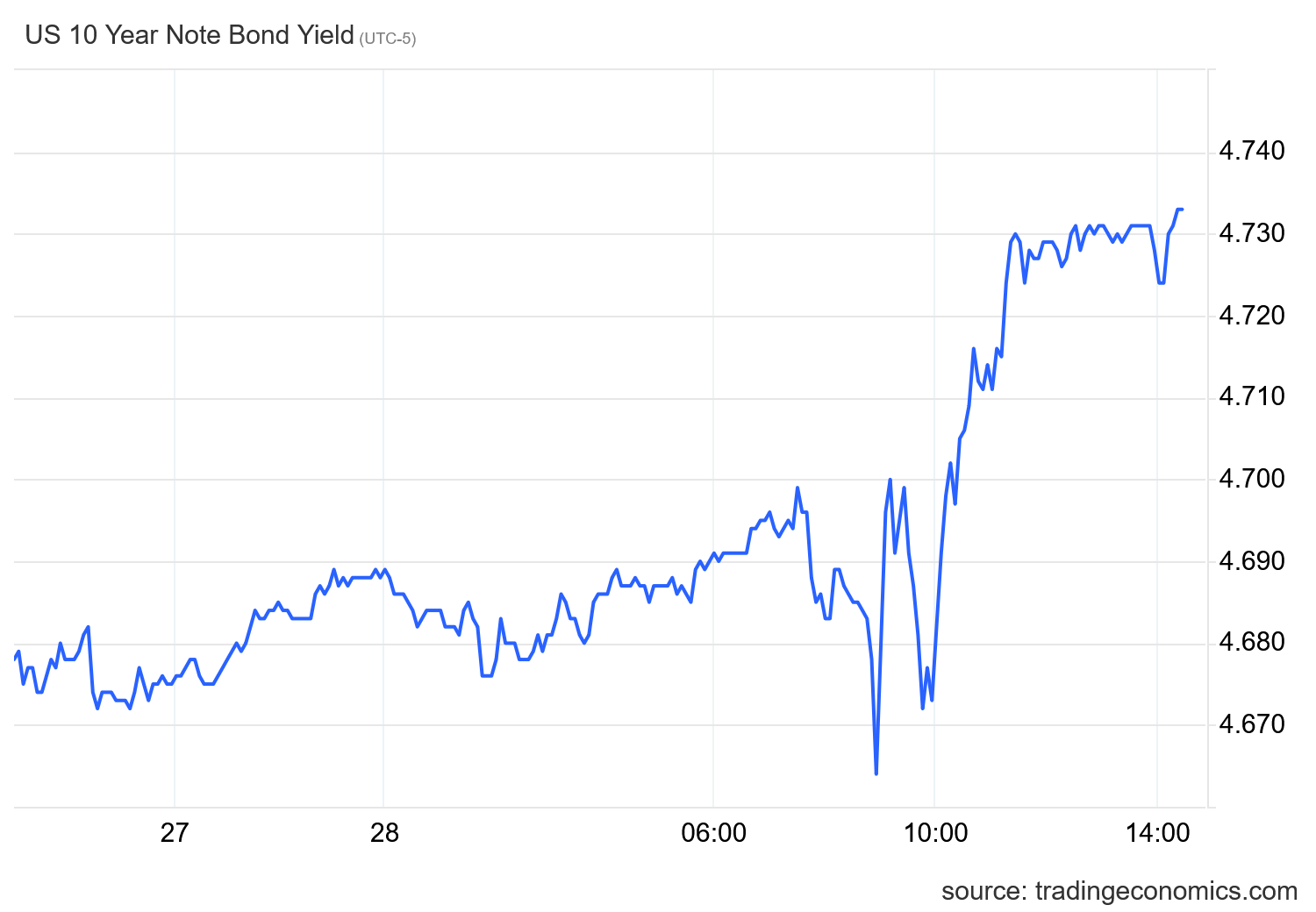
I will have more to say about Warsh’ comments in a later article, but it is worth noting that Wall Street responded to his speech by bidding Treasury yields up.
In a performance reminiscent of Jerome “Too Late” Powell, Warsh’s lamentable predecessor, by speaking Kevin Warsh succeeded in boosting the 10-year Treasury yield by over 6bps.
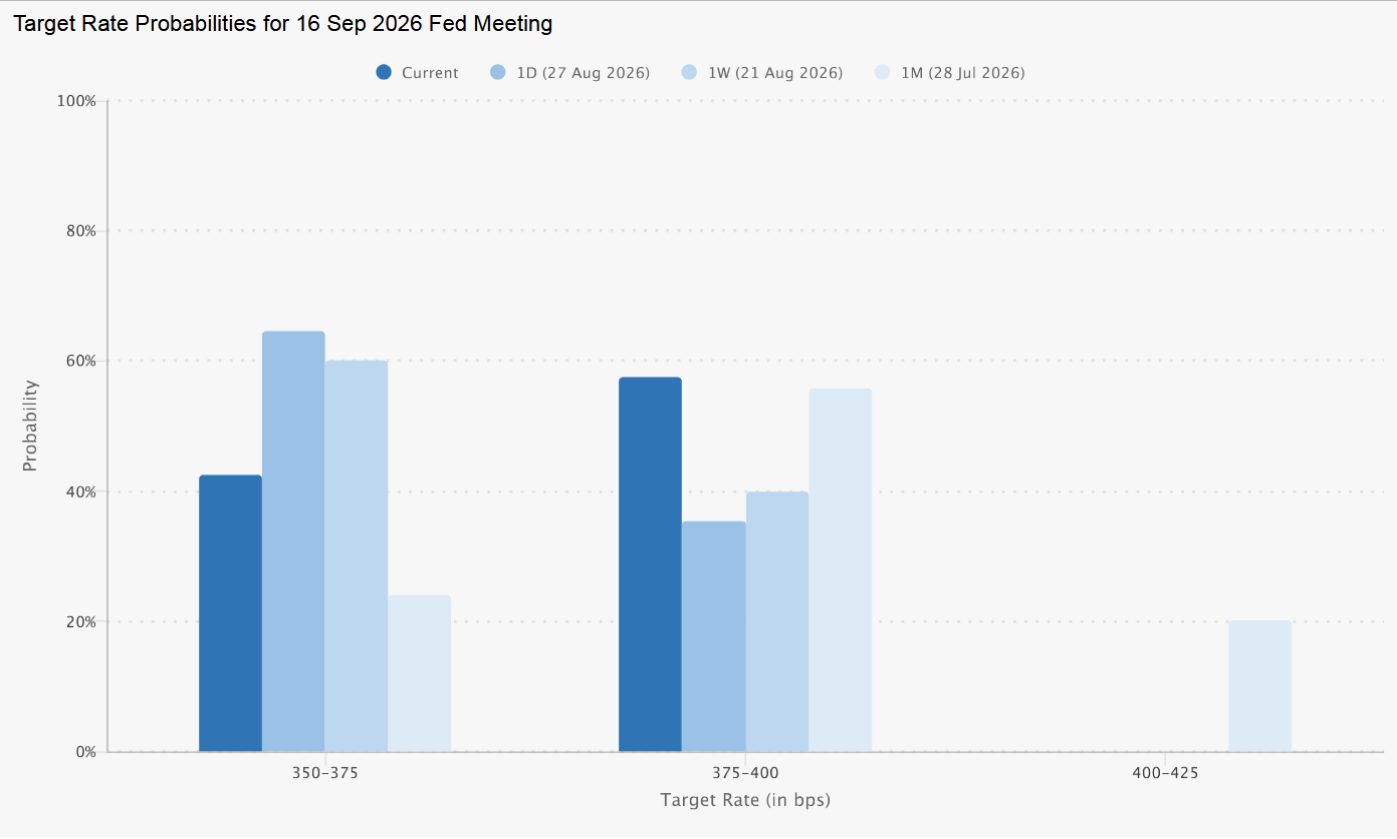
Wall Street is also starting to seriously price in a 25bps increase to the Federal funds rate when the Federal Open Market Committee meets in September to decide the federal funds rate.
For its part, Polymarket now puts the odds of a 25bps rate hike at the September FOMC meeting at 50-50 vs standing pat again.
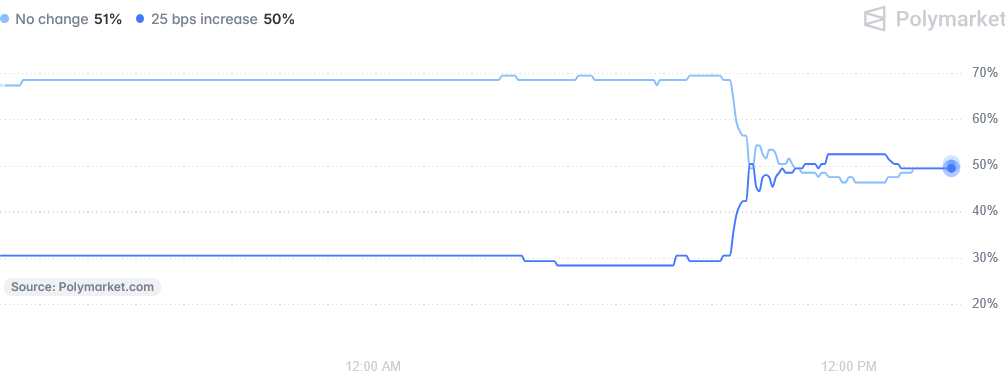
If Warsh panders to Wall Street the way Powell did, we can look forward to a rate hike next month.
Media Is Expecting A Rate Hike
Both corporate and alternative media reacted to Warsh’s speech by viewing it as a signal that a rate hike is coming.
CNBC zeroed in on his assessment of inflation and inflation risks in the economy.
Warsh at Jackson Hole gave a more hawkish reading of the economy than he had in July. He said elevated prices needed to be the Fed’s main focus and described financial conditions as not being broadly restrictive, a change from his July news conference, when he said they were uneven. He did that while swiping back at his critics and insisting his policy of deliberate ambiguity about Fed policy is here to stay.
ZeroHedge also noticed that Warsh tended towards hawkishness, while also pointing out that, for all of his words, he really did not say all that much, especially about where the Fed stood on the possibility of a rate hike next month.
Whether Warsh is accurate in his assessment of the US economy is almost beside the point, at least as far as Wall Street is concerned. Wall Street’s focus is fairly narrowly drawn on finance matters. Wall Street only wants to know if the Fed is going to raise interest rates, lower interest rates, and when.
Despite giving the longest Jackson Hole speech since Janet Yellen in 2017, Kevin Warsh refused to take any stand on interest rates.
Was it a good address? Looking at Treasury yields during and after his speech, Wall Street tended to think not. For it to be a good address, Kevin Warsh needed to say something, and Wall Street concluded he didn’t really say much of anything.


