


Last week major media made a big deal about Pennsylvania Governor Josh Shapiro pushing medical misinformation by alleging deaths from measles—when the facts flatly rejected his claims.
With less fanfare but no less malicious propaganda, a South Texas school district up and canceled two days of classes because COVID.
Just two weeks into the new school year, a Rio Grande Valley school district is closing all campuses for two days because of what officials described as the “rapid spread of COVID-19.”
San Perlita Independent School District announced Monday that all school operations will be suspended Tuesday and Wednesday “as a precautionary measure.” Classes will resume as scheduled on Thursday.
Is COVID spreading “rapidly” in Texas? Yes…but really no.
COVID cases have increased recently, in Texas and nationwide. However, the increase is from such a low level, and the cases of such low severity, that the alarmist rhetoric which accompanied the San Perlita ISD knee-jerk response to close the school district over COVID is even more out of step with reality than during the height of the Pandemic Panic.
In an ironic moment of role reversal, the Houston Chronicle outperformed alternative media outlets ZeroHedge and The Epoch Times in reporting the uptick in COVID cases. While noting that the CDC is reporting an increase in cases, the Chronicle correctly noted that severity and disease burden were not rising proportionally.
The Centers for Disease Control and Prevention’s latest epidemic estimates show COVID-19 infections are growing or likely growing in 48 states, including Texas. The agency’s Texas map shows widespread growth across much of the state based on emergency department data.
But the CDC is careful about what that actually means.
“Epidemic trends indicate direction only and do not reflect the burden of disease,” the agency notes, meaning the map can show infections increasing without telling us how many Texans are seriously ill.
And nationally, that burden remains relatively low.
While ZeroHedge noted that, even with the uptick in cases, the CDC maps showed the level of COVID cases to be “very low”, there was no mention of the disease burden context.
The Centers for Disease Control and Prevention on Friday said COVID-19 activity is “increasing” across the United States although its levels are still considered “very low” overall.
“As of August 26, 2026, we estimate that COVID-19 infections are growing or likely growing in 48 states, declining or likely declining in zero states, and not changing in two states,” the CDC said on Friday.
Overall community viral activity levels, or a measurement of the virus in wastewater levels, for COVID-19 is considered by the CDC to be “very low.” Emergency department visits were also considered “very low,” which is the lowest ranking on the CDC’s website, with “very high” being the top.
ZeroHedge was doing little more than restating an earlier report in the Epoch Times, which also failed to place the case counts in a useful disease burden context.
That disease burden context was also completely absent from Newsweek’s contribution to the medical misinformation campaign, which hyped the CDC maps showing COVID cases rising “everywhere”.
Nationally, the CDC estimates that COVID cases are growing, with infections increasing across much of the South and West. The agency has described national COVID activity as low overall but trending upward.
Growing wastewater surveillance data appears to support the trend.
In Texas, the CDC has reported rising levels of SARS‑CoV‑2, the virus that causes COVID-19, in wastewater samples in several regions, including Central Texas. Wastewater monitoring is often considered an early indicator of community spread because increases can appear before spikes in testing or hospital visits.
The disease burden context is important, because it shows how absurd the San Perlita ISD response to COVID has been, and how needlessly alarmist media reports are being by hyping the “increase” in COVID activity.
While the CDC is guilty of quite a few COVID misrepresentations and outright lies, in the curious fashion of all bureaucracies, it almost reflexively presents epidemiological data sets with little to no spin.
Where infectious respiratory diseases are concerned, the CDC has even before COVID maintained publicly accessible dashboards and databases on the state of influenza like illnesses in the United States. After the COVID Pandemic Panic, those dashboards were overhauled and consolidated into RESP-NET, a universal dashboard of the CDC’s hospital surveillance data for influenza, COVID, and Respiratory Syncitial Virus (RSV).
That data shows just how unserious COVID activity is in the US currently.
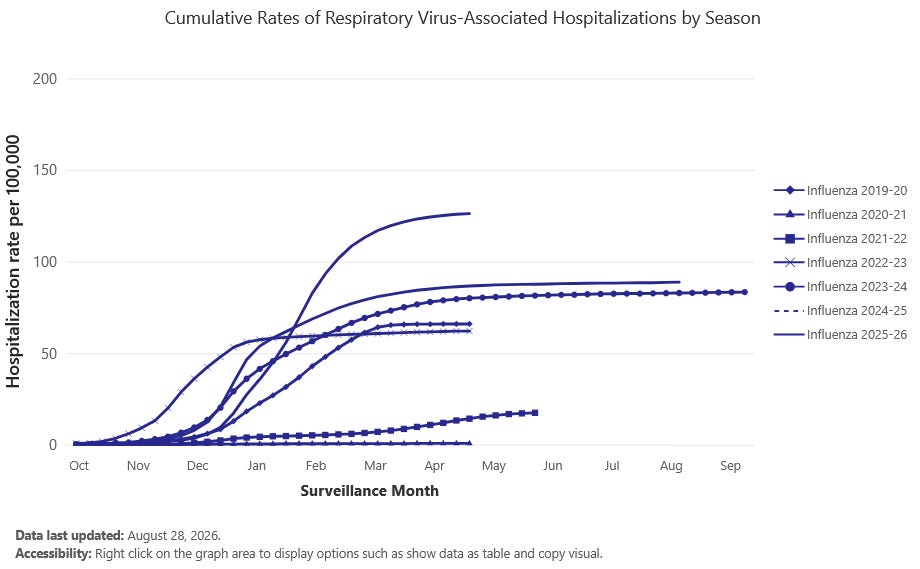
During the 2025-2026 infectious respiratory disease reporting period, the most severe illness in terms of weekly hospitalization rates was not COVID but influenza.
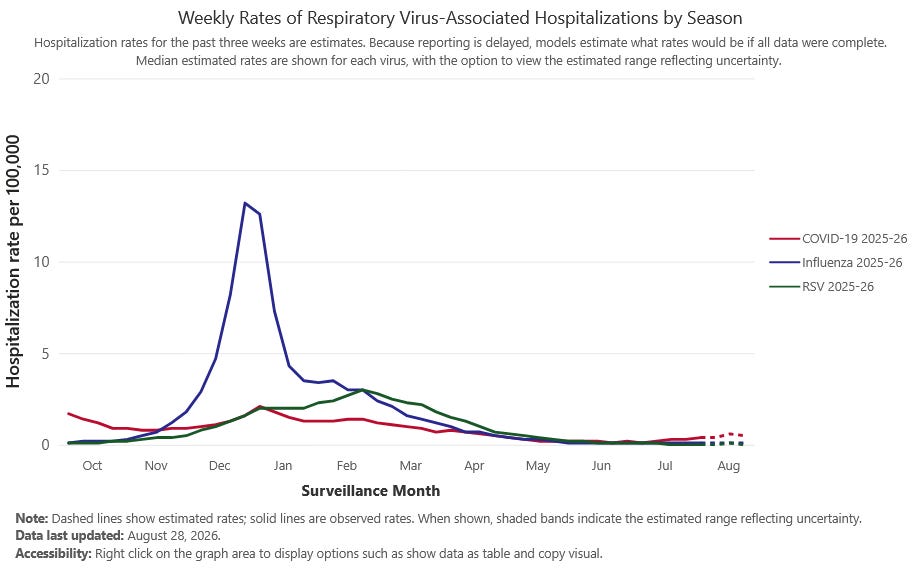
Since the start of the year COVID has been the least troublesome infectious respiratory pathogen until very recently, with the uptick in hospitalizations being minimal at best.
Overall, during the 2025-2026 reporting year, COVID hospitalizations are the lowest among the three classes of infectious respiratory pathogens tracked by RESP-NET.
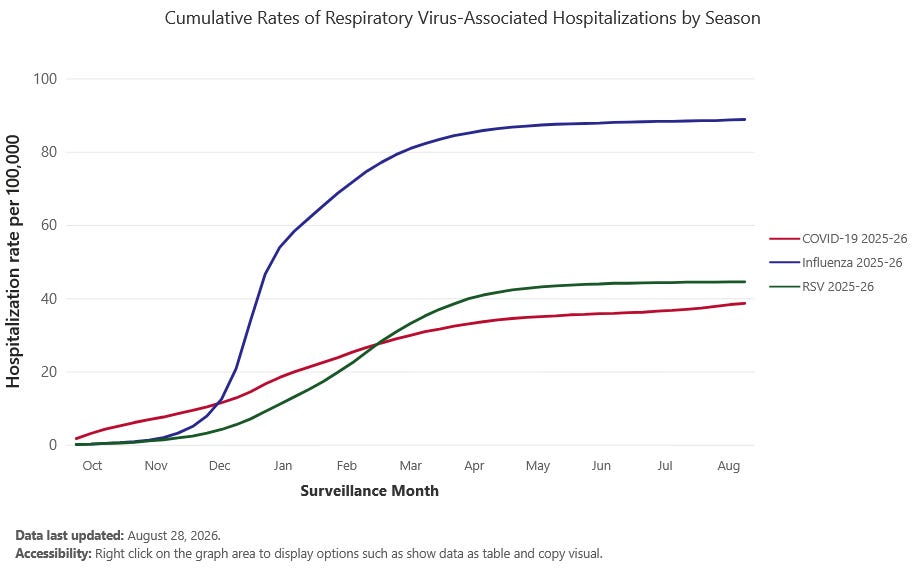
By far the most severe disease this year has been influenza, with more than double the number of COVID hospitalizations.
Moreover, since COVID reporting began after the SARS-CoV-2 virus emerged from the Wuhan Institute of Virology in 2019, the 2025-2026 reporting period has been the mildest in terms of COVID hospitalizations.
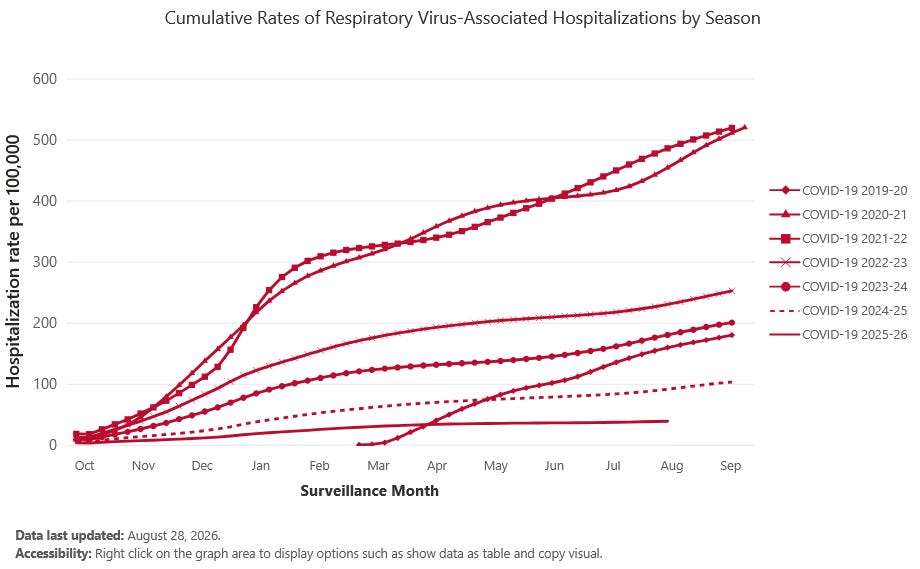
This year has been demonstrably the least severe COVID season to date.
That has not been the case for influenza. Over the same time period, influenza hospitalizations in 2026 were the second highest, just behind the 2024-2025 reporting year.
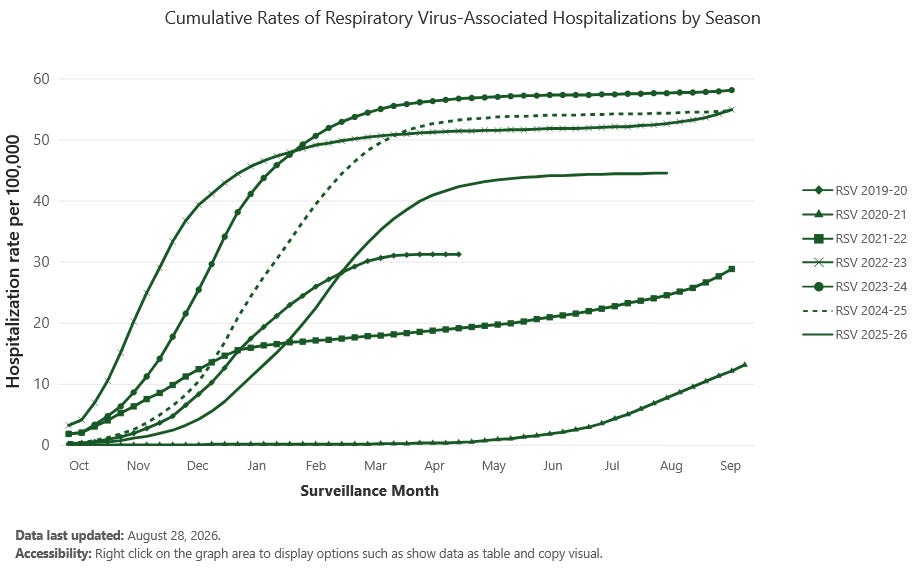
RSV hospitalizations were perhaps not as severe as in some recent years, but the 2025-2026 reporting year has been among the more severe.
The importance of the epidemiological data in understanding infectious respiratory disease cannot be overstated. It has been amply demonstrated that the corruption, the incompetence, and the sheer lunacy of this country’s response to the emergence of the SARS-CoV-2 virus stemmed from and was moved along by a complete disregard for the data.
As the Pennsylvania measles debacle as well as the reporting on the San Perlita ISD school closures demonstrate, both corporate and alternative media outlets are not trustworthy sources on the severity of disease outbreaks. With COVID once again, as with the measles non-cases in Pennsylvania, the data has never supported the narrative.
With the traditional cold and flu season coming on quickly, people are well advised to become familiar with the CDC RESP-NET dashboards, as well as the resources by their respective state and local public health agencies.
Infectious disease surveillance has been a public health function for years, and most public health agencies provide monitoring resources for people to see what the actual disease burden is in their area. That is the essential information everyone needs to make informed decisions about disease outbreaks, even the annual cold and flu season.
The COVID Pandemic Panic was from start to finish one long teachable moment on why the only successful rule of thumb for reading media outlet narratives on COVID as well as other diseases must always be “trust nothing. Verify everything.'“
Even alternative media is not immune to the perils of propaganda. Corporate media’s business model depends on it.
Trust nothing. Verify Everything.
All of this is the result of TOO MUCH GOVERNMENT. We have multiple levels of “public health officials”, whose JOB SECURITY depends upon hyping one “disease outbreak” after another. I’m not falling for any of it. And I’m angry that their fear-mongering has produced generations of fragile, weak, easily-frightened citizens who are easy to control and coerce. No nation can remain strong with such citizens!
Hard to fathom that they closed the schools for a nothing burger , unless you remember that school administrators are mostly democrats who are blind to reality and useful idiots. San Perlita is a tiny town with a tiny school district. The superintendent is a “rising star”.