


In every western-style democratic government, the eternal challenge is differentiating between the rule of law and rule by government.
Events in Poland are bringing that question into sharp focus when Polish Prime Minister Donald Tusk abruptly—and apparently unconstitutionally—suspended the President of the Constitutional Tribunal Bogdan Święczkowski.
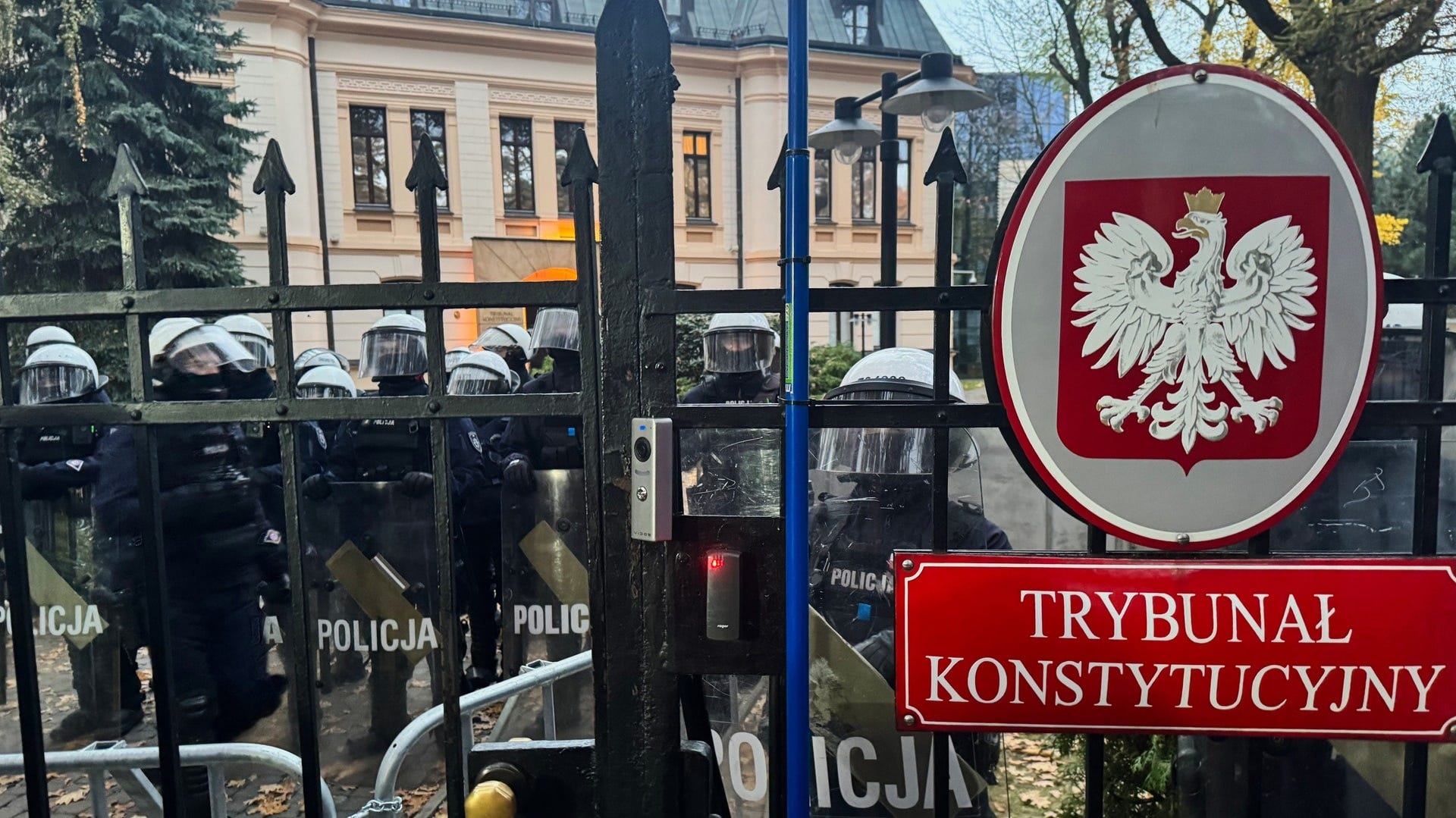
Poland’s prime minister, Donald Tusk, has vowed to see through a contested overhaul of the country’s constitutional court, declaring that “in certain matters, there can be no compromise”.
In a prime-time television address on Saturday night, Tusk was defiant, despite overnight protests that saw riot police drafted to protect the court’s building, saying the shake-up was vital to restore a tribunal crippled by years of political disputes.
Paralysed for more than a decade, the court sat at the core of rule of law clashes between the rightwing Law and Justice (PiS) party and the EU during the party’s eight-year rule.
Since returning to office in 2023, the centre-right Tusk has sought to unwind those judicial changes, but his agenda has been frustrated by opposition-aligned presidents with extensive veto powers. Earlier this year, president Karol Nawrocki refused to swear in five judges approved by parliament.
The crisis flared again on Friday when a group of government-backed judges attempted to seize procedural control of the tribunal, suspending the PiS-appointed chief judge and deputy and prompting street protests.
Earlier information about Święczkowski’s suspension was published on the court’s website, but that website went down around 6PM local time, leaving the reasons for the suspension itself somewhat unclear and unconfirmed by most media.
As anyone who has watched battles in the US Senate over Supreme Court nominees is surely aware, the composition of a nation’s top courts is invariably an eternal political football, with the governing and opposition parties forever jockeying for seats on that judicial bench.
In the past 24 hours or so, that jockeying between political parties in Warsaw has escalated to a new and constitutionally problematic level. Prime Minister Tusk surely has his reasons for seizing control of the Constitutional Tribunal in this fashion. What he does not have is clear constitutional authority to do so.
The standoff over the Constitutional Tribunal is a dispute that has been building for a number of years, beginning with a dispute in 2015 over the legality of judges appointed to the Tribunal by then newly-elected government helmed by Poland’s Law and Justice Party (PiS).
Since then, the question of which seats on the Tribunal were open and able to be filled by the Polish Sejm (the lower house in Poland’s legislature) has been a contentious and constantly litigated issue.
In 2024, Poland’s Supreme Court ruled that rulings by the Constitutional Tribunal where illegitimately appointed judges weighed in were likely not valid.
Article 194, paragraph 1 of Poland’s Constitution establishes the membership of the Constitutional Tribunal at 15 judges serving 9-year terms.
The Constitutional Tribunal shall be composed of 15 judges chosen individually by the Sejm for a term of office of 9 years from amongst persons distinguished by their knowledge of the law. No person may be chosen for more than one term of office.
Earlier this year, Poland’s President Nawrocki declined to swear in four of six judges chosen by the Sejm, citing concerns about the legality of their selection.
For its part, the Constitutional Tribunal itself decided to support Nawrocki’s decision, ruling that the President is not obligated to administer the oath of office to incoming judges—in effect establishing a Presidential veto over the selection process.
The European Court of Human Rights decided it should weigh in on the Polish judicial appointment process, finding for itself the authority to overrule Poland’s Constitutional Tribunal and Poland’s President, and ordered that the other four judges be sworn in.
That we are come to this juncture shows what Nawrocki thought of the ECHR’s order. Nawrocki’s chief of staff, Zbigniew Bogucki, bluntly rejected the ECHR involvement and the Tusk government’s position on the appointments, citing the Polish Constitution and arguing that only the Constitutional Tribunal had authority to rule in this matter.
“In Poland, the supreme law is the constitution,” said Bogucki, and “the TK is the only competent body to assess the compliance of given actions by the authorities, including in the area of jurisdictional disputes”.
After months of legal and political wrangling, Donald Tusk decided he had had enough, and when President Nawrocki left Poland on a trip to Senegal, he unilaterally suspended the President of the Tribunal, and sent police forces to take over the Constitutional Tribunal’s building.
Unsurprisingly, Nawrocki’s supporters denounced the effort as a “coup”, while Tusk supporters are defending the move as necessary, and Tusk himself framing his maneuvers as a defense of “democracy”.
Tusk said: “Let’s call things for what they are: for years, there have been organisations and politicians in Poland who seek to destroy democracy and the rule of law. It is no coincidence they find support among pro-Russian forces globally.”
He later highlighted that Russia’s former president Dmitry Medvedev had joined the opposition in an outcry over the changes, accusing Warsaw of “a constitutional coup” and “hounding the conservatives”. “And everything is clear,” Tusk said.
He also criticised opposition-aligned Nawrocki for joining the protests on Friday night and forcing his entry into the court’s building to intervene. “In a democratic state, no politician can enter a court to issue orders or intimidate judges – not even the president,” Tusk said. “We Poles have succeeded too well in building a strong state to surrender now.”
What Tusk cannot do is point to any authority given him as Prime Minister under Poland’s Constitution for the actions he has taken. Even if one concedes that Nawrocki’s refusal to swear in four of the six Sejm-selected judges is itself a violation of Poland’s Constitution, that same body of basic law does not empower Tusk to take the steps that he has. In place of support from the law, Tusk has support from loyal police elements and from the EU superstate bureaucracy.
Can Donald Tusk defend Polish democracy and constitutional governance by acting outside of the Polish Constitution? That seems unlikely. Recalling the history of Constitutional conflict here in the United States, the assessment of Chief Justice John Marshall in his historic 1803 Marbury v Madison ruling:
that an act of the legislature, repugnant to the constitution, is void
When government exceeds its brief as defined by the constitution, be that the United States Constitution or the Polish Constitution, it ceases to have operative authority and legitimacy. We certainly have seen instances here in the United States where court rulings as well as actions of government likely fell outside the scope of what the Constitution allows.
The question of Tusk’s legitimacy in these actions is complicated by the claims of illegitimacy and unconstitutionality against President Nawrocki and, perversely, the Constitutional Tribunal itself. If Tusk lacks the competence to do go beyond what the Polish Constitution allows him to do, then so does Nawrocki. Nawrocki may have already violated the Constitution itself by not swearing in four of the judges appointed by the Sejm.
If Donald Tusk is outside the lines by seizing control of the Constitutional Tribunal, is he mounting a coup against Poland’s Constitutional Tribunal? Potentially, he is.
Has Nawrocki, by not swearing in Sejm appointed judges, also stepped outside Constitutional boundaries? Potentially, he has. Potentially, Nawrocki had orchestrated a coup on the Constitutional Tribunal, an outcome no less problematic than Tusk’s seizure of authority beyond what the Polish Constitution says belongs to the Prime Minister
How this will ultimately end is, as of this writing, still an open question. However, we can see just from the rhetoric already being used by both sides that the one clear loser in this sordid debacle is the Polish Constitution itself.
There is no way to defend the rule of law by acting illegally, and there is no way to defend the primacy of a constitution by acting unconstitutionally. At present, both Donald Tusk and Karol Nawrocki are defending political positions. What neither is doing is defending Poland’s Constitution.
In a clip on X, I read today that Polish MEP Dominik Tarczyński said Donald Tusk was Liberal Left. My understanding is that they are trying to fight against have EU dictate their form of currency and also to force the opening of their the borders to "refugees".
I admit I'm confused by it all,
but your article is helpful in understanding that both the sides may very well have have crossed constitutional lines.
It reminds me a bit of J6 and the confusion that was immediately spun surrounding that day, with the press putting the blame on Trump and ignoring the fact that in the days leading up to the confirmation of the vote Trump had told Nancy Pelosi he would call in the National Guard as a precaution. And she said no. Both sides were complicit, imo.
I'd like to understand what's going on in Poland better than I (obviously) do now.