


Perhaps the most remarkable aspect of the impromptu summit between Ukrainian President Volodymyr Zelenskyy and President Trump was the lack of another Zelenskyy temper tantrum.
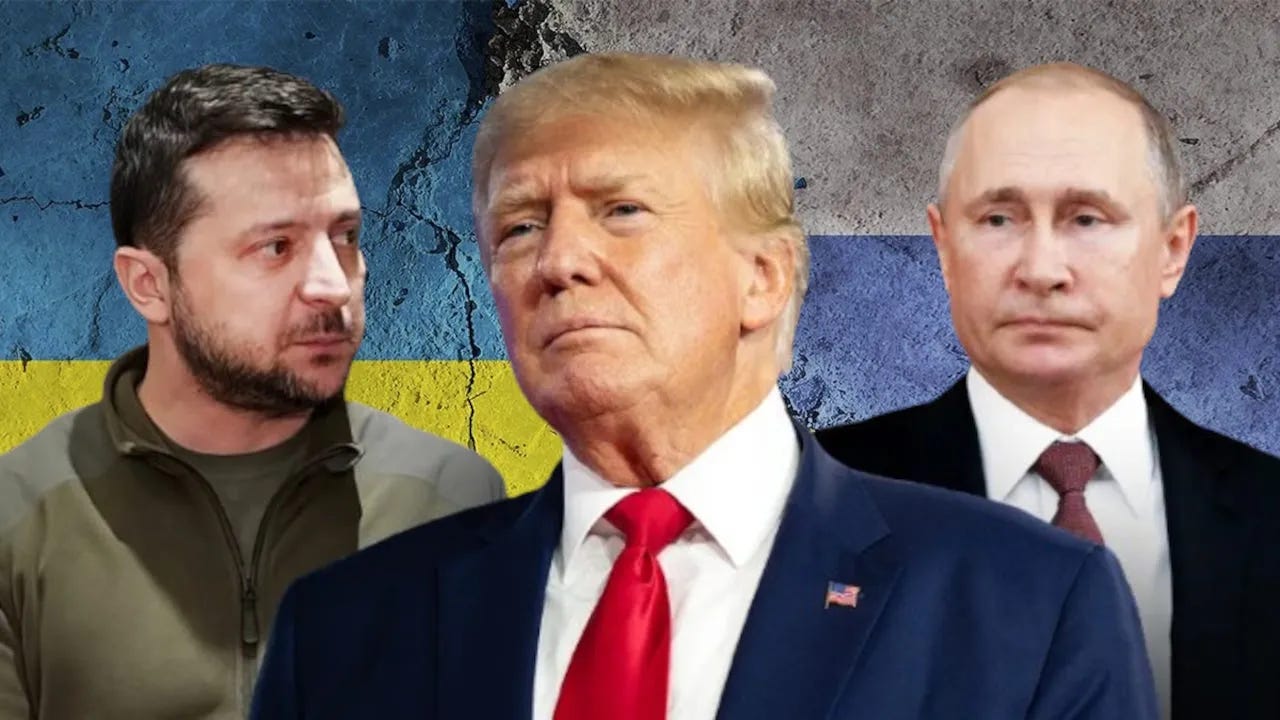
The last time Zelenskyy was in the Oval Office was February, when he received a verbal lashing from President Trump and Vice President JD Vance, who accused him of not being grateful enough for U.S. military assistance.
Monday's meeting was a much more cordial affair, with Trump and Zelenskyy sharing smiles and Zelenskyy thanking the president for his personal efforts to bring this conflict to a close.
Few are likely to forget the video footage of Zelenskyy pouting and huffing and puffing like a recalcitrant toddler because Donald Trump wasn’t saying what Zelenskyy wanted to hear.

Never has one person done so much to snatch certain defeat from the jaws of potential victory.
By all media accounts, today’s meeting as a more civil affair.
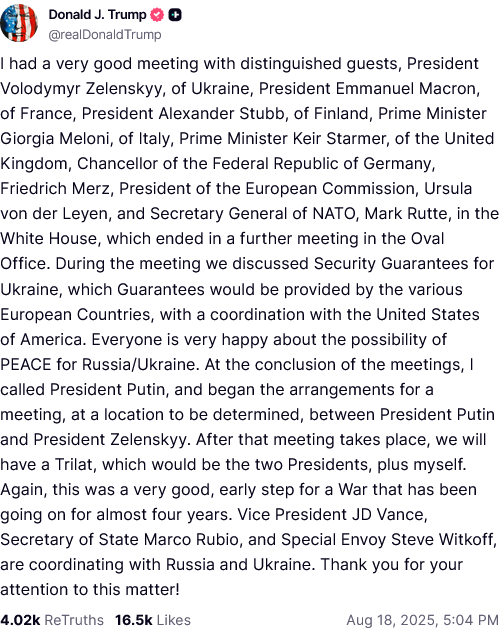
Certainly Donald Trump was pleased with how the meeting went.
Was there an actual peace breakthrough?
Possibly.
However, one pivotal question remains largely unanswered: will Zelenskyy and Ukraine agree to the territorial concessions sought by Putin? Corporate media has already sounded a skeptical note.
Zelenskiy has already all but rejected the outline of Putin's proposals from the Alaska meeting. Those include handing over the remaining quarter of its eastern Donetsk region, which is largely controlled by Russia. Ukrainian forces are deeply dug into the region, whose towns and hills serve as a crucial defensive zone to stymie Russian attacks.
Any concession of Ukrainian territory would have to be approved by a referendum.
We should note that the concession of the remainder of Donetsk would be in addition to Russia keeping the portions of Zaporizhzhia and Kherson it currently controls.
At face value, at least some of the demands would present huge challenges for Ukraine's leadership to accept.
Putin's offer ruled out a ceasefire until a comprehensive deal is reached, blocking a key demand of Zelenskiy, whose country is hit daily by Russian drones and ballistic missiles.
Under the proposed Russian deal, Kyiv would fully withdraw from the eastern Donetsk and Luhansk regions in return for a Russian pledge to freeze the front lines in the southern regions of Kherson and Zaporizhzhia, the sources said.
Ukraine has already rejected any retreat from Ukrainian land such as the Donetsk region, where its troops are dug in and which Kyiv says serves as a crucial defensive structure to prevent Russian attacks deeper into its territory.
Still, there is a perverse irony at play here. The quid pro quo for Ukraine to these territorial concessions would be strong security guarantees for Ukraine—something President Trump has signaled a willingness to provide.
"When it comes to security, there's going to be a lot of help," Trump told reporters, adding that European countries would be involved. "They are a first line of defence because they're there, but we'll help them out."
For context, we should recall Russia’s stance at the outset of this war, as articulated by Anatoly Antonov, Russian envoy to Washington, DC:
"Our principled position regarding the settlement of the conflict has been clearly defined," Antonov said, "including the demand for an unconditional consideration of Russia's security interests, the demilitarization and denazification of the Ukrainian state, ensuring its neutral and non-nuclear status as well as the recognition of Russian sovereignty over Crimea and the independence of the Donetsk and Lugansk People's Republics."
If there is a peace deal (key word remains “if”), Ukraine arguably has been effectively demilitarized by three-and-a-half years of war, but US and Europe security guarantees mean Ukraine’s neutrality is completely off the table. That much is evident from Trump’s leaving the door open to potentially stationing US forces in Ukraine at some point.
Asked specifically whether that meant American boots on the ground, Trump said: “I’ll let you know on that later today.”“We're meeting with seven great leaders of great countries also, and we'll be talking about that,” Trump said, referring to the European leaders who he met with after the Zelenskyy meeting.
Whether there are US forces in Ukraine, or EU forces, there is one overarching reality about the nature of a security guarantee for Ukraine: it will be provided by NATO forces.
The very thing which presumably concerned Putin the most—NATO forces directly on Russia’s border all along Russia’s border—is now a predicate for Putin to end the war he began when he invaded Ukraine.
If there is a peace deal, Putin might get the Donbass, Zaporizhzhia, and Kherson, but across the Dniepro will almost certainly be NATO troops. It seems unlikely that Finland and Sweden will reverse their decisions to join NATO reached after Putin invaded Ukraine, meaning that NATO will be able to maintain a military presence at or close to the Russian border from Murmansk in the north to Sevastopol in the south. The Baltic Sea is now a NATO lake, meaning NATO can shut down two of Russia’s main oil terminals (Primorsk and Ust-Luga) on extremely short notice. If Turkey closes the Dardanelles, the third, Novorossiysk, is likewise effectively shut down.
Russia’s pipelines are largely organized to feed those three ports—a strategic vulnerability that Russia will not be able to resolve for another decade at least (building new pipelines east across Siberia will not be a quick or easy project).

If there is a peace deal, Putin would keep Crimea—but restoring or replacing the water flow of the North Crimean Canal, which provided most of Crimea’s water for agriculture, as of last fall remains a challenging engineering obstacle in the aftermath of the destruction of the Kakhovka Dam on the Dniepro near Kherson. Whether the Black Sea Fleet would be able to return to its former base at Sevastopol from its current port at Novorossiysk is at best problematic. Without the water flow from the North Crimean Canal and the capacity to station the Black Sea Fleet at Sevastopol, the military and economic utility of Crimea to Russia is significantly diminished.
Russia is effectively encircled by NATO. The Baltic is now a NATO lake, with NATO countries in firm control of choke points controlling Russia’s oil terminals from which flow the bulk of Russia’s energy exports. Russia’s Black Sea Fleet is neutered, probably permanently.
Putin may acquire a bit of territory, but the price tag is certain to result in a weaker, more vulnerable, less defensible Russia.
And Zelenskyy wore a suit too. Excellent analysis of the situation.
It was significant that so many of Europe’s leaders made it their top priority to drop whatever was previously on their schedules and butt in to this meeting. What I haven’t yet heard is, what did they demand? What did they offer? Did any of them contribute something worthwhile to the negotiations? Were they just there for political posturing, or did any of them show true leadership by stepping up in a difficult situation? I ask because the future of Europe, and of NATO, depends upon having some people at the helm who are not just useless puppets. Peter, were you able to discern anything about this?