


The good news in the September Personal Income and Outlays report is we already knew what the bad news would be.
The bad news is that it is still bad news.
Consumer price inflation rose last month, and while most of the inflation is still concentrated in energy prices, core inflation rose for the third month in a row.
From the preceding month, the PCE price index for September increased 0.5 percent. Excluding food and energy, the PCE price index increased 0.3 percent.
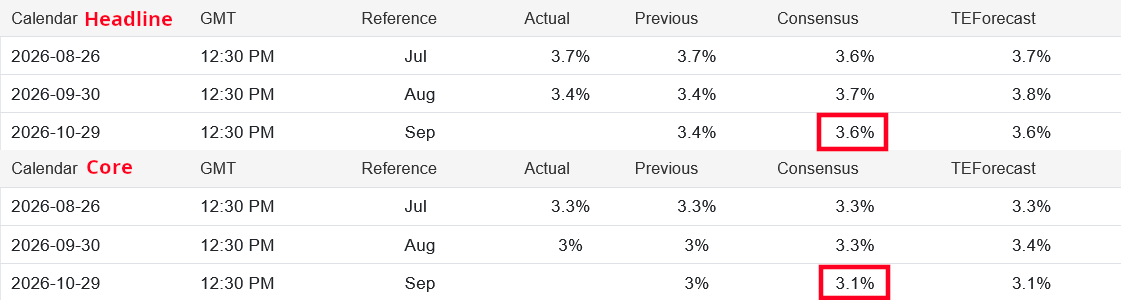
From the same month one year ago, the PCE price index for September increased 3.6 percent. Excluding food and energy, the PCE price index increased 3.1 percent from one year ago.
The PCE Price Index (PCEPI) numbers landed exactly where Wall Street projected they would.
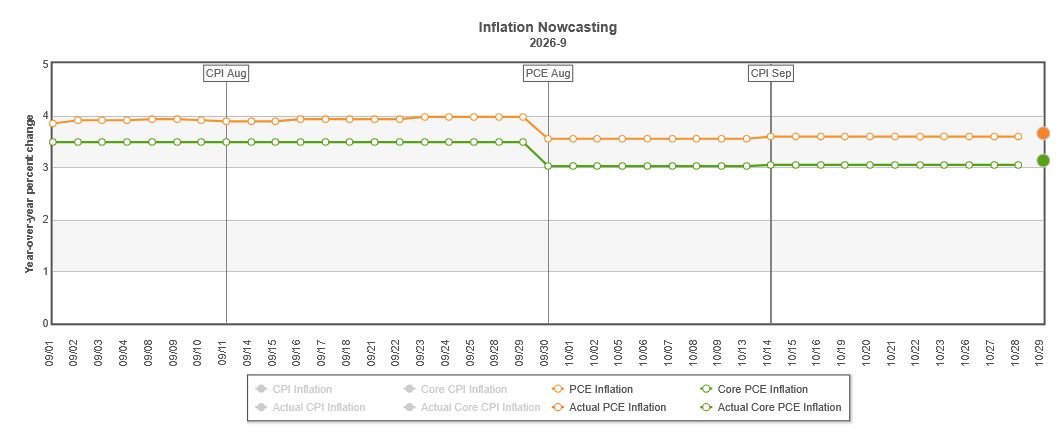
Even the Cleveland Fed’s inflation nowcast was not far off the mark.
There were very few surprises in the underlying inflation data—and that is good news. That consumer price inflation unfolded as expected in September is good evidence that we are not heading into a repeat of the 2022 hyperinflation cycle—at least, not yet.
With the prospects for peace with Iran or between Russia and Ukraine not looking terribly good, that we are not faced with destabilizing hyperinflation is unquestionably good news.
Can that last? Will we eventually face runaway inflation as happened in 2021 and especially 2022?
To say with any certainty that we will or will not presumes we have far more data about where inflation is headed than we do. The data we do have shows inflation rising along a predictable trajectory catalyzed primarily by energy prices and a global energy supply shock from the nexus of two seemingly endless attritional wars.
No Sugar Coating: Inflation Rose Significantly
There is no getting around the reality of the PCE inflation data: consumer price inflation heated up significantly in September. Headline inflation had been trending down in recent months, but in August and again in September that trend reversed.
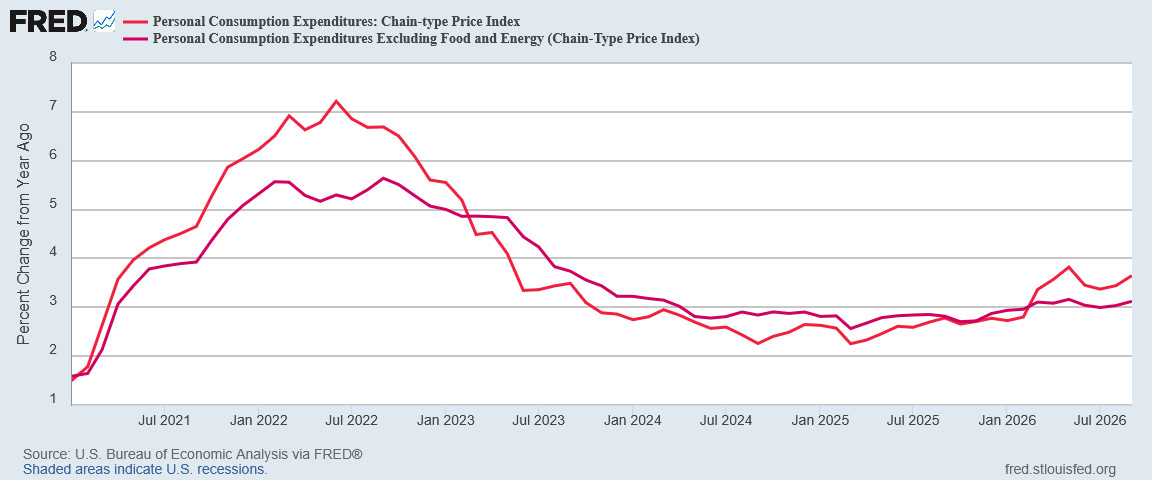
Month on month was just as bad, with core inflation rising for the third consecutive month.
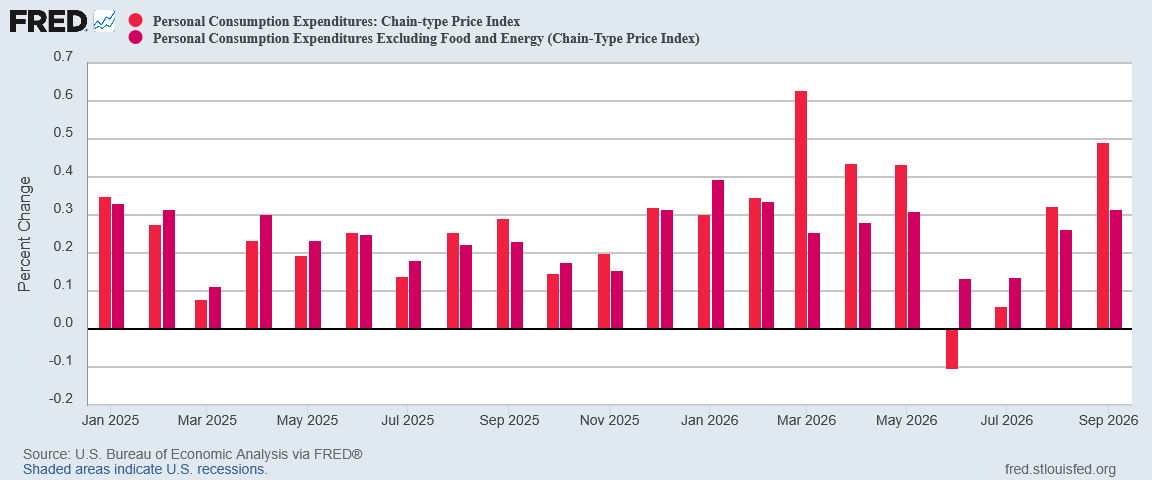
While rising inflation is never good news, even corporate media had to concede that it was expected news.
Thursday’s inflation data was in line with economists’ expectations and echoed the trends seen in the September Consumer Price Index and Producer Price Index reports, which showed inflation remaining stubbornly high because of a war-driven energy shock as well as other price pressures.
Hardly anyone is likely to have been caught off guard by the rise in consumer price inflation, and even the magnitude of that rise was anticipated.
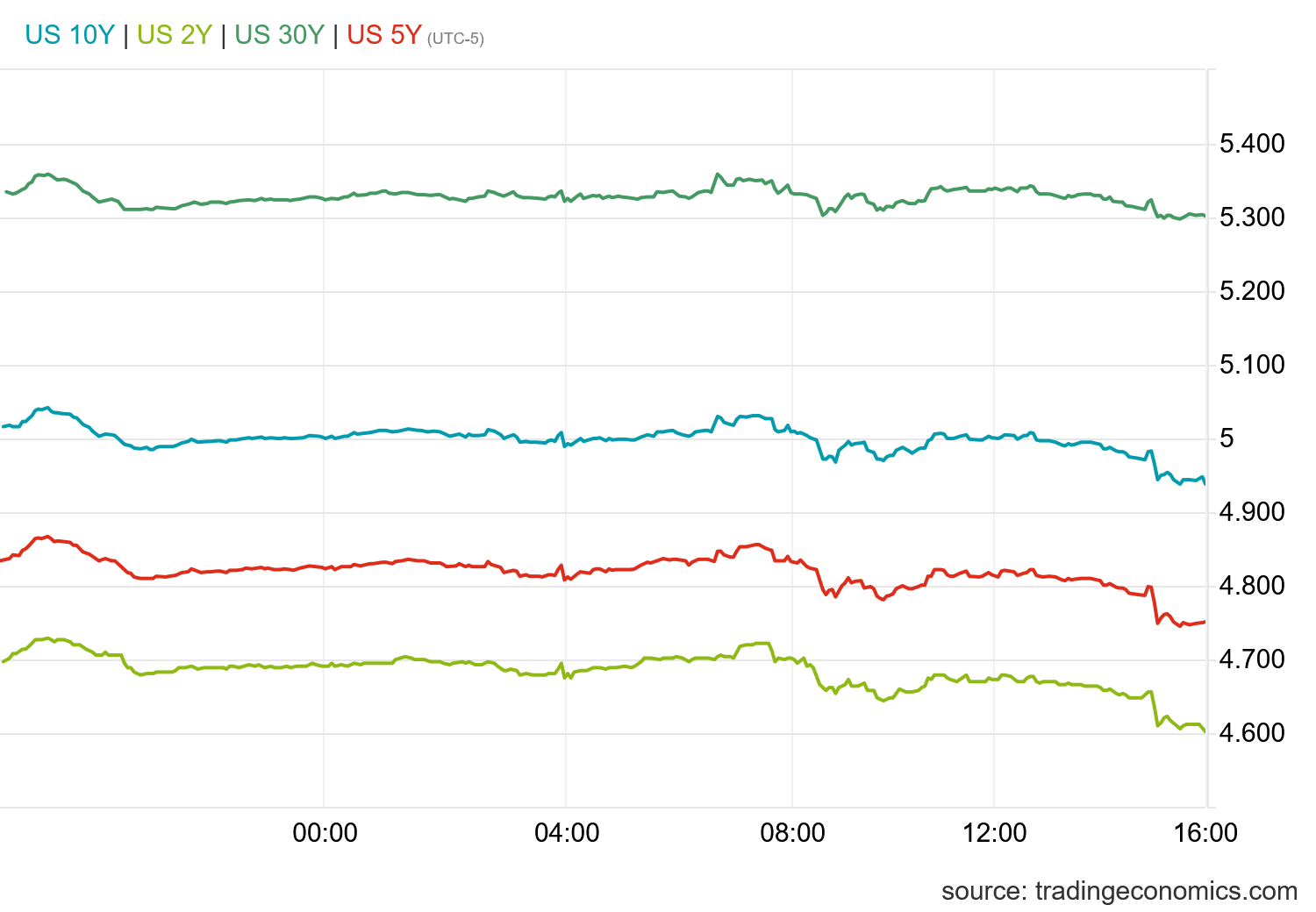
That lack of surprise goes a long way towards explaining Wall Street’s overall blase response to the inflation numbers, with Treasury yields moving down on the day across the entire yield curve.
Equities dropped to start the trading day yesterday, but after that initial plunge moved largely sideways.
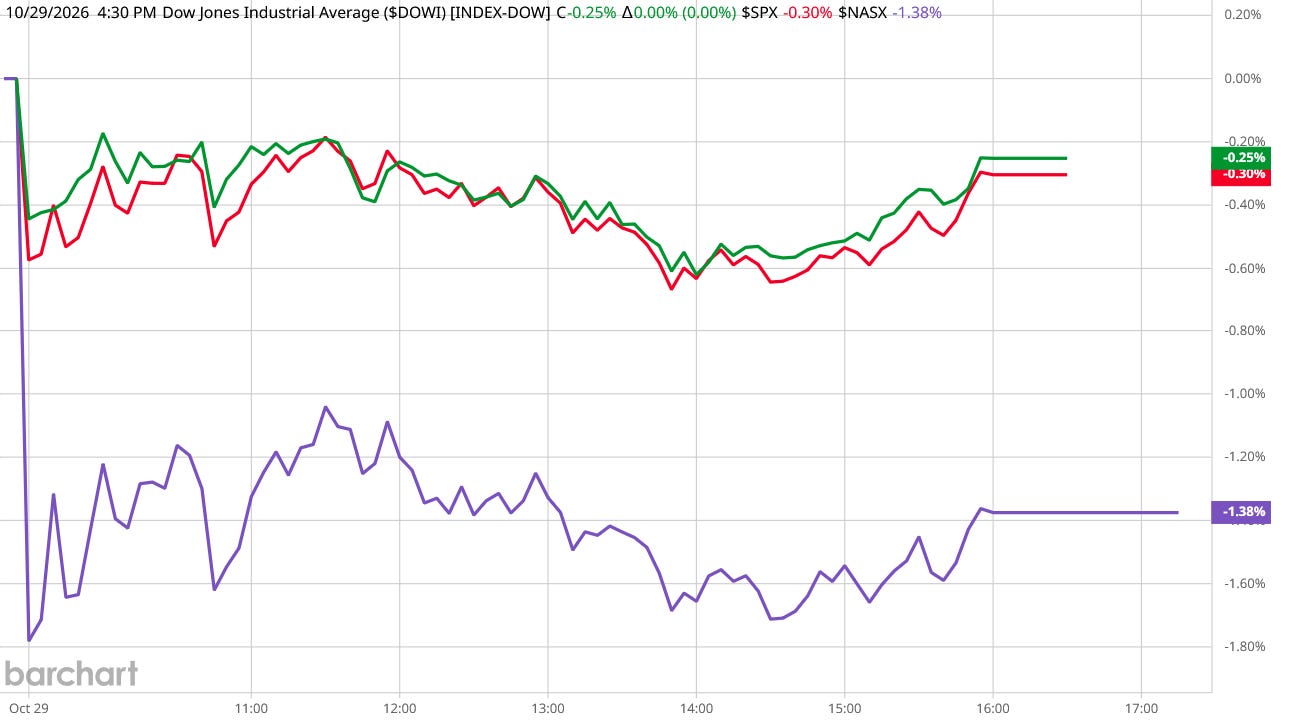
While Wall Street could hardly be said to have been upbeat about inflation, very little of what lies within the inflation report itself could be said to not have already been fully priced in by financial markets.
Everyone saw the report coming. No one is happy about the data, but no one is surprised by the data either.
Energy Price Inflation Is Still Driving The Rest Of The Index
As has been true all year, energy price inflation has been the driving force in the overall PCE Price Index rise.
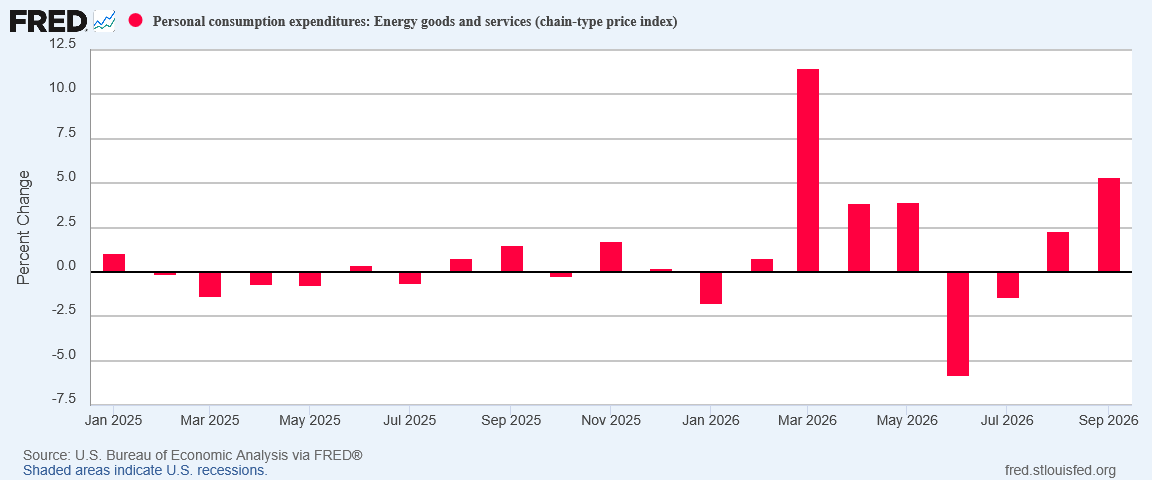
Energy prices are, readers will recall, part of what separates headline from core inflation for both the PCE Price Index and the Consumer Price Index. Yet energy prices are also captured within both nondurable goods and services, and it is immediately obvious the extent to which energy prices are the main contributor to inflation in both categories.
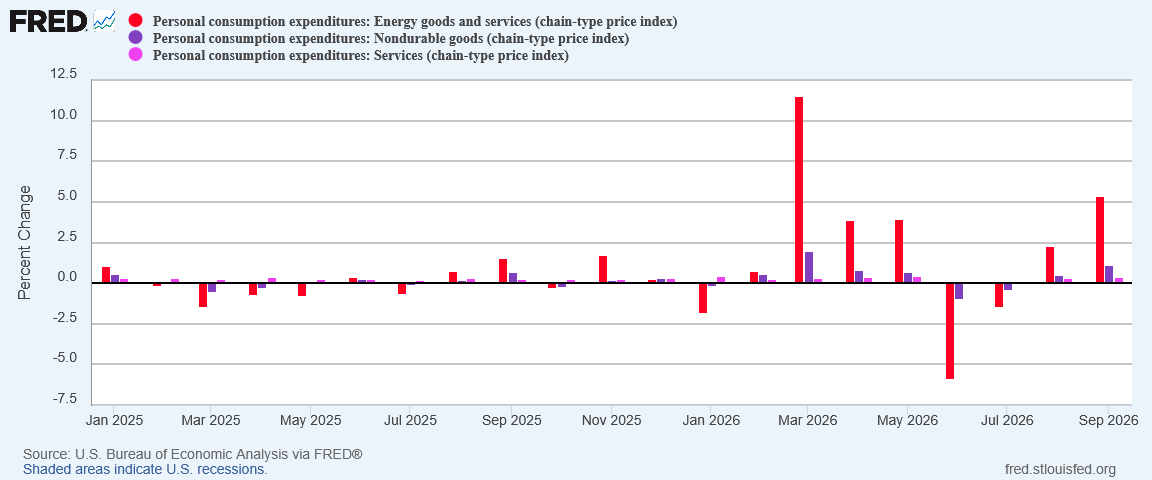
Outside of energy prices, overall inflation was still fairly muted. Food prices actually fell outright in September.
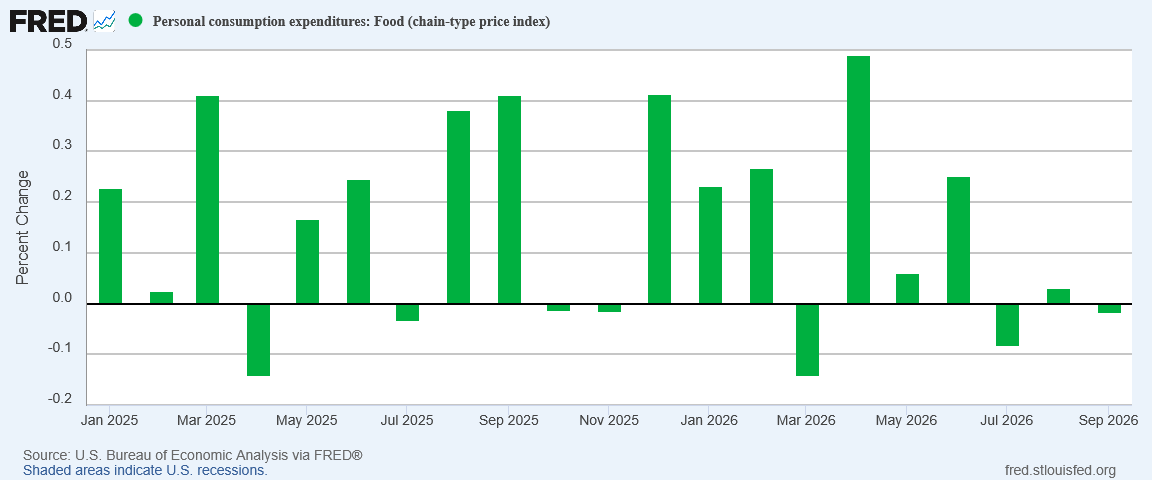
It was the third month of food price deflation in the PCEPI for 2026, and the seventh such month in the second Trump Administration.
Inflation within durable goods prices rose in September, but still printed at the fourth lowest month on month level for the year.
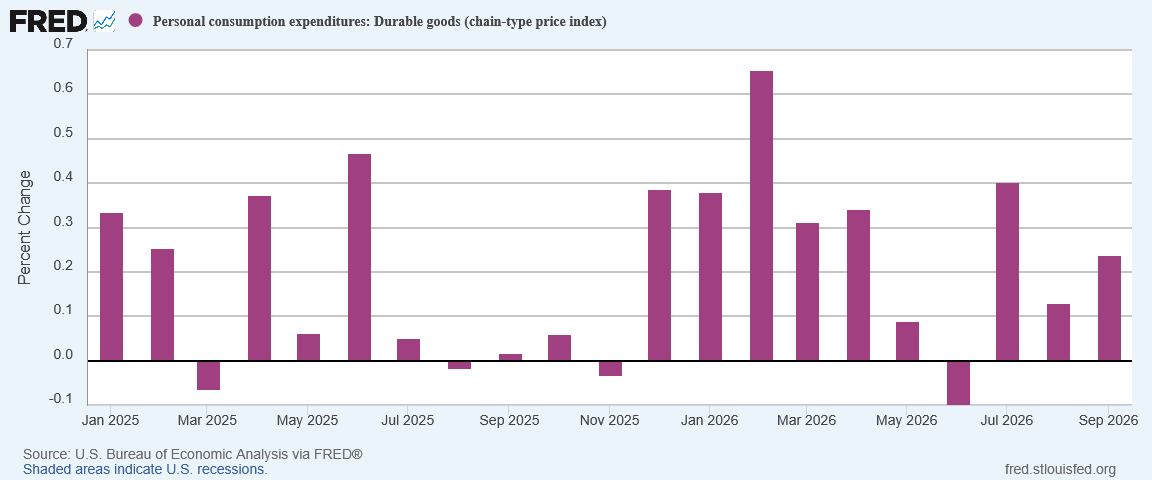
It is worth noting that durable goods prices had been experiencing elevated inflation even before the war with Iran and the energy supply shock emerging from the after-effects of Operation Epic Fury. Since the start of that war, and since the disruption of roughly 20% of the world’s oil supply, price inflation for durable goods has been relatively low.
Low does not mean nonexistent, however. September shows that there is price inflation within durable goods, but that inflation is, for now, being held in check.
A large part of what has held durable goods prices in check has been a measure of demand destruction for durable goods. This was evident in September, as real consumption spending on durable goods dropped significantly.
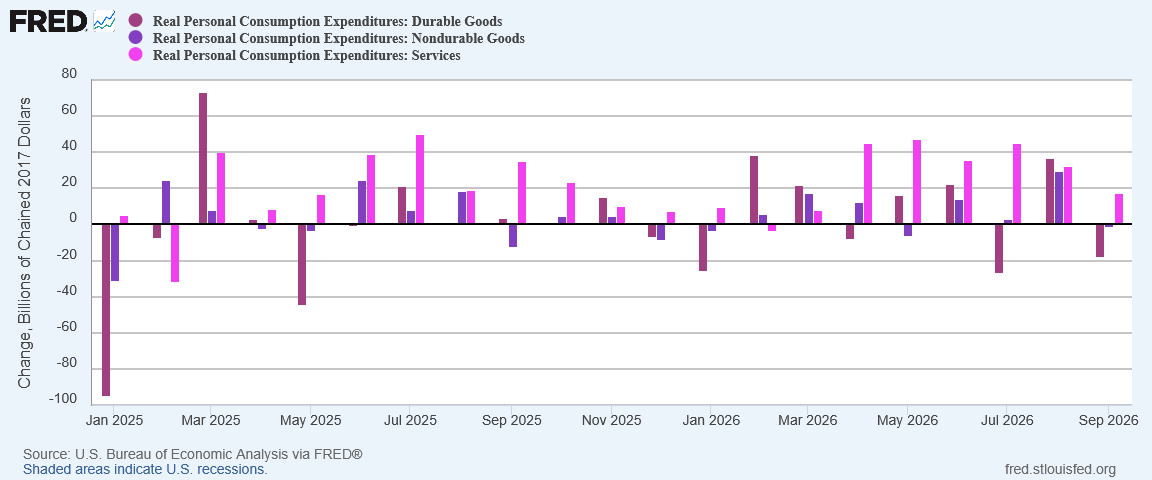
Even when inflation pressures are acting to push prices up, a lack of people buying will invariably pull prices back down again. That drop in durable goods consumption minimizes the true magnitude of inflation pressures within the durable goods category. The shift from rising durable goods consumption in August to falling durable goods consumption in September gives us an indication of the impact rising durable goods prices.
We are not seeing a tremendous amount of price inflation in durable goods, but we are seeing price inflation in durable goods, and it is holding back durable goods spending.
Lack Of Consumption Keeps Inflation From Being Worse
While there is a tendency to focus on the inflation numbers directly, prices also factor into consumption overall, not just for durable goods, and a lack of consumption is going to restrain price inflation across the board, not just in durable goods.
Lack of consumption is a key but easily overlooked aspect of the September inflation picture, as there was almost no growth in real personal consumption expenditures in September.
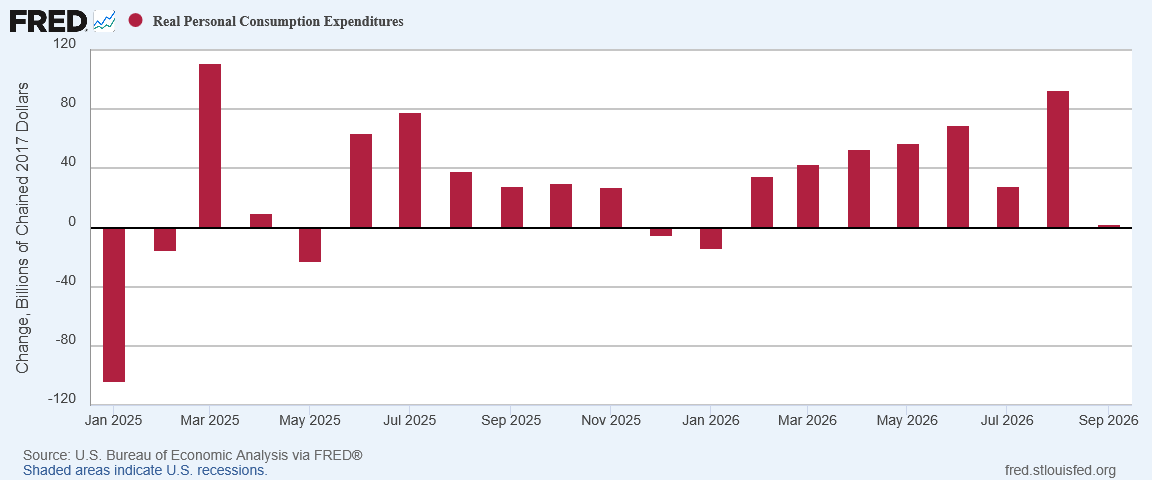
After rising throughout the year despite inflation, in September spending growth stopped cold.
We can reasonably project that September’s sharp drop in real disposable personal income contributed to the lack of consumption growth. When people have less money to spend, they are going to spend less money.
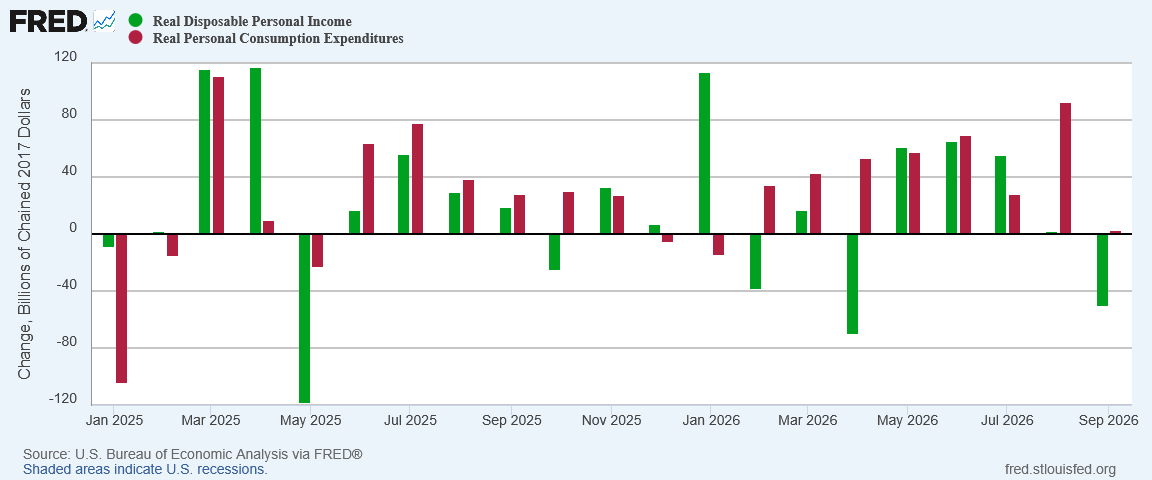
Between price pressures and lack of income growth, consumption got squeezed in September.
While everyone likely saw the rising inflation numbers coming on since the September Consumer Price Index Summary report a few weeks ago, resulting in a fairly muted market response to the PCEPI inflation data, knowing that inflation is happening does not undo the capacity of inflation to restrain consumption and thus inhibit real economic growth. Market awareness of inflation does nothing to counter the capacity of inflation to prevent consumption.
September is a case in point: excluding expenditures on food and energy, real personal consumption expenditures fell some $300 million in September.
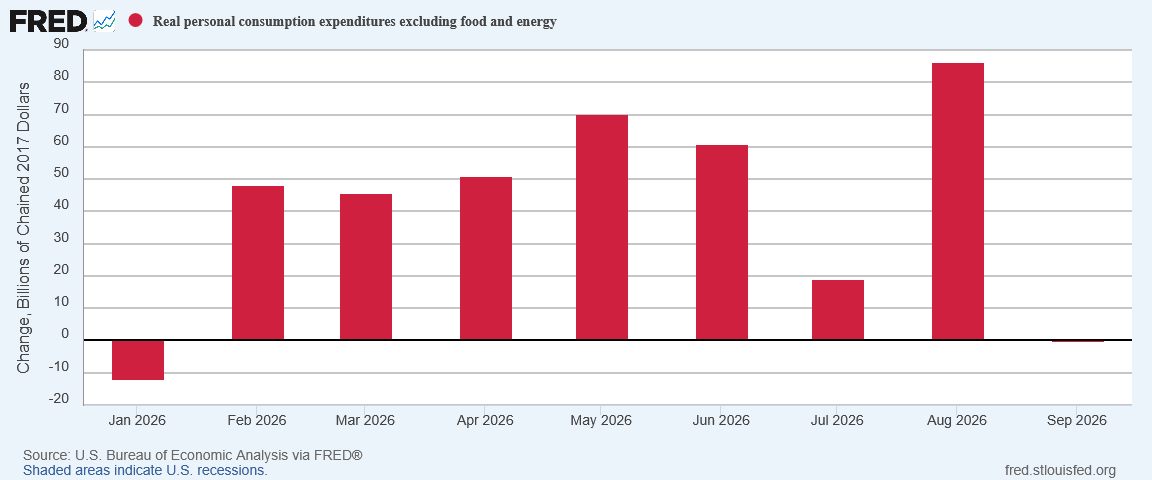
That lack of consumption almost certainly helped hold inflation in check in September, and may be why the Cleveland Fed’s inflation nowcast tracked a drop in the projection at the end of September for the monthly PCEPI print from near 4% for year on year headline inflation down to the 3.6% that was the final result for the month.
People spent less in September. Less spending slows inflation but it also slows economic growth.
Inflation Was Expected. Inflation Will Continue.
After the September Consumer Price Index report, there was little doubt regarding what the Personal Income and Outlays report would show for September inflation. Anyone who follows the monthly inflation numbers surely knew that was going to be a rise at both the headline and core levels, both month on month and year on year.
That is exactly what the report showed.
We expected inflation. We got inflation. We got rising inflation.
We also got demand destruction—and even with demand destruction we still got rising inflation.
The September Producer Price Index summary has already all but confirmed that October and November at least are sure to be months of rising inflation figures. That a drop in consumption outside of food and energy could not prevent consumer price inflation from heating up for the month is another signal that we are going to see still more inflation.
The October inflation prints are likely to be hotter than the September inflation prints. The increases perhaps will not be the runaway inflation increases that occurred in 2022’s hyperinflation cycle, but they will be increases nevertheless.
There were no real surprises in the September PCEPI inflation data. That inflation is unfolding as expected is something of a silver lining in the data, as it suggests inflation is not on a trajectory to greatly accelerate over the near term (short of a fresh oil supply shock coming either from the war with Iran or between Russia and Ukraine).
That does not change the reality that inflation is on a trajectory to accelerate somewhat over that same near term. Rising inflation is going to further constrain real personal income growth and real personal consumption. People are going to have less to spend and are going to spend less even as they pay more
The good news in the September PCE data is we knew what the inflation data was likely to be. The bad news is we still have that much inflation, and can look forward to still more.
“People spent less in September. Less spending slows inflation but it also slows economic growth.”
So now we need to watch the data on Holiday shopping. Are people just saving up for Christmas? We’ll see.
Useful framing that inflation landing where forecasts expected is itself reassuring compared with 2022. Core rising three months in a row, even with energy driving most of it, is worth watching closely.