


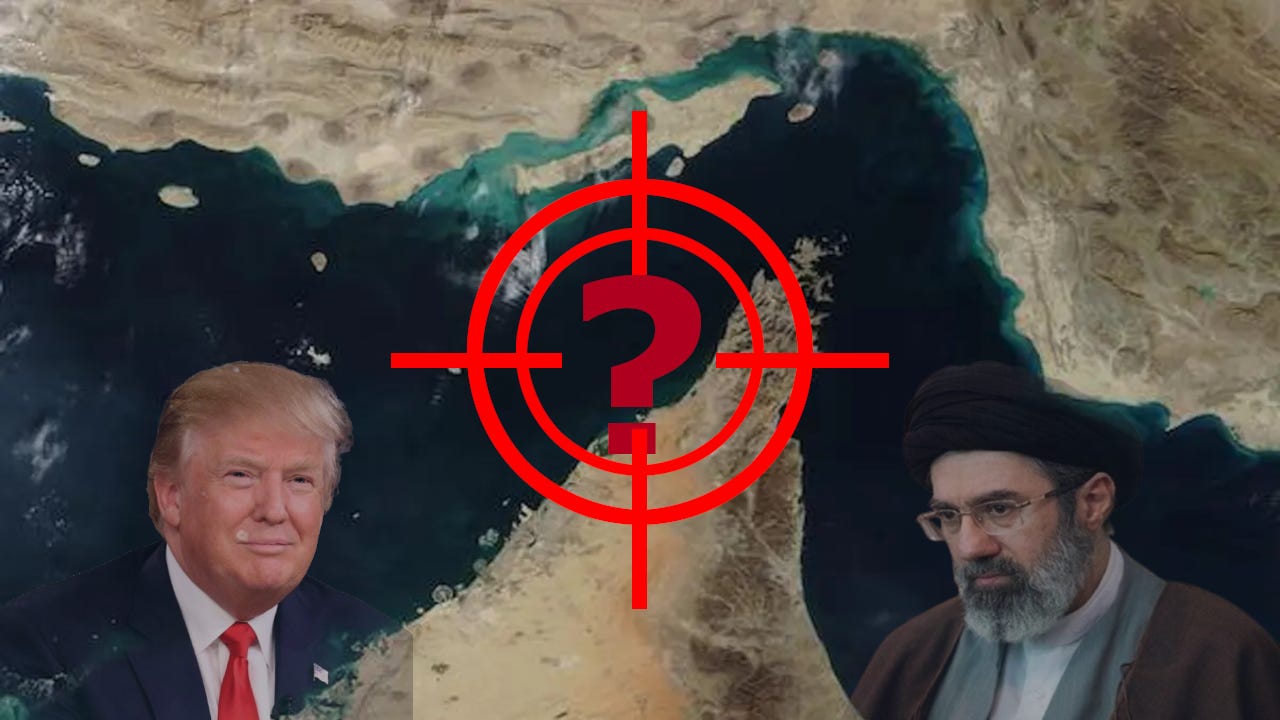
Iran has decided it really does not like the United Arab Emirates, which today was graced with yet another wave of missiles and drones.
The UAE's defense ministry said three cruise missiles coming from Iran were intercepted and a third fell into the sea, and told its citizens the loud booms heard inside the country were the result of those aerial interceptions.
Three Indian nationals were injured in the attacks, which were concentrated on the Fujairah Oil Industry Zone.
Separately, US Apache and SH-60 Seahawk helicopters engaged and destroyed several small Iranian craft in the Strait of Hormuz itself, as the IRGC launched cruise missile and drone attacks at ships within the Strait.
This was the first real escalation of hostilities by Iran since the US Navy began its blockade of Iranian shipping on April 13.
The attacks have been framed as a bold and assertive response by the IRGC to ongoing tensions in the Persian Gulf, but it may very well prove to have been an epic blunder, as the attacks revealed the extent to which allegiances and alliances in the Gulf have evolved.
IRGC Naturally Claimed Provocation
In what has become its expected pattern, the seeds for today’s attacks were apparently sown yesterday on Iranian state television, when broadcasters accused the UAE of participating in air strikes on the Iranian islands of Siri and Lavan.
Iranian media was apparently recycling a claim made at the beginning of April, that UAE Mirage-2000-9 jets were involved in a strike on the refinery on Lavan. Both the US and Israel claimed to have not been involved in a strike on Lavan, raising the possibility that the strike may have been the result of a regional actor.
That possibility was fueled in part by Iran’s apparent downing of a Chinese-made Wing Loong II drone, operated by either the UAE or Saudi Arabia, earlier that week. Neither Riyadh, Abu Dhabi, or Washington DC either confirmed or denied the loss of a drone, but there has been growing speculation that the two leading members of the Gulf Cooperation Council might be cooperating with the US against Iran to a greater degree than has been publicly disclosed.
Naturally, the UAE condemned Iran’s attack.
The United Arab Emirates has condemned in the strongest terms the renewed terrorist, unprovoked Iranian attacks targeting civilian sites and facilities in the country using missiles and drones, which resulted in the injury of three Indian nationals.
In a statement, the Ministry of Foreign Affairs (MoFA) affirmed that these attacks constitute a dangerous escalation, an unacceptable act of aggression, and a direct threat to the UAE’s security, stability, and territorial integrity, in violation of the principles of international law and the Charter of the United Nations.
The UAE emphasized that it will not tolerate any threat to its security and sovereignty under any circumstances, and that it reserves its full and legitimate right to respond to these unprovoked attacks in a manner that ensures the protection of its sovereignty, national security, territorial integrity, and the safety of its citizens, residents, and visitors, in accordance with international law.
The Ministry further underscored that targeting civilians and civilian infrastructure is unequivocally condemned and rejected under all legal and humanitarian norms, stressing the need to immediately halt these attacks and ensure full compliance with the cessation of all hostilities. The UAE holds Iran fully responsible for these unprovoked attacks and their repercussions.
Iran almost predictably stepped up its rhetoric against the UAE, warning the Emirates to to “take any unwise action” against the Khamenei regime.
“No official threat has so far been announced by the Emiratis,” the military source told Tasnim. “But if the Emiratis become a plaything of Israel and make a wrong move, they will learn a lesson they will never forget.”
“If the UAE takes any unwise action, all its interests will become targets for Iran, and no part of Emirati facilities will be safe,” the source added.
While it remains unclear if UAE fighter jets or drones have been involved in minor strikes against Iran, what is absolutely clear is that Iran views the UAE with greater hostility than it does even Israel, as the Emirates have been subjected to heavier missile and drone attacks than Israel.
Israel Promises To Help Defend The Emirates
Whatever Iran hopes to accomplish with its persistent attacks on the UAE, it very likely has made one major miscalculation: Israel has not been shy about coming to the UAE’s defense.
It has been previously reported that Israel has deployed its “Iron Dome” laser defense system to the assist the UAE with its air defenses.
That Israel was defending the UAE against Iranian attacks came to the fore once again as a result of today’s attacks.
Israel had secretly deployed an Iron Dome aerial defense system — and the soldiers to operate it — to the UAE at the beginning of the war with Iran, bolstering the Persian Gulf nation’s defenses. The deployment, first reported by Axios, was a clear sign of growing cooperation between Israel and the UAE.
Other aerial defense systems may also have been used to intercept the incoming Iranian projectiles. At least three missiles were intercepted, Emirati authorities said. It was not immediately clear how many were shot down by the Iron Dome system.
The attacks were also an opportunity for Israel to remind the world that the UAE had signed the Abraham Accords with Israel, and former Israeli Prime Minister Naftali Bennett made it clear that Israel would stand by its “strategic ally”.
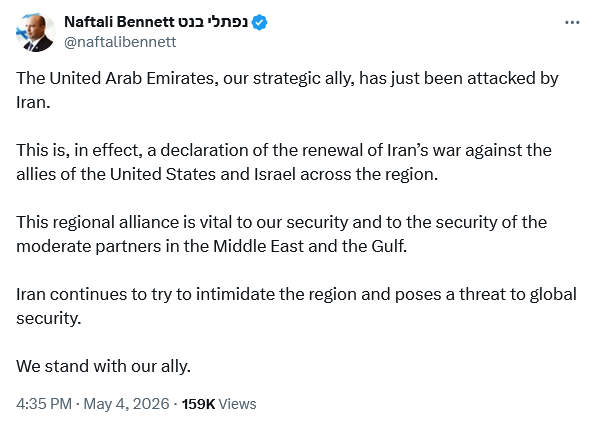
If Iran hoped to alienate the Arab states from both the US and Israel by subjecting them to attack, at least with the UAE it failed spectacularly. In a moment where the meaning, spirit, and substance of the Abraham Accords could have been called into question, Israel has made it clear there is no question: Israel means to honor the accords and come to the aid of the UAE.
Will this make other Arab states more likely to sign on to the Abraham Accords with Israel? It is far too soon to say with certainty that will be the case, but it is hard to envision the Abraham Accords not taking on a much more favorable light in Arab capitals after today.
Iran Tipped Its Hand—It Means To Control All Of Persian Gulf Oil
Iran may have revealed more than it intended about its overall ambitions in the Gulf with the UAE attack.
The Fujairah Oil Industry Zone is not just a major UAE oil refinery. It is also one of the few oil terminals in the region which lies outside the Strait of Hormuz.
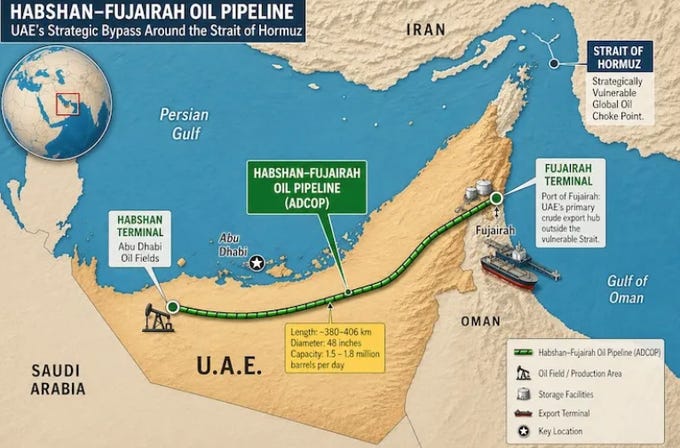
Iran attempted to disable one of the few alternatives to sending tankers through the Strait of Hormuz.
Even as Iran continues to push its claim of right to control traffic through the Strait—a claim which is completely rejected by the UN Convention on the Law of the Sea (UNCLOS)—Iran is separately attacking the infrastructures which Arab States might use to bypass the Strait and thus negate Iran’s diplomatic leverage of being able to deny Arab states in the Gulf the capacity to export their oil and natural gas.
If that is Iran’s intent, then the strikes on Fujairah are an unmistakable act of war. They are an aggressive demonstration of Iran on offense, not defense. That is not something that other Arab states, particularly Saudi Arabia, will have failed to notice.
It is not something any of the Arab states dare ignore, not if they wish to avoid bending the knee to Iran.
No US Or Israeli Retaliation…Yet
As of this writing, neither the US nor Israel has commenced any retaliatory strikes on Iran, although earlier unconfirmed reports were that strikes would be occurring within the next 24 hours.
Social media reporting was has also been rife with speculation that the UAE is prepared to declare war against Iran, although as of this writing no such declaration has been made.
Will there be retaliation? Will the UAE make a formal war declaration? At present these question are unanswerable.
Will President Trump choose to maintain the ceasefire instead? That question also is unanswerable.
Should the UAE actually declare war—or if it should end up participating in retaliatory air strikes alongside the US and especially Israel—Iran will have catalyzed a tectonic shift in the geopolitics of the Middle East.
The UAE has been a signatory to the Abraham Accords since 2020, as part of an extended diplomatic effort begun during the first Trump Administration to develop normalized relations between Israel and her Arab neighbors. Iran’s attacks have already created an opportunity for Israel to come to the defense of an Arab nation. We cannot rule out Israel and the UAE fighting side by side against Iran in at least a brief retaliation for the attack on Fujairah.
Given the long history of enmity between the Arab countries and Israel, for even one Arab state to become a military ally of Israel against a common adversary is an outcome that would have been considered unthinkable even just a few weeks ago. We are now at a juncture where that might be inevitable.
If an Arab-Israeli coalition against Iran does materialize, it is difficult to envision how the IRGC survives and remains in power.
The IRGC may have thought it was making a bold move and doing a little geopolitical flexing with its attack on the UAE. It is quite likely this attack will prove to be an epic blunder.
Tonight the ceasefire is holding. Tonight, the IRGC is still in charge in Tehran.
How long either of those statements remains true is anyone’s guess.
Attacking the UAE or any other gulf state is a huge strategic blunder by Iran.
Great writing, Peter - you’ve answered so many of my questions!
So now I’m pressing once again on your amazing analytical mind to speculate. What, in your opinion, should Trump do to ensure that America comes out on top as the hero? If he sits back and holds his share of the ceasefire, he risks losing control of the situation and having undesired outcomes - but his political opponents can’t attack him as a “warmonger”. If he steps in with full military fury, he makes America look like the strongest and best ally to have in the region - but American servicemen will die. There’s a whole slew of calculated risks and trade-offs to weigh. Your thoughts?