


Corporate media, alternative media, and much of social media is awash in reporting that a “deal” between the United States and Iran will be signed sometime today.
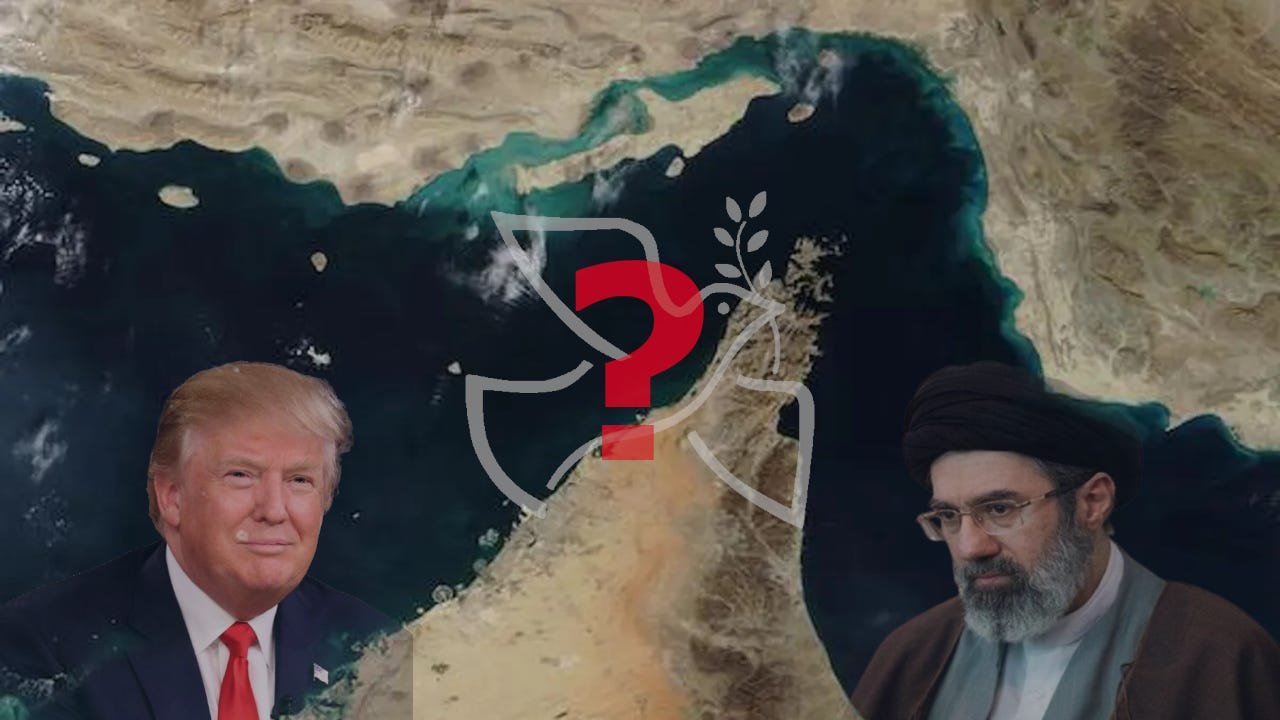
While there have been quite a bit of media fulminations about the deal, as well as what it may or may not say, what there has not been is a full and complete recitation of the deal’s text itself.
There appears to be a deal about to be reached. What that deal involves no one knows. We do not know to what the US and Iran are prepared to agree.
Media reporting is that a deal is about to be signed.
Will there be a deal signed today, or at all? The world wonders….
A Deal Will Be Done…Maybe
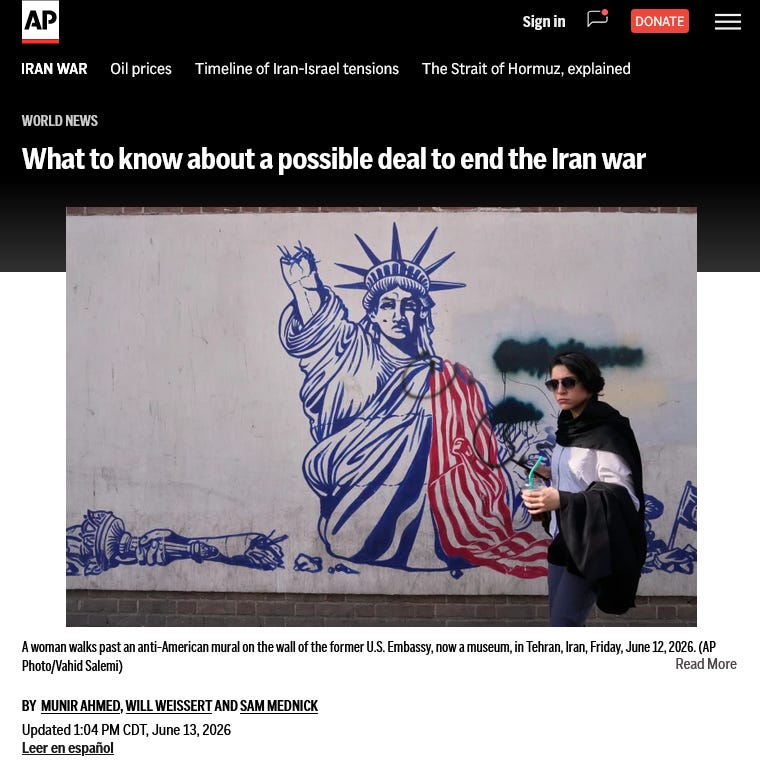
The headlines set the narrative quite plainly: the United States and Iran are on the cusp of a deal to end the war between them.
That is the thrust of the Associated Press’ reporting:
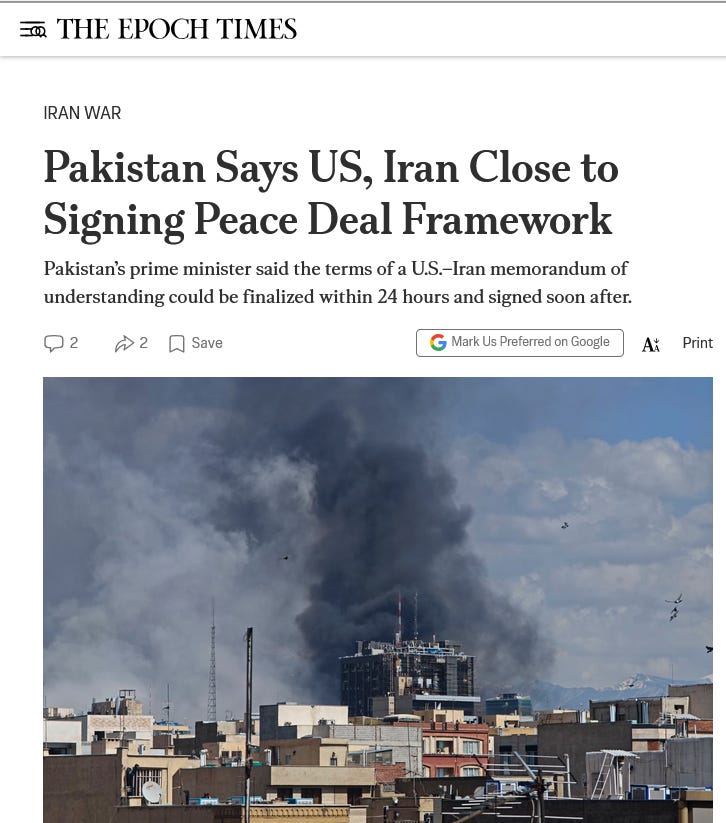
The Epoch Times’ reporting was similarly hopeful.
Even the principals were eager to weigh in, with Pakistan Prime Minister Shehbaz Sharif taking to X on Saturday to announce the imminent anticipated signing of a presumably historic peace deal.
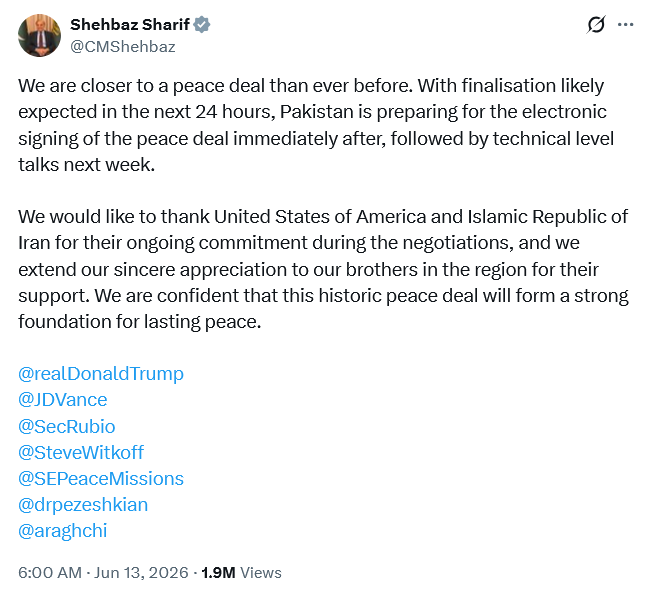
As of this writing, there has been no signing ceremony, and no deal has been officially reached.
Details Do Not Matter To The Commentariat
The lack of a deal, or even a publication of the official text being negotiated, has not stopped the commentariat from pontificating about the presumptive “deal”, and whether it is a good or bad deal.
One notable assertion presumably making the alleged deal good for the United States comes from corporate media’s favorite information source, the unnamed “senior US official.” The unnamed source has repeatedly assured reporters that Iran was agreeing to surrender its stockpile of enriched uranium.
A senior U.S. official on Friday said that under the deal, Iran’s highly enriched uranium will be destroyed and Tehran could make a long-term commitment not to procure a nuclear weapon.
The surrender of the enriched uranium would be a significant statement by Iran. While Iran has long said it was not seeking to develop nuclear weapons, they have openly admitted to possessing enough enriched uranium to produce as many as 11 nuclear weapons, based on comments reportedly made to US Special Envoy Steve Witkoff prior to the start of Operation Epic Fury.
The Iranian negotiators reportedly told Witkoff and US President Donald Trump’s son-in-law Jared Kushner “directly and with no shame” that they control 460kg. of 60% enriched uranium, and were aware that it could be quickly enriched to 90% in order to make nuclear bombs, Witkoff said.
The Iranians were proud that they had evaded all oversight protocols to achieve this, he added.
Listing out the situation, Witkoff reported that Iran possessed approximately 10,000kg. of fissionable uranium, which is broken down into roughly 460kg. of 60% enriched material, 1,000kg. of 20% enriched material, and the remainder at 3.67%.
Agreeing to surrender this stockpile or have it “downblended” to levels suitable for civilian purposes is a gesture of intent Iran has steadfastly refused previously.
That Iran has been enriching uranium to levels useful only in nuclear weapons manufacture has been a reported stated of affairs since at least 2021. Last year, during the Twelve Day War with Israel, Iran defended its enrichment program, claiming that it was not a violation of the Nuclear Non-Proliferation Treaty.
There was never a question of Iran possessing 60% enriched uranium, nor of Iran’s intent to enrich that stockpile further to 90%, the threshold level for turning fissile uranium into a nuclear weapon.
However, Iranian state news media has repeatedly published what it said were the 14 points in the “Memorandum of Understanding” being negotiated, which contained no such commitment to either surrender or downblend Iran’s store of enriched uranium. Rather, the Iranian draft of the MoU clearly punts that question into a negotiation cycle after this deal is signed and implemented.
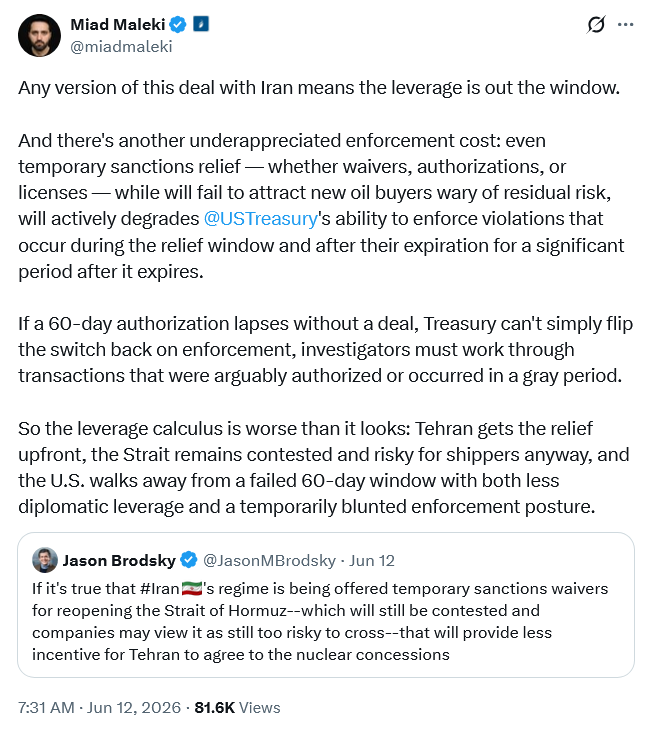
Another criticism of the deal (based on what Iranian state media has reported) has been the proposed removal of sanctions on Iran, with several critics asserting that even a temporary waiver would weaken the effect of sanctions and deny US negotiators future leverage.
Significantly, President Trump took to Truth Social to push back against that claim, and to rebut the rest of Iran’s reported text of the deal.
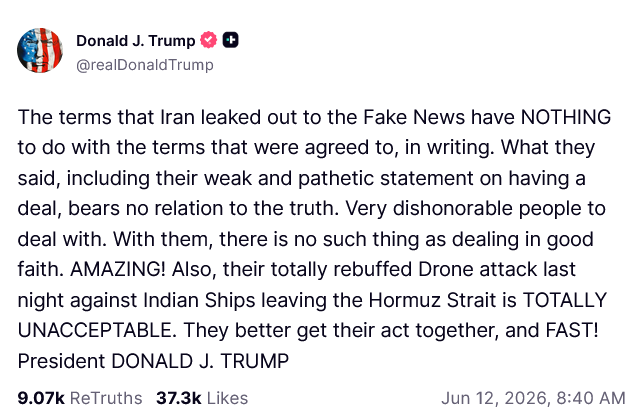
As of this writing, an official, verifiable text of the proposed Memorandum of Understanding still has not been released to the public, and so no member of the media has any actual knowledge of what the Memorandum says. No member of the media can render any informed opinion about the structure of the deal, or the obligations it imposes upon the United States and Iran.
This is not to say the deal is either good or bad. This is to say that, as of this writing, all of the media commentary the past few days about this latest “peace deal” is complete and total nonsense. There is no informed commentary to be had about the deal because there is no reliable information about the deal. For obvious reasons, assertions by the individual parties to the negotiations are not reliable information unless both sides are in agreement.
Will Iran Accept The Deal?
Even if a deal is nominally signed by representatives of the Khamenei regime, it is far from certain the deal will be accepted by the rest of the regime. Already there are reports of Iranian officials attempting to reassure the regime that a signed peace deal is not a craven act of surrender, even though the deal itself is highly flawed.
Meysam Zohourian, a member of parliament’s economic committee, said phrases such as “turning victory into defeat” or “turning Iran into a colony” were exaggerated and inaccurate, and did not match the current text despite its flaws.
That is not a statement one makes about an agreement that has broad domestic support. No matter what the actual text of the deal may say, we already have reason to doubt the Khamenei regime will be either able or willing to uphold its side.
There are reports of public protests in Iran against the deal, with Iranian women chanting threats against Iranian Foreign Minister Abbas Araghchi, one of the principal negotiators working on the Memorandum of Understanding.
In a video shared by Fars news agency, women in black chadors chanted “death to dishonorable Araghchi, the infiltrator” in front of the building, while waving red and black flags.
The protest comes as the peace deal touted by US President Donald Trump and mediator Pakistan faces opposition from hardline Iranian figures.
They argue that it does not serve Iran’s interests and would deprive Tehran of leverage over the Strait of Hormuz. They also accuse Iranian negotiators of having made too many concessions to secure the deal.
We should note that the Iranian people have no more reliable information about the actual text of the Memorandum than Americans. What they are protesting about the deal may or may not be actually in the deal.
Without speculating on the extent to which such protests are organic demonstrations by the Iranian people or staged events by the Khamenei regime, the reporting is still that there are demonstrations in Iran against the agreement by people who do not have access to any official text of the Memorandum.
Lately, Iranian state media has even been airing interviews casting a fair bit of shade on the Pakistani role in negotiations with the US, claiming Pakistan wasn’t mediating but rather delivering assassination threats.
That is not the sort of commentary Iranian state media wants to see if the objective is to build confidence in the deal when (if?) it is signed.
Regardless of the quality of the deal, if the Khamenei regime signs the deal it will be under a certain domestic pressure to convince the rest of Iran that the deal is a success for Iran. Authoritarian regimes rarely survive if they admit defeat in anything.
The Khamenei regime has to spin any deal it signs as a victory, and if it cannot do so it is unlikely the regime will want to sign such a deal. A deal which will be seen as a defeat will be a body blow to the regime.
We will have no insight into the Khamenei regime’s capacity to present whatever deal is being signed as a victory for the regime until we see the official text of the deal that is being signed. As of this writing, we do not have that text.
Israel-Hezbollah War A Threat? Or An Excuse?
Of course, the constant complication throughout the process of peace talks with Iran has been Israel’s war with Hezbollah. Iran has repeatedly connected peace talks with the United States and the fate of Hezbollah in Lebanon.
While Israel and the US have sought to separate Israel’s occupation of southern Lebanon from the wider US-Israeli war on Iran, Iran has consistently stated that it will not entertain a peace deal that does not extend to Lebanon as well.
The continued hostilities between Israel and Hezbollah have for weeks been at risk of proving to be a last-minute show-stopper derailing any substantive peace effort with Iran.
Even as President Trump was taking to Truth Social to boast about the deal’s imminent signing, Israel launched fresh attacks into Beirut against the terrorist militia.
The IDF said in a statement that it "precisely struck a Hezbollah infrastructure site in Dahieh, Beirut." The army later described the site as a command center "used by Hezbollah terrorists to advance terrorist attacks against the citizens of the State of Israel and IDF soldiers operating in southern Lebanon."
President Trump himself publicly expressed disappointment with Israel over the attack, and especially its timing.
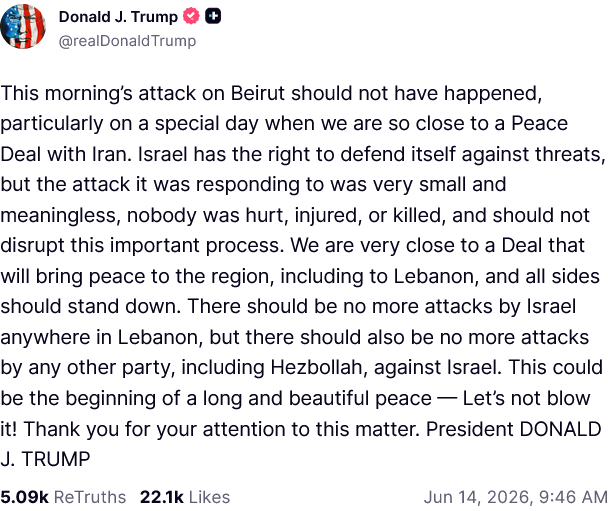
Despite the attack, the Trump Administration continues to project confidence that the deal will yet be signed, with Secretary of War Pete Hegseth taking a measured middle stance on Israel and Hezbollah, and the prospects of that conflict preventing a peace deal with Iran.
“From all I know, we are on track. It’s not a matter of if, it’s a matter of when,” Hegseth said on CBS News’ “Face the Nation.”
“We’re attuned to what’s happening with Hezbollah firing rockets into northern Israel, which they need to stop doing, and Iran needs to encourage them to stop doing that in very adamant ways,” he said.
Hegseth said Israel was “very measured in its response,” adding that it understood “we’re on the verge of a deal.”
“I don’t expect that to disrupt,” he said. “If Iran wants this to hold, they need to pull back Hezbollah, no doubt.”
The rhetoric coming from Iran’s military command, however, is not nearly as optimistic, with the military vowing retaliation for the latest Israeli attack on Hezbollah.
“The sacred ideal of the liberation of Jerusalem and revenge for the blood of Ali Khamenei will never be forgotten,” Abdollahi said.
He added that Iran was waiting for the “smallest mistake” from the enemy to “teach them an unforgettable lesson.”
One clear take-away from Iranian rhetoric is that Iran’s military is at least claiming to be at the same readiness level as US forces in the region. Neither side indicates they are willing to show forbearance on even the slightest provocation.
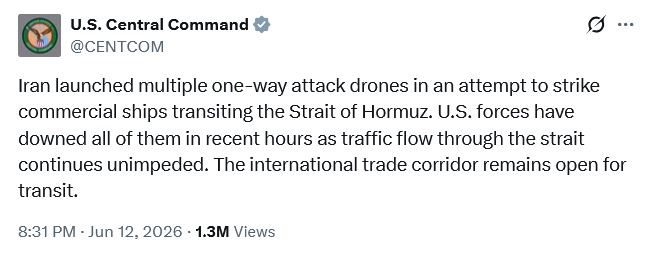
We see evidence of this in Saturday’s reported Iranian drone attacks on shipping in the Strait of Hormuz, with US Central Command reporting to have swatted them all down.
Last week the US and Iran exchanged a series of significant strikes after an Iranian drone collided with and downed an Apache attack helicopter.
Rabobank’s Ban van Geffen, writing in ZeroHedge, speculated last week that the tenuous ceasefire between the US and Iran, which has more or less held since April 13, was on the verge of breaking down and ending completely.
The US and Iran are still at odds over the frozen Iranian assets, which Iran wants released as part of any deal. But, yesterday, President Trump said that he will not unfreeze any amount of Iranian assets, nor lift sanctions, immediately after a deal is closed: “If they behave, if they do a good job, we start talking” about unfreezing these assets, he said.
And, if it is up to the US Treasury, there may be few assets left by the time Trump is willing to talk. The Financial Times reports that Treasury Secretary Bessent is considering using the Iranian assets to pay for the rebuilding of Gulf countries that were hit by Iranian attacks. So, we’ve now moved from “the US and Gulf countries help with the reconstruction of Iran” to “Iran pays to rebuild the Gulf countries.”
On top of that, new attacks put further pressure on the negotiations, and on the fragile ceasefire that was tacitly extended while negotiations are ongoing. US Central Command reported it took down two Iranian drones that threatened marine traffic near Hormuz, after Iran also fired missiles at Kuwait on Wednesday and at Bahrain on Friday. The US, meanwhile, has struck Iranian radar and surveillance sites.
Fighting between Israel and Hezbollah is also still ongoing. Defence Minister Katz said the country’s air force had launched a strike on a command center in one of Beirut’s suburbs, in response to Hezbollah’s continuing attacks on Israel.
For all the assurances from the Trump Administration that this deal will be signed, there are still multiple forces in play which have the potential to at least delay, if not completely derail, the signing of the Memorandum of Understanding.
No Deal—Yet
As of this writing, the Memorandum of Understanding has not been signed by either side.
As of this writing, the text of the Memorandum of Understanding has not been released.
As of this writing, the odds are excellent that by the time I finish publishing this article the deal will have been signed, rendering everything said here moot.
Will there be a peace deal between the US and Iran? President Trump says yes, and says it will happen today.
Is President Trump right? The world wonders…and waits.
We ARE wondering and waiting! As you have noted, Peter, there are all of these bothersome drone attacks, Hezbollah attacks, Israeli attacks, ad infinitum, to mess up the progress.
Then there are the personal aspects. It’s Trump’s 80th birthday today, and Flag Day, so he is likely itching for a triumph to celebrate on his personal milestone day. Meanwhile, leaders within the IRGC see an opportunity to snub him, denying Trump his happy birthday. And financially? Oh, you gotta bet that those IRGC people are not going to agree to anything that takes money out of their own pockets.
I’m not optimistic. I’m hoping that Trump has some more good cards to play, within the next few hours. He does have a winning history of finalizing the Deal!
Any agreement that doesn't end in the United States taking physical possession of the nuclear material, isn't worth the paper it's written on. When have assurances from the Iranian regime been anything but expedient lies advanced to allow them to continue doing what they want?
Previously, attempts to perform agreed upon inspections have been denied outright. The US response being little more than an, "Oh well - here, have some more money.'
Trump misjudged how quickly Iran could be brought to heel. Now, he's up against midterm elections, and he's in a panic to declare victory and move on.
As for Israel, there is no agreement that is going to ever prevent them from hammering Hezbollah, or any other Iranian proxy state that attacks them.