


Early this morning (daytime in Iran), the United States and Israel launched coordinated air strikes against a variety of targets inside Iran, with the explicit goal of weakening the ruling Khamenei regime enough to allow the dissident population to rise up and topple the government.
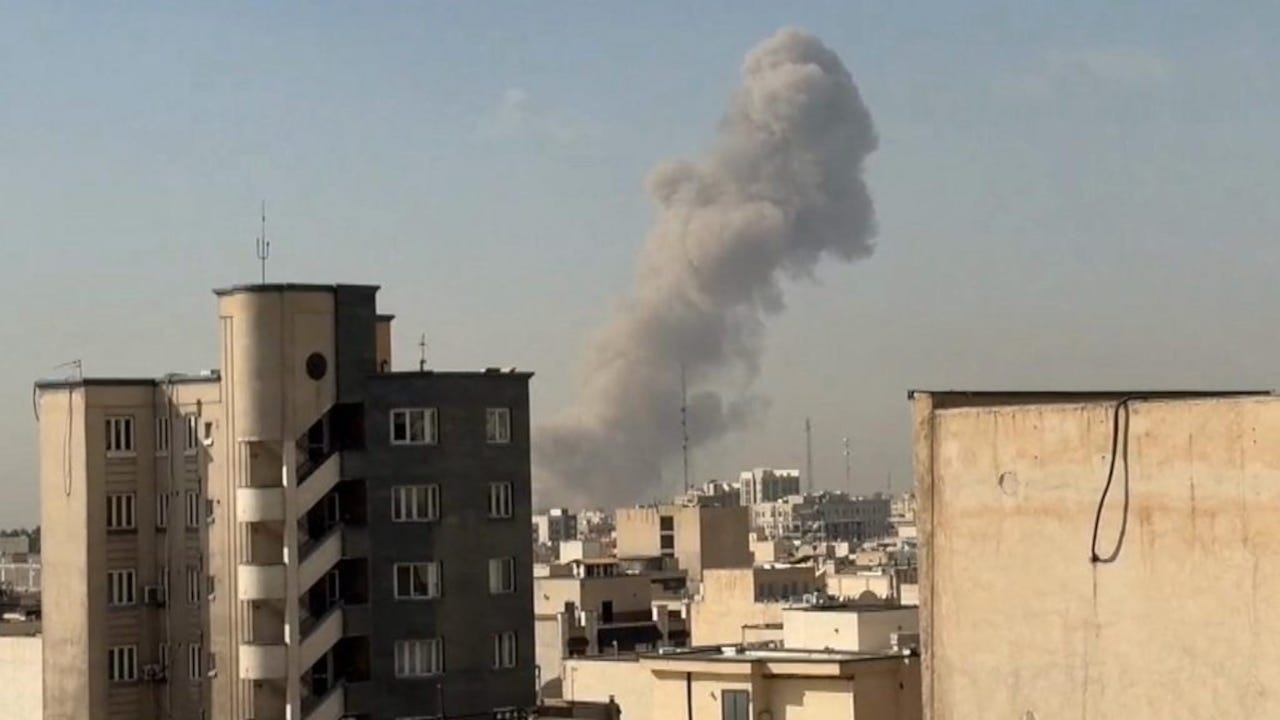

Tonight has been a night when literal decades are happening. What the geopolitical landscape of the Middle East will be even just a few hours from now will be radically altered from what it was just yesterday. More than that cannot be said, not even if this will prove to be a blessing or a curse for the Iranian people, for the Middle East, or for the United States and Israel.
These attacks were only a tactical surprise, as the world has known for quite some time that the US was likely to launch a fresh round of aerial bombardments of Iran. This included Iran, which lost no time in retaliating against Israel.
Information is still developing, which means that much of what has been reported already may not actually be what is occurring within Iran. Still, over the past few hours some significant data points have emerged.
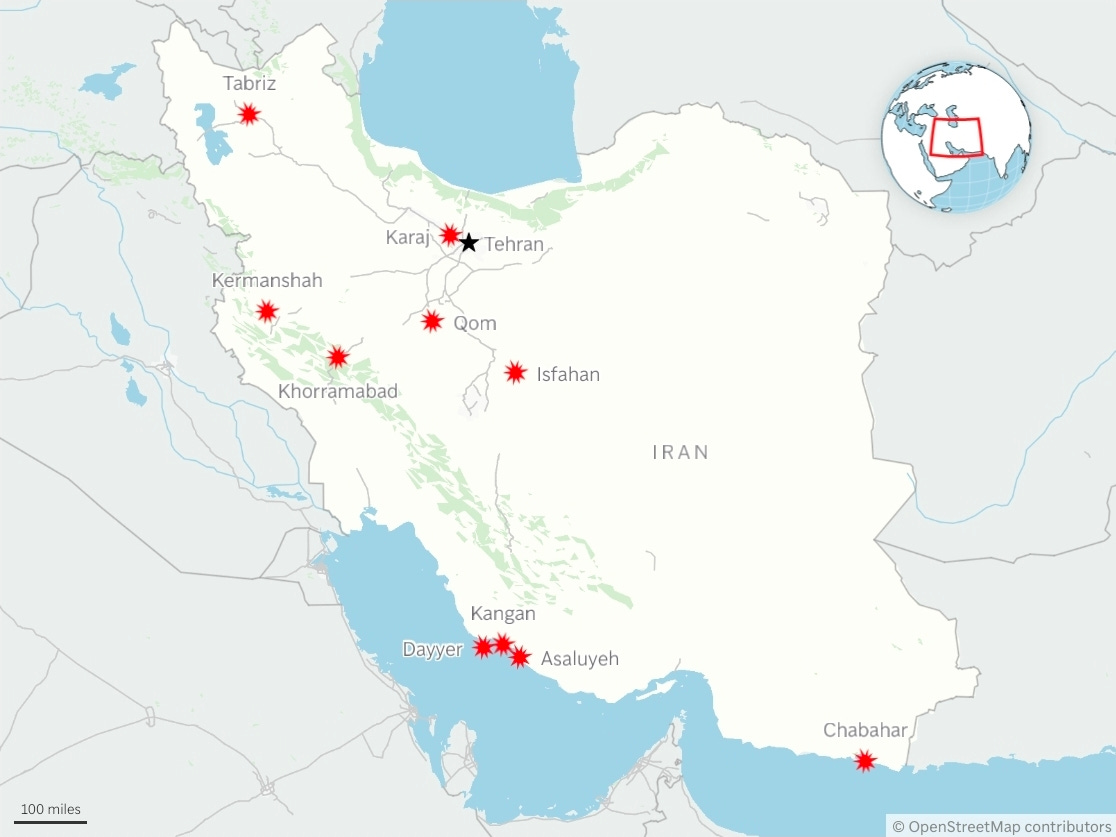
The US and Israeli air strikes cover nearly the whole western half of the country, and have done so with apparent ease and impunity.
While the usual cadre of security “experts” engage in ritual pearl clutching over Iranian military strengths, it remains unclear how much actual military strength Iran actually possesses.
Within hours of the joint U.S. and Israeli strike on Iran, Ali Vaez, who directs the Iran Project at the International Crisis Group, warned that the war could likely escalate.
Vaez on social media stressed that Iran had been preparing for the conflict and that wider war could break out across the Middle East.
As I remarked in the overnight period:
Iran has launched multiple missile attacks across the Middle East, the succes of which remains mostly unclear.
Iran has not been able to defend Iranian airspace or Iranian cities.
In war preparations, defense of the realm is usually a primary concern.
Iran can launch missiles, but it seems to have few military options beyond that, based on their response thus far.
Iran appears to have been relatively indiscriminate with their missile strikes, with a number of Persian Gulf states such as Qatar on the receiving end. For its part, Saudi Arabia has confirmed it was among the Arab states attacked by Iran, and that it successfully defended itself against the Iranian missiles.
Europe appears to be its usual feckless dysfunctional self. Even though European leaders such as Germany’s Friederich Merz were read in to some degree on at least the Israeli portion of the strike plan, European Commission Ursula von der Leyen called for all sides to exercise “maximum restraint” and “fully respect international law.”
This morning, Europe’s political leaders, including Merz, called on Iran to return to the negotiating table and seek a negotiated peace. Given Iran’s strong rhetoric up until now, it is difficult to see how the Khamenei regime can return to the negotiating table under these circumstances without it looking like abject surrender.
I do not see Iran bending the knee to the US, to Israel, nor to anyone else, certainly not right away.
As I remarked to one my regular subscribers, we are very much in the early stages of this operation.
How this plays out will be interesting to watch. Ever since the protests began in Iran at the end of 2025 there have been calls for the United States to act.
The United States has acted.
As a geopolitical flex this surpasses by far the Maduro operation in Venezuela.
That countries such as Germany were apparently read in is a curious twist. Even the “Gang of Eight” in Congress received some briefings a few days ago, which is a different approach than for Venezuela.
The full consequences and ramifications are a long way from being either known or knowable.
One interesting development actually occurred a few days ago, during a House Oversight Committee hearing, when the head of the National Endowment for Democracy casually let slip that his agency had smuggled thousands of Starlink internet terminals into Iran in recent months.
Damon Wilson, the head of the National Endowment for Democracy (NED), was interrupted by a member of Congress during a House oversight hearing on February 24 after revealing that his agency “began supporting the deployment [and] operation of about 200 Starlinks early on” amid the violence which swept through Iran last month.
Before he could finish the sentence, he was cut off by the ranking member of the House Subcommittee on State, Foreign Operations, and Related Programs, Rep. Lois Frankel, who told Wilson: “You know what, I’m going to interrupt you – we’d better not talk about it.”
Roughly two weeks prior, it was reported by the Wall Street Journal and picked up by other outlets that some 6,000 terminals had been smuggled into Iran by the US State Department.
The US sent around 6,000 terminals to Iran in an unprecedented, direct attempt to deliver internet freedom to regime-stifled protestors, according to officials cited by the outlet.
The majority of the US State Department’s purchase of almost 7,000 terminals was made in January, utilizing funds diverted from similar “internet-freedom initiatives,” to “help anti-regime activists circumvent internet shut-offs in Iran,” officials told WSJ.
Has the United States been laying groundwork for an Iranian insurgent effort to topple the regime in the aftermath of a major attack? We are presented with apparently corroborated evidence arguing that it has, which means the preparations for this attack have been ongoing for quite some time, longer than most of the US military assets deployed to the Middle East recently have been on station.
As with Operation Midnight Hammer during Israel’s Twelve Day War last summer, we are left to ponder if the talks with Iran over its nuclear ambitions were merely window dressing, a way for Trump to “run out the clock” while all elements of a regime change operation were put in place.
With reports of Iranian missile strikes still coming in, and social media is picking up multiple video clips and photos showing the extent of damage in both Iran and Israel, this story is still very much a developing story. Conclusions of any specificity are obviously premature.
Will the Khamenei regime survive this obvious attempt at regime change by the United States and Israel? It may, although with the December protests still a fairly recent memory, the Iranian people have ample reasons to rise up and effect regime change on their own.
The US and Israeli air strikes may yet give the Iranians space to act on those reasons and end the Khamenei regime.
My questions revolve around how a new regime could actually come into power, who would steer it from the inside, what would the structure look like, how it would deal with the remaining aspects of the current regime, such as the IRGC, and how it would change the posture in the region towards Israel. Can this state be hoisted into the modern world?
Watching Trump’s State of the Union address I thought, okay, now he’s going to turn his attention to Iran, as that’s next on his busy agenda. Couple of days went by, I turned my own attention to other matters, then BOOM!
And we’re barely into Year Two.
Peter, I hope you can watch for the coming big geopolitical signs. Do the Chinese/Hong Kong stock markets crater, as they realize how this will affect their energy supply? Does Putin react, in noticeable ways? Does this seem to push forward the troubles in Cuba? You know what I mean - dominoes could start falling, and you’re the insightful genius to see the patterns!