Last week, the Congress finally figured out how to fund and reopen the United States government, after the longest run of shutdown Kabuki crap ever.
The solution was simple: the Democrats surrendered. They stopped blocking the House CR in the Senate and got only a token promise of a “vote” in the Senate on extending the Obamacare subsidies within the next few weeks.
Democrats were largely united in opposition to the package, which did not address their primary demand during the government shutdown: passage of legislation to extend enhanced tax credits under the Affordable Care Act that are set to expire at the end of the year, driving up premiums for more than 20 million Americans.
Under the terms of the agreement in the Senate, Democrats will get a vote in mid-December on a bill to extend the subsidies. The Democrats who negotiated the bipartisan arrangement lauded this concession from GOP leaders as a victory, and a chance to win over Republicans who might be convinced to pursue a compromise. But Speaker Mike Johnson was not part of these negotiations and has refused to promise a similar vote in the House.
The expiration of the Obamacare subsidies—which most Obamacare policyholders use to pay their ever-increasing premiums—was the policy issue the Democrats belatedly sought to position as their rationale for their refusal to pass the House Continuing Resolution.
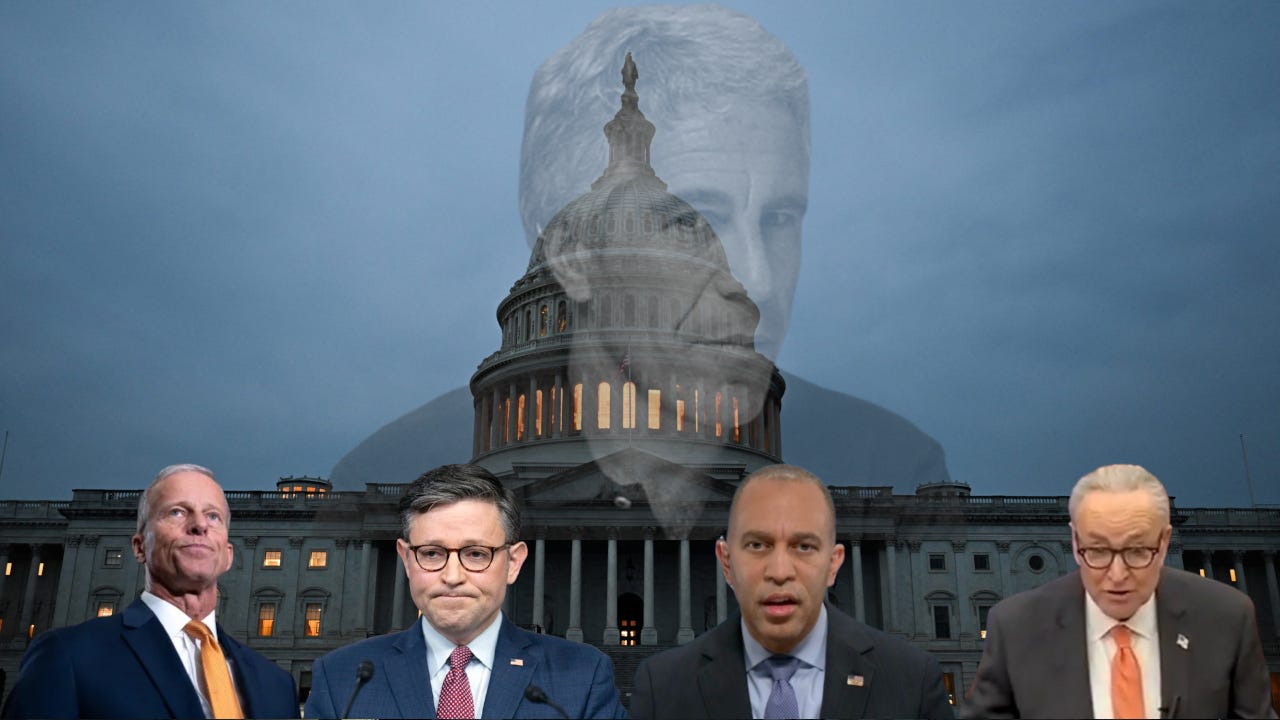
Should we really be surprised that the Democrats are now attempting to pivot to that most reliable of ongoing controversies, the “Epstein Files” currently in the hands of the government?
With the shutdown squabble finally over, Congress should be putting its energies into attending to the nation’s business, with Obamacare and SNAP near the front of the line.
With this latest pivot to Jeffrey Epstein, Congress is once again falling short of its obligations.
Every article I publish takes time, care, and independence. A paid subscription fuels that work and shields it from outside pressure. If you’re able, join me today.
From the moment the Democrats began releasing selected emails sent by infamous sex-trafficker and pedophile Jeffrey Epstein referencing President Trump, it was clear they sought to reignite that longstanding controversy, as some of the messages suggested Trump knew full well of Epstein’s sexual predations—a narrative the White House predictably denounced.
The White House called the Democratic release of the emails a “smear.” Trump attended parties with Epstein and flew on his private plane during the 1990s. But Trump later ousted Epstein from his club and has forcefully denied knowing about the sex trafficking. Epstein died by suicide in prison in 2019 while awaiting trial.
Democrats in the House released emails this week that show Epstein discussing Trump, including one that said Trump “spent hours at my house” with a victim. The emails have reignited the controversy around the Epstein case, which has dogged Trump during his second term.
The Trump administration’s decision not to release more Epstein documents has prompted backlash, and a push by Congress to get the records. A petition aimed at releasing all of the Epstein documents garnered enough signatures this week to force a vote on the issue in the House.
Responding to a question about reports that he lobbied Republican lawmakers to withdraw their signatures from the petition, Trump said “We think it’s bad to talk about (Epstein) because it gets away from the subject of how well the Republicans are doing.”
“They want to waste people’s time, and some of the dumber Republicans like that,” Trump added
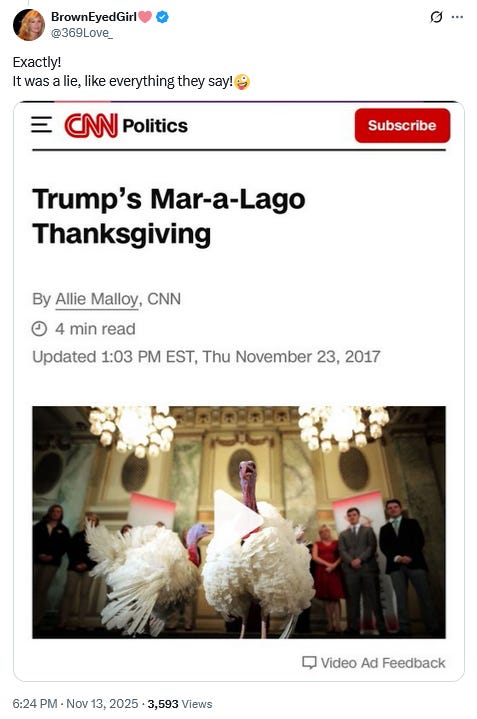
The Democrats might not end up having any better luck with their latest anti-Trump tactic than with the shutdown, however, as one of the key details they sought to highlight—a claim by Jeffrey Epstein that President Trump spent Thanksgiving 2017 with him—was quickly debunked, forcing the Democrats to quickly delete the social media postings.
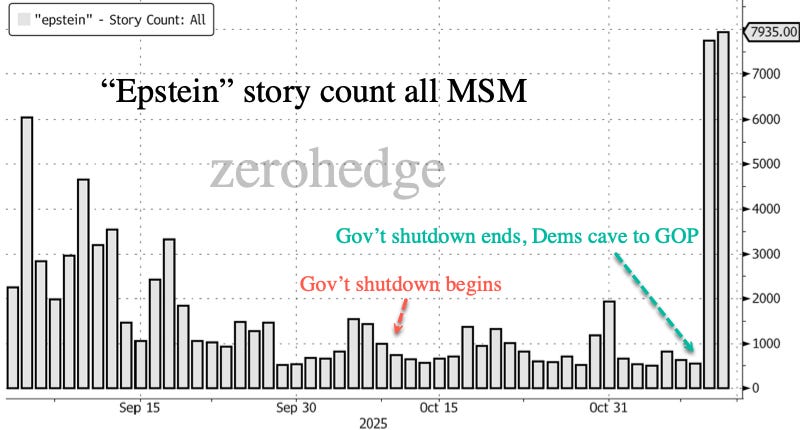
Nor was any of this coincidental. According to reporting in ZeroHedge, media data compiled by Bloomberg shows a surge in Epstein stories almost immediately after the Democrats’ surrender on the shutdown became official.
What’s clear is that the Democratic Party staked heavily on the Jeffrey Epstein email narrative. Bloomberg data shows that headlines mentioning “Epstein” were minimal throughout the shutdown, but as soon as Trump signed the bill to reopen the government, putting Democrats in a very unfavorable position and creating terrible optics in the news cycle, their propaganda cannon was fired.
In the texts, Epstein appeared to be watching the February 2019 hearing in real time and at one point informed Plaskett — whose name is redacted from the documents — that Cohen had brought up former Trump executive assistant Rhona Graff in his testimony. At the time, Cohen was testifying before the House Oversight Committee against his former boss, alleging that Trump was racist, manipulated financial records and directed hush money payments to cover up his extramarital affairs — allegations Trump denied. The president said on social media that Cohen was “lying” before testimony began..
Is Epstein playing the Democrats for fools from beyond the grave? That appears to be a not-unreasonable view of how the narrative is unfolding.
While the Democrats might have been motivated to pivot to Epstein to get media attention off their abject surrender to end the shutdown, that narrative shift is also pulling attention away from the very topic the Democrats insist was the justification for the shutdown: the expiring Obamacare subsidies and projected sticker shock Obamacare policy holders are facing on January 1.
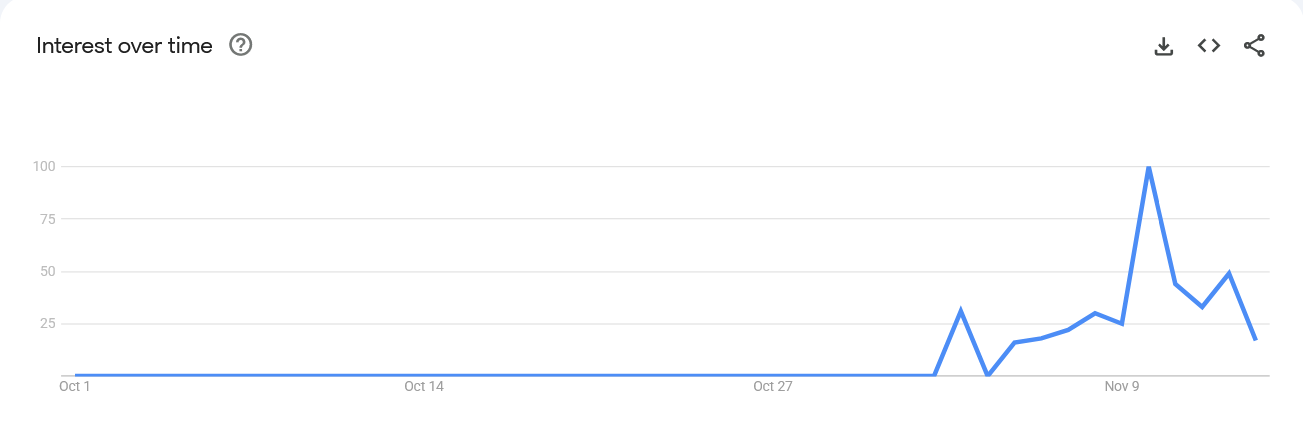
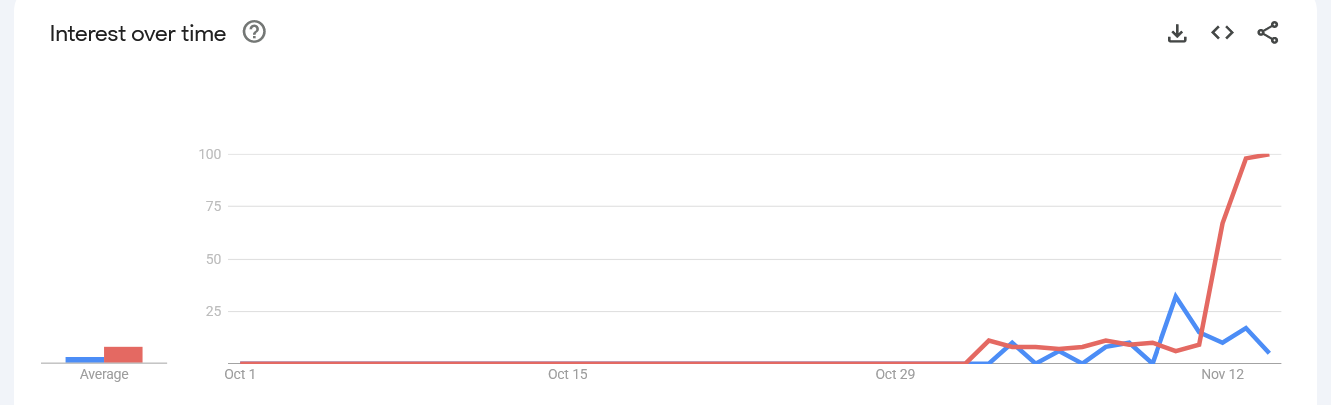
This is not mere speculation. A survey of Google Trends regarding the search term “ACA Subsidies” shows a brief surge in interest at the end of October and beginning of November, but a drop in interest at the start of last week when it became clear the Democrats were surrendering.
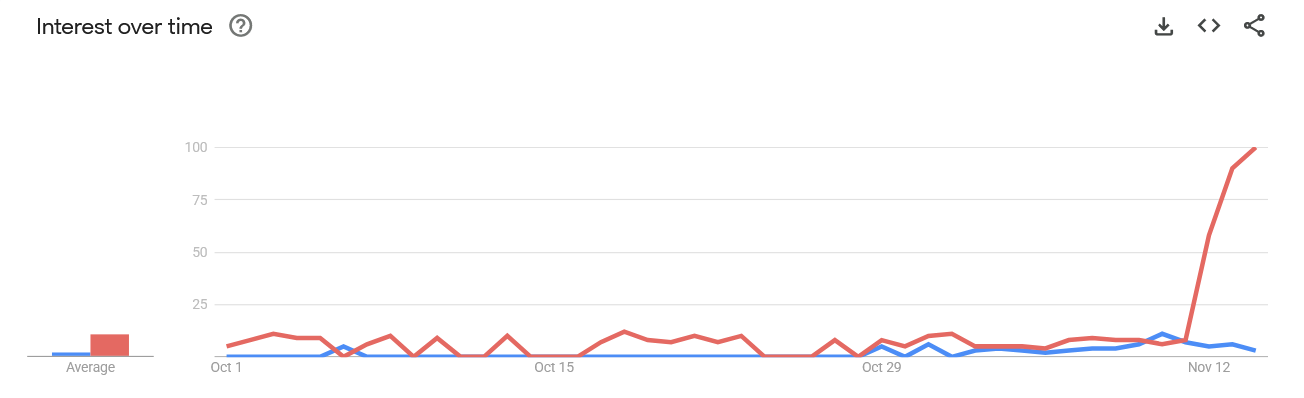
A broader topic survey shows a similar surge and dropoff for “Affordable Care Act”
That the Democrats would choose to focus on Epstein rather than Obamacare seems an odd strategic choice, given both their rationale for the shutdown and that the current state of Obamacare premiums points to a looming crisis of affordability for policy holders.
Even if Congress should opt to extend the Obamacare subsidies at the last minute, those premiums are still set to rise for calendar 2026 by an average of 26 percent. Perhaps unsurprisingly, policies purchased through Healthcare.gov—the main federal health insurance exchange—are seeing the largest increases, at 30%, while the few states which run their own exchanges are seeing “smaller increases” of around 17%.
If the enhanced premium tax credits expire at the end of this year, KFF estimates that currently subsidized enrollees will see their monthly premium payments more than double, increasing by about 114%, on average. This reflects people with incomes below four times the poverty level receiving less financial assistance and those with incomes over four times poverty no longer being eligible for financial assistance at all and therefore being hit by a double whammy of lost tax credit and higher insurer premiums.
Without the subsidies, the insurance policies Americans have purchased under the Affordable Care Act are no longer looking all that affordable.
By the numbers, this is not a small issue. 22 million Americans rely on the subsidies to cover some or all of their insurance premiums for Obamacare (out of 24 million total who are enrolled in Obamacare policies).
The Democrats stated rationale for the shutdown was to head this issue off by extending the subsidies—slated to expire automatically at the end of this year—with the goal of making them permanent.
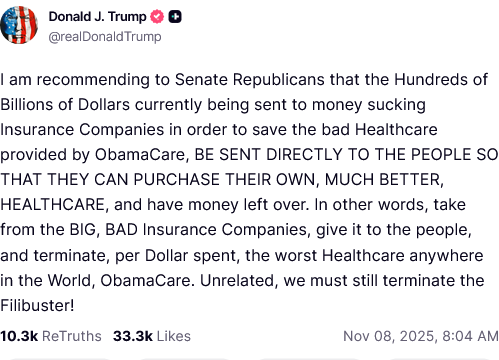
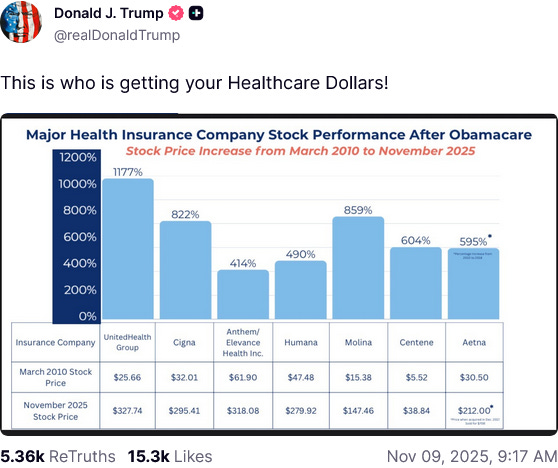
How prepared the Republicans are to have a debate over the future of Obamacare is problematic however, as in the final days of the shutdown Donald Trump posted to Truth Social a proposal to send Americans the money to purchase healthcare directly, rather than paying insurance carriers directly, as is the current practice.
The McCain health plan proposes three fundamental reforms that would change the financing of health care and reform the health insurance market to give families more control of personal health care decisions:
Equal tax treatment for health coverage. The Senator would replace the special tax breaks for employer-based health insurance with a universal system of health care tax credits for the purchase of health insurance. These health care tax credits of $5,000 for a family and $2,500 for an individual would be indexed annually for inflation and would be available to Americans regardless of income, employment, or tax liability. Even prominent critics concede that such a tax change is a principled and far-reaching proposal.[2] This change alone would lay the groundwork for unprecedented consumer choice and competition in the health care sector.
Health insurance competition on a national scale. Currently, only federal workers and retirees in the Federal Employees Health Benefits Program (FEHBP) benefit from competition among private health insurance companies on a national scale. In sharp contrast with almost every other sector of the economy, competition across state lines in health insurance is virtually nonexistent. The McCain health plan would change this by allowing individuals and families to buy health plans domiciled and regulated in other states. This would both expand personal options for affordable coverage and force health insurance companies to compete directly for consumers’ dollars on an unprecedented scale.
Federal assistance to the states to cover vulnerable populations. The Senator envisions a large role for state innovation and experimentation in health care financing and delivery, but he would provide safety-net funding to ensure coverage of the most vulnerable populations: the hard-to-insure and the uninsurable. McCain’s Guaranteed Access Plan would provide federal assistance to the states to secure access to health insurance coverage through state high-risk pools or similar arrangements. His plan would also encourage expanding coverage options for Medicaid enrollees and veterans
The Democrats apparently would rather the public focus on Epstein than on Congress’ seeming unpreparedness to tackle an issue that cannot be postponed for even a little while.
The Epstein distraction may serve to obfuscate another awkward moment for Democrats: the revelations of considerable fraud, waste, and abuse within the USDA Supplemental Nutrition Assistance Program (SNAP) which emerged during the shutdown, as Democrats sought to compel the Trump Administration to keep the program fully funded.
SNAP, formerly known as food stamps, is a federal program. Each state administers the program and enrolls participants based on eligibility determined by Congress. While the USDA and its Office of Inspector General can audit state SNAP programs, participants’ personal data typically remains under the state’s control.
In March, the USDA’s Office of Inspector General notified California, Florida, New York and Texas of inspections of their SNAP programs to see if the states were improperly using administrative funds to pay out benefits, the emails show.
That ultimately led to a request for detailed sensitive data — including citizenship status and addresses — of all SNAP participants in the previous year from at least one of the states.
“We have found thousands and thousands of illegal use of the EBT card,” Rollins said, referring to the electronic benefit transfer cards used by SNAP recipients. “We have been moving people off of SNAP. We’ve got almost 700,000 people, I think we’ve moved off just since the president took office. We’ve arrested about 118 people.”
She added, “We found one guy in six different states getting a benefit. We found about 5,000 people that are dead who are still getting benefits.”
700,000 people illegally receiving SNAP benefits certainly strains the common understanding of “rare”.
Despite the incendiary nature of Secretary Rollins allegations, the Democrats have been largely silent in response. Even corporate media has opted to focus more on pending changes to SNAP arising from the “One Big Beautiful Bill” passed by Congress earlier this year.
Apparently, corporate media at least would much rather people focus on Jeffrey Epstein than potentially millions of dollars of detectable fraud within SNAP.
For Jeffrey Epstein’s victims and their families, any disclosure of information regarding Epstein’s contacts, associates, and potentially sex-trafficking “clients” is quite significant and hugely important. Nor can there be any doubt that significant questions linger about how Epstein was able to negotiate such a favorable plea arrangement in 2008 to settle charges of sexual contact with minor girls.
For these reasons alone, the Epstein story continues to fascinate the American public, with a number of as-yet unproven hypotheses about who Epstein was and the source of his wealth.
Yet as the latest efforts by Democrats to make a fresh issue out of Jeffrey Epstein illustrate, what has never materialized from any of the revelations about Epstein or his associates over the years has been criminal indictments, let alone prosecutions.
Not only are efforts to paint President Trump with an Epstein brush apparently failing, among the recently released messages was one which claimed that Bill Clinton—a man with his own infamy for sexual predation—was never on Epstein’s Caribbean island.
Regardless of the email’s accuracy or truthfulness, it is significant for being exculpatory evidence which would help generate reasonable doubt about any Epstein-related sex crimes for which Clinton might potentially be charged.
The questions about Jeffrey Epstein are real and are significant, yet the narrative threads which have emerged surrounding Epstein are, to put it mildly, a mess. For all the certainty among some that Epstein was a notorious sex trafficker who peddled young girls to politicians and billionaires alike, as of yet significant actionable evidence able to withstand scrutiny in a court of law has not been made public. The evidence might be out there, and might even be lurking in the FBI’s records on Epstein, but unless it breaks into the light of day nothing will come of it.
As I have said before, no matter what is revealed from the FBI’s records on Epstein, people are sure to be disappointed.
By comparison, the state of Obamacare is a current crisis, and is clear-cut. Without the subsidies, Obamacare is facing a “death-spiral”, as skyrocketing premiums push healthier Americans off their policies, leaving an insured pool of sicklier—and therefore costlier—individuals. Unlike whatever information resides within the FBI’s records on Epstein, the state of Obamacare is an unfolding issue, and for the 22 million Americans who have been receiving the subsidies, an unfolding crisis.
Similarly, reports of 700,000 individuals illegally receiving SNAP benefits, and 186,000 deceased individuals still receiving SNAP payments, are an unfolding scandal that surely warrants both attention and action. If those numbers are wrong, proper administration of government finances demands that they be corrected. To whatever extent those numbers are correct, proper administration of government finances demands that SNAP be overhauled and reformed.
It is not inconceivable that, but for the levels of abuse claimed by Secretary Rollins, SNAP might have been able to fund November benefits out of the contingency fund. The lawsuits to force the Trump Administration to fully fund SNAP somehow might not have been necessary.
The Obamacare and SNAP issues both carry significant political and economic consequences. No matter what the outcomes of debate and Congressional actions might be on these issues, people’s lives are going to be impacted both in the present and in the future.
Is it truly a reasonable position that Jeffrey Epstein, someone who has been dead for over six years, should command greater attention either from the public or the media than either of these issues? Is it not possible to pursue greater disclosure on Epstein’s associates while at the same time keeping focus on issues which are going to impact quite a few Americans for the foreseeable future?
Is it a more plausible assessment that Epstein is emerging as a distraction, keeping public scrutiny away from vital issues, thereby allowing Congress to evade what little political accountability exists today?
The government shutdown is over. Congress should be focusing on returning to dealing with the nation’s business, with Obamacare and SNAP very near the top of the priority list. Both corporate and alternative media ideally should be putting the public’s focus on such a return to the nation’s business.
If this story gave you real value, help me keep going. All Facts Matter is powered by readers who believe facts should stand on their own. Your subscription makes that possible.
I think what is most telling to me is all the focus on supposed compromised politicians when the most likely people to be involved in Epstein’s salacious mess were in the financial sector. Why don’t I see any stores about investment bankers being investigated?






The SNAP fraud is so frustrating as I know many truly need this...
I think what is most telling to me is all the focus on supposed compromised politicians when the most likely people to be involved in Epstein’s salacious mess were in the financial sector. Why don’t I see any stores about investment bankers being investigated?