


In “The Hunt For Red October”, Scott Glenn's character submarine skipper Bart Mancuso pithily observes that “the hard part about playing chicken is knowing when to flinch.”
Which sets up perfectly the salient question regarding what could become the longest government shutdown ever: does either side know when to flinch?
Do the Democrats know how to find any sort of ending to the shutdown?
Do the Republicans know how to win gracefully, or how to avoid snatching defeat from the jaws of victory?
The answer to both questions is “we do not know.” That’s not a good answer.
While most of America has so far been fairly unimpressed by the shutdown Kabuki playing out on Capitol Hill, the unavoidable reality is that, eventually, both parties must come together, pass either a continuing resolution or a full budget, and restore normal government functions. One side or the other, or even both, must flinch.
As the shutdown moves into its third week, there are few indications that either side has come to grips with that reality. There are no indications the Democrats understand that reality.
At present, neither side feels particularly compelled to move off its position and seek a negotiated compromise, which means neither side is going to negotiate.
And so the shutdown will drag on.
Does either side know when to flinch? Don’t bet on it.
The Collateral Damage Is Widening
While Americans for the most part have yet to notice any immediate effect on their daily lives from the shutdown, we should not have any illusions that there is no collateral damage being inflicted.
As government operations are currently unfunded, government workers are going unpaid—including the ones still at work. Among those working without a paycheck: the nation’s air traffic controllers.
While many are still showing up for work, confident that they will be paid in full once Congress tires of their performative posturing, many are suddenly calling off their regularly scheduled shifts, producing staffing shortages at several airports and air traffic control facilities.
A total of 180 staffing shortages have been reported since the start of the government shutdown — up from 42 reported during the same dates last year.
The cause of the staffing problems is not immediately clear, but Transportation secretary Sean Duffy said last week some workers are taking unscheduled time off to protest not currently being paid for the time they are working while the government is closed.
It is not hard to fathom why workers were protest this way. No one enjoys the thought of working for free, and that is technically what government employees are doing at the moment.
How many staffing shortages among air traffic controllers can the country absorb before there is a major aviation safety incident? Will the budget battle result in a plane crash and hundreds of lives being lost? It certainly is a grim possibility.
Nor is aviation safety the only growing risk. The National Nuclear Safety Administration (NNSA), responsible for overseeing America’s nuclear weapons stockpile, is having to furlough some 1,400 workers. The NNSA Office of Secure Transportation runs out of funding next week, on October 27.
Does this mean national defense could be compromised? Not really, although the process of shutting down nuclear weapons assembly and disassembly raises the possibility of a nuclear accident.
The government shutdown is also increasing food insecurity for a not-insubstantial number of people. Without a budget or even a “clean” continuing resolution, nutritional assistance programs such as the Special Supplemental Nutrition Program for Women, Infants and Children (WIC) are currently not receiving fresh infusions of funds. Approximately 6 million low-income mothers and their children rely on WIC to ensure an adequate food budget each month, and all of them are effectively at increased risk of hunger because of the shutdown.
A week into the shutdown, President Trump redirected some $300 million in tariff funds into WIC, enough to keep most states funded through the end of October. With the end of October getting closer, however, whether Trump will be able to find additional funds to keep WIC going even longer remains a question.
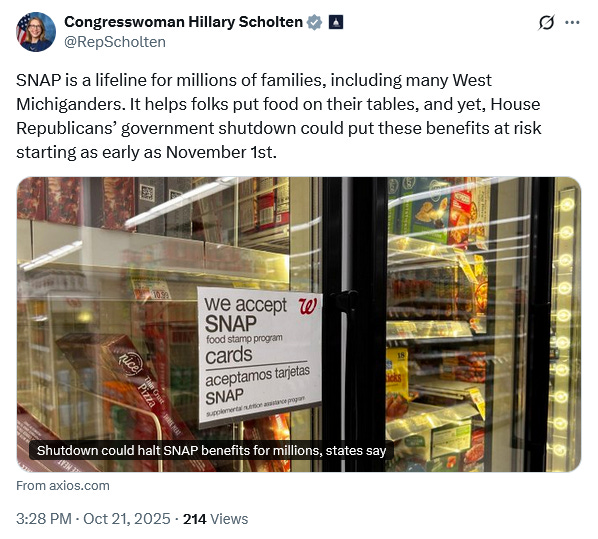
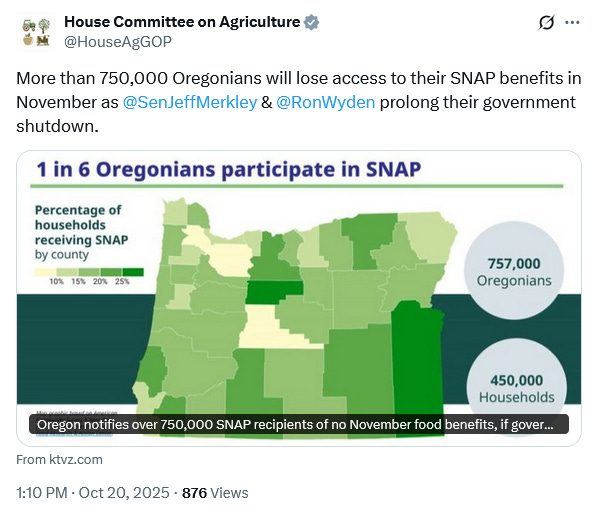
A much larger food assistance program, the Supplemental Nutrition Assistance Program (SNAP), is in much the same funding predicament. While the program has a $6 billion contingency fund it can utilize, with 42 million SNAP recipients, November’s cash requirements for SNAP could easily top $8 billion, meaning the program would run completely out of money sometime in November.
Several states have already started notifying SNAP recipients not to expect full benefits in November.
While the nation’s food pantries can absorb some of the need for food assistance, they will not be able to replace SNAP benefits completely.
Regardless of how one views government nutritional assistance programs, an abrupt discontinuity in benefits means at least some people are going to experience at least some food insecurity. The government shutdown is on the verge of literally taking food out of people’s mouths.
Always The Other Party’s Fault
What is particularly disturbing about the looming disruption to WIC and SNAP is that both parties are fully aware of the funding dilemma, and its consequences.
We know both parties are aware of the problem, because both parties are only too happy to get on social media platforms such as X and virtue-signal about how horrible the other party is for putting the nation’s vulnerable at risk of hunger.
The Democrats are blaming the Republicans.
The Republicans are blaming the Democrats.
The Democrats even managed to turn President Trump’s decision to fund WIC with tariff funds into a reason for criticism.
“Since President Trump is now signaling he cares about the WIC program, he should finally get to the negotiating table to reopen the government,” said Sen. Patty Murray, a Democrat from Washington state. “And he should immediately disavow his budget request to significantly cut benefits for millions of moms and kids — and tell House Republicans to back off their proposed cuts as well.”
We must not forget that neither party was terribly interested in avoiding the shutdown. That has been painfully obvious all along.

Both parties were willing to shut the government down.
Both parties were willing to disrupt WIC and SNAP benefits by shutting the government down.
Both parties are not willing to admit they chose to disrupt WIC and SNAP benefits by shutting the government down.
Not Flinching: Political Optics Matter Most
Both parties have already proven one thing: the shutdown standoff is driven primarily by political “optics.” Democrats are far more concerned with seeming to show strength and unity of purpose then they are with the harms done to various constituencies by the shutdown.
That the Democrats are chiefly concerned with appearances was a thesis highlighted recently by White House economic advisor Kevin Hasset.
Hassett said on CNBC that he has heard from the Senate that Democrats thought it would be “bad optics” to vote to reopen the government before this weekend’s massive nationwide “No Kings” protests against President Donald Trump.
“Now there’s a shot that this week, things will come together, and very quickly,” Hassett said. “The moderate Democrats will move forward and get us an open government, at which point we could negotiate whatever policies they want to negotiate with regular order.”
We should note that CNN reported the Democrats’ stance on healthcare was a motivation for this past weekend’s “No Kings” protests. We should also note that Democrats have had for weeks an option before them to end the shutdown: a one-year extension on Obamacare subsidies due to expire at years end.

CNN reports that another cause for protest was healthcare—and in particular the ending of the enhanced premium subsidies that have sustained Obamacare in the past few years.
Left out of that reporting, however, is the reality that the GOP has proposed a one-year extension to those subsidies, only to have House Minority Leader derisively dismiss the idea as a “non-starter.”
Rep. Jen Kiggans (R-Va.) is pushing legislation to extend enhanced Affordable Care Act tax credits, which expire on Jan. 1, through the end of 2026. The proposal has bipartisan support, and some political observers view it as a launching pad for securing a deal to reopen the government.
Jeffries, though, has other ideas, saying a one-year extension is “a non-starter.” He emphasized that President Trump and Republicans had adopted a permanent extension of tax cuts for the country’s wealthiest people earlier in the year. With that in mind, he’s demanding a similarly permanent extension of the enhanced ACA subsidies, which overwhelmingly help working class people.
The Democrats quite literally could have both ended the government shutdown and won a legitimate victory on Obamacare two weeks ago, and quite literally laughed it off.
Following Hassett’s line of reasoning, now that the “No Kings” protests are done, a primary reason for the Democrats’ intransigence has disappeared. Lacking a continuing reason for holding out, Democrats are likely to buckle soon, with enough defections to overcome the filibuster in the Senate and secure passage of the Republicans’ clean Continuing Resolution to temporarily fund the government.
Some in corporate media are unconvinced of this, and assess that Democrats will continue to be concerned about their image during the shutdown.
There are two very questionable assumptions Hassett articulated in his happy talk about an end to the shutdown. The first is that “Democratic moderates” will split with the rest of their party (presumably in the Senate, where a Democratic filibuster is the obstacle to a reopening vote) to give Donald Trump and the GOP exactly what they want. It’s true that three Democratic senators (John Fetterman, Catherine Cortez Masto, and Angus King) have from the get-go voted for the Republican measure funding the government at current levels until November 21. But it’s also true that not a single Democrat has joined them in nine subsequent Senate votes. In March, when ten Democrats did “cave” and vote to keep the government open, they were led across the line by Chuck Schumer, whose standing among grassroots Democrats took a severe pounding he is unlikely to ever forget.
Yet we should not assume that optics are important only to Democrats. Republicans, including President Trump, have made it clear that they do not want to be seen indulging the Democrats’ “extortion” by negotiating over the shutdown.
President Donald Trump said Tuesday that the Democrat lawmakers’ shutdown strategy is extortion and Republicans will not give in to “this crazy plot of theirs.”
Trump’s comments came on day 20 of the government shutdown during a lunch with Republican senators in the Rose Garden Club, as Democrats have repeatedly opposed a stopgap continuing resolution (CR) that would fund the government at the 2024 levels approved by then-President Joe Biden.
“I wanted to say from the beginning, our message has been very simple: We will not be extorted on this crazy plot of theirs. They’ve never done this before. Nobody has. You always vote for an extension,” Trump said.
“Chuck Schumer and the Senate Democrats need to vote for the clean, bipartisan CR and reopen our government. It’s got to be reopened right now,” he added.
Senate Majority Leader John Thune echoed that sentiment.
Everybody here has voted now 11 different times to open up the government, and we are going to keep voting to open up the government. And eventually, the Democrats, hopefully sooner or later, are going to come around.
Perversely, the one point of agreement between Democrats and Republicans is that their priority is not to be seen agreeing with each other. Negotiation itself becomes surrender and defeat.
GOP At Least Preparing To Negotiate
While neither party is interested in negotiating over the shutdown at the moment, the Republicans are reportedly developing a negotiating position for when the Democrats do finally decide to negotiate. At a minimum, the GOP is fleshing out what sort of compromises they are willing to accept on Obamacare’s premium subsidies.
Key Republicans have floated a list of possible ways to curb the subsidies without eliminating them entirely when they expire on Dec. 31. Those include imposing an income cap for beneficiaries, forcing some individuals to pay a minimum out-of-pocket premium or grandfathering in current enrollees while cutting off new enrollment.
Indeed, even the Republicans’ “fiscal hawks,” such as Freedom Caucus chairman Andy Harris, concede they can accept some extension of the Obamacare subsidies, under the right circumstances.
They’re also hoping to shape how the deal moves through Congress. Rep. Andy Harris (R-Md.), chair of the House Freedom Caucus, said in an interview Monday that while leadership could move a health care package attached to a bundle of funding bills, he said he would prefer “a standalone bill.”
The spending bills, Harris said, “should be kept as clean as possible.” And he added that his support for the health care piece “depends on what the whole package is” and that he wants the ACA credits to be eventually sunsetted completely in any deal.
Eventually, such thinking goes, it will be time to negotiate and compromise with the Democrats. That time is not now, but presumably that time will come—not that the Republicans know (or much care) when that time will be.
Are there similar thoughts on the Democrat side of the aisle? None that have been reported in either corporate or alternative media. If Senate Minority Leader Chuck Schumer and the rest of the Democrat leadership have thought beyond the shutdown, they have buried those thoughts deep and not disclosed them to anyone.
Eventually, The Shutdown Must End
Left unspoken by everyone, including President Trump, is that the final outcome in every conceivable scenario is already known: the shutdown has to end.
If the government does not reopen, the government ceases to exist.
Nobody wants that, not even the people who are most okay with the government remaining shut down.
If the government is to reopen, there must be funding.
If there is to be funding, Democrat and Republican must actually agree on the funding.
Because the government must open, eventually there must be agreement between Democrats and Republicans, there must be funding, and the present standoff between Democrats and Republicans must end.
The only real question is the timing. When will the shutdown end? When will Democrat and Republican both decide to stop the posturing and pontificating and actually pass funding legislation?
The simplest ending is that the Senate Democrats pass the “clean" continuing resolution already passed by the House of Representatives. Only seven Democrats need cross over to vote with Republicans on cloture for this to happen. Chuck Schumer could even select seven Democrats to make the necessary votes while the rest of the Democrats howled “betrayal”—that would be a fitting end to the performative nonsense of this shutdown.
The ending which saves the greatest amount of face on both sides is that the Republicans agree to a one year extension on Obamacare premium subsidies. With the Freedom Caucus in the House already signalling they can live with that, that presents as a relatively low-cost compromise for Republicans to make. The House could pass that extension as a standalone bill before the Senate Democrats vote on cloture on the “clean” CR to fund the government, to show good faith on the matter.
The ending that is least likely to happen is the Democrats succeed in their quest to make the Obamacare subsidies permanent. There is no appetite for that in the Republican Party, and the Freedom Caucus in the House has already said the subsidies must sunset eventually. Speaker Mike Johnson needs Freedom Caucus votes to move legislation through the House, so what the Freedom Caucus says on this very likely carries the weight of the entire Republican caucus in the House.
It requires no great political insight or reading of Congressional tea leaves to see how this shutdown “fight” must end. Since it must end, it is a matter of simple logic and common sense to work out the various and most plausible ways in which it will end.
Unlike debates over Obamacare subsidies, there are no complicated issues at play. The government needs to be funded. There is a continuing resolution passed by the House to fund the government—a “clean” resolution without a lot of extra goodies tacked on, as even Democrats have implicitly acknowledged. This much is easily established by a plain reading of what both Republicans and Democrats have said. That makes passing the continuing resolution the easiest and most direct path to funding the government, albeit briefly.
The Democrats want to add a number of funding items to that continuing resolution—only one of which involves the Obamacare subsidies, we should note—funding that is in addition to maintaining the government funding for a period of weeks while the final budget bill for fiscal 2026 is cobbled together. The Republicans have signaled willingness to bend on Obamacare subsidies, but have used the rest of the Democrats’ wish list as talking points against the Democrats, which effectively ends the possibility of them being adopted alongside the continuing resolution.
The Republicans know all of this as well as the Democrats, and both sides are aware of what the shutdown is doing to government infrastructures deemed essential (and aviation safety and maintenance of the nuclear weapons stockpile do seem pretty essential infrastructures), as well as the impact of a funding loss for assistance programs such as WIC and SNAP. Both sides are willing to impose on the country the damage of having these infrastructures and programs compromised by lack of funding.
Both sides are sacrificing the well being of Americans for the sake of their political priorities. Whether those sacrifices are necessary and defensible is a conclusion I leave to the reader. What is indisputable is those sacrifices are being made, even though neither Democrats nor Republicans are willing to be honest enough to admit it.
The shutdown will end when Democrats and Republicans alike decide the performative Kabuki of the shutdown, and the intentional infliction of economic distress on various constituencies, has gone on long enough. At that point Democrats and Republicans will get together and fund the government along the lines of one of the scenarios outlined here.
The shutdown will end when one or both sides chooses to flinch.
Do either the Democrats and Republicans understand that? I doubt that very much.
What will it take, to get Democrats in office to actually do their jobs? It is ridiculous that Republicans are always expected to give in, to a party that simply refuses to negotiate.
Maybe next year after screaming, kicking, wailing, tantrum-throwing socialists are replaced by grownups.