


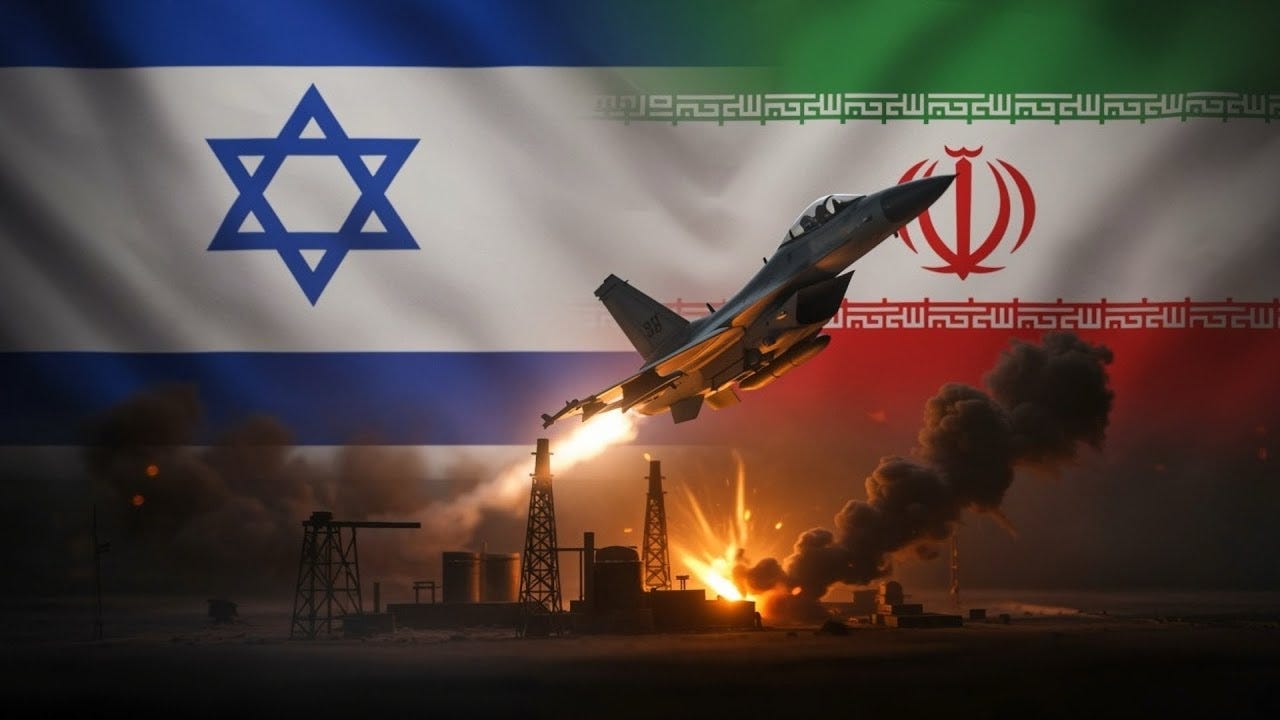
Israel is done waiting on Donald Trump to negotiate a deal with Iran over its nuclear weapons program.
Evening Update
Iran finally started launching missile salvos at Israel earlier this afternoon.
Shortly after 1PM Central time (9PM Israel Daylight Time/IDT), the first missiles reached Israel, triggering the expected response from Israel’s Iron Dome missile defense batteries. Still, as this video near Tel Aviv shows, some missiles did get through.
At least one missile struck near the heart of Tel Aviv, doing significant damage.
The total number of missiles is unclear, although the IDF is reporting around 150 missiles were in that first wave.
Israel’s Army Radio reported shortly after 10:00 p.m. that Iran had fired about 150 missiles, not all of which made it to Israel. Dozens were intercepted, and there were several direct impacts in central Israel.
After that first series of missile attacks Israel reported that around 34 people were wounded.
Iran launched a second wave of missiles around 1AM IDT. Only seven people were reported injured in that second attack.
According to the Magen David Adom ambulance service, a total of 63 Israelis have been injured during Iran’s missile attacks, one critically. No deaths have been reported as of yet.
By comparison, Iran is reporting that Israel’s ongoing strikes have thus far killed 78 people and injured over 320.
Iran's U.N. envoy Amir Saeid Iravani said 78 people, including senior military officials, were killed in Israel's strikes on Iran and more than 320 people were wounded, most of them civilians.
Based on the reporting, Israel done far more damage to Iran than vice versa.
Even though the damage thus far has been relatively minor, Israel is still not pleased that Iran has, in Israel’s view, deliberately targeted civilian populations—something that for Israel is a “red line” warranting further escalation.
Amid Iran’s missile attacks across Israel tonight, which have seen some 200 missiles fired, Channel 12 quotes an unnamed Israeli political source threatening Iran with escalated strikes.
“Iran will pay an unbearably heavy price for its fire at civilian areas,” the Israeli source is quoted as saying.
Whether that means that Iran’s Supreme Leader, Ayatollah Ali Khamanei, will be targeted and perhaps even killed is not certain.
Internationally, while Saudi Arabia and other Gulf states have criticized or condemned Israel for the attack on Iran, the messaging from Iran’s erstwhile allies Russia and China has used far more circumspect language.
China, which recently signed a 25-year cooperation agreement, said it was “highly concerned” about Israel’s attacks. Through Chinese Foreign Ministry spokesman Lin Jian, China urged descalation and restraint.
In response to Israel's attack, Lin Jian, Chinese foreign ministry spokesman, said, according to state media, that "China is highly concerned about Israel's attacks on Iran and deeply worried about the potential serious consequences of these actions."
Lin also said Beijing, which has been developing closer ties with Tehran, including a 25-year cooperation agreement, "opposes any violation of Iran's sovereignty, security, and territorial integrity, and opposes actions that escalate tensions and expand the conflict."
"The renewed sharp escalation of the regional situation is not in the interest of any party," he continued.
"China urges all relevant parties to do more to promote regional peace and stability and to avoid further escalation of tensions. China is willing to play a constructive role in helping to de-escalate the situation."
Russian President Vladimir Putin spoke with both Israeli Prime Minister Benjamin Netanyahu and Iranian President Masoud Peseshkahan by phone earlier today, and, per the read out of the calls posted to the Kremlin website, was more forceful than China in his rhetoric, condemning Israel’s actions but at the same time calling for all sides to return to the negotiating table.
Vladimir Putin stressed that Russia condemns the actions taken by Israel in violation of the Charter of the United Nations and international rights. The Russian side fully supported the efforts to resolve the situation around the Iranian nuclear program is peaceful, put forward specific initiatives aimed at finding mutually acceptable agreements. Russia further will contribute to the de-escalation of the conflict between Iran and Israel.
Given that Israel indisputably attacked Iran, and given the closer ties that Iran has supposedly been cultivating with both Russia and China, one might reasonably have expected either China or Russia to be more strident and bellicose in their pro-China rhetoric. Instead, both countries sounded almost banal in their formulaic calls for negotiations and de-escalation.
Iran can hardly want for enemies with friends such as Russia and China!
With Israel continuing to launch raids with impunity against Iran, one conclusion is unavoidable: Iran is completely defenseless against the Israeli Air Force. Israel can attack Iran when, where, and how it chooses, and Iran can apparently do nothing to stop it.
Retaliatory missile strikes are not nearly as great a deterrent against ongoing air raids as shooting down a large number of Israeli fighter jets—which Iran apparently cannot do.
Barring a successful missile salvo against Israel producing fairly substantial casualties, the reality of Operation Rising Lion is Israel is manhandling Iran, and Iran cannot do anything about it.
Mid-day Update
So far, there have been no media reports of missile launch by Iran against Israel, let alone successful strikes. Israel’s attack may be a reason why not.
Per Times of Israel, the Israeli Air Force has been targeting Iranian missile sites, including missiles pre-targeted towards Israel. The shared video footage indicates Israel has enjoyed a good measure of success, which would limit Iran’s immediate options.
Part of that success may be due to intel provided by the US, which has claimed no role in the Israeli attack.
What's certain is that Iran has yet to mount a meaningful retaliation. The longer Israel continues to attack Iran the less likely it is that Iran will possess the ability to mount a meaningful retaliation. Drones alone are not going to be sufficient, militarily or geopolitically.
Meanwhile, Israel continues pound the enrichment facility at Natanz. Natanz is Iran’s largest enrichment facility--or perhaps now it is more appropriate to say it was.
Israel’s objective is clear: they mean to end Iran’s nuclear weapons program. They may be succeeding.
Morning Update
Israel’s attack on Iran appears to be an unqualified success.
In addition to damaging Iran’s enrichment facility at Natanz, a number of senior military commanders have been killed. Not only was Iranian Armed Forces Chief of Staff General Mohammed Bagheri killed in last night’s air strikes, but so was the head of the Iranian Revolutionary Guard Corps missile forces, General Amir Ali Hajizadeh, as well as the overall head of the IRGC, General Hossein Salami.
Strikes against the Natanz facility are apparently ongoing. Israel seems determined that facility not return to operation at all. Iran’s reactor sites as Ishafan and Bushehr have apparently not been targeted, according to the IAEA.
Iran is naturally threatening severe reprisals, although thus far their response appears to have been limited to waves of drones, which Israel has so far managed successful defense.
Surprisingly, Russia’s Foreign Ministry has stopped short of an outright condemnation of Israel’s air attack, expressing instead “extreme concern” at an “unprovoked attack” on a sovereign nation (irony abounds).
Notably, Iran appears to be largely defenseless against Israeli air assaults. While Iran will almost certainly attempt to mount some sort of reprisal attack, that Iran is unable to stop Israel’s attacks is a fairly stark showing of Iranian military weakness.
Iran’s days of playing regional hegemon in the Middle East are quite likely at an end.
The United States officially declaims any involvement in Israel’s “Operation Rising Lion”, although it is virtually certain the Trump Administration has known about the operation for some time. President Trump hinted as much on Truth Social.
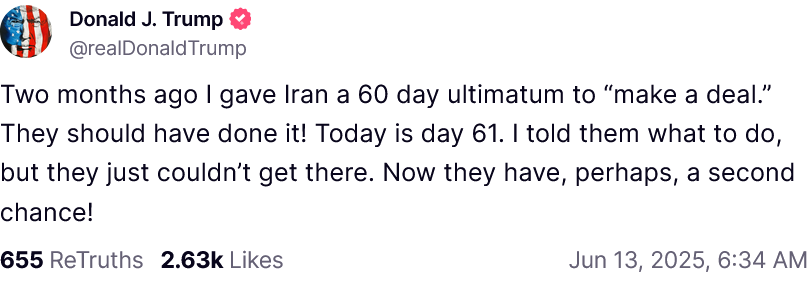
This came after a typically Trumpian and chest-thumping “I told you so” post earlier.
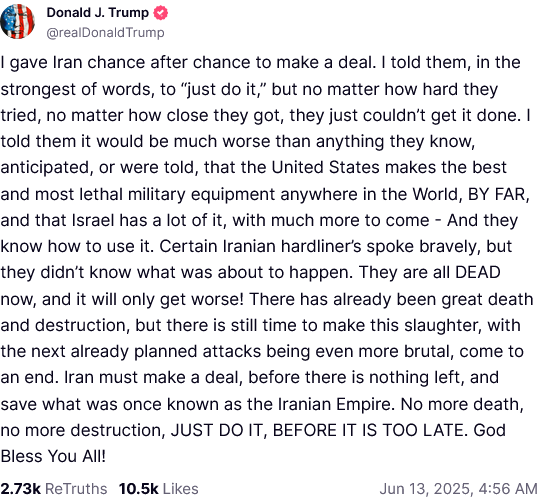
The United States may not have any official involvement in the attack, but it is certain no one in the Trump Administration is upset by it. There are no indications that President Trump is at all dismayed by Israel’s presumably “unilateral” action.
Will Trump be tagged with some measure of culpability over the attack, especially by people in the Middle East? Almost certainly.
Whether the outcome of the attack, as well as America’s largely assumed role in it, is more or less instability in the Middle East remains to be seen.
Late Night Update
The IAEA has confirmed that Israel has struck Iran’s main uranium enrichment facility at Natanz.
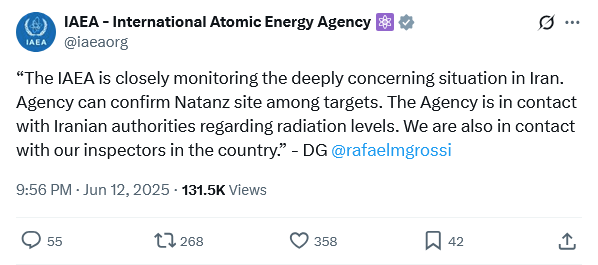
Additionally, Iran’s FARS news agency is reporting that General Mohammed Bagheri, Chief of Staff of the Iranian Armed Forces, is among the casualties of the attack.
As of this writing, Iran’s response has been to launch approximately 100 drones at Israel.
Saudi Arabia has publicly rebuked Israel for the attack, calling it a violation of Iran’s sovereignty.
“The Kingdom of Saudi Arabia expresses its strong condemnation and denunciation of the blatant Israeli aggressions against the brotherly Islamic Republic of Iran, which undermine its sovereignty and security and constitute a clear violation of international laws and norms,” the country’s foreign ministry said in a statement.
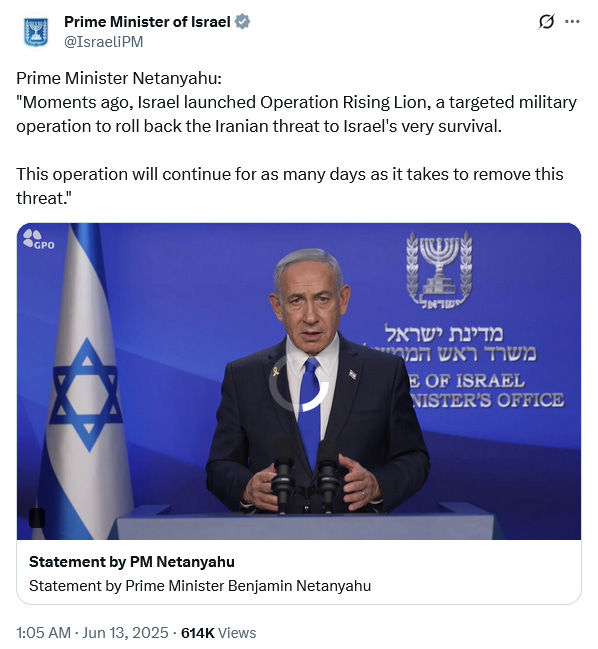
Earlier, Israeli Prime Minister Benjamin Netanyahu said in a televised address that the operation would continue “many days.”
People will have their opinions about the geopolitical (un)wisdom of Operation Rising Lion, but the attacks appear to have been largely successful at damaging multiple Iranian nuclear sites.
Starting Point
With explosions being reported across Tehran, Israel has confirmed that it has launched a major strike on the Islamic Republic, initially reported as “Operation Nation Of Lions.”
The IDF confirms it has launched an aerial campaign against Iran’s nuclear program.
Dozens of targets across Iran related to the nuclear program and other military facilities are being struck by the Israeli Air Force, it says.
In a televised address, IDF Chief of Staff Lt. General Eyal Zamir referred to the ongoing operation as “Operation Rising Lion.”
Speaking in a nationally televised address, Zamir declared the launch of Operation Rising Lion, a large-scale military initiative aimed at strategically targeting Iranian regime threats against the State of Israel.
The Chief of Staff emphasized that the operation was initiated because Israel had reached a "point of no return." Referring to lessons learned from history, Zamir underscored that Israel must not ignore existential threats. "We cannot afford to wait for another time to act," he stated.
While the attack has undoubtedly been long in preparation, the apparent catalyst appears to have been the International Atomic Energy Agency’s decision to censure Iran yet again over its non-compliance with the Nuclear Non-Proliferation Treaty.
The attack comes as tensions have reached new heights over Tehran’s rapidly advancing nuclear program. The Board of Governors at the International Atomic Energy Agency for the first time in 20 years on Thursday censured Iran over it not working with its inspectors. Iran immediately announced it would establish a third enrichment site in the country and swap out some centrifuges for more-advanced ones.
The statement released earlier by Iran’s Foreign Ministry made it clear that it was expanding enrichment specifically in response to the IAEA censure.
As previously announced, the Islamic Republic of Iran sees no option but to respond to this political resolution, it said.
Accordingly, Iran’s atomic chief has issued orders to establish a new enrichment center in a secure location.
Advanced IR-6 centrifuges will replace the older first-generation centrifuges at the Shahid Dr. Alimohammadi (Fordow) site.
Israel has stated that it was specifically targeting those same nuclear sites.
It seems likely that President Trump knew of Israel’s attack plans ahead of time, as he had earlier ordered a partial evacuation of personnel from Iraq.
What happens next?
That is a very good question, which we will probably not have to wait long to have answered.
Updated to reflect latest reporting on the IDF naming of the operation.
Couldn’t have happened to a better batshit crazy group of morons.
Informative. Thanks for the concise analysis for us plebes.