


On its face, the February ADP National Employment Report is quite an improvement over January.

Just going from 22,000 jobs to 63,000 jobs created during the month is undeniably a step in the right direction.

ADP’s Chief Economist, Nela Richardson, had her usual optimistic take on the data.
“We’ve seen an increase in hiring and pay gains remain solid, especially for job-stayers. But with hiring concentrated in only a few sectors, our data shows no widespread pay benefit from changing jobs. In fact, the pay premium for switching employers hit a record low in February.”
The numbers came in higher than expected, beating the Wall Street consensus by 13,00 jobs and demolishing the Trading Economics forecast.

With stronger than expected job growth for February, we should feel good about the data and look to tomorrow’s Employment Situation Summary with a bit of optimism—shouldn’t we?
We know the Trump Administration will. Wall Street may. Yet if last month illustrated anything about the data is that a healthy dose of skeptism is warranted. We should be skeptical about this month’s ADP data as well.
Last month, with its mass downward revisions, proved even the ADP data is not immune to the taint of Lou Costello Labor Math. Are this month’s revisions “normal”, or signs of bias and tainted data?
As readers will recall, last month the ADP jobs report took the astounding step of revising its entire database down by approximately 2 million jobs, without any mention or documentation within the jobs report press release.

This month we can see just looking at the top-level numbers that there was no such mass revision in February.
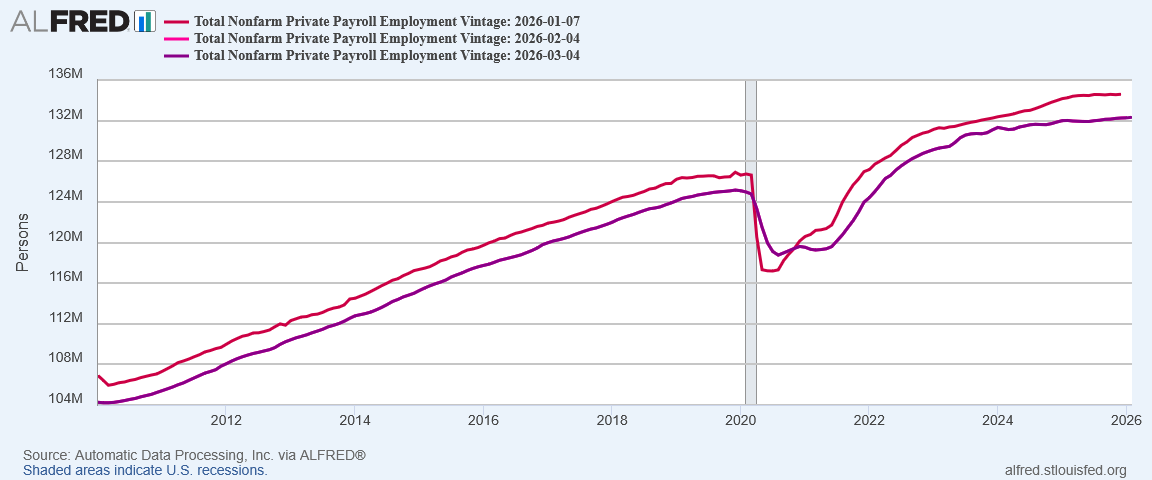
However, the lack of a mass revision across the entire data set does not mean there were no revisions. If we zero in on the change in employment month on month, we see that the data did shift in January.
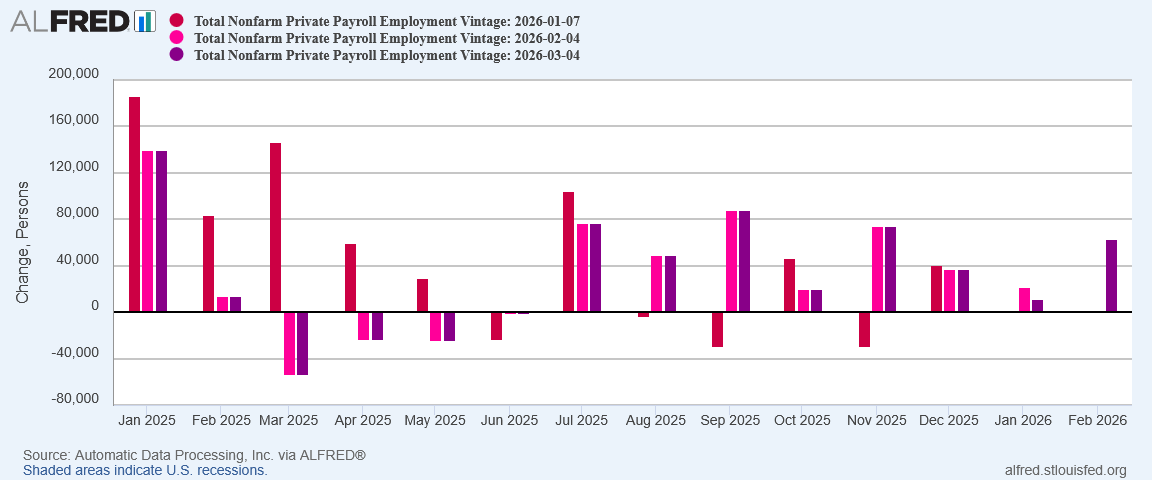
It turns out that job growth in January was only 11,000 jobs, according to ADP. As I noted yesterday shortly after the jobs data was published, these historical revisions work against the job growth reported by the headline data.
Much as with the BLS data, ADP revised its January estimate downward based on late data. Within the FAQ portion of the monthly press release, ADP states that this can happen sporadically.
How are prior-month revisions calculated in the ADP National Employment Report?
Employment estimates are based on weekly summaries of anonymized and aggregated ADP client activity. Employers pay individuals on different cadences, including weekly, biweekly, semi-monthly, or monthly. In any given month, a small number of clients might report no activity. These clients are excluded from NER estimates of employment change. In the subsequent month, if and when we receive any client data remaining from the prior month, that information is incorporated into the revision.
Data can always arrive late, and so it is unsurprising that there would be revisions to prior months. With the BLS Employment Situation Summary, there are always revisions to prior months.
As with the Employment Situation Summary, the full ADP press release quantifies the prior month’s revisions.
The January total number of jobs added was revised from 22,000 to 11,000.
What was shocking about the January report is that there was no quantification of the mass revision, or acknowledgement that it was backdated to the very beginning of the ADP data set.
The December total number of jobs added was revised from 41,000 to 37,000.
The January 2026 report reflects a scheduled annual revision of the ADP National Employment Report. The data series has been reweighted to match the Quarterly Census of Employment and Wages (QCEW) benchmark data through March 2025.
Beginning this month, in addition to the annual benchmark revision, the ADP National Employment Report also will reflect data from the most recent QCEW release.
That is a significant omission, as it can lead to a misapprehension of the magnitude of recent job growth. When revising a data set it is imperative that the revision be quantified, in order to adequately report the consequence of the revisions.
Because of that lack in the January report, the February report is giving a better treatment of the data.
That being said, job growth was still cut in half for January. As bad as the January ADP jobs report was initially, the revisions made it even worse.
Should we consider the revisions normal, or signs of bias? To determine that, we need to look at the data sector by sector.
When we look at the sector by sector data, we see that not all sectors saw their numbers revised in January.
That has been a mixed blessing, as it means that Manufacturing, which has been shedding jobs for months, is still shedding jobs.
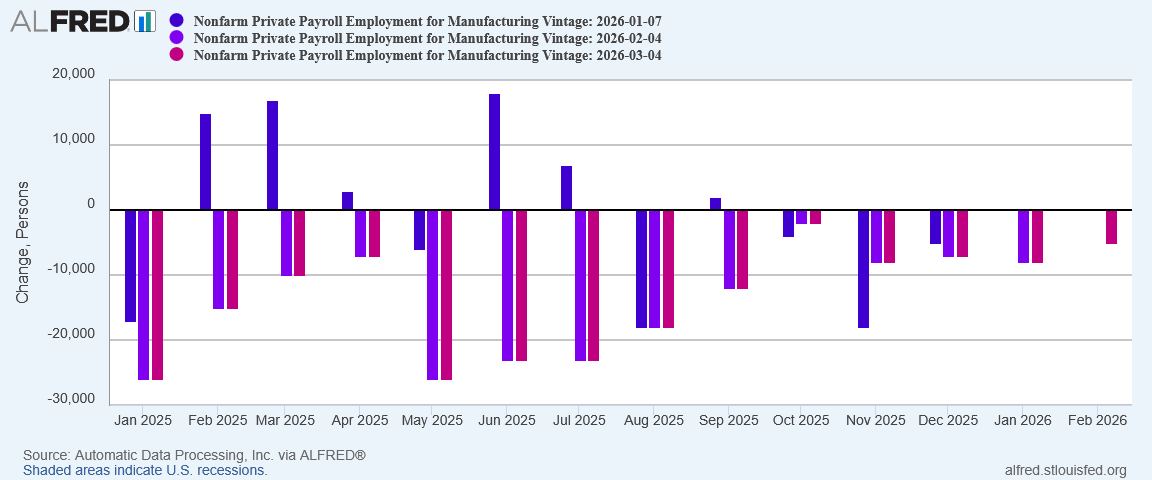
Construction and Leisure and Hospitality also saw no change in their January numbers.


Trade, Transportation, and Utilities, an important services sector, actually saw an upward revision, from 4,000 to 16,000 jobs.
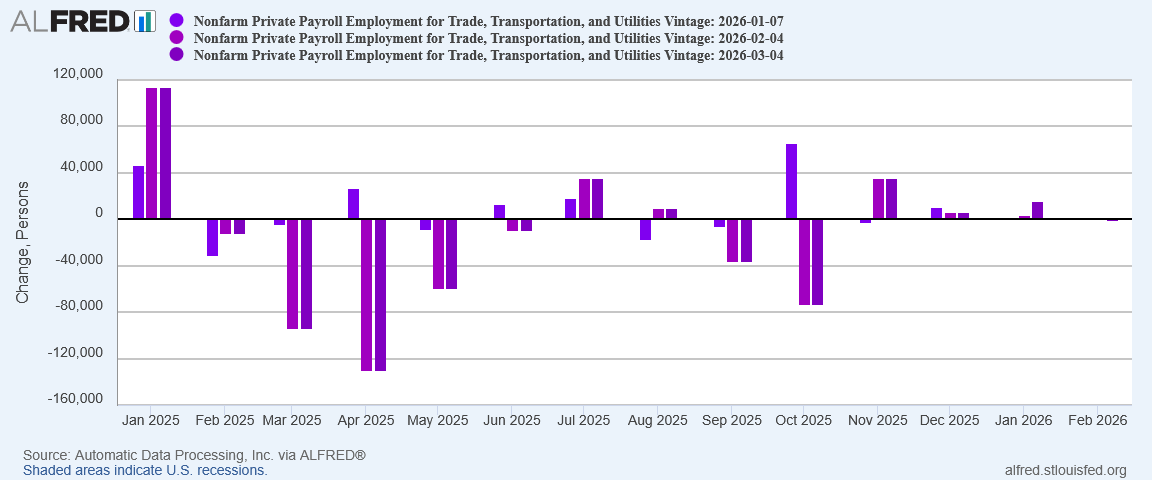
Professional and Business Services, as well as Information, both of which shed quite a few jobs in 2025, also were revised upwards—meaning they lost fewer jobs.


Sectors which had downward revisions for January included Mining and Financial Services, which lost 1,000 jobs each.


By far the sector which had the largest downward revision for January was Healthcare, which was reduced by 24,000 jobs for January.
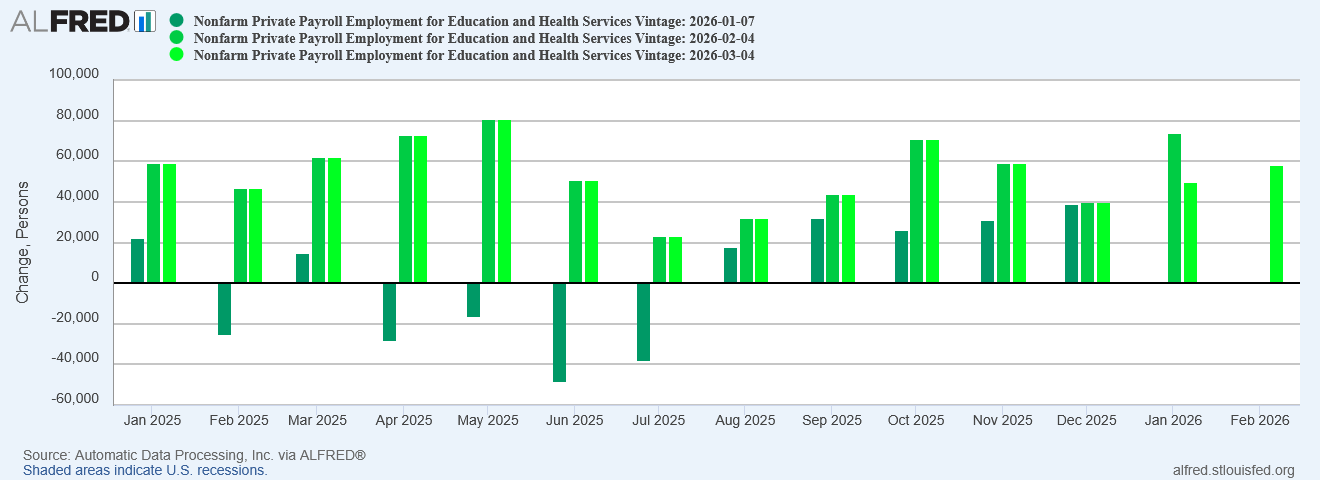
The Healthcare revisions are particularly noteworthy, as that sector has been where most job growth in the US has been concentrated.
Outside of the concentrated decline in healthcare jobs, however, the sector level revisions are fairly small and move in both directions. That tends to argue against any form of bias in the data, which would skew all the sectors in the same direction, either up or down.
Is the ADP data tainted by Lou Costello Labor Math? No, it is not—at least, not for February.
While there were revisions to the January data, outside of Healthcare the magnitude of the revisions was relatively small—a few thousand jobs either up or down. That is not indicative of bias, but of normal sampling error.
This month’s revisions are distinctly different from the mass revision introduced (and poorly explained) for January. Lowering employment levels extending back to the very beginning of the data set is an extraordinary alteration to the data. Absent clear explanation for such a revision, it has to be viewed with suspicion.
The revisions we see in this month’s ADP jobs report are not like that. They are incremental. They move both up and down.
We should note, however, that the overall jobs number was revised down in January just as it was revised down in December, independent of the mass revision across the entire data set.. As with the Employment Situation Summary, when revisions are always in the same direction, that is a clear indication of bias in the data. What sets the ADP revisions apart from what we’ve seen in the BLS data is the magnitude of revisions. In the BLS data prior months’ revisions can wipe out an entire month’s jobs gain.
We should not expect the 63,000 jobs figure to stand. If the current patterns hold, we will see the February headline number reduced just as in December and January. If the headline number is revised down by 11,000 jobs, just as was done this month, the ADP report will have landed line with the Wall Street consensus.
Is the ADP data therefore more reliable than the BLS data? If we look just at the magnitude and distribution of prior month revisions, we can at least say the ADP data set shows greater consistency month to month.
As all the job reports are estimates, the total numbers are inherently just “best guesses”. When the data is consistent any trends which are observed—month on month rising job growth, for example—are going to be a more reliable indicator of movement within job markets in the US.
We need to remain skeptical of the numbers, and anticipate another round of downward revisions when the March data is released, but, going by the January revisions, the ADP data for February appears to be relatively “clean”.
In February, ADP held the Lou Costello Labor Math to a minimum.
Thank you for another objective analysis, Peter. You’re the best!
There have been multiple posts on Substack regarding the enormity of fraud throughout America, particularly Democrat-dominated cities. Much of this fraud is in the health care sector, such as home health care and daycares. As this becomes exposed, the government may have to make huge revisions to the data. I know I can count on you to jump on that!
Speaking of jobs- I’m just a single mom from NY state with an almost 20 year old son, who has had a hell of a time keeping a job. And I mean any job. This is not due to my son lacking in any of the traits employers seek when hiring. This is due to the lack of actual available jobs.
In the past year alone, my son has applied to, and had been hired by four different companies. All of which insured he would get at least 25-30 hours per week of work.
Welp, all four companies lied. Same story, every company:
He’d start work, first week was training…and places seemed overstaffed, but training hours got him a full paycheck. Then, starting week two, hours were drastically cut. I mean, cut in half or more! With no explanation when he inquired, just a “ give it some time, we only have so many hours we can distribute between all employees”. However, every company continued to display their “help wanted” signs, and continued interviewing new hires. Why on earth would companies hire more employees then they had hours of work for?
Discouraged, and desperately needing wages, my son moved on to the next company- only to find out that their tactics were exactly the same as the company prior. Currently he was hired at chipotle. Annnnd, you got it! Same shit! Week one, training hours. Week two, hours cut down to ONE (6 hr) SHIFT. Week three, TWO shifts. And they get paid bi-weekly. My son attempted several times last week to contact the manager about the cut in hours. My son never got a return call. Went online to read employee reviews and was struck by a wall of absolutely horrific confessions that validated every single awful scenario I have described, and many more. It seems part of the system of systems of the employment sector has implemented some kind of bs that makes job attainment and security for young adults, near impossible to acquire. Luckily I’m a mother who bears integrity that I can pass on to my son, so we don’t give up trying. However, imagine the true implications of this?
As hiring signs are still displayed, people are still being hired, yet aren’t given any work. Making it damn hard to acquire any type of useful income. Being tethered to jobs that make false promises.
I’m sure this is meant to keep statistics heading up in numbers when it comes to employment opps. But in all actuality, these companies aren’t actually putting people to work. And they certainly aren’t paying them for doing nothing.