


The January ADP National Employment Report makes one thing crystal clear: with only 22,000 new jobs created overall in January, the jobs recession is not ending. For most employment sectors in the report, the jobs recession is getting worse.


Even Dr. Nela Richardson, ADP’s Chief Economist, acknowledged that the data was not great.
Job creation took a step back in 2025, with private employers adding 398,000 jobs, down from 771,000 in 2024. While we’ve seen a continuous and dramatic slowdown in job creation for the past three years, wage growth has remained stable.
What Dr. Richardson did not acknowledge is that ADP has been overstating private payroll employment by on average around 2 million jobs since 2010.
What Dr. Richardson also did not acknowledge is that without Education and Health Care, the overall jobs number for January would be negative.
Job growth has been slowing in both the ADP report and the BLS Employment Situation Survey for years, and with January’s report it is clear that trend is not going to reverse any time soon. Job growth is continuing to disappear.
America needs jobs. ADP has confirmed yet again that, in most sectors, America has lost jobs.
This is not a good thing.
ADP Made Two Million Jobs Disappear
ADP gave itself a significant self-inflicted credibility wound in the January jobs report: it made a major correction to its historical data but made no mention of it in the report.
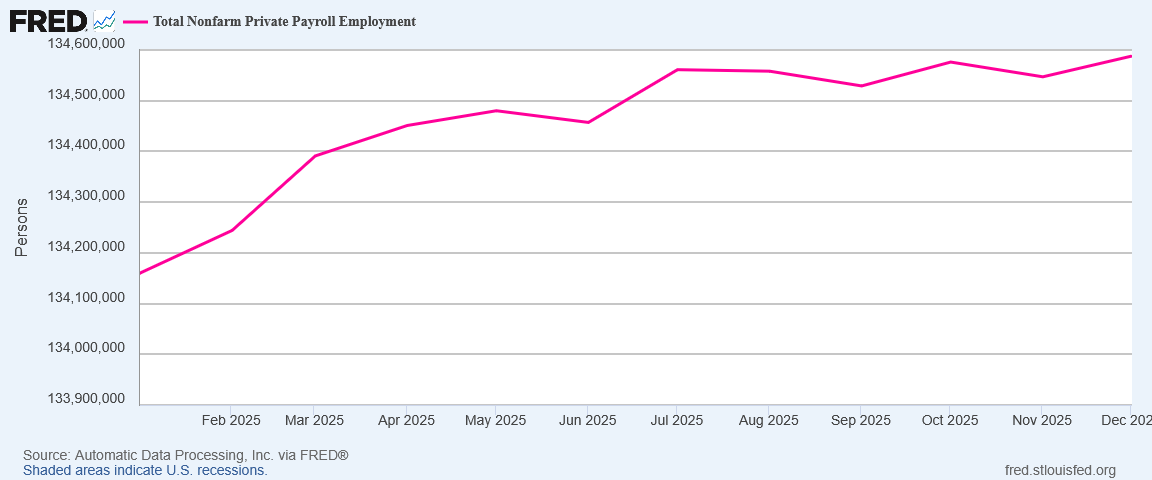
Looking at the top level numbers, it was immediately apparent that something had shifted in the data. The Total Nonfarm Private Employment chart last month looked like this:
The same report, pulled from Fred using the same pre-saved graph, this time look like this:
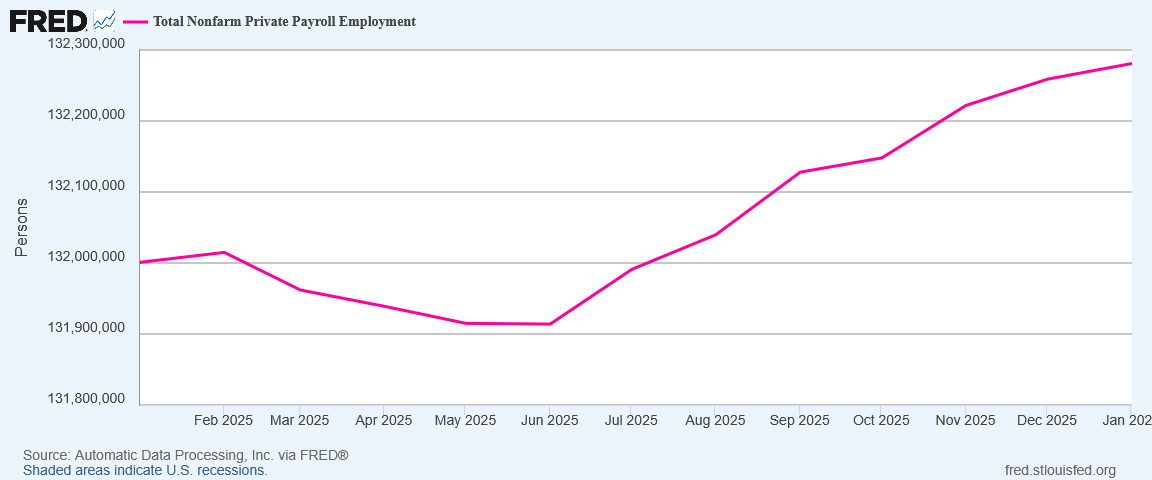
Obviously, something drastically changed for the total figure to move from job growth in the December print to job loss in the January print. ADP does not normally revise its historical data.
When you look at last month’s data set going back to 2010 and this month’s data set, it is immediately clear that ADP shifted the data down approximately two million jobs.
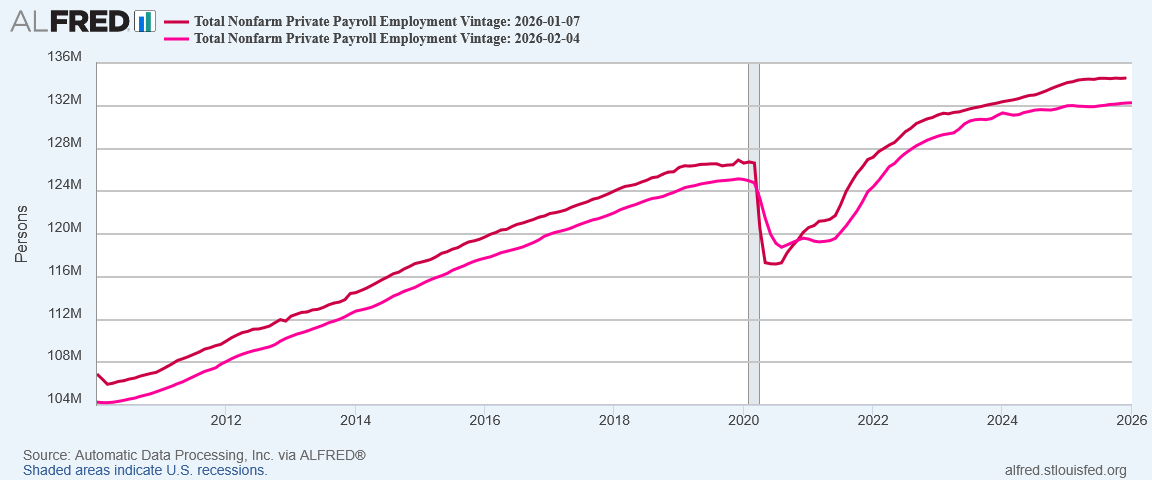
Historical revisions and database corrections are not at all unusual, but ADP owed those who use their National Employment Report transparency on the revision. There is no disclosure of this revision at all. All ADP concedes is that January is the month when the BLS revises its data sets.
The January 2026 report reflects a scheduled annual revision of the ADP National Employment Report. The data series has been reweighted to match the Quarterly Census of Employment and Wages (QCEW) benchmark data through March 2025.
With economic data especially, historical trends are generally more important than the raw data itself. ADP altered the job growth trend across its entire database and said nothing about it.
Sector Jobs Suckage Continues
There is no getting around the ADP job growth figures by sector: they suck.
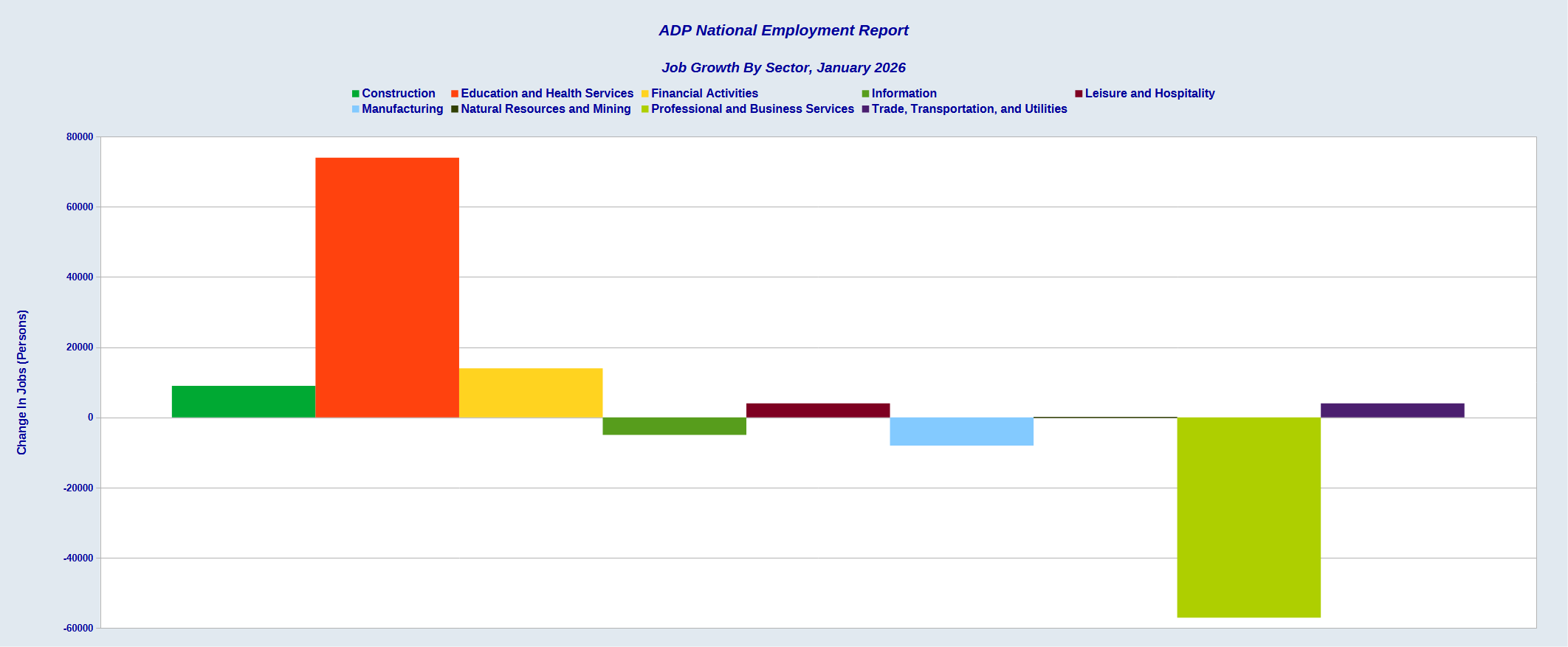
Within the month of January, but for Education and Health Services, ADP would have printed job loss, with Information leading the carnage.
Manufacturing has proved to be a blood bath for the whole of 2025, with nothing but job loss across the entire year and into January 2026.
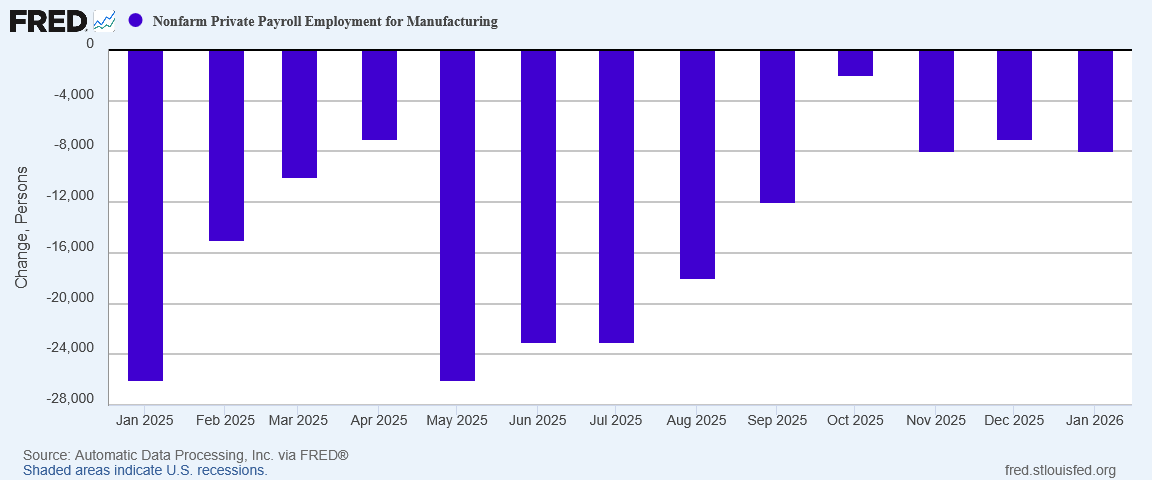
Manufacturing was a sector that saw significant historical revisions as well—this was the chart from last month.
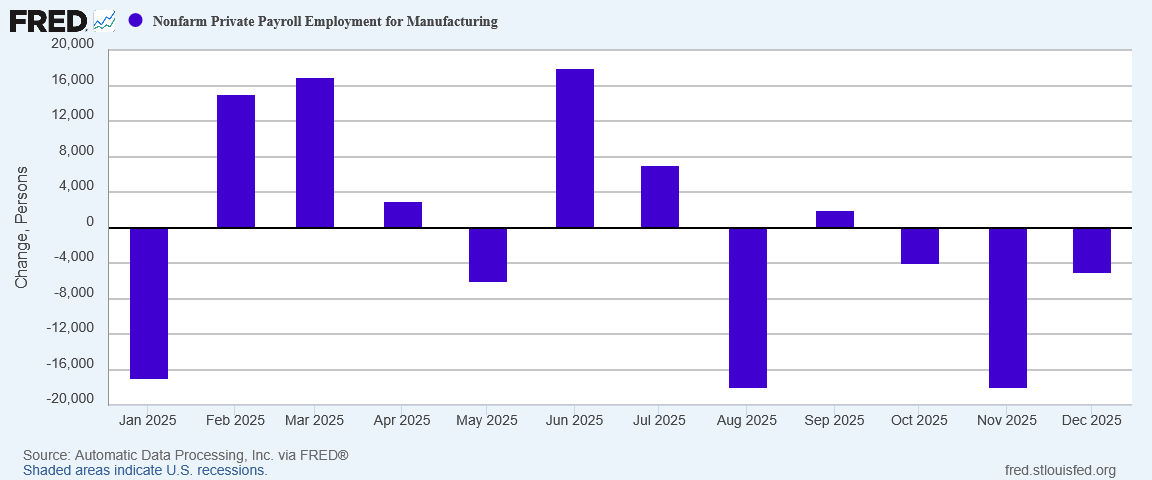
This highlights the magnitude of ADP “revisions”.
Trade, Transportation, and Utilities added a paltry 4,000 jobs last month.
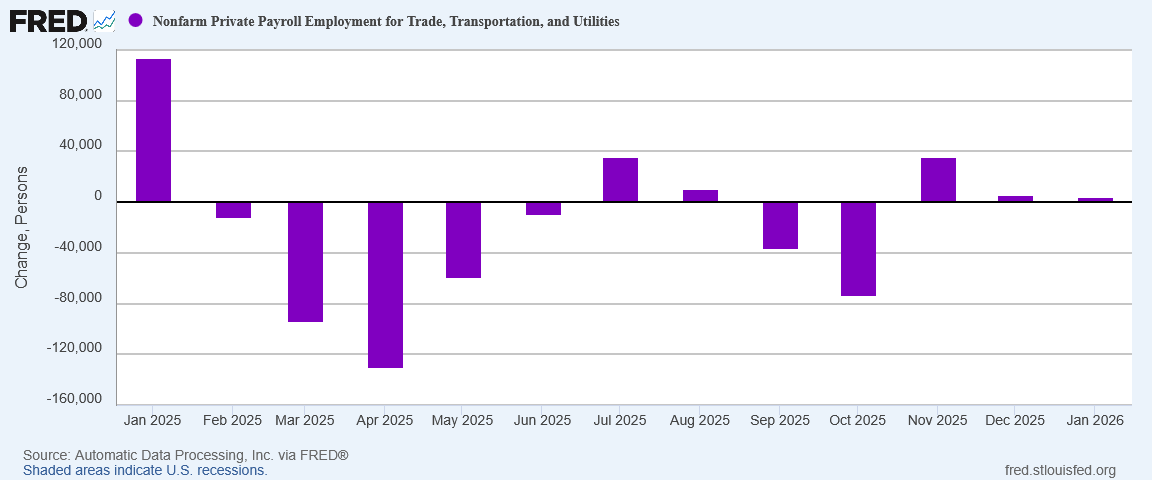
Overall, the sector lost jobs in 2025.
Construction did a bit better in January, at 9,000 jobs.
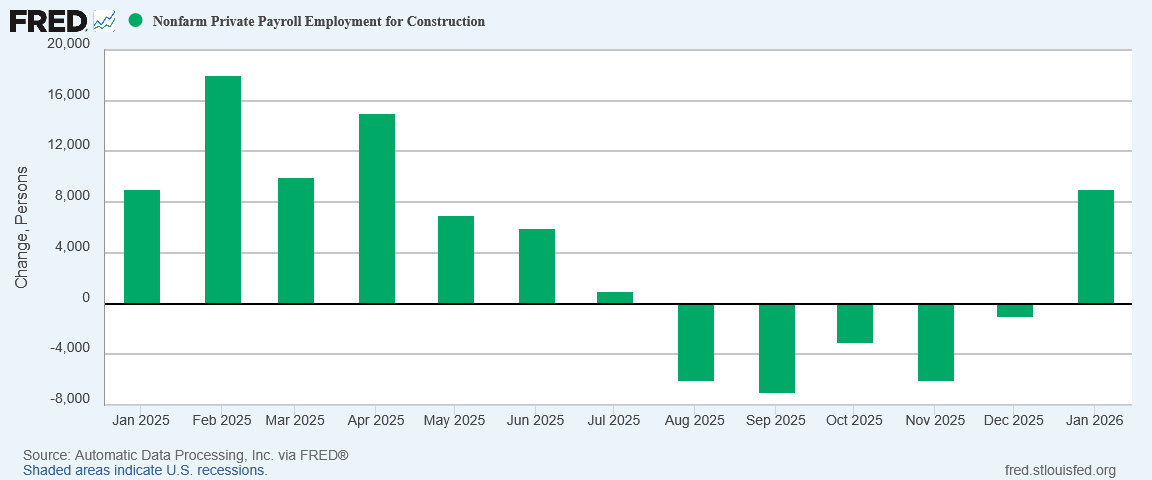
This was a welcome turnaround after nothing but job loss since last August.
The only sector which shows sustained employment strength in 2025 was Education and Health Services.
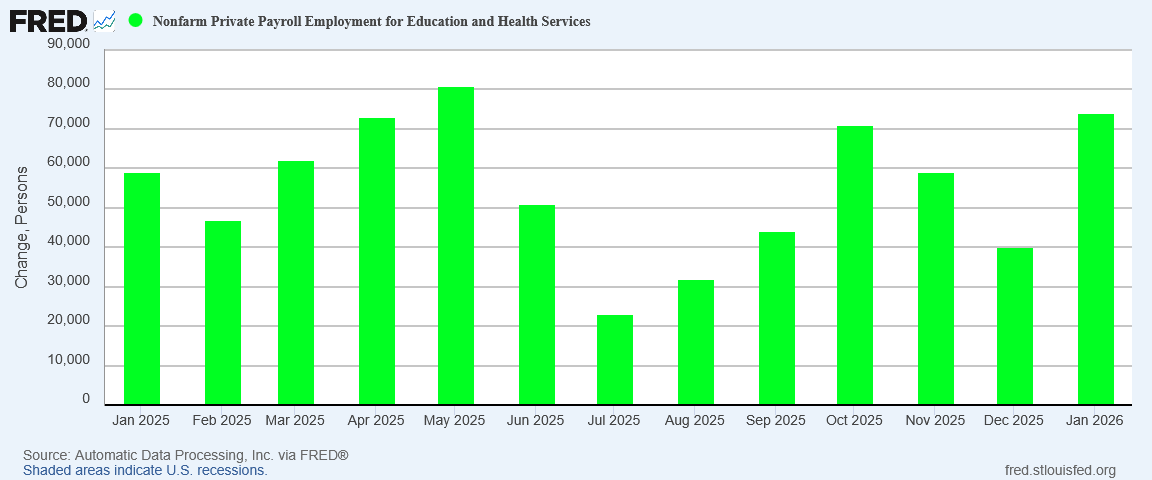
Leisure and Hospitality, Professional and Business Services, and Financial Activities all eked out job growth last month, but job growth in these sectors since January 2025 was either slim or none.


Information warrants a special mention, as its job growth numbers have been horrible for quite some time.
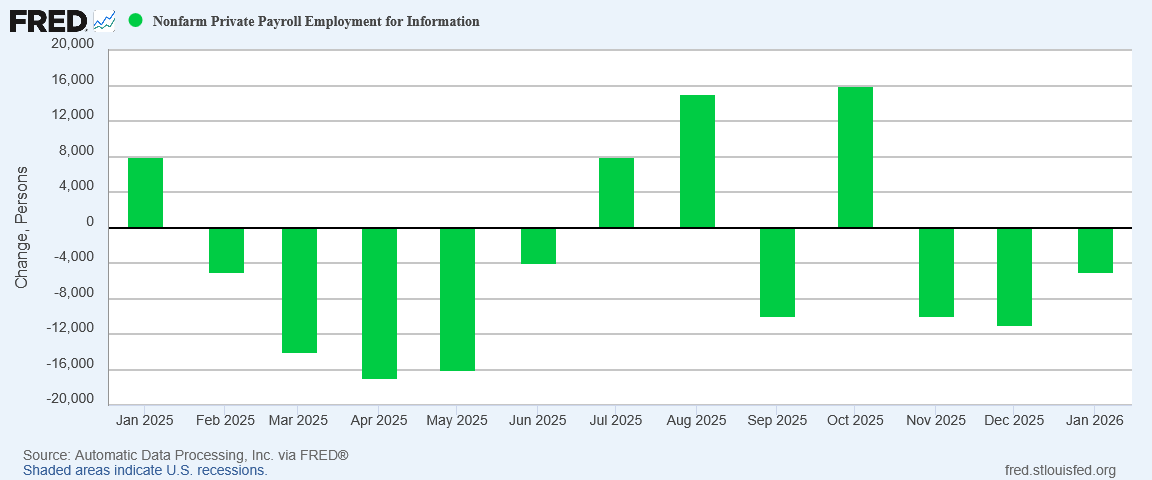
Not only was job growth negative for 2025, but Information has been shedding jobs since February 2023.
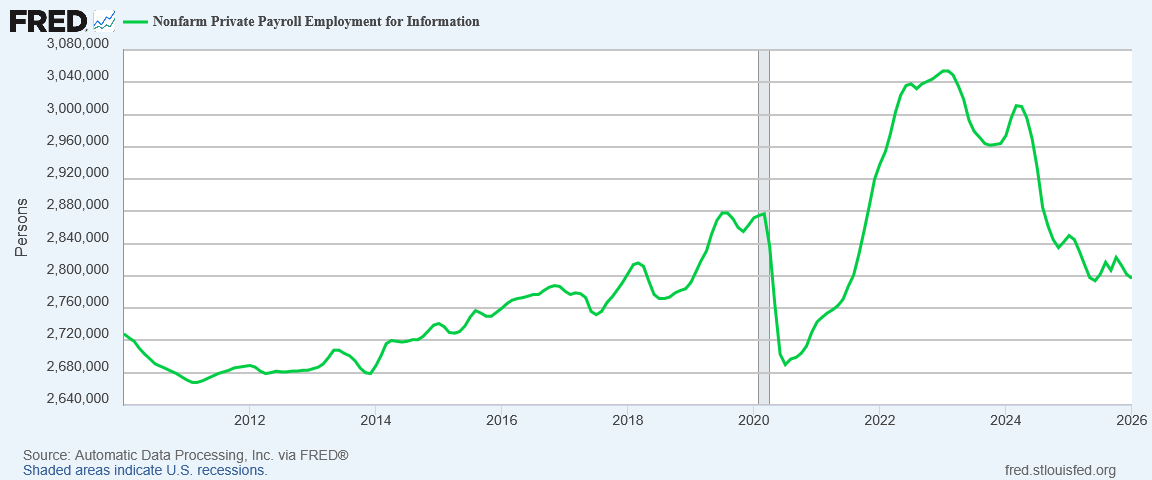
The tech sector, as the source of supposed tech “revolutions” such as artificial intelligence, is unable to sustain employment even within the sector. How technology is going to foster employment elsewhere under those circumstances remains very much a mystery.
Wall Street Did Not Expect This
Not only were the ADP job numbers by sector horrible last month, but they were a shock to most of Wall Street.
Wall Street had a relatively optimistic consensus forecast for jobs growth of roughly 48,000 to start the year. Trading Economics was more conservative at 35,000 jobs.

Both estimates were wildly wrong. The Wall Street consensus was more than double the actual job creation number. Equities, particularly the technology-heavy NASDAQ, were quick to express their displeasure, with the NASDAQ Composite Index losing more than a percentage point on the day.
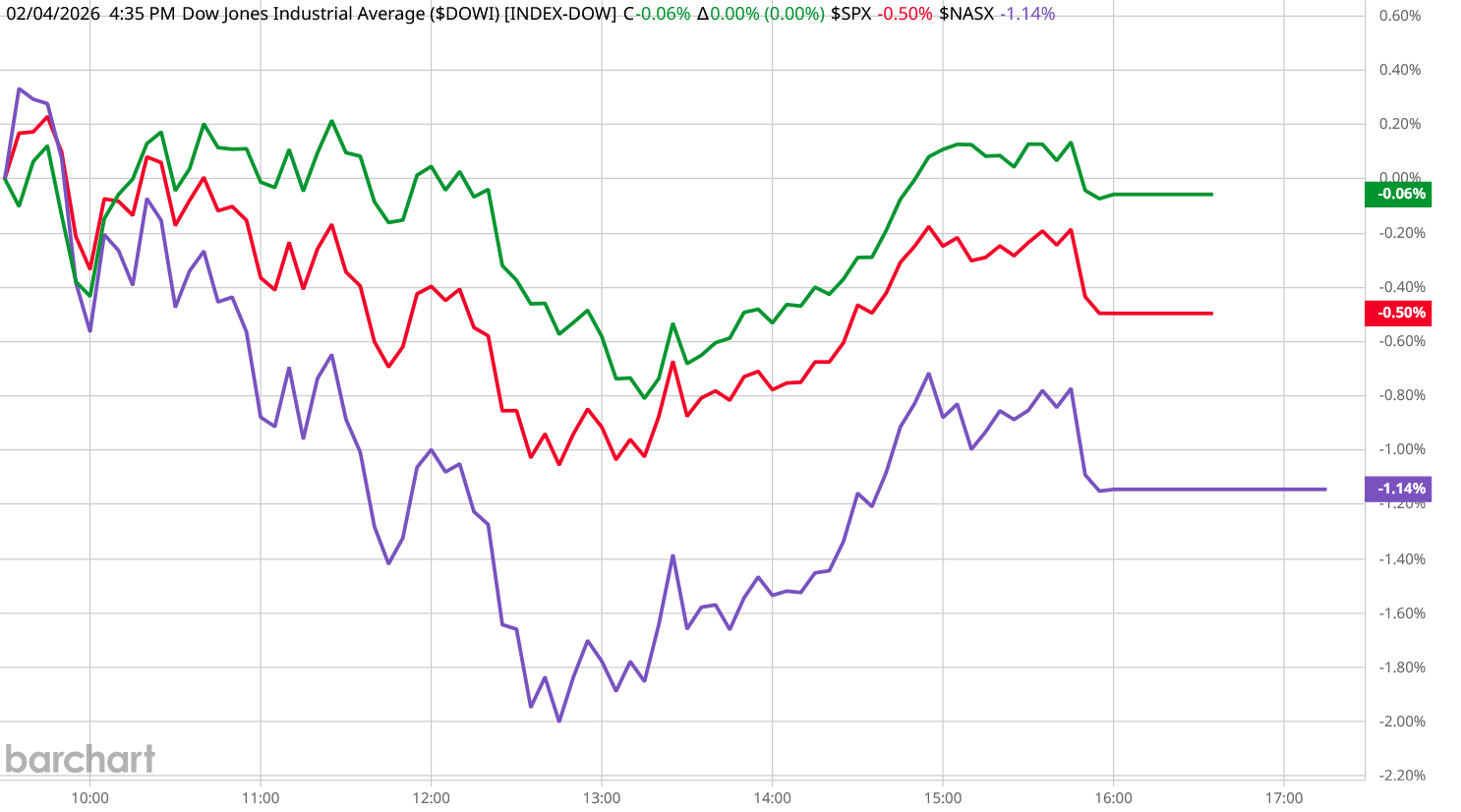
Wall Street being wrong has become a perverse sort of “new normal”. It has been happening so often of late that even the usually clueless New York Times saw fit to comment on it.
Forecasts that turn out to be wrong — or defy expectations — are as routine as a heartbeat.
But now something is up. Familiar guideposts to how businesses, consumers, investors and workers have historically responded to economic slings and arrows have turned out to be less reliable.
Wall Street’s dramatic miss is not only the latest exemplar of a missed forecast, it is also another illustration of how much the overall economic environment has shifted post-COVID, a reality I noted just the other day.
The breakdown in Wall Street’s forecasting abilities underscores the need to delve into the details on all economic data sets. The headline numbers simply do not have the significance that has long been attributed to them, and never really did. Wall Street’s complete misread of the ADP jobs data proves that much in abundance.
America Needs Jobs, But Is Losing Them Instead
There is no need for detailed introspection into the ADP job numbers. With an anemic headline number, with historical downward revisions of approximately two million jobs going all the way back to 2010 and beyond, and with nearly all sectors have minimal job growth or outright job loss, the January edition of the National Employment Report is a downright horrible report.
Bad jobs reports has been the trend at ADP for the past few months in particular, a grim attestation to the jobs recession.
The December report was a jobs disappointment.
The November report was an alarm klaxon just as this one is.
The October report tried to look good but still ended up a disappointment.
Even though the Labor Department’s unemployment claims data has recently offered some reasons to have a moment of optimism that the jobs recession may be about to end, negative employment signals have been in abundance across the whole of the US economy.
The shifting economic landscape may make forecasting difficult, but no forecast is needed to understand that the present employment outlook in America simply sucks.
America is losing jobs. Across nearly every sector, there have been months of job loss in 2025. Key sectors such as Manufacturing and Information are downright toxic where job growth is concerned.
This is not good news. This is yet another reminder that President Trump’s “Golden Age” for the American Economy has not yet filtered through to Main Street.
Jobs are the still foundation for all economic prosperity in every country. Jobs were foundational to Adam Smith’s understanding of national wealth in 1776, and jobs are still where national wealth is formed.
Without jobs, economic prosperity cannot happen in this country.
Without a reversal of manufacturing job loss, America can never become a manufacturing superpower.
Without a reversal of Information job loss, AI will bring little economic benefit to Main Street.
America needs jobs, but is losing them instead. I don’t need reliable forecasts to know that trend will end disastrously if not reversed.
I think your observation is correct Peter. The economy has shifted in ways that are not being shown accurately in the economic models and metrics used in the past.
One shift is in the increase of people receiving transfer payments - benefits - from the government. More people on disability, more Boomers retiring, more Democrat-controlled cities with increased government handouts, plus fraud that apparently has become widespread and normalized. All of these have resulted in an economy that is not as much structured toward productivity as in the past, and that’s not a good thing! Previous economic reporting metrics assumed an economy geared for productivity, not dependency, and consequently the projections/reporting/metrics are all skewed somehow. Economists need to figure this out, or we’ll be investing in the economy in unproductive ways.
Another shift is the increased propaganda that is everywhere! Corporate media, government agencies, NGOs, and private entities are constantly projecting pictures of our economy that are propaganda, not facts. The result is an economy where resources are misdirected. Here’s an example from today’s edition of the local leftist newspaper:
https://www.startribune.com/minnesota-refugees-and-immigrants-are-hiding-in-a-prison-of-fear/601571791?utm_source=gift
The propaganda in this article is that small businesses are failing in Minneapolis because ICE has employees and customers hiding in fear from ICE, when the actuality is that many customers are staying away from these businesses because of the protesters! We are afraid of our cars being vandalized by activists, and of being attacked by rioters. Mobs of self-appointed vigilantes are literally blocking intersections and demanding IDs from drivers trying to get through. Who wants to go to a store or restaurant under those circumstances? Yet, the media misrepresents the entire situation! How much do misrepresentations like this newspaper article skew the use of resources, and thus skew the economic figures and projections?
Bottom line: we’ve got an economy that has been losing jobs, as you’ve repeatedly and accurately noted, Peter. Thank you!