

Update 07:30 AM CDT 12 May 2025
Ukrainian President Volodomyr Zelenskyy is either taking a positive step forward towards peace or taking the bait in a Vladimir Putin head fake on talks. While reiterating his call for a general ceasefire, Zelenskyy is tentatively agreeing to meet with Putin in Turkey and talk.
The challenge in holding talks without a ceasefire in place is that there is no guarantee Russia would agree to a ceasefire once talks begin. There is also a risk that Putin will not negotiate in good faith, instead choosing to use the direct talks as a means to forestall further sanctions while continuing to press Ukraine on the battlefield.
But Putin’s offer for direct talks – made in a rare televised address at 1 a.m. local time Sunday – was a gamble to distract from the fact that Russia is likely to snub Monday’s ceasefire deadline, analysts said.
Putin’s offer put Zelensky under “huge pressure” to agree to hold talks in Turkey, Sergey Radchenko, a professor at the Johns Hopkins School of Advanced International Studies, told CNN.
“Why? Because otherwise, he’ll have to deal with Trump, who’s going to say, ‘Why are you undermining my peace initiative here? Why can’t you just talk?’”
This is a very real risk in agreeing to these talks.
However, while Putin is putting pressure on Ukraine militarily, military gains have been relatively small and incremental.


Even after months of attacks, pressure, and casualties, a key Ukrainian defensive position, Pokrovsk, still has not been taken by Russian forces.
That’s a problem for Putin, a problem made worse by a 24% drop in the price of Russia’s benchmark Urals oil blend.
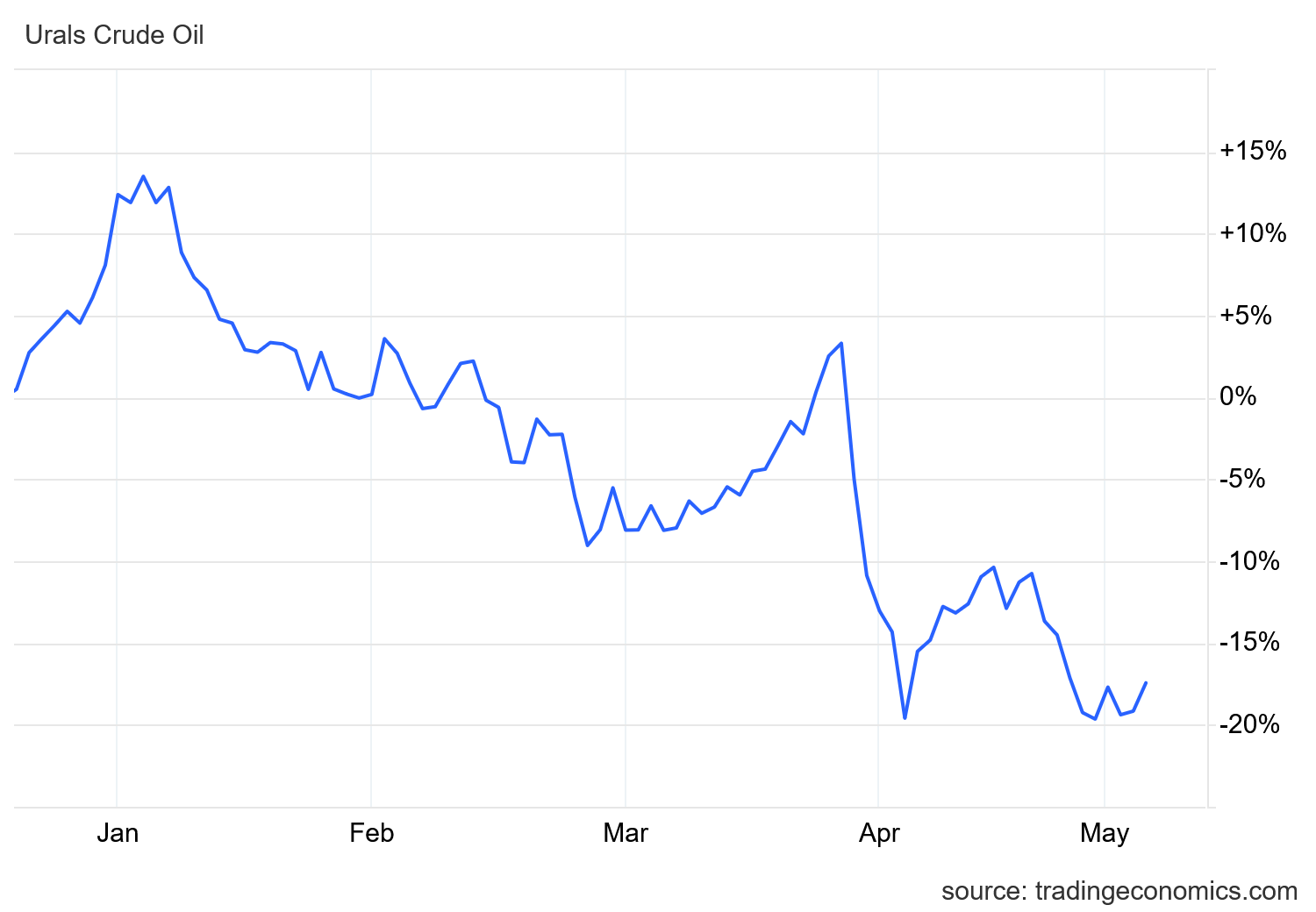
Russia needs oil revenues to fund its war effort; the drop in oil prices is a severe crimp in that funding.
An argument could be made that Putin would find a ceasefire right now advantageous, as it would open a window of opportunity to reinforce and resupply Russian troops in eastern Ukraine—at the risk of Ukraine doing the same thing.
This is the nature of the gamble in agreeing to Putin’s offer of direct talks. On the one hand, it is not a ceasefire, but on the other hand that means the negotiations are not a cover for resupply and a fresh military buildup.
This is also why the EU should follow through with its threat of further sanctions despite the offer of talks. Talks are not a ceasefire, and the EU ultimatum was for a ceasefire.
There will need to be some risks taken if there is to be peace in Ukraine. While talks are a risk worth taking at this point, no one should presume the talks are themselves a guarantee there will be peace. They are at most a starting point and a chance for peace.
Starting Point
Is the Trump Administration’s apparent diplomatic success brokering a ceasefire between India and Pakistan about to pay an unexpected dividend in Ukraine?
Maybe. Vladimir Putin wants to talk.
Russian President Vladimir Putin on Sunday proposed holding direct talks with Ukraine in Istanbul on May 15, hours after Kyiv and European leaders called for an unconditional 30-day ceasefire to start Monday.
This is not to say that Donald Trump is the only factor here. He isn’t. Ukraine and the EU preceded Putin’s offer of direct talks with an ultimatum: agree to a 30-day ceasefire or face further sanctions.
However, the EU ultimatum was itself preceded by substantially the same ultimatum by Donald Trump, issued on May 8 in a post on Truth Social.
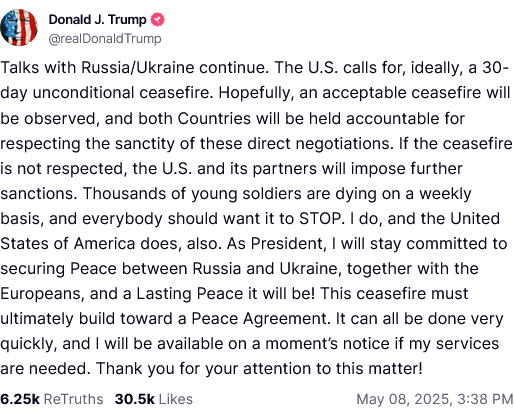
Moreover, Trump, Ukraine, and the EU have been pushing Russia to commit to a 30-day ceasefire for quite some time.
Yesterday, Putin responded not by agreeing to a ceasefire but offering direct talks “without preconditions”.
"We propose to the Kyiv authorities to resume the talks that they broke off in 2022, and, I emphasise, without any preconditions," Putin said.
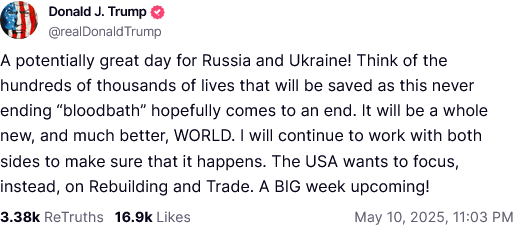
Trump’s response on Truth Social was positive—although it did not rescind either his call for a ceasefire or the threat of sanctions if a ceasefire was not forthcoming.
Talks are not a ceasefire, and at first glance this is easily dismissed as an effort by Putin to evade the diplomatic pressure for a ceasefire, which is the assessment of the BBC.
So, is the Kremlin's offer a serious peace initiative? Or is it simply an attempt by Moscow to play for time and to prolong the war? And, with this proposal, might Russia also be trying to split the Western coalition that is backing Ukraine?
However, while it is appropriate to question Putin’s motives for offering direct talks, it is equally appropriate to question Putin’s timing. Why make the offer now? What has changed with respect to the war in Ukraine that he decided to offer a counter-proposal to a ceasefire?
The sanctions threats are certainly one alteration in the status quo—but Russia is already heavily sanctioned. The practical impact of further sanctions seems problematic at best.
There is also Zelenskyy’s decision to (finally) sign a minerals deal with the United States. Regardless of the relative merits and demerits of that deal, its one undeniable geopolitical reality is that it gives the United States a vested interest in both Ukrainian sovereignty and Ukrainian territorial integrity—two elements that heretofore have been missing regarding military support for Ukraine’s war effort. The existence of that deal means Vladimir Putin cannot hope to simply wait for US war fatigue to persuade the Trump Administration to simply wash its hands of Ukraine.
But there is also the geopolitical reality that the world is having to acknowledge, albeit grudgingly in some cases, Donald Trump as being a serious peacemaker on the world stage. That is an unavoidable takeaway of Marco Rubio and JD Vance succeeding in brokering a ceasefire between India and Pakistan when others could not.

The Gulf States tried to arrange a ceasefire and failed. China wanted a ceasefire but could not get one. Even Russia offered to mediate a ceasefire without success. The Trump Administration succeeded—and as of this writing, that ceasefire is holding.
What does the ceasefire between India and Pakistan have to do with Putin? It adds gravitas to Trump’s earlier calls for a ceasefire in Ukraine—and that adds gravitas to the EU ultimatum. Coupled with the strategic reality that, thanks to the minerals deal, the US now has a direct interest in Ukraine to protect, if the Trump Administration “walks away” from peace efforts that could very easily mean walking towards greater military support for Ukraine.
Russia can grind just Ukraine down in a war of attrition. Russia might even be able to outlast the EU in their economic war of attrition over Ukraine.

If the United States continues to provide material support to Ukraine, however, Russia cannot grind just Ukraine down, certainly not in a short period of time.
Time is not Russia’s ally in this war. It never really was, and it absolutely is not now.

Trump receiving a boost of geopolitical credibility by arranging the ceasefire between India and Pakistan might very well have been the tipping point where Putin is convinced he needs to do “something”. Between the minerals deal and the India-Pakistan ceasefire, Trump’s leverage to pressure Russia to sit down and negotiate has only increased, and might have increased enough to move Putin off his initial position.
Direct talks are not a ceasefire, but neither are they a rejection of diplomacy. For whatever reason, Putin is warming up to diplomacy over Ukraine—at least superficially.
Should there be direct talks? Possibly—although the first item to be discussed would without a doubt be a ceasefire.
Should the talks preclude the imposition of further sanctions? Probably not. Both Trump and the EU have issued the sanction threat. It would be a dangerous message to send to Putin if he can use the chimera of talks to evade further sanctions against Russia.
However, everyone should remember that peace is what is in the best interests of both Ukraine and Russia, geopolitical posturing be damned.
Putin is starting to bend towards seeking peace over Ukraine. If Putin is more willing to respond to the United States as peacemaker as a result of India and Pakistan’s ceasefire, that is an opening in the Ukraine war which should not go to waste.
