


The Bureau of Labor Statistics remains quite addicted to its favorite anodyne bit of boilplate, “little changed.” The July Job Openings and Labor Turnover Summary report once again presumably showed no real change in America’s employment outlook, according to the BLS news release.

The number of job openings was little changed at 7.3 million in July, the U.S. Bureau of Labor Statistics reported today. Hires and total separations both changed little at 5.1 million. Within separations, quits (3.1 million) and layoffs and discharges (1.7 million) were little changed.
We should not pretend that “little changed” is at all the same as “unchanged.” Relative to some previous months, the changes in the JOLTS jobs data were fairly small—and that is precisely the problem.
A conspicuous lack of both hiring and firing means there is not a lot of labor turnover, period. A lack of labor turnover means a lack of job market volatility, which in turn means a jobs market that is just this side of completely frozen.
A jobs market locked in stasis would be a major red flag on the US economy. The July JOLTS report portrays a jobs market close enough to stasis that it qualifies as a minor red flag.
Corporate media wants to believe otherwise, but the low hires and separations totals yields a grim outlook for the US economy over the next few months.
Job Openings Ticked Up…Hooray!
While hiring and separations fell in July, reported job openings rose.
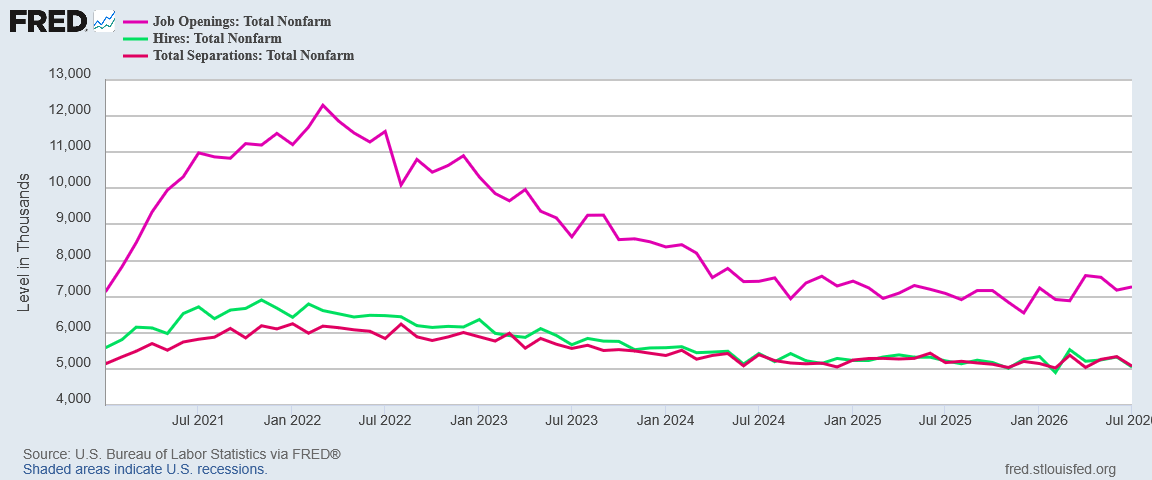
The Associated Press viewed this as a sign that US jobs markets were “ambling”.
The American job market is hardly booming, but it is ambling along despite an energy shock caused by the fighting with Iran that has squeezed family budgets.
Bloomberg spun the numbers as a sign of “stability”.
The report signals the labor market remains in the low-hire, low-fire environment that has defined much of the past few years. Employers may be cautious about expanding headcount amid geopolitical uncertainty and persistent inflation, but they have also been hesitant to let go of employees.
The Indeed Hiring Lab had perhaps the most honest assessment, that this “little changed” report might be reflective of a new normal for job markets.
For those looking for some kind of definitive turning point (in either direction) after months of similar job market dynamics, this report isn’t it. Job openings were little changed at 7.3 million, up from a downwardly revised 7.2 million in June. The hires rate fell to 3.2%, quits ticked down to 1.9%, and layoffs dropped slightly to 1%. We’re a ways off from the days of 8 million or more job openings in a given month, but the truth is the market doesn’t need to have that level of open jobs anymore to continue chugging along as it has. The labor market remains low-hire and low-fire, and at this point, it’s starting to look less like a phase and more like the new normal.
That may be the case—we certainly have seen enough low-hire, low-fire JOLTS reports to argue that is the case—but if it is, that’s not at all encouraging.
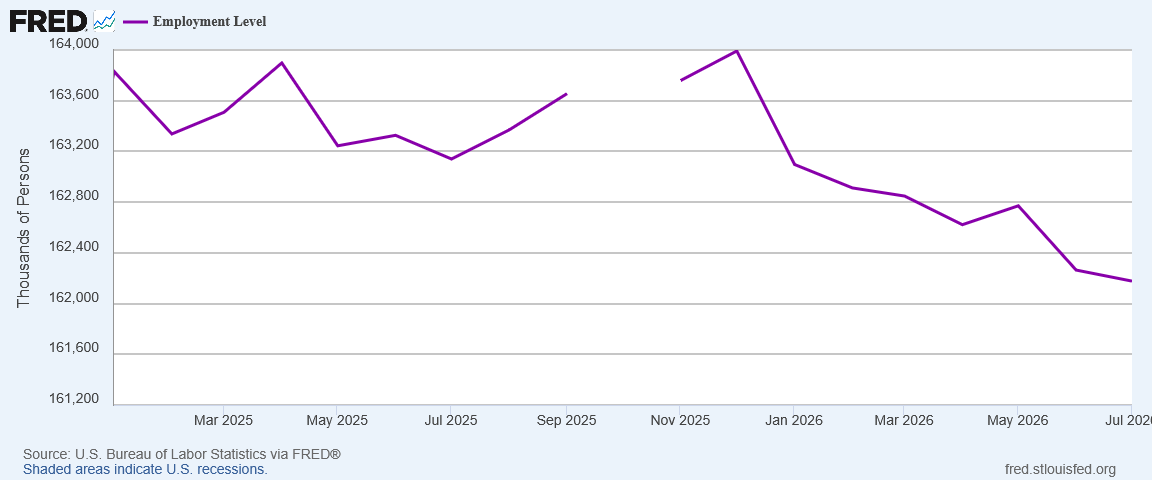
We should note that the July Employment Situation Summary shows the overall Employment Level in the US has dropped by nearly 2 million workers since last December.
The total Civilian Labor Force has declined by more than 2 million.
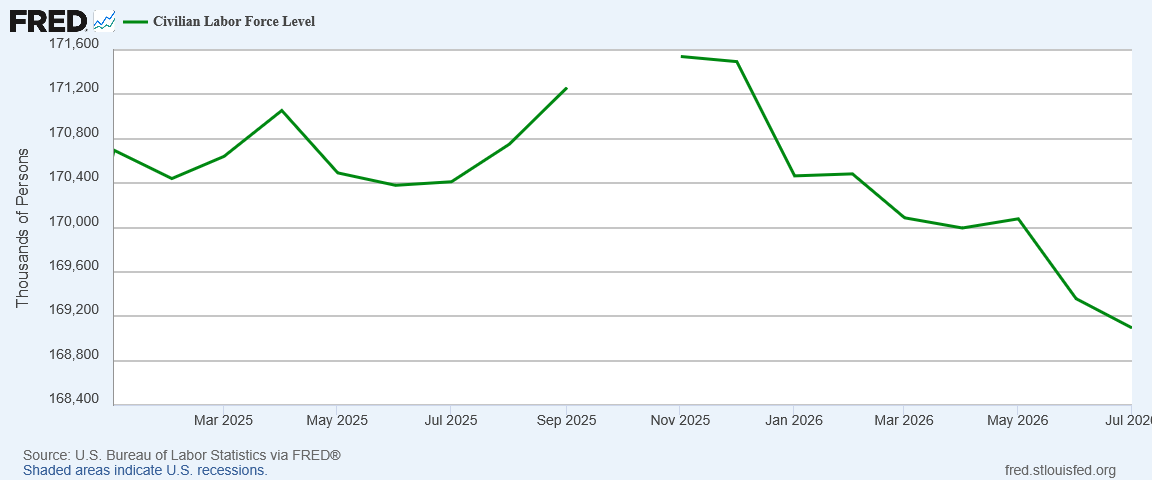
This “new normal” apparently is one where the US is losing workers, and is continuing to lose workers.
Labor force shrinkage is never a good sign for any economy. Ideally, a growing economy means more businesses producing more goods and needing more workers. If the US economy does not need so many workers, it very likely means the US economy is not growing as some have reported.
If the low-hire, low-fire labor market environment indicates a lack of confidence by workers in being able to find a job alongside a lack of confidence by employers in being able to find workers, it would be quite consistent with ongoing labor force shrinkage.
That would be a problem, and not a small one.
Nonfarm Net Hiring Declined Due To Government Job Loss
Superficially, the net hiring (Hires less Separations) for the total non-farm job market was in the negative for July.
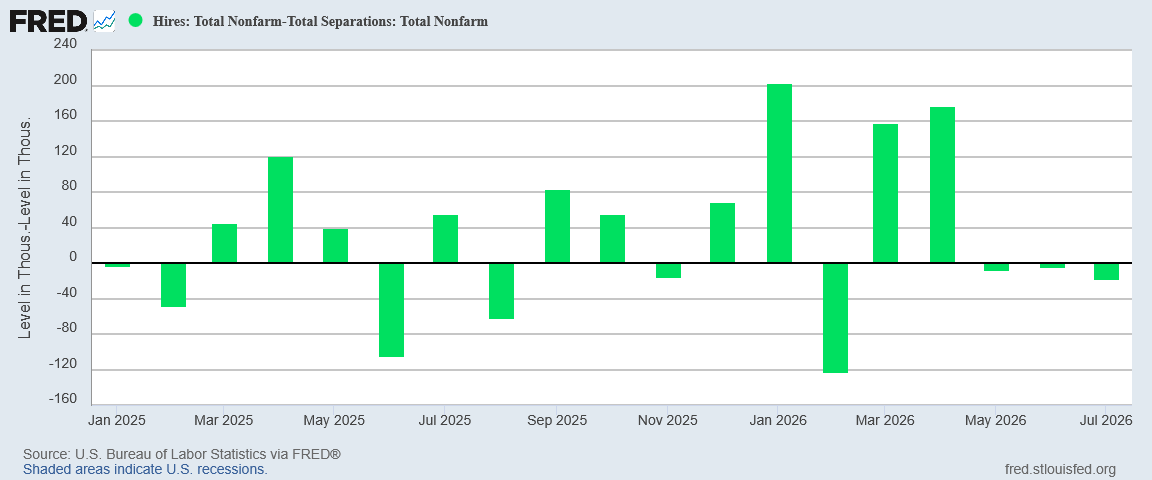
July was the third month total nonfarm net hiring was negative.
However, the consolation in that negative number is that it is driven by government job loss. When we look at total private net hiring, we see some job growth on the month.
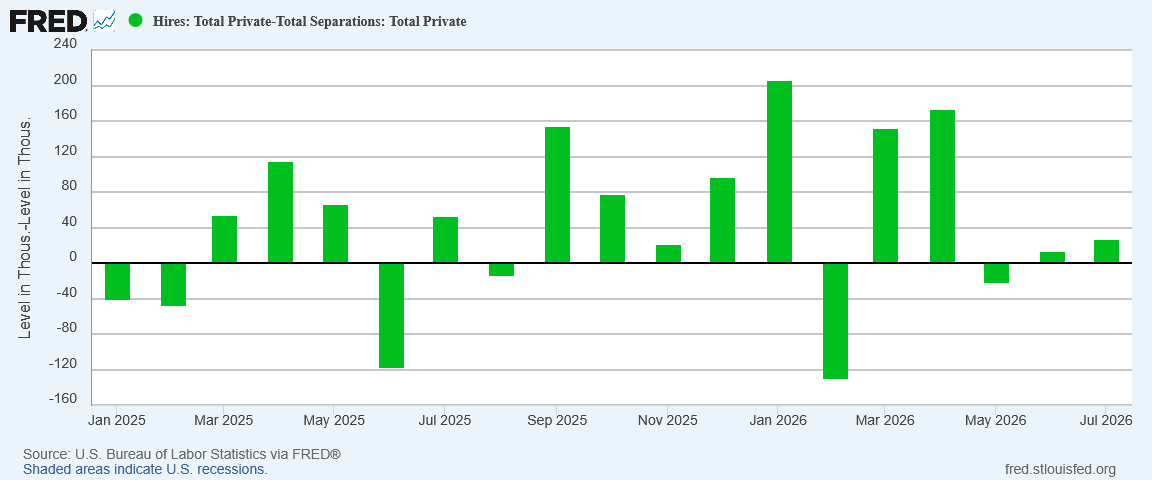
We are not seeing anything like the private net hiring we saw in March or April, however, as July was the third worst positive job growth month since January 2025.
Job markets have indisputably chilled in just the past few months. That is not a good sign in any economy.
The next few months may end up proving even worse, however. Even within the JOLTS, not only were the July numbers not encouraging, the June numbers have been revised downward almost completely across the board.
The number of job openings for June was revised down by 177,000 to 7.2 million, the number of hires was revised down by 16,000 to 5.3 million, and the number of total separations was revised down by 14,000 to 5.3 million. Within separations, the number of quits was revised down by 19,000 to 3.2 million, and the number of layoffs and discharges was revised up by 19,000 to 1.8 million.
The JOLTS data also suggests we may have significant revisions in the upcoming August Employment Situation Summary. A sizable portion of job sectors have shown less job growth in last three months’ JOLTS reports than in the corresponding Employment Situation Summary.
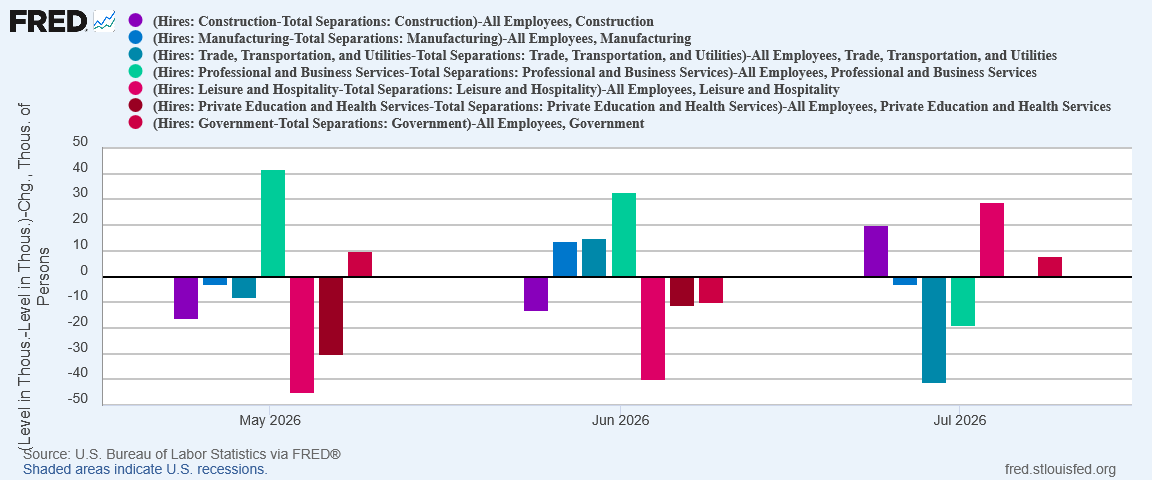
Where job sector growth is overstated in one month, we can expect corrections and downgrades over the next few months.
The variances between the JOLTS data and the Employment Situation Summary data reminds us that the BLS still has not weaned itself from Lou Costello Labor Math.
Job Sectors Cooled Across The Board
The most disconcerting aspect of the JOLTS report was that, outside of Construction, job growth in July cooled across the board.
Construction did great in July, according to the JOLTS data.
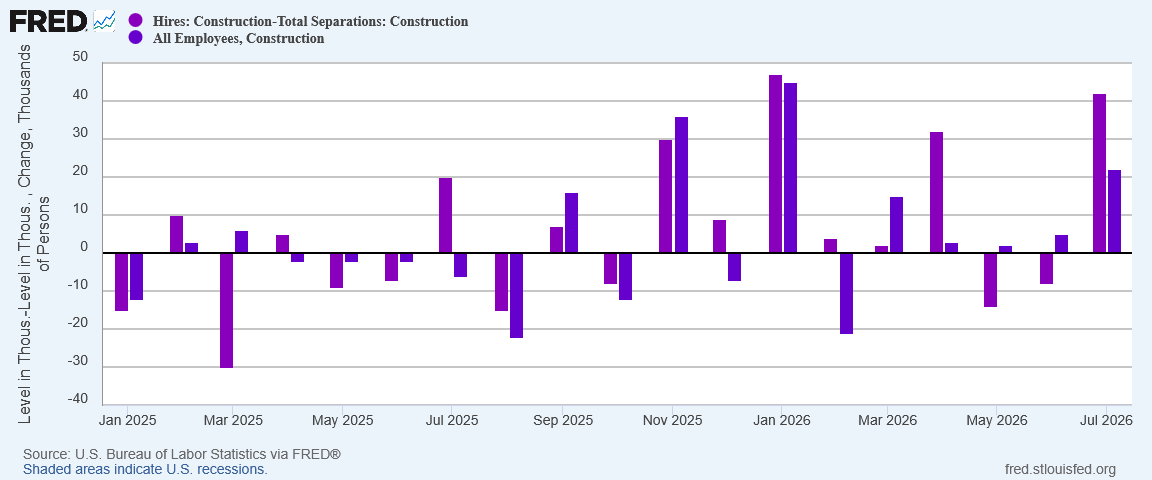
Construction was the only sector to have a good month.
Manufacturing and Healthcare showed some job growth, but noticeably less than in June.
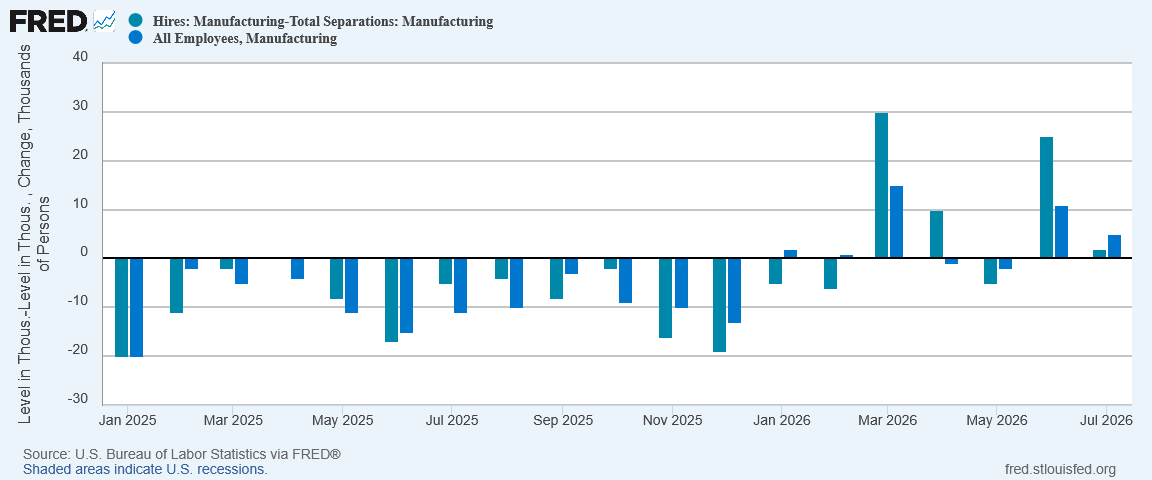
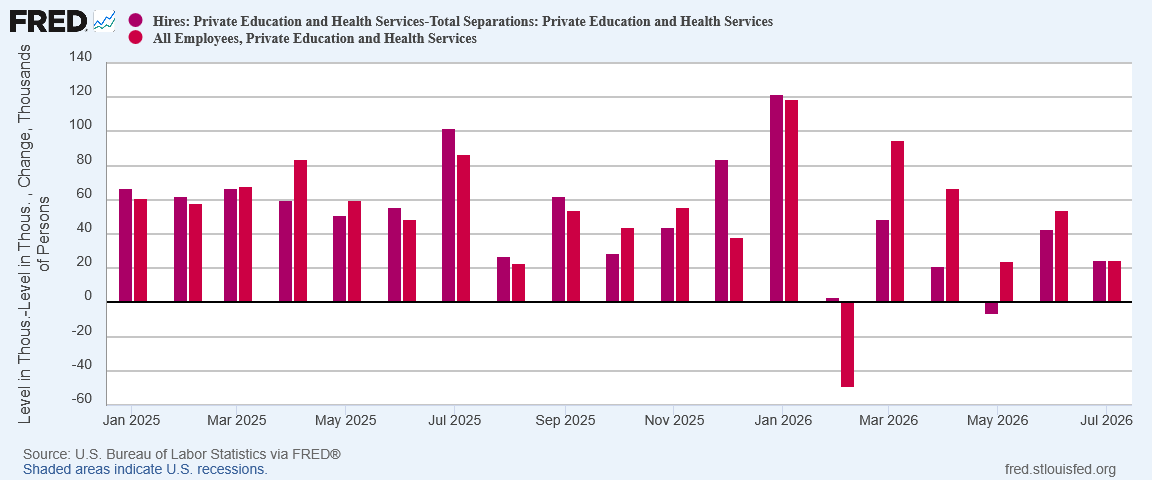
Professional Services, Trade Transportation & Utilities, and Leisure all charted job loss in July.


Less job growth and even less jobs do not signal a robust labor market or a vibrant economy.
For all of corporate media’s spin, the data in the July JOLTS report does not signal stability, sturdiness, or resilience. The data in the July JOLTS report signals slowdown, weakness, and potentially another jobs recession.
But…PMIs
If we looked solely at the July JOLTS report, we would get one perspective of US job markets. Necessarily, we would be getting a skewed perspective as a result.
The JOLTS data is telling us that the US economy is heading into a rough patch over the next few months. However, the JOLTS report is not the only economic signal we have, and a proper understanding of the US economy includes looking at several signal sources to see where there might be overlap, or where there is noticeable variance.
When we look at the Institute for Supply Management Purchaser’s Managers’ Index data, for example, we see signs of an economy that is doing rather well for itself.
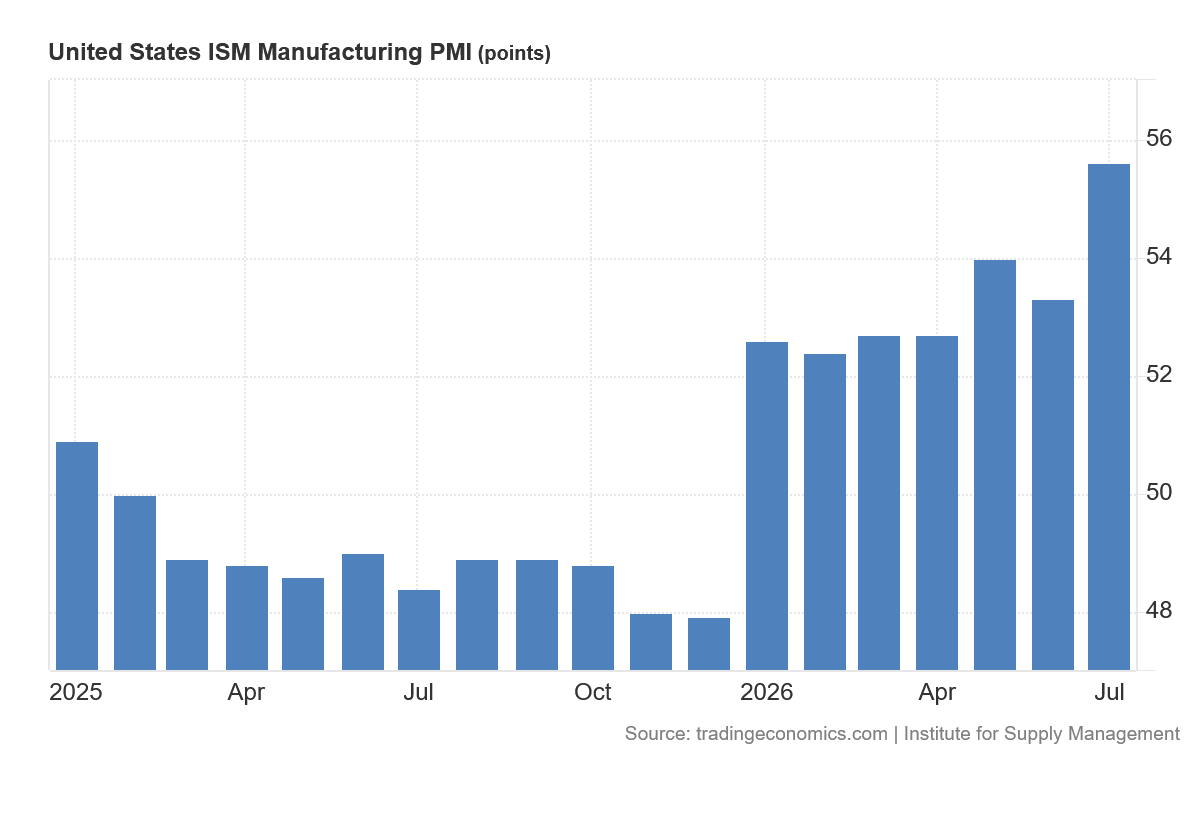
The Manufacturer’s PMI has charted growth since January.
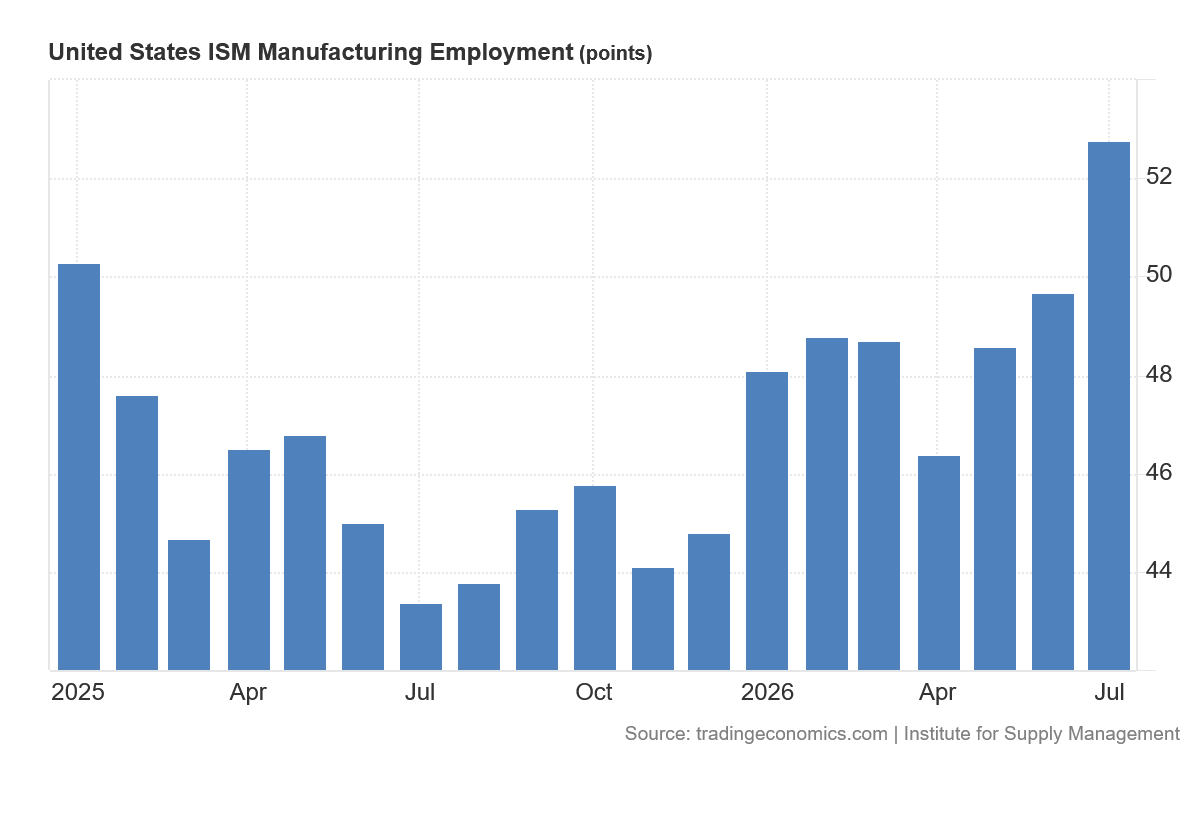
Manufacturing employment per the ISM PMI data warmed up in July, leaping from contraction in June to a robust 54.6 in July.
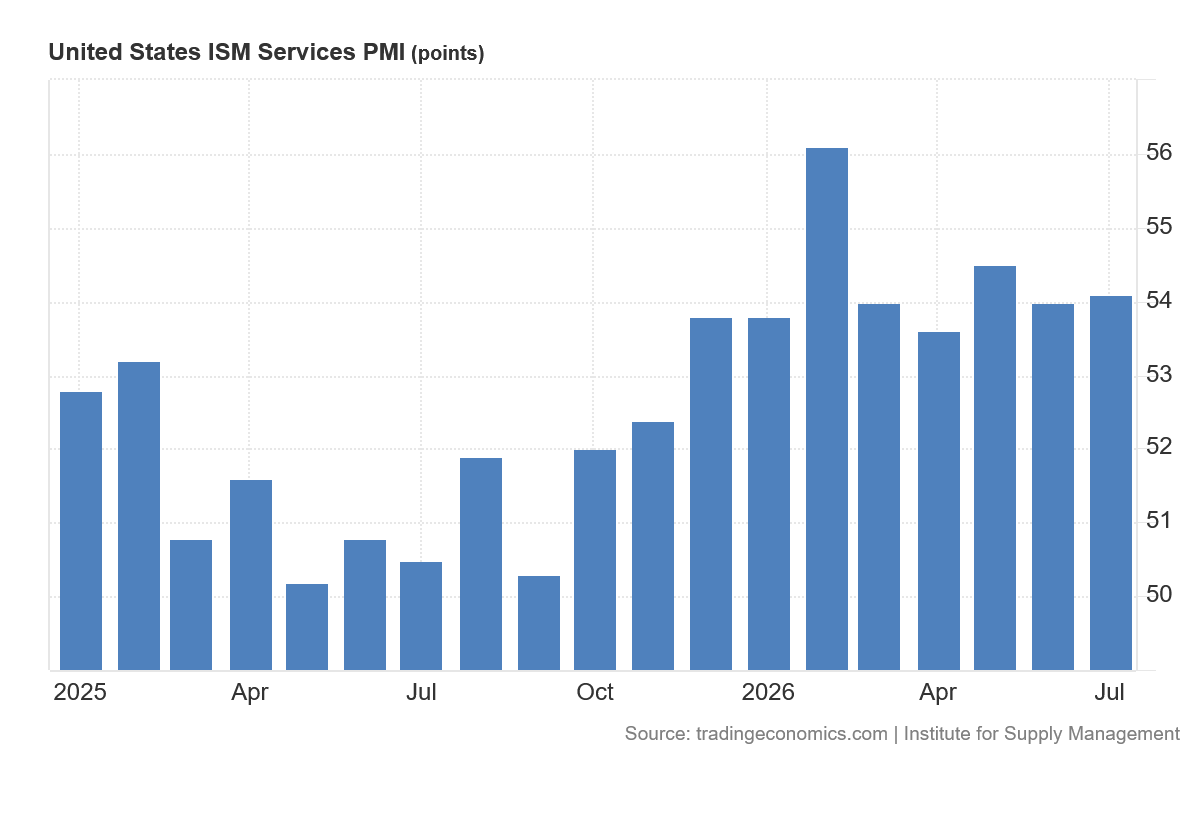
For its part, the ISM Services PMI has been charting growth since before 2025.
However, the ISM Services Employment PMI plunged in July, going from moderate expansion to moderate contraction.
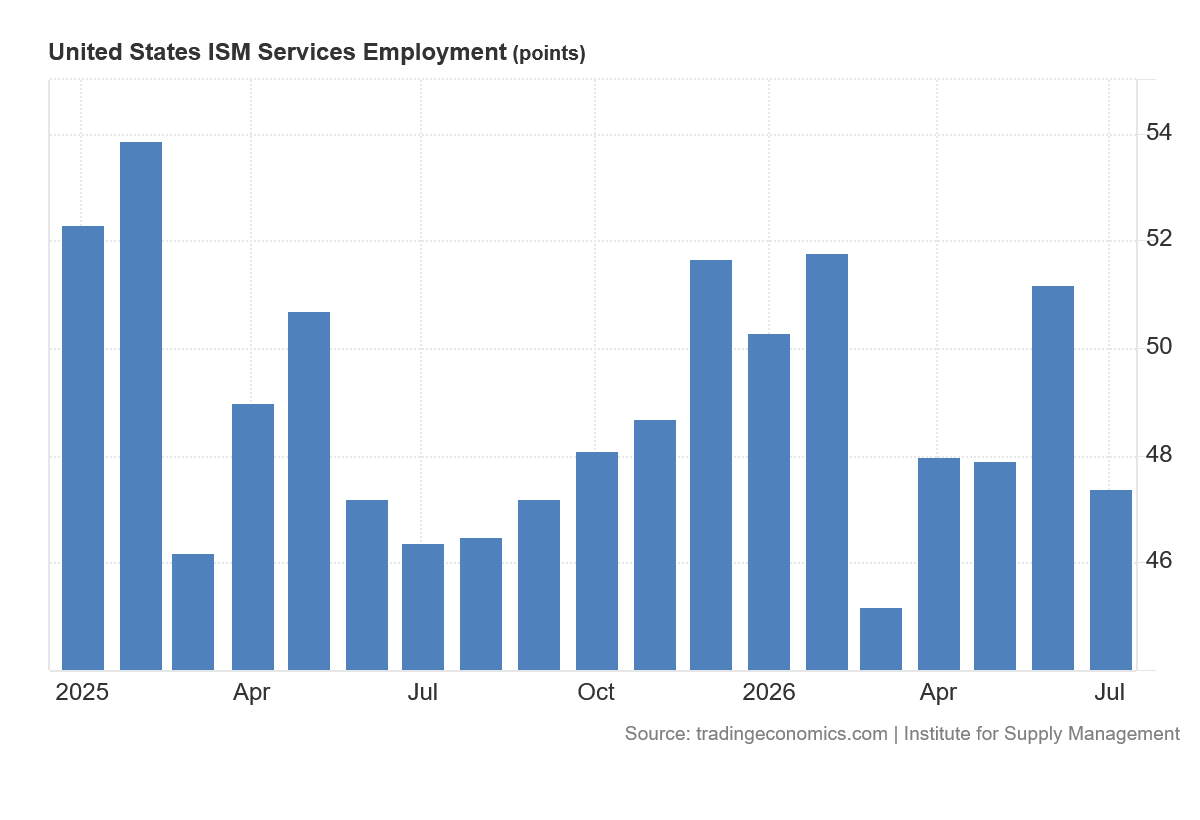
Just as the JOLTS report presents a perspective of weak and receding US labor markets, the ISM PMI data suggests a relative robust economy with at least manufacturing employment expanding.
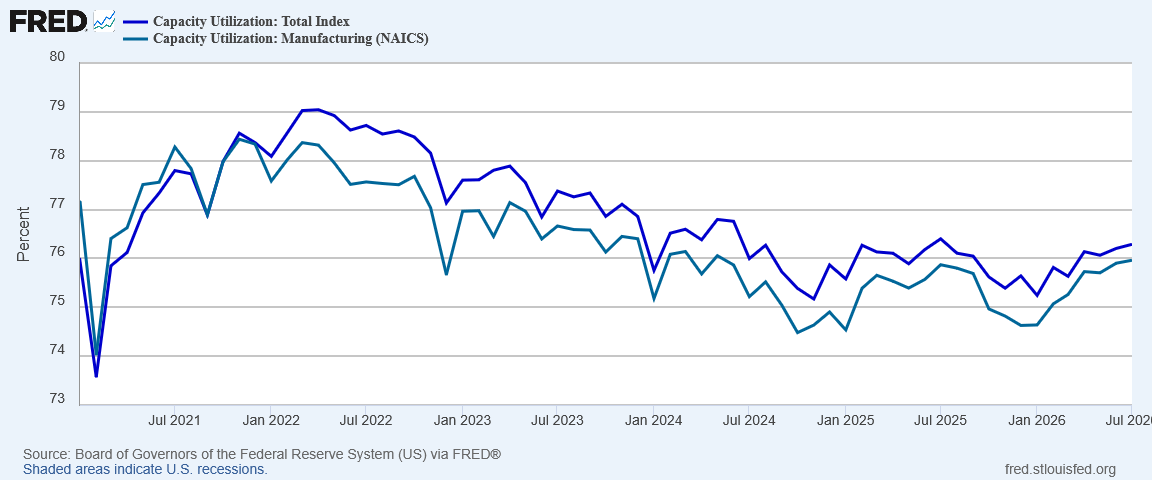
The Federal Reserve Capacity Utilization data indicates the economy is growing, reversing the years-long downward trend that prevailed during the Biden-Harris Reign of Error.
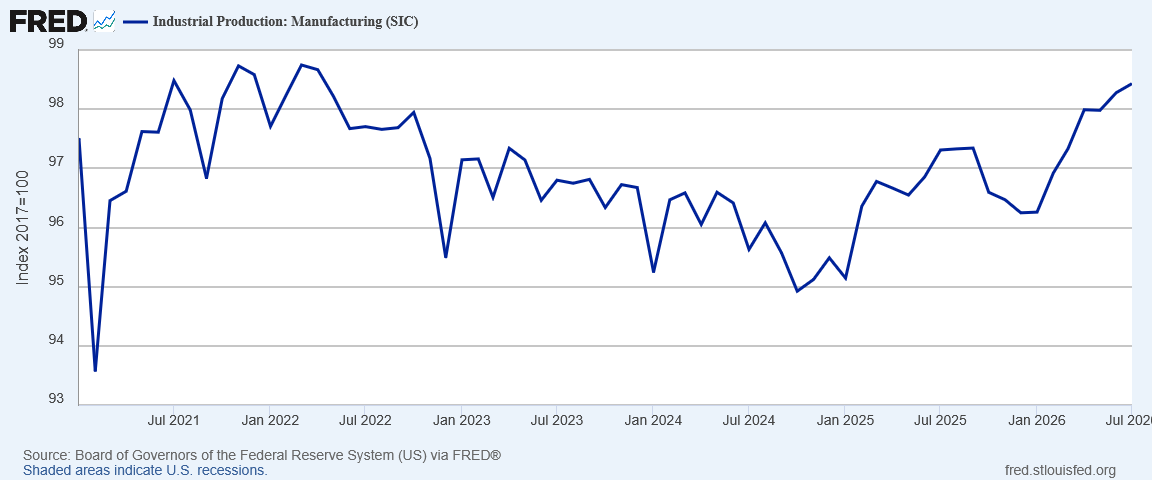
The Fed’s Industrial Production indices show similar growth trends since the start of the year.
Behind both the positive and negative economic signals is a context of rising market interest rates, highlighted by Treasury yields which have risen significantly across the entire yield curve since the beginning of March, when the war with Iran began.
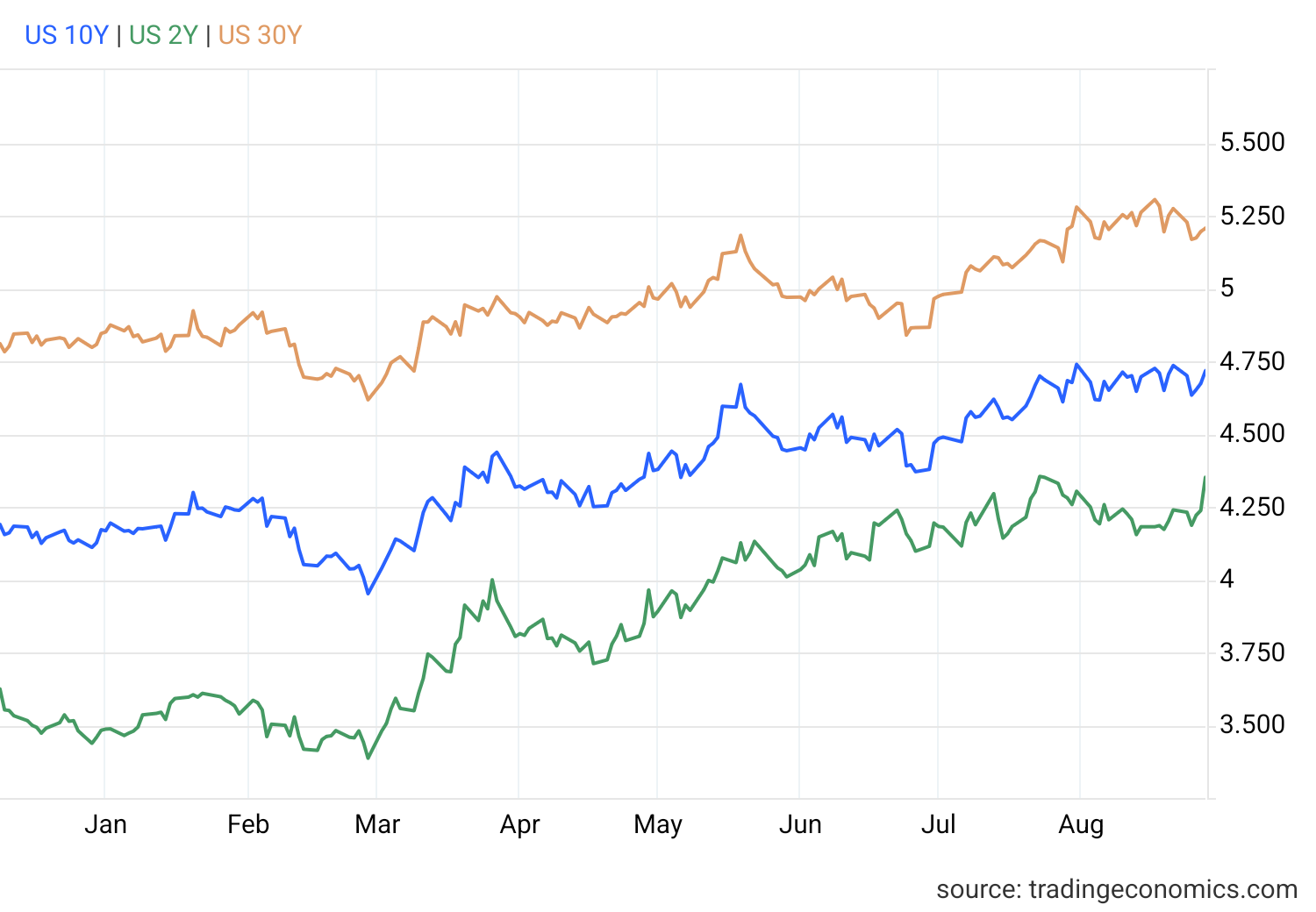
Investment capital has become more expensive since the war with Iran began.
With a number of diverse signals indicating the economy is doing well, what are we to make of the negative JOLTS data?
The JOLTS data might be signalling that the economic growth being seen in the PMI indicators and capacity utilization data is unsustainable. If the job numbers persist in this stagnant low-hire, low-fire volatility range, it is only a matter of time before the lack of job growth pulls the economy back down to earth.
By the same token, the economic growth indicated by the PMI and capacity utilization data could be about to pull the job growth data upwards. If those growth trends are maintained, eventually they have to translate into greater job growth.
Viewed another way, if market interest rates continue to rise due to the war, they are likely to choke off the expansion being charted by rising industrial production and capacity utilization. If market rates reverse and move lower, they are likely to stimulate a thaw in job markets.
One set of indicators is almost certain to pull the other set of indicators towards its reality. Which set does the pulling and which set gets pulled is a question only time and the constantly unfolding war with Iran answer.
What Next?
What is the JOLTS report telling us is coming next to US labor markets? If the current trends continue, what is coming next are weaker US job markets, less job growth, and potentially another jobs recession.
When it comes to the BLS jobs data especially we need to proceed with a certain skepticism. We know that revisions to the data have long been the norm, and continue to be the norm. As a consequence, we need to be careful about declaring both a jobs recovery and a jobs recession.
We have now had three consecutive months of less than glorious JOLTS reports. Two of those three months we had similarly downbeat jobs reports from both the BLS and ADP.
We may not be in an outright jobs recession yet, but three different jobs reports from three different surveys are painting a picture of US labor markets which has worsened significantly over at least the past two months. Job growth has slowed over that time period, even if the overall economic outlook has stayed upbeat and positive.
Given that we are still very much at risk of an “oilpocalypse” outcome to the war with Iran, the same skepticism we need for the jobs data we need to maintain for all economic data. If a worst-case oilpocalypse occurs, we can expect all the economic indicators which are currently presenting an optimistic view of things to reverse completely.
If we avoid an oilpocalypse altogether, continued economic growth will eventually translate into substantial job growth.
If President Trump wins the war with Iran outright, and especially if there is regime change within Iran, both the broader economic indicators and the jobs data from ADP and the BLS will likely move significantly upward.
Which outcome we get depends almost entirely on what happens in the Persian Gulf. As recent events in the Persian Gulf demonstrate, the trajectory of that war can change very quickly, oscillating between lulls, ceasefires, and escalations with regularity, making a prediction about how that war ends quite difficult if not impossible.
Despite that, what unfolds in the Persian Gulf is impacting oil prices, fuel prices, and a number of commodities prices. We should not be surprised to see job growth being hampered as well. Heightened uncertainty and heightened cost are not economic environments conducive to robust job growth.
As long as the war with Iran drags on, we are likely to continue to see disappointing job reports.
How the war ends with Iran, and when, will determine whether future job reports will get better or much, much, worse.
You are smart to see the worryingly signs and scenarios, Peter. Trump needs to win this war, NOW.
The good news is that the data will mostly be seen as “little changed” by the average voter. This means that the Left doesn’t have much in the way of glaring negative data to use to sway voters. Republicans have a few good results to point to, such as growth in manufacturing jobs, but the Left has little ammunition here. That means that the conversation can be focused on the rampant FRAUD that has been perpetrated by the Left - and boy, are they vulnerable on that issue!