


You have to marvel at the complete lack of clue in the opening of the July Employment Situation Summary press release, which dismisses a sudden drop in payroll employment as a “little” change.
Both nonfarm payroll employment (-23,000) and the unemployment rate (4.1 percent) changed little in July, the U.S. Bureau of Labor Statistics reported today. Employment declined in local government education and retail trade. Employment continued to trend up in health care.
Apparently, the Bureau of Labored Statistics has outsourced their press releases to the bastard stepchild of ChatGPT. Describing a drop of 23,000 jobs as nonfarm payroll employment as having “changed little” the sort of psychedelic hallucination we have come to expect of AI slop. Meanwhile, in the real world, we recognize a sudden loss of 23,000 jobs across all US job markets as a pretty ginormous deal.
A loss of 23,000 jobs puts the July jobs report a full 100,000 jobs below where Wall Street expected the report to be.

Exactly why Wall Street had such high hopes is a mystery. Both the June JOLTS Report and the July ADP National Employment Report signaled a weakening job market.
When we unpack the details of the July BLS data, we quickly see one grim reality emerge: The JOLTS and ADP signals were not wrong. US labor markets have softened significantly in recent months.
The US lost jobs in July. That’s never a good thing.
If this is not a return to jobs recession, it is uncomfortably close to it.
Government Job Loss Is The Reason Headline Figure Was Negative
A loss of 23,000 jobs is a shocking headline statistic, and makes for quite the shocking headline. Certainly corporate media had little hesitation about pushing that exact headline:


Even alternative media outlets such as ZeroHedge and The Epoch Times highlighted that negative headline number.
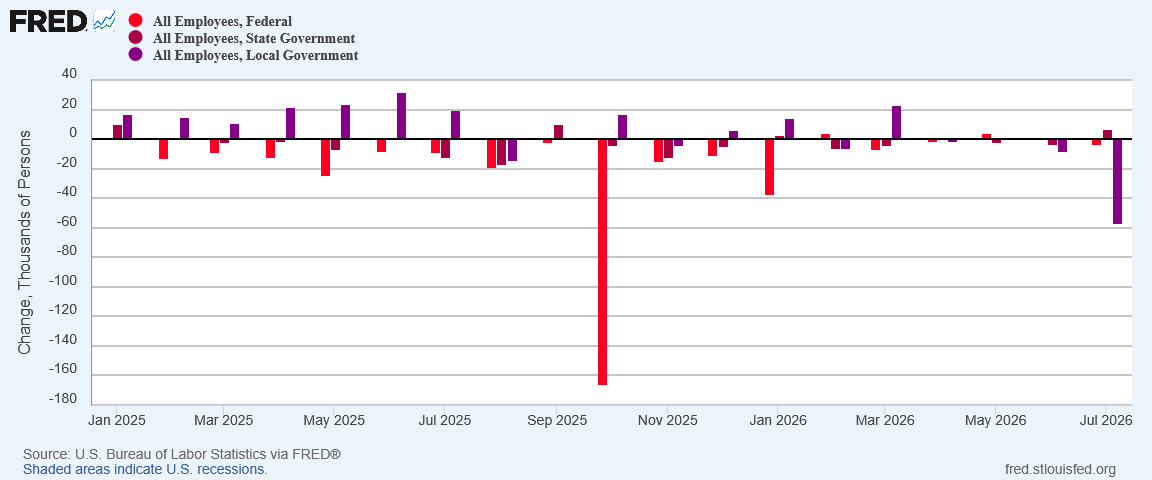
However, we should note that government employment dropped by 53,000 jobs in July, mostly at the local government level.
When we look at just private non-farm employment (which is the same filter used by ADP), the job tally for July is a positive 30,000 jobs.
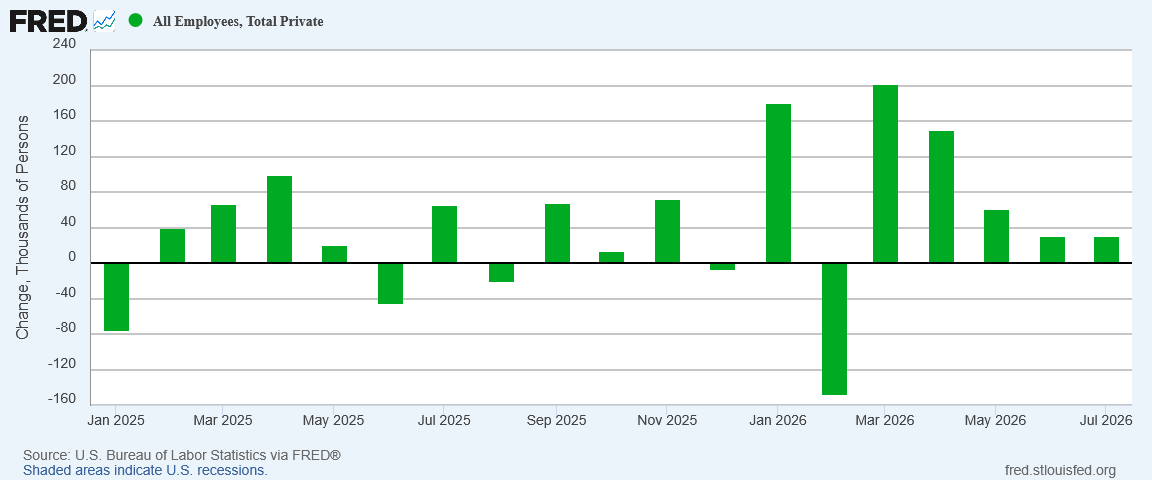
30,000 jobs created is a figure with less suckage than 23,000 jobs lost, but it is still a far cry from a great jobs number. it is also a far cry from what Wall Street was anticipating.

The private sector fared better than the economy overall, but not much better.
June JOLTS Was Again Right About Downward Revisions
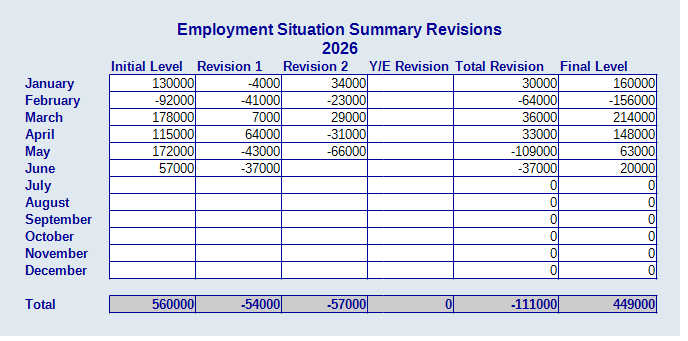
That government jobs were the sole reason for the negative headline number was the good news for the July report. The most glaring piece of bad news was that the June JOLTS figure once again correctly anticipated major downward revisions, as the revisions reported on the July report wiped out more than half the jobs reported in May and June.
The change in total nonfarm payroll employment for May was revised down by 66,000, from +129,000 to +63,000, and the change for June was revised down by 37,000, from +57,000 to +20,000. With these revisions, employment in May and June combined is 103,000 lower than previously reported.
The size of the revisions dwarfs the private payroll jobs reported in July. The robust job reports that heralded the end of the jobs recession have now been largely walked back, and the overall magnitude of revisions for 2026 now sits at 111,000 jobs lost.
When we index the BLS Establishment Survey data, the BLS Household Survey data, and the ADP data, we may safely conclude that Lou Costello Labor Math is still the driving force behind the BLS monthly job reports.
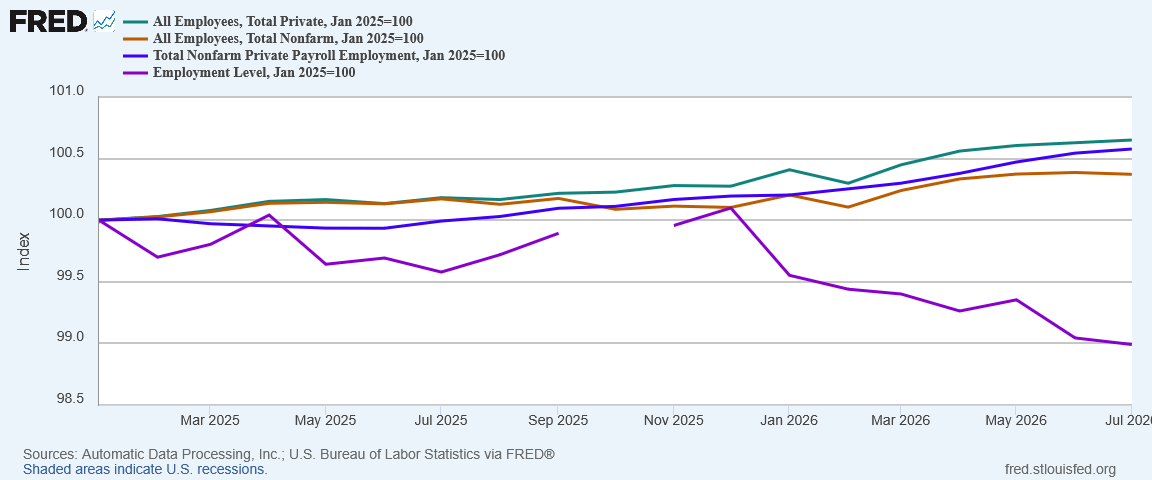
The BLS has yet to even acknowledge the widening variance between payroll employment and the overall employment level, let alone account for it. Until it does, the headline numbers especially should be taken with several very large grains of salt.
And Manufacturing?
As longtime readers know, I put particular emphasis on the Manufacturing jobs numbers. In my view, President Trump cannot achieve his Agenda 47 goal of making the US a manufacturing superpower without greatly expanding manufacturing employment.
Unfortunately, manufacturing job growth dropped by more than 50% in July, to less than 5,000 jobs.
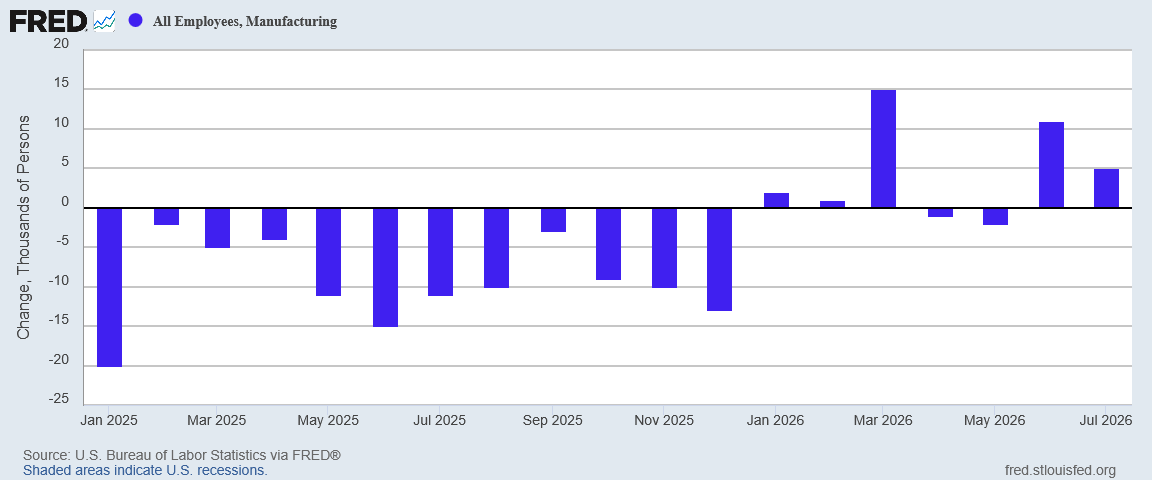
However, that less-than-glorious aggregate manufacturing job total did not stop John Carney at Breitbart from posturing about how well manufacturing was doing, by focusing on the durable goods jobs numbers.
But the headline loss concealed impressive strength in durable goods manufacturing. Payrolls at durable goods factories climbed by 18,000 in July, following a 12,000 job gain in June and a 14,000 job gain in May. Both the June and July numbers were significantly revised up, meaning the sector was even stronger than we thought.
However, what gets overlooked in that perspective is the steady hemorrhaging of nondurable goods jobs since late last fall.
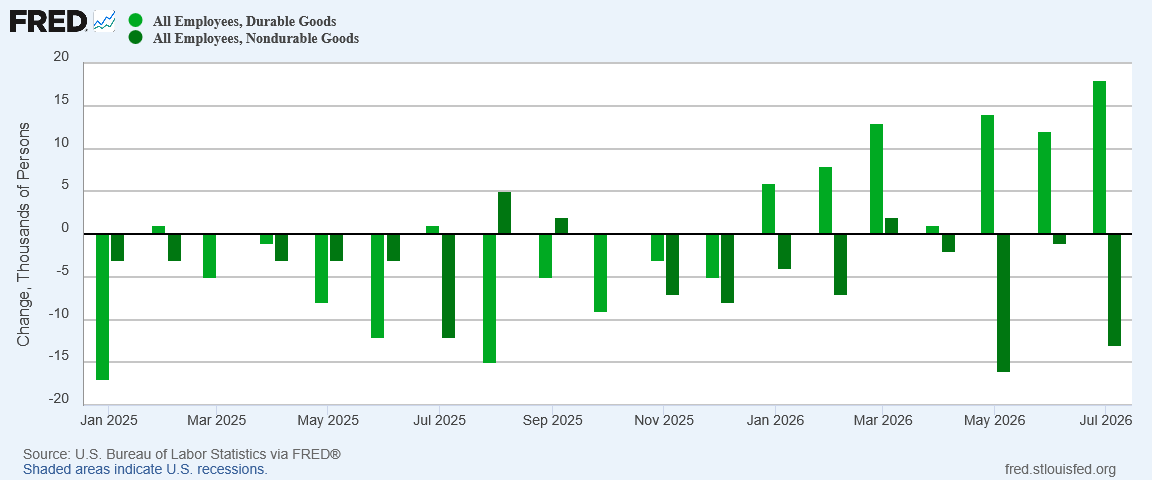
The durable goods job growth is indeed significant, and job growth in that sector is very much a good thing. However, much of that growth is merely an offset to job loss among non-durable goods over that same period. There might be some overall advantages to shifting from nondurable goods to durable goods employment, but expanding both, or expanding durable goods jobs without sacrificing nondurable goods jobs, would undoubtedly be even more advantageous.
More Goods-Producing Jobs Than Service Jobs, But Weaker Growth
No amount of spin by Breibart or any other media outlet can hide the reality that the Employment Situation Summary has been charting a weakening labor market over the past few months. Goods-producing jobs outpaced service-sector jobs for July, but both classes of employment are at far lower job growth levels than in March.
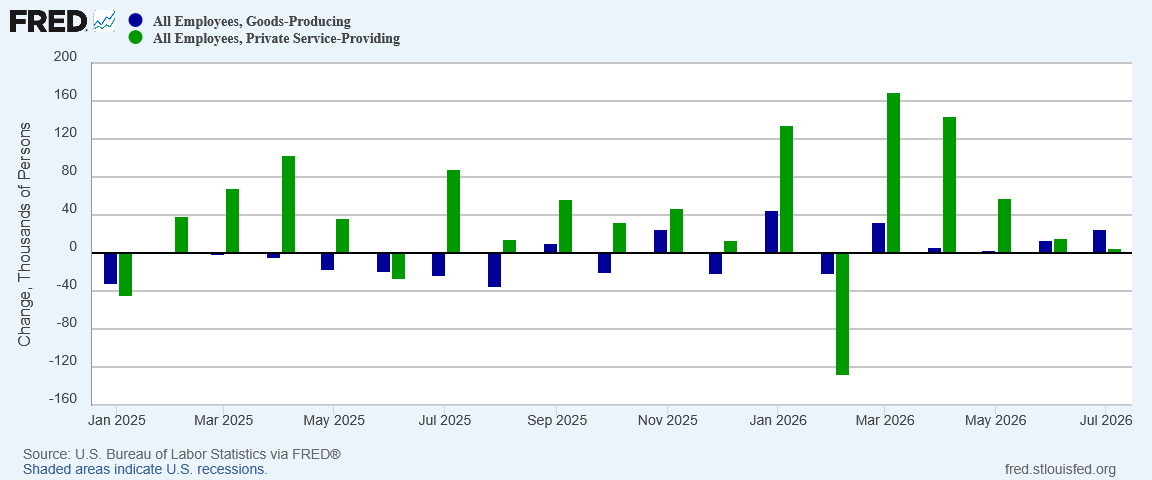
Across the board, job sectors are either shedding jobs or posting weaker growth than just a few months ago.
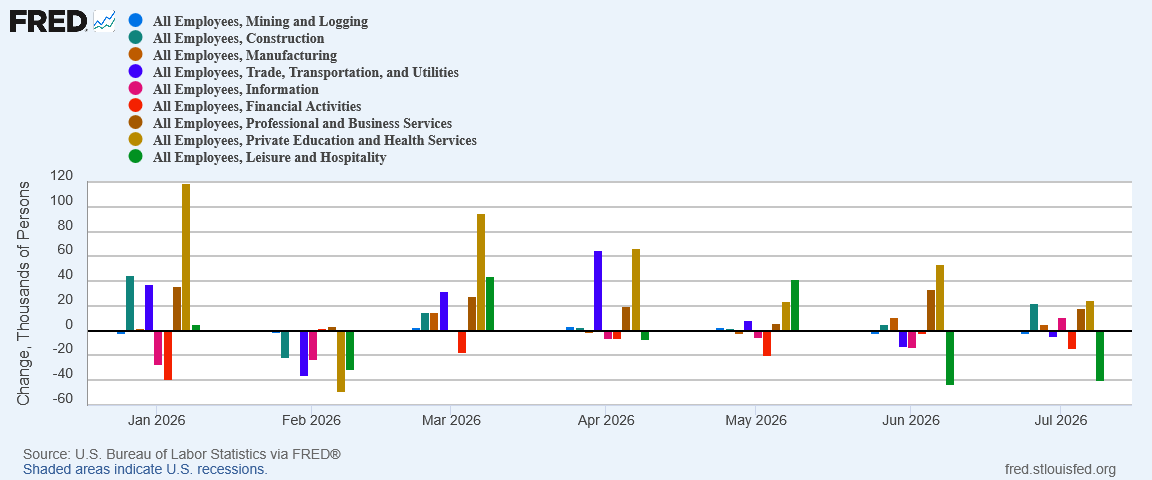
Notably, for the second month in a row, the Leisure sector has shed the most jobs by far in the private sector.
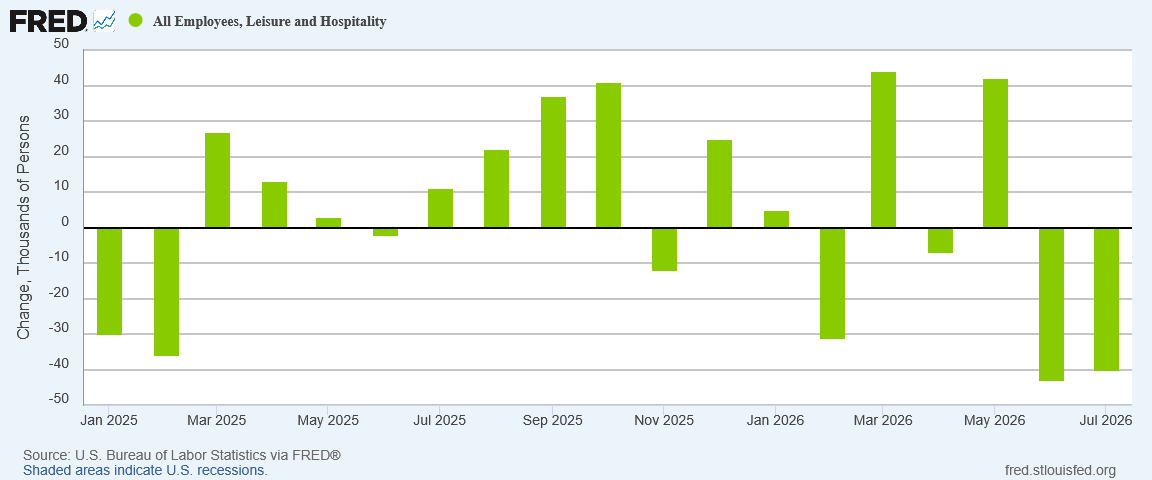
Whether this is the result of the ending of temporary jobs supporting World Cup venues or the result of inflation eating into leisure and recreation budgets is uncertain. What is certain is that, over the past two months, Leisure has lost over 80,000 jobs.
When viewed sector by sector, there just are not a lot of bright spots in the July data. Construction and Information posted growth gains, while every other sector posted job loss or weaker job growth.


Wages Are Still Lagging
Weekly earnings were another disappointment in the July jobs report. While we will not have the July inflation figures for another couple days yet, it is clear from the earnings data we have for July that weekly earnings overall still have not caught up with inflation from 2021.
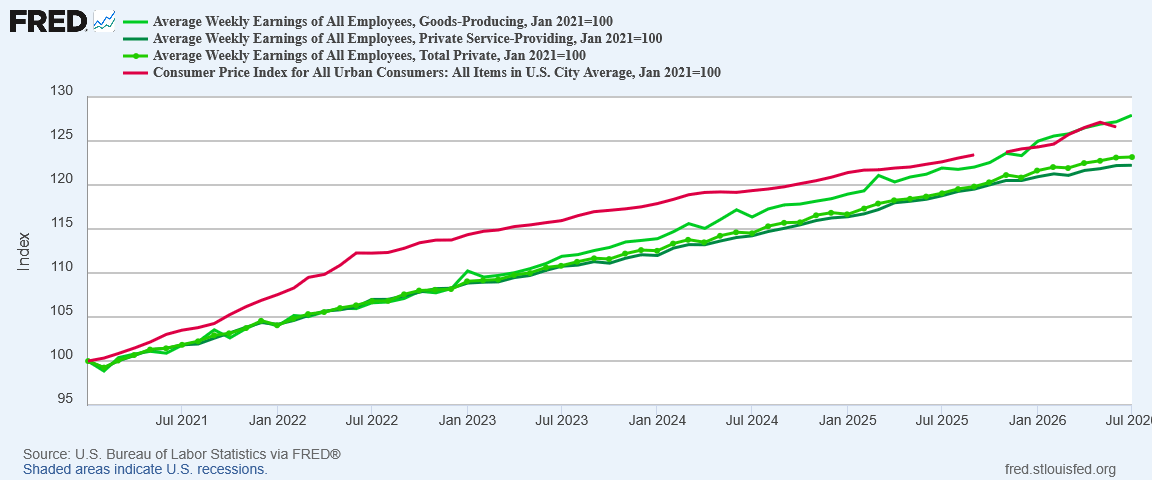
We should note that wage growth has, overall, outpaced inflation growth since January 2025, but even at that, it appears wage growth slowed in July.
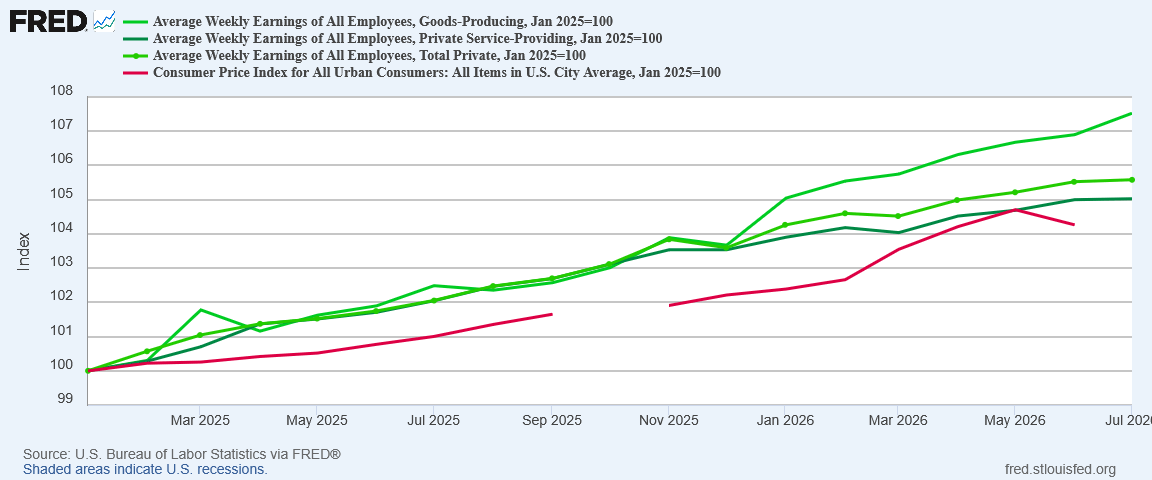
As the threat of the oilpocalypse draws ever closer to becoming reality, now is not the time for wage growth to be slowing. If the full force of an oil supply shock from an extended closure of the Strait of Hormuz crashes across the world’s economies, American workers will need every penny of wage growth they can get ahead of that to weather the stagflationary storm which is sure to follow.
Right now, American workers are not seeing that wage growth.
Unemployment Rates Are Down
One bright spot in the July jobs data: unemployment levels are genuinely down.
The number of unemployed as well as the number not in the labor force but who want a job now dropped significantly in July, the second consecutive month both metrics decreased in the same month.
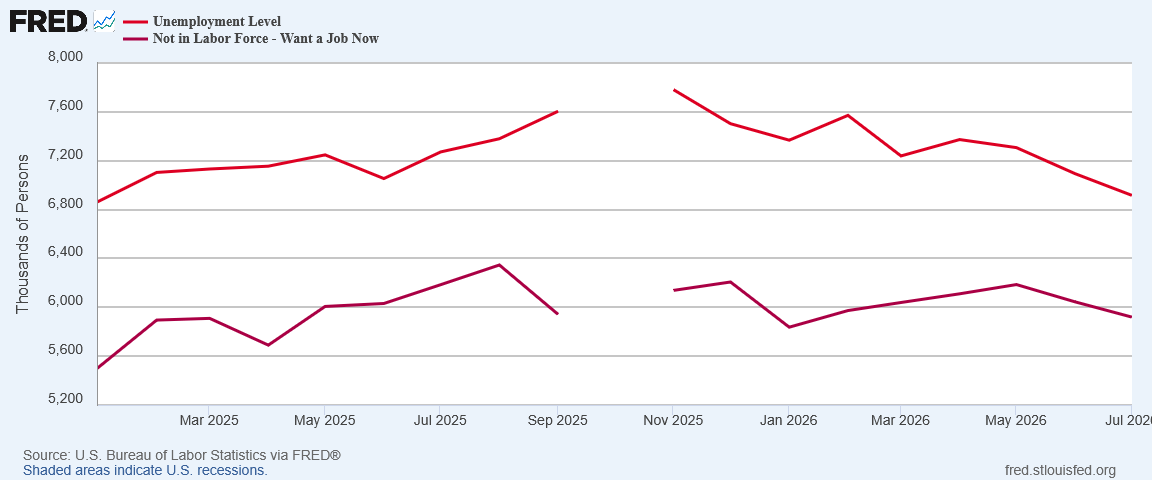
These are welcome declines, and they translate into not just the official unemployment rate, but also the “real” unemployment rate (the unemployment rate with those not in the labor force but who want a job now included) declining.
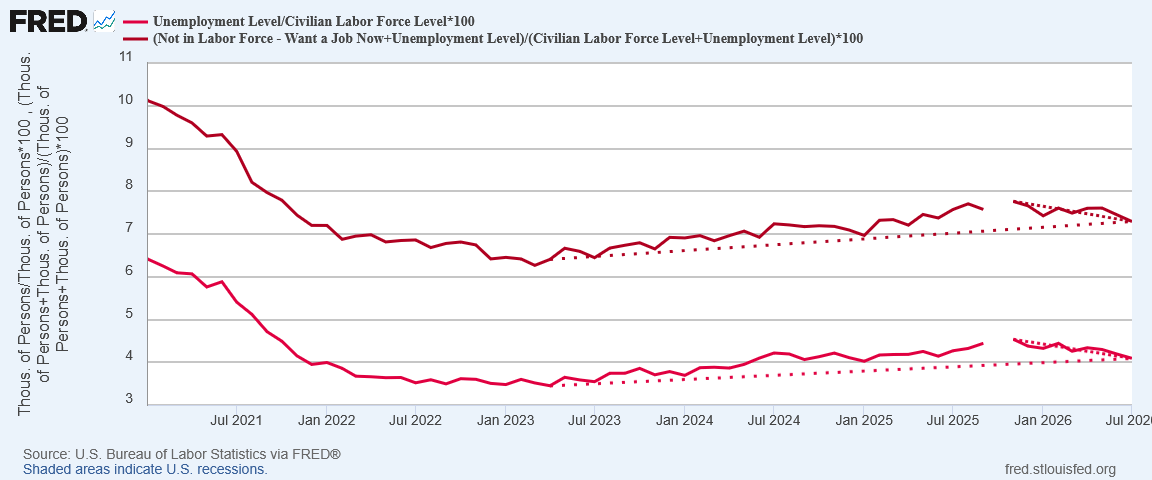
This much, at least, is a healthy macroeconomic trend for labor.
One important caveat, however, is that the number of potential workers not in the labor force rose yet again in July.
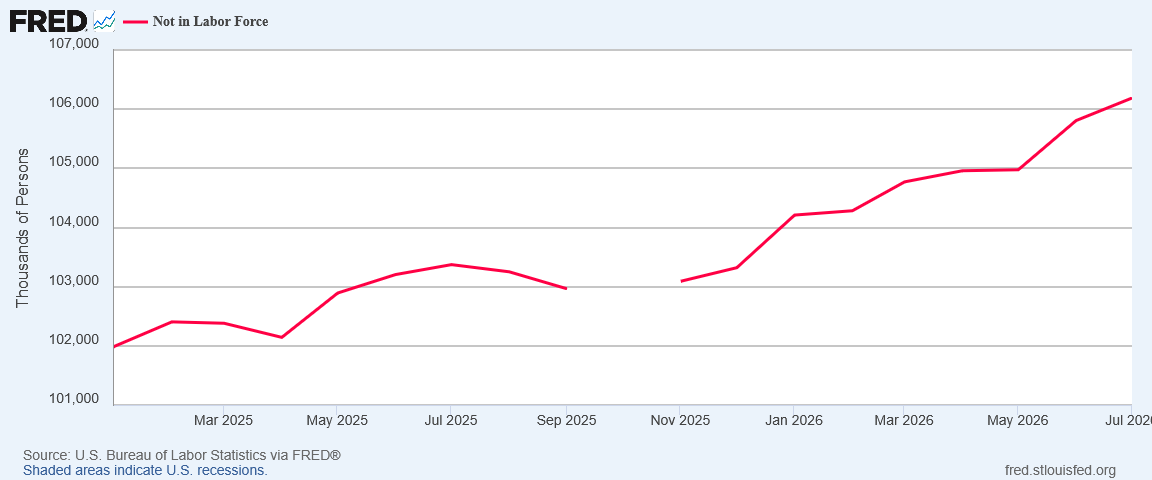
As we can see from the continued decline in the overall employment level, most workers who are no longer unemployed have simply left the labor force altogether.
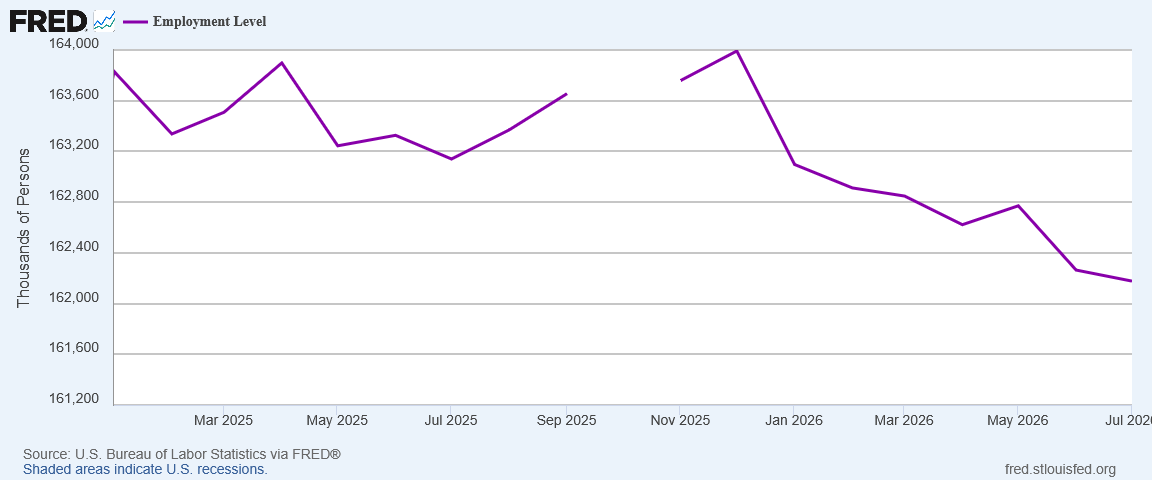
These declines add up to a very disturbing statistic: the U.S. Civilian Labor Force has declined by over 2 million since last November.
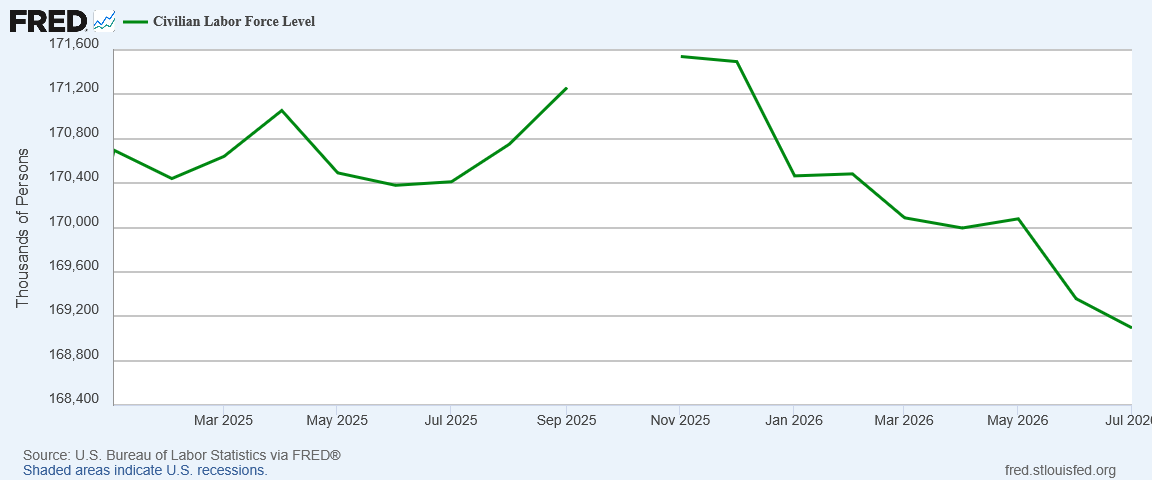
It is difficult, if not impossible, to have sustainable growth in any economy with a shrinking labor force. Right now the United States has a shrinking labor force.
A Return To Jobs Recession?
Given the poor data quality inherent in the BLS Employment Situation Summary, we must be as cautious in calling the latest job metrics a return to the jobs recession as we were in concluding a jobs recovery is under way. even with the revisions, the US has still only had poor jobs performances for the past two or three months. The trends over those three months are disconcerting, and if they persist then we will be in another jobs recession, but just as we have seen a sudden reversal from the high growth just in March, we may yet see the same reversal back to the upside in coming months.
The data gives no indication that this is what will happen, but prior months also tell us that it can happen.
Regardless of what the payroll data reports, however, it is mathematically certain there will be no long-term jobs recovery if there is no long-term growth in either the employment level or the labor force level. We may not be in a jobs recession yet, but without growth within the civilian labor force, we soon will be.
These reversals in US labor markets could not have come at a worse time. As energy prices continue to apply inflationary pressure not just on the US economy but on every economy, a weakening labor market increases the likelihood the looming oilpocalypse will translate into a stagflationary shock of increasing magnitude. As overall employment declines, there is less labor to buffer higher prices. Whatever inflationary impacts we see in the economy emanating from the Persian Gulf, those impacts are made considerably worse when employment levels are down and unemployment levels are up.
There is no way to know with certainty how the situation in the Persian Gulf will unfold. The Strait of Hormuz could be reopened this week—or it could remain closed for several months. Right now, both scenarios are feasible.
Once the Strait does reopen (and, long-term, it almost certainly will), oil prices are sure to stabilize fairly quickly. If that happens, the inflationary pressures on the US economy will be significantly eased. We could even see a resurgence of the Civilian Labor Force and unemployment level metrics.
We are not (yet) backsliding into jobs recession.
We are, however, dangerously close to doing exactly that.
This is a Monday-morning type of bummer. It’s primary-election time, when many voters start to really pay attention, and the last thing Republicans need is any kind of economic metric that can be campaign-spun against them. Sigh. Trump needs to win the war and get out of Iran - now! He needs to get much better economic indicators within WEEKS.
The only bright spot for me is seeing 53,000 fewer government workers. This is what I voted for! Every inefficient, unproductive, freedom-squashing government job that is permanently eliminated is a brick torn down in the wall that was blocking the fresh air of America. Keep it coming, Mr. President!
More Monday-morning bad news: a 7.4 magnitude earthquake just hit Columbia -
https://www.theepochtimes.com/world/major-earthquake-strikes-western-colombia-damage-reported-6073178?utm_source=ref_share&utm_campaign=copy
Fortunately, its epicenter is very deep - 66 miles down. That’s deep enough where the damage and casualties should be minimal. But still - Monday morning bummer!