


According to the press release by the Bureau of Labor Statistics on the June Job Openings and Labor Turnover Summary report, job markets in the US hit “pause” for the month of June.
The number of job openings was little changed at 7.4 million in June, the U.S. Bureau of Labor Statistics reported today. Hires were unchanged at 5.3 million, while total separations changed little at 5.4 million. Within separations, quits (3.2 million) and layoffs and discharges (1.8 million) were unchanged.
In fact, the job openings number upon which Wall Street remains eternally and inexplicably hyperfocused, declined in June, falling well short of Wall Street expectations.

Hiring and separations both rose in June, and effectively negated each other.
Overall, the June JOLTS data shows job growth in this country was a lot less robust that month than the earlier ADP and ESS reports had sown—so much less robust that we should not be surprised to learn that, when the July Employment Situation Summary comes out on Friday, the May and June ESS data sets are revised significantly downward.
Is the jobs recovery at an end? Did the jobs recovery ever really get started? The takeaway from the June JOLTS report is a disturbing answer to both questions: “Possibly.”
Advance Warning Of Lou Costello Labor Math?
While the media remains fixated on the mostly irrelevant job openings number within the JOLTS report, the far more consequential hiring and separations numbers show that net hiring was effectively zero for the month of June.
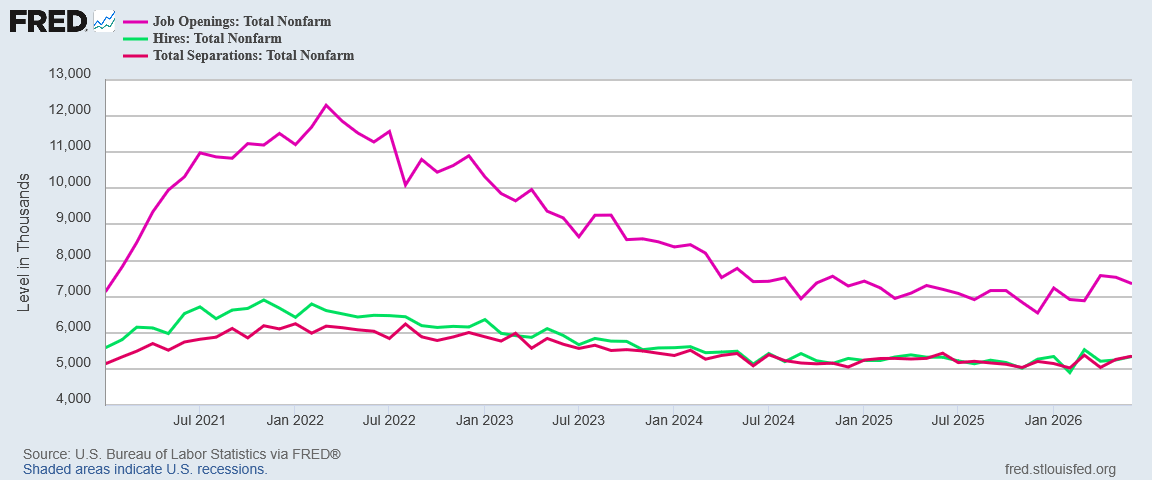
Job openings declined by 178,000, the second consecutive monthly decline. Hiring rose by 96,000, and separations rose by 91,000. Overall, total nonfarm net hiring fell by 3,000, and total private net hiring rose by 5,000, meaning the JOLTS data is telling us there was almost no job growth in this country in June.
That outcome, of course, is very much at odds with the June Employment Situation Summary, which reported total nonfarm job growth of 57,000 jobs—at least for now. We should not be surprised if that number is revised sharply downward when the July jobs report comes out. In most sectors, the June JOLTS report shows much less job growth than the June ESS data.
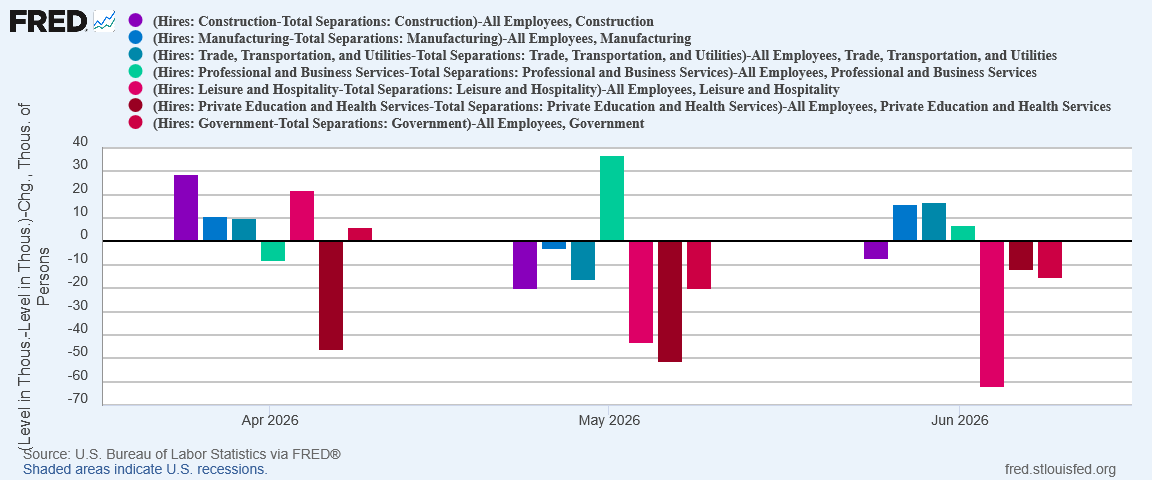
The JOLTS report was far less glowing in May than the ESS report, and June saw significant downward revisions.
The JOLTS report is far less glowing for June than the ESS report, so we should expect more significant downward revisions.
Lou Costello Labor Math lives on at the BLS.
Manufacturing Held Its Own
One encouraging note in the June JOLTS data: Manufacturing net hiring rebounded after losing ground in May.
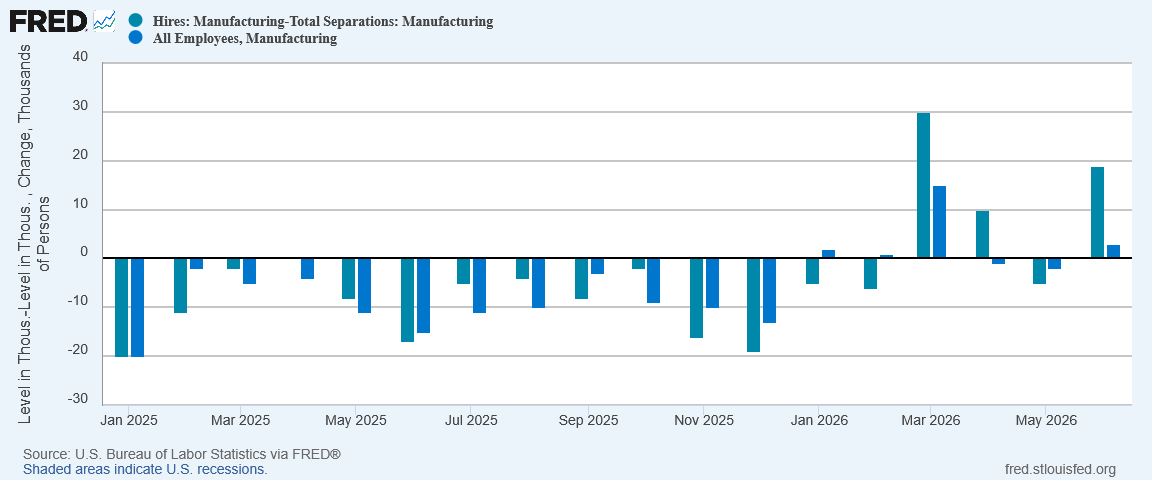
Not only was Manufacturing net hiring positive for June, it outperformed the ESS data by a wide margin.
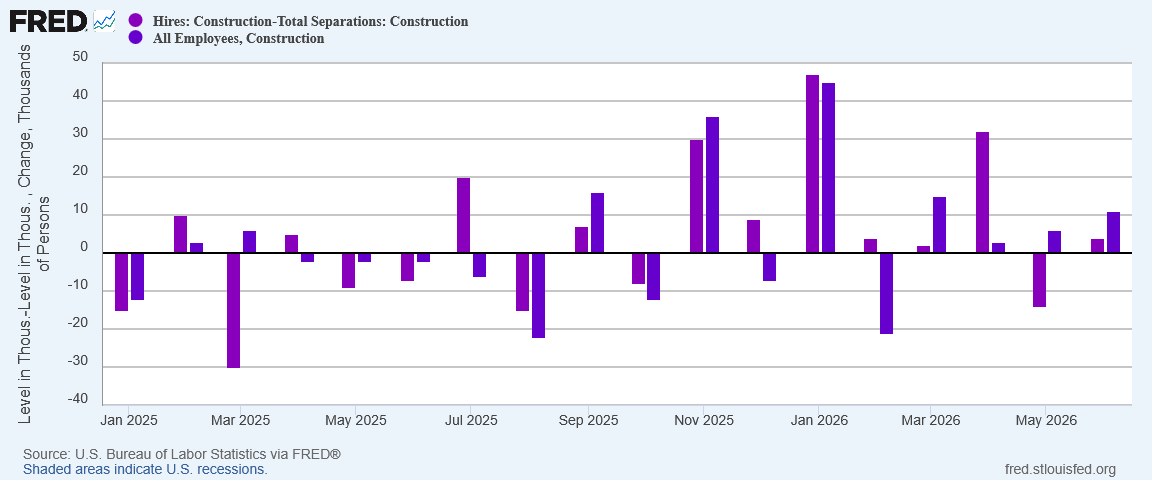
Construction also rebounded in June, although June JOLTS was again more pessismistic than the June ESS data.
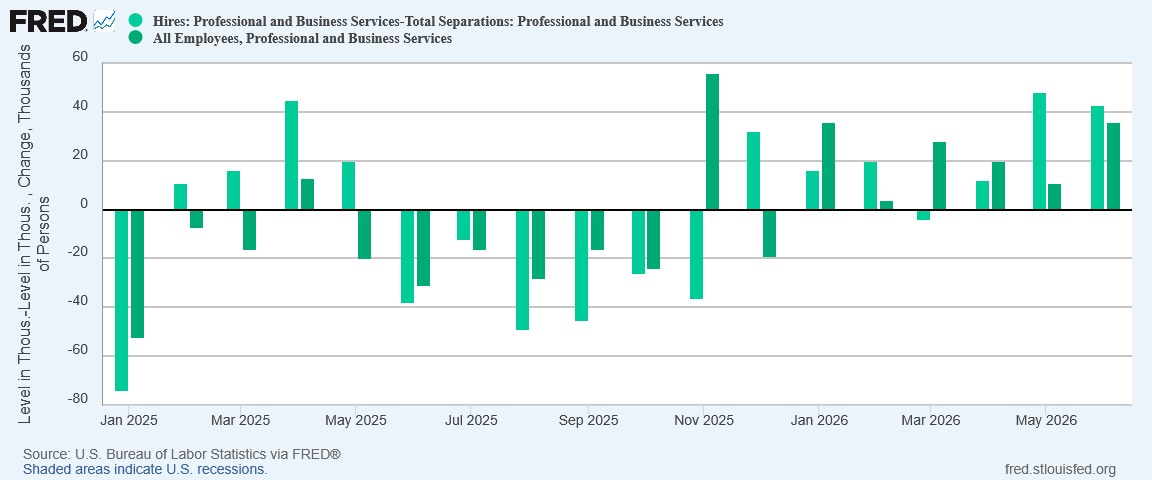
Professional and Business Services also held its own for the month. Although June net hiring eased somewhat, the June JOLTS data remained ahead of the June ESS data.
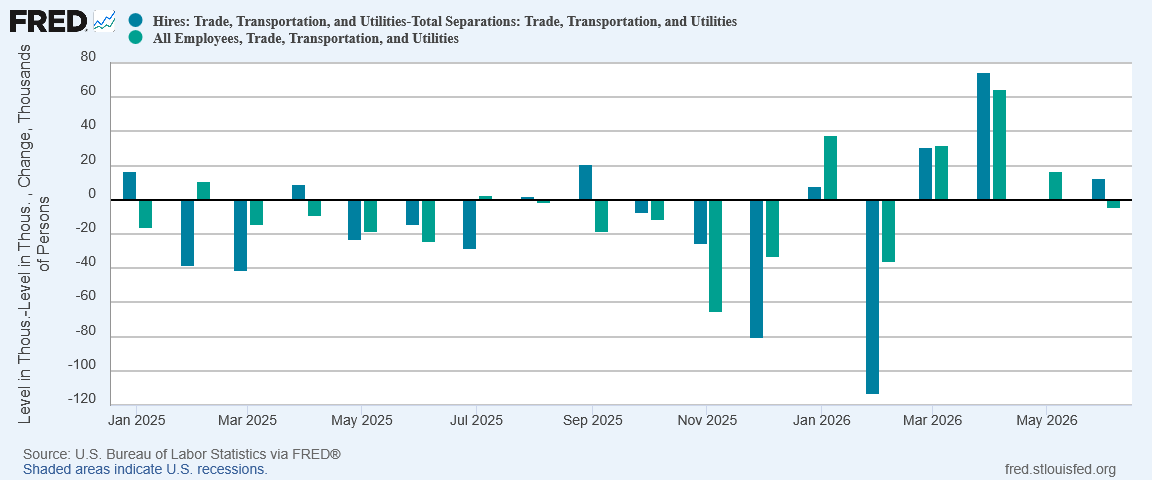
Trade, Transportation, and Utilities was the other sector that did well on the June JOLTS.
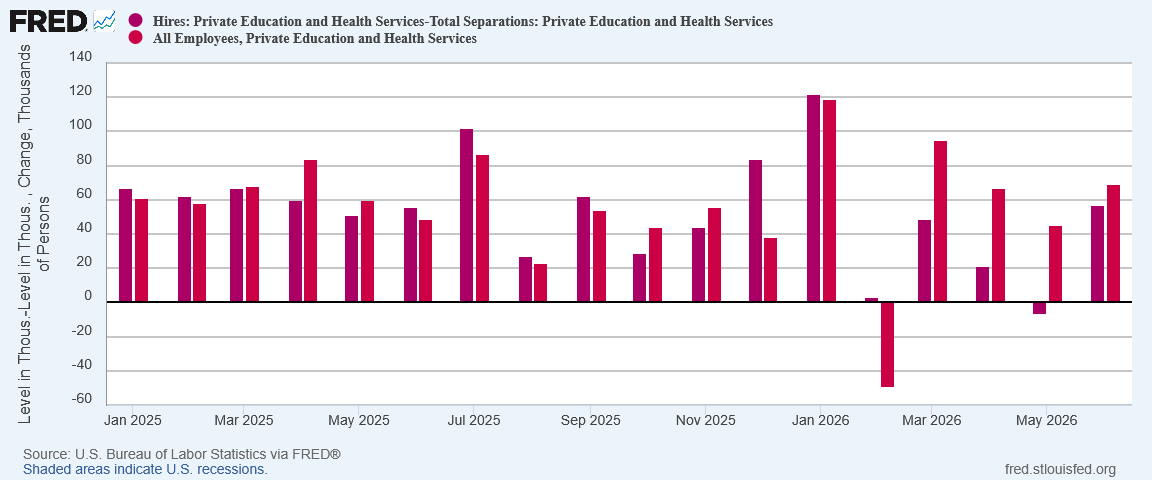
While Healthcare job growth rebounded per the June JOLTS data after May, it still lagged behind the June ESS.
While all of these sectors reported job growth, Leisure manage to wipe out most of that job growth in the aggregate.
Leisure Loses Bigly
According to the JOLTS data, the Leisure and Hospitality sector lost even more jobs in June than was reported by the ESS.
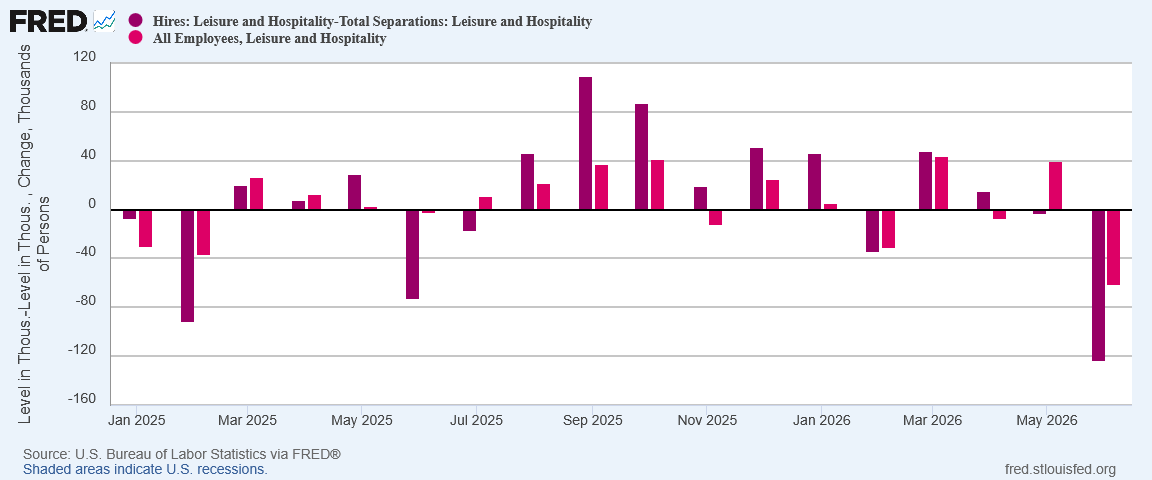
Leisure hemorrhaged jobs in June, and outpaced the decline per the ESS, meaning we should anticipate the July jobs report revising the June Leisure numbers significantly further down.
Meanwhile, the 123,000 Leisure jobs lost per the JOLTS report all but wiped out the job growth in other sectors. Despite the job gains in Manufacturing and Construction, total net hiring in the private sector was just 5,000.
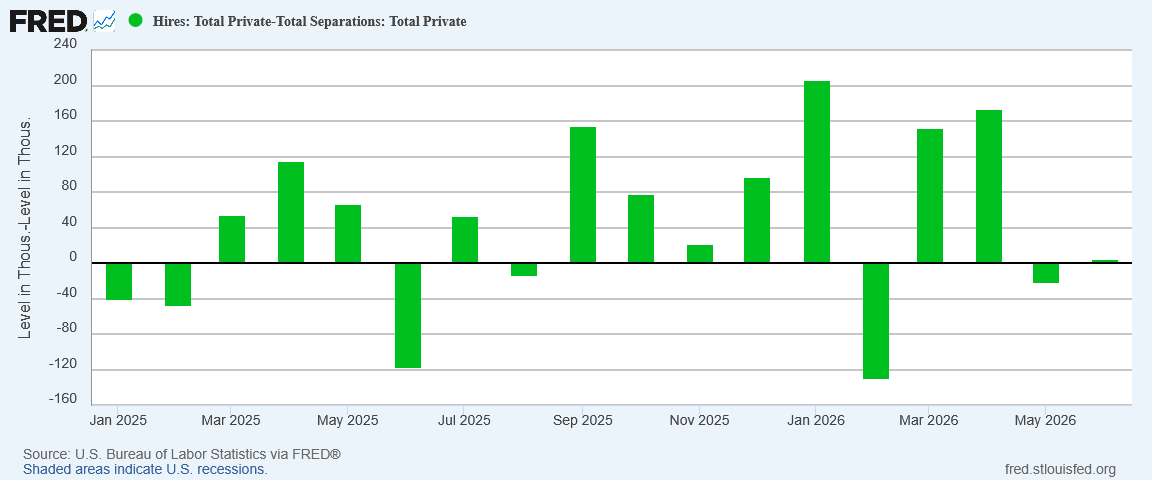
Across all nonfarm sectors, total net hiring showed a loss of 3,000 jobs.
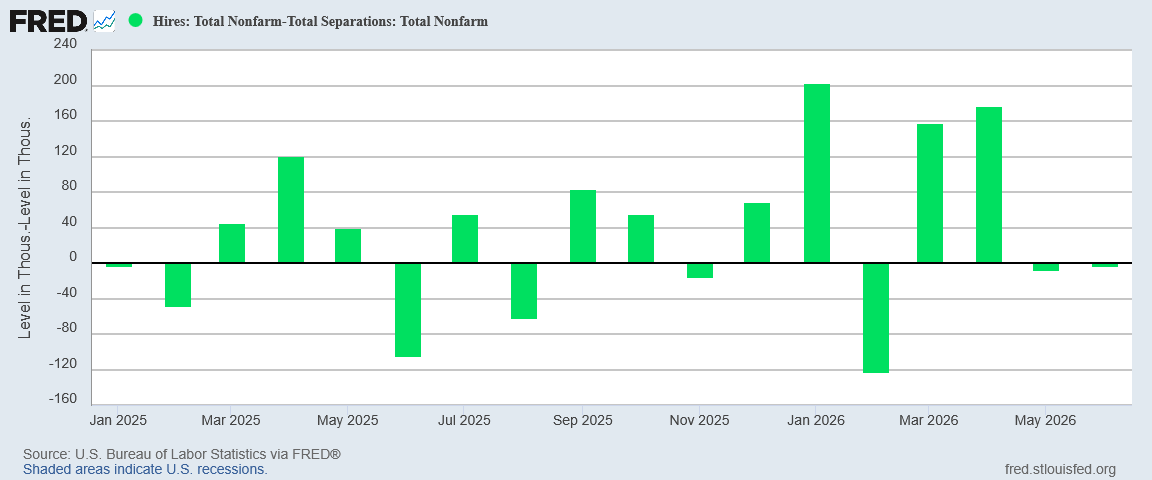
The difference between the two is arguably a “good-bad” news scenario: Government also shed jobs according to the June JOLTS report.
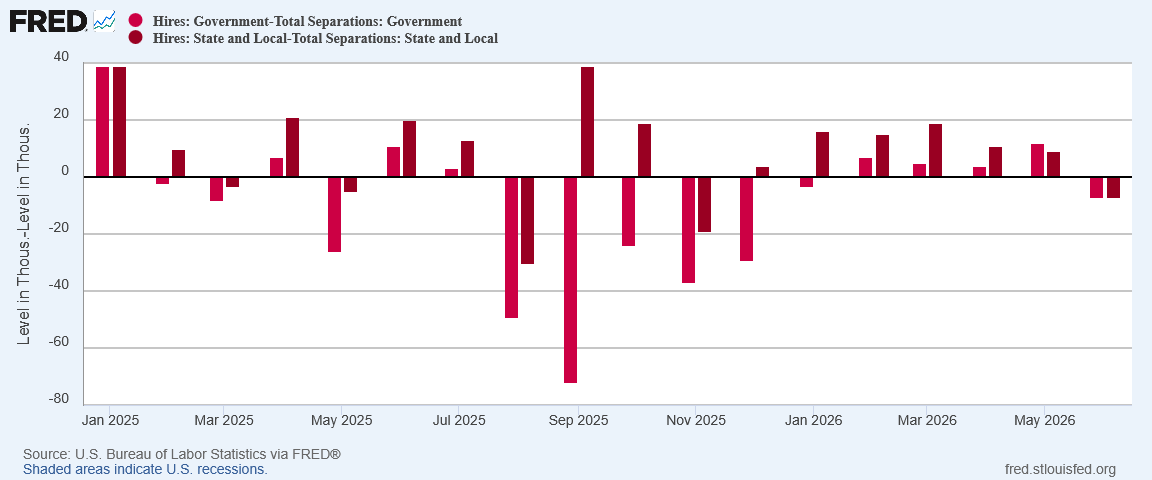
In most sectors job loss is cause for concern. When the sector is government, a little job loss will be for many people cause for celebration, as it means the government got that much smaller.
However, the job losses in Leisure within the JOLTS data indicates that job growth, rather than just cooling steadily since March, collapsed outright after April.
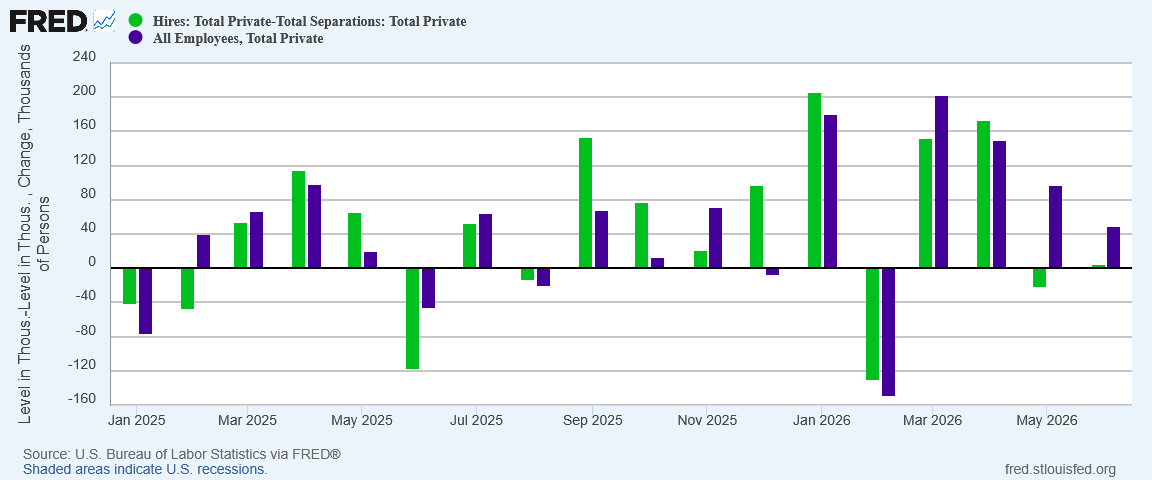
If the JOLTS data is a more accurate snapshot of US job markets than the Employment Situation Summary, we have not had any job growth since April.
Jobs Recovery Or Jobs Recession?
The June JOLTS data does not show robust job growth. The June JOLTS data shows US labor markets more volatile than in May, but without any job growth to make up for the increased volatility.
The June JOLTS report is considerably more pessimistic than the June jobs report. If we looked at the JOLTS data exclusively, we would have to conclude we have slid back into a jobs recession. That several job sectors show weaker job growth within the JOLTS data than within the ESS data arguably means we are flirting with a return to a jobs recession even with the positive Employment Situation Summary data.
That is doubly a cause for concern, because if job growth weakens at the same time the oil supply shock from the war with Iran causes a fresh surge in oil prices, the United States might quickly find itself in the throes of 1970s-style stagflation. With the war cycling almost weekly between ceasefire and escalation, that “oilpocalypse” scenario remains very much a possibility, and increasingly a probability.
If US job markets remain robust, showing good growth month after month, the US economy will find it easier to weather the economic storm of a severe oil supply shock. Based on the jobs reports of the past few months, there was reason to hope the US might have the economic resilience to shake off the worst effects of the oilpocalypse.
The June JOLTS report suggests that hope might have been in vain all along. Not only does the oilpocalypse beckon, jobs recession may be signaling its return, and that means stagflation could be preparing to make its entrance sometime in the next few months.
The future outcomes indicated by the June JOLTS report do not look at all encouraging.
Sadly, I’d have to agree with your assessment, Peter. The plunge in Leisure is a serious sign that people have less money to spend on discretionary items - dinners out, travel, entertainment, etc. - all of the fun things that make working for a living worthwhile.
This makes for national crankiness before the election, and crankiness can result in rash decisions by voters!