


ADP’s July National Employment Report confirmed the warning signal that flashed on Tuesday in the June Job Openings and Labor Turnover Summary: job growth is slowing, or has already slowed. After a couple months of strong job growth, July ADP assessed the US economy as having created just 44,000 jobs.


ADP’s Chief Economist Nela Richardson tried to shift the focus away from the job numbers and towards wage growth.
Job-changers are highly sensitive to real-time economic conditions, and their rapid pay growth implies supply constraints in parts of the labor market. Typical hiring patterns, meanwhile, are changing as employers react to shifting macro-economic conditions.
Wage growth is important, but wage growth is of limited utility in the entire economy if there is not also job growth. The month of July is coming up a little bit short on job growth.
When I say “a little bit short”, I mean 26,000 jobs short of Wall Street’s consensus estimate.

When I say “a little bit short”, I mean 46,000 jobs short of the Trading Economics Forecast.
Yesterday I discussed the JOLTS data, and the prognosis it was signalling an end to the jobs recovery, a return to jobs recession. With the ADP July data, that outcome became that much more probable.
July was expected to be another good month for jobs.
Expectations have not been met.
There Was Growth, Just Not Much Growth
The July numbers are especially disappointing, as it was just two months ago, in the May data, that job growth appeared to be starting to accelerate. The July ADP data does not do much to sustain that trend.
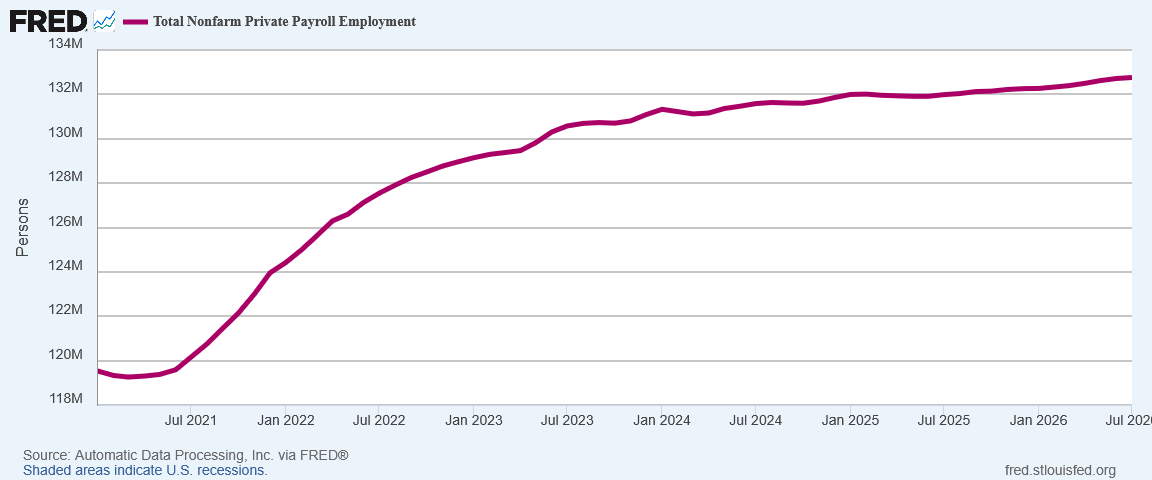
Yet just as the May data showed broad growth across virtually all sectors, by July the sector-level data had softened considerably.
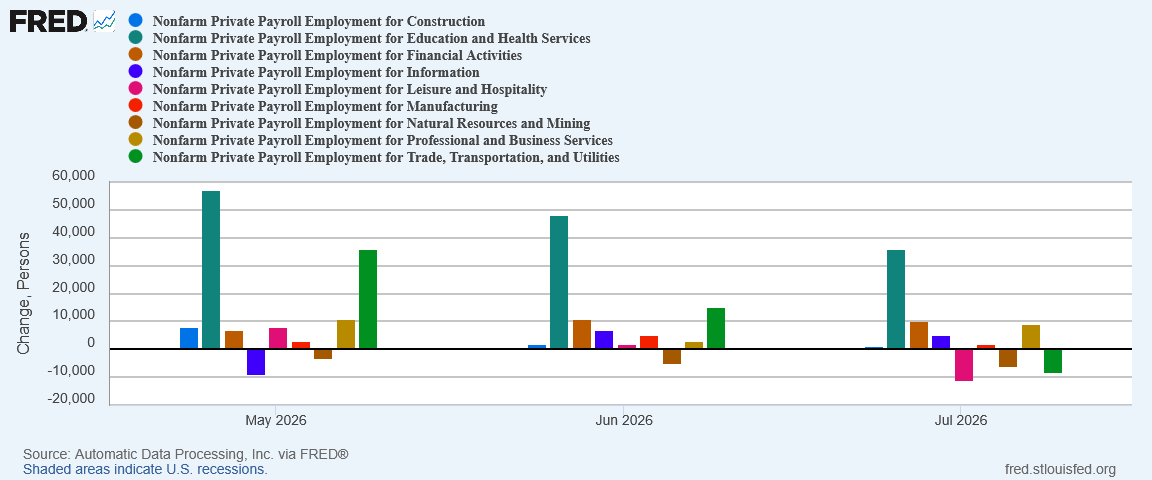
While healthcare remained strong, job growth in other sectors slowed, with first one sector in June then three sectors in July showing job loss. Even healthcare job growth has slowed considerably since May’s upbeat job report.
Perhaps more ominously, as the table above reminds us, the Wall Street consensus estimate for the ADP numbers in June was 15,000 jobs too high.
Even with July’s more conservative estimate, the final ADP numbers were well below that, by 26,000 jobs. Job markets appear to be slowing down faster than Wall Street has projected.
That is not a good trend for jobs in this country.
Goods Producing Sectors Suffered
One disquieting aspect of the July data is that it shows goods producing sectors losing jobs, while service sector job growth has cooled significantly since May.
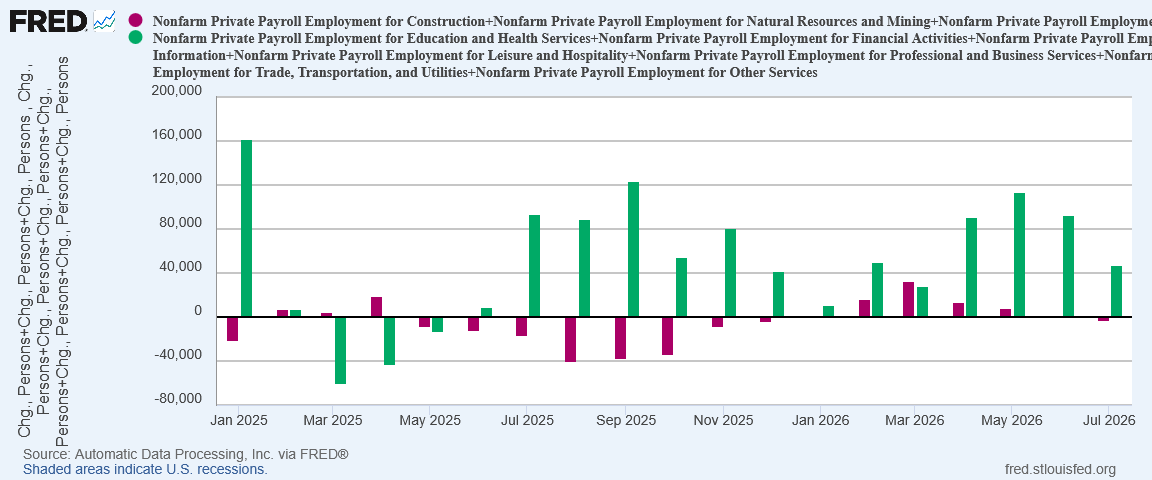
Fortunately, Manufacturing managed to show job growth, albeit a slower growth pace than before.
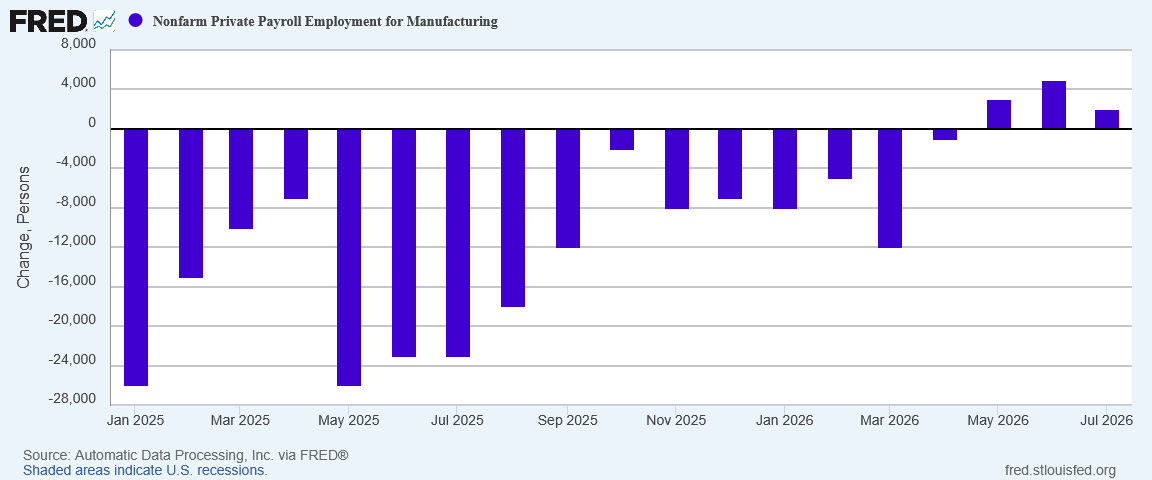
After sixteen months of job loss, job growth in Manufacturing is a welcome sight, even if it has slowed down.
Construction job growth also remained positive—barely.
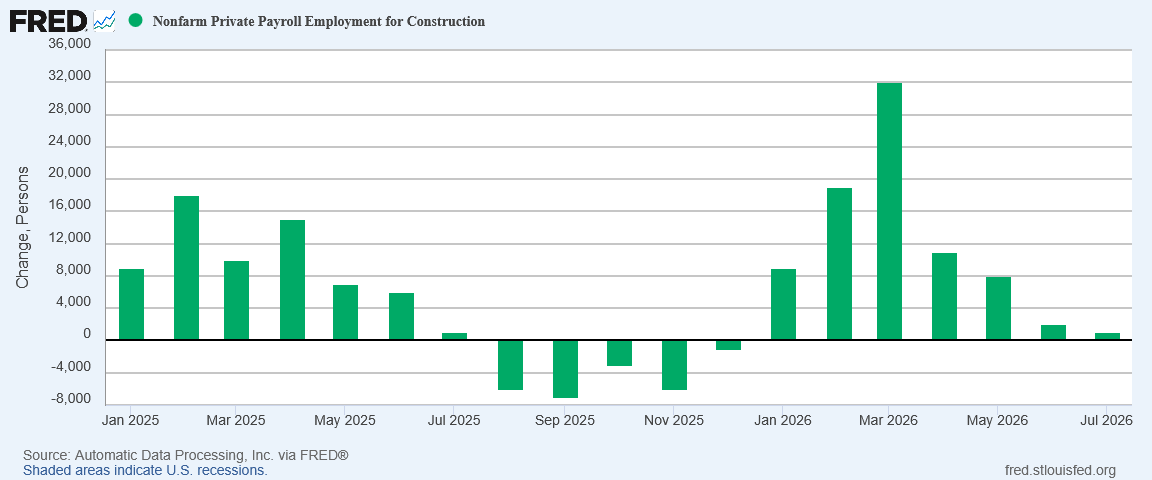
Since peaking in March of this year, construction job growth has all but disappeared.
Resource extraction and Mining were the goods producing jobs where the job losses have been materializing.
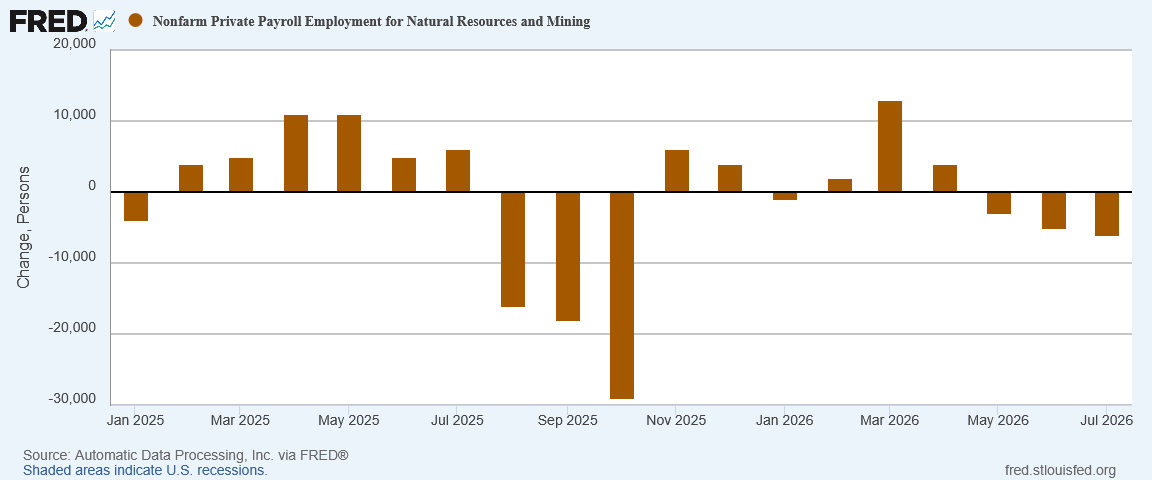
Mining was the one sector with job loss in May, and the job loss has only worsened since then.
In every context and dimension, job growth among goods-producing jobs has been slowing, and in July it really slowed.
Service Sector Jobs Fared Somewhat Better
While Service Sector job growth has been slowing as well since May, most service sectors fared better than goods-producing sectors.
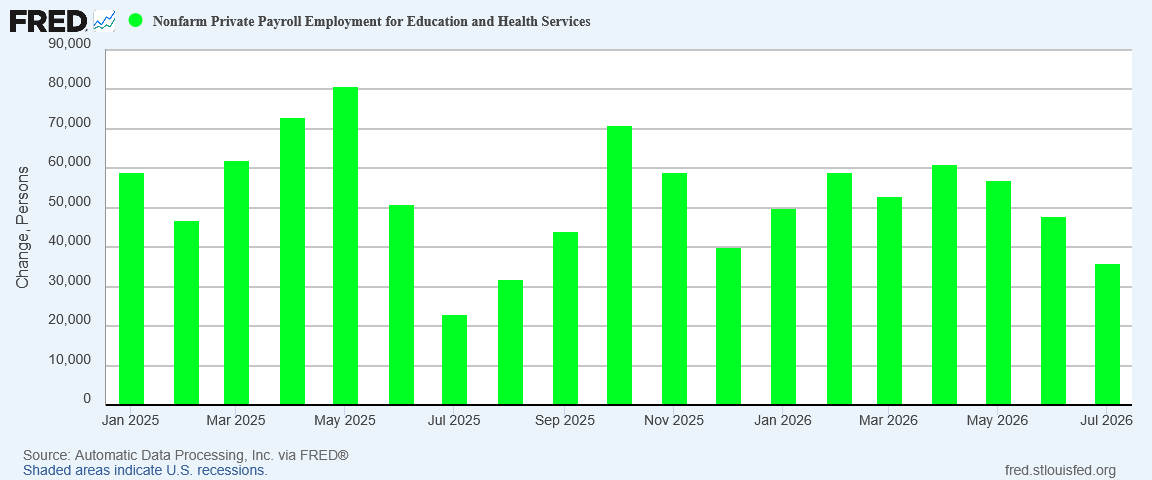
Education and Healthcare remained the main engine of job growth in the economy.
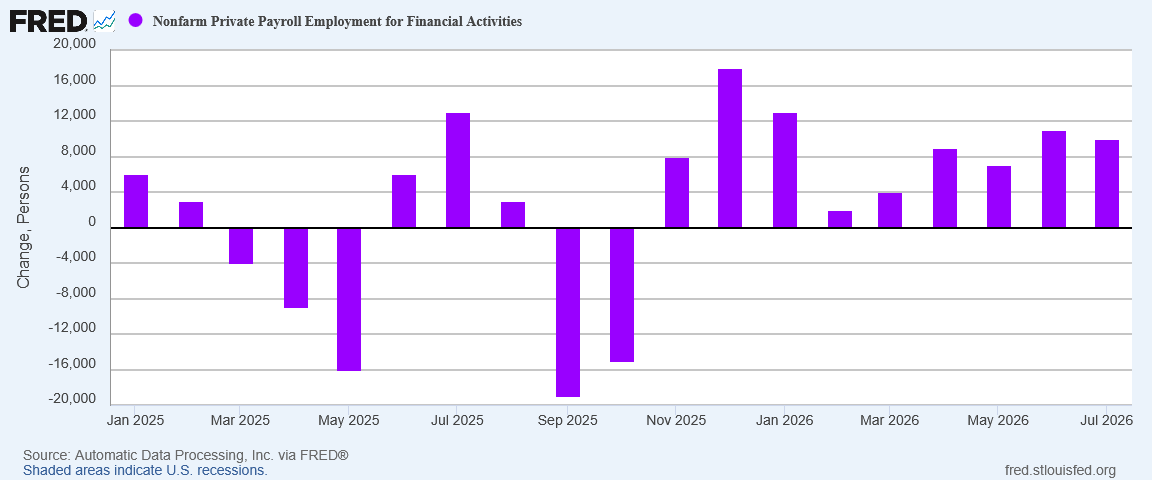
Finance was another sector where job growth only slowed a little.
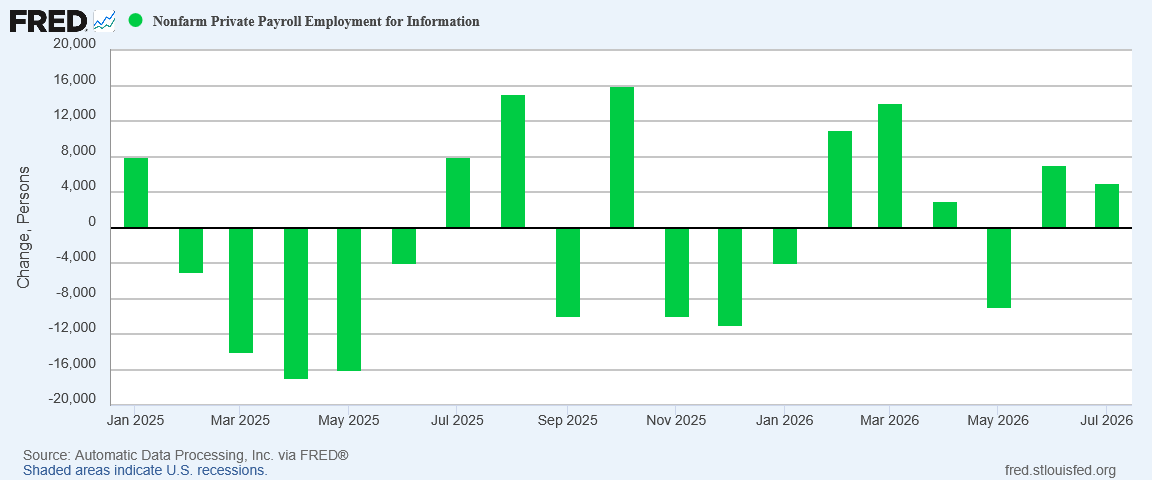
While Information has been a weak contributor to job growth for some time, in July it was at least not that much weaker a contributor to job growth.
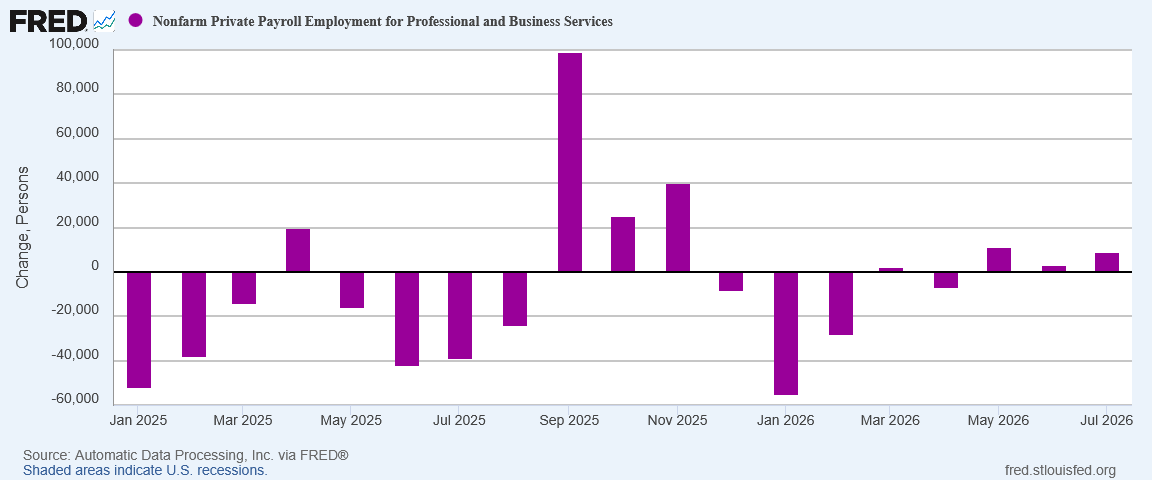
Professional and Business Services were the one sector where job growth actually increased in July, although not by much.
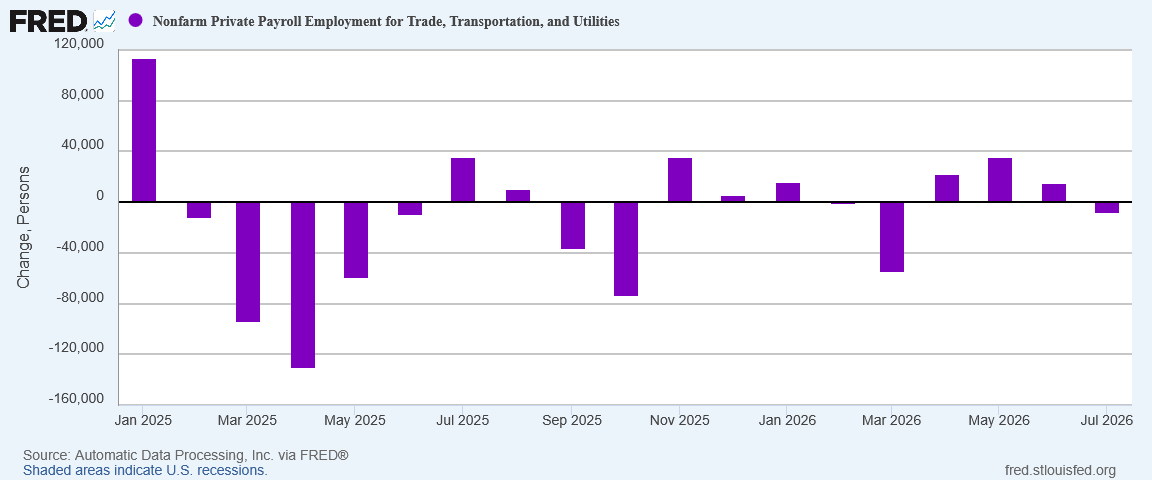
Trade, Transportation, and Utilities, long a source of higher paying service sector jobs, slipped into job loss for July.
In another grim confirmation of the June JOLTS data, Leisure was the biggest source of job loss in July.
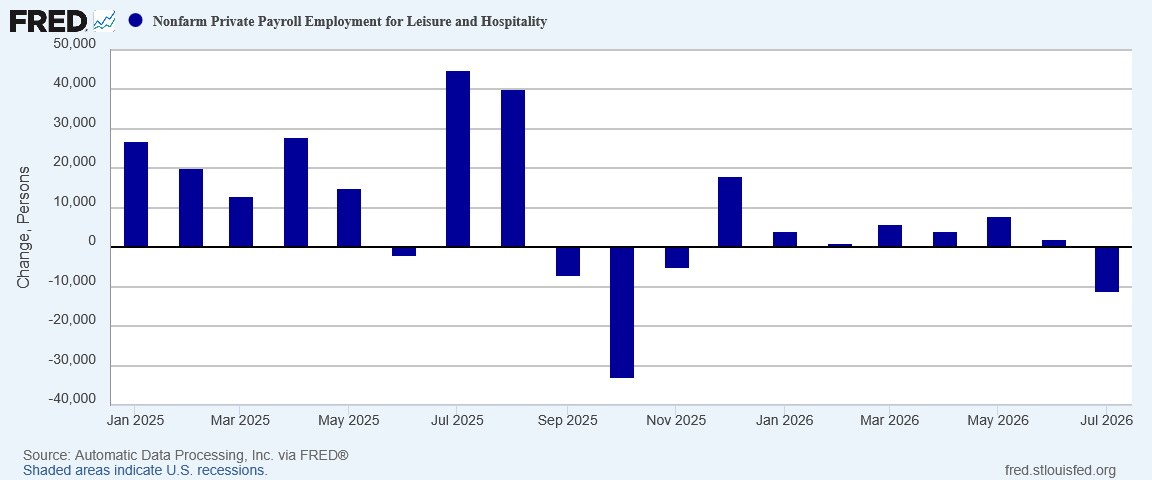
With the exception of Professional and Business Services, every sector in the ADP data set posted either larger job loss or weaker job growth than in June. July was a slowdown across the board.
PMI Data Sends Conflicting Signals
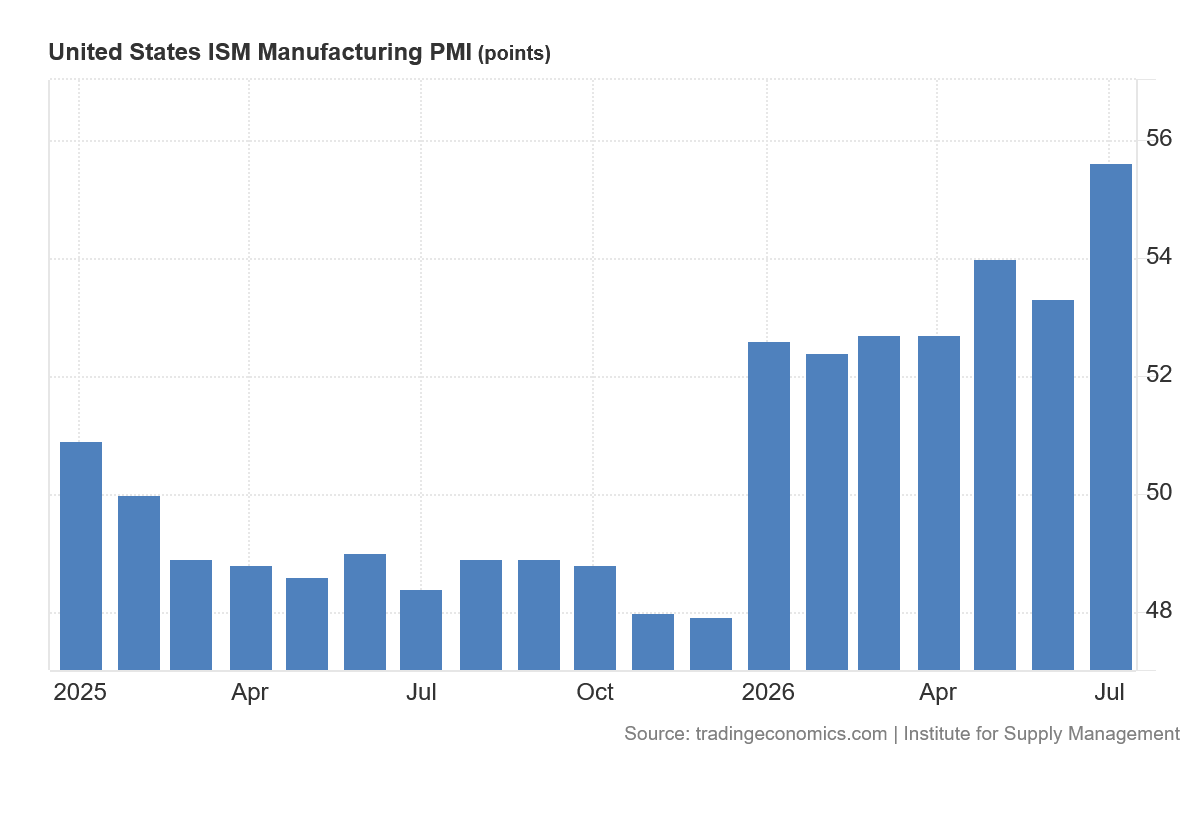
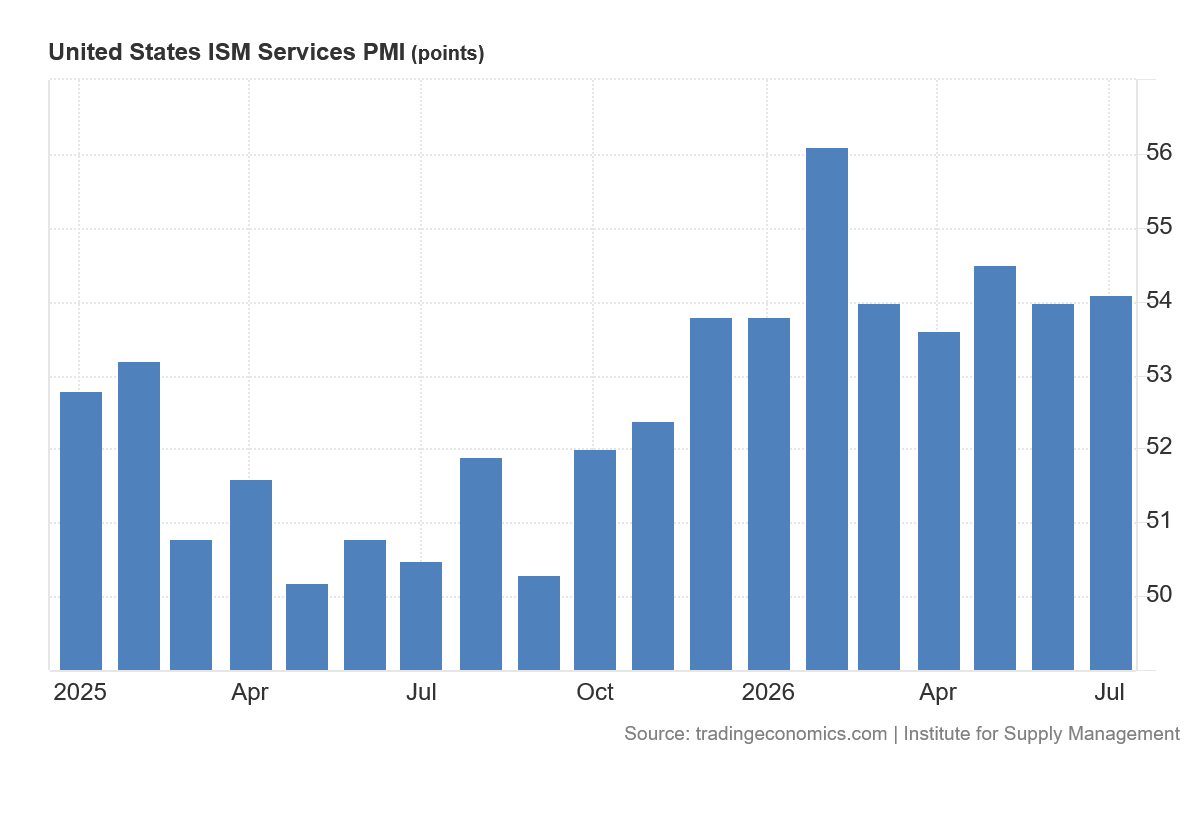
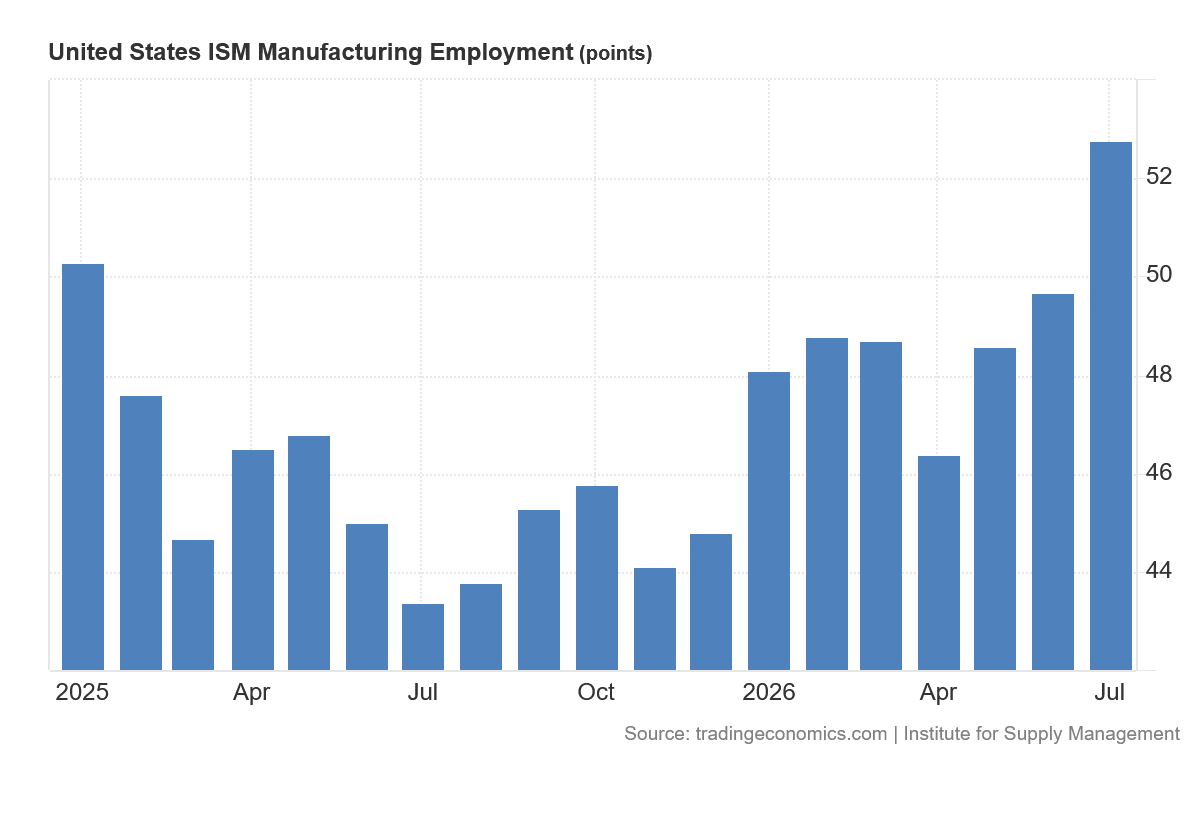
The ADP data is clearly printing a slowdown in job growth, and perhaps even heralding a return to jobs recession. Muddying the waters, however, are the July Purchasing Managers' Index metrics, which present a conflicting counter-narrative to the ADP data.
The ISM Manufacturing PMI printed major expansion in July at 55.6 (50+ is expansion, below 50 is contraction).
The ISM Services PMI printed a cooler but still strong 54.
The ISM Manufacturing Employment Index also had a strong print 52.8, surging out of June’s contraction well into expansion territory.
Yet the ISM Services Employment Index plunged into contraction at 47.4.
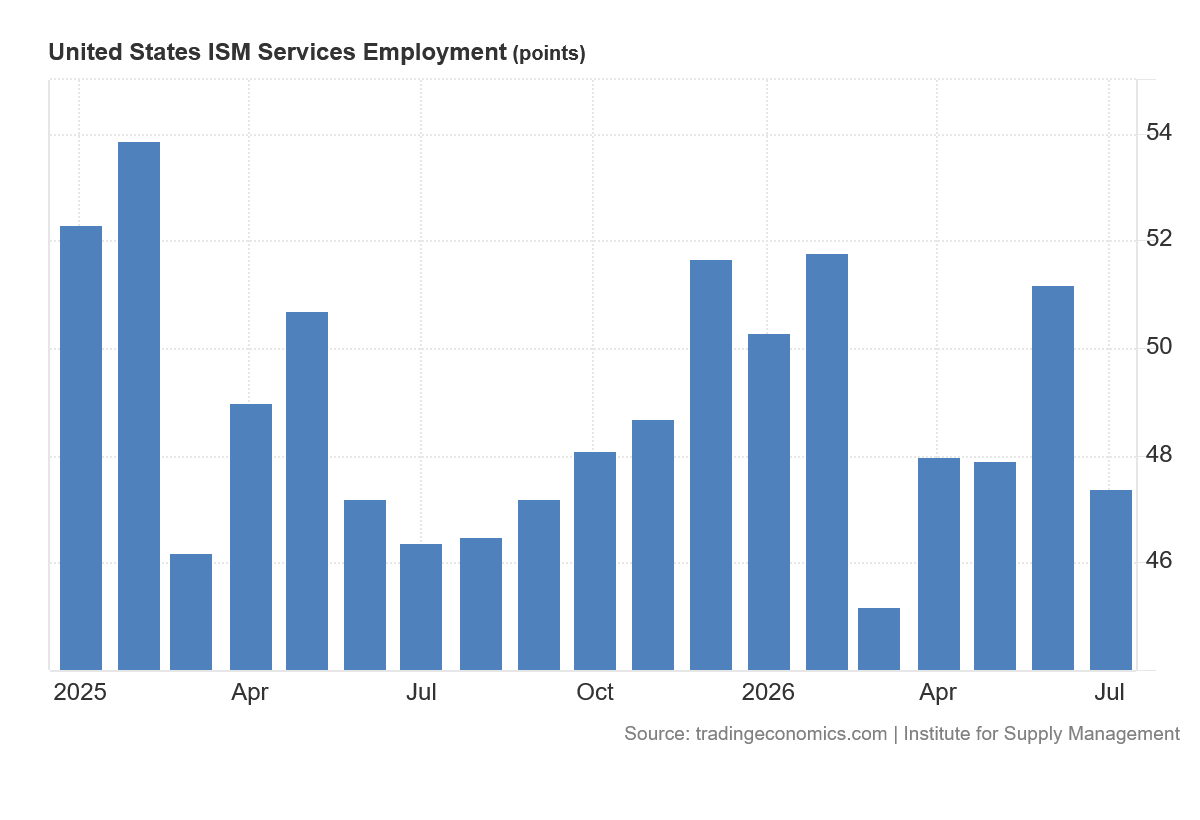
According to the ISM data, Manufacturing was the strong performer for July, and Services the weaker—the exact opposite of what the ADP data reports. Yet among Services at least the two data sets agreed that job growth weakened in July.
The PMI data suggests that, for now at least, claiming a return to jobs recession is premature. If job growth numbers remain dismal, however, a return to jobs recession is inevitable, regardless of what the PMI data shows.
Not Jobs Recession…Yet
The ADP jobs report is, to say the very least, a disappointment. Certainly Wall Street had much higher hopes.
The ADP jobs report is also a confirmation that the weaknesses signaled in the June JOLTS report were not outliers.
Both reports show Leisure taking a sizable jobs hit.
Both reports show overall job growth having slowed considerably from just two months ago.
Yet the ADP data only shows three sectors with job loss, which is a better result than the JOLTS report. While all sectors cooled in July, the ADP print was still stronger than the June JOLTS print.
While ADP confirms that the warning signals in the JOLTS data are real, ADP also printed strong enough that we cannot say the US economy has slipped back into jobs recession—at least, not yet.
The ADP reports have been showing cooler job growth trends over the past two months. If that trend continues, we will be back in a jobs recession, and sooner rather than later. For July at least, however, we are not yet there.
The PMI data suggests we might not actually get there. With both Manufacturing and Services printing expansion for July, sector growth eventually will compel job growth. If the PMI data continues to print expansion, eventually job growth must occur across the board.
Regardless of what the longer-term outlook for job growth might be, however, the weak ADP numbers, coupled with the dismal June JOLTS numbers, tells us not to expect much out of the BLS Employment Situation Summary due out on Friday. With two independent data sources charting a slowdown in job growth, there is simply no foundation for having much optimism for the BLS jobs data.
The July ADP jobs report is not a good jobs report. It is a warning sign the July BLS jobs report will very likely be itself a fairly dismal affair.
The jobs recovery, and job growth overall in this country, are slowing down. Those are not encouraging trends.
I love seeing accurate data, even when it doesn’t give me the news I hoped to read. Thanks, Peter!
“Muddying the waters, however, are the July Purchasing Managers' Index metrics, which present a conflicting counter-narrative to the ADP data.” Peter, what is the track record for this index? Do you give much weight to what it reports?