


Wall Street’s reaction to Kevin Warsh’s latest FOMC Press Briefing can be summed up in a single syllable: “Meh.”
This is perhaps unsurprising, as no one expected the Federal Open Market Committee to raise the federal funds rate, and the FOMC did not surprise anyone.
In keeping with the changes begun under Warsh, the announcement itself was brief, even terse:
The Committee decided to maintain the target range for the federal funds rate at 3-3/4 to 4 percent, in support of the Federal Reserve’s dual mandate. The Committee is continuing its policy of maintaining ample reserves in the banking system.
Economic activity is expanding at a strong pace. While uncertainty remains elevated owing, in part, to geopolitical developments, domestic spending has been resilient. Productivity growth is strong, and capital investment is robust. Job gains have kept pace with the workforce, and the unemployment rate has changed little.
Markets fluctuated modestly around the time of the presser, but there were no notable moves up or down.
Either Wall Street was content with what they heard or Wall Street is deciding the Federal Reserve should be less relevant to the markets.
We can easily assess how Wall Street perceived the press briefing simply by looking at the intraday movements on Treasury yields.
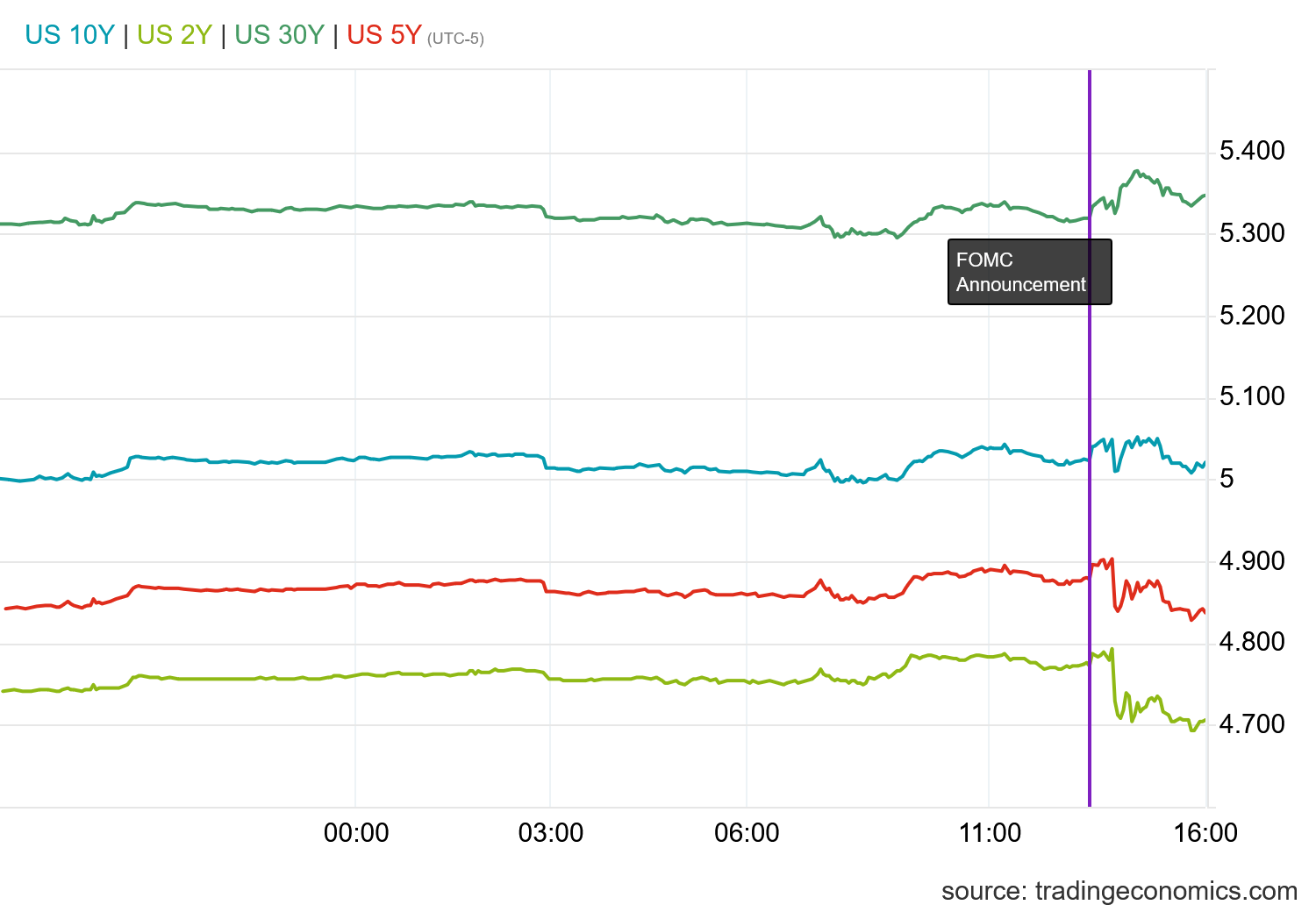
Short-term rates actually came down a few basis points, and the benchmark 10-Year yield stayed about the same. Only the 30-Year yield posted a significant rise in the aftermath of FOMC announcement at press briefing.
Equities told a similar story to Treasuries.
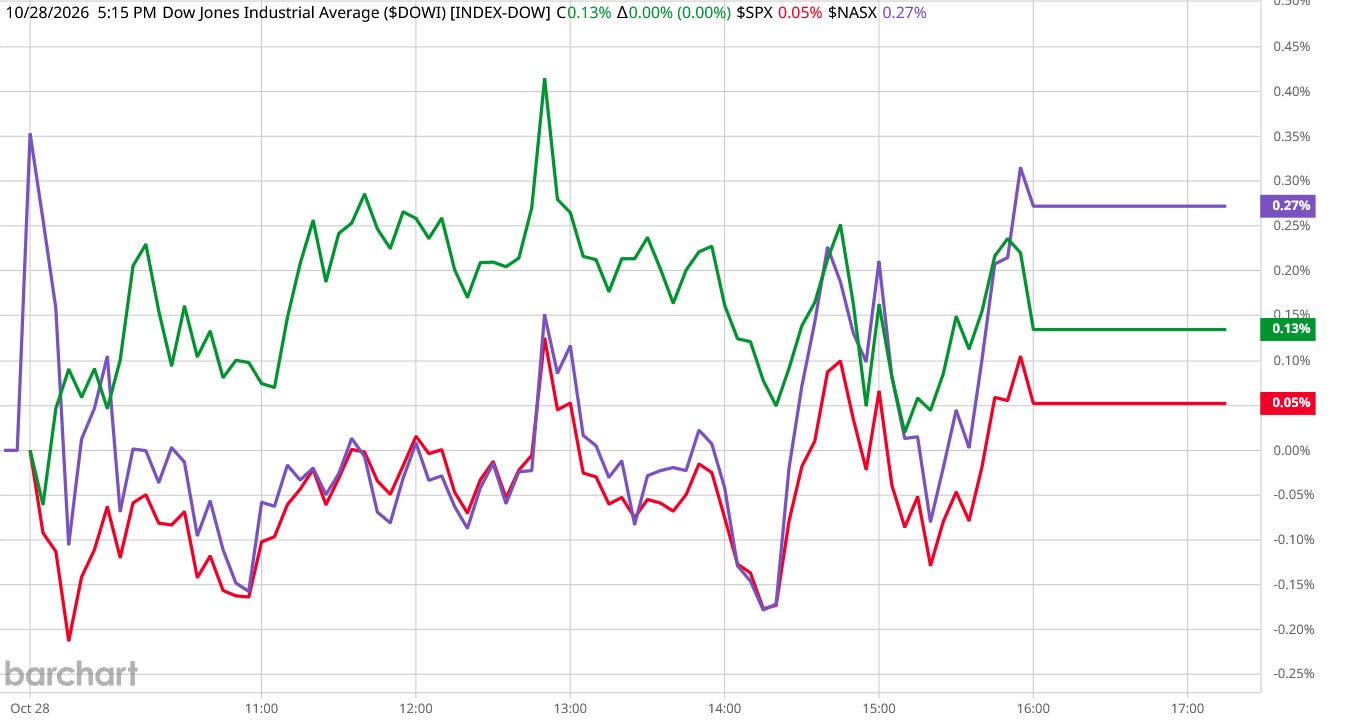
Neither equities nor Treasuries moved significantly in response to anything Kevin Warsh had to say.
Perversely, that might be the best outcome for the monthly FOMC press briefing. Warsh has said before he did not want Wall Street taking its cues from the Fed. If today’s market movements are any guide, he may be getting his wish.
Certainly Warsh offered no cues to anyone with his cryptic non-answers, most of which boiled down to yet another reiteration of Warsh wanting “more information”, as could be seen when asked if perhaps the federal funds rate was already at an ideal “neutral” rate.
Thank you, Chair Warsh. So if I could, this statement says that the accumulation of more information will help the committee determine the policy stance appropriate to ensure timely return of inflation to the 2% goal. Does that mean that the current level of the Fed funds rate might already be the right one?
Well, we’ve got to determine the appropriate protocol. If you were listening next to me in that room the last couple of days, the overwhelming consensus, the overwhelming judgment is that what we’ve done in this monetary medicine, starting to work some, but there’s no firm conclusions. If we had a firm conclusion about the conduct of monetary policy, we’d announce it to much fanfare today. What we decided to do was to Colby’s question, take stock of where we are, evaluate what we’re seeing out the window, ask ourselves whether the period right in front of us is likely to provide more clarity on the appropriate protocol. My judgment, the judgment of my overwhelming number of colleagues is that it would.
In other words, no one at the Fed knows if the 25bps rate hike last month helped or hurt either inflation or the economy, and the majority of the FOMC wanted to punt on whether to raise or lower rates as a consequence.
While in the past that admission would have given Wall Street fits, this time Wall Street simply shrugged it off. The Fed may not know the impacts of last month’s rate hike, but Wall Street apparently does not care.
As was to be expected, the media lost no time in second-guessing the stand-pat decision it knew was coming.
While the atmosphere in the brieifing room was polite, cordial, and even boring, CNN was having fun speculating that the Fed just screwed up by not making another ticky-tack rate hike, because inflation will just be that much higher in December.
By waiting, however, the Fed is also taking a significant gamble. The Fed risks another 2021-like mistake, when it assumed the inflation monster staring the economy directly in the face could be defeated by just ignoring it. (The Fed was disastrously wrong).
This time may truly be different, and not acting with haste could prove prescient.
Or it could force the central bank to give the economy some December shock therapy that it may have been able to avoid with an October rate hike.
For his part, bond vigilante Jeffrey Gundlach was miffed that there wasn’t a rate hike this month.
“I think the Fed should be raising interest rates, based upon the 2-year Treasury being at 4 and three-quarters percent, and now the yield curve in the wake of this news conference is steepening again,” Gundlach, CEO and Chief Investment Officer of DoubleLine Capital, said on CNBC’s “Closing Bell” after Fed Chairman Kevin Warsh wrapped up his news conference.
Gundlach’s argument, however, is undone by the reality of where Treasury yields are relative to the September rate hike.
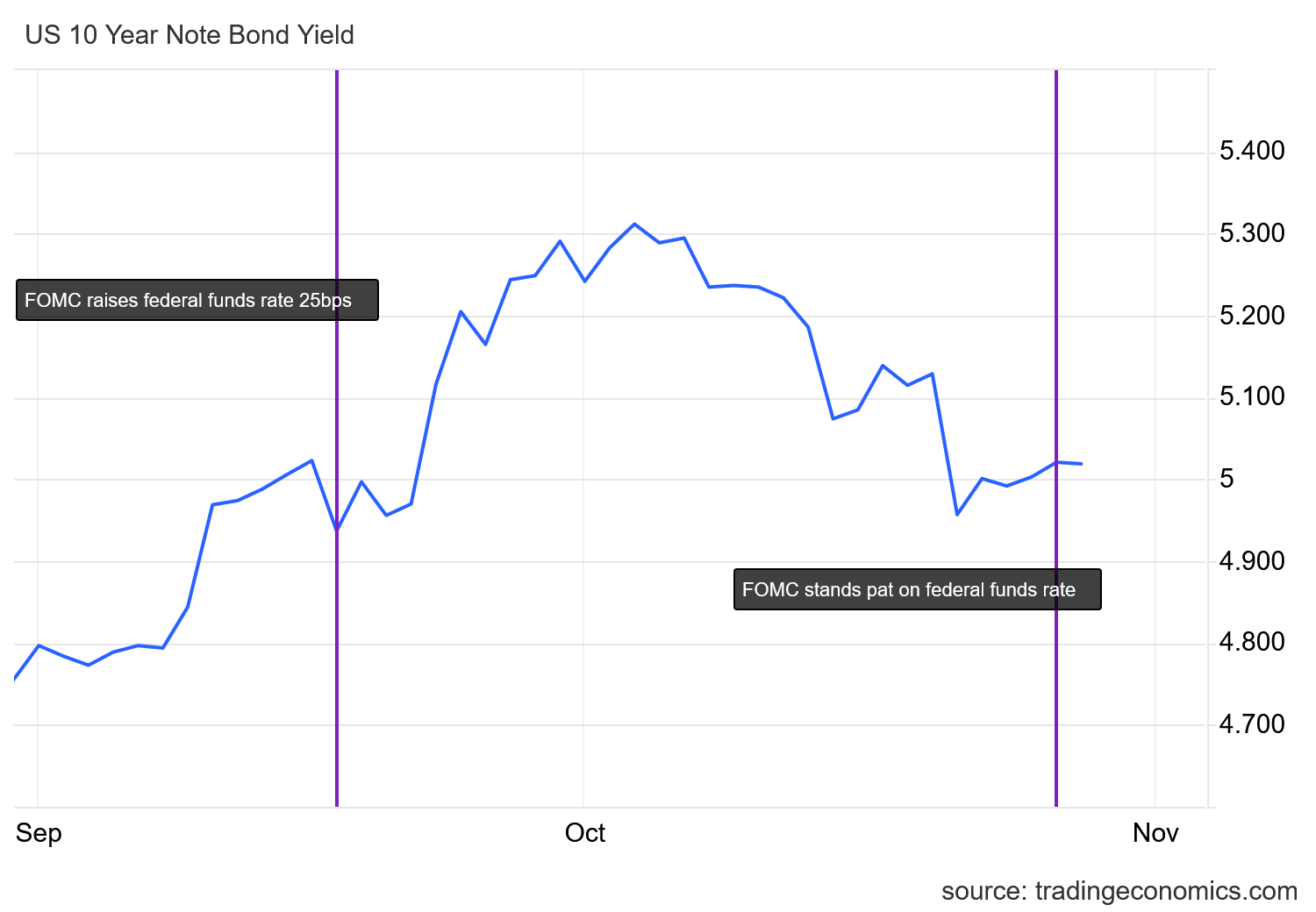
While the 10-Year Treasury yield rose significantly after the September FOMC meeting, peaking at just over 5.3%, it has since fallen almost as significantly, so that between the September FOMC meeting and yesterday, the 10-Year Treasury yield has moved up a whopping 9 basis points, from 4.93% to 5.02%.
Bond markets are not exactly clamoring for a higher federal funds rate at present.
Will that change by the time of the next FOMC meeting? That is certainly possible.
Will the bond vigilantes force a rate hike in the coming months the way they likely helped pressure the Fed to hike rates last month? That is also possible, and perhaps even probable. That might even be the outcome Warsh wants—he has said in previous press briefings he wants the Fed to be taking its cues from Wall Street and not the other way around.
What is certain after the FOMC press briefing is that Wall Street was neither enthused nor discouraged by either the FOMC announcement or the press briefing. Either financial markets are content with the FOMC decision on interest rates or financial markets are unconcerned with the FOMC decision on interest rates.
If Wall Street has decided it doesn’t care, the next great financial shock will be when Wall Street changes its mind and decides to care. Whether that will be next month or next year remains an open question for now.


