


The Bureau of Labor Statistics released the May Job Openings and Labor Turnover Summary report with its usual anodyne boilerplate emphasizing little change.

The number of job openings was unchanged at 7.6 million in May, the U.S. Bureau of Labor Statistics reported today. Hires were unchanged at 5.2 million, while total separations changed little at 5.1 million. Within separations, quits (3.1 million) changed little, while layoffs and discharges (1.7 million) were unchanged.
If we take the JOLTS report at face value, job markets in this country hardly change ever.
My advice: do not take the JOLTS report at face value.
On the surface, the JOLTS report appears strong, with job openings printing well above Wall Street projections, and even above Trading Economics more optimistic forecast.

What that seemingly robust job opening number obscures is the significant drop in private net hiring during the month of May.
What that seemingly robust job opening number obscures is the rise in separations during the month of May.
What that seemingly robust job opening number obscures is the fact that net hiring is significantly less in each job sector than the change in the All Employees data from the Employment Situation Summary. While not proof positive, the weak JOLTS net hiring is a warning signal there may be a major downward revision to the All Employees data in the near future.
For all the corporate media hooplah over job openings, the weak net hiring data suggests the May JOLTS report may be much ado over not very much.
Corporate Media Loves Job Openings, All But Ignores Net Hiring
The number of new job openings is indisputably an optimistic number when it comes to jobs in this country. An employer posting a job opening presumably is a company hoping to expand its payroll, or at least sustain it.
When that job opening does not soon translate into actual hiring, the job opening might as well not even exist.
The Associated Press, as is the case with nearly all corporate media, ignores this simple reality in favor of pushing Wall Street’s preferred narrative that job openings tell the tale on US job markets. We can see that much just in their headline regarding the preferred narrative.
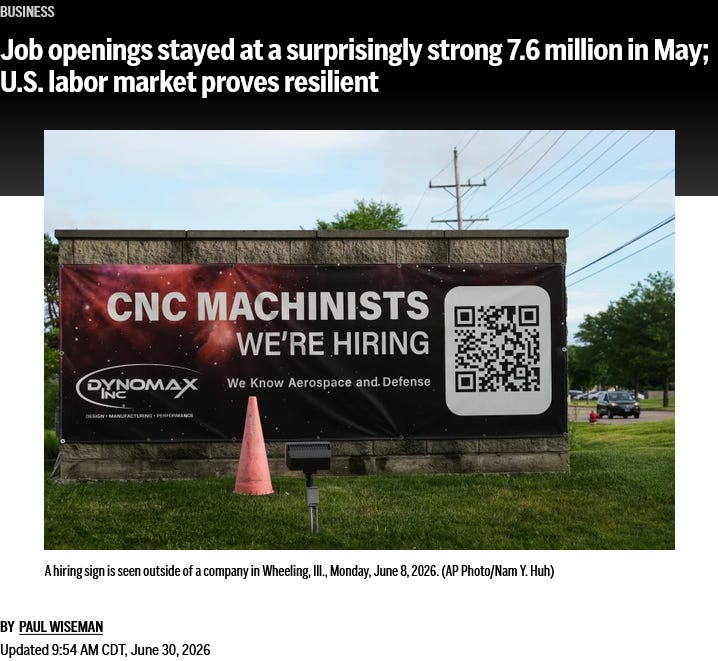
One has to get to the fourth paragraph before the AP report acknowledges that private net hiring is anemic at best.
Employers are advertising openings, but they aren’t actually doing much hiring. Gross hiring — before counting people who lost or quit their jobs — dipped to 5.17 million in May from 5.26 million in April. When the job market was booming from mid-2021 to mid-2023 after COVID-19 lockdowns, gross monthly hiring regularly topped 6 million.
Reuters buried the possibility the JOLTS report is signalling a downward revision on May jobs in the bottom half of its reporting on the BLS release.
“We were surprised to see the total hiring rate unchanged and the private hiring rate decline again in May despite stronger May job growth,” said Veronica Clark, an economist at Citigroup. “This could mean possible revisions lower to May data or weaker net job growth could reflect actions taken in the second half of May. This would suggest softer June employment.”
CNN, still the Most Busted Name In Fake News, once again lived down to its reputation by ignoring the drop in net hiring. Their take extrapolated solely from the job opening numbers to pronounce US jobs markets are still very robust.
“The hiring recession is over, and we are starting to see more industries look for workers again, and that’s really good news,” Heather Long, chief economist at Navy Federal Credit Union, told CNN in an interview Tuesday.
With the May Employment Situation Summary being the third consecutive strong jobs report, even I have considered the possibility that the jobs recession is now over.

However, such speculation should not blind us to the reality that a drop in net hiring on the JOLTS report is a signal that perhaps the jobs recession is not quite over. The JOLTS report is a signal we should not blithely ignore.
Job Openings Still Not Real
As wonderful as a high job openings number sounds—and 7.6 million job openings absolutely sounds wonderful and optimistic—the unalterable reality of the data is those job openings are not translating into actual hiring. We can see that just from the headline data itself.
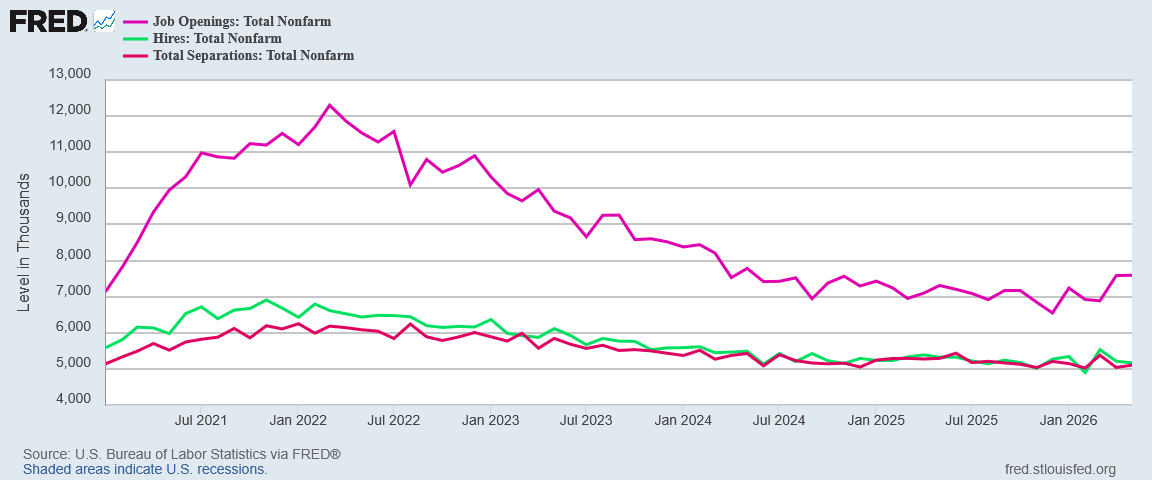
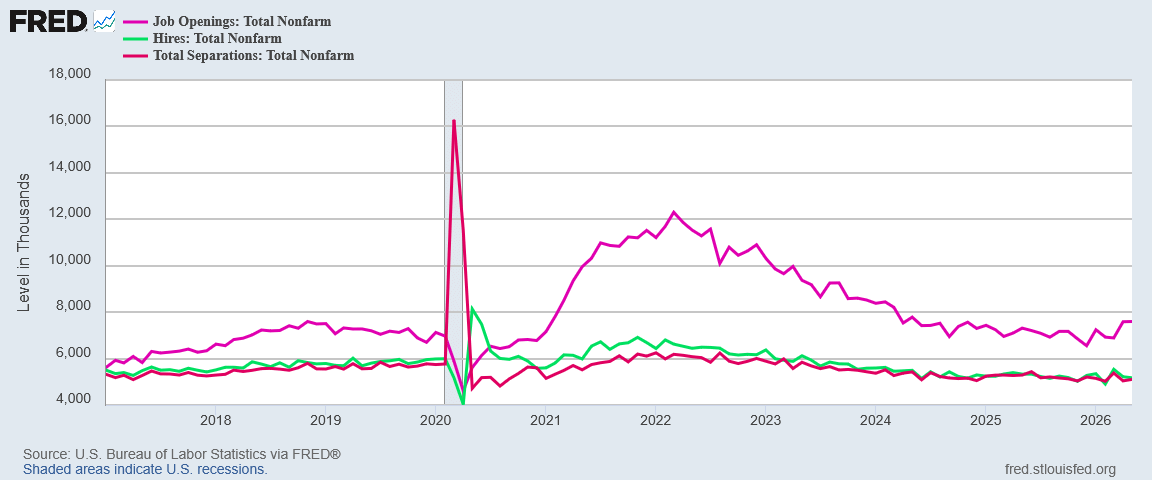
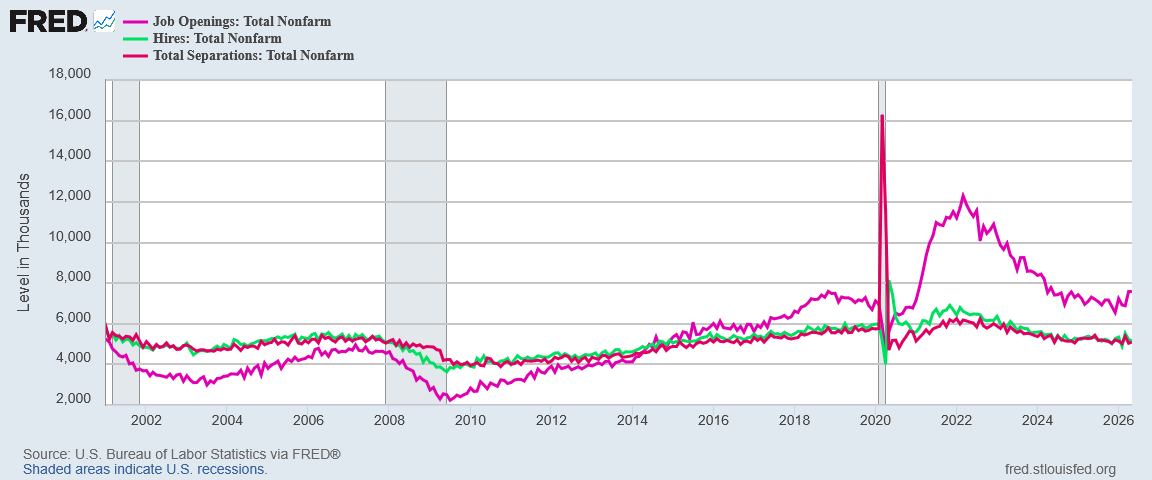
What is frequently ignored is that the job openings data has printed well above hiring and separations ever since the start of the Biden Reign of Error, which is a marked change from pre-Pandemic Panic data.
If we strip away the job openings data, the hiring and separations data loses quite a bit of its luster.
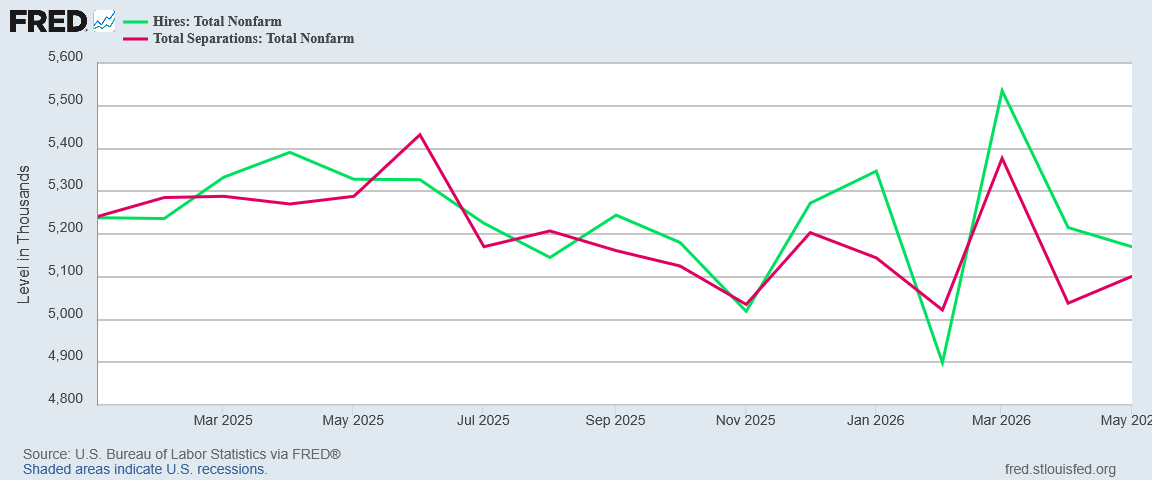
Hiring and separations have been more volatile in recent months, but the longer term trend since the start of the Trump Administration 2.0 in January 2025 is still slightly down. March was the strongest hiring period in that time, but it comes on the heels of the worst hiring period, which was February.
As optimistic as 7.6 million job openings sounds, the reality is that net hiring is still not even attempting to fill that many openings, rendering most of them effectively unreal.
Net Hiring Declined Overall
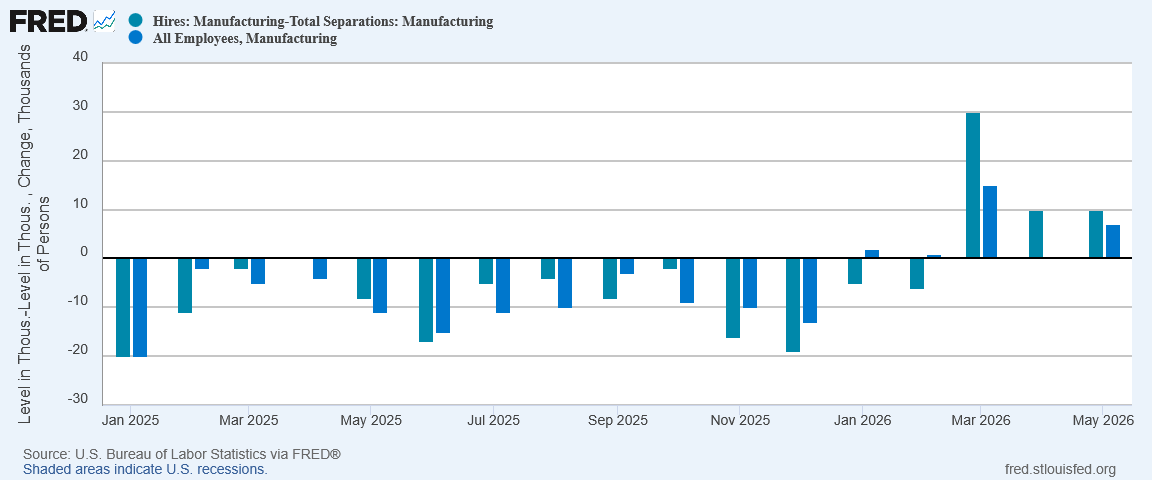
One undeniable bright spot in the JOLTS report was that Manufacturing held its own, once again printing 10,000 net hires in May.
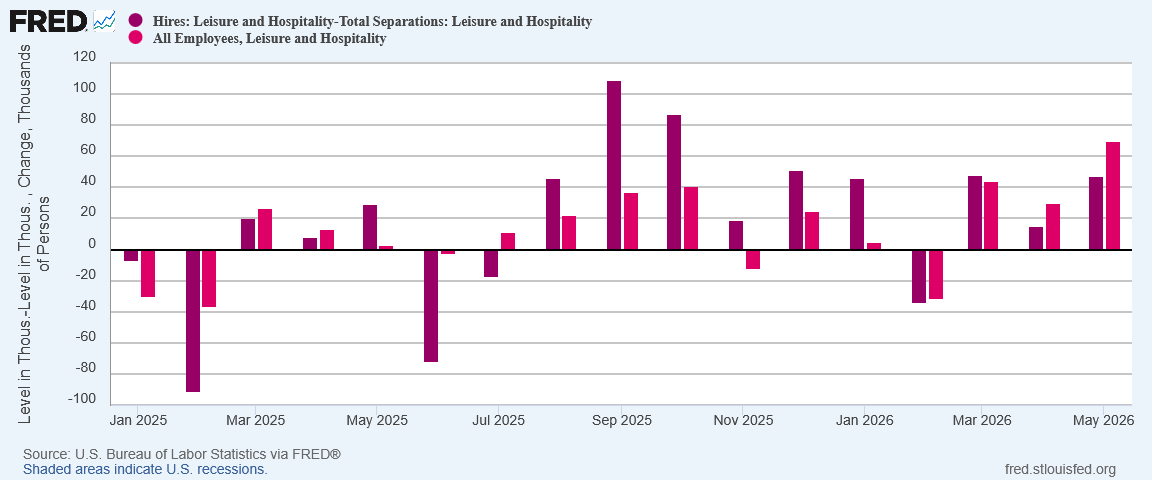
Leisure and Hospitality rebounded in May, with its net hiring of 47,000 very nearly equaling its March level.
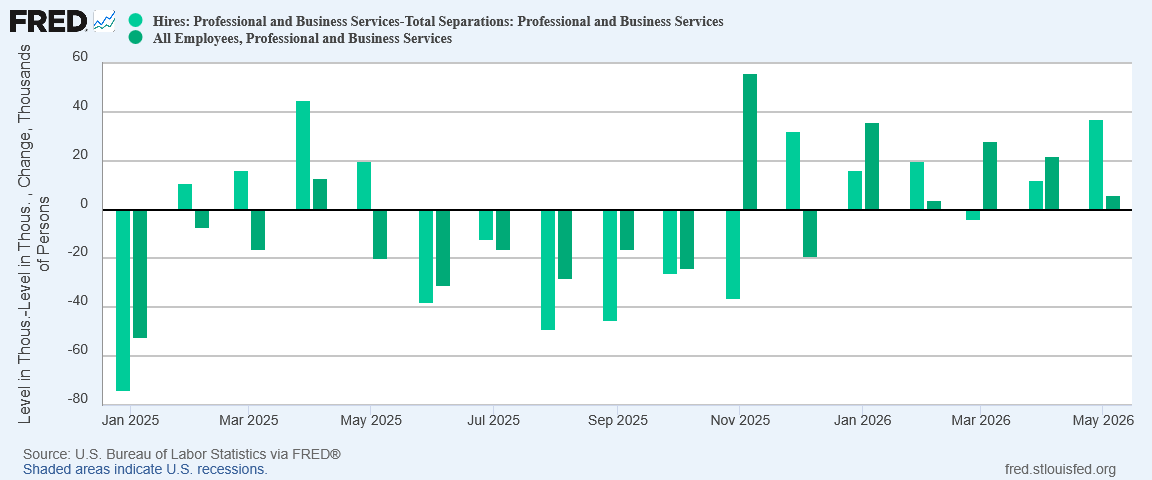
Professional and Business Services had perhaps the best results, as its net hiring of 37,000 was its best result since April of 2025.
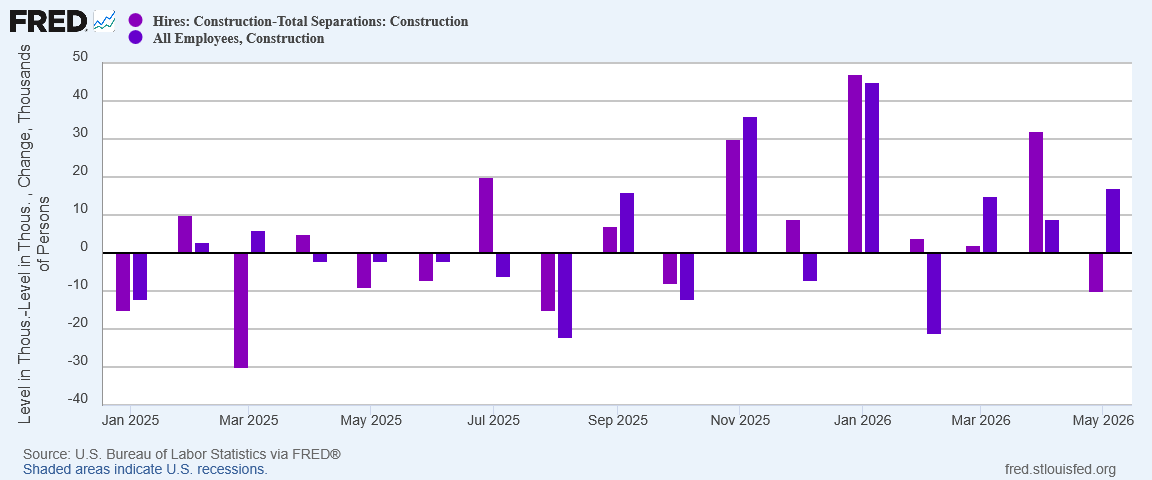
Construction, on the other hand, shed jobs in May according to the JOLTS report.
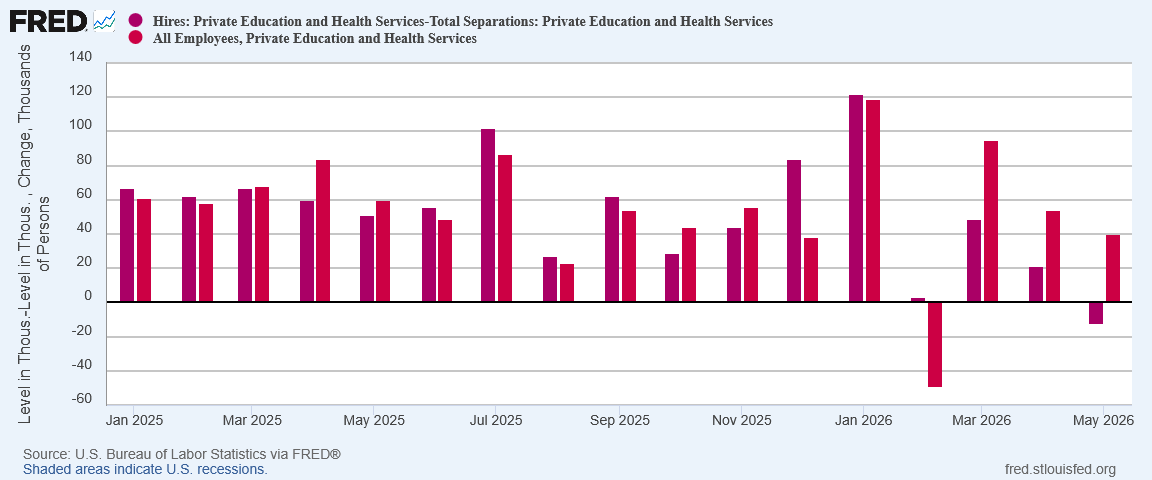
Healthcare also did not fare well on the May JOLTS report, shedding jobs in what has been a steady decline since January 2026.
Net Hiring for Trade Transportation and Utilities (TTU) simply vanished for May.
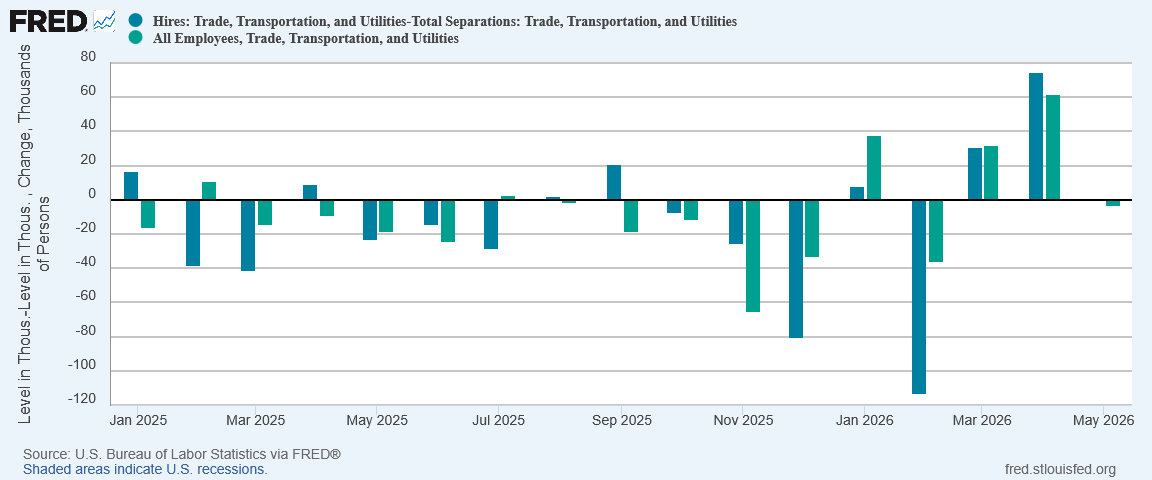
TTU shed jobs throughout most of 2025, and April was the first time since the start of Trump Administration 2.0 that TTU net hiring printed consecutive months of job growth.
Taken together, net hiring across all private sectors plunged from 173,000 jobs in April to just 34,000 jobs in May.
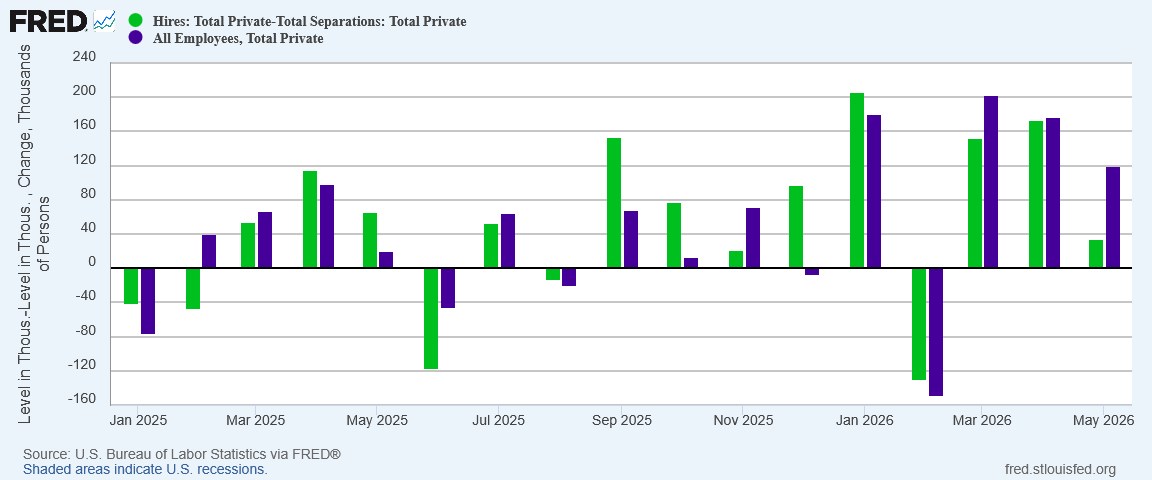
With the Employment Situation Summary having printed private sector job growth of 120,000 jobs in May, the JOLTS report is quite a bit less optimistic. The disparity between the ESS and JOLTS reports—86,000 jobs—is the largest such gap since February 2025.
There are good reasons to fear a major downward revision coming to the Employment Situation Summary data. Those same reasons also warn us the jobs recession perhaps is not quite over after all.
We do not want to abandon the jobs recovery narrative on the basis of one weak report in one month, just as we would not want to declare a jobs recovery on the basis of one strong report in one month. Still, we do well to be mindful of the possibility the jobs recovery was just a flash in the pan.
Openings Are The Least Important Data
Contrary to what Wall Street insists and what corporate media promotes, the job openings data itself is the least important data set in the entire JOLTS report.
When hiring responds to job openings, that data can be a useful leading indicator of where hiring might be heading. The data shows that, since the COVID Pandemic Panic of 2020 especially, hiring has not responded to job openings. Even worse for the job openings data is the reality that, since late 2014, job openings have not only exceeded hiring and separations, but that gap has grown steadily wider.
Perhaps most damning of all for the job openings data is that, from 2001 through 2014, the job openings number was consistently below hiring and separations.
The simple reality of job openings is that not a single job opening has economic significance until it is filled.
A job opening is not an expansion of payroll—a paycheck is.
A job opening is not a reduction in unemployment—a new hire is.
In the May JOLTS report, the least important number rose, while the most important number fell.
That is a warning sign. The data is reminding us that, for all the positive job growth data over the past few months, much about US labor markets remains unwell and unresolved.
The May JOLTS report is not a horrible report. Arguably it is not even a bad report.
It is a report that printed net hiring of 34,000 in May. That is still job growth, and that is very much a good thing, but 34,000 is quite the climbdown from 173,000.
That cooling off to the tune of 139,000 jobs not filled precludes the possibility the May JOLTS report is an indisputably good report.
There is some good in the May JOLTS report, but there is considerable bad as well.
Pay attention to both.
Heavens, I love how factual you are, Peter!
But that being said, “…As wonderful as a high job openings number sounds—and 7.6 million job openings absolutely sounds wonderful and optimistic” - I’m glad Trump has numbers that can be spun into additional Republican votes come November!
Thank you for being authentically you, dear man.