


Happily, Saturday’s “No Kings” protests around the country proved not to be an escalation of the Democrat Rebellion. They were largely an exercise in futility, but at least they were a peaceful exercise.
That is a welcome change from how Democrats have chosen to oppose the Trump Administration thus far.
Yet their conspicuous lack of messaging substance is itself a useful point of departure for assessing how political opposition should unfold in a constitutional republic. For every free and democratic society, it remains a given that there will be disagreements over politics as well as policy. How society digests those disagreements says much about the health of its politics and the sobriety of its policies.
We do well to remember that state and local opposition to federal authority is nearly as old as the Republic. In this regard, “No Kings” is merely the latest cycle of state and local vs national politics. Even the Democrat Rebellion is not without certain historical antecedents, over and above the obvious one of the American Civil War.
We do well also to note that states have in the past handled their defiance of federal authority with far greater principle and far greater fidelity to the Constitutional order than have the modern Democrats. The best example of this comes from 1830s South Carolina, home of the pivotal “Nullification Crisis”, a major turning point on this nation’s tragic path to the American Civil War.
Unlike South Carolina then, Democrats today are not championing Constitutional principles, but advocating Constitutional destruction.
Unlike South Carolina then, Democrats today seek to dismantle the Constitutional order, leaving nihilistic anarchy in its wake.
That difference is the difference between the political crisis of the 1830s and the Democrat Rebellion of today.
That difference is why the Democrats are not fighting President Trump, but the United States Constitution.
The Nullification Crisis
The Nullification Crisis at one time was an essential teaching in high-school civics, and it remains a key object lesson in the dynamic tensions which both sustain and restrain Constitutional governance. With respect to the ongoing Democrat Rebellion and the “No Kings” rallies in particular, the Nullification Crisis also gives a practical measure by which we may measure the extent to which both are an abject political failure.
The Crisis erupted in 1832 in South Carolina1 as that state’s vehement opposition to the Tariff of 1828 (popularly known as the “Tariff of Abominations”)2 boiled over, leading the state to simply declare the tariff itself void.
The Tariff itself was a protective tariff which sought to protect the nascent northern industrial economy from external competition. For South Carolina and its primarily agrarian economy, that was a problem. The tariff’s clear pro-Northern bias was seen as an assault on South Carolina’s economy by a federal government that in theory was as obligated to preserve South Carolina’s economic interests as it was the North’s.
It is instructive for our purposes here to observe that the imposition of tariffs is indisputably a federal authority and prerogative, explicitly stated in the very first clause of Article 1 Section 8 of the Constitution:
The Congress shall have Power To lay and collect Taxes, Duties, Imposts and Excises, to pay the Debts and provide for the common Defence and general Welfare of the United States; but all Duties, Imposts and Excises shall be uniform throughout the United States;
Congress is allowed to establish tariffs, and the states are not given a say in the matter. The states are explicitly enjoined from establishing their own tariff regimes in Article 1 Section 10.
No State shall, without the Consent of the Congress, lay any Imposts or Duties on Imports or Exports, except what may be absolutely necessary for executing it’s inspection Laws: and the net Produce of all Duties and Imposts, laid by any State on Imports or Exports, shall be for the Use of the Treasury of the United States; and all such Laws shall be subject to the Revision and Controul of the Congress.
On the surface it might seem that South Carolina did not have much of a legal leg to stand on. They might not have liked the Tariff of 1828, but Constitution delegates the power of the tariff to the Congress and denies it to the states.
Yet the Tariff of 1828 was an extreme tariff for its time, with some tariff rates approaching 49%. The tariff was not merely a revenue measure, nor was it even run-of-the-mill economic nativism. It was extreme economic protectionism, and at that protection of one part of the country at the expense of another.
The apparent regional bias of the Tariff caused great resentment in the South, and in South Carolina especially.
There was perhaps also a bit of sour grapes at work, for the Tariff of 1828 was largely the handiwork of southern Democrats led by Andrew Jackson. Jackson, aided by then-Senator (and later President) Martin Van Buren, manipulated a tariff bill through the Congress3 that was intended to be so extreme—so “abominable”—that the northern states would recoil at the tariffs placed on raw materials imports.
That plan backfired, as a sizable contingent of northern interests calculated that the long-term impacts of the tariff would be beneficial to the north’s growing industrial economy. As a result, that “abominable” tariff bill passed Congress in 1828 and was signed by President John Quincy Adams, and so the Tariff of 1828 (the “Tariff of Abominations”) became law.
Into this conflict waded America’s second greatest political thinker after Thomas Jefferson, John C. Calhoun.
Calhoun’s Theory Of State “Nullification”
Calhoun was the Vice-President under both President John Quincy Adams and his successor Andrew Jackson. Ironically, as Vice-President he had also been one of the players in crafting the Tariff’s extreme rates4.
When the tariff became law, and the extent of the Democrats miscalculation became clear, Calhoun began arguing strenuously against the tariff, developing a political theory of “nullification”, where states could “nullify” federal laws they considered to be unconstitutional.
While Calhoun acknowledged the power of the federal government to enact tariffs, in an essay first published anonymously, “South Carolina Exposition and Protest”5, he argued that the protectionist nature of the Tariff of 1828 exceeded the power allocated to the Congress.
The general government is one of specific powers, and it can rightfully exercise only the powers expressly granted, and those that may be “necessary and proper” to carry them into effect; all others being reserved expressly to the states, or to the people. It results necessarily, that those who claim to exercise a power under the constitution, are bound to shew, that it is expressly granted, or that it is necessary and proper, as a means to some of the granted powers. The advocates of the Tariff have offered no such proof. It is true, that the third section of the first article of the constitution of the United States authorizes Congress to lay and collect an impost duty, but it is granted as a tax power, for the sole purpose of revenue; a power in its nature essentially different from that of imposing protective or prohibitory duties. The two are incompatable; for the prohibitory system must end in destroying the revenue from impost.
Having established a Constitutional argument against the legitimacy of the Tariff, Calhoun went on to recall Alexander Hamilton’s assessment of federalism under the Constitution in Federalist 516, and the imperative of not disfavoring minority interests to appease a majority.
There are, moreover, two considerations particularly applicable to the federal system of America, which place that system in a very interesting point of view. First. In a single republic, all the power surrendered by the people is submitted to the administration of a single government; and the usurpations are guarded against by a division of the government into distinct and separate departments. In the compound republic of America, the power surrendered by the people is first divided between two distinct governments, and then the portion allotted to each subdivided among distinct and separate departments. Hence a double security arises to the rights of the people. The different governments will control each other, at the same time that each will be controlled by itself. Second. It is of great importance in a republic not only to guard the society against the oppression of its rulers, but to guard one part of the society against the injustice of the other part. Different interests necessarily exist in different classes of citizens. If a majority be united by a common interest, the rights of the minority will be insecure.
Calhoun found in Hamilton’s thesis an argument that the individual states within the United States remain the true sovereign entities, and arguably the final governmental authority.
Our system, then consists of two distinct and independent sovereignties. The general powers conferred on the general government, are subject to its sole and separate control, and the states cannot, without violating the constitution, interpose their authority to check, or in any manner counteract its movements, so long, as they are confined to its proper sphere; so also the peculiar and local powers, reserved to the states, are subject to their exclusive control, nor can the general government interfere with them, without on its part, also violating the constitution. In order to have a full and clear conception of our institutions, it will be proper to remark, that there is in our system a striking distinction between the government and the sovereign power. Whatever may be the true doctrine in regard to the sovereignty of the states individually, it is unquestionably clear that while the government of the union is vested in its legislative, executive and political departments, the actual sovereign power, resides in the several states, who created it, in their separate and distinct political character.
Accordingly, when states found federal action exceeding the Constitutional constraints placed upon federal action, they were endowed by their native sovereignty to resist—to “nullify”—federal law.
We should note that Calhoun’s thesis was less radical than it might first appear. At its core was the same premise Chief Justice John Marshall elucidated in 1803’s historic Marbury v Madison Supreme Court ruling7:
Certainly all those who have framed written Constitutions contemplate them as forming the fundamental and paramount law of the nation, and consequently the theory of every such government must be that an act of the Legislature repugnant to the Constitution is void.
Marshall in turn channeled Thomas Jefferson and James Madison, who promoted much the same arguments in the Kentucky8 and Virginia9 Resolutions in 1798.
In fact, one could argue—and I have argued—that Marshall’s defense of judicial review is a lineal antecedent to theories of nullification as a necessary check on federal power.
Thus, Calhoun argued, as the federal government exceeded its authority with the overprotective Tariff of 1828, South Carolina was within its prerogatives as a sovereign state to declare that Tariff unconstitutional and, therefore, void.
The Ordinance Of Nullification And Andrew Jackson’s Brutal Response
Calhoun’s arguments resonated with South Carolinians, and as resentment and opposition to the Tariff of Abominations rose, a culmination was reached on November 24, 1832. Congress had attempted to defuse the crisis that summer by passing the Tariff of 1832, but that provided only token reductions in tariff rates.
South Carolina responded by holding a popular convention to enact the “Ordinance of Nullification.”10 Calhoun’s theories on state nullification were put to practical test.
And just like that, the Tariff of Abominations was deemed null and void within the state of South Carolina.
President Andrew Jackson was not at all impressed, not with his Vice-President’s cerebrations on state nullification and especially not with South Carolina’s “Ordinance of Nullification.” His response came swift and was unequivocal: On December 10, 1832, Jackson issued his blunt and brutal “Proclamation Regarding Nullification”11, where he flatly rejected the entire argument, making it clear that he was prepared to back up federal authority with federal force.
One week later, Jackson began making preparations to use federal troops to enforce the Tariffs of 1828 and 1832, and South Carolina began making preparations to resist.
On December 17, 1832, one week after issuing his proclamation, Jackson told Secretary of War Lewis Cass, “We must be prepared to act with promptness and crush the monster in its cradle before it matures to manhood. We must be prepared for the crisis.” At the same time, the new South Carolina governor, Robert Hayne, whose former Senate seat was now occupied by John C. Calhoun and who had resigned as Jackson’s vice president, was mobilizing men and arms to defend the state’s sovereignty.
Eventually, cooler heads would prevail. With other Southern states declining to support South Carolina’s nullification efforts, the state bowed to reality and rescinded the Ordinance of Nullification. At the same time, Senator Henry Clay brokered a compromise tariff, and the protectionist tariff rates were diluted for a time, temporarily diffusing the crisis.
Still, many consider the Nullification Crisis as a pivotal contest between state and federal authority which would explode a generation later into the bloodbath of the American Civil War, when Jackson’s threat of federal force against South Carolina’s assertion of state sovereignty became a grim reality instead of merely a hypothetical possibility.
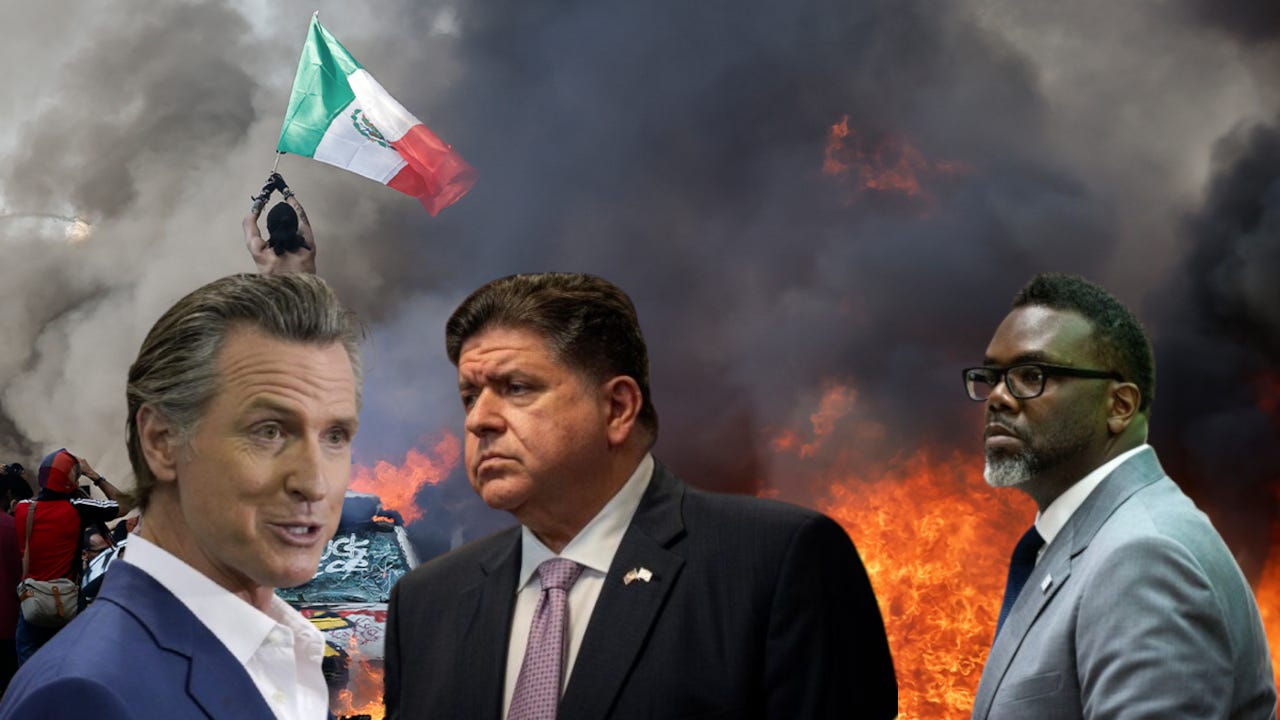
One is certainly tempted to see within the Nullification Crisis echoes of themes we hear today in the Democrat Rebellion: we have the absurdity of Mayor Brandon Johnson of Chicago pretending to impose restrictions on federal agents in the discharge of their federal duties. We have Governor J. B. Pritzker of Illinois threatening to arrest and prosecute federal agents for carrying their federal duties. We have Gavin Newsom enacting laws purporting to regulate whether ICE agents may wear face masks to prevent doxxing.
Now in the Democrat Rebellion as during the Nullification Crisis, we have states asserting authority to effectively cancel federal government acts and policies.
Why, then, are the Democrats today guilty of rebellion, when the people of South Carolina were not in 1832?
The Democrat Rebellion: No Debate And No Ideas
The principal distinction between South Carolina then and the Democratic Party today lies in how the Nullification Crisis unfolded. Without commenting on the merits and demerits of either side, the Nullification Crisis was, first and foremost, a debate.
South Carolina did not simply resort to violence when the Tariff of 1828 was passed. There was protest and there was dissatisfaction, but violence and force were not a first response, or even a reflexive response. Calhoun, as one of the state’s political luminaries, analyzed the situation and advanced a substantive argument in favor of South Carolina nullifying the tariff at least within the boundaries of South Carolina.
The threat of force emerged when both the federal government and South Carolina would not budge and would not back down from their respective positions.
Was Calhoun on to something with his theory of state nullification?
A great many staunch political conservatives today would argue otherwise, holding that the Civil War resolved all such ideas permanently through force of arms.
Advocates for states rights might argue that force of arms can never resolve such questions with finality. Full Disclosure: I would be one of those states rights advocates.
Yet for such questions to be resolved both sides have to put forward ideas. They have to put forward policies. They have to promote legislation to enact those policies and implement those ideas. South Carolina did all three.
When we look at the Democrat Rebellion today, what ideas have the Democrats put forward? What policies are they promoting? What legislation are they seeking to enact?
We do well to observe that Democrats’ lack of ideas or policies is what has left them straitjacketed during the current government shutdown.

The Democrats in Congress have not articulated a clear case for anything, allowing the Republicans in Congress to frame even the corporate media narratives, sapping the usual Democrat edge in the political gamesmanship of shutdown. They blunted what could have been a clear message on avoiding a potential economic shock when the Obamacare subsidies expire with a grab-bag of other policy preferences, including Medicaid expansions which would, among other things, fund healthcare for illegal aliens.
It should surprise no one that Republicans seized on the gift of those talking points and have made political hay with them.
In similar fashion, the “No Kings” protests articulate little of substance. They call President Trump a “King” but cannot articulate how he is behaving like a king.

Nor is that merely my opinion. A witness to Saturday’s “No Kings” protest in New York City made substantially the same observation.
Yet whenever I asked someone what they hated about Trump, the answer was almost always the same: “Everything!” This was true of men and women, young and old, black and white. When pressed, they would detail a list of personal qualities and moral failings. He was gross, vulgar, a rapist, disgusting, vile, fat, stupid, mentally deficient. No one seemed particularly fazed by tariffs or spending, though some signs denounced ICE as an agency and dispatching National Guard troops to cities.
Democrats call his willingness to dismantle the federal bureaucracy and aggressive enforcement of the nation’s immigration laws “authoritarian”, while ignoring both the Constitutional reality that enforcing the laws is a President’s sworn obligation and the electoral reality that both of these actions are part of President Trump’s Agenda 47 platform which propelled him back into the Oval Office.

Democrats object to President Trump deploying the National Guard into Washington DC and other cities to contend with both assaults on ICE and CBP agents in the performance of their duties and to the urban blight of rampant crime and lawlessness, yet have no ready alternative to combating crime and lawlessness in America’s cities.
Is sending National Guard troops into urban areas to combat crime an appropriate deployment of the Guard? One could make an argument that it is not. Indeed, even Calhoun argued that the federal government has no authority to intervene in areas of governance which are unambiguously within state and local jurisdictions.
Yet surely combating crime is an issue of concern for everybody, Democrats included. Nobody desires to live in an unsafe community. The Constitution, in Article 4 Section 4, even provides for federal intervention when “domestic violence” impedes the working of state government. A President taking a stand for law and order in American cities is part and parcel of the Constitutional order in this country, even if his methods of addressing the issue carry their own problems and Constitutional concerns.
While we can and should debate the wisdom of President Trump relying on the National Guard to root out crime in America’s cities, we cannot debate the need for somebody to root out crime in America’s cities. Any level of crime above “no crime” is too much crime by definition. If Democrats do not want Trump to use the National Guard to address crime, what do they propose as an alternative? Thus far, they have proposed nothing.
Similarly, we can debate the merits and demerits of a policy of aggressive immigration enforcement, to include raiding workplaces where illegal aliens are working—illegally, it should be noted—but we cannot deny that persons in this country illegally are subject to deportation, nor can we deny that the federal government has a legal obligation to deport every illegal alien it can.

What immigration reforms have the Democrats proposed as an alternative to Trump’s aggressive deportation policies. Thus far, they have proposed nothing.
Alas, such subtleties of thought are lost on today’s Democrats. Their argument against immigration enforcement, downsizing the federal bureaucracy, and the use of the National Guard is that these policies are championed by President Trump. That is the entire substance of their position.
Trump Derangement Syndrome is simply not an argument.
The Democrat Rebellion Must Be Put Down
The First Amendment guarantees to every person in the United States an unfettered right to peaceably assemble and an equally unfettered right to petition for redress of grievances. These rights are no less significant than the considerably more popular rights of Free Speech and a Free Press.
To the extent that the “No Kings” rallies have been peaceable, they have been a celebration of this First Amendment principle and, on that basis, warrant a certain celebration.
If the Democrats confined their opposition to such rallies, we would not be talking about a Democrat Rebellion now. Unfortunately, as we have seen for many months, the Democrats have not confined their opposition to such rallies.
Instead of championing a reform of the nation’s immigration laws, the Democrats have used terroristic violence and intimidation to thwart enforcement of those laws. They have arrogated to Democrat states a power and authority over immigration that the Constitution explicitly denies them.
The Democrats’ insistence that the federal bureaucracy be considered sacrosanct flies in the face of the Constitutional order in which We The People are the final check on government power. Donald Trump was elected in part on a promise to rein in the federal bureaucracy, and Democrats do not get to impose their own veto on the clearly expressed will of the electorate who voted Trump into office.
The Democrats’ demands that President Trump allow crime to run unchecked in America’s cities is nothing short of a plea for anarchy. The Constitution is explicit that public safety is of paramount importance to the governing of the Republic, yet the Democrats would set public safety aside for the sake of their own political power. The Constitutional order rejects anarchy while the Democrats celebrate it.
The Democrats’ willingness to resort to violence when their messaging fails to persuade is proof positive that nihilistic anarchy is their ultimate objective. They do not want Constitutional governance, nor do they want a continuation of the Republic. They want power for themselves and for none other.
For the Democrats to get what they want, the United States Constitution must cease to exist. There is no third alternative on the table.
Saturday’s “No Kings” protests were peaceful, and for that we should be thankful. We should celebrate the right of all those who attended those protests to assemble peaceably, even when they are unable to articulate any actual grievances they wish redressed.
Yet Saturday’s “No Kings” protests were also very much the exception and not the rule. While Democrats as a party share the “No Kings” protests’ lack of coherent messaging, Democrats as a party remain committed to insurrection and rebellion. Saturday’s “No Kings” protests offered nothing to suggest that has changed.
Instead of debate and eventual compromise and accommodation, as happened even during the Nullification Crisis, the Democrats today demand total surrender. Lacking the voter base to support that demand, they substitute coercion and intimidation. They substitute insurrection and rebellion.
This must not stand. We The People must never accept the Democrats’ intended eradication of the Constitutional order.
The Democrat Rebellion must be put down.
Julie Silverbrook, iCivics. “The Nullification Crisis”. Accessed on 10/18/2025. https://billofrightsinstitute.org/essays/the-nullification-crisis/
U. S. Laws, Statutes, Etc. An act in alteration of the several acts imposing duties on imports. Washington. Washington, 1828. Pdf. Retrieved from the Library of Congress, <www.loc.gov/item/rbpe.2290170a/>.
Remini, Robert V. “Martin Van Buren and the Tariff of Abominations.” The American Historical Review, vol. 63, no. 4, 1958, pp. 903–17. JSTOR, https://doi.org/10.2307/1848947. Accessed 18 Oct. 2025.
ibid.
Wikisource contributors. “South Carolina Exposition and Protest/Exposition.” Wikisource . Wikisource , 9 Mar. 2022. Web. 18 Oct. 2025.
Hamilton, A. The Avalon Project : Federalist No 51. 8 Feb. 1788, https://avalon.law.yale.edu/18th_century/fed51.asp.
Marbury v. Madison, 5 U.S. 137 (1803)
The Avalon Project. “Draft of the Kentucky Resolutions”, Avalon Project. 2008. https://avalon.law.yale.edu/18th_century/jeffken.asp.
The Avalon Project. “Virginia Resolution - Alien and Sedition Acts”, Avalon Project. 2008. https://avalon.law.yale.edu/18th_century/virres.asp.
The Avalon Project. “South Carolina Ordinance of Nullification, November 24, 1832”, Avalon Project. 2008. https://avalon.law.yale.edu/19th_century/ordnull.asp.
The Avalon Project. “President Jackson’s Proclamation Regarding Nullification, December 10, 1832”, Avalon Project. 2008. https://avalon.law.yale.edu/19th_century/jack01.asp.
Just became a paid subscriber, Peter. Your clarity on our important issues is outstanding and to the point. (You have talked me off the ledge many times.) 👍🏻👍🏻c
Thank you for this excellent analysis and the refresher course on the Nullification Crisis. You covered a lot of ground and I can't say I disagree with anything!