


Aside from a relatively small downward revision, the October ADP National Employment Report was a repeat of September’s upbeat jobs numbers.
ADP had initially reported 90,000 jobs created in September. With the release of the October data, that number has been revised down to 86,000—which by a quirk of fate happened to be the October number as well.


ADP’s Chief Economist Nela Richardson was almost gushing over the numbers, suggesting that October was the best employment month since March 2024.
Employers of all sizes were hiring last month, and our data suggests that job-changers were lured by a combination of bonuses, overtime, and more hours in addition to higher base pay. Taken together, earnings growth for these workers hit its fastest pace since March 2024.
Despite having already turned in a strong September, labor markets in the US outperformed Wall Street’s consensus estimates yet again, surpassing by some 17,000 jobs Wall Street’s best prognostications.

The US economy is doing something it hasn’t done since the spring: create a significant number of jobs multiple months running.
ADP Report Has Had A Pretty Steady Year
While the October print of 86,000 jobs is a good report all on its own, what is perhaps most encouraging about the October print is that it continues a long-term trend of steady job growth
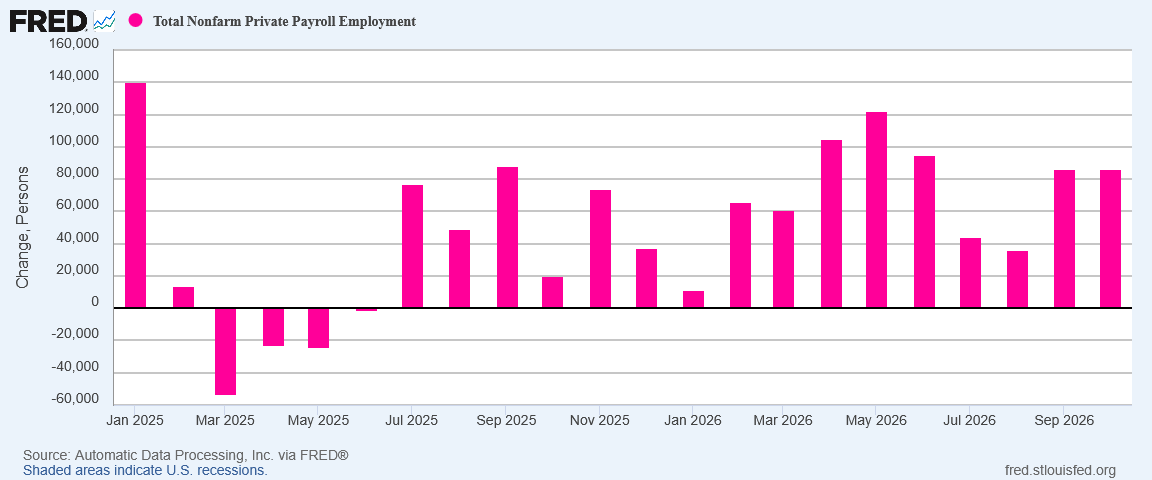
After a weak spring of 2025, job growth per the ADP report has been consistently above 40,000 jobs a month. Even more encouraging is that October is the sixteenth consecutive month without job losses. Since April, the ADP report has had only two months where job growth was less than 80,000.
Even corporate media had to concede that job growth has had a fairly decent 2026.
Private sector job growth held steady in October, with gains spread across sectors, as the labor market showed fresh signs of stabilization, ADP reported Wednesday.
The payrolls processing firm said companies added 86,000 jobs during the month, the same as the downwardly revised total for September and slightly ahead of the Dow Jones estimate for 75,000.
ADP’s October National Employment Report posted solid gains, the latest month in a growing list of months with solid jobs gains.
We should note that the gains weren’t across the board. Four sectors still manage to shed jobs.
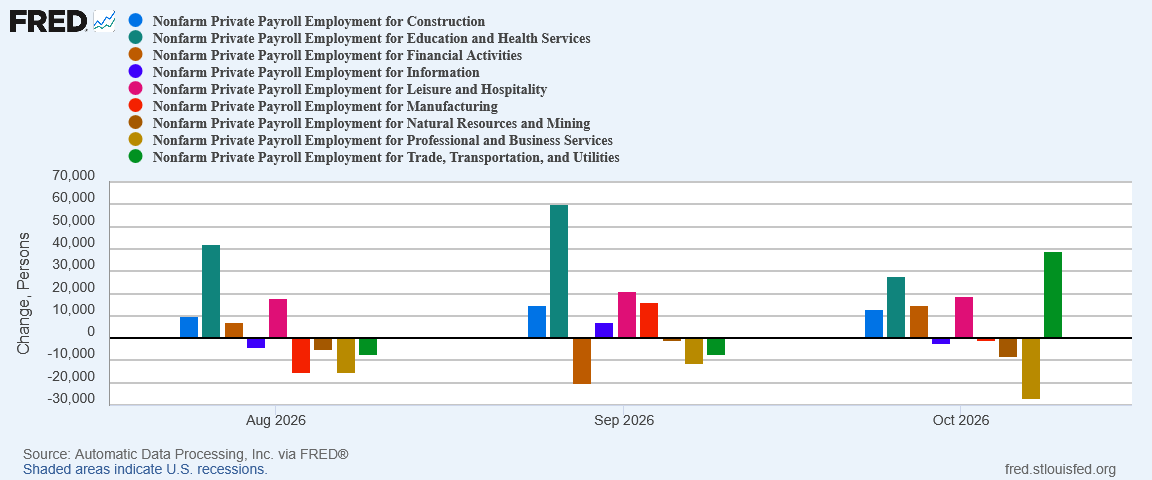
Coming right on the heels of a strong September JOLTS report, the ADP report makes a good case for standing as a continuation of the September jobs data.
Once Again, Trade Transportation And Utilities The Big Winner
The most significant jobs gains came in the area of Trade, Transportation, and Utilities.
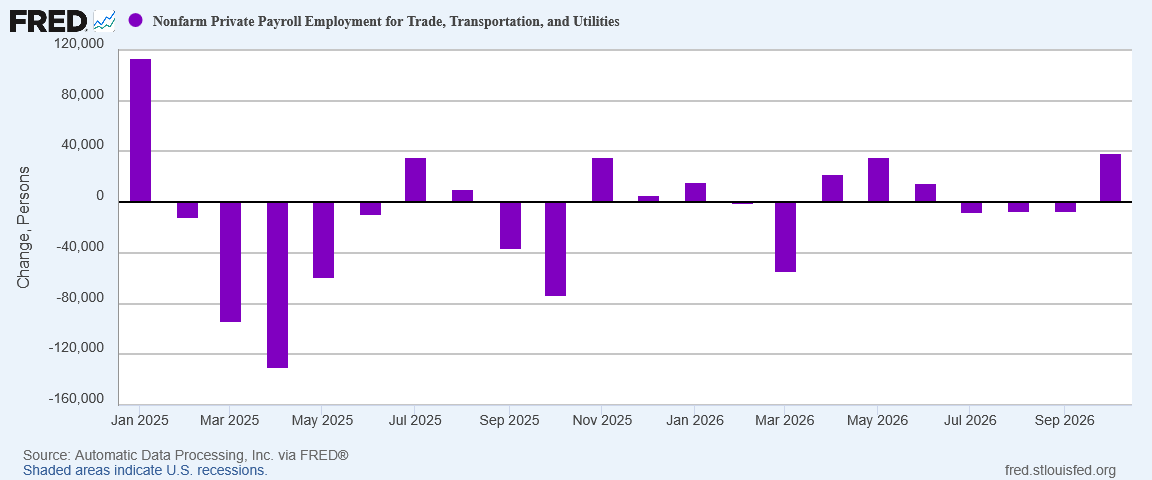
At 39,000 new jobs, the TTU sector had the strongest month of job growth since before Donald Trump took office. After three consecutive months of job losses, the gains are more than a nice turnaround.
The other sectors posting job gains were predictable: Construction (which has been a steady jobs producer since the start of 2026), Healthcare, Finance, and Leisure.


Of the sectors which lost jobs, the least surprising was Information.
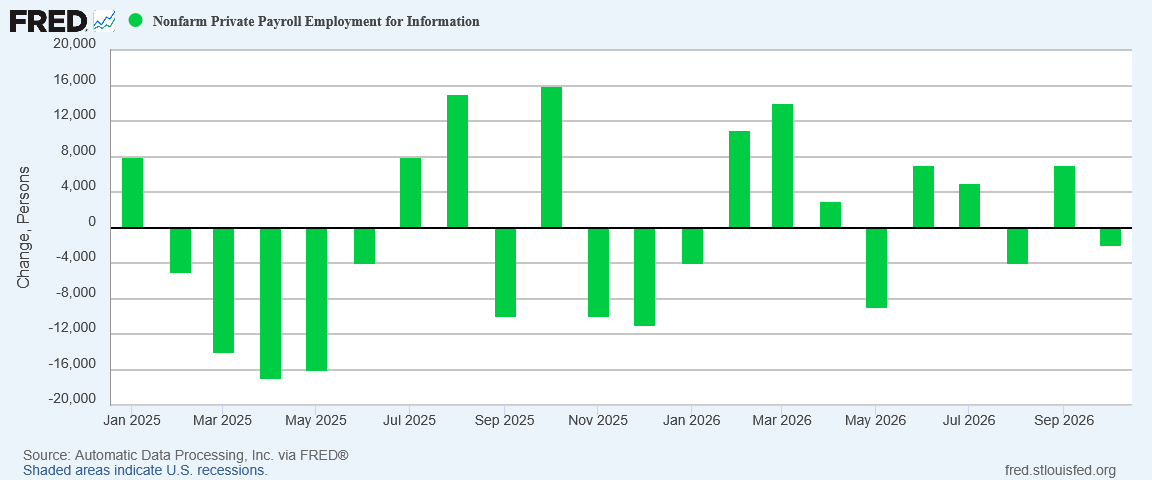
The information sector has been losing jobs more often than not since January 2025. With Artificial Intelligence the “next big thing”, the lack of Information sector jobs is a curious phenomenon at the very least.
While the job losses were fairly minor, at 2,000 jobs, Manufacturing was the other notable sector losing jobs.
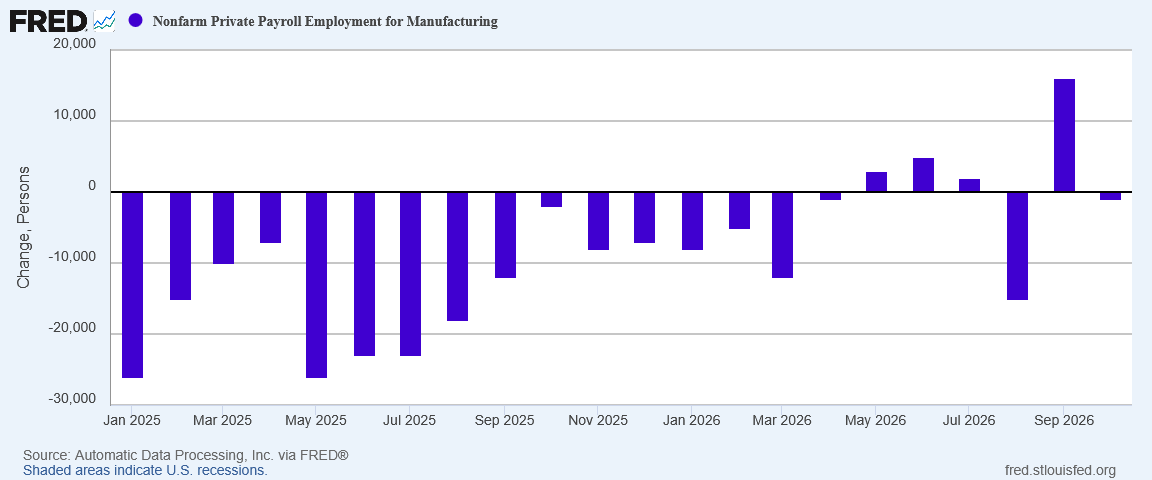
Within the ADP report, Manufacturing has been in a slump going back before the start of the second Trump Administration. While the summer months had shown some job growth in the sector, overall Manufacturing has been a steady source of job loss within the ADP data set. We should note that the BLS Employment Situation Summary has had stronger manufacturing numbers, especially in 2026.
The remaining two sectors, Professional Services and Mining, have been relatively weak sectors all year long. Job loss in these areas is part of a well-established trend.


Despite The Gaps, The PMI Data Concurs
As we saw when looking at the September JOLTS report, the October PMI data from the Institute of Supply Management reinforces the notion that there has been robust economic and job growth for the month.


Additionally, both the Manufacturing and Services PMI data from S&P Global show the US economy in expansion for October.


While the PMI data does show some cooling of economic activity in October, the indices still show definitive expansion across the board.
Just as with the September JOLTS report, the external data provides compelling validation for the ADP report. The job growth is real. The economic growth is real.
Will The ESS Report Measure Up?
With a strong JOLTS report to finish out September and a strong ADP report to start October, the burning question of the moment is whether Friday’s Employment Situation Summary will produce similarly upbeat results.
Certainly the expectation is that it will. The Wall Street consensus projection at the moment is for some 65,000 non-farm jobs to be reported on the BLS jobs print.

The vast bulk of the jobs are projected to be private sector jobs, with Wall Street projecting 64,000 private sector jobs for October.

What is not generally forecast but which is no less significant will be the size and direction of revisions to the past two months’ reporting. The September jobs report was dismal not just because it reported only 29,000 jobs for the month, but because it erased another 60,000 jobs from the July and August reports as well.
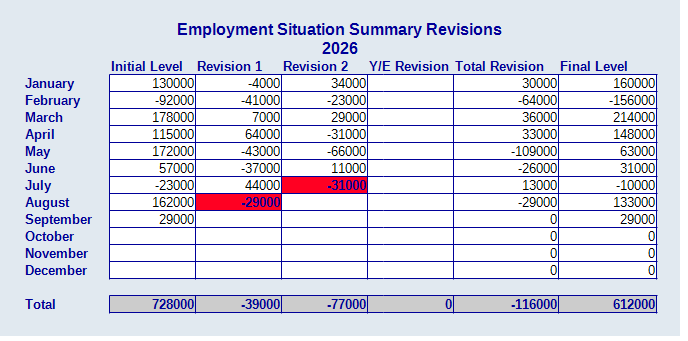
If even just September is revised upward, the year to date employment outlook for the US economy could be improved considerably.
October’s ADP National Employment Report is in many regards a repeat of the September report—and that is perhaps the best aspect of the report. The October ADP report is a comprehensive argument that the jobs recovery in the US is continuing, and that even the apparent unevenness of recent months has not derailed that recovery.
That is always a welcome piece of economic news.
I’m endlessly grateful for your factual reporting, Peter. This is how we separate propaganda from reality. Trump is destroying America? The actual data does not support that argument!