


The definition of “hot” is always “not cool”.
For the October Consumer Price Index Report “hot” inflation is inflation that did not cool sufficiently for Wall Street’s preferences.
The Consumer Price Index for All Urban Consumers (CPI-U) increased 0.4 percent on a seasonally adjusted basis in October after rising 0.6 percent in September, the U.S. Bureau of Labor Statistics reported today.
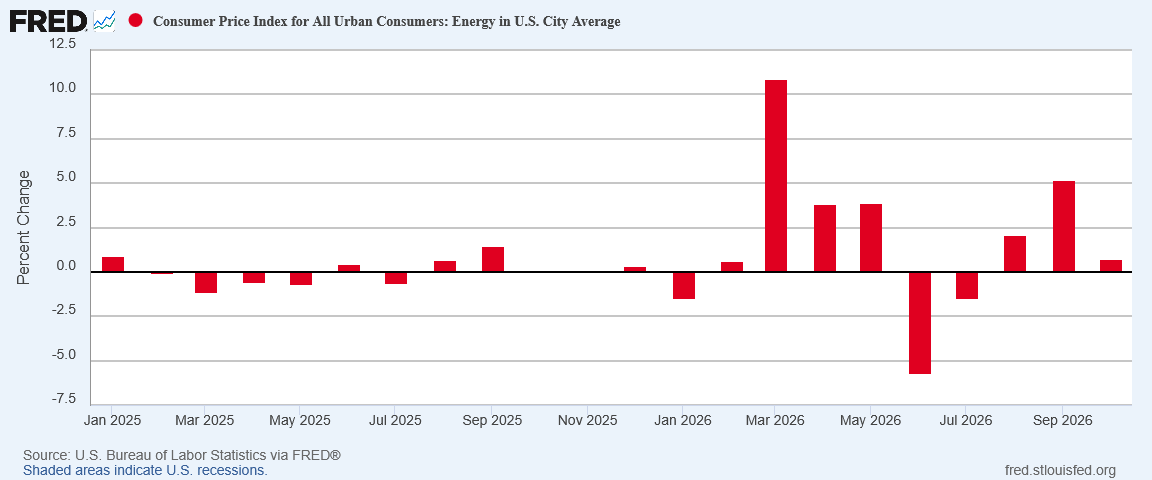
The index for shelter rose 0.3 percent in October, accounting for over thirty percent of the monthly all items increase. The food index increased 0.5 percent in October, as the food at home index rose 0.4 percent and the food away from home index increased 0.5 percent. The index for energy increased 0.7 percent over the month following a 5.2-percent increase in September.
The index for all items less food and energy rose 0.3 percent in October, as it did in September and August. Indexes that increased over the month include recreation, medical care, motor vehicle insurance, household furnishings and operations, and education. Conversely, the index for used cars and trucks and the index for communication were among the small number of major indexes that decreased in October.
Month on month increases of 0.4% for headline inflation and 0.3% for core inflation were 0.1pp higher than Wall Street projected.
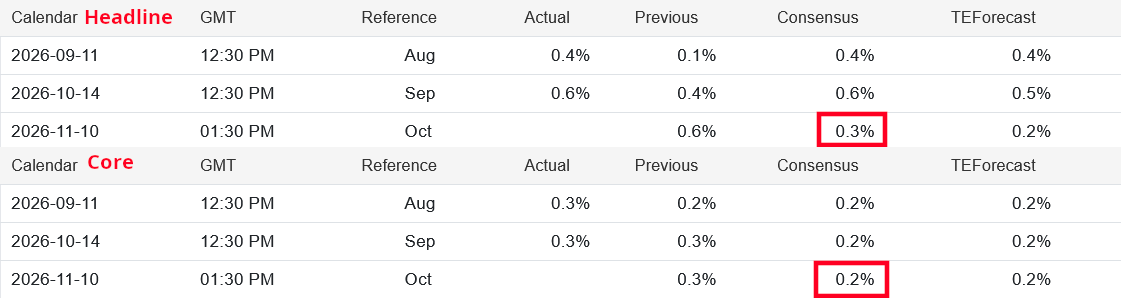
Those same increases were 0.3pp and 0.1pp less than month on month inflation in September.
Inflation slowed in October. Inflation cooled in October. Inflation ran “hot” in October because it did not cool “enough”.
Wall Street Tantrumed Then Thought Better Of It
There was no misunderstanding Wall Street’s reaction to the Bureau of Labor Statistics inflation print: Equities dropped throughout yesterday morning before recovering in the afternoon.
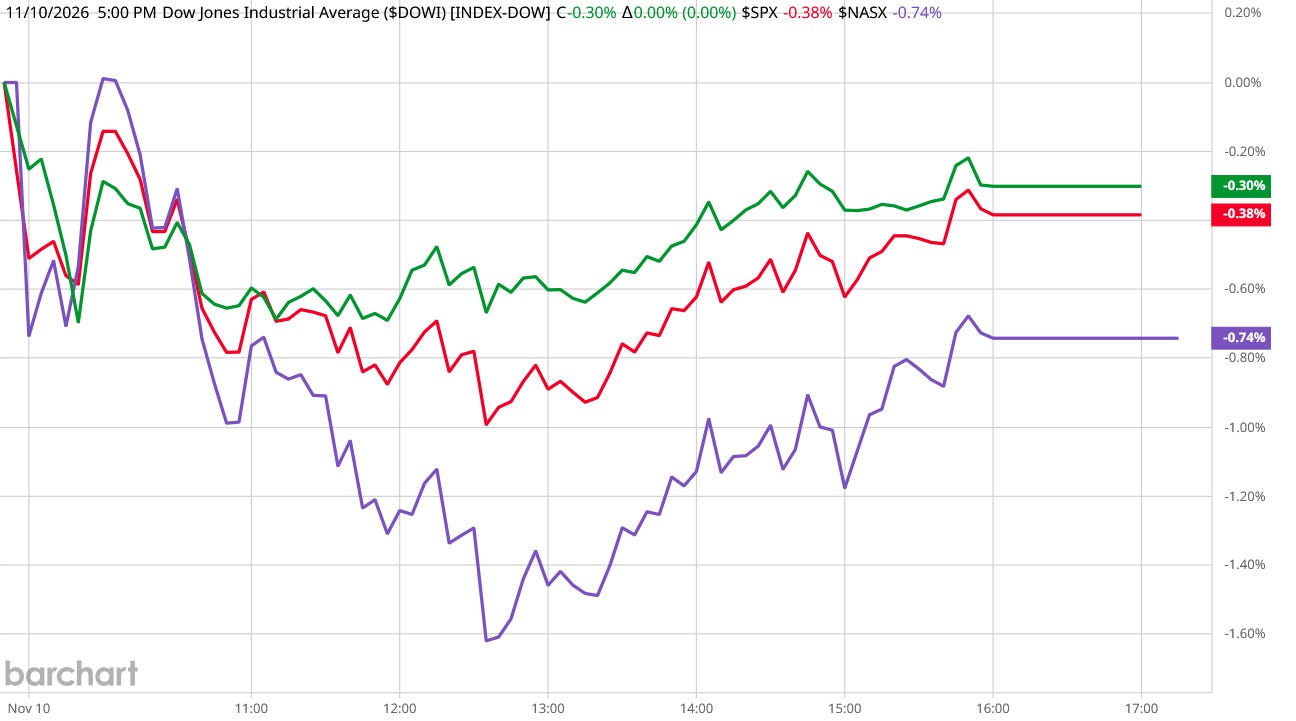
Media outlets were quick to play up the missed projections.
“There are some fears that underlying price pressures are starting to build again. It creates some concern,” said James McCann, senior economist at Edward Jones.
“Markets had been pricing out some of the Fed tightening in recent weeks. Now it’s probably being forced to contemplate a bit more tightening.”
CNBC chose to play up hawkish Fed Governor Chris Walker’s call for a 50bps rate hike.
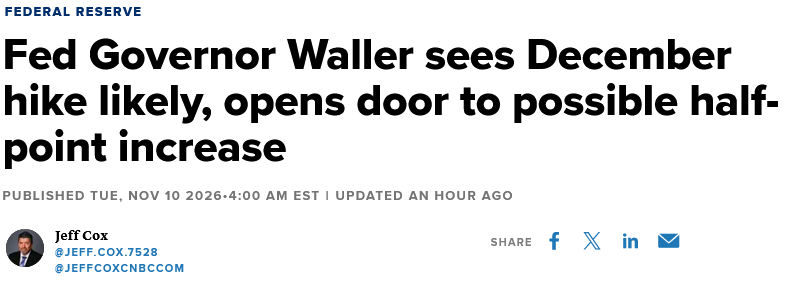
Speaking in London, the policymaker said he “is leaning toward” a rate increase in December even if the October inflation data comes in softer than expected — and would support “more robust action” if readings come in higher than forecast.
“In that case, I believe a 50 basis point hike in the policy rate should be considered at the December meeting,” he said. “Hiking only 25 basis points would put our credibility at risk, a risk I am not eager to take.”
One does have to marvel at the rationale. Walker is pushing for aggressive rate hikes not because inflation is running amok, not because he’s worried about prices, but because the Fed has to be seen as aggressive about inflation. Because “credibility.”
Perhaps if the Fed had some actual credibility, that might be a plausible concern, but between the partisanship of Jerome “Too Late” Powell and the studied ignorance of Kevin “Completely Wrong” Warsh, whatever credibility the Fed might have had once upon a time evaporated ages ago.
Even ZeroHedge could not resist going for the click-bait headline.

Bear in mind that all of this hyperventilation is over inflation that is demonstrably less in October than it was in September.
Headline Inflation Slowed. Core Inflation Held Steady.
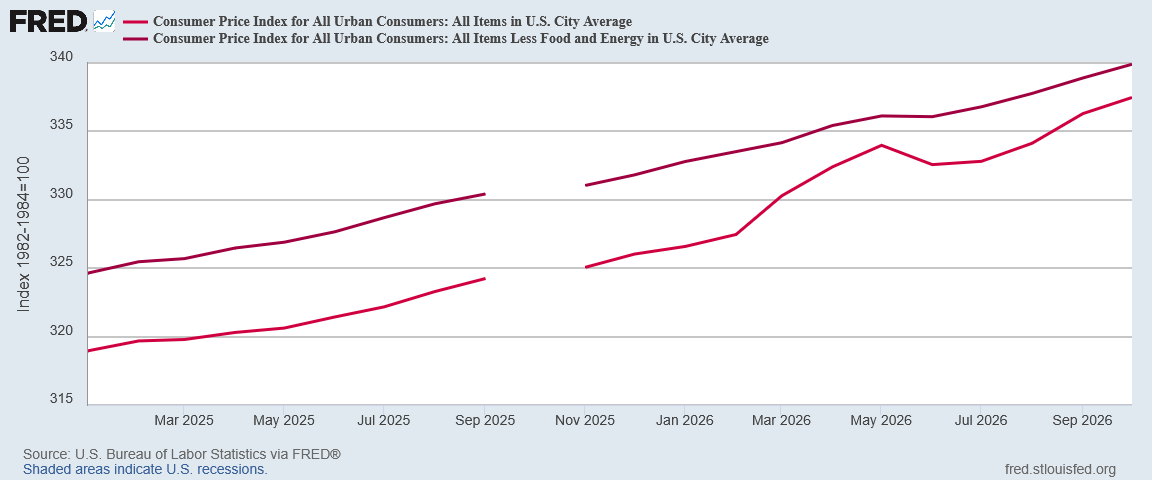
How did consumer prices shift in October? Obviously, prices rose. But when we look at the CPI levels themselves, we can see that the rate of increase—which is what inflation actually measures—did not rise at all for either the core or headline numbers.
If we index the data to January 2025, the lack of an upward inflection is even more apparent.
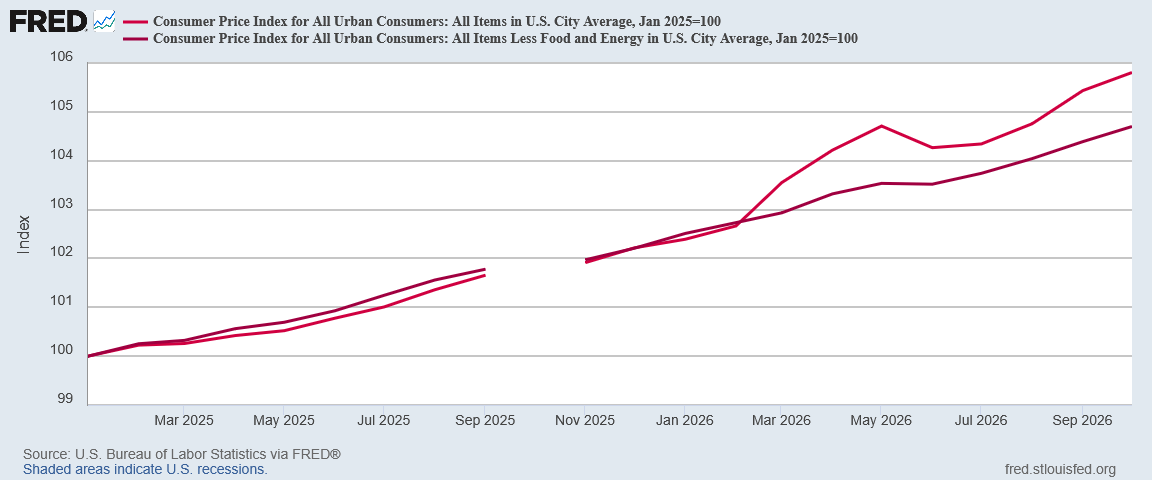
Headline inflation cooled noticeably in October, as evidence by the headline graph bending down. Core inflation shifted hardly at all.
Cooler inflation is why both the headline and core month on month inflation rates were lower in October than they were in September.
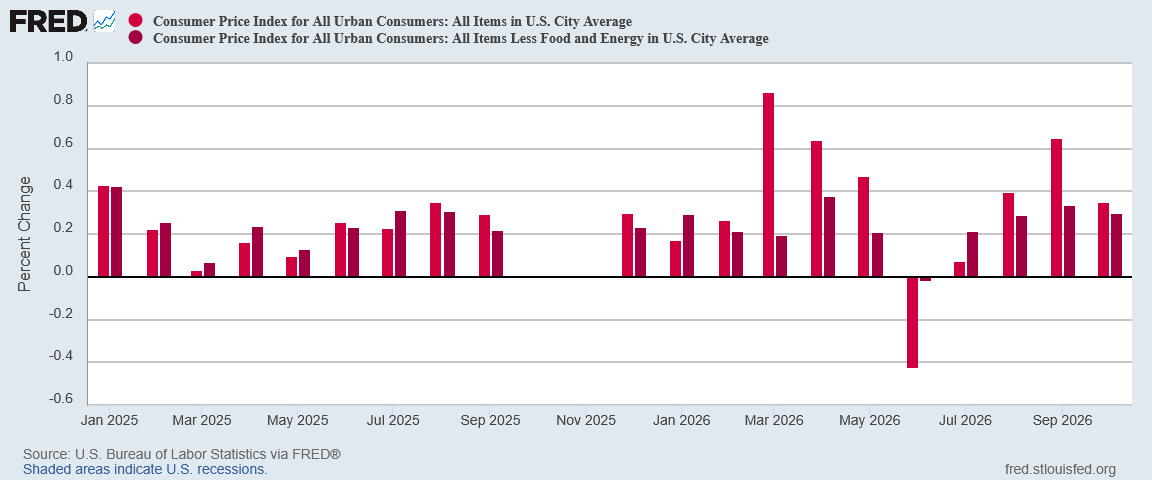
Was inflation projected to run lower than it did? Yes.
Would it be better for the economy if inflation were lower than it is? Absolutely.
Is a slower price rise in October after a surge in September a sign “underlying price pressures are building again”? Pressure building means inflation increases. In October inflation decreased, which would signify price pressures are not building.
Readers will note that I am not commenting on the year on year increase. Because October 2025 was the month of the Silly Schumer Shutdown, there is no raw data for the Consumer Price Index.
BLS did not collect survey data for October 2025 because of a lapse in appropriations. For most CPI series, BLS could not publish October 2025 indexes. As a result, BLS cannot publish 12-month percent changes for October 2026 for indexes where October 2025 data are unavailable.
As a result, there is no actual year on year comparison to be made.
Even without the year on year comparison, however, there are no signs that price pressures are building.
Food Price Inflation Increased. Everything Else Decreased.
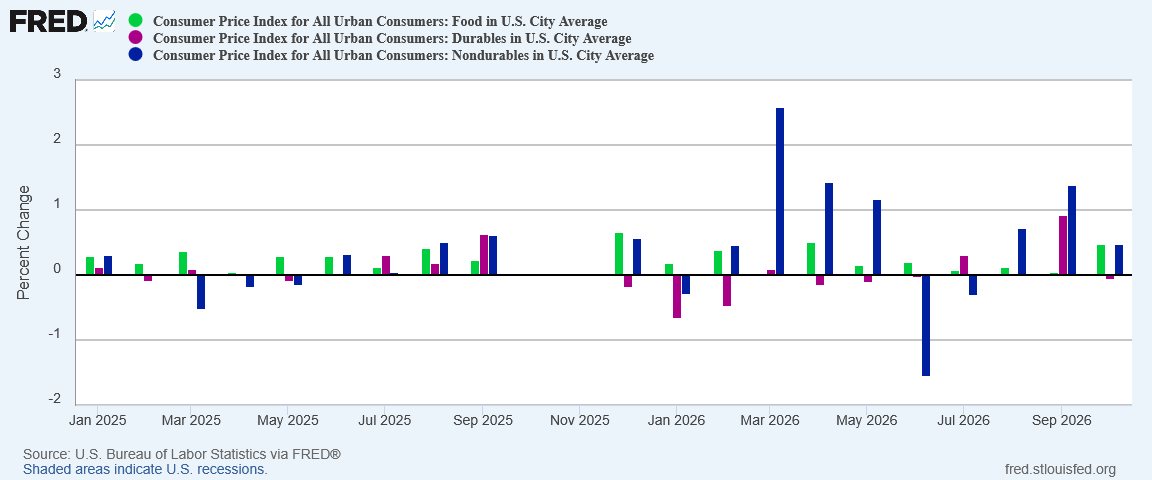
The one component in the CPI where inflation did get significantly hotter was Food.
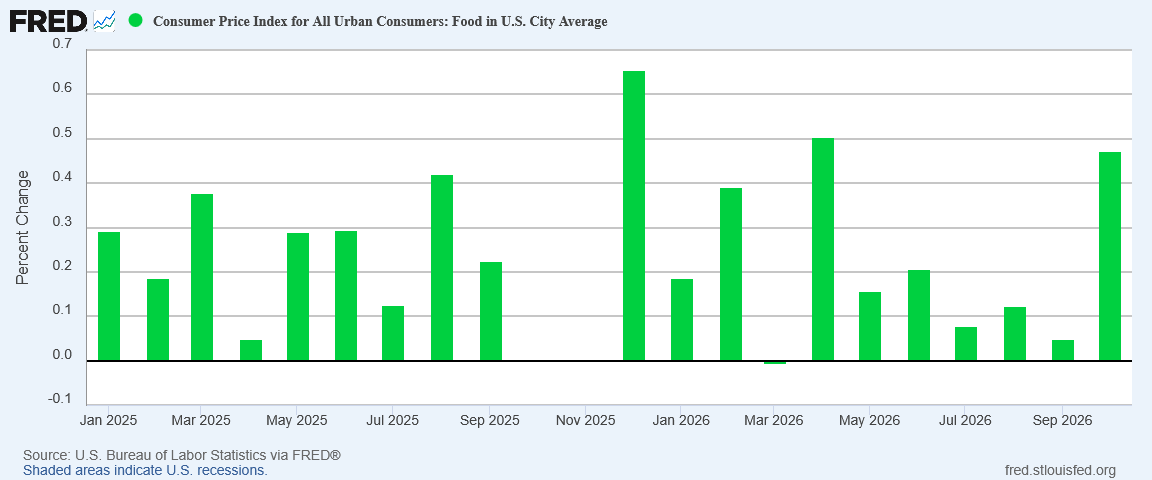
From less than 0.05% in September to .47% in October is quite the jump. Still, April had a larger jump, and we have frequently seen month on month food price inflation rise by more than 0.2pp multiple times since January 2025.
There is a reason food is excluded from core inflation. It and energy tend to be highly volatile, with significant variance in inflation rates from one month to the next.
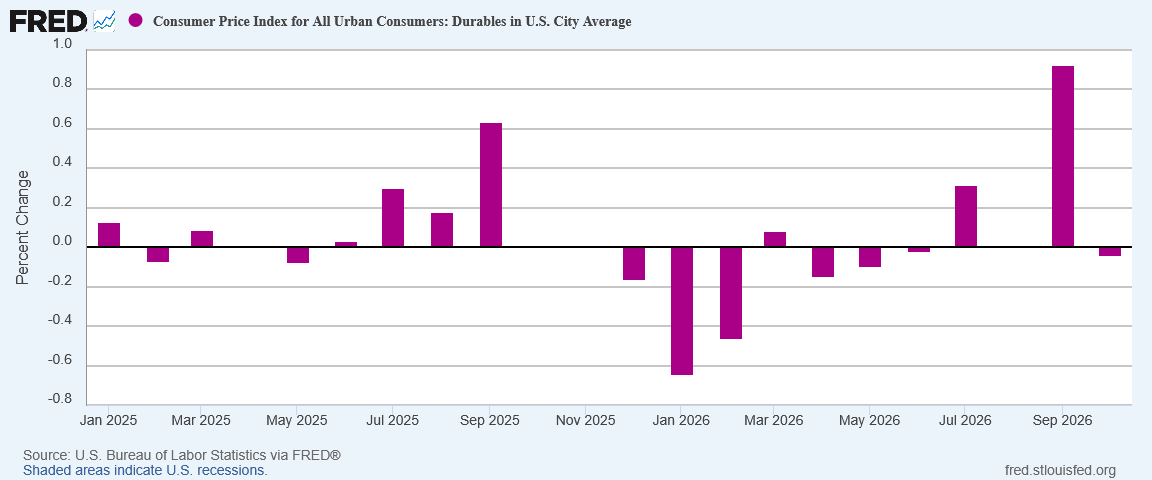
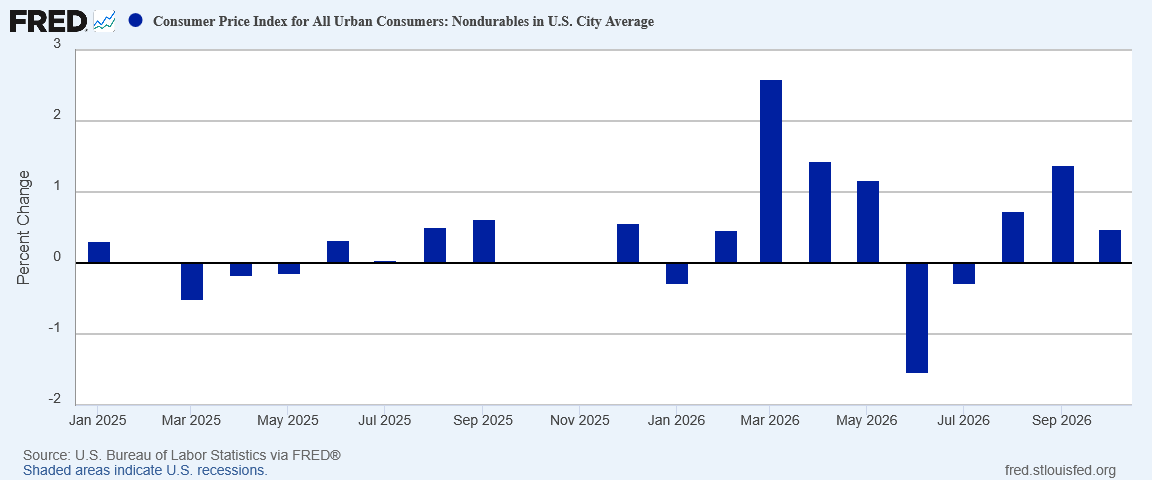
As we can see when we look at the shift in food price inflation vs durable and nondurable prices, we see that, within core inflation, inflation eased everywhere.
Durable goods went into outright deflation for October.
Nondurables improved almost as much.
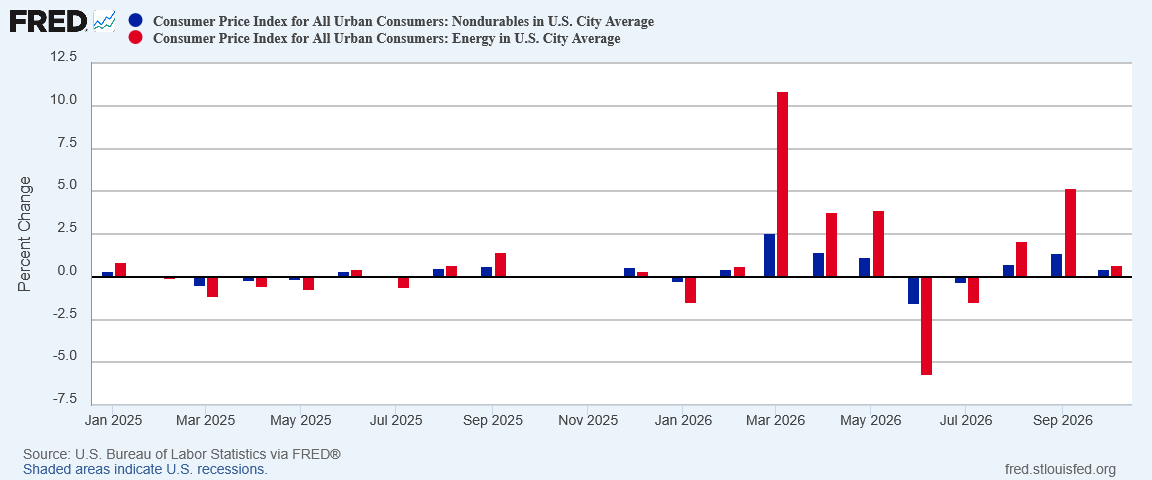
Nondurables were helped by a relatively low contribution from energy.
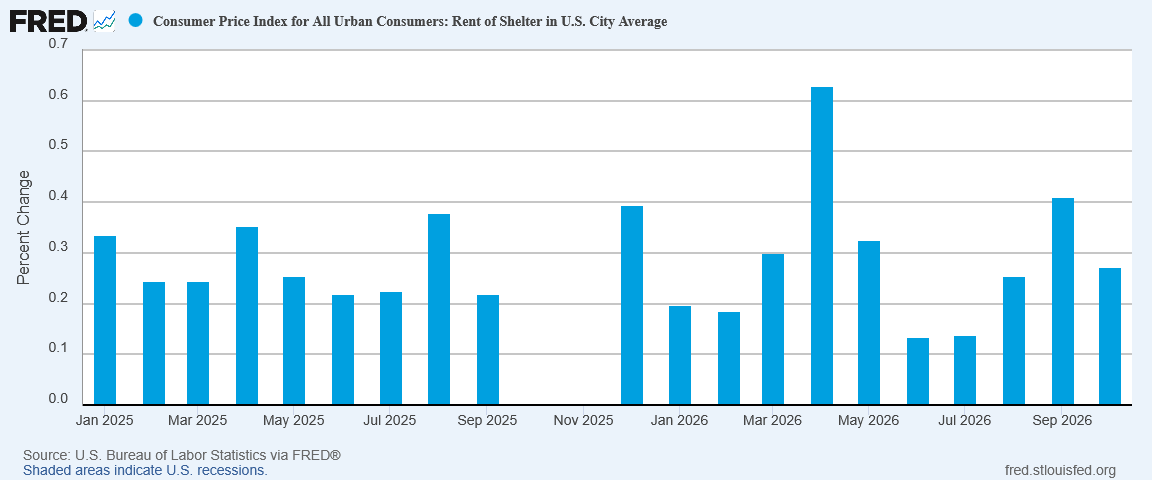
Even shelter price inflation cooled by more than 0.1pp in October.
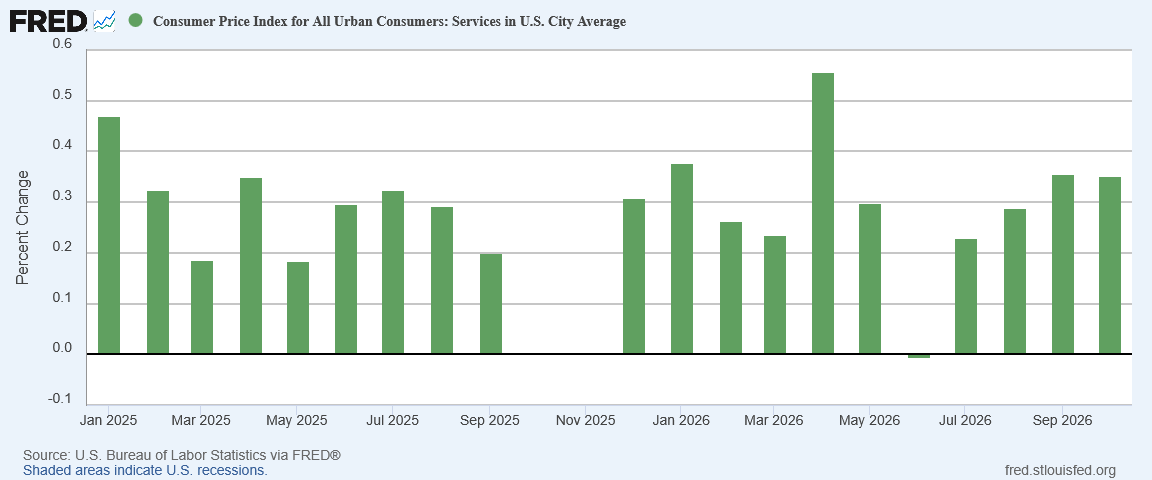
Services eased only incrementally.
Even energy price inflation cooled dramatically in October.
Nor do we have to look far to understand why energy price inflation cooled in October—the components within energy price inflation cooled as well.
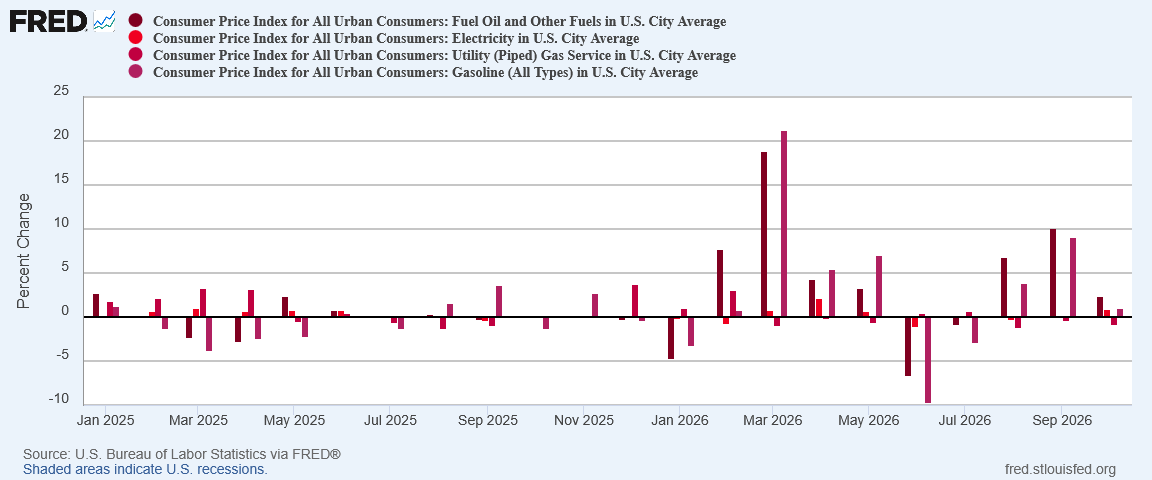
Inflation within electricity rates rose in October, but all other parts of the energy price indices charted slower inflation in October from September.
This is what Wall Street considers a “hot” inflation print.
Pump Prices Fell. Energy Futures Prices Slowed Their Rise
When we look at the EIA’s weekly prices for gasoline and diesel at the pump, we can see there are solid reasons for energy price inflation cooling in October.
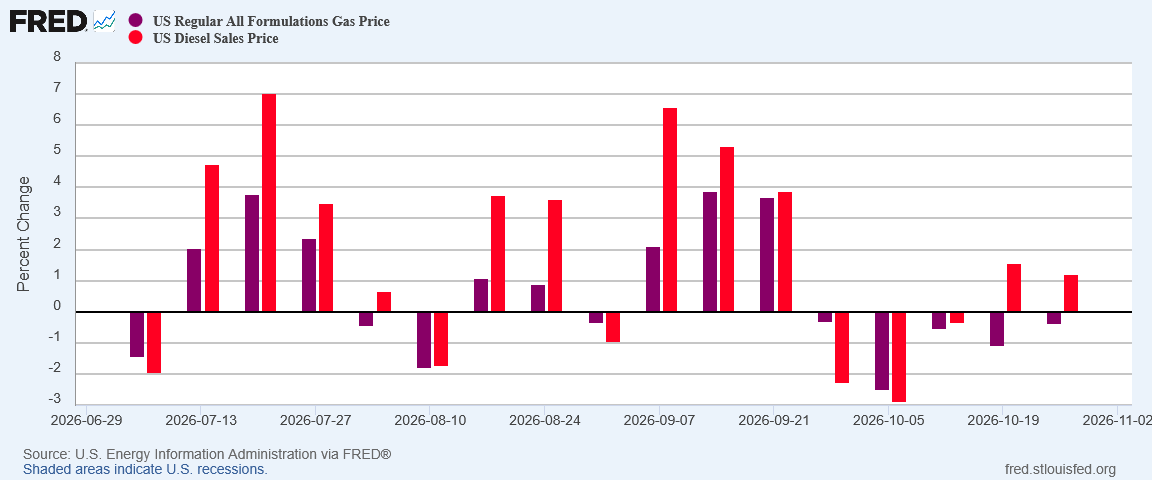
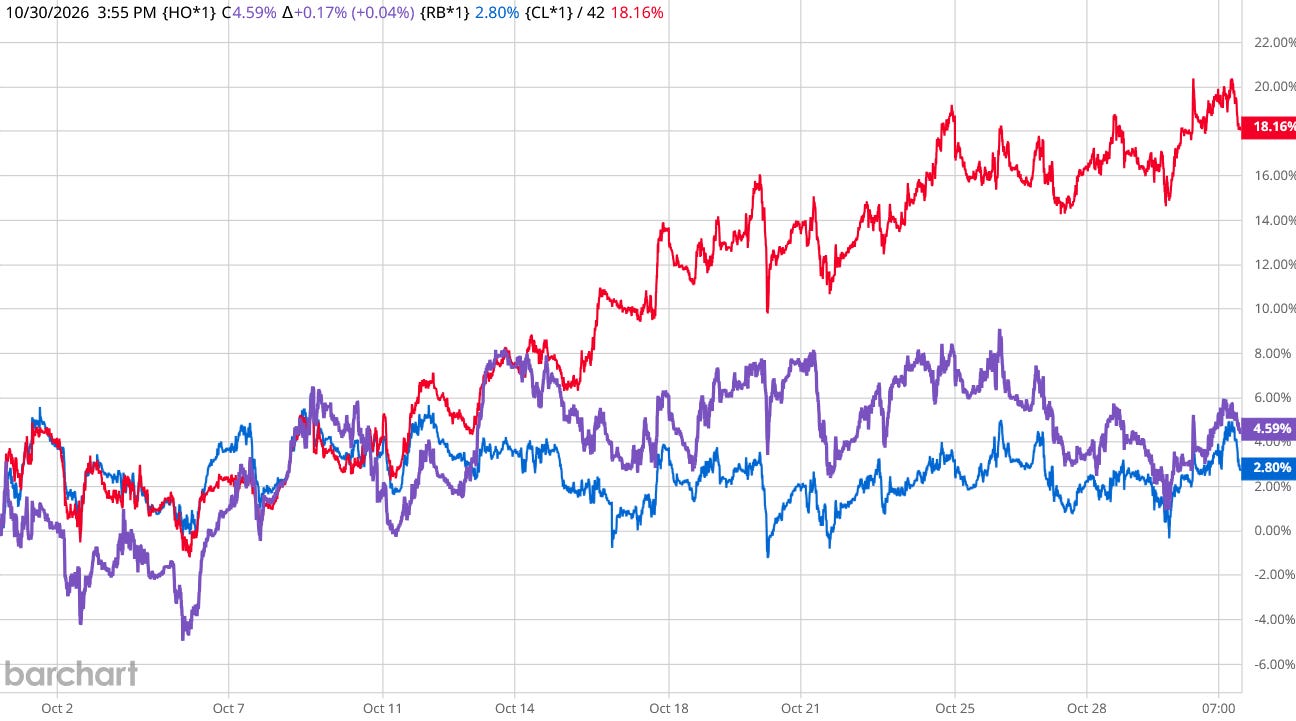
While crude prices pushed throughout October, gas and diesel futures largely plateaued for the second half of October.
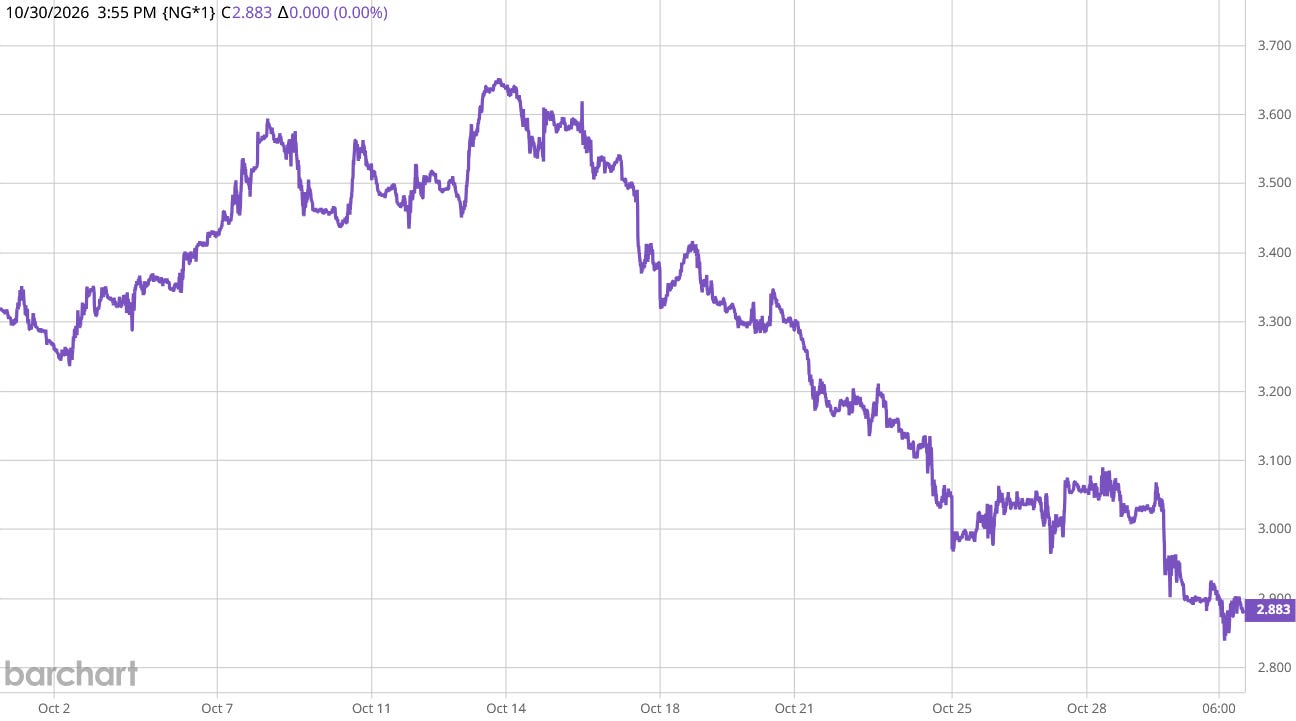
Natural gas futures fell substantially during the last half of October.
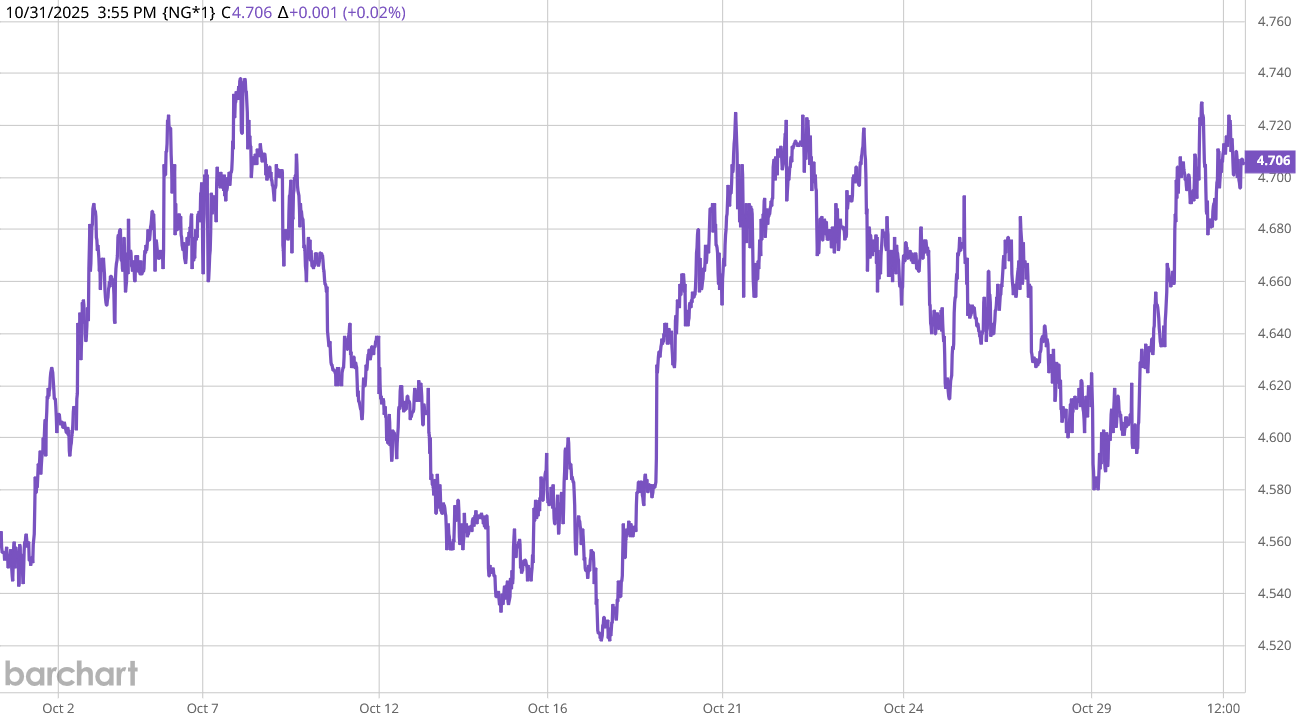
For comparison, in October 2025 natural gas prices rose substantially.
While the oilpocalypse brought on by the war with Iran and the war in Ukraine means oil prices are still high, and diesel prices are still high, during October energy prices slowed their rise almost across the board.
About Affordability
We do well to remember that prices do not rise in a vacuum. “Affordability” is the interplay of price increases against wage and earnings growth. While wage growth itself was something of a disappointment for October, in terms of overall affordability, October was not a bad month.
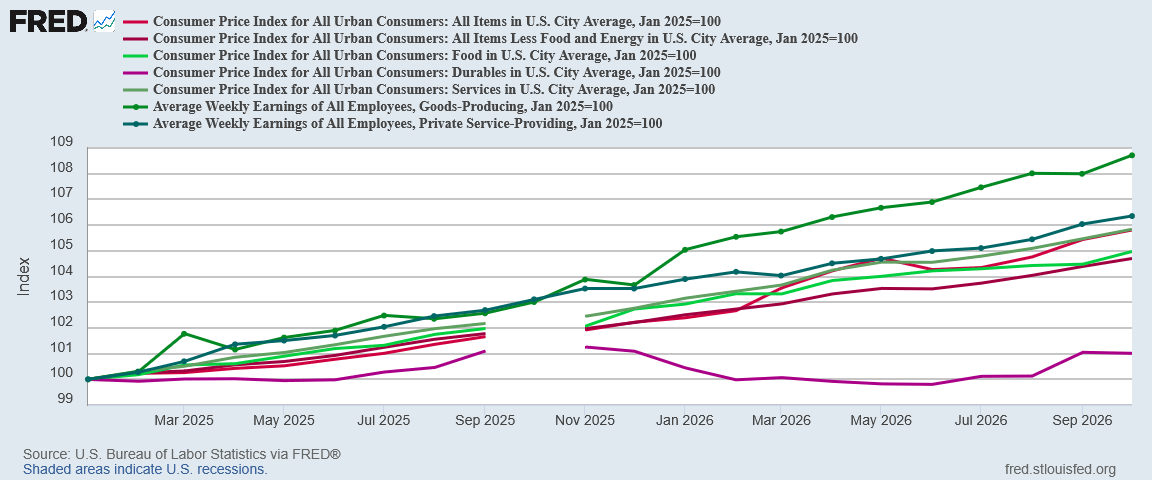
When indexed to January 2025, weekly earnings in goods producing jobs gained ground on prices, and weekly earnings in service providing jobs held their own.
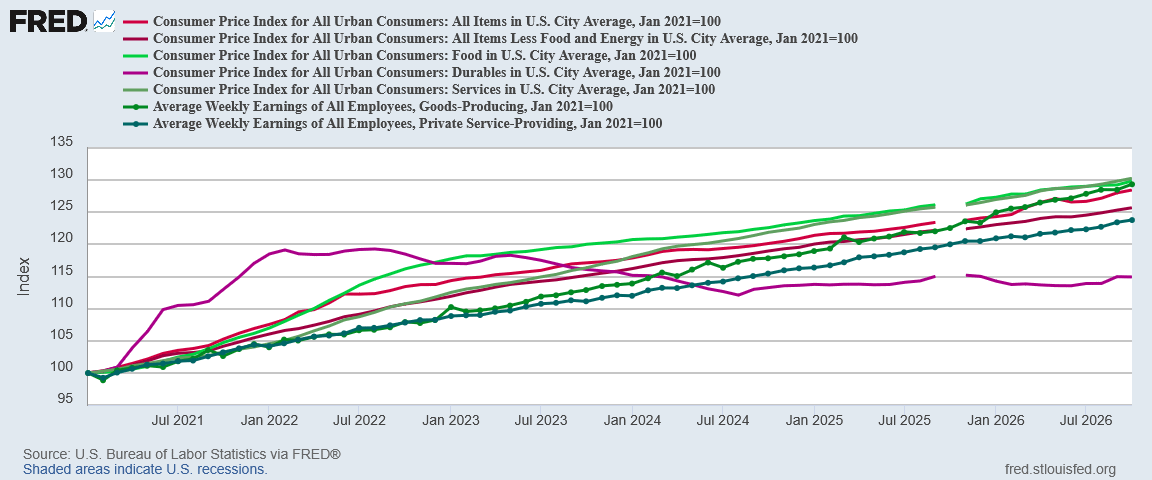
Even when indexed to January 2021, to take in the lingering effects of the 2022 hyperinflation cycle, average weekly earnings held up against inflation in October.
When we look at the relative movements within the components of the Consumer Price Index, indexing them to January 2025, we do not see any of them charting an increased inflation rate for October.
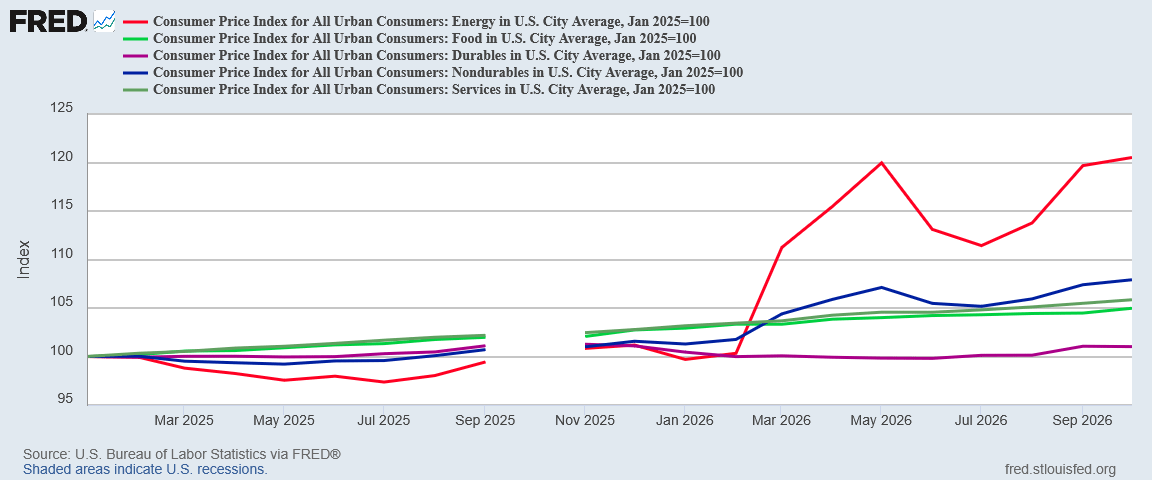
Energy prices are still a concern, and all the data still shows that, yet even energy prices slowed their rise in October.
October’s disinflation figures should be especially encouraging given that the September Producer Price Index report signaled there would be more inflation in October, not less.
When we look at what is happening in the world, we see very few signs if any that the dislocations within global oil and energy markets are about to be resolved. As I said in July, so long as these dislocations persist, they will push prices up.
So long as these dislocations exist, we will see producer prices pushed higher, and then through contagion we will see consumer prices pushed higher.
Unless there is a sudden outbreak of peace in the world, energy price inflation will continue. Unless there is a sudden outbreak of peace in the world, energy price inflation will push up fuel costs, push up transportation and freight costs, and that will push up prices beyond energy goods and services.
While over the longer term this still holds true, in October the inflation outcome can be summarized as “not yet”.
Inflation Is Still Here. Inflation Did Not Get Worse
Will there be more inflation for this month and also for December? There may be. Considering last month’s PPI print, we should perhaps presume that there will be.
At the same time, last month’s PPI print is from last month. The signals from that data have not changed and will not change until the October Producer Price Index report comes out on Friday.
Can we project higher inflation for this month and also for December from the October Consumer Price Index report? No. We cannot, certainly not from a direct extrapolation of 2026 CPI data.
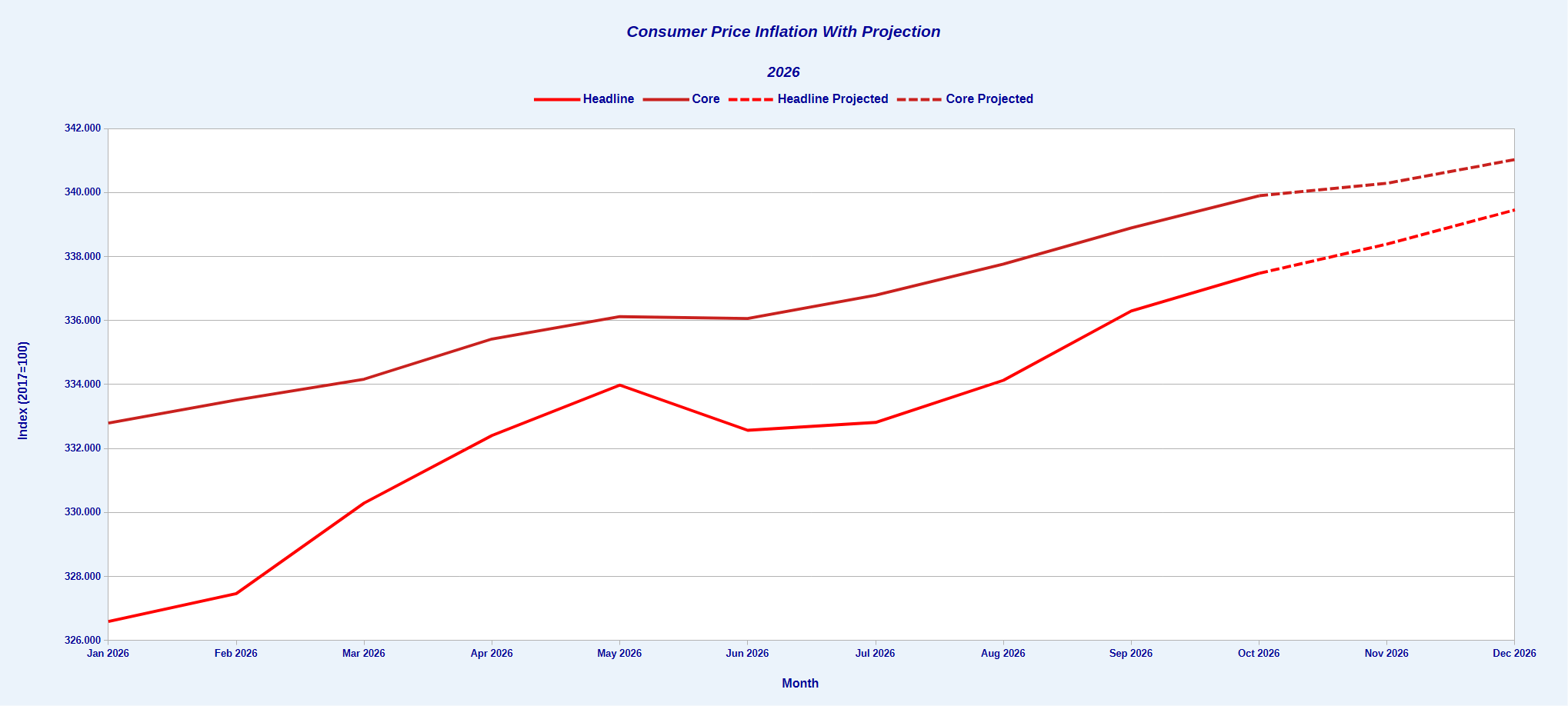
A linear extrapolation of inflation is hardly a reliable predictor of what future inflation will be. Still, a linear extrapolation does give us a sense of how much price pressure is legitimately building within the Consumer Price Index—not much, if any.
Prices are rising, and they are rising more than anyone wants or likes. That has been the case since the 2022 hyperinflation cycle. It was certainly the case in September, when there were definite signs inflation was heating up—and despite those signs the Fed chose to stand pat on the federal funds rate.
Those same signals are not present in the October CPI data. Perhaps they will return in the November print, and perhaps we will see new signals in the October PPI data on Friday. Longtime readers will surely appreciate that I do not rule such things out.
However, sober analysis means we assess the data that is in front of us today, not the data that might be in front of us tomorrow. The CPI data in front of us today does not show inflation getting any worse, and in many respects inflation has gotten slightly better.
Wall Street tantrumed yesterday morning because the CPI data for October was not “good enough”. By that logic Wall Street should be tantruming every month, because no inflation report is ever really going to be “good enough”—the desire will always be for even less inflation than what we have.
Inflation is still here. Inflation might get worse on the November CPI report. Inflation did not get worse on the October CPI report.
That is what the data says.
After last week’s election results, I’ll take any positive sign I can get. Thanks for actual data, Peter.
And I thank you once again for serving your country, Peter. I am so, so grateful - especially on Veterans’s Day - to ALL those who served!