


September’s Consumer Price Index Summary was not good news. Not only did it show inflation rising significantly for the month, it carried the first real signs of inflation spreading beyond energy prices.
September’s Producer Price Index Summary is even worse news. Coming in above forecasts, producer prices for September are signalling that inflation will keep rising for the next few months, and that inflation will continue to spread across the wider economy beyond energy.
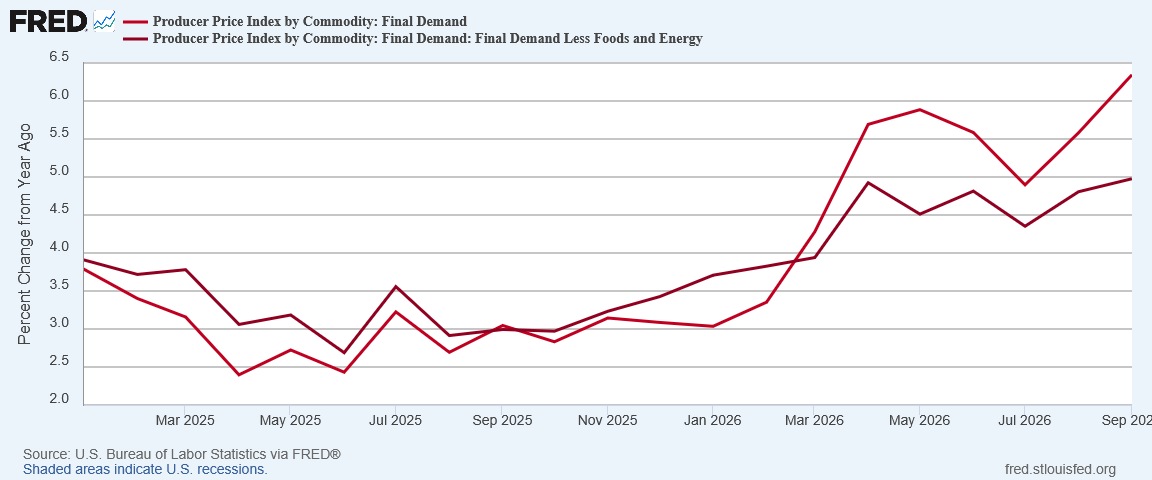
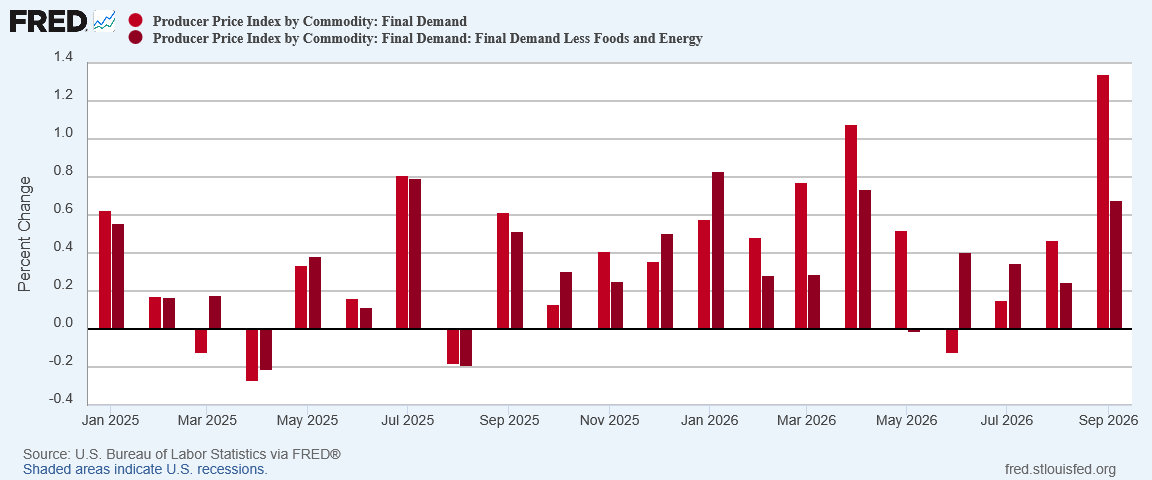
The Producer Price Index for final demand increased 1.3 percent in September, seasonally adjusted, the U.S. Bureau of Labor Statistics reported today. Final demand prices moved up 0.5 percent in August and 0.2 percent in July. (See table A.) The September increase is the largest advance since rising 1.7 percent in March 2022. On an unadjusted basis, the index for final demand climbed 6.3 percent for the 12 months ended in September, the largest 12-month increase since moving up 6.4 percent in December 2022.
In September, prices for final demand goods rose 2.6 percent, and the index for final demand services advanced 0.8 percent.
Prices for final demand less foods, energy, and trade services moved up 0.5 percent in September after increasing 0.3 percent in August. For the 12 months ended in September, the index for final demand less foods, energy, and trade services rose 5.0 percent.
Printing at 6.3% year on year, producer price inflation came in an entire percentage point above Wall Street’s consensus estimate.

Energy prices continued to be a major inflationary pressure within the PPI, but goods besides energy as well as the various components of services all printed significant increases in their inflation rates.
The scope of the inflation increase not only signals that we can look forward to even more inflation, but that we will be seeing more inflation in more economic sectors. Contagion from the oilpocalypse’ rising energy prices is pushing more and more prices up.
The worst case oilpocalypse scenario is becoming increasingly inevitable.
Corporate Media Was Alarmed—But With Reason?
As was true with the CPI report, corporate media wasted no time before focusing on the PPI report’s negatives. This time, however, they were not necessarily wrong.
As CNN reported (accurately, for a change!), September 2026 saw the fastest rises in producer prices since 2022.
Economists had expected September PPI to increase 0.5% from August and 5.3% annually, according to FactSet. Instead, September marked the fastest monthly increase since March 2022 and the highest annual rate since December 2022, the year when US inflation hit a 40-year high.
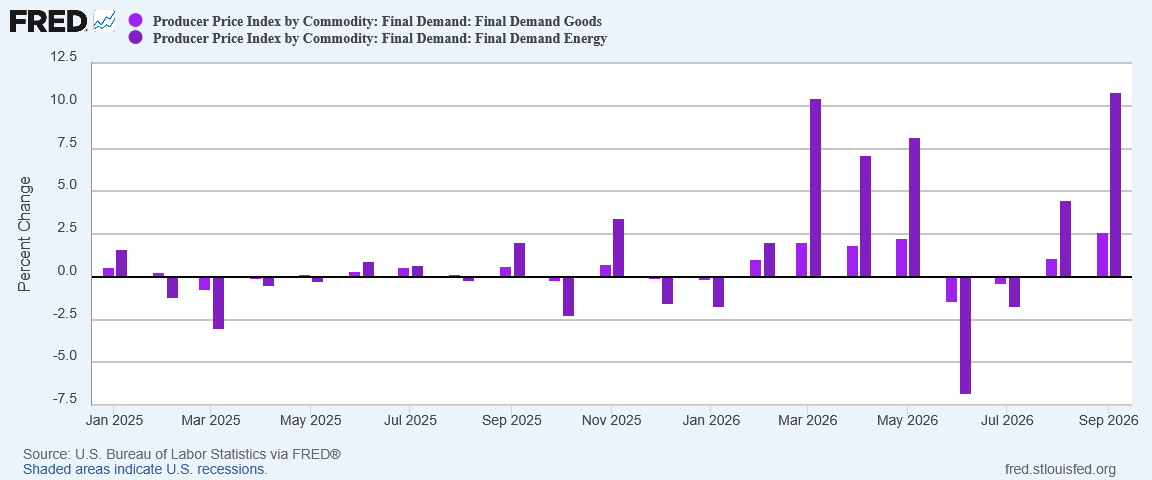
Energy prices, driven higher by geopolitical conflicts including the war with Iran, drove September’s increase, accounting for 80% of the 2.9% leap in goods prices. That’s the largest-ever monthly increase, according to BLS data that goes back to 2009.
According to CNBC, rising diesel prices are a primary factor in the price increases for a widening number of producer prices.
But there are signs that soaring energy prices are having downstream effects on other categories. The BLS said in Thursday’s release that almost half of September’s increase in processed goods for immediate demand was connected to the rise in diesel fuel prices.
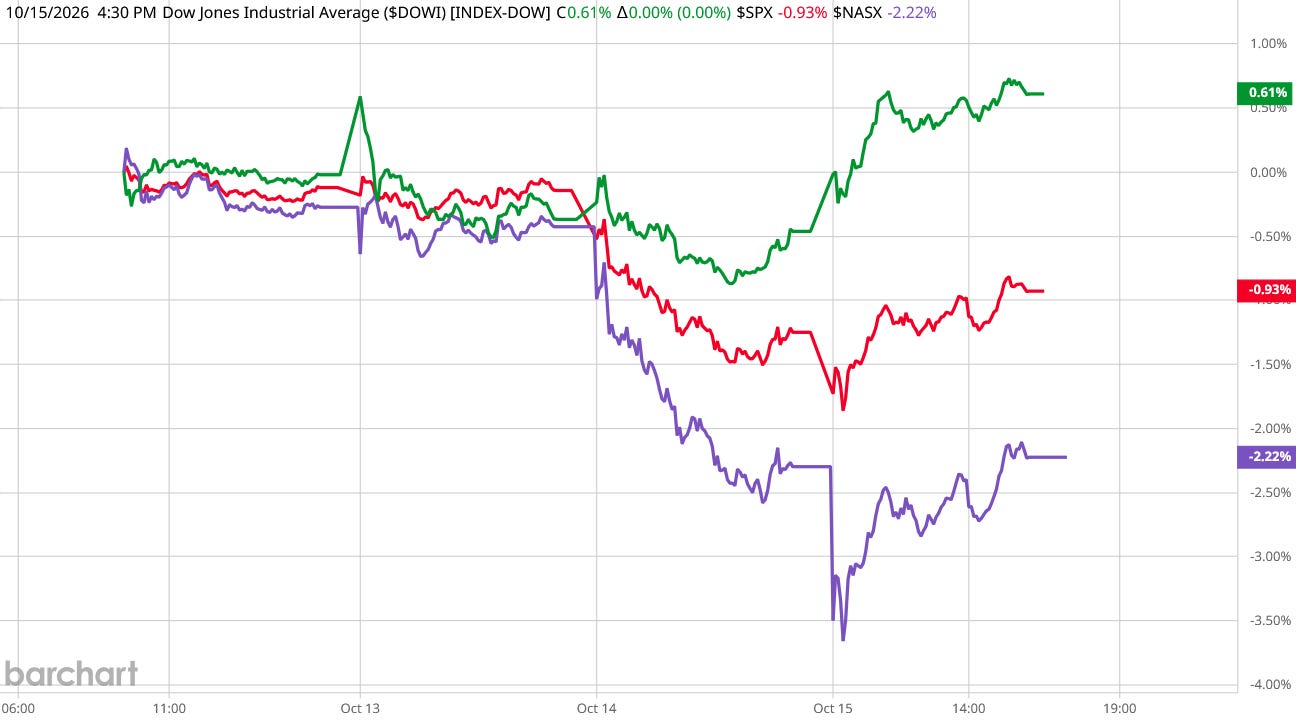
Strangely enough, Wall Street’s reaction was rather quiescent. After falling on Wednesday after the CPI report, equities rose throughout the day yesterday.
Treasury yields didn’t even spike on the PPI report’s release, choosing instead to go straight into decline.
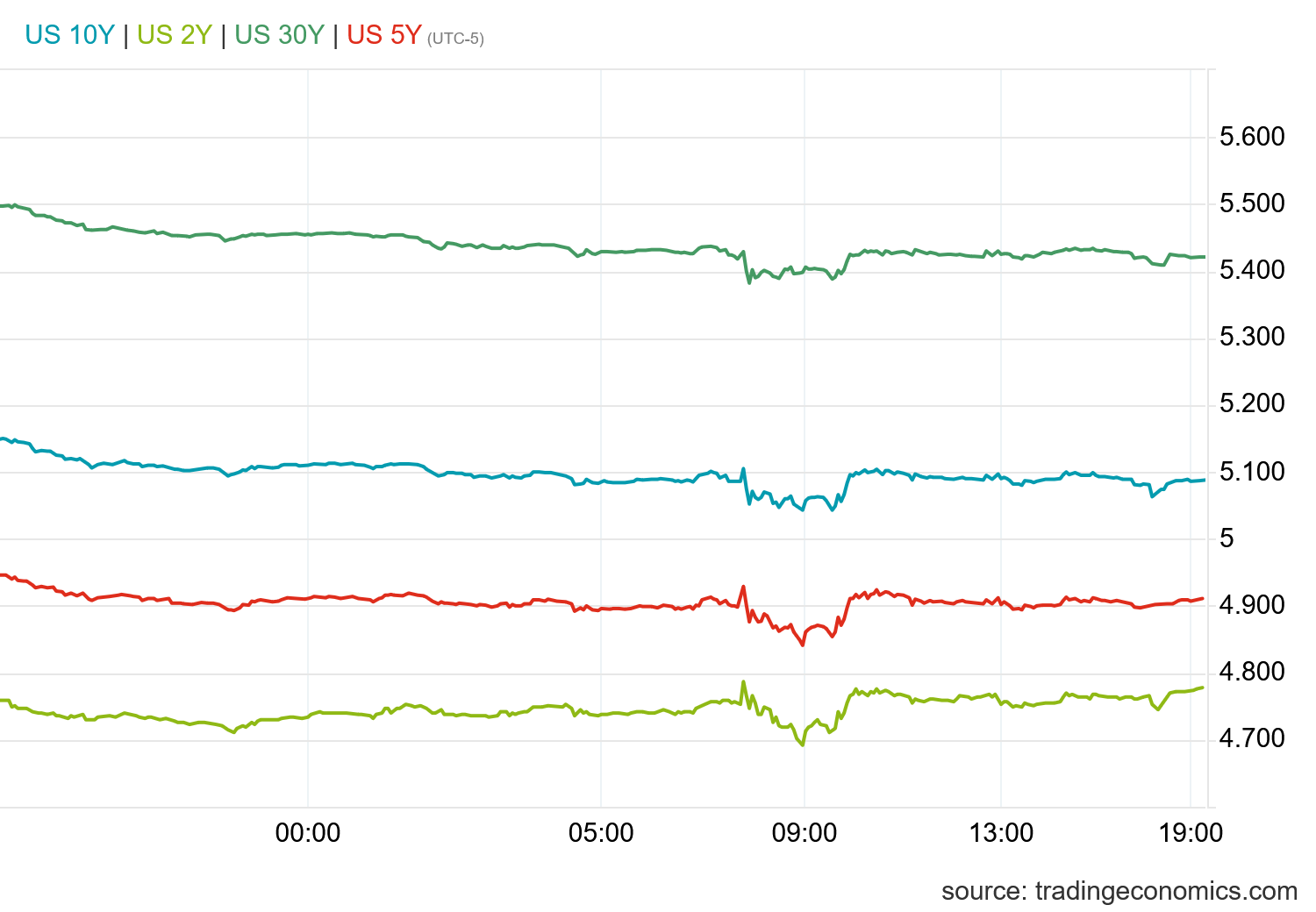
Rising equities and falling yields are market movements we generally associate with good economic news. All things being equal, we would never expect Wall Street to be nonchalant about accelerating inflation, yet that is exactly how Wall Street responded to the Producer Price Index report.
All PPI Sectors Were Up
The PPI report was not good news simply based on the report's headline inflation numbers. An increase of 6.3% year on year was a major increase in the pace of producer price inflation and a continuation of August’s surge.
Month on month, not only did headline inflation surge within the PPI, but core inflation reversed a recent disinflation trend, rising 0.5% month on month, the third worst core inflation print for the PPI this year.
Within the PPI report’s details, inflation for final demand energy was elevated as expected.
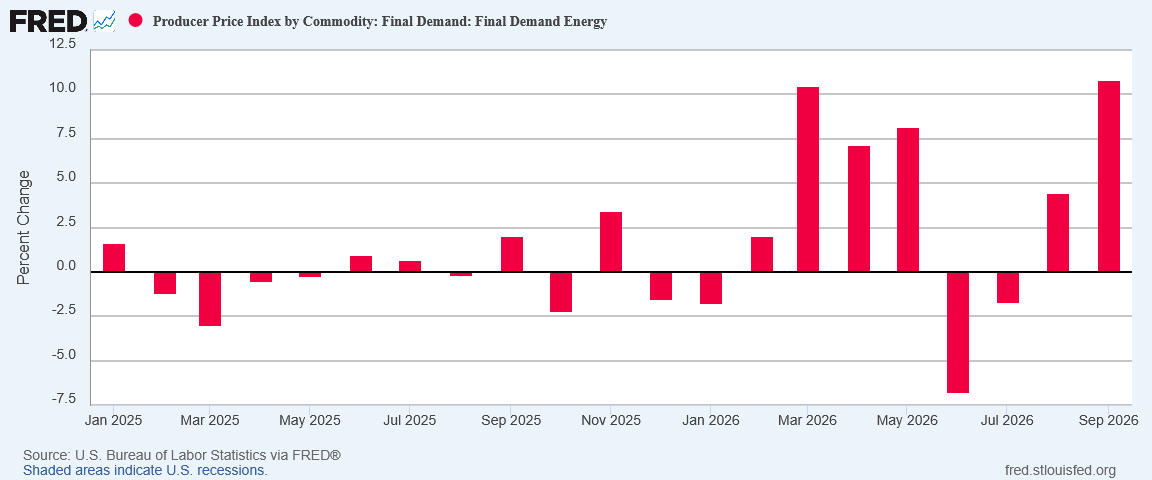
What was not expected was that energy price inflation within the PPI would more than double, month on month, to 10.8%.
Even worse news was food flipping from August’s deflation print to a 1.2% rise month on month.
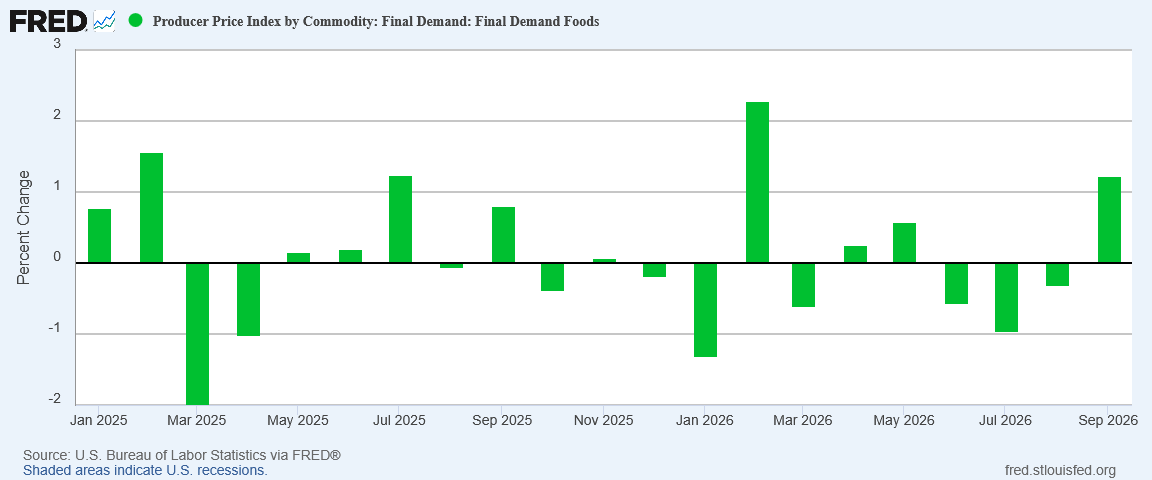
September was the second worse month this year for food price inflation within the PPI.
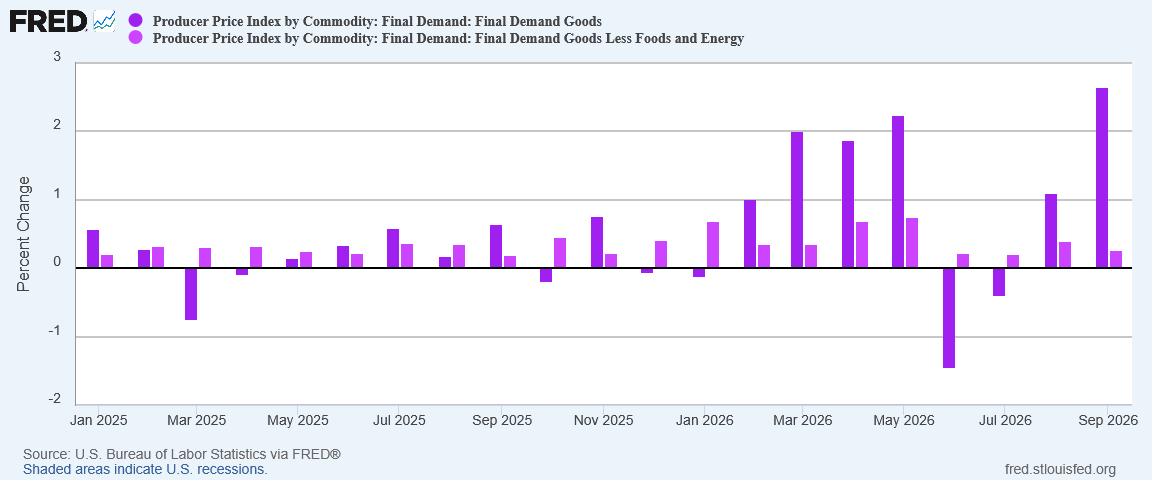
Goods price inflation more than doubled from August to 2.6% month on month.
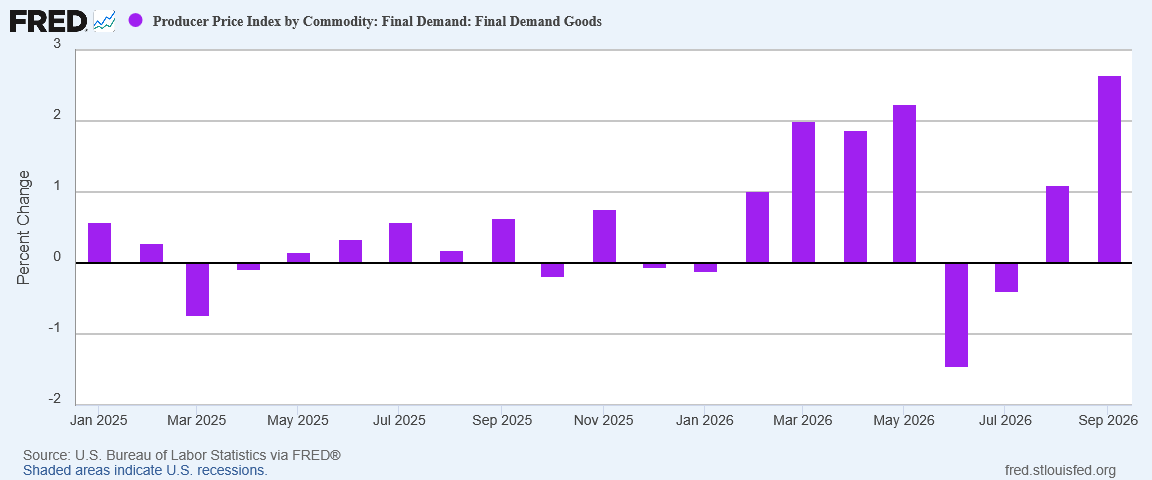
The impact of energy prices on goods prices is immediately visible when we look at the two side by side.
One small bit of comfort in the PPI report: without food and energy, goods prices cooled in September.
However, service prices surged to 0.8% month on month.
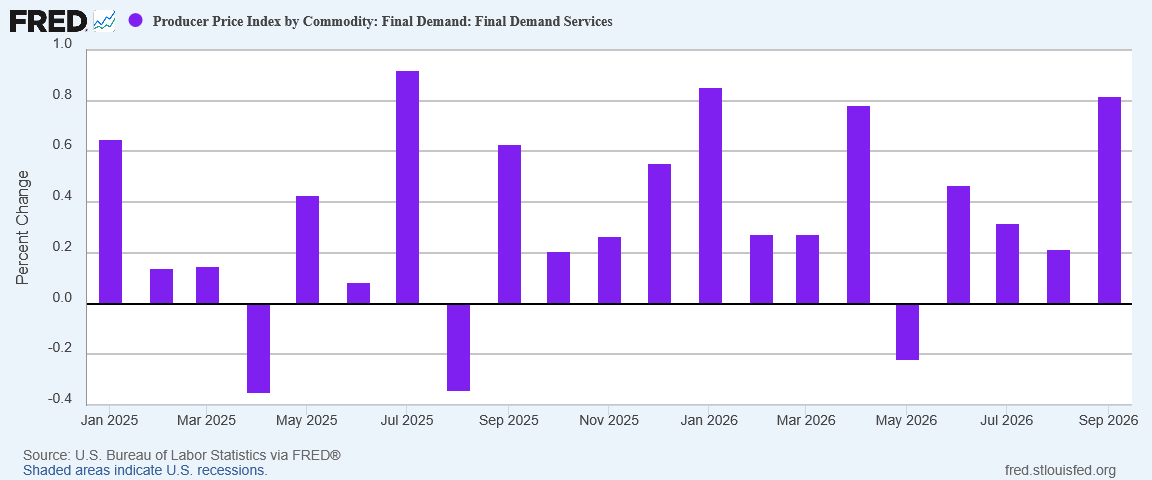
Service prices not only rose, they reversed a two-month disinflation trend to post their second worst monthly inflation figure for 2026, and the third worse since the start of President Trump’s second administration.
That trend reversal is the most notable—and the most concerning—aspect of the PPI report. Core inflation and service price inflation had been trending down. In September that trend not only reversed, it became an indisputable surge in prices across the board.
Intermediate Demand Confirms Contagion Effect
Final demand inflation figures were, on their own, quite enough bad news for any inflation report. To that bad news, however, we must also add intermediate demand’s inflation surge, which shows that there is more consumer price inflation still to come.
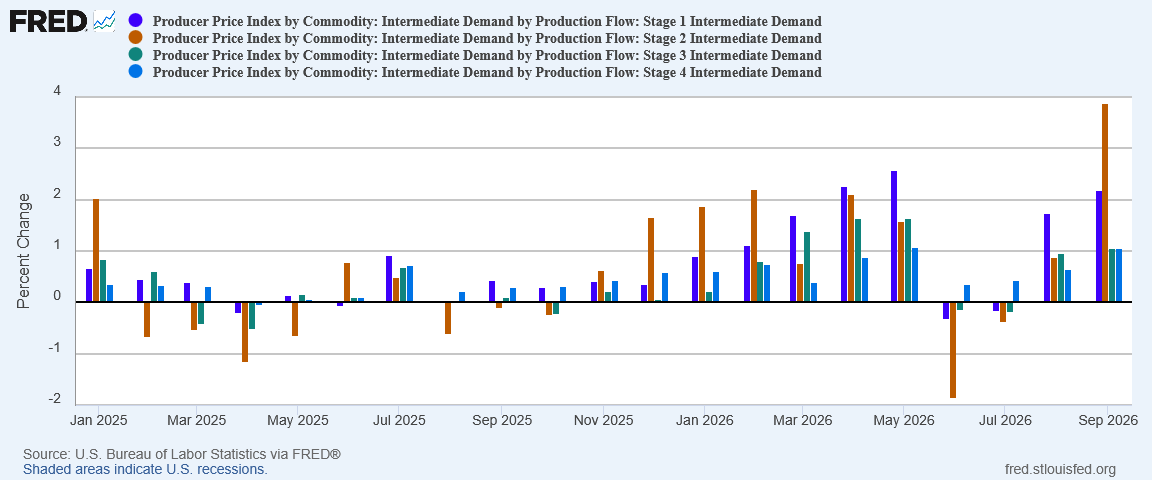
The largest surge came in Stage 2—an interesting shift from August—but we must note that producer price inflation increased across all four stages of intermediate demand. Rising inflation this month in intermediate demand indicates rising inflation within the CPI report.
The other contagion marker within the PPI was the surge of inflation within the components of the service price category.
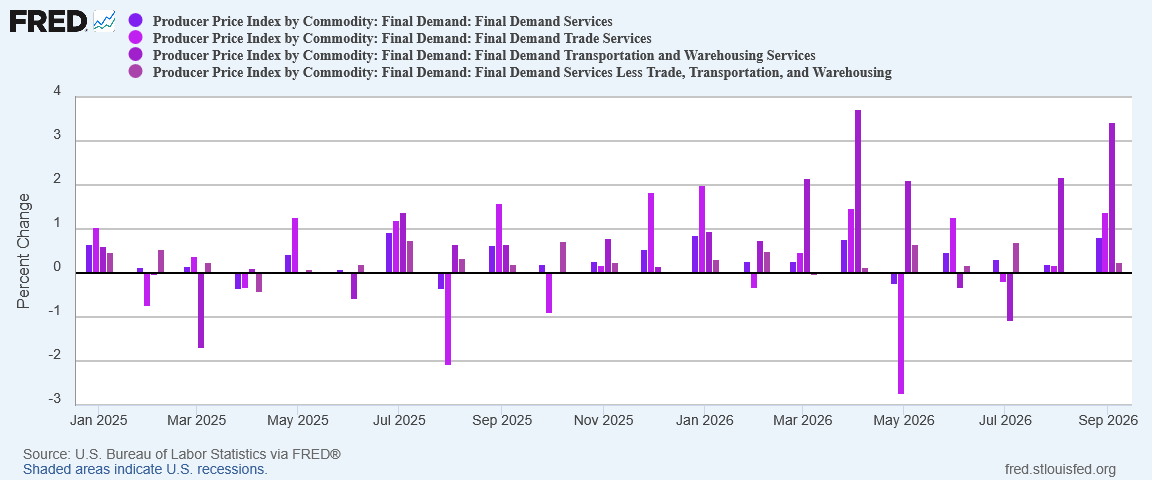
Transportation and warehouse prices especially had been cooling before rising again in August.
Transportation and warehousing services are, of course, cost elements for consumer goods. Just as was the case in August, September’s service price breakdown shows the contagion effect spreading inflation throughout an economy.
Given that we can generally view the Producer Price Index as a leading indicator of what is about to happen in the Consumer Price Index, the surge within the PPI of inflation for Transportation and Warehouse services is a grim forecast of what we can expect over the next few months within the CPI.
Inflation Is Here. Inflation Is Getting Worse
There is no good spin to put on the September PPI print. Just as the CPI print shows a surge of consumer price inflation that is long overdue, the PPI print shows the producer price inflation that was always inevitable, given what has been happening with energy supply since February.
Longtime readers will recall that even in July, when there was little producer price inflation at all, my assessment was that, if war with Iran continued long enough, if the oil supply shock endured long enough, oilpocalypse was not only assured but that it would lean towards the worst case scenario.
There was no magic and certainly no crystal ball in that assessment. Lack of oil and lack of diesel drive up prices within energy markets, which eventually translates into higher prices at the fuel pump. As diesel is an essential cost for nearly all freight, if pump prices rise, freight becomes more costly. Inflation spreads throughout an economy. That much is economics 101
The question of higher inflation as a result of the war with Iran was never a question of “what”. It was always a question of “when”.
We now are seeing the question of “when” answered—and the answer is “now.”
The war with Iran continues. While much has been done to restore traffic through the Strait of Hormuz, it remains a contested waterway.
We must also add Russia’s war in Ukraine into the mix. Ukraine has had great success launching drone strikes on Russia’ oil refining infrastructure, and that impacts global supplies of diesel as well.
When we look at what is happening in the world, we see very few signs if any that the dislocations within global oil and energy markets are about to be resolved. As I said in July, so long as these dislocations persist, they will push prices up.
So long as these dislocations exist, we will see producer prices pushed higher, and then through contagion we will see consumer prices pushed higher.
Unless there is a sudden outbreak of peace in the world, energy price inflation will continue. Unless there is a sudden outbreak of peace in the world, energy price inflation will push up fuel costs, push up transportation and freight costs, and that will push up prices beyond energy goods and services.
Unless there is a sudden outbreak of peace in the world, energy price inflation within the September Producer Price Index confirms that the oilpocalypse is unfolding almost inexorably towards the worst case scenario.
Thank you for staying on top of this Peter.
I read this bad news and literally thought, “I’m going back to bed”. Ugh.