


Last month, the big news in the war with Iran was President Trump adopting a strategy of total economic isolation of Iran, dubbed “Operation Economic Outcast”.
Conceptually, the strategy is a simple one: The US is going to exert economic pressure in every direction to make certain that no one does business with the Islamic Republic at all. The goal is to cut Iran off from all economic linkages with the wider world.
As is the case with most countries in the world, Iran needs to import certain goods. Iran needs to sell oil abroad to pay for those goods. Iran needs to be able to receive payments and make payments in hard currency. Operation Economic Outcast aims to make all of those things no longer possible for Iran.
Since then, the United States has pulled a number of financial and economic levers, all designed to starve the Islamic Republic of cash.
Meanwhile, Iran leveraged its terror proxies, particularly the Houthi rebels in Yemen, to prevent as much oil as possible from flowing through both the Strait of Hormuz and the Bab al-Mandab Strait at the entrance to the Red Sea.
What began as a war over Iran’s illegal nuclear weapons program is now a war for control over Persian Gulf oil resources. Both the US and Iran are attempting to prevent each other from benefiting from Persian Gulf oil flows.
The oilpocalypse is approaching for somebody—but for whom?
Scott Bessent Turns The Financial Screws
Operating Economic Outcast is more than simply applying more sanctions on Iran and its trading partners. Treasury Secretary Scott Bessent has brought a number of his department’s resources to bear on Iran’s international trade. Most notably, he has leveraged the Financial Crimes Enforcement Network (FinCEN) to identify and disrupt several of the financial relationships that keep Ayatollah Mojtaba Khamenei’s regime going in Tehran.
The scope of what FinCEN can reach began to be made plain after a September 16 FinCEN Exchange session where information on Iran’s revenue streams was shared, allowing the Treasury to target and disrupt those streams.
The FinCEN Exchange program was started during the first Trump Administration in 2017, with expanded authority thanks to the Anti-Money Laundering Act of 2020.
FinCEN Exchange is a confidential, event-based, invitation-only program. In consultation with law enforcement and other stakeholders, FinCEN identifies high priority topics and hosts issue-specific events that bring relevant financial institutions, other private sector entities, and government stakeholders together to examine related risks, threats, and potential approaches for disruption. Participants share information relevant to the focus of the event, whether on emerging trends and typologies or tactical, case-specific information.
Iran’s Achilles heel is that international trade requires international finance—and the United States has considerable leverage over international financial networks. The extent of that leverage was tacitly conceded by Iranian President Masoud Pezeshkian during an interview with Fox News’ Bret Baier while in New York for the recent United Nations’ General Assembly Meeting, when he acknowledged that even Iranian funds in China were frozen.
One of the problems that we face is that our money in China is blocked. The fact that you touched upon earlier the accusations that we supply so-and-so with fundings, we can’t even get our own money out of a country to which we have supplied goods, let alone using those funds to pay someone else in another corner of the world.
Even Russia’s banks are proving not to be beyond the reach of the US Treasury. On September 14, the Treasury’s Office of Foreign Assets Control sanctioned VTB Bank Public Joint Stock Company, for helping Iranian banks evade US financial sanctions.
To say that Iran is completely isolated, economically, would be an exaggeration even now, but the US has steadily cut off the flow of hard currency into Tehran its attritional campaign to starve Iran of cash.
Houthis Raised The Stakes?
While the US Treasury was disrupting Iranian cash flows, Iran, through its Houthi terror proxies in Yemen, was attempting to disrupt tanker traffic in the Red Sea—and in particular from Saudi Arabia’s Red Sea port of Yanbu, at the western terminus of its East-West Pipeline.
At the same time Russia’s VTB Bank was being sanctioned, the Houthis were advancing on Mokha, a Yemeni city near the Bab al-Mandeb Strait, furthering that rebel group’s ambition of stopping oil traffic in and out of the Red Sea.
The Houthis also launched drone and missile attacks against Saudi Arabia’s East-West Pipeline, momentarily disrupting oil transit, successfully halting oil flows to Yanbu for a time, curtailing Saudi Arabia’s Red Sea oil shipments.
While the Houthis have managed to disrupt some oil flow through the Bab al-Mandeb, however, they have not achieved the near-total shutdown Iran accomplished back in March and April in the Strait of Hormuz. Even with Houthi mischief, oil is still flowing through the Bab al-Mandeb.
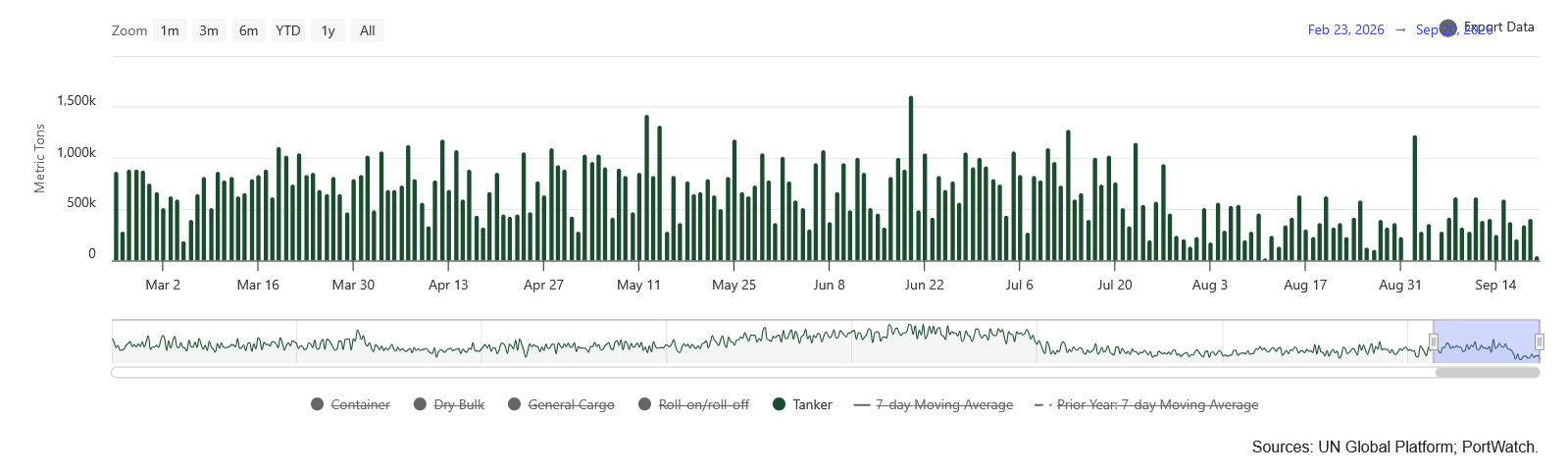
Thus far, the Houthis have added stress to global oil markets, but have not had game-changing impact.
Talking But Not Talking
While the IRGC continues its bellicose rhetoric, one persistent reality undermining their position has been various reports of attempts to restart negotiations between Iran and the United States.
On September 19, Supreme National Security Council secretary Mohsen Rezaei acknowledged that “mediated diplomacy” had been taking place, with Qatar and Pakistan acting as go-betweens with the Trump Administration. Rezaei even laid out three conditions Iran wanted before formal negotiations could resume:
Three important conditions are set here by Mohsen Rezaei during this exclusive interview. First, he is calling for a halting of war… across the region, specifically with a focus on the Yemeni front.
Second, he is talking about the frozen assets of the country and the need for these assets to be released.
And third, he is also talking about the ending of the naval blockade, which is critically important, a key point of concern for Tehran, seeing the role of this naval blockade and its impact on Iran’s oil exports in this crippling economic situation for the country.
For obvious reasons, this non-starter of a set of demands gained absolutely no traction with the Trump Administration.
Yet even with the imperious tone of Rezaei’s three “conditions”, that Iran was willing to extend even that much of an olive branch could be a signal that even the most pro-war factions within the Khamenei Regime are losing their grip.
The diplomatic overtures reached a zenith late last week, when Iran, working through Qatari and Pakistanian negotiators, offered to completely re-open the Strait of Hormuz within seven days in return for an end to hostilities and a return to the Memorandum of Understanding.
Foreign Minister Abbas Araghchi outlined the plan to reporters in New York on Thursday, according to US media. The proposal seeks to implement the conditions in the Memorandum of Understanding agreed by Washington and Tehran in June, including a halt to hostilities and the reopening of the Strait of Hormuz.
Reportedly passed to Washington via mediators earlier this week, Iran’s proposal asks the US to meet specific conditions within seven days to restart ceasefire talks and end the blockade choking the strategically important strait.
The restrictions on maritime traffic in Hormuz have become a key issue in the conflict due to the impact on oil and gas exports and the global economy.
During that same interview on Fox, Pezeshkian even said Iran would surrender its stockpile of enriched uranium.
Given Iran’s stance on preserving its nuclear weapons program and nuclear assets, that was quite an offer.
In an interesting bit of role reversal, for this latest peace overture it was President Trump who rejected it.
Well, I’m rejecting their deal. They want to make a deal where they open the Strait immediately because they’re losing so badly. You know, you don’t read that or you don’t see that in the fake news. But we’re winning tremendously.
We have total control of the Hormuz Strait. Massive amounts of oil are coming out of the Hormuz Strait. Last night, we had 29 ships come out. They want to make a deal. And I think that’s fine. I like making a deal, too. But I’m not — that deal would not be acceptable.
With President Trump’s rejection of their offer to resurrect the Memorandum of Understanding, the war with Iran remains in much the same place as it was a month ago: both sides posturing and attempting to project a measure of strength and neither side achieving either a military or diplomatic breakthrough.
Is Oil Flowing Despite Iran?
What has changed over the course of the past month has been an increasing amount of reporting indicating that Iran’s chokehold on the Strait of Hormuz is slipping.
Right before Labor Day, President Trump had been making grandiose claims that, under the aegis of the US military, tanker traffic through the Strait of Hormuz was close to pre-war levels. If true, those claims would be a significant defeat for Iran, as closing the Strait has been their only real strategic option in this war.
However, those claims have remained impossible to verify, as the IMF’s PortWatch data indicates that almost no tanker traffic is moving through the Strait.
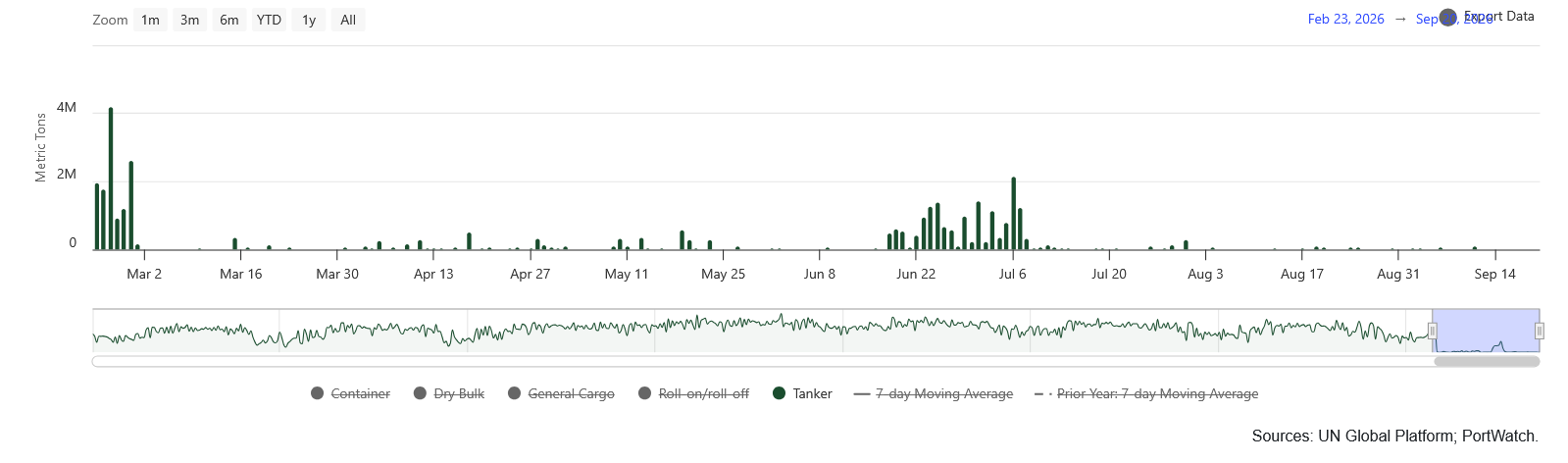
However, recent shipping data compiled by Bloomberg suggests that Saudi Arabia has shipped an average of 5.28 million barrels per day thus far in September, with 3.4 million barrels per day of that loading at terminals in the Persian Gulf.
Building off those estimates, Saudi oil exports have made a significant recovery, indicating that Iran’s grip on the Strait is genuinely eroding.
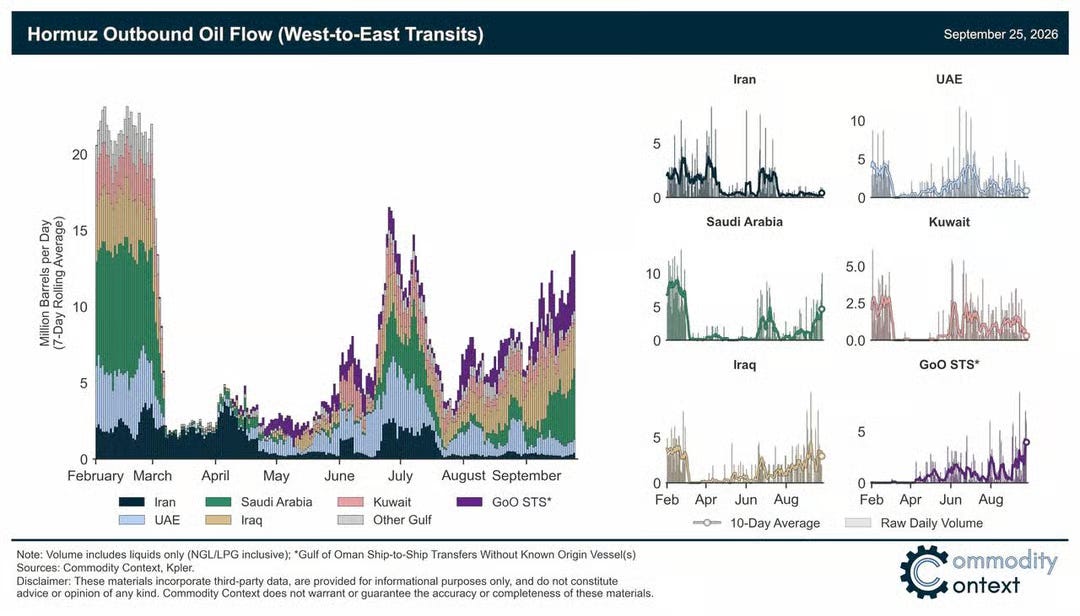
Another independent analyst over the weekend assessed that tanker traffic through the Strait was at 92% of pre-war levels, with Saudi Arabia continuing to load crude at Yanbu on the Red Sea, despite recent Houthi attacks on their East-West pipeline.
▪️Yanbu loadings at ~2.5mbd (based on @phileepos data) still provide some relief despite the E-W pipeline challenges
▪️Saudi PG flows reached 6mbd - above 2025 avg levels, fully offsetting the reduced flows from Yanbu bypass
▪️STS volumes also increased significantly vs last week
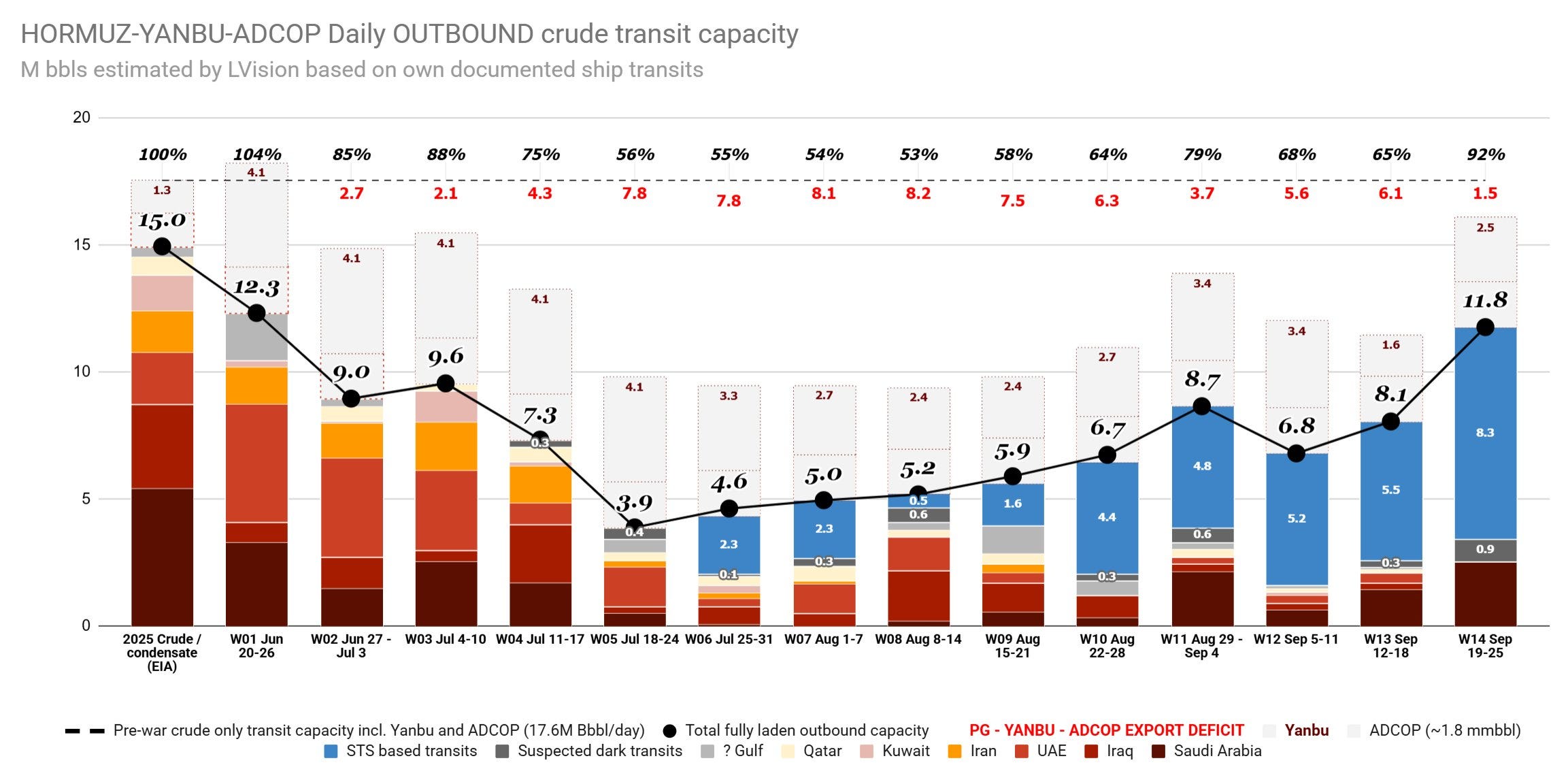
These analyst projections are entirely unconfirmed at this point, and represent more thumbnail calculations and rationalizations for why benchmark crude prices are not higher than they are, but even if these estimates are exaggerated (which they probably are), they still point to a steady increase of oil flows through the Strait, which would be a clear setback for Iran.
What is a more definitive setback for Iran is that Qatar, the Persian Gulf’s major exporter of natural gas, has been increasing LNG loadings recently, steadily moving more natural gas through the Strait than over the summer.
At least two laden carriers have been sent outbound through the narrow strait in the last week, while at least two moved in the opposite direction to enter the Persian Gulf, according to ship-tracking data compiled by Bloomberg. One of the shipments is on its way to India’s west coast.
No signals were detected from the four vessels when they traversed Hormuz, but jamming and interference is common in the area, complicating efforts to ascertain the exact location of ships.
The Rigzone report also highlights why Portwatch isn’t registering the traffic: to avoid unwanted attention from the IRGC, between signal jamming and ships turning their transponders of (“going dark”), the normal traffic monitoring resources are not able to track ships exiting the Persian Gulf.
Separately, another Rigzone report suggests that Gulf nations are offering sizeable discounts for shipments of crude, a development that on the one hand indicates there have been more oil traders than previously acknowledged willing to take on Persian Gulf cargoes but also indicates that several of them have recently backed out of loadings in the region.
The Strait of Hormuz is not moving oil at pre-war volumes, but it is increasingly clear that the Strait is moving oil, and that volumes are increasing not decreasing.
Oil Prices Are High, But Not Moving Higher
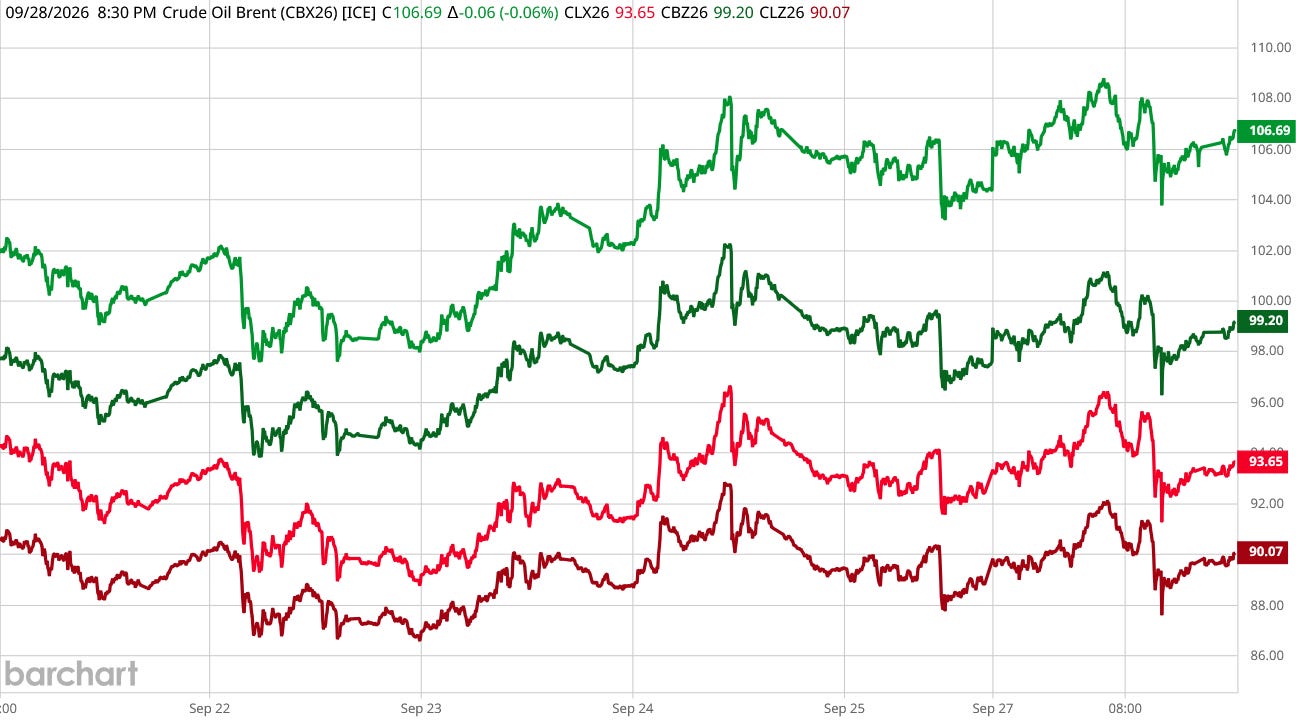
A major reason to believe that some oil is flowing through the Strait is that oil prices themselves have not moved much higher, even after President Trump rejected Iran’s offer to resurrect the MoU. While Brent Crude is still firmly above $100/bbl, resistance has been consistently shown over the past week at the $108/bbl threshold.
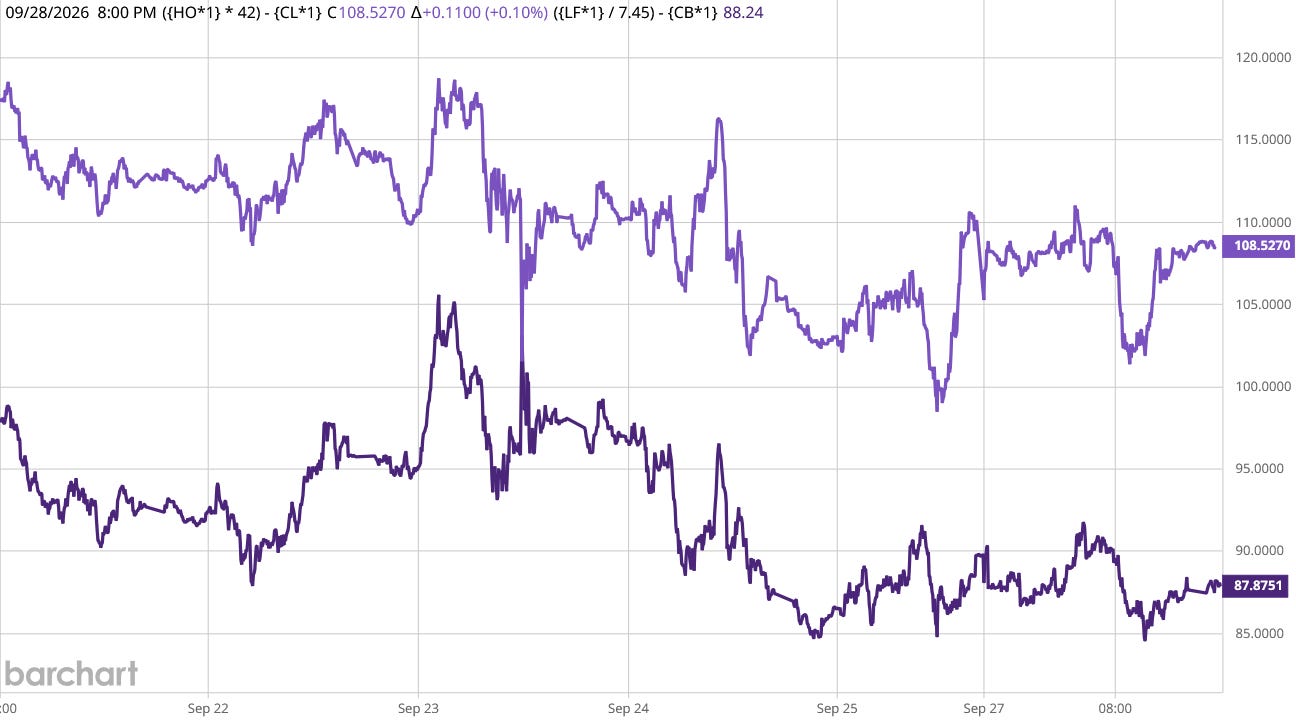
Perhaps even more significantly, diesel crack spreads have been easing over the past week.
For the US, crude oil prices as well as gasoline and diesel prices moved lower over the past week.
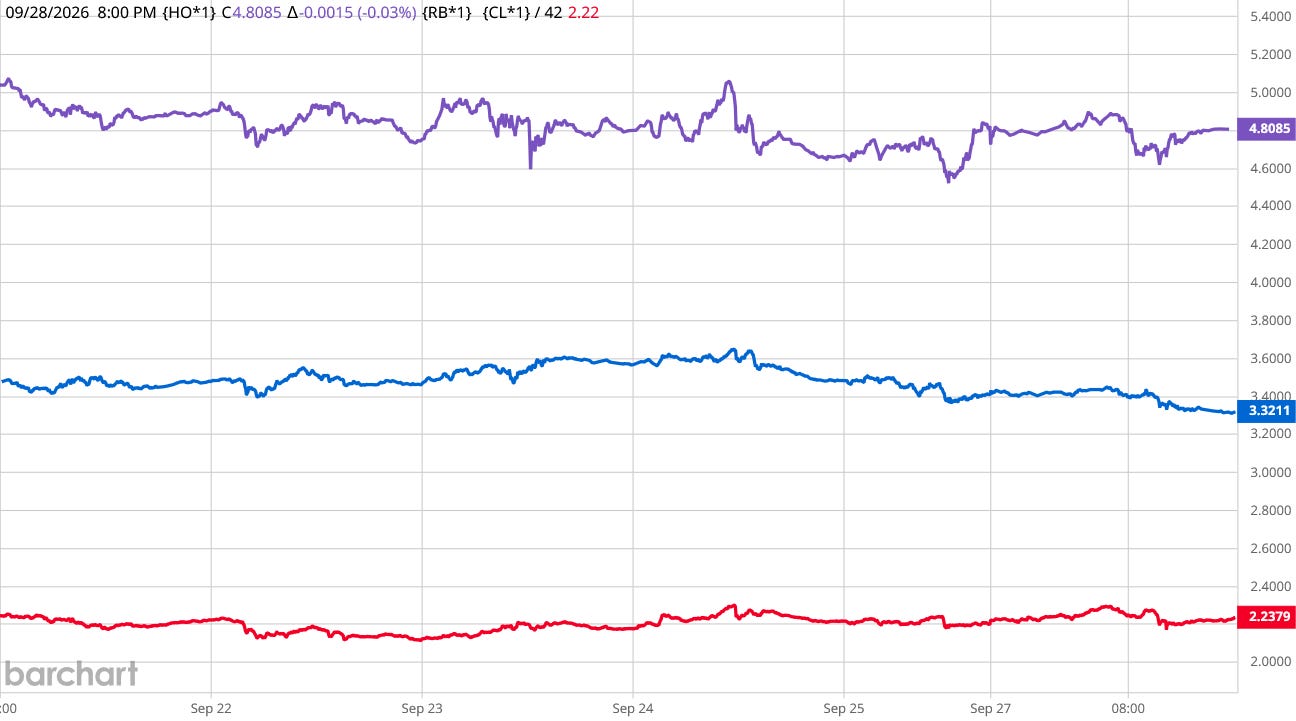
While these are not dramatic declines, that there is any decline at all bolsters assessments that Iran’s grip on the Strait of Hormuz—and thus its sole geostrategic leverage against the United States—has already weakened considerably.
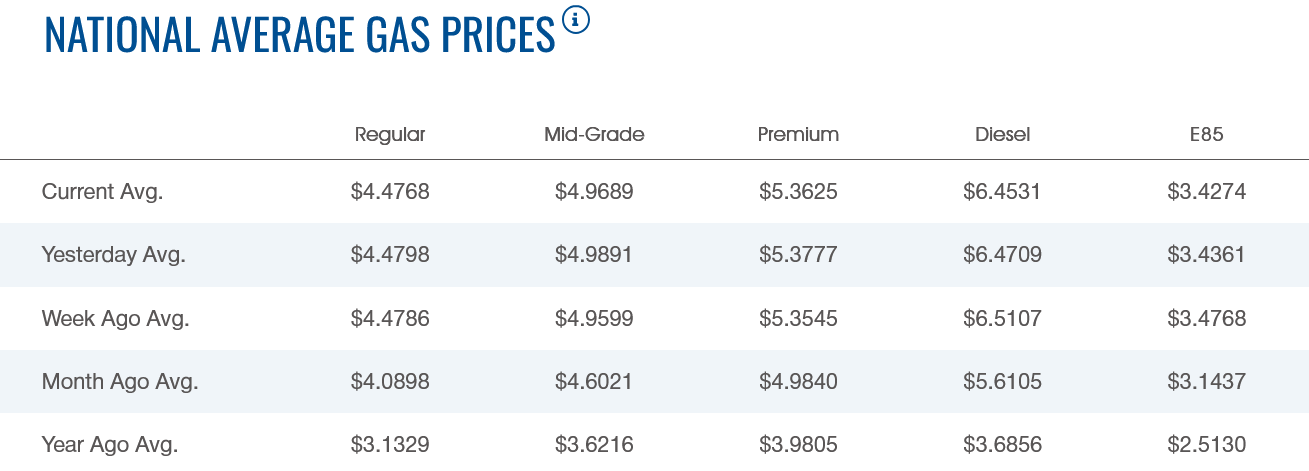
At the pump, this has meant that diesel and gasoline prices have also moved down slightly.
The drop in diesel prices also brings into focus the disparate impact of state regulations on fuel costs. Not only does California pay roughly $2.50/gal more for diesel than Texas, but the week’s decline in diesel prices has been far more pronounced in Texas than in California.
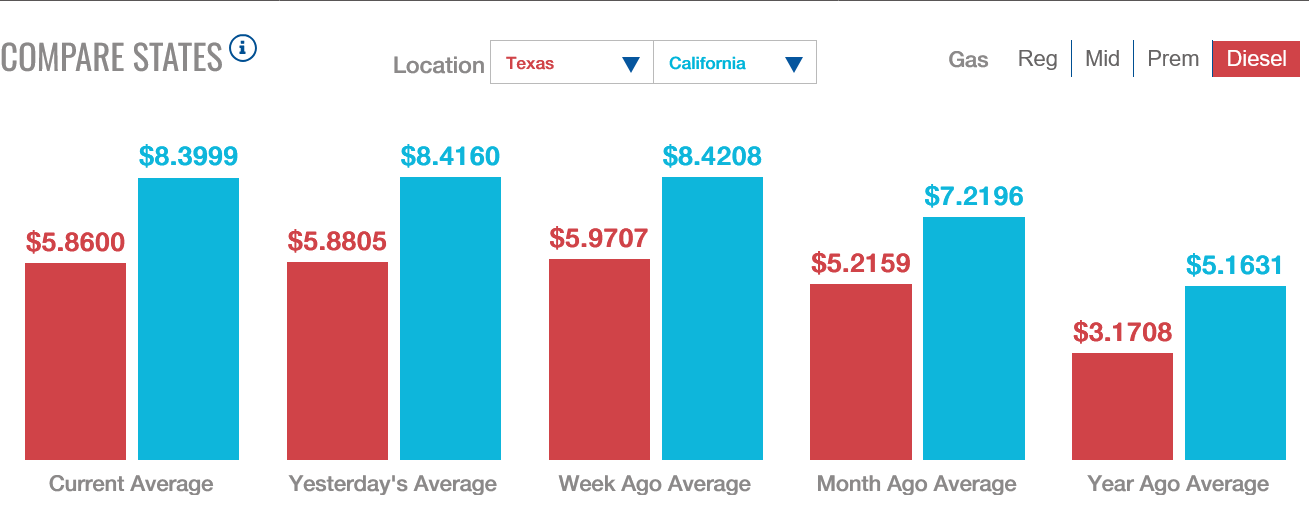
Not only does the variance in diesel prices make a compelling case against California’s onerous fuel regulations, that state regulations can have larger impact on fuel prices than Iran’s crumbling closure of the Strait of Hormuz merely adds weight to the narrative that Iran is losing its grip on the Strait.
Is Anybody Winning?
At first glance, an assessment that Iran is losing control over the Strait of Hormuz plays very easily into a claim that Iran is “losing” and the United States is “winning”.
On the longer horizon, such a claim has a certain merit. If Iran cannot prevent oil from transiting the Strait of Hormuz it has effectively lost the war. It has already lost the military confrontation, and an inability to control oil traffic through the Strait greatly weakens its geopolitical leverage in this conflict.
If Iran cannot control oil traffic through the Strait, while the US is still able to prosecute Operation Economic Outcast, Iran’s eventual collapse very quickly becomes a question of “when” and not “if”.
At the same time, US diesel prices at the pump are still well above $6.40/gal. Gasoline prices at the pump are well above $4.40/gal. These are prices that pinch. These are prices that push the Cleveland Fed’s inflation nowcast for the PCE Price Index (due out later this week) higher.
Iran may be losing the only leverage it has had in this conflict, but the world is still a long way from restoring pre-war flows of oil and refined products out of the Persian Gulf. The loss of Persian Gulf oil supply is pushing up fuel and energy prices around the world. Increased fuel prices are increased fuel costs to move goods around, and we may already be seeing some indication of that pushing core inflation up in September in the Cleveland Fed nowcast data.
Iran may be losing the only leverage it has had in this conflict, but it is doing so incrementally. The Iranian position is eroding, not collapsing. Operation Economic Outcast is likely to eventually cause the Khamenei regime to crack and collapse, but, barring some unforeseen development, that could still be weeks if not months away. Meanwhile, the attritional nature of such economic warfare means the US is still grappling with the inflationary influences of high oil and fuel prices. If Iran manages to launch another strike at Saudi Arabia’s East-West Pipeline, or if the Houthis eventually succeed in imposing a more stringent blockade of the Bab al-Mandeb, oil prices and thus diesel prices could quite easily soar upward again.
With oil prices remaining quite high, but not trending sharply higher, the oilpocalypse is still looming just ahead. It’s just not clear who it’s for: the US or Iran.
Light Sweet n Heavy Sour,
Got Refineries? 🚢🛢️🏭⛽
“The Iranian position is eroding, not collapsing. Operation Economic Outcast is likely to eventually cause the Khamenei regime to crack and collapse, but, barring some unforeseen development, that could still be weeks if not months away.” Okay, I would expect the IRGC to be reaching out by now, in desperation, to the world’s mega-wealthy illegal operatives, such as criminal gangs in Russia and China, and drug-smuggling cartels. The IRGC would be trying to cut deals for financing and currency, but what could Iran offer these criminal enterprises? New drug-smuggling routes? A willingness to harbor fugitives from international justice?
Peter, you’re not likely to be able to find any hard data documenting such deals. But are there certain metrics that the Trump administration can follow that would indicate any transactions with criminal gangs - crypto and gold transactions, etc.? And can Bessent effectively shut those down? This is all shadow-world, dark-web stuff, and I don’t know to what extent a government can realistically have a major effect on it. You’re the resourceful analytical genius who could detect clues.
Your posts are wonderful sources of factual data and insightful analysis, Magnificent Man. Thank you!