


President Trump’s latest strategic pivot in the war with Iran is a scorched earth economic policy of total isolation for Iran, dubbed “Operation Economic Outcast”.
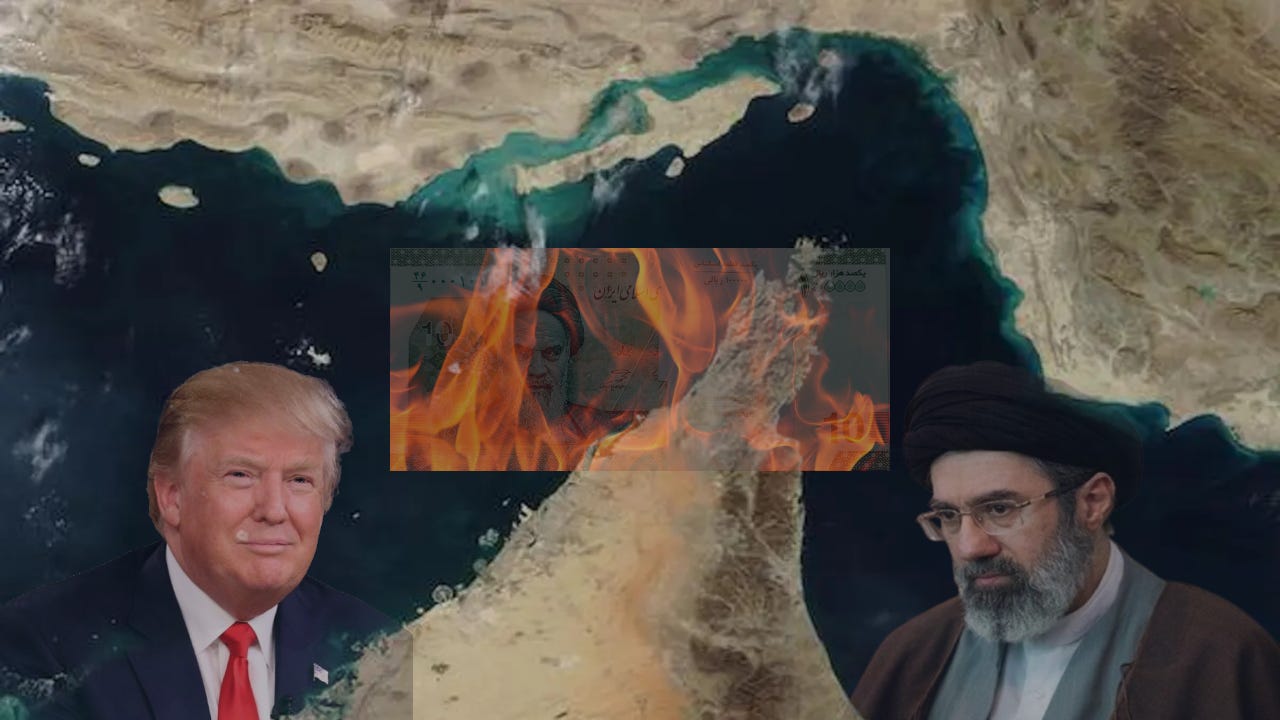
Today, the Trump Administration unleashed Operation Economic Outcast, an unprecedented campaign to sever every remaining economic lifeline sustaining the Islamic Republic of Iran. After President Trump and the overwhelming might of the U.S. military dismantled Iran’s military capabilities and crippled its nuclear program, America is entering the endgame with the single greatest financial offensive ever mounted against an adversary.
Conceptually, the strategy is a simple one: The US is going to exert economic pressure in every direction to make certain that no one does business with the Islamic Republic at all. The goal is to cut Iran off from all economic linkages with the wider world.
As is the case with most countries in the world, Iran needs to import certain goods. Iran needs to sell oil abroad to pay for those goods. Iran needs to be able to receive payments and make payments in hard currency. Operation Economic Outcast aims to make all of those things no longer possible for Iran.
While it is difficult to fathom how such total economic isolation would not bring the Khamenei Regime to its knees, there is still a pressing question for which we do not yet have a good answer: will it work?
Can the US actually compel other countries to cut all economic ties with Iran?
Most importantly, can the US compel China to cut all economic ties with Iran? China is Iran’s single largest trading partner, and virtually the only purchaser of Iranian oil. Arguably, China has the capacity to make or break the isolation campaign.
We will know the actual answer in due course, but when we consider China’s situation especially, we can see a possible answer lurking in another related question: how valuable is Iranian business to China?
Is Iran worth enough to China to justify a diplomatic row with the US? Not necessarily.
Operation Economic Outcast
The scope of what the US is attempting is quite staggering: The US Treasury aims to disrupt every financial lifeline and conduit Tehran has, bar none. Treasury Secretary Scott Bessent made that very clear in his Monday press briefing to announce the isolation campaign.
Bessent said on Monday that the US would target all of Iran’s sources of revenue, including oil, with the aim of preventing other countries and companies from doing business with Tehran.
“Around the globe, our objective is to sever every economic lifeline that sustains this tyrannical regime until Tehran stands alone,” he said.
Where the implementation might get tricky is in the mechanisms needed: secondary sanctions against countries and companies that do business with Iran currently.
The operation expands the categories for secondary sanctions on entities and countries that transact with Tehran and also introduces new sanctions across a variety of vital sectors, including digital assets, gold, aviation, technology and shipping.
Bessent said any entity that facilitates money laundering on behalf of Iran “will be removed from the U.S. dollar system. The clock just started ticking.”
Many of the secondary sanctions, he said, won’t be immediate.
“We are giving everyone the opportunity to remedy bad behavior,” Bessent said. “Why would I want to blow up the global financial system? We believe that it is important to level set and give people a cure period, but they should know that that will move very quickly and that we are serious.”
Bessent made the case for the sanctions effort in an op-ed published over the weekend in the Financial Times:
President Trump has decimated Iran’s economy to a point where the rial has never been weaker and inflation has rarely been higher. The regime’s final refuge now lies in the self-deception of fearful nations that still believe accommodating aggression can secure a durable peace.
Iran’s enablers purchase and transport its petroleum. They facilitate the flow of its finances through exchange houses and free trade zones. They welcome Iran’s flights and maintain registries on its behalf. They turn a blind eye to seaborne fuel transfers and the illicit use of their banks, all while concealing the extent of their complicity.
In short, these countries calculate appeasement of the regime to be the safer course. But they would do well to consider the consequences of sustaining it.
What Operation Economic Outcast proposes to do is to draw a very bright economic line, with America’s economic allies on one side, and Iran on the other—and any country which chooses to continue to trade with Iran.
Those who sever Iran’s remaining financial and commercial connectivity will reinvigorate their own. They will deepen their access to global capital, reinforce confidence in their markets and attain the standing they seek in the world economy.
The alternative for those who tether themselves to Tehran is the foreclosure of any path to lasting prosperity. Illicit finance will flourish, as it so often does, where confidence has collapsed. And any nation that serves as a financial artery of a withering regime should expect to share in its isolation. To become a sanctuary for terror is to become, in the eyes of the United States, a global pariah.
Much as was said in the opening days of the Global War on Terror, the stance of the Trump Administration on Iran is “you’re either with us or against us.”
President Trump is demanding the nations of the world decide: do they want a belligerent Iran? Do they want a nuclear-armed Iran? Do they want the Mahdist Twelver Shi’a cult that is the Khamenei regime deciding who can and cannot sail through the Strait of Hormuz?
The countries of the world will have to decide how they will answer those questions, recognizing that the available options are “Yes” and “No.”
What Will China Do?
At first glance, one might be tempted to presume that China would never go along with President Trump’s campaign of economic isolation. China has for years been buying Iranian oil in defiance of the sanctions placed on Iran.
Certainly China has not voiced any support for any form of sanctions or other pressure against Iran. As China’s Foreign Ministry Spokesman said on Friday, “Sanctions and pressure tactics are not the solution. China calls on parties to act responsibly and stick to the political and diplomatic approach.”
Publicly, a number of analysts and commentators within China take the view that China has the upper hand when it comes to President Trump pressuring them to go along with an economic isolation of Iran.
But Beijing has reasons to feel confident it can withstand Mr. Trump’s latest warning — if it is ever fulfilled. And increasingly, Chinese analysts see the war in Iran, which the White House seems unable to end on favorable terms, as a sign of America’s mounting weakness.
“This threat reveals how desperate the Trump administration has become on the issue of Iran,” said Wu Xinbo, a leading American studies scholar at Fudan University in Shanghai, who advises China’s foreign ministry.
“They issue this threat, not because they think it is workable, but because they have no other options,” he said, to get out of this “self-created dilemma.”
In their assessment, China has leverage over the US because of its control over strategic resources such as minerals essential to American defense industries. The US presumably can only push so far to coerce China without China pushing back.
Yet we must also remember that China’s economy has been revealed to be stuck in a persistent "lost-decade” style of deflation reminiscent of Japan’s economic woes in the 1990’s and early 2000’s. A substantial portion of China’s slashing of oil imports in May and June was little more than China deciding not to put oil in strategic reserve the way it had been. As it is China succeeded in putting some 210,000 barrels in reserve in July even with July oil imports running at about 75% of pre-war volumes.
Beyond the lack of oil consumption, consumer spending barely budged in July, with investment contracting 6.7% year on year.
China’s economy, which has never been strong since the COVID Pandemic Panic in 2020, grew weaker in July.
While China’s economic woes have not been helped by America’s war with Iran, those economic woes did not start because of America’s war with Iran. China’s slowdown is more attributable to the collapse of its housing markets and ongoing deflation within its manufacturing sector than it is to even a mild variation on “oilpocalypse”.
That matters because the weaker China’s economy is, the lower its demand for oil—and the less need it has of Iranian crude.
China might not openly support Operation Economic Outcast, but all China needs to do is simply not buy Iranian oil. Given that oil purchases make up 75% of China’s bilateral trade with Iran, if China simply stops buying Iranian oil, that one step alone shrinks China’s trade with Iran by that 75%.
While China would be unlikely to cease buying Iranian oil simply to play along with US sanctions, China is equally unlikely to buy oil from Iran that it does not need, especially at the elevated prices that have prevailed since the start of Operation Epic Fury.
Is Iran Even Selling Oil To China?
An interesting wrinkle in any assessment of China’s likely response to Operation Economic Outcast is that Iran is not selling much if any oil to China at the moment.
The number of offers for Iranian oil cargoes to China for September and October delivery has declined from July and August cargoes, four trade sources familiar with the matter said. The offers have declined as barrels already in ships on the water have been sold, they said.
Since the the US Navy first started blockading Iranian shipping, Iran had been selling China oil from the seaborne crude it has outside the Persian Gulf. With that seaborne supply now dwindling, Iran is making fewer offers of oil cargoes to China.
China’s interest in purchasing Iranian oil is certainly not helped by the fact that the deep discounts Iran has had to extend to China for it to buy Iranian oil have turned into a premium of as much as $2/bbl. Even before Operation Economic Outcast was formulated, Iranian oil was becoming much less attractive to China.
With the US Navy maintaining its blockade of Iranian shipping coming out of the Persian Gulf, Iranian oil is projected to continue to lose its luster as the amount of crude Iran has on tankers outside the Persian Gulf gets sold off, as no Iranian crude has emerged from the Persian Gulf since the collapse of the Memorandum of Understanding.
Kpler senior analyst Muyu Xu predicted oil buyers “could face virtually no new Iranian supplies available for late-September delivery onwards since no laden Iranian tankers have so far managed to break through the U.S. blockade.”
China’s independent “teapot” refineries, which had been the primary recipients of Iranian crude, have recently begun sourcing oil from Brazil and Iraq, among other nations.
Even without the threat of new sanctions, Iran’s prospects for selling oil to China in the future are plummeting for the simple reason that Iran has so far been unsuccessful at penetrating the US Navy blockade, according to Bob McNally of Rapidan Energy Group.
The blockade, which the U.S. had lifted for about three weeks while negotiations were being held in June and early July, is now back and effectively blockading Iran’s oil exports.
“Kharg Island is not exporting anymore,” McNally told CNBC, referring to Iran’s key oil export terminal that handles more than 90% of all shipments.
“Iran has stopped being a factor for the oil market in terms of its exports because of the blockade,” McNally said.
Data from ship tracking company Kpler has confirmed that Kharg Island is effectively idled as of the end of July.
As an historical footnote, Iran has tried in the past to curtail the discounts it has offered to China on oil purchases. In 2024 Iran attempted to raise its offer price to China by approximately $1 per barrel. That effort proved to be relatively short lived, as just under a year later, in 2025, Iran increased its discounts to China to more than $6 per barrel.
China’s willingness to buy Iranian crude has always been extremely price sensitive. Now that the discount has become a premium, China has much less reason to purchase Iranian crude. In that calculus Operation Economic Outcast does not even register.
As Oil Goes, So Goes Iran’s Trade Relationships
The blunt truth of Iran’s economy is that it needs oil sales abroad to generate the hard currency it needs to buy various needed imports. With tankers not filling up at Kharg Island, and with Iran’s offshore supply of crude nearly completely sold off, Iran is currently unable to export oil at all.
No oil exports mean no hard currency for Iran, and that implies no ability to purchase and import goods. Even if Iran could make the purchases, the US Navy’s blockade makes it extremely difficult for Iranian merchants to take delivery.
Even before the economic isolation campaign was announced, Iran was already largely cut off from the global economy.
As draconian as the new sanctions promise to be, the practical reality of Operation Economic Outcast is the new secondary sanctions are far more incremental than the typically Trumpian title of the policy suggests. Iran is precluded from selling much of its oil as it is, and that greatly limits how much of other things Iran can buy. Even if Iran could swing the purchase of various goods from abroad, the US Navy’s blockade goes in both directions, and ships inbound to Iranian ports are being stopped by the same naval vessels stopping Iranian tankers from leaving the Persian Gulf.
Will other countries fall in line with Operation Economic Outcast and cut ties with the Islamic Republic? That remains to be seen.
Will China play along with Operation Economic Outcast? Superficially, probably not. China remains very much an economic and geopolitical adversary to the US. There are few geopolitical upsides to China openly backing any policy of President Trump’s.
However, with China’s economy stuck in the doldrums, and Iranian discounts on crude oil gone, China has the option of striking a rhetorical stance against Operation Economic Outcast while at the same time simply not purchasing Iranian oil, thereby satisfying the objectives of Operation Economic Outcast. With there being little economic advantage to purchasing Iranian oil as a result of the war to date, the question of why would China support Operation Economic Outcast has to be balanced with the question of why would China do business with Iran when there are no discounts to be had?
The nature of any campaign of economic sanctions is that they hinge entirely on what countries and companies actually do with respect to international trade. China would not get hit with secondary sanctions for openly criticizing Operation Economic Outcast, but only for purchasing Iranian oil or selling drone parts and other dual-use technologies to Iran. If without Operation Economic Outcast China has decreased reason to do business with Iran, with Operation Economic Outcast China’s adversarial relationship with the US does not give it any increased reason to do business with Iran.
If Kharg Island stays idle and Iran does not export any more oil, China is likely to effectively fall in line with Operation Economic Outcast even as rhetorically China is likely to continue opposing it.
If the US can keep Iranian oil off the market, severing the rest of Iran’s economic linkages to the global economy becomes a much smaller, much more achievable objective.
Can the US actually isolate Iran economically? Potentially, yes.
Here we go! This operation could be unprecedented in financial history. I know we can count on you, Peter, to keep an eye out for signs of financial “unintended consequences” which might be devastating.
The wild card I haven’t heard discussed is the extent of blockade-running types of black market activity that could easily arise. Would Trump fire on small boats bringing in food and goods to Iranians (for profit, of course)? Remember the WW2 evacuation at Dunkirk; the Nazis couldn’t blow up thousands of small boats, and most of the British soldiers were able to get to England safely. Could thousands of private small boats defeat the purpose of this new economic tactic? Have Bessent and Hegseth thought about how they could thwart such activities?
We’ll see!
Thanx Pete