


Is Donald Trump reaching too far with his Executive Order on flag burning?
Or is he taking a long-overdue measure to restore civility in our public discourse?
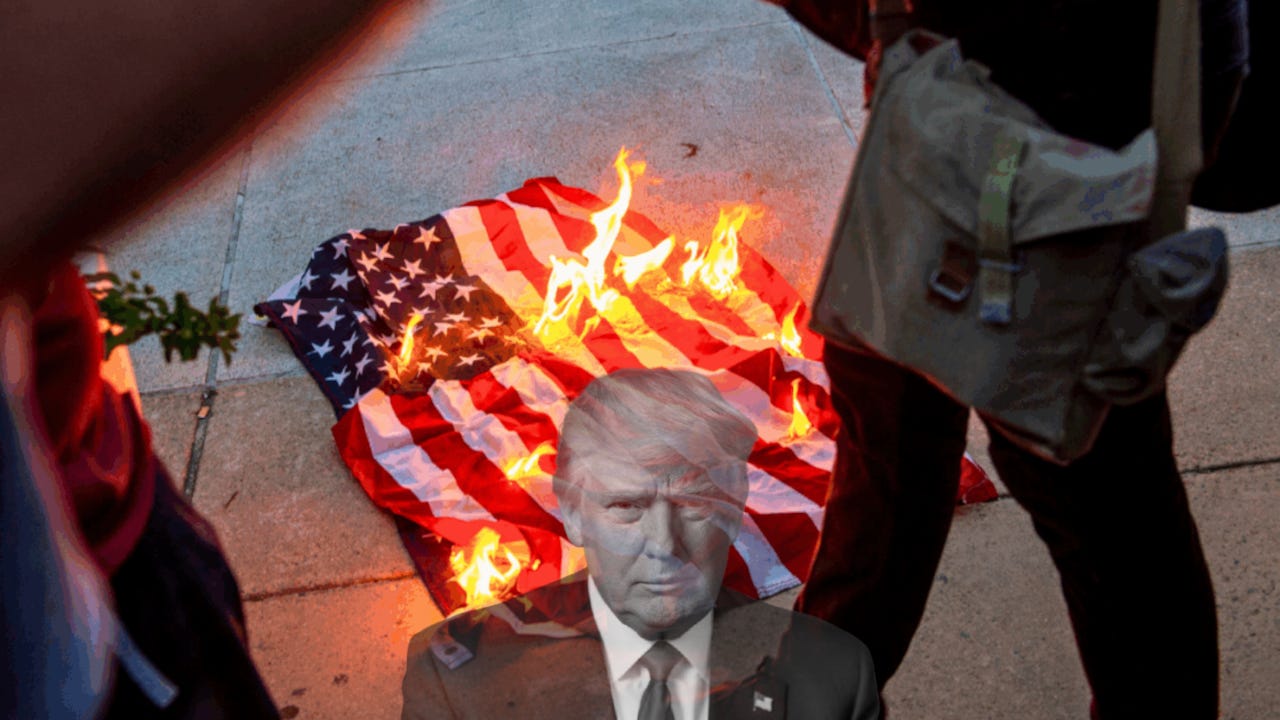
How one answers those questions will of course hinge largely on where one stands on the political spectrum.
The First Amendment is supposed to ensure that the government will not curtail Free Speech in any form.
At the same time, the Supreme Court has for over a century ruled that expression which precipitates criminality is not protected1—thus we have Justice Oliver Wendell Holmes historic conclusion about “falsely shouting fire in crowded theater”:
The most stringent protection of free speech would not protect a man in falsely shouting fire in a theatre and causing a panic. It does not even protect a man from an injunction against uttering words that may have all the effect of force.
As many in corporate media have rightly observed, however, a more recent Supreme Court ruling2 concedes that burning the US flag is arguably protected speech.
I have said many times that Free Speech is a moral imperative—and it is. There is no doubt about this, nor room for disputation. It necessarily follows that we should be extremely hesitant to impose punishments on any form of speech, no matter how objectionable it may be to some.
There was a reason I wrote in defense of Louis Farrakhan when he was banned from Facebook in 2019.

Farrakhan’s speech is generally vile and beyond offensive. Yet his right to speak is no less than mine or anyone else’s because of it.
How, then, shall we apprehend President Trump’s Executive Order?
In a word, cautiously.
We must first note that President Trump is not, as some in corporate media would argue, thumbing his nose at the Supreme Court. On the contrary, he is very specific and particular with respect to the scope of his Executive Order, speaking specifically and explicitly to the potential for flag-burning to incite riots and violence.
Burning this representation of America may incite violence and riot. American Flag burning is also used by groups of foreign nationals as a calculated act to intimidate and threaten violence against Americans because of their nationality and place of birth
We must also note that every video of a flag-burning protest where someone attempts to salvage the flag only to be met with a violent response is significant evidence in favor of Trump’s view of the matter.
We must also concede what the Supreme Court conceded in 1989, when it ruled that flag burning could be considered protected as Free Speech:
Thus, we have not permitted the government to assume that every expression of a provocative idea will incite a riot, but have instead required careful consideration of the actual circumstances surrounding such expression, asking whether the expression "is directed to inciting or producing imminent lawless action and is likely to incite or produce such action."
That criteria—the so-called “Brandenburg tests” after the 1969 Supreme Court case3—in fact was not set aside in Texas v Johnson.
A moment’s consideration suffices to show that the core logic of both Schenck in 1919 and Brandenburg in 1969 has merit: while we should not punish people for what they say, people should face consequences for what they do. It has never been considered an infringement on Free Speech to demand accountability, else the civil torts of slander and libel would be an impossibility.
Is every instance of burning the US flag likely to incite a riot? That seems improbable.
Have some instances of burning the US flag proved a predicate to violence? As I have already shown, there are innumerable instances of this available on YouTube.
Are some instances of burning the US flag specifically intended to incite a riot? While the answer is ultimately dependent on the extant evidence in every case, we certainly cannot exclude the possibility on any general principle defending Free Speech. If the riot is the objective, then the flag burning cannot be considered protected Free Speech.
Personally, I find burning the US flag highly offensive. People should not do it. People should not burn any nation’s flag, any more than they should burn books, or the Bible, or the Koran.
People should not riot and act violently, either. The US government—including the Trump Administration—should not disregard or violate the First Amendment, no matter what the circumstance. Civic society only functions when it is a civil society, where decorum guides our public discourse.
Unless the surroundings are such that burning an American flag is clearly intended to incite a disturbance of any kind, presuming that flag-burning is not speech is at best problematic. At worst it is outright censorship.
In the face of that uncertainty, I choose to err on the side of caution. Absent clear unequivocal evidence to the contrary, I presume that flag-burning is an instance of speech, and demand that it receive the same deference as more traditional modes of expression.
The politics of President Trump’s Executive Order are not hard to fathom. The Order is of a piece with his federalizing law enforcement in Washington DC, and it dovetails very well with almost perfectly with Trump’s recent rhetoric about deploying National Guard troops in Chicago. His objective is, simply put, “law and order.” President Trump wants to see civility, decency, and rationality restored to the nation’s public discourse.
As a political objective, his desires are laudable. People should want to see civility, decency, and rationality celebrated as the expected norm in our society.
Within the MAGA Coalition that is Trump’s political base, this objective is undeniably a winning political theme and pursuing it a savvy political strategy.
Comprehensible politics does not make a position legal or Constitutional, however. As much as we can say that people should not burn the flag as a statement of moral principle, the extent to which such expressions can be criminalized is suspect.
President Trump’s Executive Order is sure to be challenged. I suspect that, when it is challenged, it will not withstand judicial scrutiny, even at the Supreme Court level.
I do not believe it should withstand scrutiny. For all President Trump’s efforts to thread the Constitutional needle between protected Free Speech and unprotected incitement to riot, the potential for this Executive Order to suppress protected Free Speech is simply too great to ignore.
People who burn the flag and chant such offensive sayings as “Death To America” should be ashamed. They probably would be if they took a moment for self-reflection. Such protests are as stupid and silly as they are offensive, and accomplish little beyond offending people. Hearts and minds are rarely swayed by such mass tantruming.
However, it is the inalienable right of everyone within the United States to be offensive. It is the right of everyone say and do offensive things, so long as they do not incite others to violence. That is the essence of Free Speech, and why it is essential that it be protected above all else.
Has President Trump’s reach exceeded Constitutional limits with this Executive Order banning flag burning?
Yes, it has.
While I support and agree with the moral reasoning Trump lays out in his Executive Order, that reasoning does not override the moral imperative that is Free Speech. People burning the American flag are morally wrong. President Trump banning such acts is Constitutionally wrong. As the Constitution is the Supreme Law of the land, it must prevail. President Trump’s Executive Order therefore must fail.
President Trump needs to rescind this Executive Order immediately. Burning the US flag is offensive, but it is also speech, which is to say that it is Free Speech. We are better off tolerating offensive speech than if we censor and suppress it merely for being offensive.
Schenck v. United States, 249 U.S. 47 (1919)
Texas v. Johnson, 491 U.S. 397 (1989)
Brandenburg v. Ohio, 395 U.S. 444 (1969)
Burning the flag is wrong in my opinion, however, Ben Bartee made a valid point today on X and in a Substack article that: "If you have to explain to a right-winger who's been complaining about leftist censorship for the last five years why flag-burning is protected speech, understand this:
They never believed in free speech in the first place." - https://x.com/ArmageddonProse/status/1960302823922381221
and Substack article -
( https://armageddonprose.substack.com/p/trump-flag-burning-ban-unconstitutional )
Linking your take as usual, Peter @https://nothingnewunderthesun2016.com/
I always admire you for taking the difficult, but correct, stance, Peter.
Several of our Founding Fathers wrote about this confounding matter of free speech vs morally wrong action. Their conclusions were that society must have an underpinning of ethics, morals, and compassion. We should not WANT to incite riots or do any harm when we are exercising our right of freedom of speech. The root solution lies in being a moral society - and we have not been making any progress in this area during my lifetime. This is my root issue with the Left: you’re making our civilization less civilized- stop it!
Please keep standing up for principles, Peter. It’s important, and you are wonderful at this!