


Israel may just have won its war with Iran.
Update 3 (9:00PM CDT)
Whether there is or is not an actual ceasefire has been quite the challenge for all media to get right. That is how fluid and shifting this story has been.
According to the The Mirror, an hour before President Trump announced the ceasefire, Iran had received no ceasefire proposal.
Just an hour before President Donald Trump announced a ceasefire agreement between Israel and Iran, a senior Iranian official that the country had not seen any ceasefire proposal, and reportedly saw no reason for one, a source has revealed.
The official went on to say that Iran would continue to fight until it achieves a "lasting peace," adding that it would view remarks from Israel and the US as “a deception” intended to justify attacks on Iran’s interests.
Breitbart picked up on this bit of news after CNN echoed the Mirror’s reporting.
CNN later reported Iranian Foreign Minister Abbas Araghchi confirming that “there was currently no ceasefire agreement” with Israel. Interestingly enough, in that same update Araghchi said that if Israel stopped fighting so would Iran.
Araghchi added that if Israel stops its “illegal aggression” against Iran “no later than 4 a.m. Tehran time, we have no intention to continue our response afterwards.”
Later, Araghchi would post on X praising Iran’s armed forces for fighting until the very last minute before the ceasefire took effect.
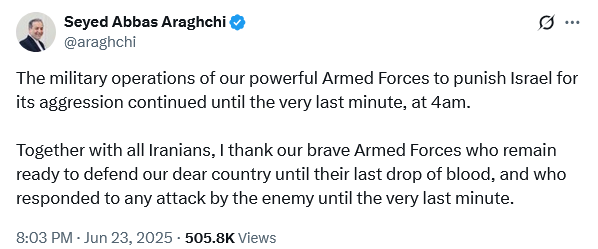
Iran’s semi-official Mehr News Agency repeated Araghchi’s social media post.
Meanwhile X was filled with posts such as this claiming there was no ceasefire.
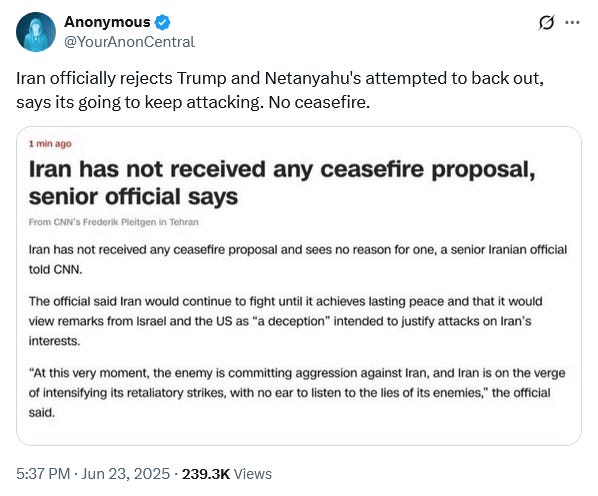
Al Jazeera is noting the difference between Araghchi’s tone and Trump’s tone, and questioning the validity of Trump’s ceasefire announcement principally on that basis.
Certainly, this is not the “full agreement” that Trump posted about three hours ago, and perhaps those congratulations were premature.
Is there a ceasefire in effect? Araghchi certainly makes it sound as if there is. Official or not, I, for one, certainly hope there is. There’s too much war in the world as it is. We need an outbreak of peace.
Update 2 (7:40PM CDT)
If Donald Trump’s Truth Social posts are accurate, Iran has agreed to a ceasefire with Israel, to be phased in by Wednesday.
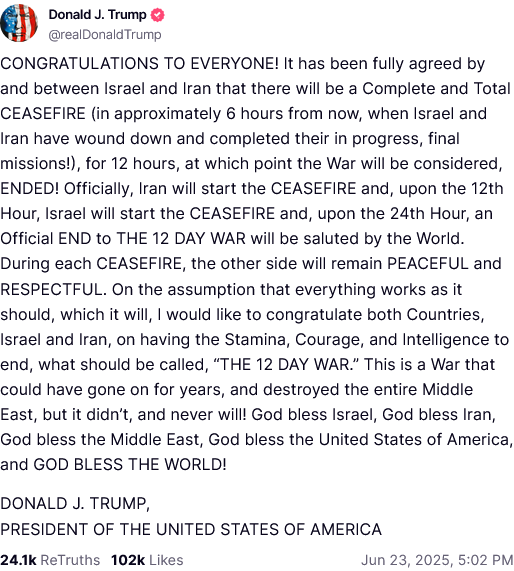
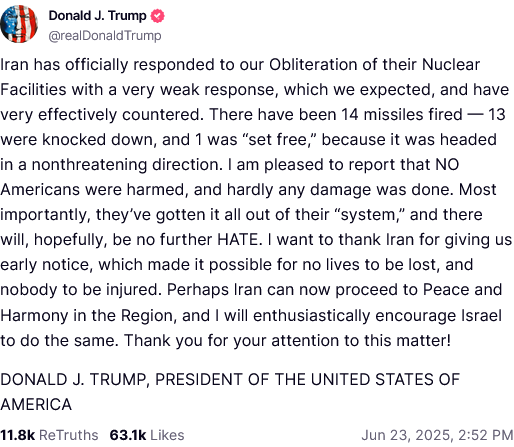
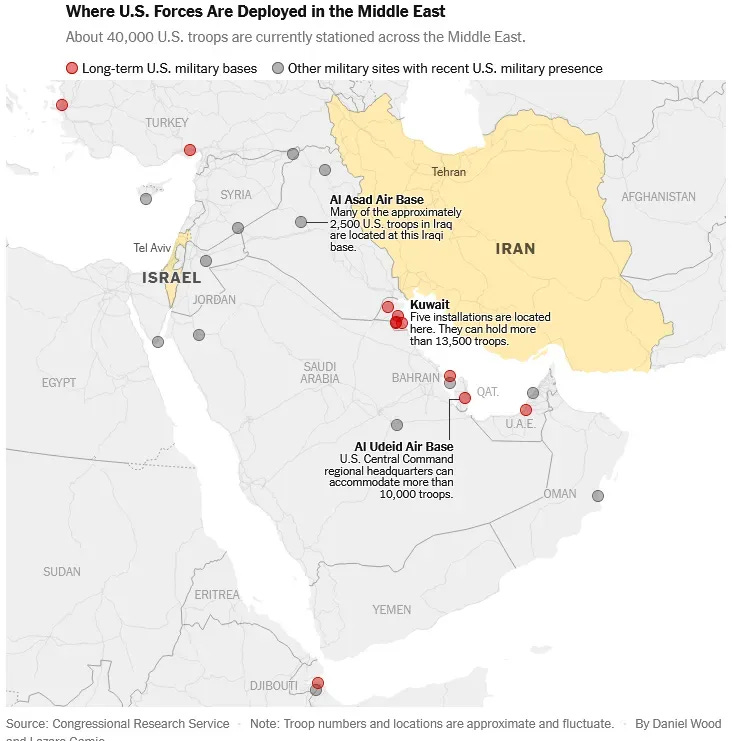
This came on the heels of a typically Trumpian post roasting Iran for its missile attack on Al-Udeid Air Base in Qatar, in which a total of 14 missiles were fired and 13 shot down.
Oil markets were ecstatic on the news, with the price of both Brent Crude and West Texas Intermediate plunging.
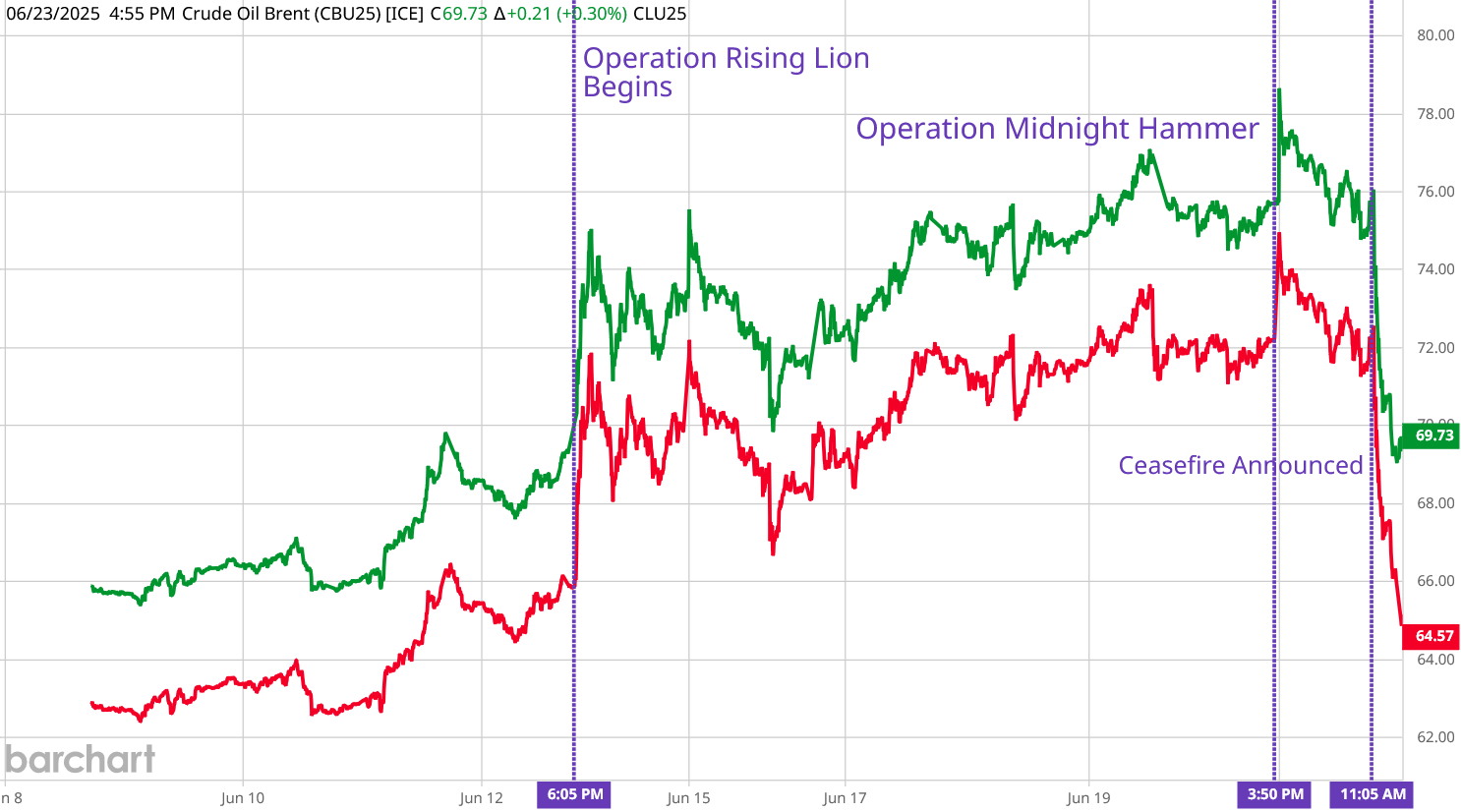
Oil prices had already retreated to their Friday price levels after surging in the wake of Operation Midnight Hammer. Now they are below where they were at the start of Operation Rising Lion.
With a missile strike that seemed almost performative, it is difficult not to conclude that Iran is ready for this war to end. It certainly has not gone well for them.
However, if one prefers the typically conspiratorial take from ZeroHedge, this could all be Iranian Kabuki theater.
To some degree, more 'known unknowns' (cue Rumsfeld) have been created in the wake of Trump's alleged destruction of Iran's enrichment facilities. Perhaps the Iranians will now hasten to begin the actual secretive nuclear bomb program?
To be sure, the status of Iran's store of highly enriched uranium is very much a mystery, and very much a concern. It would require no great technology or infrastructure to convert that into a series of radiological weapons.
If the facilities at Fordow and Natanz are out of commission, Iran is out of the uranium enrichment business for the time being. That's no small setback for the Islamic Republic. Add to that the reduction of their ballistic missile capacities and the apparent destruction of Iran's air defenses. The sum is not one that amounts to any sort of victory for Iran.
Is the Iran-Israeli War, what Trump calls the “Twelve Day War”, over? For now it seems that it might be. Politically, that is a win for both President Trump and Israeli Prime Minister Benjamin Netanyahu.
Will Iran give up its nuclear weapons program after being mauled by Israel? That is difficult to believe. Yet it is not impossible. If Iran does abandon its nuclear ambitions, the Middle East has just undergone a dramatic geopolitical “reset”, and Israel is officially the big dog on the block.
What will be the ultimate outcome? I am hopeful, but I still don’t know…and neither does anybody else. Folks should remember that.
Update 1 (12:00 CDT)
Has Iran's retaliation begun? There are early reports of explosions near Al-Udeid Air Base in Qatar. Nearby residents are being advised to “shelter in place.” There are reports at this time of any casualties or damage.
Separately, Israel is expanding its range of targets, as it proceeds to further dismantle the regime's infrastructure. Israel may not be pushing regime change per se, but they are making it progressively more difficult for the regime to govern.
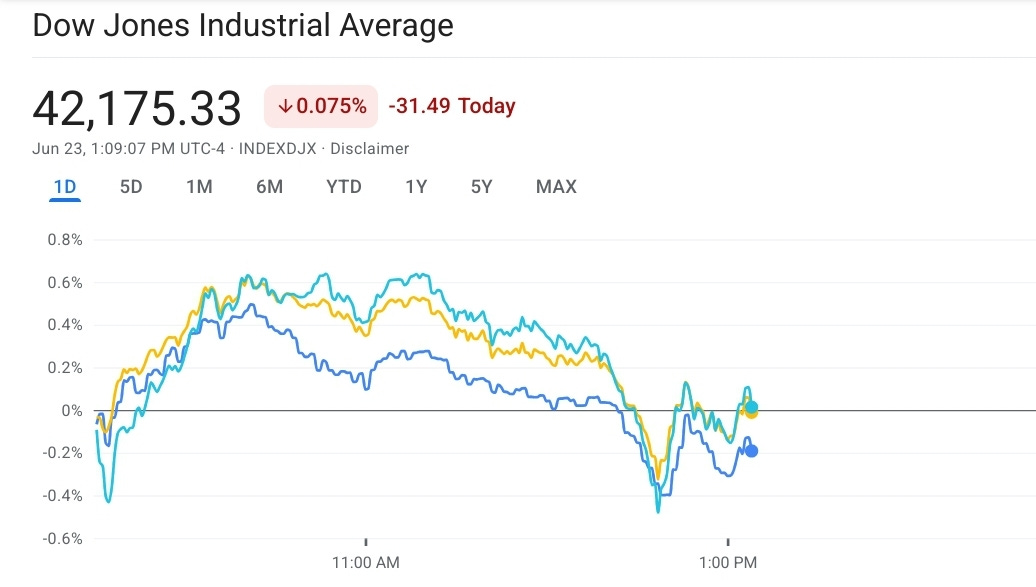
Wall Street is mostly taking the news in stride, with the Dow down only slightly in recent trading.
Iran is going to need a more intense strike to make the statement of strength they need to make.
Starting Point
At least some damage was done to the Fordow fuel enrichment facility, as well as the facilities at Natanz and Isfahan. Whether the damage is as “superficial” as Iran claim has of this writing not been determined.
Predictably, oil prices surged as soon as oil trading resumed Sunday evening.
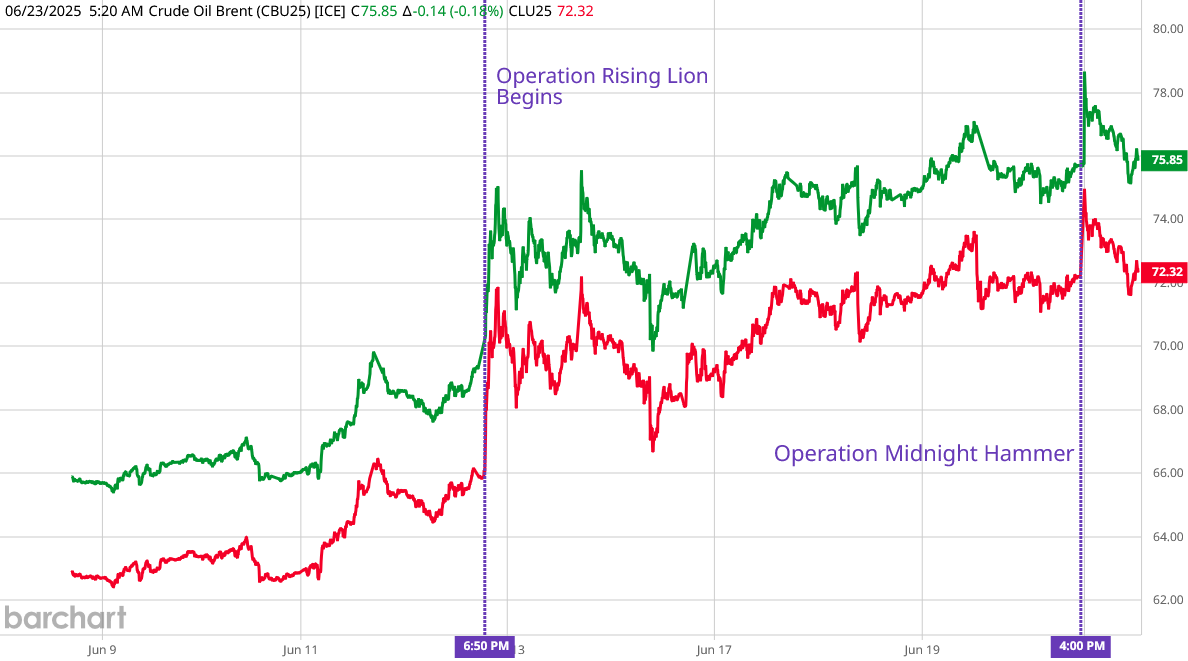
Remarkably, oil prices retreated again almost immediately, and as of this morning are at about the same level they were before President Trump ordered the attacks on Iran.
It has now been well past 24 hours since the US bombed Iran’s nuclear enrichment facilities, and thus far there has still been no retaliatory measures taken by Iran.
US forces in the Middle East have not been attacked. We should not forget that, with about 40,000 troops at various bases in and around the Persian Gulf region, and with 2,500 troops in Iraq specifically, Iran does not lack potential US targets at which to strike.
The Iranian parliament has called for the closure of the Strait of Hormuz as a response to the US attack. This would disrupt approximately 20% of the world’s oil and liquid natural gas shipments, and would undoubtedly cause a tremendous spike in energy prices globally. However, as of this writing, Iran has not taken any actions to interdict oil tankers passing through the Strait.
Iran, of course, is quite forcefully saying that it will respond.
Abdolrahim Mousavi, the new chief of staff of Iranian armed forces, said in a short statement on Monday morning that the US violated Iran’s sovereignty when it attacked the Fordow, Natanz and Isfahan nuclear sites on Sunday and had “entered the war clearly and directly”.
“The criminal US must know that in addition to punishing its illegitimate and aggressive offspring, the hands of Islam’s fighters within the armed forces have been freed to take any action against its interests and military, and we will never back down in this regard,” he said, in reference to Israel.
Words, however, are not the same as actions. Iran has not taken any action as of yet.
That Iran has yet to respond is not to suggest that Iran will not respond. Some level of retaliation is almost compulsory for Iran, given the efforts it has expended in the region to be a hegemonic geopolitical actor. After the demolition of the Assad regime in Syria and the near-total destruction of Hamas and Hezbollah, Iran’s levers of influence have been greatly diminished over the past twenty or so months; a failure to respond to the US attacks on its own facilities would almost certainly be seen in the region as a sign of perhaps fatal weakness for Iran’s theocratic regime.
Iran has yet to respond—and that is itself a potential indicator of weakness. The longer it takes Tehran to respond, the weaker that response will be. Alternatively, the longer it takes Tehran to respond, the more dramatic that response will need to be to have geopolitical effect.
The length of time it takes Iran to formulate a response also invites a certain speculation: what capacity does Iran still have to respond? What are its ballistic missile capacities after Israel’s near constant aerial assaults? What resources remain with which to menace shipping in the Strait of Hormuz?
Between Operation Rising Lion and Operation Midnight Hammer, the possibility is growing that Iran has been dealt an even more devastating defeat than the reporting thus far suggests is the case.
Will that prove to be the case? We will know in short order.
"...the possibility is growing that Iran has been dealt an even more devastating defeat than the reporting thus far suggests is the case."
Wishful thinking I suspect. There is talk that Iran removed most of the uranium from Fordow a few days before the strike. If so, they may take a few days/weeks, months maybe, to cobble together, at the very least, a dirty bomb.
Iran has been wounded badly; how severe is open to question at this time.
Your reply to my comment on another post regarding activating asymmetrical operations is correct. Iran has both impact and operational questions to resolve. The optics are important.
An asymmetrical proxy attack would have better operational success and optics in a Middle East location. If conducted anywhere else in the world; success in creating mayhem may be good, the optics would go against Iran.
As a nation, Iran must balance that against further retaliation by the US and Israel. Currently, we have uncontested control of Iranian airspace. While both Russia and China could help Iran; both countries are weighing thier increased involvement against US economic sanctions.