


The Islamabad talks to end the United States’ war with Iran have failed. After 21 hours of negotiations, Vice President JD Vance and the US delegation left Pakistan without any agreement on the Strait of Hormuz or Iran’s nuclear weapons ambitions.
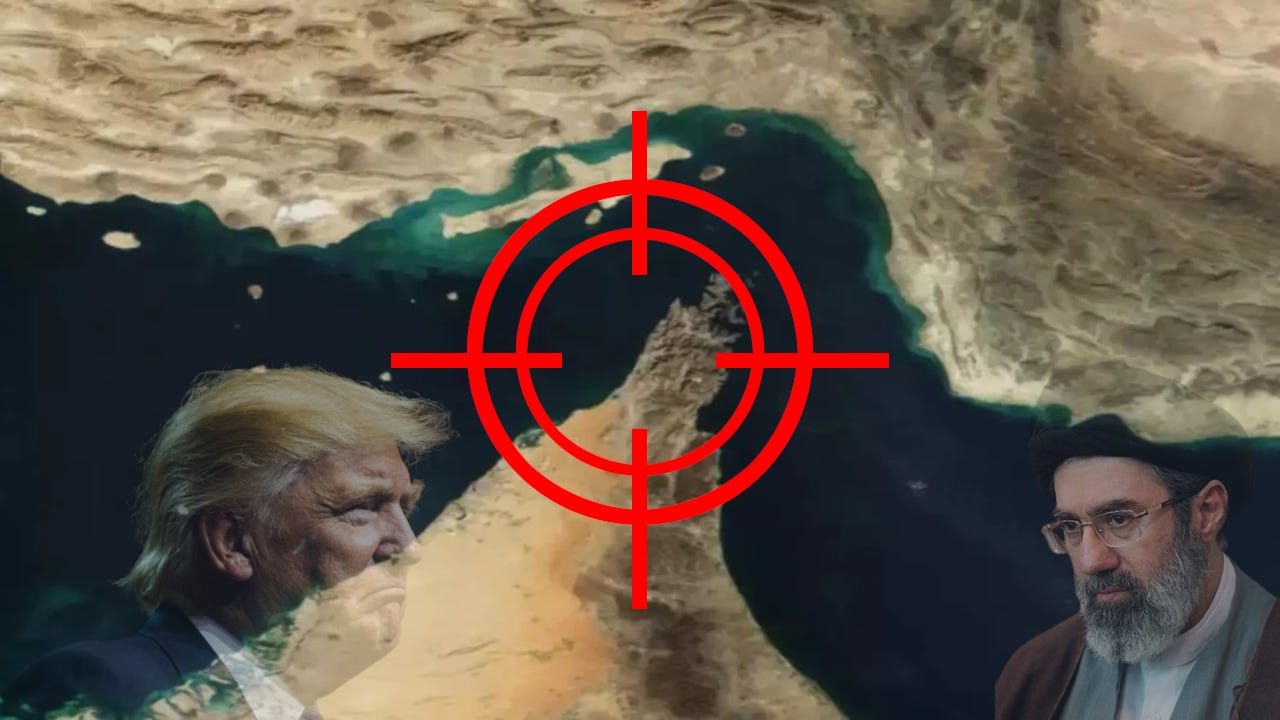
“We have been at it now for 21 hours, and we’ve had a number of substantive discussions with the Iranians. That’s the good news,” Vance said. “The bad news is that we have not reached an agreement, and I think that’s bad news for Iran much more than it’s bad news for the United States of America.”
With regards to the war and to the broader impasse between Iran and the United States, not a lot has changed over the past few days. My assessment of the state of affairs in the Persian Gulf is broadly the same as it was four days ago:

All scenarios are still on the table. The ceasefire could collapse today, tomorrow, or next week. The Khamenei regime could collapse today, tomorrow, or next week.
There is, however, one notable shift, and we shall have to see how it plays out: President Trump is threatening to impose his own blockade on the Strait of Hormuz.
Is this a collapse of the ceasefire? Not yet, if only because as of this writing there are no new reports of air strikes, missiles, or drone attacks from either side. I will not be surprised if that changes even within the next few hours.
Will this change the strategic calculus in the Persian Gulf? It could. How the blockade unfolds will determine its ultimate impact. For now President Trump’s message to Iran is clear and unequivocal: If the United States’ demands are not met, Iranian oil will not flow.
21 Hours Of Talking Without Resolution
As diplomatic negotiations go, the Islamabad talks were put together with blinding speed—and collapsed with equally blinding speed.
We must remember the ceasefire was declared less than a week ago, when Donald Trump and Iranian Foreign Minister Abbas Araghchi jointly accepted a Pakistani ceasefire proposal, and agreed to the talks.
Yet even before the talks began, Iran put out some extraordinary claims on what agreements had already been made (or not made)—including an assertion that the US agreed to release some $6billion in frozen Iranian assets.
That claim was quickly denied by the US, and there have been no independent reports of any frozen Iranian funds being released to the Khamenei regime.
The denial of such claims did not stop the head of the Iranian delegation, Parliamentary Speaker Mohammad Bagher Ghalibaf, from doubling down on them during the runup to the actual talks themselves.

While we cannot say if Ghalibaf genuinely believed those claims to be true or was merely attempting to gain leverage in the negotiations, we can say that the effort produced no leverage against the US negotiating team of Vice President JD Vance, Special Envoy Steve Witkoff, and Jared Kushner, President Trump’s son-in-law. In remarks made prior to leaving Islamabad, JD Vance made it clear that Iran did not agree to meet US “red line” conditions for peace.
As I have noted previously, the US “red line” conditions are easily and succinctly stated:
Iran will not enrich uranium
Iran will not pursue nuclear weapons
Iran will not develop long range ballistic missiles
Iran will not maintain its network of terror militias across the Middle East
Iran will not close the Strait of Hormuz
Iran will not threaten Arab states in the Persian Gulf
While we do not know what was actually said during the negotiations themselves, there is little reason to presume the US position on any of that has been altered.
With that as a backdrop, we perhaps should not be surprised that President Trump chose to respond to the failure of the talks by blockading the Strait of Hormuz.
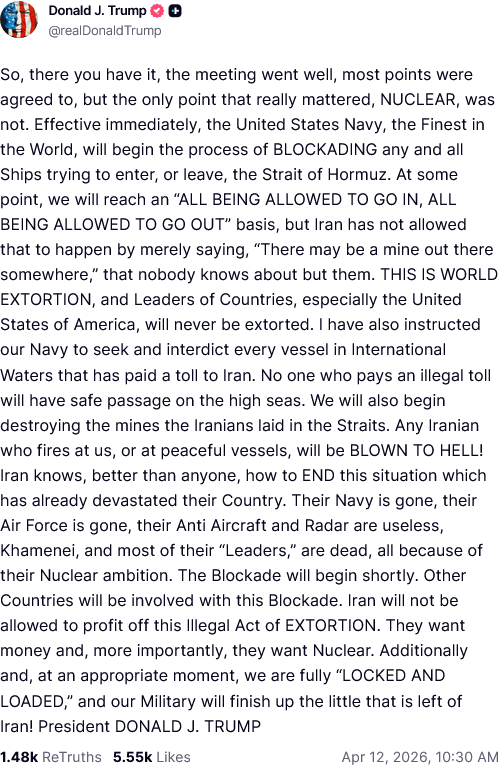
Regardless of how much control Iran has or does not have over the Strait of Hormuz itself, there is little doubt which navy can control the egress to the Strait into the Gulf of Oman. The United States Navy will now be interdicting shipping traffic out of the Strait of Hormuz, thereby cutting off even Iran’s oil exports.
Did Trump Anticipate This?
While it is purely speculation on my part, I do wonder if the Trump Administration had not been preparing all along for the talks to fail.
While the talks were ongoing, the Trump Administration announced the US Navy was beginning minesweeping operations in the Strait to clear out the Iranian mines.
CENTCOM said USS Frank E. Peterson and USS Michael Murphy transited the strait and operated in the Persian Gulf in a broader mission aimed at removing mines previously laid by Iran’s Islamic Revolutionary Guards Corps.
“Today, we began the process of establishing a new passage and we will share this safe pathway with the maritime industry soon to encourage the free flow of commerce,” said CENTCOM commander Gen. Brad Cooper.
President Trump, in typical Trumpian fashion, was even more braggadocious, not only calling out Iranian failures in reopening the Strait but also the failures of other leading nations to step up and help defend internationally recognized rights of transit passage through the Strait.
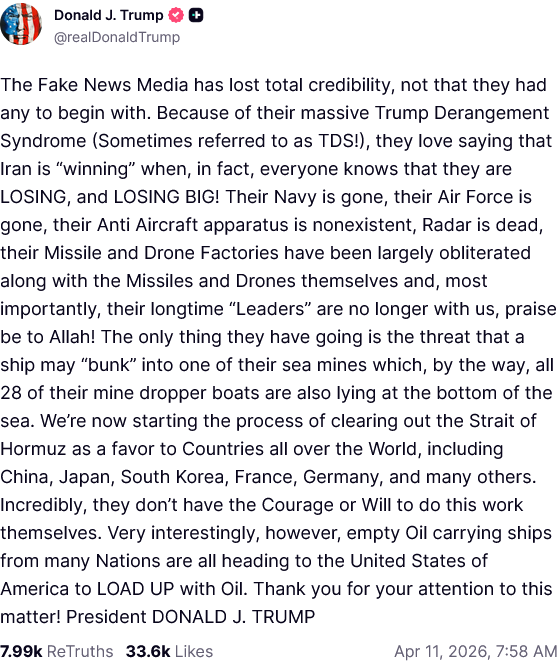
All this he posted to social media as the Islamabad talks were getting underway—whatever else one wishes to conclude about Donald Trump’s social media postings, one thing seems clear: Donald Trump was not worried about the Iranians agreeing to reopen the Strait because the US Navy was already starting to reopen the Strait.
One reason the US was doing this was advanced by the New York Times, and has not been refuted by the Khamenei regime: Iran does not know how to locate or remove its own mines from the Strait.
Iran used small boats to mine the strait last month, soon after the United States and Israel began their war against the country. The mines, plus the threat of Iranian drone and missile attacks, slowed the number of oil tankers and other vessels passing through the strait to a trickle, driving up energy prices and providing Iran with its best leverage in the war.
Iran left a path through the strait open, allowing ships that pay a toll to pass through.
Iran’s Islamic Revolutionary Guards Corps has issued warnings that ships could collide with sea mines, and semiofficial news organizations have published charts showing safe routes.
Those routes are limited in large part because Iran mined the strait haphazardly, U.S. officials said. It is not clear that Iran recorded where it put every mine. And even when the location was recorded, some mines were placed in a way that allowed them to drift or move, according to the officials.
If that report is true, then Iran’s claim of control over the Strait is ultimately illusory.
If that report is true, then Iran cannot guarantee safe passage through the Strait to any ship, regardless of whether or not it pays a toll. If Iran does not even know where the mines are, it does not know what the safe sea lanes are.
The New York Times reporting relies on unnamed US officials, and provides no solid provenance for those assessments, but Iran has not said or done anything to rebut the reporting. While we do not know the New York Times is correct on this, neither can we assume the New York Times is wrong.
If the New York Times reporting is at all factual, then the failure of the talks could suit President Trump just fine. If the US Navy succeeds in clearing the mines and reopening the Strait while maintaining a blockade in the Gulf of Oman, Iran’s strategic leverage collapses.
Oil Prices—Iran’s Real Target?
While the geopolitical calculus over the Strait of Hormuz remains very much an exercise in speculation, what is not a speculation is the impact these events have had on energy prices.
Even with the encouragements of the Islamabad talks getting underway, spot prices for diesel contracts are as of Friday trading still 44% above pre-war levels.
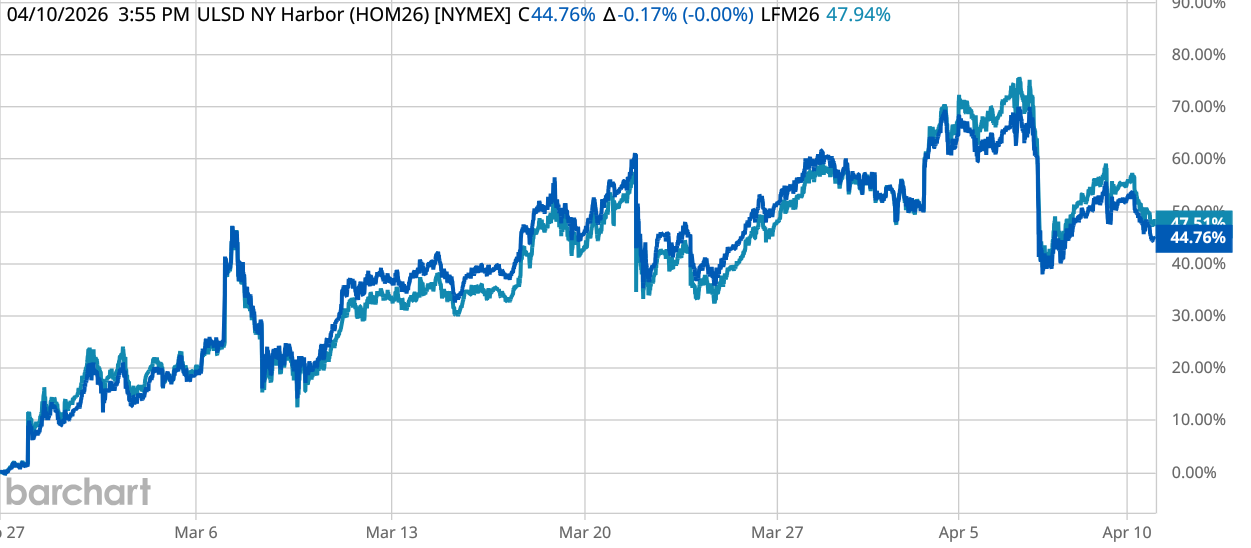
Not only are energy prices up, but significant differentials have emerged between European benchmark energy contracts and American ones, especially for natural gas.
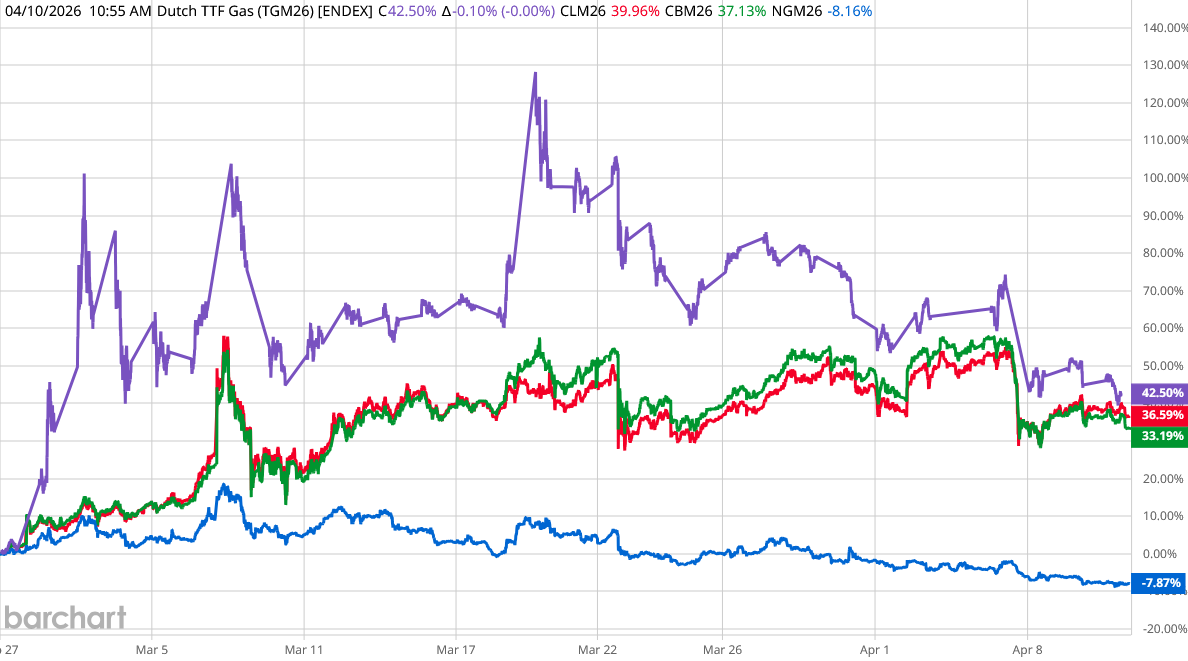
Nor is that the only energy price differential to emerge. Since the war began, Arab “heavy” (or “sour”) crude—the crude type from which diesel is extracted—has gained a significant price premium both over benchmark oil prices for Brent crude and West Texas Intermediate.
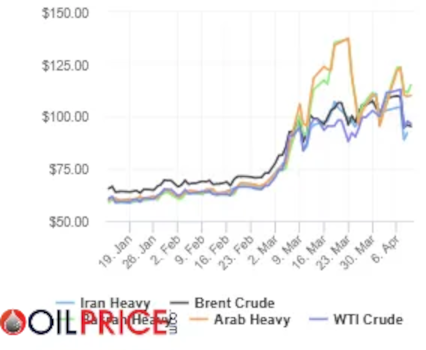
Iran’s heavy crude has not had the same price appreciation.
While it is too soon to assess exactly how this shift in pricing—the Arab premium did not exist prior to the war with Iran—will impact global energy economics, if this becomes the “new normal” for oil prices, there will be significant impact.
Even without this shift in oil pricing becoming more or less permanent, the present reality remains that the Strait of Hormuz is not open to commercial traffic, with some two thousand vessels trapped within the Persian Gulf.
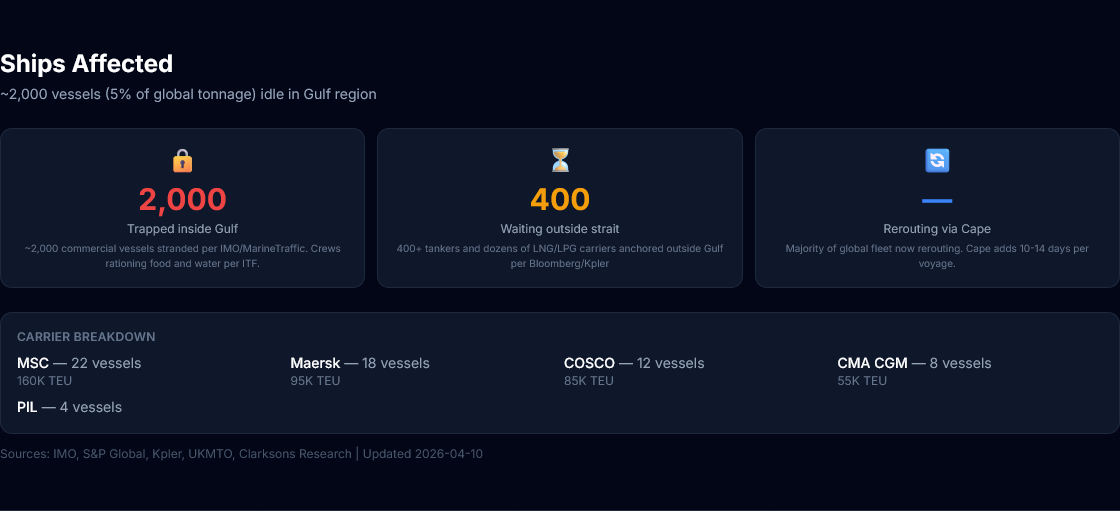
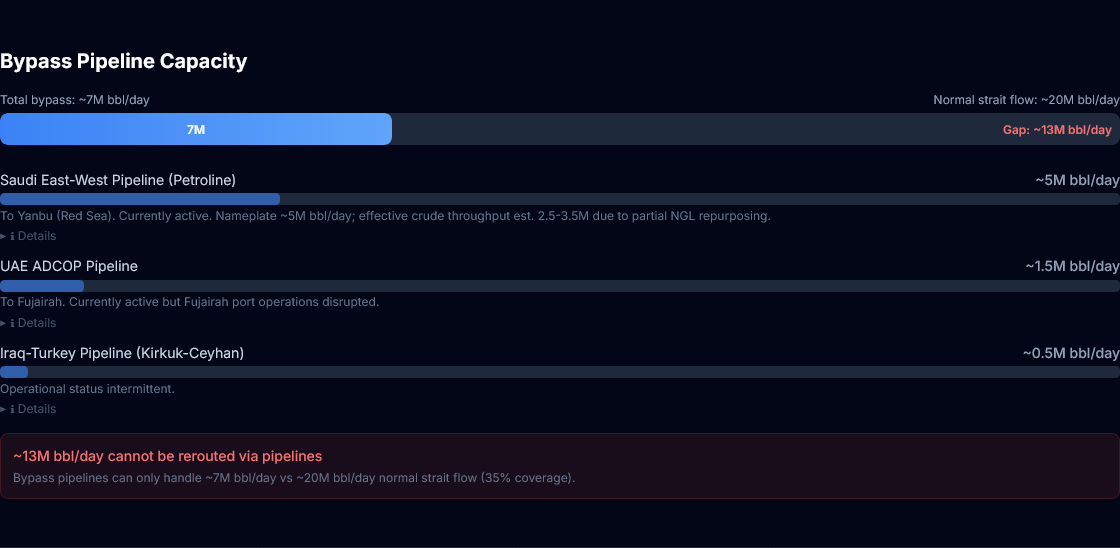
Even though Iran nominally has declared the Strait of Hormuz open, most of the Strait’s 20 million barrels per day of oil flow is currently blocked, and the few oil pipelines in the Persian Gulf region cannot even begin to compensate for the disruption in flows of seaborne crude.
At present, more than 90% of normal traffic through the Strait is idled on side or the other, waiting for the US and Iran to sort out their differences.
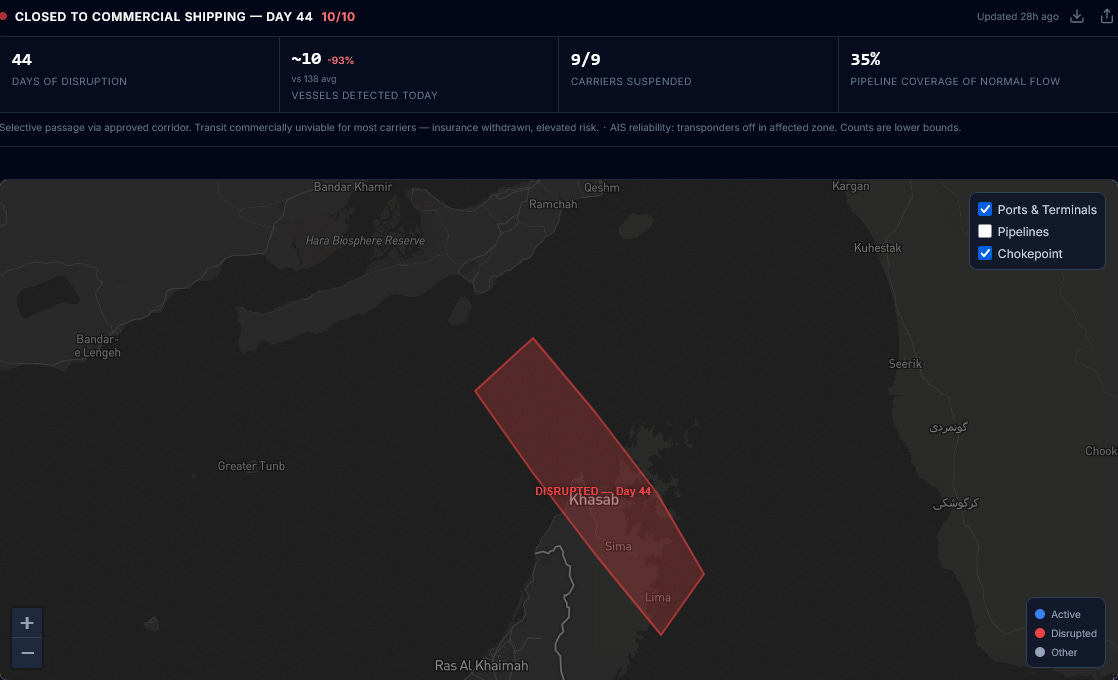
With Persian Gulf oil as well as natural gas still bottled up in the Persian Gulf, unable to safely transit the Strait, a substantial portion of global energy flows have been taken at least temporarily offline.
This reality has not gone unnoticed by the Arab states. As the Islamabad talks were heading toward their unsatisfactory conclusion, the UAE oil minister Dr. Sultan Al Jaber posted on X defending the Strait as an international waterway and condemning any attempt by Iran to close or regulate it.
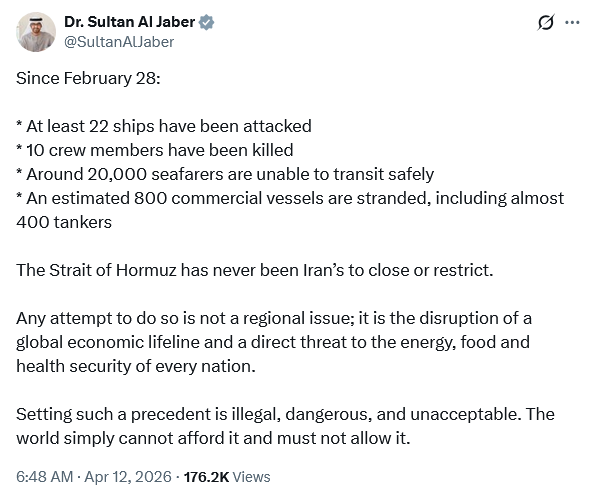
Was this part of Iran’s strategy all along? Have they closed the Strait and attacked Arab oil and natural gas production infrastructure precisely to alter the pricing dynamics of the Persian Gulf?
To answer that question now would be pure speculation. However, during the Islamabad talks, an account on X purportedly belonging to Iran’s new Supreme Leader Mojtaba Khamenei posted a sovereign claim by Iran to the Strait.
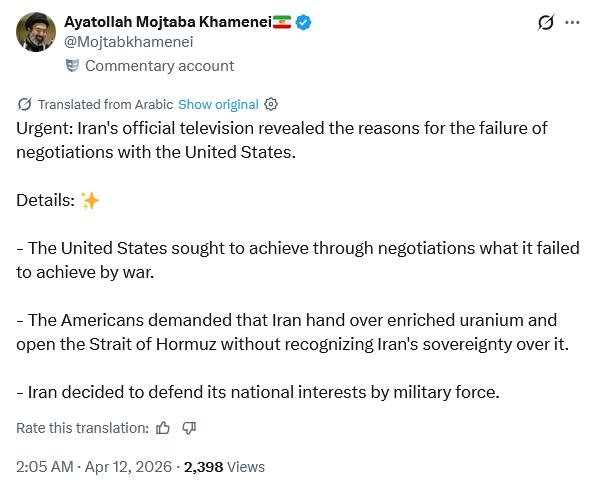
Whether that social media posting represents the official stance of the Khamenei regime is uncertain. Still, the posting is in line with earlier regime commentary on the status of the Strait and Iran’s claimed “rights” over it.
Has Iran used the war as an opportunity to improve its own export position in the Persian Gulf by disrupting oil production by the Arab states in the region? We cannot dismiss that possibility.
What Comes Next? Mostly Questions
As has been true throughout this war, we cannot say with certainty what will unfold next.
Will oil prices surge again when trading resumes after the weekend? At least for the immediate term, that is a likely result.
Will the Strait of Hormuz reopen? Eventually it must, but there is no way to ascertain any definitive timeline as to when.
Presumably the US Navy will continue minesweeping the Strait to remove Iran’s rogue mines. Presumably the US Navy will also interdict traffic coming out of the Persian Gulf in much the same way it interdicted shipping to and from Venezuela previously. That would mean that oil flows will resume not when Iran says they will but when the US says they will.
Until the Strait reopens, global energy flows and petrochemical logistics will remain disrupted. While not necessarily the energy apocalypse some are predicting, the longer the disruption prevails the greater the impact it will have on the global economy.
Here in the United States, retail fuel prices have surged, and diesel especially is flirting with highs last seen during the 2022 hyperinflation cycle.
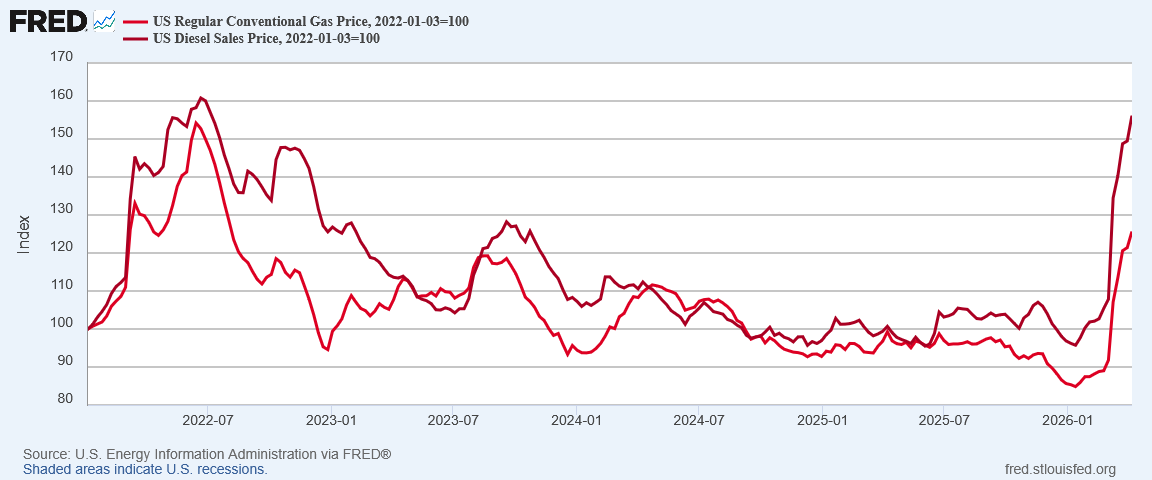
With the failure of the Islamabad talks, we can safely presume that retail diesel prices will continue to move higher at least for the next few days and possibly weeks.
Already the impacts are reverberating into the wider US economy, with the March inflation numbers surging. With no prognosis for a reversion to pre-war energy price levels, within the US inflation will almost certainly rise again in April, driven primarily again by energy prices.
The impact of the diesel price surge on the world’s economies is likewise certain to severely negative. Diesel is the primary fuel for trucking operations worldwide. The cost for that fuel has increased worldwide by roughly 50% in the span of just a few weeks. Transporting goods overland is quite a bit more expensive today than it was just a month ago, and there is every reason to presume it will be more expensive a month from now than it is today.
That is a logistics shock which, while unlikely to completely halt global commerce, is quite likely to create new logjams not unlike the post-COVID supply chain ruptures experienced in 2021 and 2022, and which further contributed to the 2022 hyperinflation cycle globally.
The immediate economic ramifications of the Strait’s continued closure are fairly straightforward. These are things we know must happen because these are the consequences of Persian Gulf oil not being allowed to flow.
Less certain is what other nations besides the United States will do in response. Virtually all nations have affirmed that the Strait of Hormuz is an international waterway, yet the United Nations Security Council has been unable to pass even a resolution to that effect, much less one calling for the Strait to be reopened by force if necessary.
Geopolitically, what we have now are mainly questions.
Are the nations of the world content to sit passively on the sidelines while 20% of global energy flows are effectively cut off? So far, they have been.
Will the US blockade of Iranian traffic out of the Strait of Hormuz bring enough global pressure to bear that other nations will be forced to take stand and do something, either with the United States naval effort or against it? Prior to this war, I would have speculated the answer to be “yes”, but the willingness of even America’s NATO allies to remain uninvolved in protecting energy flows which demonstrably impact their economies far more than they do the US economy makes that presumption extremely problematic.
The larger and still unanswerable question coming out of this war: what is the future of the current maritime trading order which is the foundation of nearly all the world’s economies? Can global commerce proceed smoothly when vital waterways are vulnerable to the whims of various regional powers and conflicts?
Corollary to that is what force protects those vital waterways? Can any force protect them?
As regards the propriety of the war itself, and of Operation Epic Fury, Iran’s responses and obvious duplicity just prior to the Islamabad talks leaves another awkward question hanging: what is the alternative?
What is the alternative? I see two main forms of action open to Trump. He can bide his time, while he works behind the scenes (probably via the CIA) to divide, undermine, and confuse the factions within Iran’s power structure. Ultimately, they will likely self-destruct, as their actions thus far have been irrational and violent.
Or, Trump can resume violence himself. He’s got the firepower to prevail. I am glad that he’s called Iran’s policy “extortion”, because that’s what it is. I am super-glad that he is standing firm on his insistence that Iran can NOT have nuclear arms! That’s the entire point of this war!
We do not want to destroy the Iranian people, their culture, their power plants, or anything they need to survive. So I hope Trump finds ways to just continue to knock off the few people in power, until there are none left and our brave military forces can come home!
We’ll see tomorrow what course he chooses. Looking forward to your excellent posts, Peter!
Great work Pete,
Semper Fortis! ⚓
🛢️🌴🌙 Pray as if one of your own children was manning the walls of the Polis today! 📯🛡️⚔️🪖