


Presumably, the details of the Memorandum of Understanding to which the Islamic Republic is Iran and the United States have agreed to end the war between them have been made public.
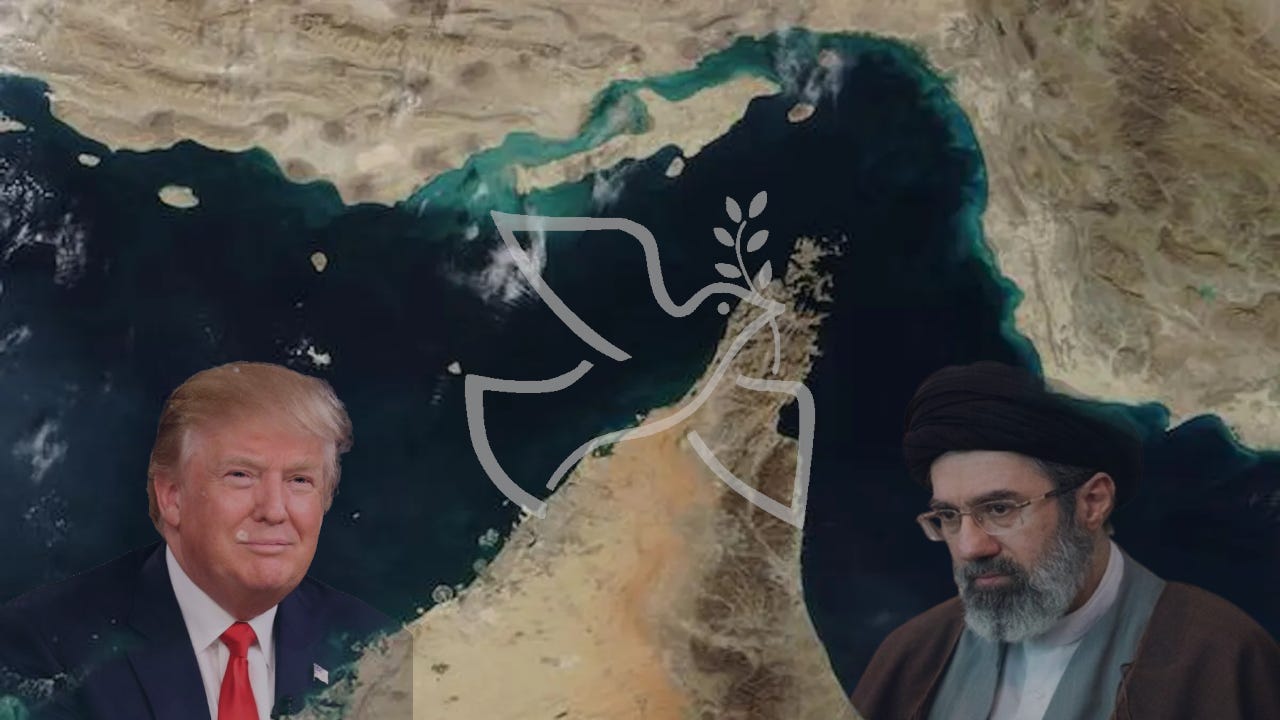
As highlighted when the “deal” was announced on Sunday, evaluating the terms of the deal requires the specific text of those terms. We have now been given that text, and we can judge for ourselves if this is a good deal or a bad one.
I will present my initial thoughts after the text itself, but I invite everyone to read the terms and decide for themselves. The deal is not made “good” merely because I or any other analyst says it is. The deal is not made “bad” merely because I say it is.
The deal is the deal. Good or bad, this is the Memorandum of Understanding to be signed on Friday.
The Fourteen Points
These are the fourteen points of the Memorandum of Understanding to be signed on Friday, as released to CNN, Bloomberg, and other media outlets.
1 — The Islamic Republic of Iran and the United States, together with their allies in the current war, declare upon the signing of this Memorandum of Understanding an immediate and permanent end to the war on all fronts, including Lebanon, and undertake that from now on they will not launch any hostile action against each other, and will refrain from the threat or use of force against each other. The final agreement will confirm the provisions of this Article and the remaining Articles.
2 — The Islamic Republic of Iran and the United States undertake to respect each other’s sovereignty and territorial integrity, and to refrain from interfering in each other’s internal affairs.
3 — The Islamic Republic of Iran and the United States undertake to negotiate and reach a final agreement within a maximum period of 60 days, extendable by mutual consent.
4 — Immediately upon the signing of this Memorandum of Understanding, the United States lift the naval blockade and prevent any interference or obstruction against the Islamic Republic of Iran, and restore traffic within a maximum of 30 days to its full capacity; the traffic of ships shall be proportional to the pre-war volume of traffic on the part of the Islamic Republic of Iran. The United States also undertakes to withdraw its forces from the surrounding areas within 30 days after the final agreement.
5 — Upon signing this Memorandum of Understanding, the Islamic Republic of Iran will immediately take steps to ensure that the movement of merchant ships from the Persian Gulf to the Sea of Oman and vice versa is resumed within 30 days to the pre-war volume, taking into account the need for the removal of technical obstacles and the neutralization of mines by Iran.
6 — The United States undertakes, together with its regional partners, to create a comprehensive plan agreed upon by both parties for the rehabilitation and economic development of the Islamic Republic of Iran, while ensuring financing of at least $300 billion. The implementation mechanism of this plan, as part of the final agreement, will be formulated within 60 days.
7 — The United States commits to ending, on a schedule to be agreed upon as part of the final agreement, all types of sanctions currently facing the Islamic Republic of Iran, including resolutions of the United Nations Security Council and the Board of Governors of the International Atomic Energy Agency (IAEA), and all unilateral U.S. sanctions, both primary and secondary.
8 — The Islamic Republic of Iran reiterates that it will never produce nuclear weapons. The Islamic Republic of Iran and the United States have agreed that the fate of enriched material and the fate of all other mutually agreed nuclear-related issues, including Iran’s nuclear needs, will be adequately addressed in a final agreement; the final agreement will confirm the provisions of this Article.
9 — The Islamic Republic of Iran and the United States agree that, pending a final agreement, they will maintain the status quo: Iran will maintain the status quo on its nuclear program, and the United States will not impose new sanctions on Iran or strengthen its forces in the region.
10 — The United States undertakes that immediately after the signing of this Memorandum of Understanding, and until the date of the lifting of sanctions, the United States Treasury Department will issue waivers for exports of Iranian crude oil, petrochemical products and their derivatives, and all related services, including banking, insurance, transportation, and the like.
11 — The United States undertakes that, in light of the progress of negotiations towards a final agreement, frozen or restricted funds and assets of the Islamic Republic of Iran will be released and made fully available. These funds, whether held in the master account or transferred, will be used for any final beneficiary payment determined by the Central Bank of the Islamic Republic of Iran and will be fully available for use. The United States undertakes to issue all necessary permits and licenses on this basis.
12 — The Islamic Republic of Iran and the United States agree that an implementation mechanism will be established to oversee the successful implementation of and future commitment to the Final Agreement.
13 — Following the signing of this Memorandum of Understanding, and upon receipt of assurances regarding the commencement of implementation of Articles 4, 5, 10, and 11 of this Memorandum of Understanding, and the continued implementation of these steps, the Islamic Republic of Iran and the United States will enter into negotiations for a Final Agreement solely with respect to the remaining Articles.
14 — The final agreement will be approved through a binding resolution of the UN Security Council.
These are the terms of the MeMemorandum Of Understanding due to be signed this coming Friday.
What Do The Terms Mean?
What to make of the MOU?
The critics of the concept of the MOU who have claimed this is not a deal, but a deal to negotiate a deal, are correct. Nothing in the language of this Memorandum finalizes what is to become of Iran’s nuclear weapons program. Iran pledges that it won't develop nuclear weapons, but if such pledges were meaningful, Operation Epic Fury and even last year's Twelve Day War would never have happened.
The Memorandum does fully reopen the Strait of Hormuz and allows unrestricted maritime traffic. Points Four and Five call for reciprocal withdrawal of Iran's mines and other barriers within the Strait and the US naval blockade of Iranian shipping. This is the only substantive point of agreement within this Memorandum text.
What the Memorandum does not address even tangentially: Israel's war against Hezbollah. Nothing in this text obligates Israel to stand down or pause any ongoing operations. Given the diplomatic outcry about that war raised by Iran with respect to the ceasefire agreement, that is a striking omission.
Does the Memorandum call for immediate release of any frozen Iranian assets? Not really, although we should not be surprised to see Iran press the argument that Point Eleven does. However, the language “in light of the progress of negotiations towards a final agreement” is sufficiently vague that we can expect JD Vance be confidently dismissive of such claims, and President Trump to say that the Memorandum does not call for that at all. War hawks and Democrats will go with Iran's interpretation, as it best furthers their individual political agendas.
Point Seven does not lift any sanctions against Iran. It does establish that the ending of sanctions will be part of the final deal to be negotiated over the next 60 days. Point Ten calls for waivers on sanctions restricting oil shipments to be issued for the next 60 days. If no deal is reached, the expiration of the 60 days and thus the waivers indicates a “snap-back” mechanism is fundamentally in place.
War hawks will almost certainly argue that even a sixty day window in which Iran can export oil without sanction penalties being triggered is too much generosity. Some media analysis suggests Iran could generate as much as $100 billion in oil revenue over that 60-day time frame.
The Memorandum confirms there will be a reconstruction fund. However, Point Six does not call for United States tax dollars to be involved nor does it call for Iran to receive a blank check.
Point Six is clearly the most controversial point in the Memorandum. This is definitely an innovation from previous agreements such as Barack Obama's lamentable Join Comprehensive Plan Of Action.
Yet it might also be the point with the most promise. An investment fund could be a means for reintegrating Iran into the global maritime trading order, and that is probably the most enduring deterrent for keeping Iran from funding terrorism and trying to develop nuclear weapons; being invested in a social infrastructure is a powerful disincentive against damaging that infrastructure.
That is what the fund could be. It could alternatively be a $300 billion boondoggle that funnels more cash to the IRGC than the JCPOA.
The best that can be said of the fund proposal is that it is a high risk, high reward concept for both sides. It is outside the box thinking, and that alone makes it worth considering, given the obvious failures of conventional thinking on Iran.
While the Memorandum does not specify downblending of Iran's enriched uranium stockpile, Point Eight makes it clear that the disposition of the stockpile is very much on the table. Given Reuters having reported earlier that Iran understood downblending would happen, I have my doubts how effective Iranian counterarguments to downblending would be, especially if the Khamenei regime desires to see its funds unfrozen.
Point Nine presumably freezes all activity on both sides surrounding Iran’s nuclear weapons program. That means Iran has to halt any work on the facility under Pickaxe Mountain.
Points Twelve through Fourteen are predictable diplomatic boilerplate that any agreement reached will be self-enforcing, with adequate implementation mechanisms, and that the United Nations will put its imprimatur on the final deal.
Is the Memorandum of Understanding a good agreement? It is an agreement to reopen the Strait of Hormuz, and that is all. Everything else is a point to be negotiated later.
Is that enough of an agreement? Readers will have to reach their own conclusions.
Will The Deal Hold?
Will the Memorandum produce a lasting peace? That seems problematic. There is enough imprecision in the points to ensure considerable argument about what is in the Memorandum.
Can Iran be trusted to negotiate in good faith? Not even a little bit. Iranian duplicity rivals Vladimir Putin's, and that is no easy hurdle to clear. If Iran were an honest negotiating partner we would not be at this juncture now. That alone makes this Memorandum an unlikely foundation for any future agreement.
Iran is sure to make Israel an issue during negotiations despite their being excluded from the text of the Memorandum itself.
Yet the Memorandum is a starting point for new negotiations. That is not nothing.
War hawks will push for no negotiations and more bombs.
Democrats and corporate media fabulists have excoriated President Trump for this war with Iran. President Trump has pulled together a plan to end the war, which Democrats will again excoriate. President Trump will remain wrong in their eyes, simply because he is Donald Trump and for no other reason.
War hawks and Democrats alike, however, are faced with one awkward reality: their attempts to deal with Iran's nuclear weapons program have been spectacularly unsuccessful. While there is a significant probability this attempt will not have any better success, the singular question remains: what is the alternative?
President Trump’s critics have been completely silent with respect to realistic alternatives to his strategy thus far. For that reason alone it makes more sense for President Trump to at least attempt a different diplomatic tack.
Will the Memorandum of Understanding hold? Will it lead to a lasting deal on Iran's nuclear weapons ambitions?
We do not know, and cannot know. We can hope, however, and we absolutely should.
Praying for our leaders!!!
"The Islamic Republic of Iran reiterates that it will never produce nuclear weapons"
Notice it doesn't say anything about buying them!