


It has been a full week since my last commentary on the US war with Iran, dubbed “Operation Epic Fury” by the United States War Department.
Perhaps unsurprisingly, the fog of war has only increased in that week. Many of the lingering questions from the outset of the war are no closer to being answered.
Can Iran keep the Strait of Hormuz closed?
Will the Iranian regime survive?
Will the Arab states join the war against Iran?
At present, even after a week of emerging information, the answer to each of these questions remains “we do not know.” There are signs and hints, but what is known is in every instance less than conclusive—and information is still emerging, putting the constant caveat of “as of this writing” on everything covered here.
Still, with more speculation than fact swirling around in the media, we do well to keep a close eye on the facts that we do know.
The information reported here is current as of Monday evening, March 9. Circumstances may easily overtake what has been reported thus far.
Can Iran Keep The Straight Of Hormuz Closed?
The most pressing global question is without a doubt the status of the Strait of Hormuz, easily the most vulnerable and most crucial maritime choke point affecting global oil flows.
Last week, IRGC commanders threatened to burn any tanker which attempted to transit the vital waterway between the Persian Gulf and the Gulf of Oman.
“Any ship that seeks to pass through the Strait of Hormuz we will set on fire,” Brigadier General Ebrahim Jabbari said in remarks carried by Iranian media on Monday.
Understandably, a number of tanker captains and their crews were reluctant to chance an Iranian attack, with the result that the seas on either side of the Strait quickly filled with blockaded tankers.
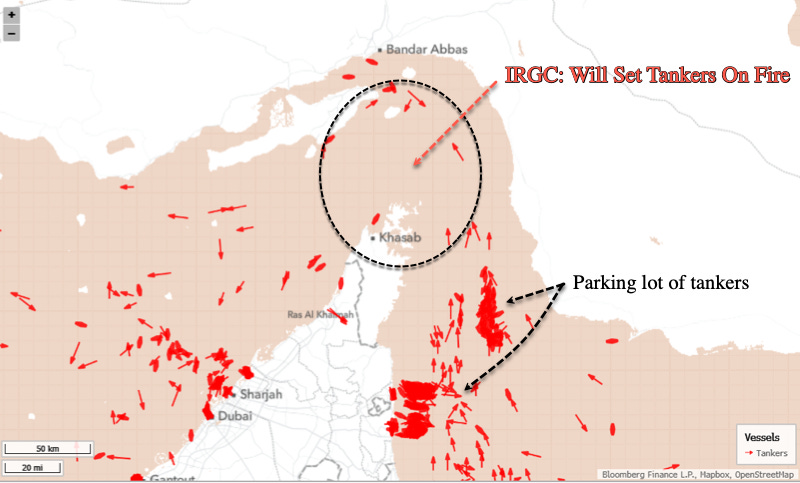
Even as those threats were being made, reports of oil tankers coming under attack were emerging.
So far three commercial ships have suffered direct hits. This morning come reports that the tanker Stena Imperative was temporarily on fire after being hit at port in Bahrain. Over the weekend a sailor in the engine room of the tanker MKD VYOM died when an Iranian rocket hit it off Oman. A much smaller tanker, the Skylight, was also hit and evacuated while on fire. Friendly fire? According to TankerTrackers, Skylight had been anchored 5 miles north of Khasab, Oman for the past week and has a history of being used by Iranian ships for bunkering, or refueling.
On March 5, Middle East Monitor reported that Iran’s Islamic Revolutionary Guard Corps claimed a successful attack on a US ship in the Persian Gulf.
The Guards’ Public Relations Department said in a statement carried by the state news agency IRNA that Iranian naval forces “successfully targeted an American oil tanker in the northern Persian Gulf.”
Over this past weekend, additional reports emerged of an Iranian attack on the Marshall Islands-flagged Louis P near the Saudi port city of Jubail.
The IRGC quickly claimed credit for the attack.
“An oil tanker operating under the commercial name ‘Louise P’, flying the flag of the Marshall Islands and considered one of the assets of terrorist America, was struck by a drone in the central Persian Gulf,” the IRGC statement said.
While it was unclear this time last week how successful Iran would be in interdicting traffic through the Strait of Hormuz, it is clear that Iran has been determined to disrupt vital oil traffic in that passage.
Benchmark oil prices have predictably soared as a result of both the real and threatened disruptions to Middle Eastern oil flows, with Brent Crude flirting with $120/bbl over the weekend, while West Texas Intermediate moved past $110/bbl before retreating below $100/bbl by Monday morning.
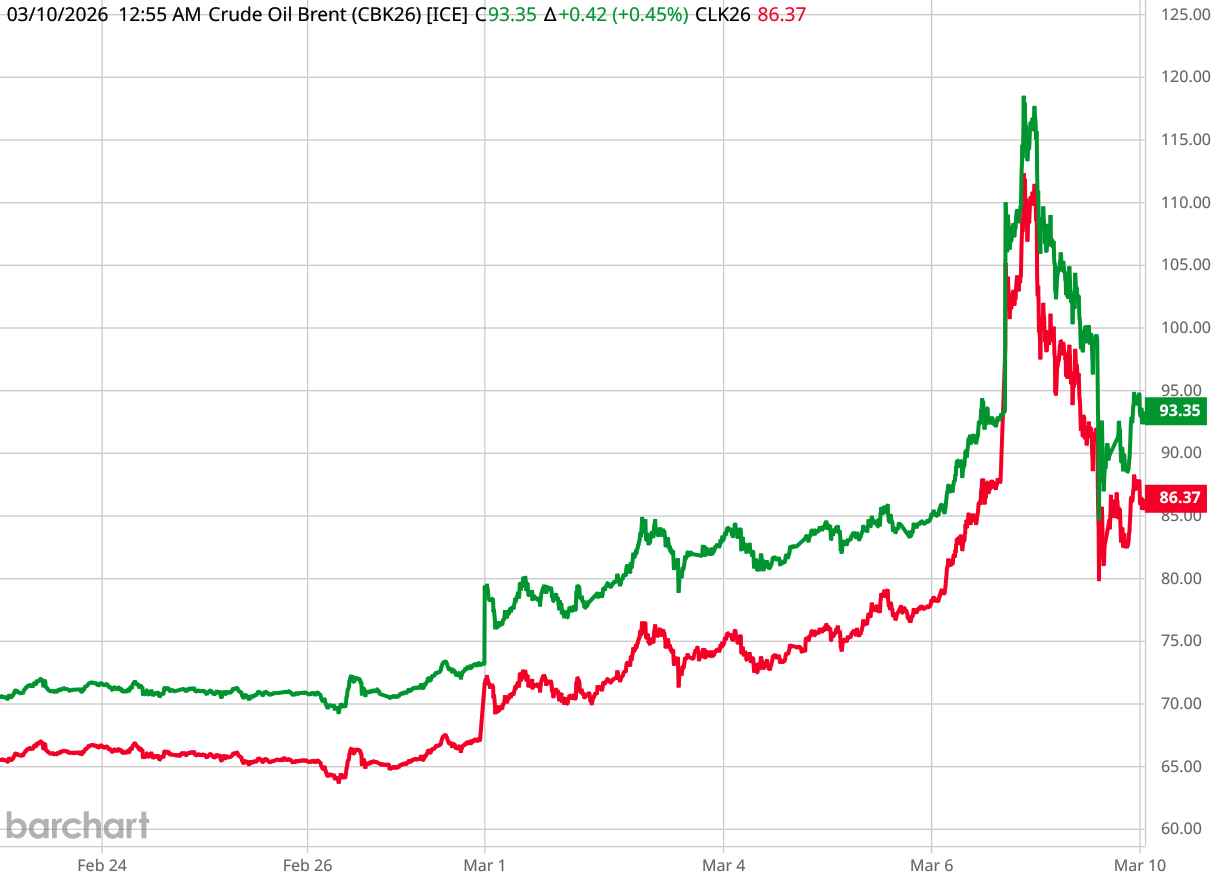
By the end of the day Monday Brent Crude had retreated to $93/bbl, and West Texas Intermediate had descended to $86/bbl.
Equally predictably, before Monday’s price freefall there had been considerable speculation that oil prices will move even higher, as Iran proved to have been quite effective in stopping tankers passing through the narrow strait.
Goldman Sachs had anticipated that flows of crude through the strait would fall to 15% of normal levels but Iran’s effective blockade on tankers passing through the narrow waterway mean that only 10% of oil cargoes that usually transit the trade route have been able to pass.
In a bid to alleviate global price pressures, the United States responded by granting India a 30-day waiver to purchased otherwise sanctioned Russian crude.
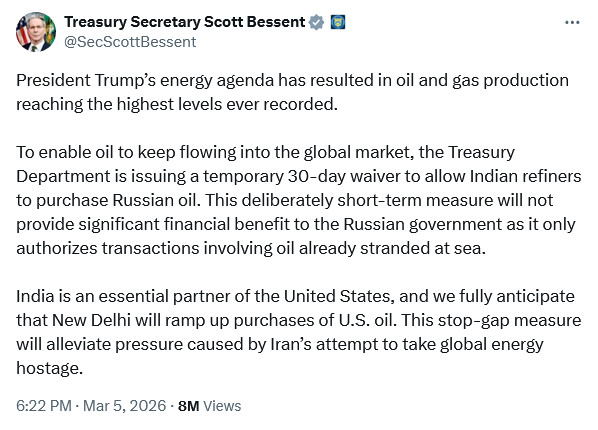
Whether the waiver was a significant factor in Monday’s oil futures retreat is of course not knowable at this time.
Equally uncertain is whether or not Iran is still able and intent on closing the Strait of Hormuz to maritime traffic. Ali Larijani, Secretary of the Supreme National Security Council and Iran’s top security official, threw considerable shade on the prospect of the Strait being open so long as hostilities were ongoing.
“It is unlikely that any security will be achieved in the Strait of Hormuz amid the fires of war ignited by the United States and Israel in the region, especially if it is designed by parties that were not far from supporting this war and contributing to fueling it,” Larijani said in a post on X.
Despite such remarks, oil prices still retreated yesterday afternoon.
In the short term, one clear beneficiary of the war with Iran is Russia, as its benchmark Urals Crude has moved to its highest prices in five years, reaching $90.97/bbl on Friday, March 6..
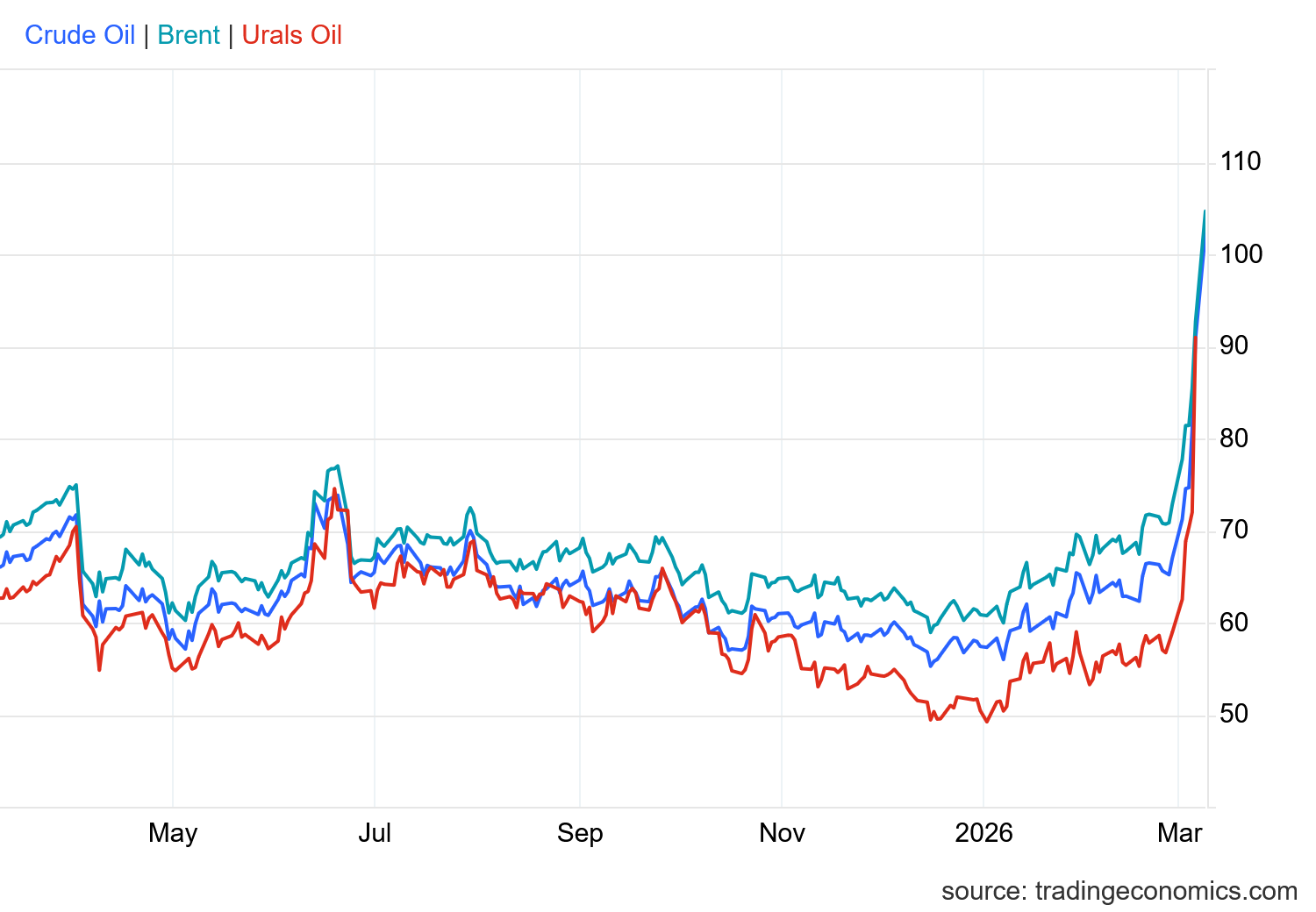
Will oil prices once again go higher? If Persian Gulf oil is found to be still cut off, absolutely. While oil prices did not hold yesterday, it would be facetious to mistake volatility for a reversion to the mean. So long as the Strait of Hormuz remains contested we should anticipate further benchmark crude price volatility, as well as price increases.
Could the world see a return to $100/bbl oil, or even a spike to $150/bbl? We cannot rule out either one, although as of this writing (Monday evening, March 9), both possibilities are a good deal less likely than they were just twelve hours ago.
However, the key word here is “if”. We do not know if or how long Iran can or will keep Persian Gulf oil bottled up. If the world believes the Strait of Hormuz is open to maritime traffic, then oil prices are less likely to surge again as they did over the weekend.
Speaking with CBS News correspondent Margaret Brennan on Sunday’s “Face the Nation”, US Energy Secretary Chris Wright expressed confidence that the oil price surge was strictly temporary, and that a quick end to the war would mean a quick restoration of previous price levels.
They shouldn’t go much higher than they are here because the world is very well supplied with oil. There’s no energy shortage at all in the Western Hemisphere. The United States is a net exporter of oil, a large net exporter of natural gas. But refineries in Asia and Europe are seeing an interruption from the normal crude flows. But there is massive energy stores around the world.
What you’re seeing is emotional reactions and fear that this is a long-term war. This is not a long-term war. It’s a temporary movement.
Sorry, go ahead. Temporary movement?
No, I’m saying, look, we’ve seen previous administration have done everything they could. They’ve begged, bartered and bribed the Iranian government to stop its nefarious activity, stop its murderous behavior. And it simply hasn’t worked. And now they’re expanding missile and drone program that are rapidly growing to protect their desire to build a nuclear weapon. We’re going to cross a threshold where we can’t put them back in the box. Now is the time to end their risk to America and the world.
Is Secretary Wright correct in his assessment?
Certainly with respect to the weekend surge into triple digits, he was spot on. Whether Secretary Wright is correct over the long term we do not know, and we cannot know. As with all war, we will not know when this war will end until it ends. Until it ends, the world can look forward to elevated oil prices, constituting an oil shock for many parts of the world.
For his part, President Trump on Monday sent a similar signal to Secretary Wright’s, stating in a telephone interview with CBS News that he felt Operation Epic Fury was very nearly complete.
“I think the war is very complete, pretty much,” the president said, speaking from his Doral, Florida, golf club. “[Iran has] no navy, no communications, they’ve got no air force. Their missiles are down to a scatter. Their drones are being blown up all over the place, including their manufacturing of drones.”
Much of the world no doubt breathed a sigh of relief upon hearing that assessment from Donald Trump. $90/bbl oil is a major energy price increase for most of the world's economies. $100/bbl is an oil price shock for most countries.
Deeloping economies dependent on energy imports are especially vulnerable to an oil price shock. Many sub-Saharan African nations in particular would face potentially severe price dislocations should there ever be an extended closure of the Strait of Hormuz. The global ramifications of Iran’s retaliatory actions have been not only significant, but potentially extreme.
Will the Iranian regime survive?
One needs no particular expertise in geopolitics or economics to recognize that the future of global oil prices is closely connected to the future of the Iranian theocratic regime.
That we are speaking of the future of the regime at all at this point is itself rather remarkable. As I wrote at the very beginning of Operation Epic Fury, what was unfolding looked for all the world like the destruction of the Islamic Republic.

President Trump, in announcing the operation on video put out on Truth Social, very specifically called for the Iranian people to overthrow the regime.
Finally, to the great, proud people of Iran, I say tonight that the hour of your freedom is at hand. Stay sheltered. Don’t leave your home. It’s very dangerous outside. Bombs will be dropping everywhere. When we are finished, take over your government. It will be yours to take. This will be probably your only chance for generations.
However, the National Intelligence Council had assessed a fairly low probability of regime change being an outcome of military operations even before Operation Epic Fury commenced.
The report, completed about a week before the United States and Israel initiated the war on Feb. 28, outlined succession scenarios stemming from either a narrowly tailored campaign against Iran’s leaders or a broader assault against its leadership and government institutions, the people familiar with its findings said. In both cases, the intelligence concluded that Iran’s clerical and military establishment would respond to the killing of Supreme Leader Ayatollah Ali Khamenei by following protocols designed to preserve continuity of power, these people said.
The prospect of Iran’s fragmented opposition taking control of the country was described as “unlikely,” said the people, who spoke on the condition of anonymity t o discuss a classified report.
President Trump last Wednesday rather darkly hinted that any future Iranian Supreme Leader would quickly be killed by either US or Israeli attacks.
“Their leadership is just rapidly going. Everybody that seems to want to be a leader, they end up dead,” Trump said on Wednesday.
Despite the ominous and bellicose commentary, by the week’s end the Wall Street Journal was reporting that President Trump was shifting his war aims from regime change in Iran to a “surrender” by the regime.
“Even as the conflict has escalated into a regional crisis involving more than a dozen countries, President Donald Trump appears to be refining the rationale and endgame of the war on the fly, according to current and former US officials and allied diplomats,” the report said.
“It will be impossible to replicate the model in Iran, analysts say. Unlike in Venezuela, where the US was dealing with a hollowed-out petrostate, Washington is confronting an entrenched theocracy backed by a vast security apparatus that is built to preserve the system even after the loss of senior leaders,” the report added.
President Trump himself appeared to acknowledge an improbability of regime change in a CNN interview, where he stated openly he was prepared to accept a religious leader for Iran.
Trump also said he was open to having a religious leader in Iran. “Well I may be yeah, I mean, it depends on who the person is. I don’t mind religious leaders. I deal with a lot of religious leaders and they are fantastic,” he said.
And pressed on if he is insisting there needs to be a democratic state, Trump told CNN, “No, I’m saying there has to be a leader that’s going be fair and just. Do a great job. Treat the United States and Israel well, and treat the other countries in the Middle East — they’re all our partners.”
At the same time, on Friday Trump called for “unconditional surrender” by Iran.
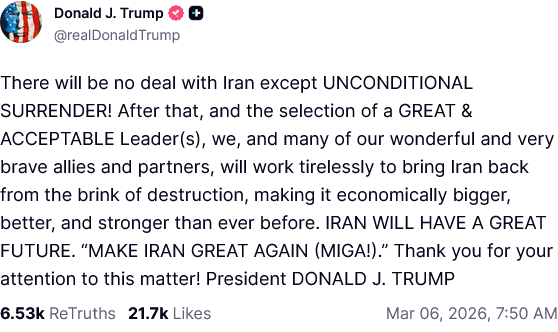
Inside Iran, Iran’s Assembly of Experts, the clerical body tasked with selecting the next Supreme Leader, has selected Ayatollah Khamenei’s son Mojtaba to succeed him.
A statement from the Assembly of Experts — the panel of Shia clerics responsible under Iranian law for choosing the country’s top leader — said Mojtaba Khamenei had been selected as the third leader of the Islamic Republic, according to reports from IRIB state TV and the Fars, Tasnim and ISNA news agencies.
While Mojtaba has been officially chosen, it remains unclear if his accession to the position of Supreme Leader is sufficient to ensure the future of the regime.
President Trump himself has dismissed Mojtaba Khamenei as a “lightweight” who would not bring peace to Iran. Trump has repeatedly insisted he be involved in the selection of Iran’s next leader, a condition which would obviously exclude the junior Khamenei.
Intriguingly, at the outset of Operation Epic Fury there was a substantial body of speculation that Mojtaba Khamenei would not be tapped as his father’s successor, as he is widely viewed inside the regime as lacking key credentials.
The first challenge is likely to be constitutional requirements. As per the Islamic Republic’s constitution, Assembly of Experts appoints Khamenei’s successor. Candidates must have ‘political experience’ as per the law. Mojtaba reportedly fails on this account, the institute noted. This is because despite running the Office of the Supreme Leader, de facto, he’s had no formal political roles in the regime.
If Mojtaba were to be the next Supreme Leader it would go against the Shi’a Islamic convention, which notes that blood lineage for the mantle is exclusively reserved for 12 divinely ordained Shi’a Imams. Khamenei himself was elected supreme leader in 1989 over Khomeini’s influential son, Ahmad, due to this. In 2023, Khamenei had said in a speech “dictatorship and hereditary government are not Islamic,” as per US-based think tank, Stimson Center.
They also reported that Ayatollah Mahmoud Mohammadi Araghi, a member of the Assembly of Experts revealed in 2024, “The news reached the leader that the experts are investigating the case of Mojtaba’s leadership. The leader said, ‘What you are doing raises suspicions about the leadership’s hereditary issue.’ So the investigation was not allowed. … On another occasion, when they sought permission from the leader to investigate a person related to him, he responded, ‘No, draw a line under this issue’.”
As it became clear that Mojtaba would become the next Supreme Leader, speculation shifted to the possibility that the IRGC effectively forced his selection on the Assembly of Experts.
This is not a routine succession. It is a wartime decision shaped by the security state, and it raises serious questions about constitutional procedure. The priority appears to be speed and control, as the Islamic Republic faces attacks from outside and a leadership vacuum at the top.
If this view is correct, then the IRGC is now functioning as a sort of latter-day Persian Praetorian Guard, arbitrarily selecting the next ruler of the empire based on what fits their agenda, not what the rest of the government mandates and expects.
If this view is correct, then Mojtaba is arguably an IRGC puppet, with the theocratic elements of the regime being correspondingly diluted in favor of base authoritarianism.
At a minimum, Mojtaba Khamenei is broadly understood to have deep ties to the IRGC, and his background in security affairs may outweigh his problematic clerical credentials. His elevation would seem to give the IRGC added prominence within Iranian leadership circles, at least for now.
At the same time, it is an open question as to how much “regime” is left for Mojtaba Khamenei to govern. Not only has much of the senior leadership been killed, but Israel and the US are moving on in their strike packages to Iran’s eeconomically and politically vital oil infrastructure, with several oil storage facilities around Tehran being targeted over the weekend.
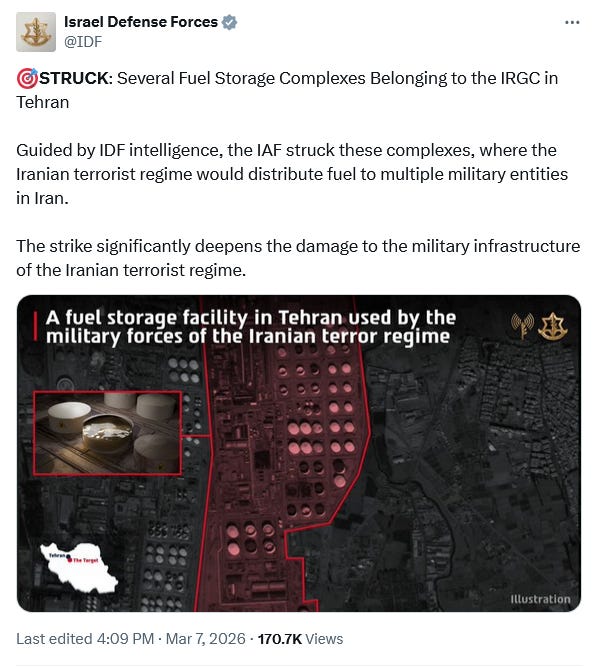
Israel is also reportedly striking oil refineries as well.
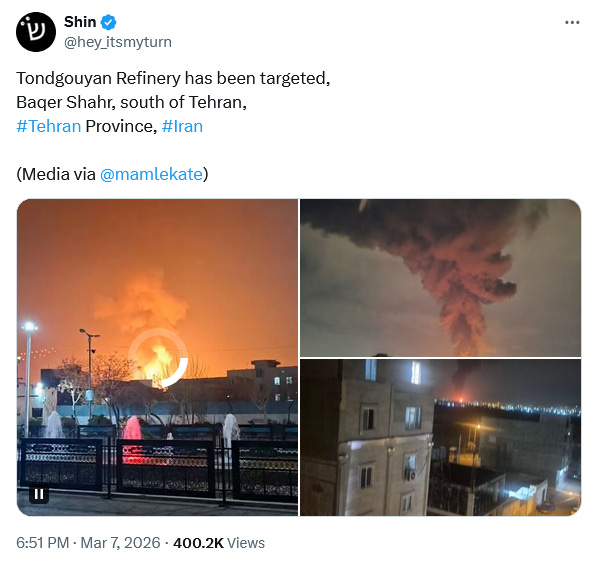
An extended analysis on X suggests this is a strategic effort to both weaken the regime and undermine Iran’s nominal ally (and principal oil customer) China.
Energy infrastructure is the bloodstream of a regime’s war machine.
Strike the fuel… you slow the missiles.
Strike the depots… you choke the logistics.
Strike the energy grid… you weaken the entire system.
Aqdasiyeh was not widely known for oil storage in older public records… but the pattern is unmistakable. Earlier strikes hit facilities tied to fuel distribution across Tehran, including the Shahran depot.Now the fires have reached deep into the capital.
For Beijing this is a nightmare scenario.
China relies heavily on Iranian oil flowing east through a fragile web of sanctions evasion, shadow fleets, and backchannel supply chains. When depots burn in Tehran… supply chains tremble in Beijing.
Every explosion in Iranian energy infrastructure sends shockwaves through the strategic calculus of the Chinese Communist Party.
If this is the strategic calculus for the US and Israel, that strategy could reverberate back into global oil markets even after the war ends. Given that Iran’s oil infrastructure is clearly being targeted, with multiple oil storage facilities around Tehran being hit over the weekend, we cannot dismiss the possibility this is the strategic calculus behind Operation Epic Fury, or a calculus very close to this.
If China is not able to purchase Iranian crude or refined products because Iran’s own energy infrastructure is obliterated, China will have to purchase crude from other countries, which will permanently bid up the price of oil. Even if market speculation is correct that China has bulked up its oil reserves over the past year, those reserves can only last so long before China is forced back into global oil markets to purchase crude.
If Israel and the US effectively end the Iranian regime by ending its capacity to extract, export, and refine oil, they will also effectively remove a considerable quantity of oil from global supply.
Even if the US and Israel do not destabilize the regime by destroying Iran’s oil infrastructure, whether or not an uprising by the Iranian people culminating in regime change leaves the status of Iran’s oil wells and oil refineries very much up in the air. There exists the possibility that regime change could result in a disruption of Iranian oil production, which would again remove a considerable quantity of oil from global supply.
Chris Wright may think there’s not an oil shortage now. Would he still think that if Iran’s oil spigot were permanently turned off?
Ending the Iranian regime and thereby ending China’s access to Iranian oil—or ending China’s access to Iranian oil and thereby ending the Iranian regime—is fraught with inflationary perils for the rest of the world.
Will the Arab states join the war against Iran?
After soaring energy prices, perhaps the world’s greatest concern in the war with Iran is the potential for that war to expand and encompass other Persian Gulf states.
Already last week saw Qatar shooting down a pair of Iranian Su-24 bombers, marking the first time an Arab state has fired on Iranian targets since the Iran-Iraq war of the 1980s.
In the immediate aftermath of the initial strikes by the US and Israel, Iran had responded by quite literally spraying missiles and drones all around the Middle East, apparently indiscriminately, with over 200 drones and 137 ballistic missiles being launched at UAE alone.
There were additional reports of attacks on both Qatari and Saudi natural gas and refining facilities.
As Bernard Haykel, Professor of Near Eastern Studies at Princeton University, frames the situation, these attacks on civilian infrastructure are pushing the Saudis—and, by extension, the rest of the Arab states—into open confrontation with Iran.
Haykel explained that Riyadh had previously communicated a specific warning to Tehran: if Saudi Arabia remained neutral during a US-Israel conflict with Iran, its infrastructure must remain off-limits.
“The Iranians did tell the Saudis that if they faced an existential attack by Israel and or America, that they would attack Saudi Arabia,” Haykel said. “And so the Saudis said, if you do that and we’re neutral, we will join forces with the Americans and attack you.”
Even Iran’s northern neighbor Azerbaijan found itself on the receiving end of a drone attack, for which Azerbaijan’s President Ilham Aliyev promised retaliation.
“Today a terrorist act was carried out from the Iranian side against the territory of Azerbaijan,” Aliyev told a security council meeting.
Azerbaijan’s military “has been instructed to prepare and carry out retaliatory measures” and “placed on mobilisation level number one, and must be ready to conduct any operation”, he added.
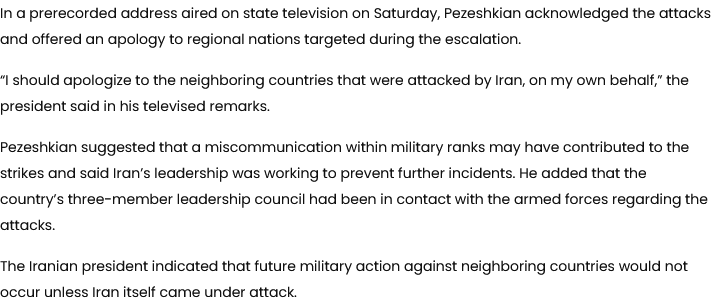
In a bizarre illustration of the “fog of war” at work, Iran’s President Masoud Pezeshkian apologized for the attacks on Iran’s neighbors—even as more attacks ensued.
Over the weekend, a desalination plant in Bahrain was reported struck by Iranian drones. Iran’s public reply to the accusation was to blame the United States.
“The Iranian aggression randomly bombs civilian targets and causes material damage to a water desalination plant following an attack by a drone,” the ministry statement said.
Iran said it was the United States that set a precedent for such attacks when it targeted a water desalination plant on Iranian soil.
“The US committed a blatant and desperate crime by attacking a freshwater desalination plant on Qeshm Island,” Iran’s Foreign Minister Abbas Araghchi said in a post on X on Saturday.
“Water supply in 30 villages has been impacted. Attacking Iran’s infrastructure is a dangerous move with grave consequences. The US set this precedent, not Iran.”
The attacks on water desalination plants is a particularly dicey escalation, as they are a vital infrastructure for many of the Persian Gulf countries.
In Kuwait, about 90% of drinking water comes from desalination, along with roughly 86% in Oman and about 70% in Saudi Arabia. The technology removes salt from seawater — most commonly by pushing it through ultrafine membranes in a process known as reverse osmosis — to produce the freshwater that sustains cities, hotels, industry and some agriculture across one of the world’s driest regions.
It is not at all surprising, given this context, that the UAE President Mohammed bin Zayed Al Nahyan openly refers to Iran as an “enemy”. Thus far, that rhetoric has not translated into direct military action.
While the Arab states have not launched offensive military operations against Iran as of this writing, the rhetoric from Arab leaders has indisputably shifted against Iran. In what could prove to be an epic miscalculation, Iran may very well end up expanding the roster of nations seeking to attack it from the US and Israel to include some or all of the Persian Gulf states.
Will that happen? We will not know until it does, but the probability of Arab attacks on Iran is at present increasing and not decreasing.
We Do Not Know
Despite what the chattering class across corporate and alternative media might present, we do not know how this war ends.
We do not know if the regime will fall.
We do not know who would take over if the regime does fall.
We do not know how long the war will last.
We do not know how long before the price of oil comes back down to prewar levels.
We do not know if Saudi Arabia, the UAE, and other Arab states will join the war against Iran.
Will the United States “win” this war? In most military respects, it already has. No matter what else transpires, Iran’s military has been shattered. Their capacity to launch missiles and drones at neighboring countries has been significantly degraded. Their leadership has been thrown into chaos.
Iran was already suffering from a collapsing economy before this war began, and the devastation of this war is only going to amplify the economic distress.
Would Iran count the regime surviving despite weeks of relentless air assault as a “victory”? Certainly we should expect Iran’s propaganda machine to promote such a narrative. Regimes do not generally stay in power by admitting defeat.
If an unbowed and unrepentant theocratic regime, especially one dominated by the IRGC, is the long-term outcome of Operation Epic Fury, its military successes may be overshadowed by far less favorable geopolitical outcomes. Military victory and geopolitical defeat are not mutually exclusive, and war in Iran may yet prove a potent reminder of that.
Can Iranians opposed to the Islamic Republic regime unite and overthrow that government? Potentially, but until their opposition elements do united into a common cause they likely do not pose a significant threat to the regime. The Islamic Republic regime is unquestionably vulnerable at the moment, the most vulnerable it has been in decades, but it has not become clear the Iranian people are ready, willing, and able to exploit that vulnerability to effect regime change.
With or without a unified opposition, Iran’s problems from before the war are still around, only more so because of the war. Everything that pushed the Iranian people to protests back in January is still very much an issue now. In terms of crises and issues facing the regime, not much has actually changed even with the war, except that every crisis and issue has gotten worse by an order of magnitude at least.
We do not know how this war will end. Even so, already it is clear that when Operation Epic Fury does end, for Iran it will not be the end of the crisis. It will not even be the beginning of the end. At most, it will be the end of the beginning.
2026 will not be a kind year to the Islamic Republic.
Excellent analysis, Peter. Much to think about.2 observations of mine.
When the bombing stops, will Iran be able to repair the damage to their petrochemical industry? Personnel with expertise and equipment along with finances will need to be obtained to repair the damage. Can they source it? I don’t see Iran having much of either.
Regarding the Iranian population effecting regime change; the ordinary people are disarmed and not able to effectively able to challenge the Basij militias and IRGC troops. Can they at least obtain small arms? Slim chance they could obtain "battlefield pickups"; even so, they need ammo.
What a ton of research you’ve done in order to get a clear picture of what’s going on - thank you, Peter! And of course, in this fog of war the only truth is “we don’t know - yet”. With so much speculation, rumor, and narrative, I appreciate your objectivity.
One thing I’m pondering is if Trump is going to deliberately allow oil prices to remain high until Cuba, China, or Zelensky are destabilized to the point of change. We’ll see!
Peter, if you have time, I’m interested in your assessment of what this Substack author wrote two days ago. Lawyer Jeff Childers is an unabashed Trump supporter and eternal optimist, as this post shows. Is he missing something?
https://coffeeandcovid.substack.com/p/gentlemens-agreements-sunday-march?utm_campaign=post&utm_medium=email