


“Generalissimo Francisco Franco is still dead!”
Those who are of a certain age may well remember Chevy Chase’s “Weekend Update” news parody during Saturday Night Live’s inaugural season, where for weeks he mocked mainstream news coverage of the Spanish dictator’s decline and death by breathlessly announcing that Franco was “still dead.”
Corporate media should hire Chevy Chase to present their headlines on yesterday’s release of the latest Current Employment Statistics Preliminary Benchmark (National) Summary by the Bureau of Labor Statistics. Even Chevy Chase’ mediocre comedic skills would give the media reporting more credibility on this topic than their news coverage currently enjoys.
The preliminary estimate of the Current Employment Statistics (CES) national benchmark revision to total nonfarm employment for March 2025 is -911,000 (-0.6 percent), the U.S. Bureau of Labor Statistics reported today. The annual benchmark revisions over the last 10 years have an absolute average of 0.2 percent of total nonfarm employment. In accordance with usual practice, the final benchmark revision will be issued in February 2026 with the publication of the January 2026 Employment Situation news release.
Take particular notice of what the BLS has to say about the ten-year historical average revision, and that the 2024 correction is three times the historical average.
Corporate media was surprised and dismayed at the large correction. I was not, and neither were any of my regular readers. I have been charting the decline of US labor markets literally for years.
To Reuters, CNBC, and all the rest who suddenly realized US labor markets are not doing well: ”I told you so.”
Those of us who pay attention to the monthly jobs reports published by the BLS are not at all surprised that the revision was ginormous and that it was—once again—down rather than up.
Appalled? Yes.
Infuriated? Yes.
Surprised? Not even a little bit.
Why should we be surprised? We’ve seen this before—last year. Back then, the BLS made 818,000 jobs disappear.

How big was that 818,000 revision? It was big enough to shift the historical margin of error from ±0.1% last year to ±0.2% this year. That made it big enough so that last year’s revision—which was five times the historical average—made this year’s revision “only” three times the current historical average.
Still, this year’s revision was even larger—both in absolute terms (-911,000 vs -818,000) and in relative terms (-0.6% vs -0.5%)—than last year’s, highlighting yet again the trend in the BLS jobs data of steady deterioration.
If we suppress the changes during the COVID Pandemic Panic years of 2020 and 2021—where the labor dislocations upended all labor market trends and patterns—we can see in a comparison of pre-COVID revisions vs post-COVID revisions that data quality has declined, and continues to decline.
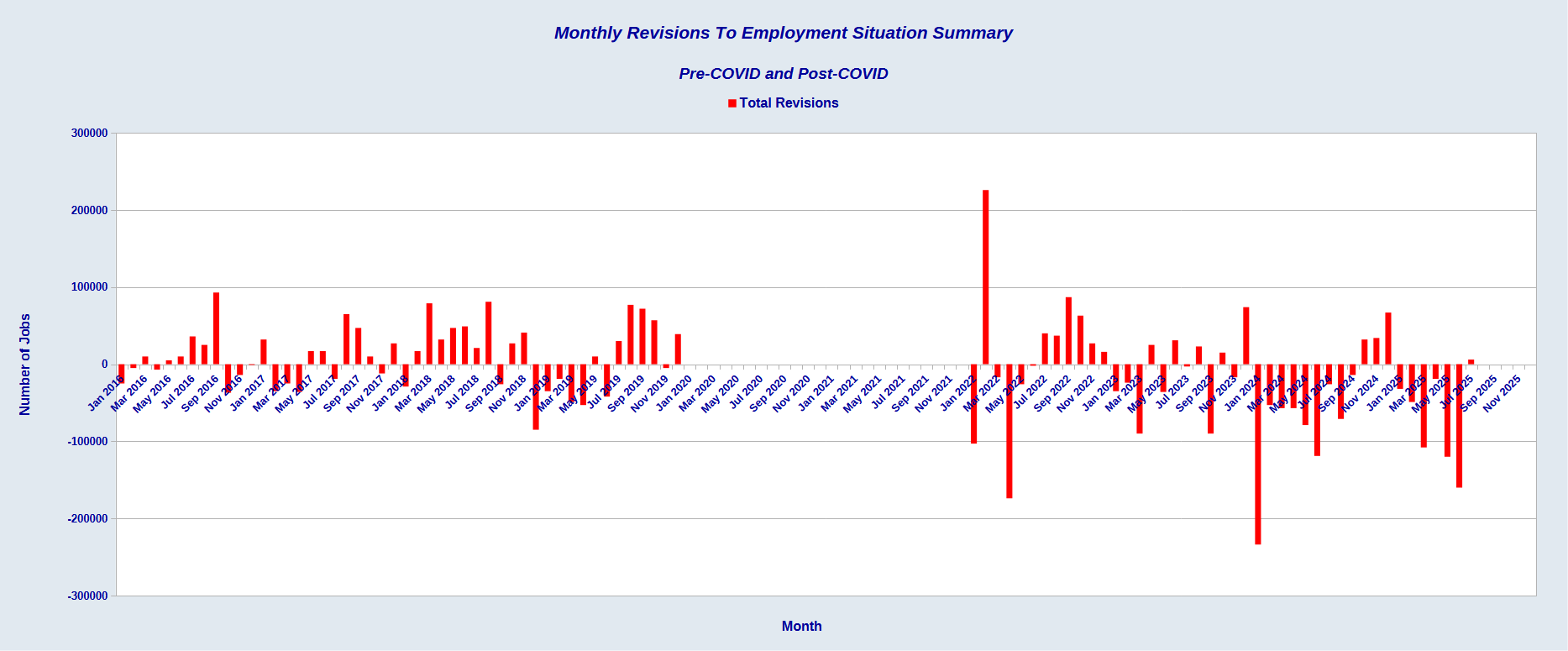
Pre-COVID revisions were generally smaller in magnitude and more likely to be positive, indicating the BLS jobs reports were demonstrably more conservative than they have been since the COVID Pandemic Panic.
So obvious has been the decline in the jobs data since the end of the Pandemic Panic that I took to calling the BLS sketchy jobs numbers “Lou Costello Labor Math” as far back as February of 2022.
So obvious has been the decline in overall jobs despite the deteriorating data quality that it was clear by late summer of 2024 that the US has been in a “jobs recession” since at least the fall of 2023.

The data has been painting a grim picture of toxic, dysfunctional job markets and overall declining employment in the US since long before the 2024 election. Yet only now, with Donald Trump sitting behind the Resolute Desk, does corporate media find it palatable to acknowledge the truth within that data.
Thus we have Mark Zandi last week concluding that America has just now entered a “jobs recession.”
Thus we have Reuters admitting that labor markets were not doing well even before Donald Trump was elected to a second term as President.
Thus we have NPR admitting that job numbers under Biden were “overstated”.
Thus we have CNBC putting JPMorgan Chase CEO Jaime Dimon in the spotlight to announce that the revision shows the US economy is “slowing down.”
No kidding.
Corporate media conveniently overlooks the Philadelphia Federal Reserve’s 2022 early benchmark revision which showed that, during that summer, the United States added only 10,500 jobs, despite the BLS claiming over a million jobs were created.

The April Employment Situation Summary claimed 428,000 jobs were added that month.
The May Employment Situation Summary claimed 390,000 jobs were created during the month.
The June Employment Situation Summary claimed 372,000 jobs were created during the month.
All told, the Bureau of Labor Statistics claimed 1,190,000 jobs were created during those three months.
Last week, the Philadelphia Federal Reserve shredded the narrative, stating that the actual number of jobs created during those three months was a whopping 10,500.
US labor markets are not just now deteriorating. The US has not just now entered into a “jobs recession”.
Both phenomena began well before Donald Trump was even elected, much less sworn in. The data has shown this to be the case all along. Anyone who looked at the data, who analyzed the data, would know that corporate media’s reporting is about two years behind the curve.
The corporate media headlines should have read: “US labor markets are still toxic.” “US economy is still saddled with little or no actual job growth.”
Corporate media could have had an easy victory lap on the BLS revisions release. All they needed to do was report the job numbers honestly over the past few years.
Corporate media has not done this. Corporate media has ignored the data and lied about the jobs data.
Now corporate media is hoping you won’t notice their slipshod excuse for economic journalism. Corporate media is hoping you will buy into their narrative that jobs markets are bad because Trump.
Do not be misled. Labor markets have been weak and getting weaker in this country since the COVID Pandemic Panic. The data not only shows this now, but it has shown it all along. It was not concealed. It was not covered up.
Instead, the data was simply ignored, until it could no longer be ignored.
The BLS revisions do not “suggest” the US economy is weaker than has been proclaimed in corporate media. The BLS revisions confirm the US economy is weaker than has been proclaimed in corporate media.
Do not accept any narrative unchallenged. Look at the data for yourself. Do your own research and form your own conclusions.
Trust nothing. Verify everything.
Corporate media has proven once again why this is the only way to avoid being misled down the rabbit hole.
Geez! Are there any gov’t agencies that weren’t corrupt and politicized against Trump? We see it in these numbers. We see it in the undercover reporting by James O’keefe. We see it in what’s been uncovered by DOGE. We saw it in the lawfare against Trump.
It’s to the point where I assume every gov’t agency is politically biased.
To anyone asking why the whole system needs to be burned down and rebuilt, a story like this is exhibit A.
Well, well, well, looks like additional evidence of the political nature of the BLS. When were the “great” numbers cobbled together? And when was the “correction” finally applied? The questions answer themselves. If walks like a duck and quacks like a duck…