


Iran and Israel are at war. After the past 48 hours, there is no question about that.
Nor is there any doubt about who sides with Israel in this war: The United States.
There is, however, plenty of doubt about who sides with Iran. While several nations are willing to verbally condemn Israel, even Iran’s presumably closest allies, Putin’s Russia and Xi Jinping’s China, have only offered words. When it comes to actually fighting a war with Israel, Iran right now stands very much alone.

While the United States has made it quite clear that Israel acted independently in attacking Iran, the US has also not been shy about helping Israel defend itself against Iran’s retaliatory missile salvos.
The U.S. has both ground-based Patriot missile defense systems and Terminal High Altitude Air Defense systems in the region capable of intercepting ballistic missiles, which Iran fired in multiple barrages in retaliation for Israel’s initial attack.
Naval assets also were involved in assisting Israel as Iran fired missiles at Tel Aviv, one official said. It was not immediately clear if ships fired interceptors or if their advanced missile tracking systems helped Israel identify incoming targets.
The United States also is shifting military resources, including ships, in the Middle East in response to the strikes.
The US had also aided Israel during last year’s tit-for-tat strikes with Iran.
Even France’s Emmanuel Macron, who just last year called for an arms embargo on Israel, put the onus of this war entirely on Iran.
"Iran bears a very heavy responsibility for the destabilisation of the region," Macron said.
"Iran is continuing to enrich uranium without any civilian justification and to levels that are very close to what is needed for a nuclear device," he said.
The United Kingdom and Germany, who have also criticized Israel over its war with Hamas, have similarly voiced support for Israel’s “right to defend itself” against an Iranian nuclear threat.
While France, the UK, and Germany have thus far offered only statements of support, their statements provide the US the geopolitical benefit of making American assistance in defending Israel against Iranian missiles considerably less controversial.
Iran’s network of supporters, however, have been far more reticent.
Hezbollah, the centerpiece of Iran’s “Axis of Resistance” network of proxy militias and terror groups, condemned Israel’s attacks, but did not indicate they would be launching any fresh terror attacks on Israel.
Iraq’s Kataib Hezbollah (not related to Hezbollah) , similarly called Israel’s actions “deeply regrettable.”
Russia, who has also been a major buyer of Iranian drones for its war with Ukraine, condemned Israel in a statement posted to the Kremlin website—but also called for “peaceful” efforts to resolve Iran’s nuclear weapons program.
Vladimir Putin stressed that Russia condemns the actions taken by Israel in violation of the Charter of the United Nations and international rights. The Russian side fully supported the efforts to resolve the situation around the Iranian nuclear program is peaceful, put forward specific initiatives aimed at finding mutually acceptable agreements. Russia further will contribute to the de-escalation of the conflict between Iran and Israel.
According to the statement, Putin reiterated the importance of diplomacy to Israeli Prime Minister Netanyahu, and further pledged to maintain contacts with both Iran and Israel in hopes of “mediating” the conflict.
Contrast that evenhanded rhetoric with President Donald Trump’s bombastic post on Truth Social after Israel’s attacks began.
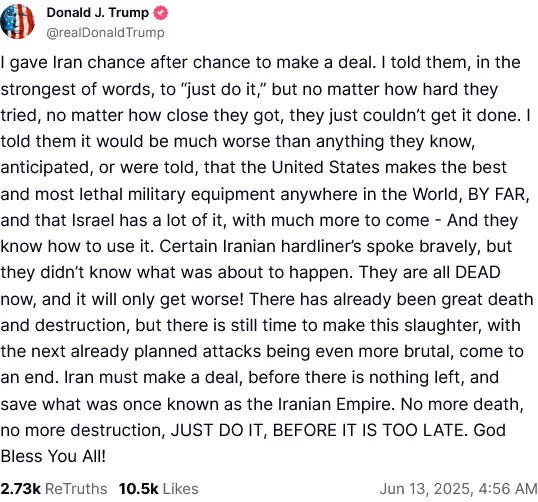
Which rhetoric is a more full-throated declaration of support for an ally?
China, Iran’s other major ally—who recently signed a 25-year cooperation treaty with Iran—initially was quite anodyne in its statement about the conflict, saying only that China was “deeply worried” about possible consequences.
In response to Israel's attack, Lin Jian, Chinese foreign ministry spokesman, said, according to state media, that "China is highly concerned about Israel's attacks on Iran and deeply worried about the potential serious consequences of these actions."
Lin also said Beijing, which has been developing closer ties with Tehran, including a 25-year cooperation agreement, "opposes any violation of Iran's sovereignty, security, and territorial integrity, and opposes actions that escalate tensions and expand the conflict."
"The renewed sharp escalation of the regional situation is not in the interest of any party," he continued.
"China urges all relevant parties to do more to promote regional peace and stability and to avoid further escalation of tensions. China is willing to play a constructive role in helping to de-escalate the situation."
China’s UN Ambassador Fu Cong ramped up the condemnation of Israel more forcefully—but stopped short of pledging any form of support for Iran.
"China opposes the intensification of contradictions and the expansion of conflicts, and is deeply concerned about the consequences that may be brought about by Israel's actions," Fu was quoted as saying at a meeting held by the UN Security Council on the Middle East situation on Friday.
China is seriously concerned about the negative impact of the current developments on diplomatic negotiations on the Iranian nuclear issue, said Fu.
Iran has been calling for the United Nations to condemn Israel, but thus far the UN Secretary-General António Guterres has been willing only to condemn “military escalation.”
At yesterday’s emergency meeting of the UN Security Council, UN Under-Secretary-General for political affairs Rosemary DiCarlo was similarly equivocal, calling for Israel and Iran to show “maximum restraint.”
“I reaffirm the Secretary-General’s condemnation of any military escalation in the Middle East,” she said, urging both Israel and Iran to exercise maximum restraint and “avoid at all costs a descent into deeper and wider regional conflict”.
If Iran is expecting that anodyne rhetoric to metamorphose into a more pointed criticism or condemnation of Israel, Iran is sure to be disappointed.
To underscore Iran’s true standing in the region, we should note that the United States, which had been apprised of Israel’s plans to attack Iran, on Thursday provided advance warning to several American allies in the Middle East—and apparently none thought to warn Iran.
Qatar, which condemned Israel’s attack, was one of the countries notified of that attack in advance.
It is likely that Saudi Arabia, which also condemned Israel, was alerted as well.
They oppose the attack yet none thought to warn Iran? A few hours advance notice would likely have prevented Iran’s senior military leadership from being targeted and killed.
While none of the statements actually made by Russia, or China, or the Gulf States, or even the United Nations indicates any degree of support either for Israel or Israel’s attack on Iran, that no country is stepping up with any offers of assistance for Iran to help defend against Israel’s air attacks is quite telling.
Many of the Gulf states may not like Israel all that much, but they apparently are not enamored of a nuclear-armed Iran, either. They are willing to offer up the usual bloodless words of condemnation against Israel, but are not willing to take any concrete actions to assist Iran.
Apparently, their outrage does not extend as far as their rhetoric.
Equally apparently, the Gulf states would rather deal with an Israel now poised to play regional hegemon than a nuclear-armed Iran eager to play for the same role.
What the final outcome of this war will be remains, as with all war, very much a mystery until the shooting is finally done and the bombs stop falling. However, one aspect that does seem likely even now is that Iran will end this war quite a bit more isolated geopolitically than when it began, with even its friends proving to be somewhat less than friendly.
Iran’s ambitions for power and influence in the Persian Gulf and beyond are quite likely ended for at least the foreseeable future.
Great work, Peter! Here the world is worried about an Islamic jihad, encompassing dozens of countries, and you show us that most so-called “allies” of Iran aren’t coughing up any more support than words like “deeply concerning”. Pathetic!
There is chatter on Substack Notes that the elite of Iran are fleeing the country. The airports - closed to ordinary citizens of Iran - are reportedly packed with the regime’s upper crust running away. Which maybe goes to show that this war is more about social classes than anything else. The poor get bombed, the elite escape to safety. If the world is lucky, maybe the long-standing regime running Iran will now be usurped by pro-democracy factions, and hostilities will end. Let’s hope!
Are the leaders (the ones still living) of the islamic republic of iran making a break for the runway 🛫 while the gittin' is still good?
Link up with Assad up north? Bring euros💶 and 💎bling? Saw unconfirmed 📹 Vid of limousines headed out on a deserted tarmac.....