


After more than six weeks and the longest run of government shutdown Kabuki crap, the Bureau of Labor Statistics finally released the September Employment Situation Summary.

Total nonfarm payroll employment edged up by 119,000 in September but has shown little change since April, the U.S. Bureau of Labor Statistics reported today. The unemployment rate, at 4.4 percent, changed little in September. Employment continued to trend up in health care, food services and drinking places, and social assistance. Job losses occurred in transportation and warehousing and in federal government.
119,000 jobs is quite an improvement over August’s initial 22,000 jobs report, and it shattered Wall Street estimates, which anticipated 50,000 jobs created.
In typical bureaucrat fashion, the only nod to the government shutdown which kept this report bottled up for six weeks was the legalese boilerplate in the news release acknowledging that the shutdown happened—thus making the data already stale—and that the government would not be attempting to publish an October jobs report. Instead, the BLS will fold whatever October data it has into November’s jobs report, which will be released later than usual, on December 16.
What should we make of this belated view of September employment?
Less than corporate media or the Trump Administration would like. BLS’ claims of accuracy and reliability notwithstanding, even the headline data invites more than the usual skepticism, given its optimistic assessment surpassed ADP by 151,000 jobs for September.
ADP, we should recall, assessed 32,000 jobs were lost during that month.


A variance that large would raise eyebrows under any circumstances. Coming off the BLS’ extended vacation due to the shutdown, and less than three weeks before the Federal Open Market Committee has to make its final decision on the federal funds rate, a variance that large guarantees that the September jobs report is tainted with a heavy dose of Lou Costello Labor Math.
Moreover, when we peel back the layers, contrary to the rosy jobs outlook claimed by the Trump Administration, we see that the September jobs report has one good number and lots of grim ones. We see that manufacturing jobs are down again, that real wages are flat or down, while joblessness is up yet again.
That's the reality described by the details of the September Employment Situation Summary.
No Question About Lou Costello Labor Math
Given that the Employment Situation Summary blew past Wall Street estimates of around 50,000 jobs created, there is no surprise that White House Press Secretary Karoline Leavitt took a victory lap over the news.
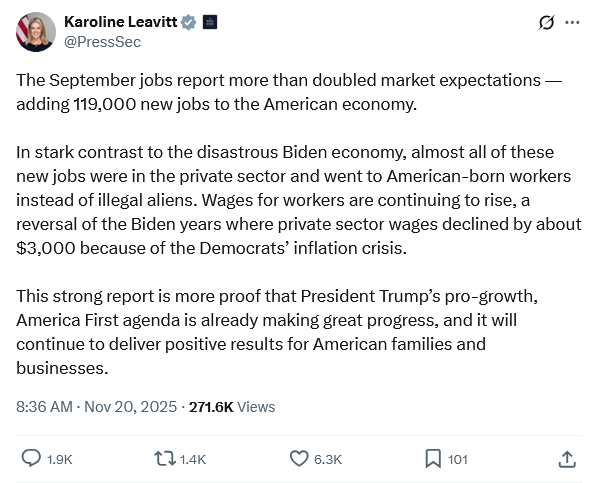
Nor was the Trump Administration shy about lining up other positive comments from various “experts” from within corporate media and Wall Street.
There is no doubt that the September jobs report is tainted. As I have observed before, one of the easy “tells” of Lou Costello Labor Math is when the Employment Level from the BLS’ Current Population Survey trends differently than the All Employees data from the Current Establishment Survey—which is clearly the case.
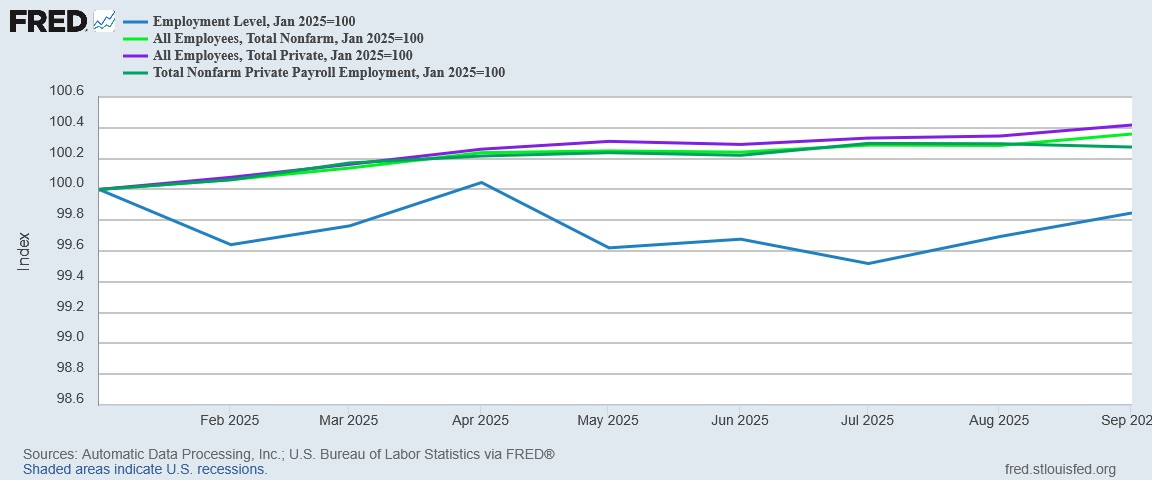
Corporate media, of course, never makes such comparisons, and so was quite willing to agree with the Trump Administration on the strength of the jobs report.
Corporate media was also willing to gloss over the fact of yet more downward revisions to prior months erasing 33,000 jobs. August became a month of job loss because of the revisions.
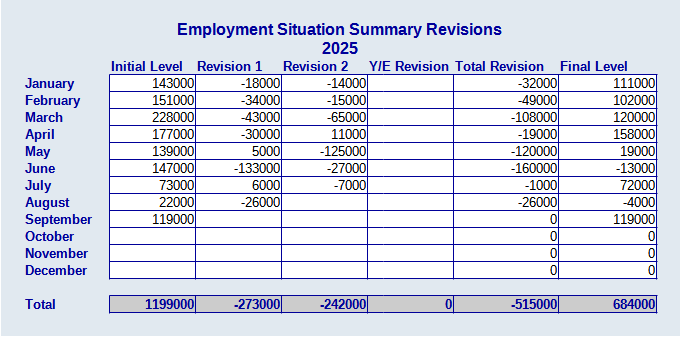
Thus far in 2025, these subsequent revision cycles have eliminated 515,000 jobs from what has been claimed year to date.
Given that the BLS still has not overcome its penchant for overestimating jobs numbers initially, we should anticipate significant downward revisions to the initial September estimate. Such is the nature of Lou Costello Labor Math—it never lasts for long.
Only Some Sectors Gained
Even without the skepticism that comes from Lou Costello Labor Math, a closer look at the September jobs data quickly shows the report is not nearly as upbeat as the headline number suggests.
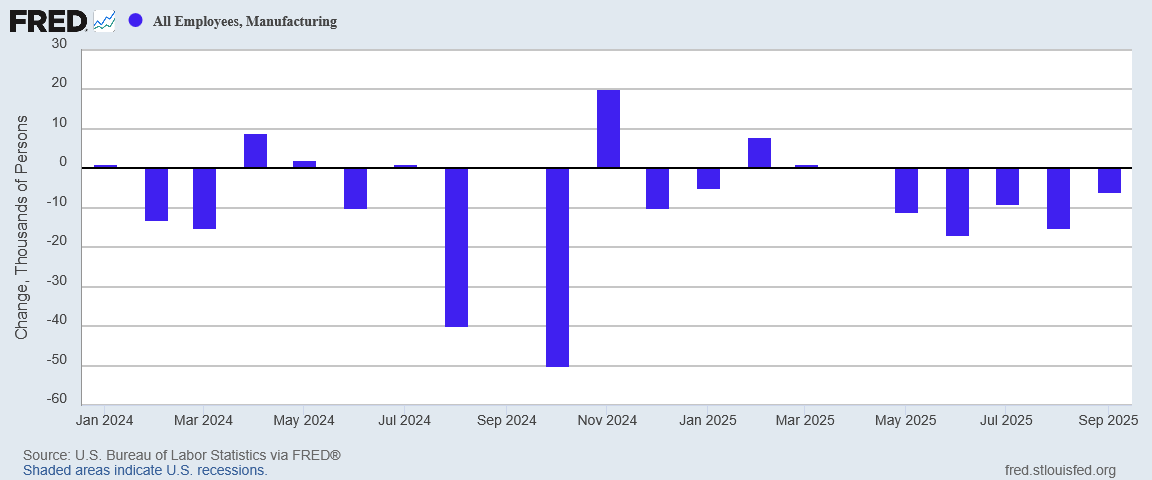
Manufacturing continues to hemorrhage jobs—6,000 of them—as it has done consistently for the past few years.
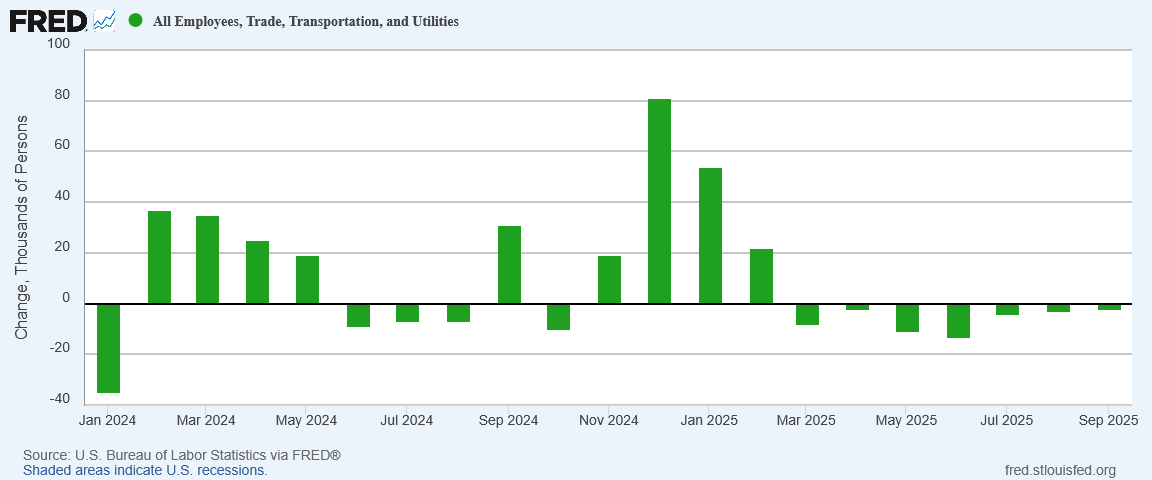
Trade, Transportation, and Utilities, historically a mainstay of service sector employment, also continued a trend of job loss, giving up roughly 2,000 jobs.
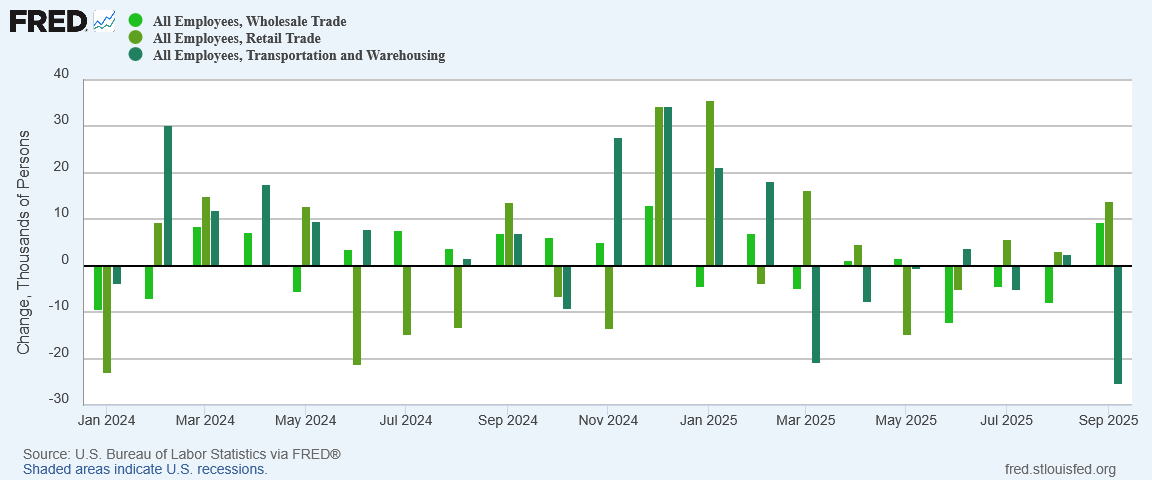
Retail (13,900 jobs) and wholesale (9,400 jobs) trade posted modest gains, but they were completely overwhelmed by a steep decline of 25,000 in transportation and warehouse jobs.
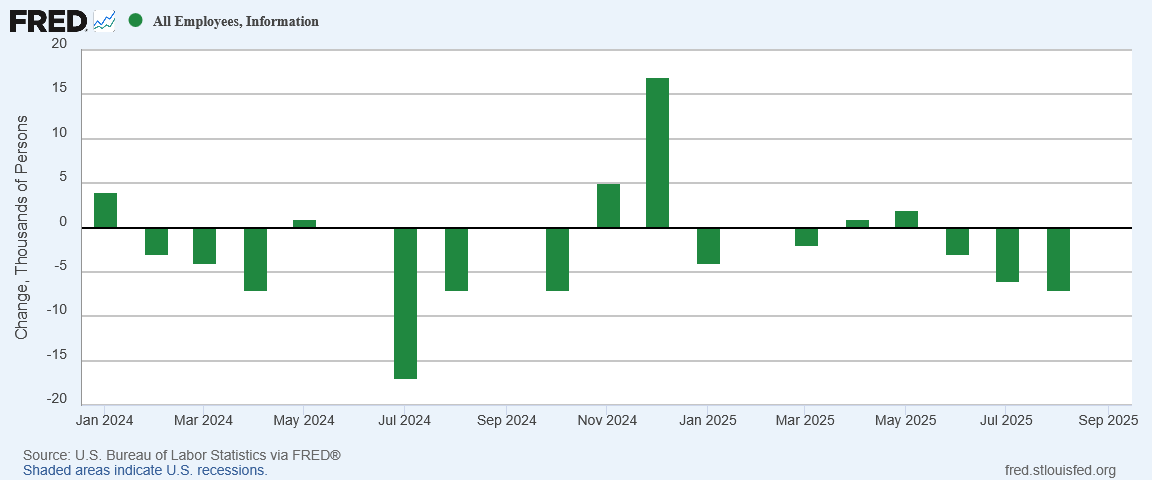
The Information sector also continued to post grim numbers, managing to just break even for September.
The only two sectors to post significant job gains were the Private Education and Healthcare sector (59,000 jobs), as well as Leisure and Hospitality (47,000 jobs).


Nor is the concentration in those two sectors slight. When we look at a cross section of job gains and losses for the month, those two areas have the bulk of the total job growth for the month.
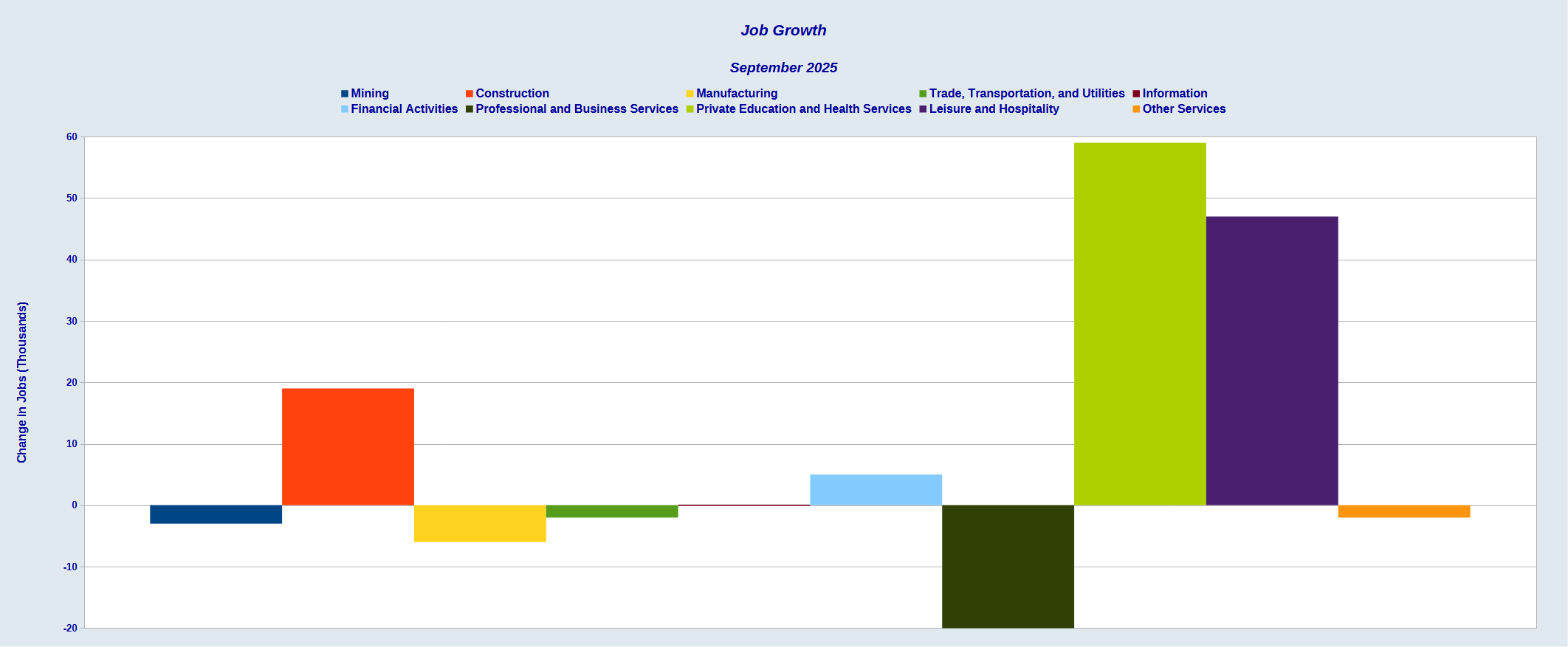
Most sectors lost employment during September. That’s not a positive sign for any economy.
Wages Are Not Growing
To add wage insult to job loss injury, when we assess the wage data relative to inflation, we see that September was not a month for wage growth.
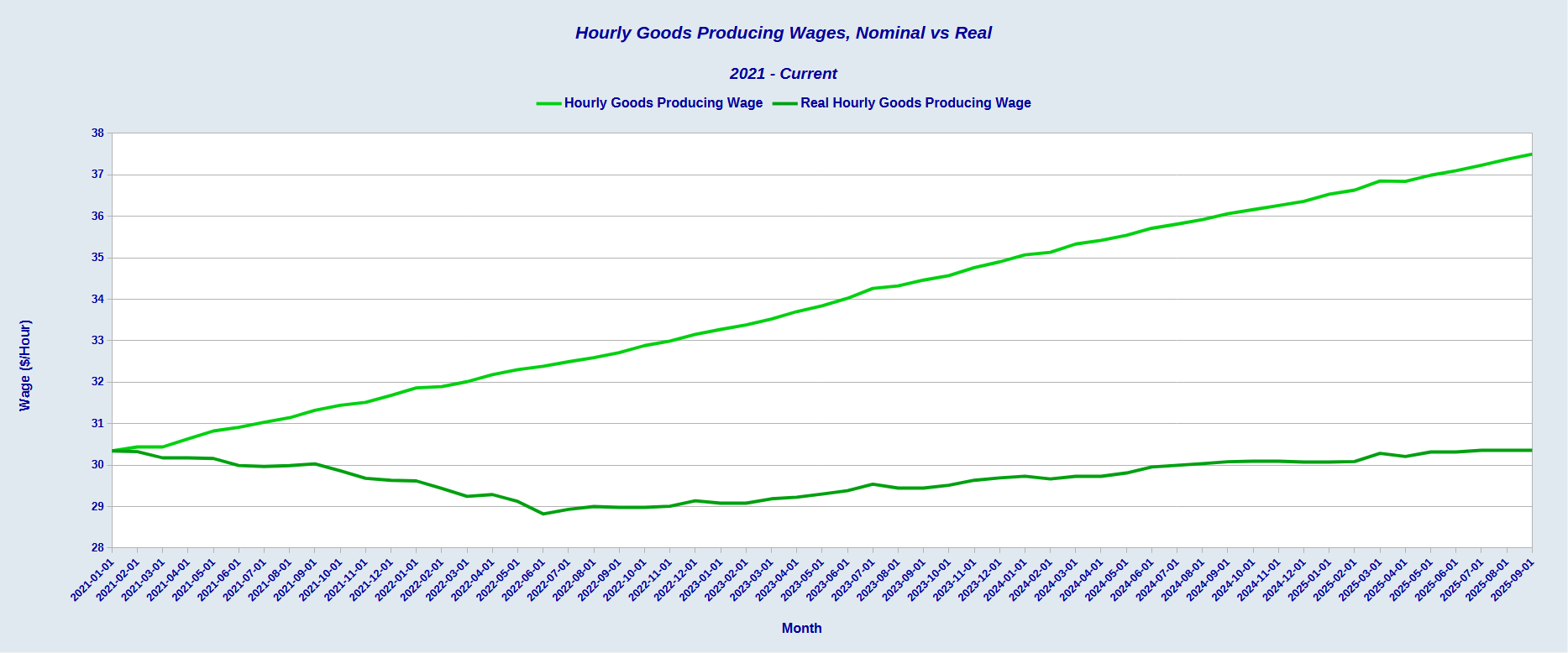
Hourly goods-producing wages barely increased—from $30.35 per hour to $30.36—in real terms for the month.
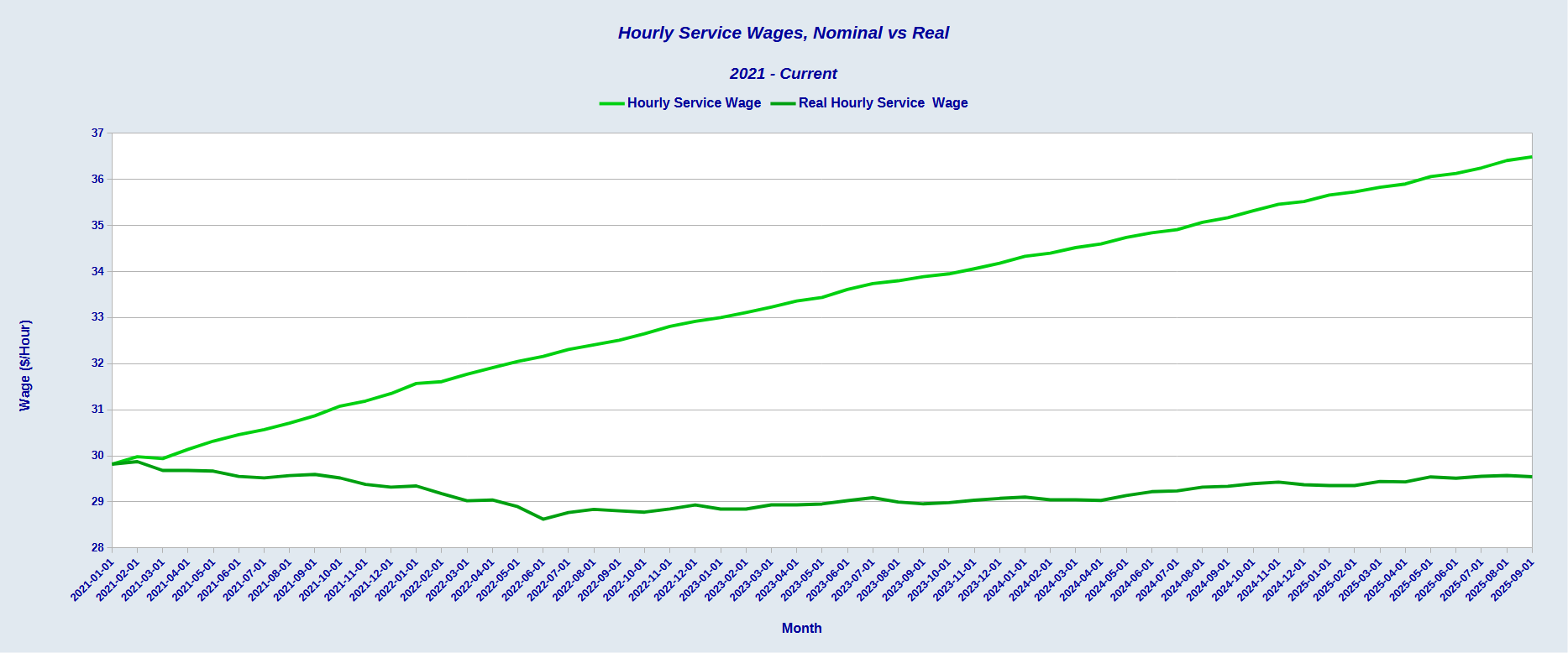
Real hourly service wages declined $0.03 to $29.54 per hour.
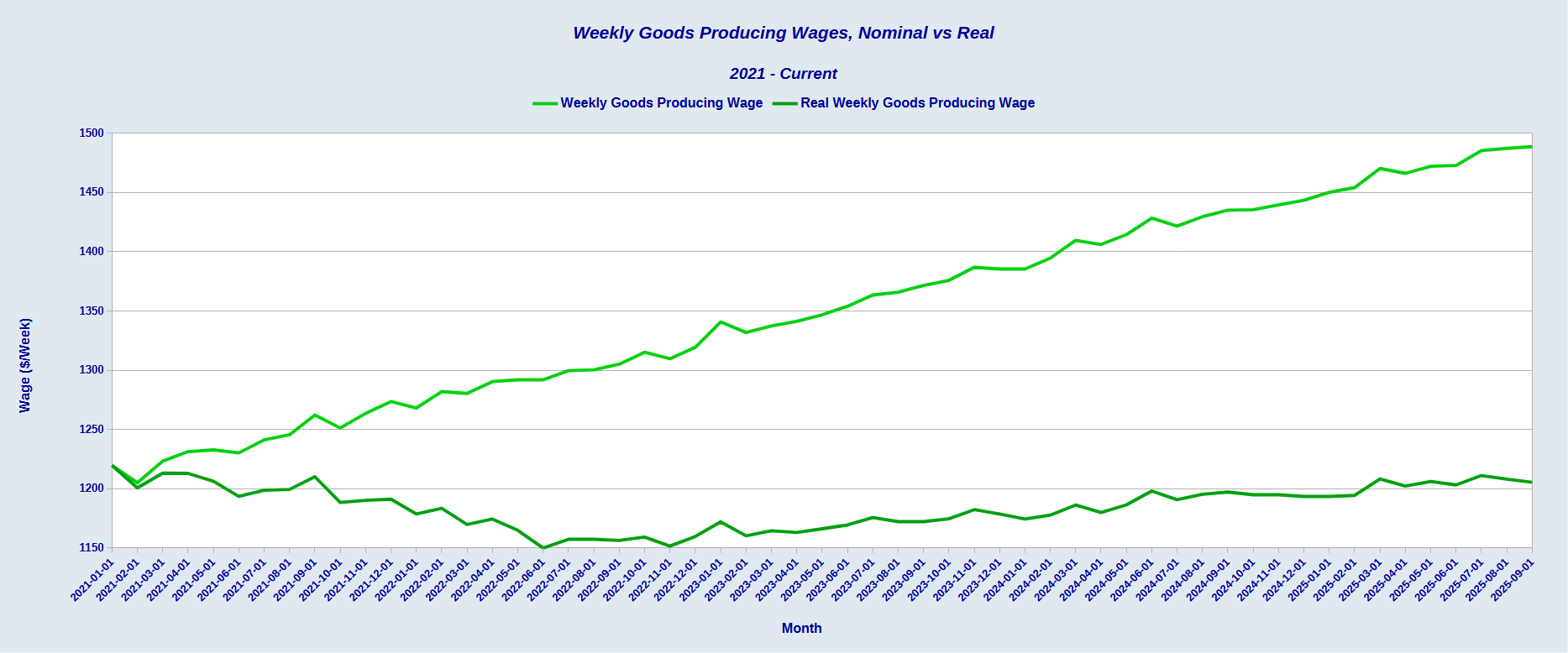
Real weekly wages declined $2.58 in goods producing sectors, to $1,205.43.
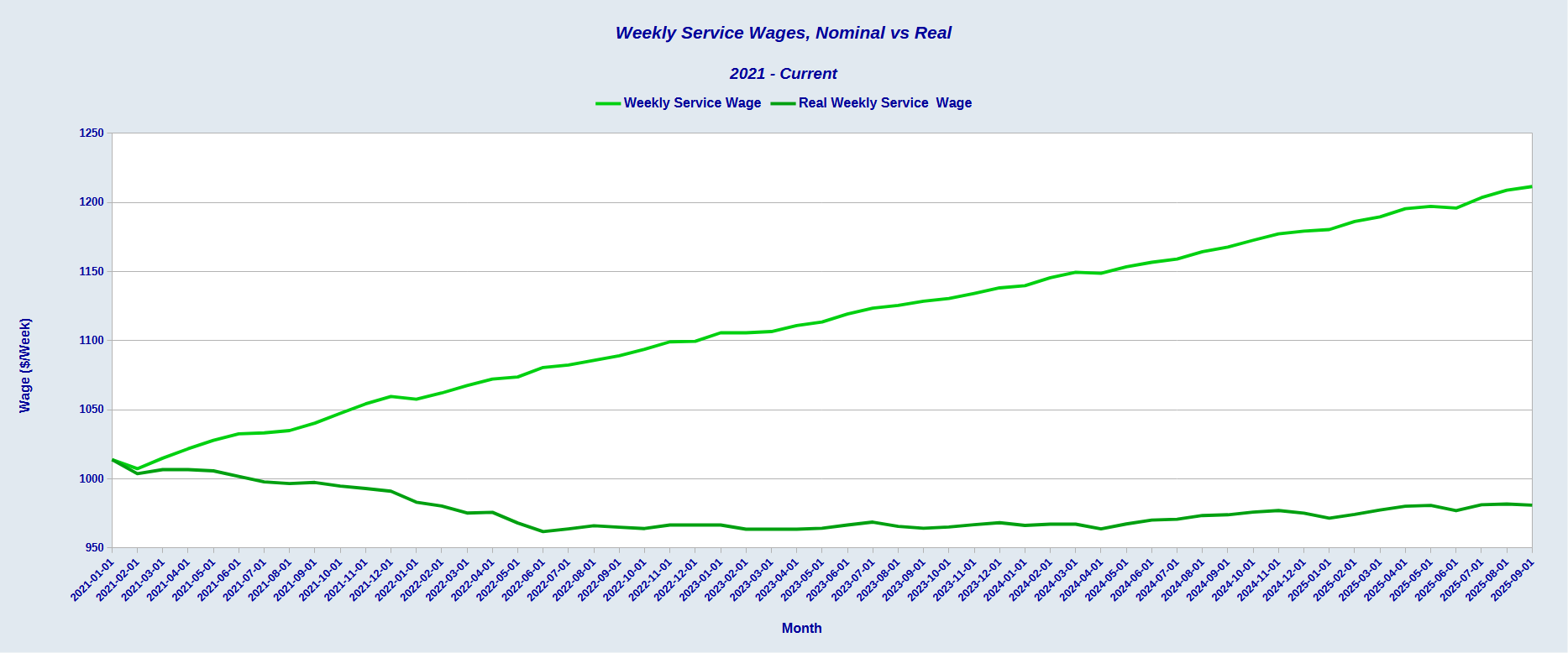
Real weekly wages slid $0.89 in service sectors, to $980.92.
The lack of real wage growth can be clearly seen when we index weekly wages for goods producing and service sectors against the Consumer Price Index.
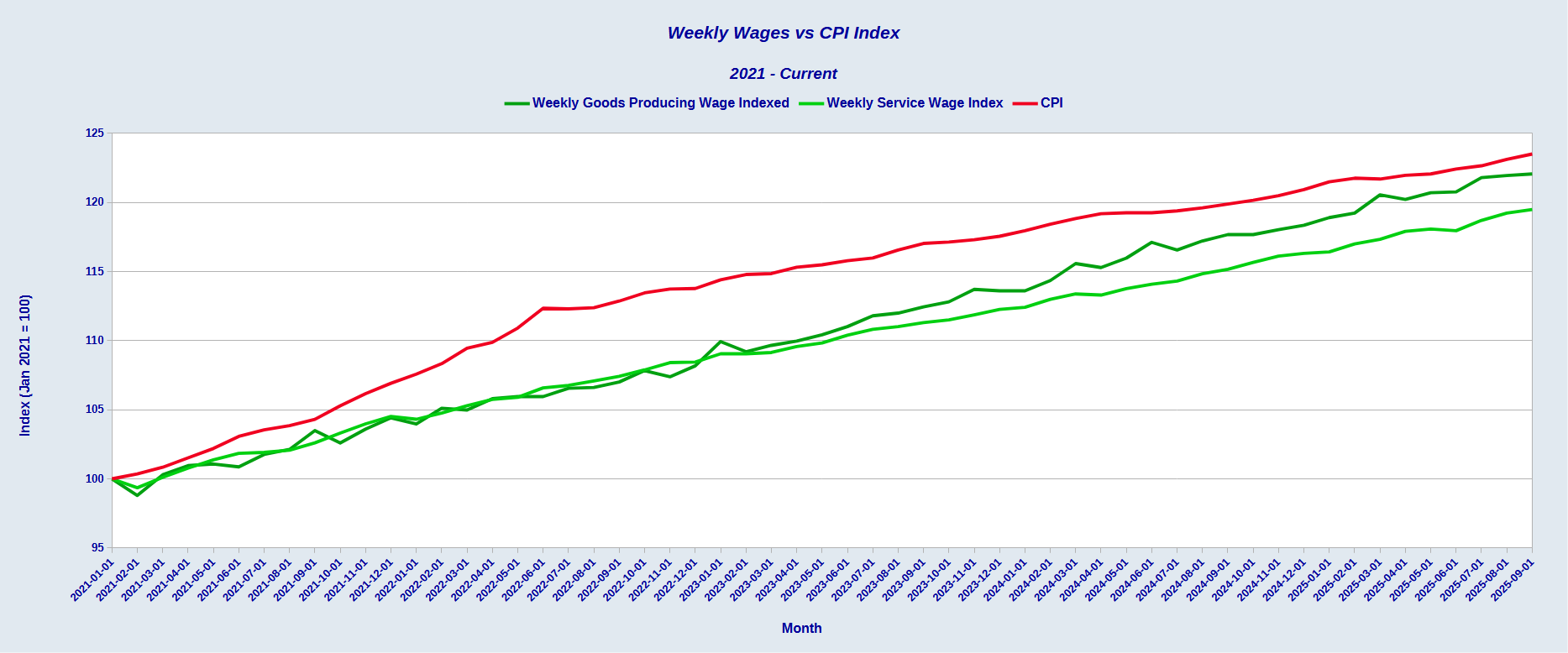
For all the “gains” touted by both the Trump as well as the previous Biden Administration, real weekly wages still have not recovered from the 2022 hyperinflation cycle. Wages declined before and during that episode, and have yet to fully recover.
Nor is there any great mystery as to why wages continue to languish. Workers are not working as many hours as they have in the past.
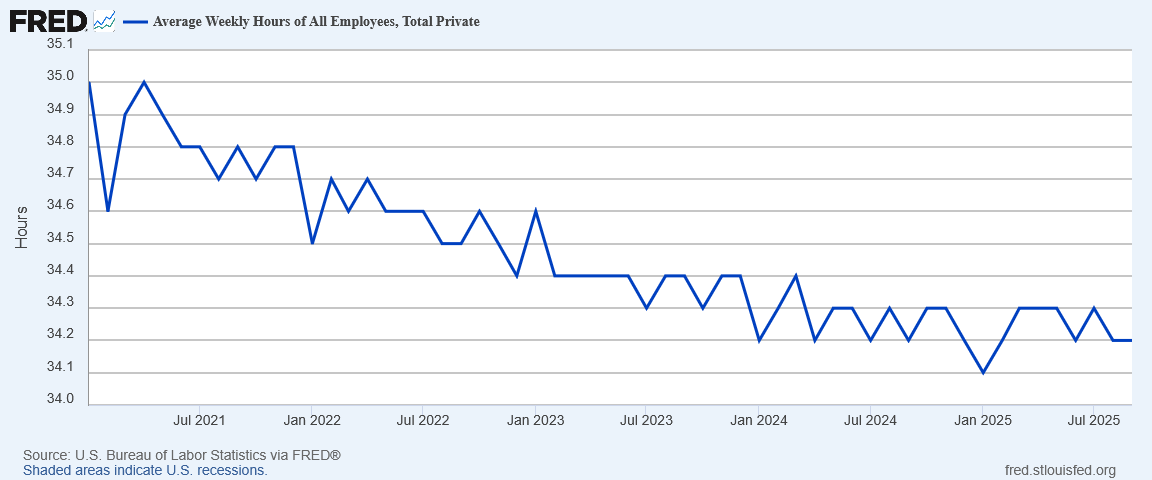
Goods producing jobs have had brief periods of growth over the past five years, but the overall trend has still been down.
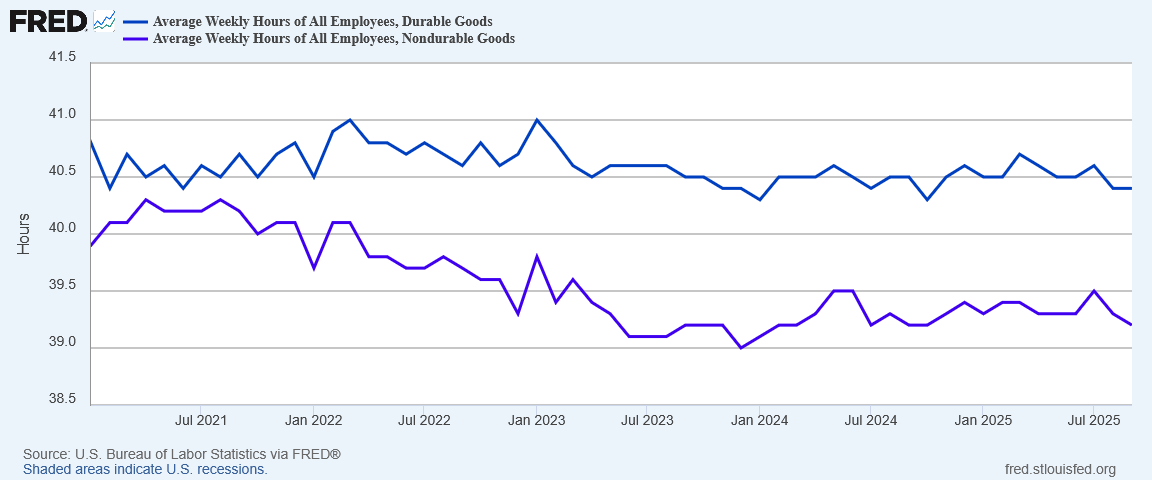
Service sector jobs have fared even worse.
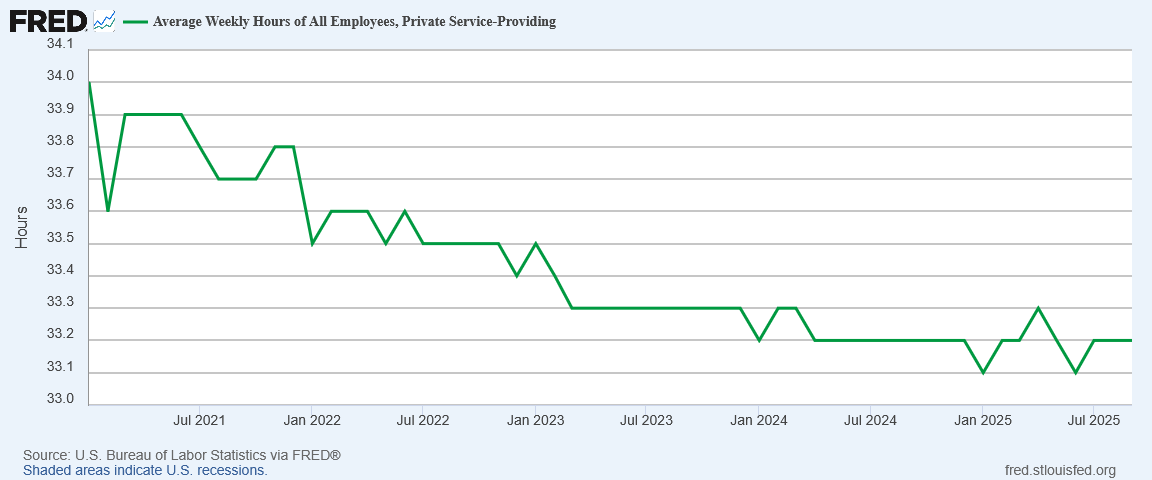
Employment math is simple and brutal: when weekly hours worked decline, so too do weekly wages.
As much as the Trump Administration wants to tout economic successes, workers’ wages still do not count as a success.
Joblessness Still Rising
For all the attention paid to the headline “jobs created” number, a stark reality lurks in the details of the Employment Situation Summary: joblessness is still rising.
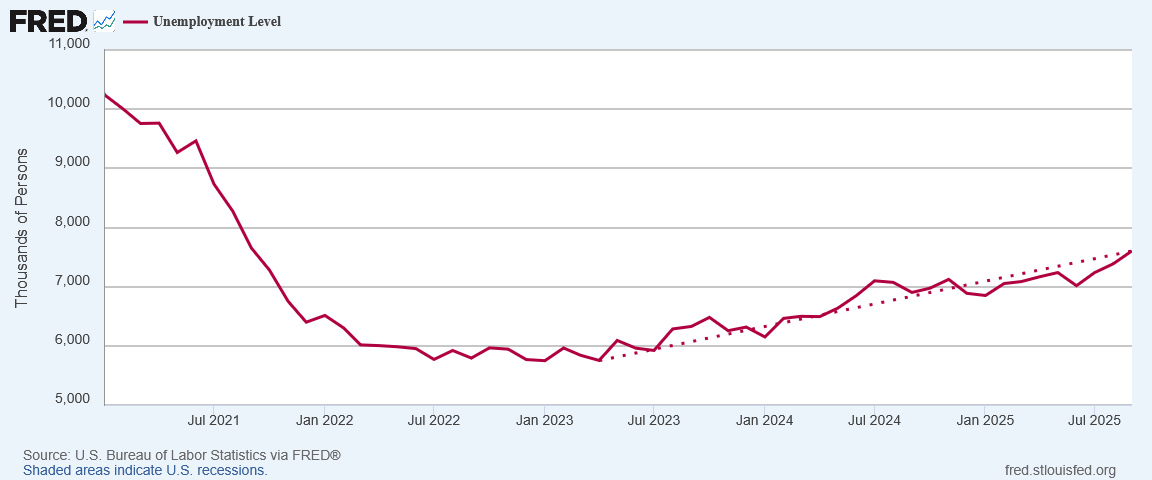
We see that when we look at the unemployment level, which has been steadily increasing since mid-2023.
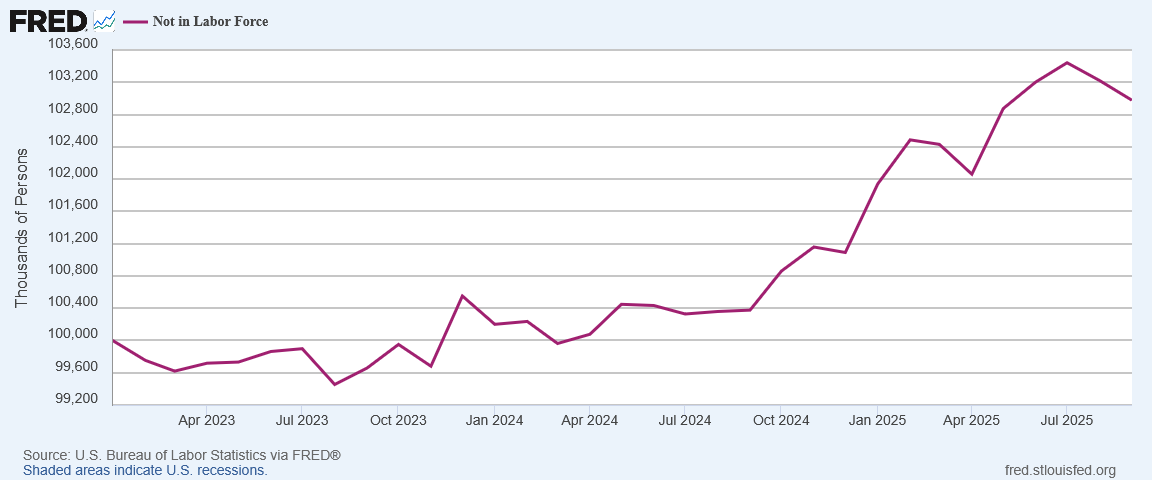
While the number of individuals not in the labor force has declined over the past few months, there is no avoiding that the number has risen significantly since Donald Trump took office.
As a result of these unpleasant realities, the real unemployment rate in this country is significantly higher than the official rate—a rate we can easily assess if we add to the number of unemployed those not in the labor force but who want a job now.
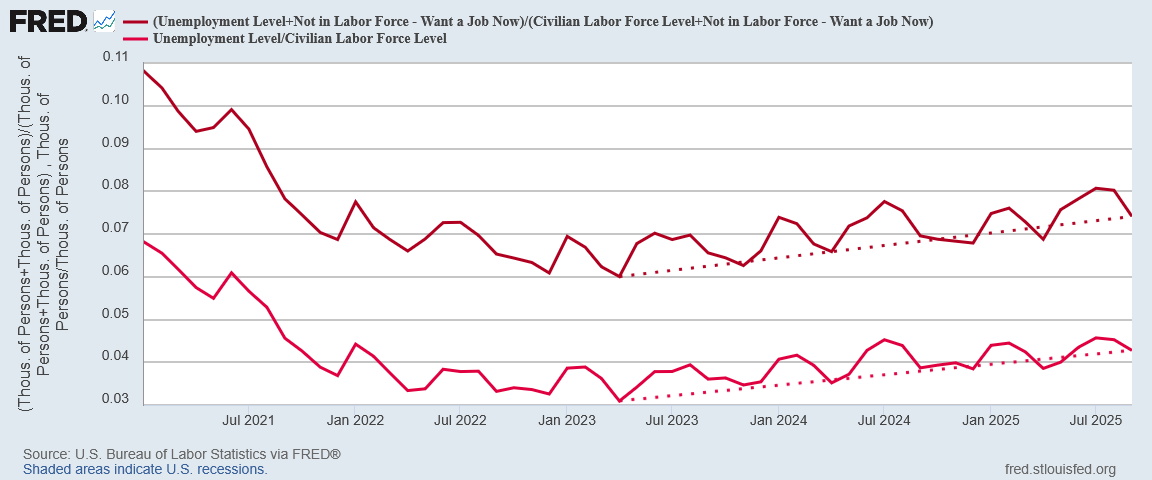
As of September, the real unemployment rate in this country was 7.4%—almost double the official rate of 4.2%. This after declining from 8.0% in August.
This has been a trend of increasing joblessness since April of 2023. Arguably, the jobs recession in this country has been going at least that long.
No, Donald, This Is Not A “Golden Age”
President Trump loves to brag, and loves to brag about America having entered a “Golden Age” especially.
The US economy is clearly not in a “Golden Age” where the American worker is concerned.
It is not a “Golden Age” when manufacturing is losing jobs. This is especially awkward because turning America into a manufacturing superpower is part of Donald Trump’s Agenda 47.
Affordability is part of that agenda as well, but there will be no progress on affordability and inflation if real wages do not rise—which at the moment they are not doing.
Rising joblessness is not part of a “Golden Age” for any economy. Rising joblessness is what is happening in the US economy right now. To be clear, that joblessness did not start with Donald Trump’s second term of office, and we cannot say the joblessness is solely the result of his economic policies. We can say—and should say—that Trump’s economic policies have yet to reverse that trend.
We need President Trump’s economic policies to reverse that trend, and they have not.
We need President Trump’s economic policies to create new manufacturing jobs, and they have not.
We need President Trump’s economic policies to spur real wage growth, and they have not.
Perhaps they will. Perhaps with the coming of the new year there will be renewed job growth and an end to the jobs recession this country has endured for more than two years. Perhaps with the coming of the new year we will finally see real wage growth in this country.
I certainly hope this proves to be the case. I voted for Donald Trump. I voted for Agenda 47. I want to see Trump succeed, and I want to see Agenda 47 fully implemented.
On jobs, Donald Trump has not yet succeeded, and Agenda 47 has not been fully implemented.
As with all economic metrics, it is easy to be seduced by the headline numbers in any data set and consider them to be an accurate and complete portrayal of the entire data set. Corporate media certainly is willing to be seduced by the headline numbers on jobs as they are on inflation. The Trump Administration—like all presidential administrations—is more than happy to encourage such seduction.
Yet we do ourselves a disservice if we are seduced, and corporate media does a disservice if they are seduced. Official Washington absolutely does a disservice when they are seduced.
We need to look at all the data, and we need to consider the impact of all the data.
The impact of all the jobs data is that this country is still in a jobs recession. For most individual economic sectors, the impact of all the jobs data is that the jobs recession got demonstrably worse in September.
Labor markets are still not doing well in this country. Workers are still not doing well in this country. That means the economy is still not doing well.
The headline jobs number was a good number for September jobs report. That was the only good number in the jobs report. The rest were somewhere between grim and gruesome.
That's the reality described by the details of the September Employment Situation Summary—somewhere between grim and gruesome.
Since 2021, the US has come off the idiotic Covid shut down, and has experienced annual inflation rates as high as 8%. Additionally, it has experienced artificially high interest rates as a result of poor stewardship and fraudulent economic data (like the job reports you constantly expose). In short, the US economy has been somewhat of a shit show. IMO the real question now is: Are Trump economic policies the proper way to right this ship, and when will we have enough economic history and data to determine the answer to this question?
I still have hopes that Trump’s plans for increased domestic manufacturing will significantly increase in 2026. But yes, there are worrying signals. A couple of writers on Substack have recently pointed out that the transport of goods is dramatically down, indicating a coming severe recession. Peter, do you also see this as a horrible sign, or do you think it’s being overblown?