


In May the Personal Income and Outlays Report indicated that consumer price inflation may have peaked—for now. Then came the June Consumer Price Index Summary which printed outright deflation nearly across the board.
Now, in the June Personal Income and Outlays Report we have seeming confirmation of the CPI print of outright deflation, with all categories showing at least disinflation month on month, and several in outright consumer price deflation.
From the preceding month, the PCE price index for June decreased 0.1 percent. Excluding food and energy, the PCE price index increased 0.1 percent.
From the same month one year ago, the PCE price index for June increased 3.7 percent. Excluding food and energy, the PCE price index increased 3.3 percent from one year ago.
Unlike with the Consumer Price Index, the PCE Price Index (PCEPI) was right in line with expectations. Both Wall Street and the Trading Economics forecast guessed correctly for the year on year inflation rate.

Even the Cleveland Fed’s inflation nowcast matched the final PCEPI inflation print.
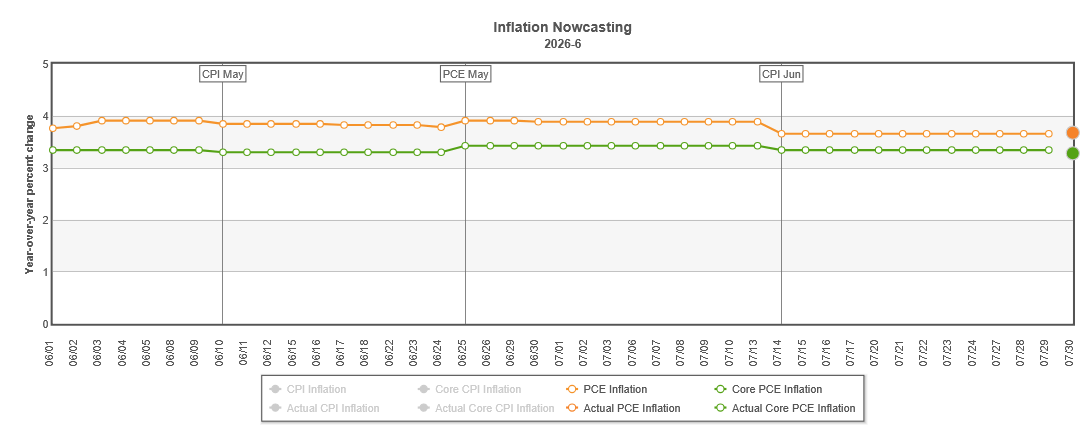
Is the June PCEPI report a confirmation that inflation has peaked, and that inflation will not rise uncontrollably in the future? If everything had stayed as it was in June, that would have been a realistic read on the data.
With the war with Iran heating back up, and with the Strait of Hormuz once again being contested, it is already virtually certain inflation will return for July, and if a fresh oil supply shock develops, stagflation is still a very real hazard.
June will prove to be just a pause for inflation returns, and the risks of stagflation grow.
Headline Inflation A Repeat Of CPI Print
The immediate takeaway from the headline inflation numbers for the PCE Price Index is that they are essentially a repeat of the June CPI data: deflation month on month, and disinflation year on year, are very much the order of the day.
Year on year, PCEPI headline inflation dropped from 4.1% to 3.7%.
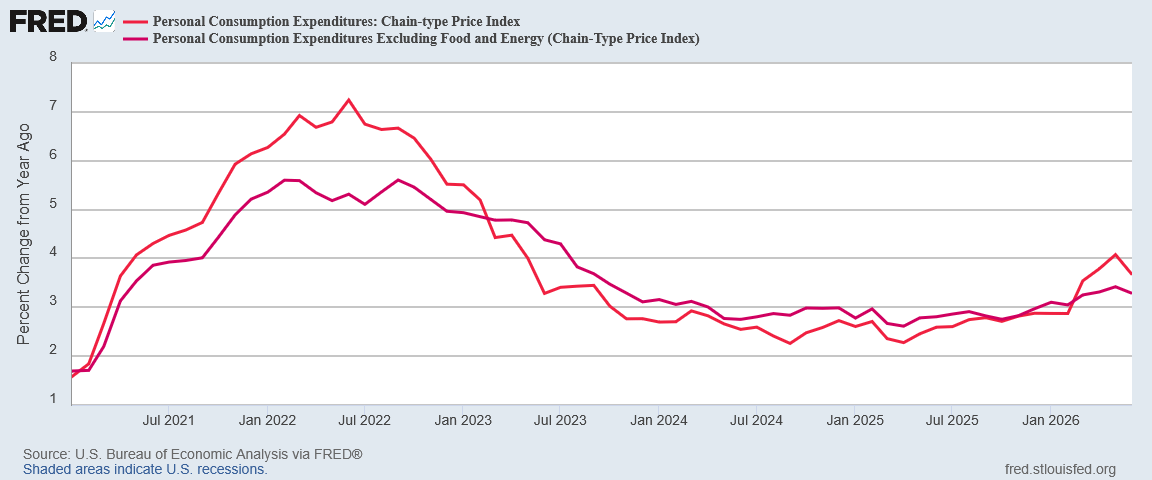
Core inflation dropped from 3.4% to 3.3%
Month on month, the headline PCE Price Index printed outright deflation, dropping from 0.5% to -0.1% from May to June.
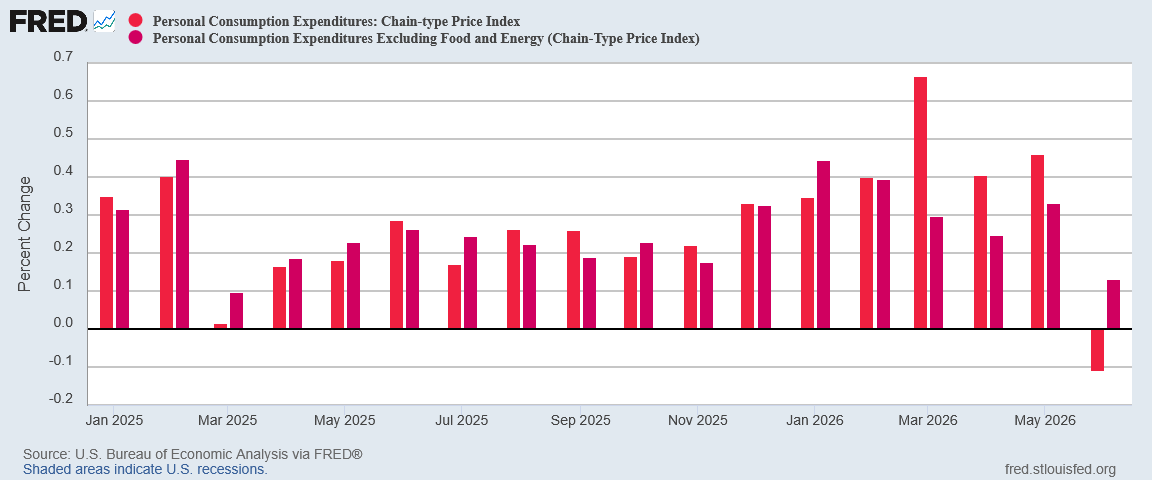
The core index still showed some inflation, but printed a healthy 0.2% decline month on month, to 0.13%, the lowest month on month core inflation print since March 2025.
There is no denying that the headline numbers, just as with the Consumer Price Index, are exactly what consumers want to see, and show prices moving in the right direction.
Even drilling into the details underneath, the data continued to show healthy downward price movements.
Energy Down, Food Up
Just as with the CPI print, deflation was not quite universal. Some price sectors still printed positive inflation rates, albeit lower rates in most cases.
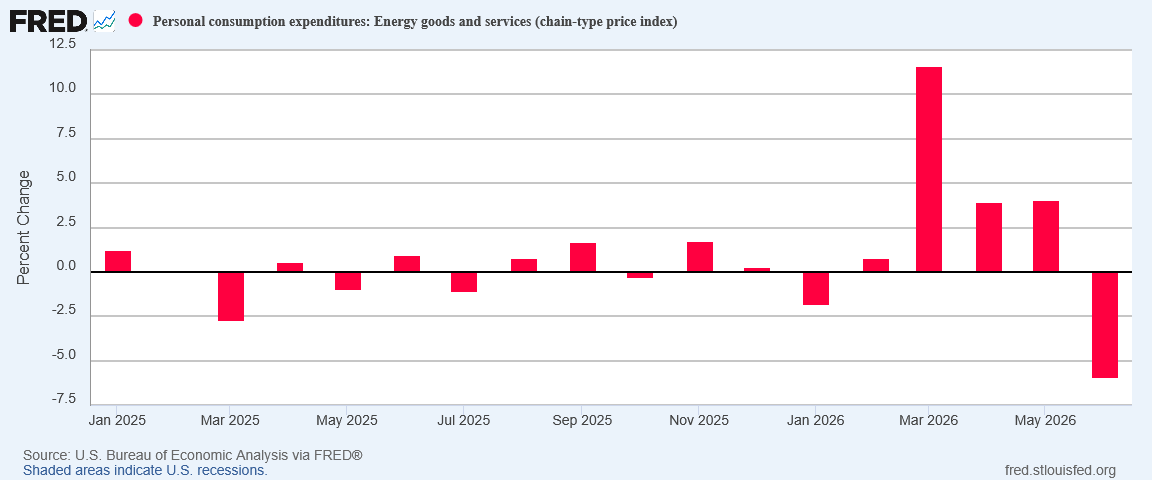
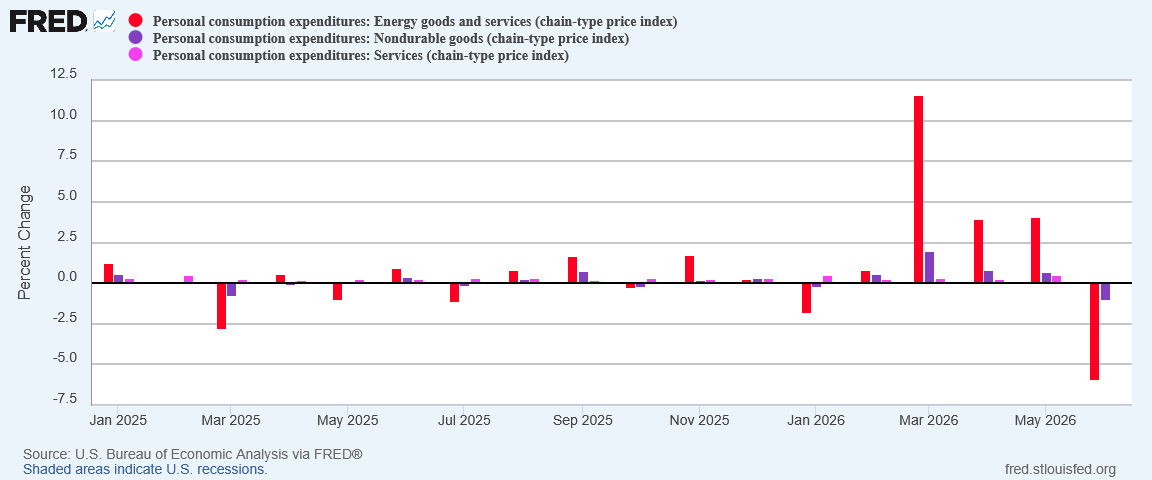
Just as with the CPI, the month on month energy price inflation rate was negative, printing a steep -5.9% decline just for the month of June.
Nor is there any great mystery as to why energy prices printed deflation for the month: Benchmark oil prices dropped significantly, with the September contract for Brent Crude dropping $18/bbl, to $73.19/bbl by the end of the month, and West Texas Intermediate dropping to $69.34/bbl.
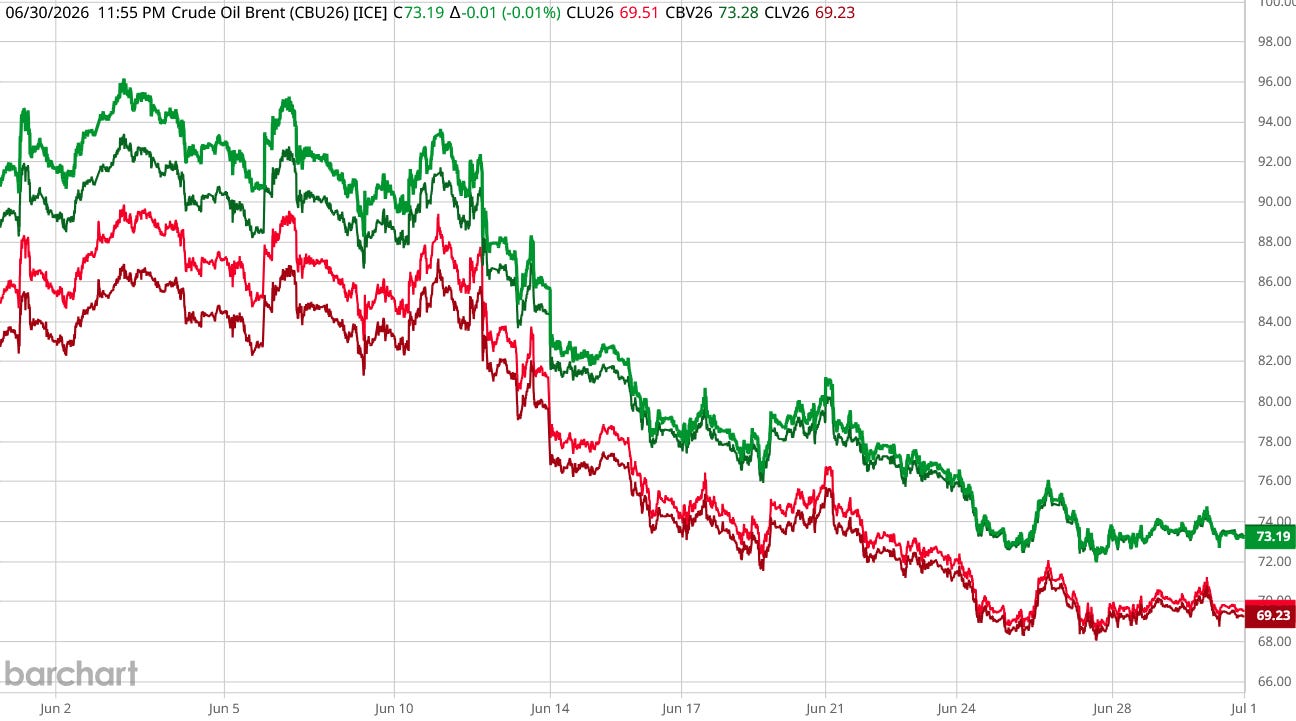
The spread between the September and October contracts all but vanished, with the spread between Brent and West Texas Intermediate narrowing as well.
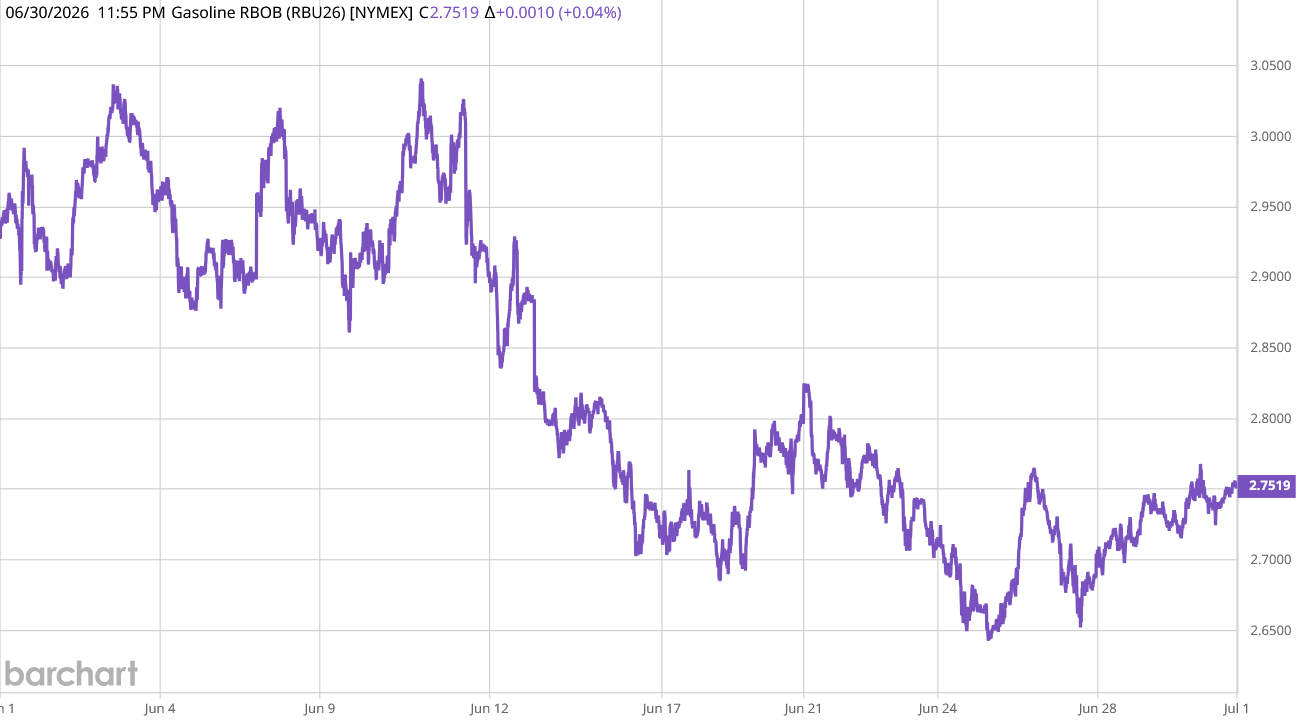
Refined products trended down as well, with RBOB Gasoline dropping $0.18/gal, to $2.75/gal for the September contract.
Prices at the pump fell throughout the month, based on Energy Information Administration data.
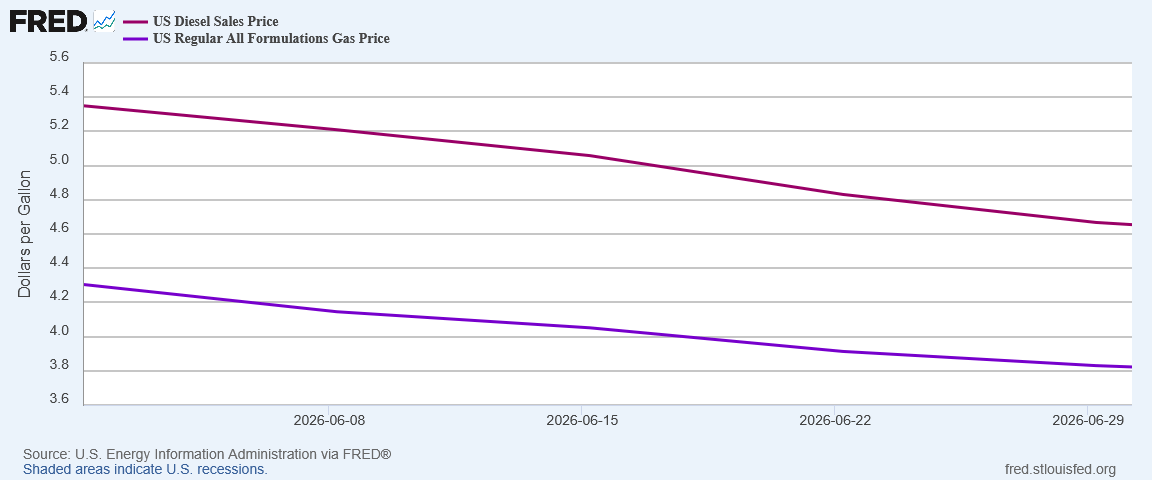
June was definitely a month when peace prospects in the Middle East translated into steep declines in energy prices, steep enough to cool the entire PCE Price Index.
The news was not universally good, however, as food was the notable exception to the deflationary/disinflationary trend for the month.
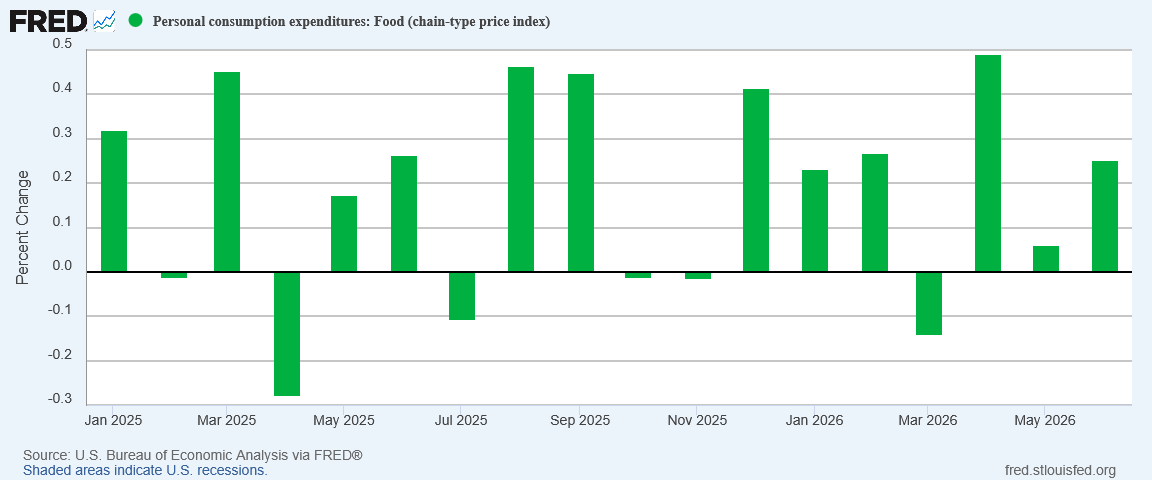
After flirting with food price deflation for May with a 0.06% month on month print, food prices rebounded, with the inflation rate rising in June to 0.25% month on month.
It grew cheaper to fill your gas tank in June, but it grew more expensive to fill your belly.
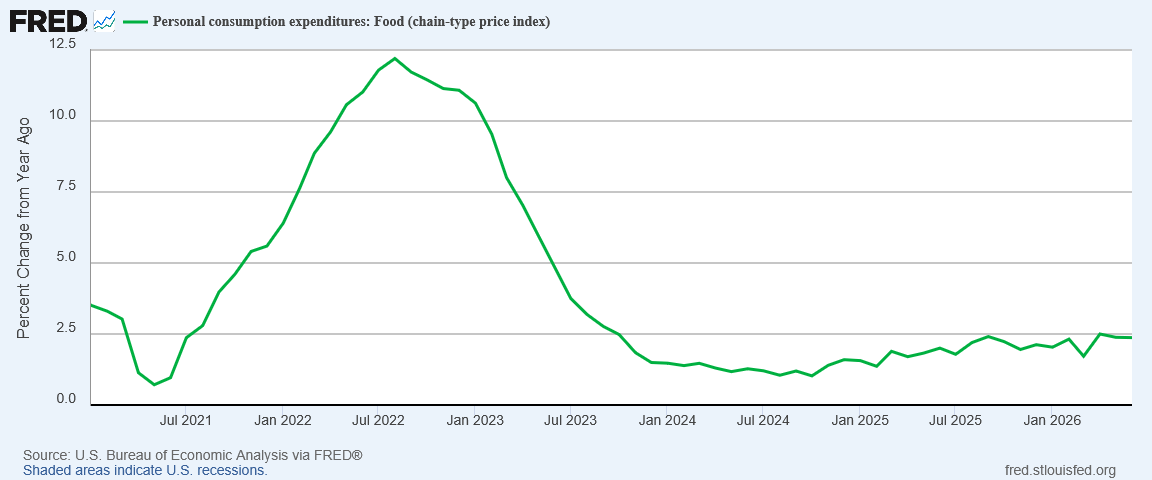
However, over the longer time frame, food prices are not destabilizing. Despite the month on month fluctuations, year on year food price inflation has been hovering just below 2.5% since September of last year.
Durable Goods Almost Unchanged, Non Durable Goods Sharply Down
While durable goods did not repeat its deflationary performance from May, it only barely printed actual inflation, registering a barely perceptible 0.02% month on month.
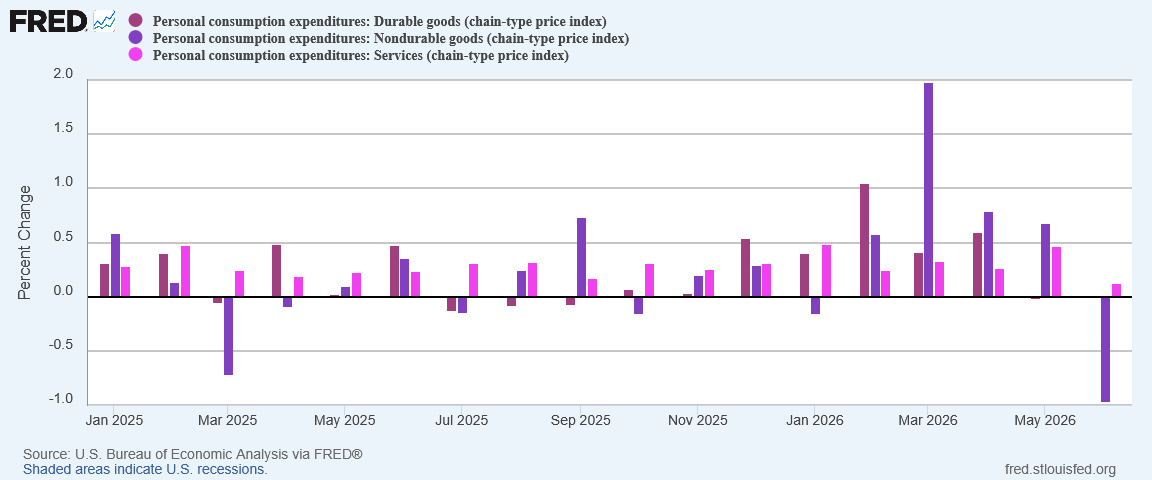
Nondurable goods printed the most deflation, falling nearly a percentage point on the month. While service price inflation rose on the month, at 0.13% services inflation rate is the lowest since the start of the Trump Administration 2.0.
The drop in nondurable goods prices was, of course, almost entirely due to the drop in energy prices.
Yet while prices were down, consumption was not. Real spending on durable and nondurable goods actually rose in June.
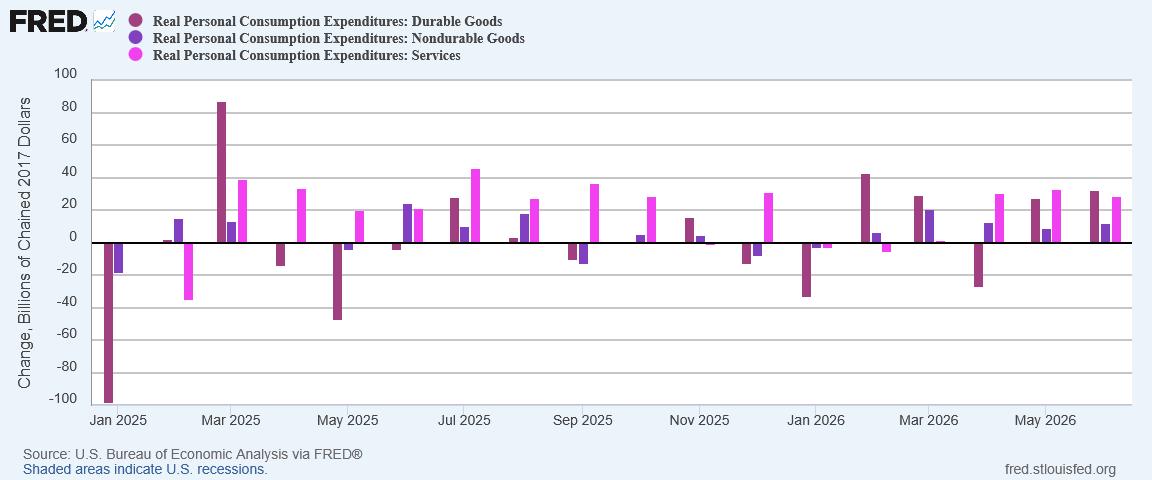
Only real spending on services declined marginally month on month.
This is particularly encouraging, as it means the drop in prices is not due to declining demand, but to expanded supply. It is also further confirmation that the energy price inflation from the spring months never spilled over into other areas.
Even AI Could Not Drive Inflation In June
It is worth noting also that the AI inflation fear from May did not carry over into June, as the index of computer hardware prices declined.
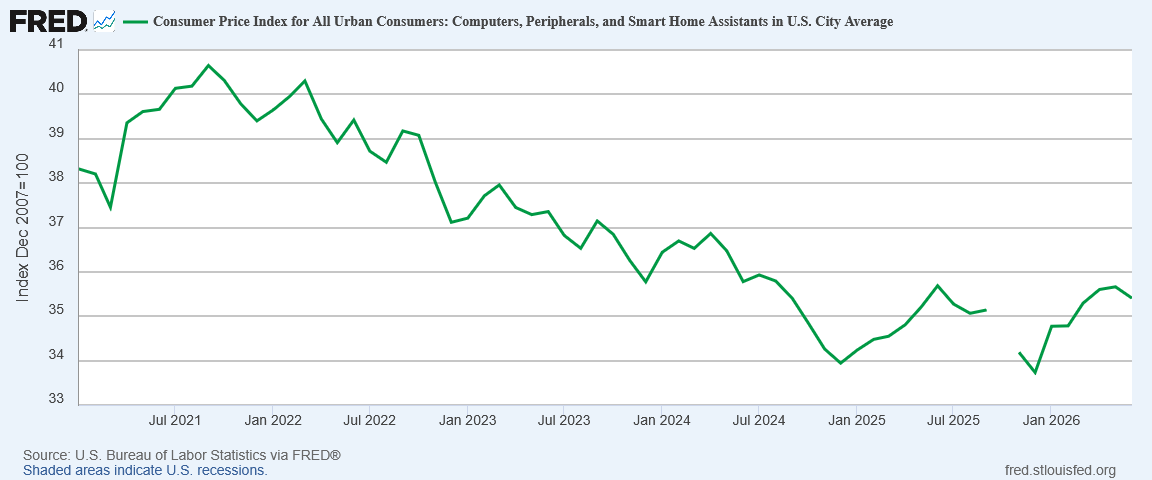
One month does not make a trend, of course, but one month does disrupt an existing trend. In this case, the index for computer hardware prices ended its increase that began in December of last year.
Does this mean the AI boom has peaked, and Wall Street’s AI bubble is soon to burst? One month’s change will not answer that question, but easing hardware prices means either supply of memory chips, et cetera, has expanded or demand eased in June.
The former would be a very positive sign of economic growth. The latter could be a warning sign that Wall Street’s AI bubble is indeed bursting or about to burst, with all the ramifications for equities that attend upon a ruptured asset bubble.
It Will Not Last
The June PCEPI print is undoubtedly good news. It will not be repeated in July.
We know this because we have seen a month’s worth of news headlines about the collapse of the Memorandum of Understanding between the US and Iran.
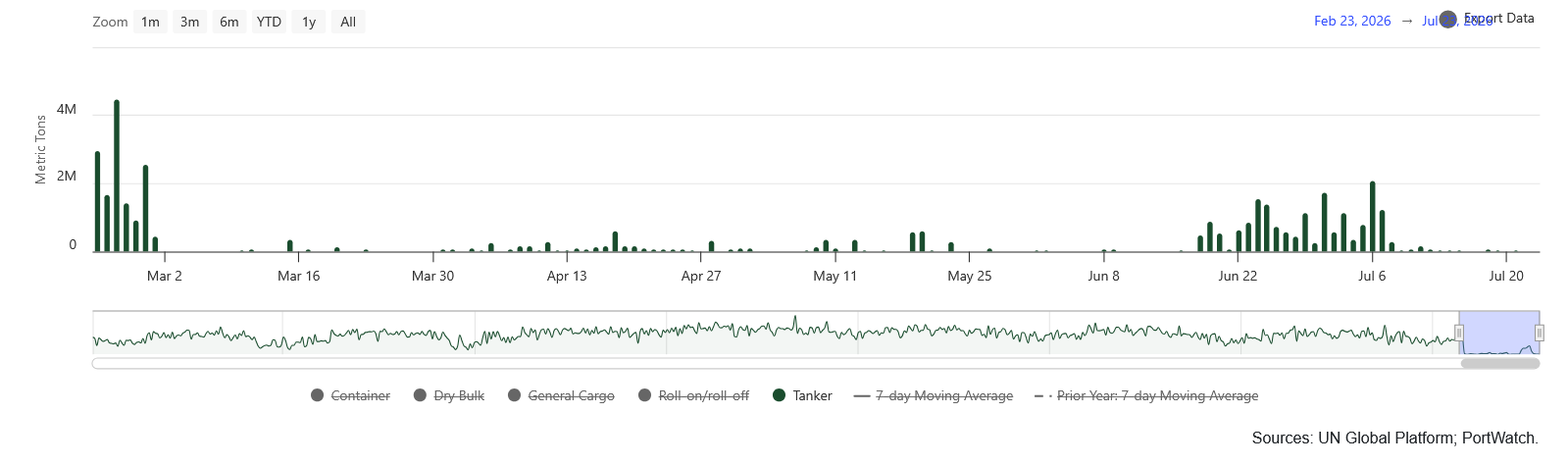
We know this because traffic in the Strait of Hormuz has collapsed yet again.
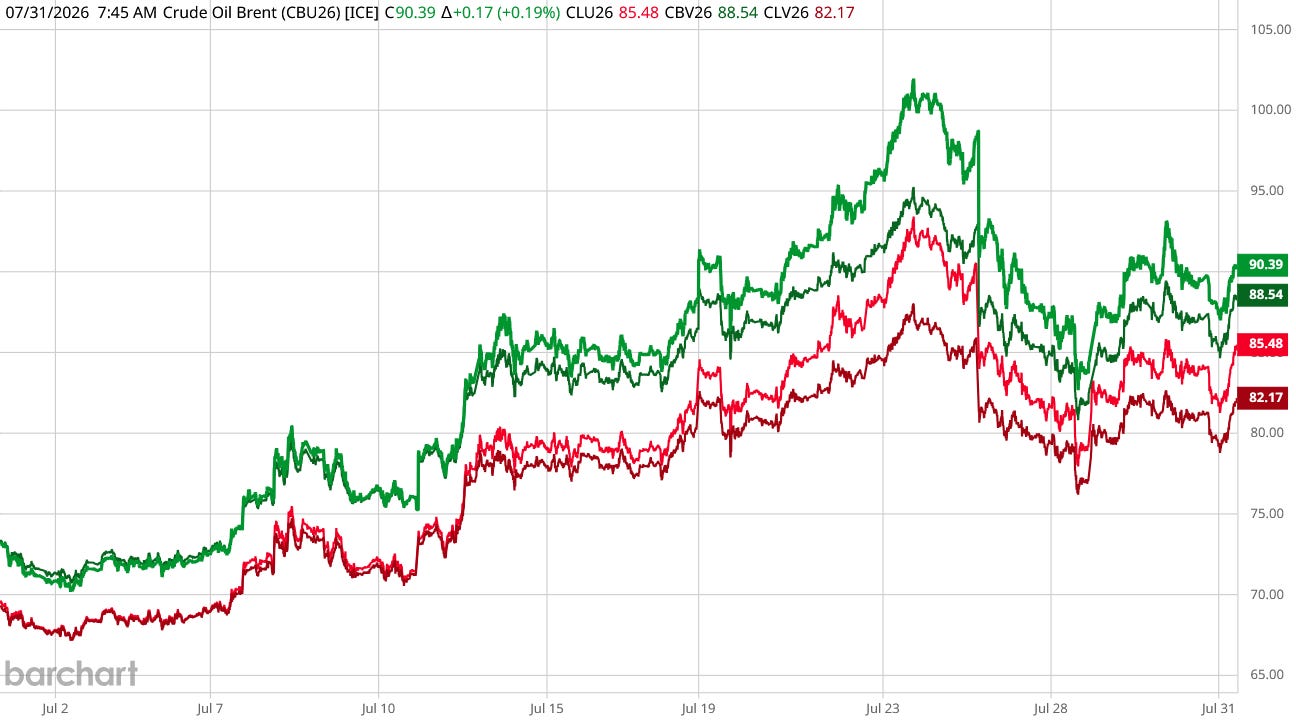
We know this because oil prices, after falling in June, rose sharply again in July.
We do not yet know how these will register on the July Consumer Price Index Summary or the July Personal Income and Outlays Report—the July CPI print will not be read for another twelve days—but basic economics tells us which direction the movements will be. Energy prices will rise, energy price inflation is sure to rise, and that means headline consumer price inflation is also likely to rise.
With oil prices having recovered nearly all the pricing surrendered in June, unless there is a new ceasefire and a return to the negotiating table, a second oil supply shock is sure to hit economies around the world, including the United States’. If the Strait of Hormuz is closed for an extended period, or if Persian Gulf oil production infrastructure is severely damaged, the oil supply shock could become a reduction in global oil supply for the foreseeable future. That would be the “oilpocalypse” scenario, where energy prices soar, with all the attendant economic wreckage one expects when a price surges uncontrollably.
The oilpocalypse is not a certainty. Peace would certainly ward it off, and if Persian Gulf oil infrastructures suffer only minimal damage in future attacks, if there is an oil supply shock it may prove less severe than might otherwise be the case.
What is a certainty is that energy prices have already risen for July. Inflation cooled in June, but it is a certainty it will heat up again in July—and quite possibly beyond.
June was a welcome pause in a trend of rising consumer price inflation. Unfortunately, a pause is all we will get. More inflation is headed our way.
I keep reading about our Debt blasting past 40T, so I asked AI "has the USA ever not been in debt?? Here is the answer: "Yes—once. The US started life in debt (over $75 million from Revolutionary War financing by 1791) and has been in debt continuously ever since 1837, but there was a brief window under President Andrew Jackson when it hit zero. Jackson made eliminating the debt a personal crusade, calling it a "national curse." Through aggressive tariffs, vetoing spending bills, and selling off federal land, he drove the debt down from about $58 million in 1829 to nothing by January 1835. On January 8, 1835, Congress formally announced the national debt was paid in full — the only time in US history that's happened (TreasuryDirect, NPR).
That debt-free condition lasted only about a year or two. The Panic of 1837 hit soon after — tied partly to the same policies (bank liquidation, the Specie Circular) that had enabled the debt payoff — and the government had to start borrowing again almost immediately. The US has run a national debt continuously ever since, now around $38 trillion.
So the honest answer is: briefly, yes, but it's been a 190-year debt streak since then with no sign of repeating it."
Now I'm not 100% trusting of AI and I only asked Perplexity, but it certainly seems like debt is the American Way so the consequences of inflation, rates and productivity etc are all complicatedly connected. Complicated to me, but not to Peter.
Every time you post an analysis like this, Peter, I am consciously grateful for your balanced and highly intelligent work. I’ve said it many times: you are a treasure!
There are scenarios leading up to the midterm elections where economic indicators may balance out, at least in the eyes of the voters. IF the war ends, IF the AI bubble doesn’t collapse in some catastrophic way, IF no new disaster happens.
Last week, I saw some article about China’s stock market losing more than a trillion dollars of value within a very short time, but I’ve heard nothing more about it. The Korean stock market apparently has also dropped considerably, as of today. But sometimes these articles amount to just clickbait. If you see any substantial indicators of Asian stock turmoil, I hope you will bring your level-headed genius to sorting out what’s happening. We all know - thanks, in part, to you - how precarious the financial world is. Thanks, Peter!