


The October Employment Situation Summary from the Bureau of Labor Statistics is unquestionably a strong jobs report.
Remarkably, the October jobs report still managed to be a surprise, despite twin leading signals from the September JOLTS report and the October ADP report that strong jobs numbers were to be expected. Neither of those signals indicated the October jobs report would be as strong as it is.

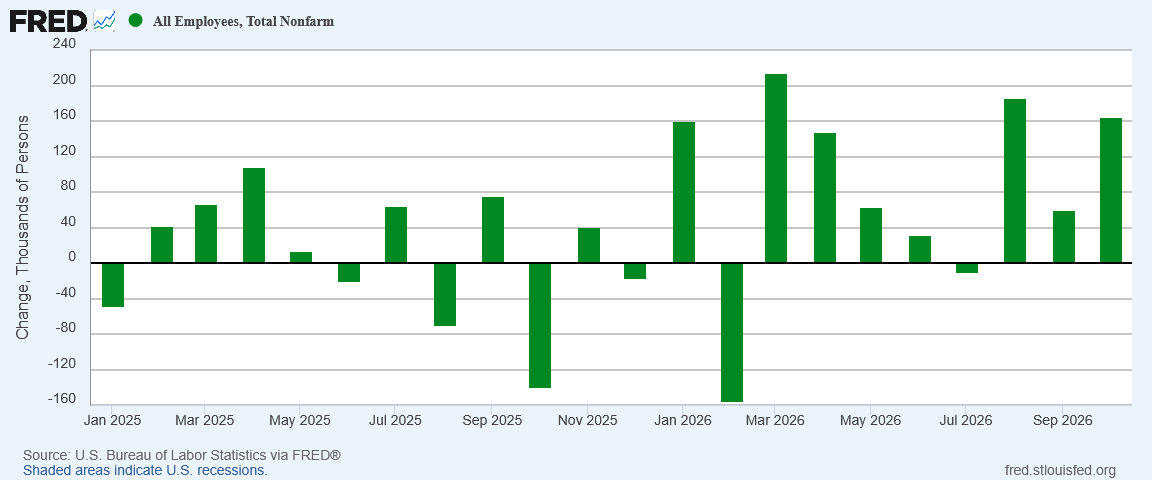
Total nonfarm payroll employment rose by 165,000 in October, and the unemployment rate changed little at 4.1 percent, the U.S. Bureau of Labor Statistics reported today. Employment increased in professional and business services, in health care, and in transportation and warehousing.
165,000 jobs surpassed Wall Street’s expectations by 100,000 jobs.

Even within the private sector, at 159,000 jobs Wall Street’s expectations were surpassed by 95,000 jobs.

By any measure, those are blowout results.
As was the case in August, even if there are downward revisions next month, the net result is still likely to be a strong jobs growth figure for October.
Whether through methodological errors or economic resiliency, October succeeded in replicating August, with labor rebounding bigly after a poor jobs report the month prior.
Will the numbers hold? The data suggests they may.
Not Lou Costello Labor Math
This being a report from the Bureau of Labor Statistics, the very first thing we must do is ponder the possibility of the numbers simply being garbage. Even under President Trump, the BLS has retained its peculiar predilection for Lou Costello Labor Math.
Yet the thumbnail test—comparing movements within the major labor surveys—shows job gains in each.
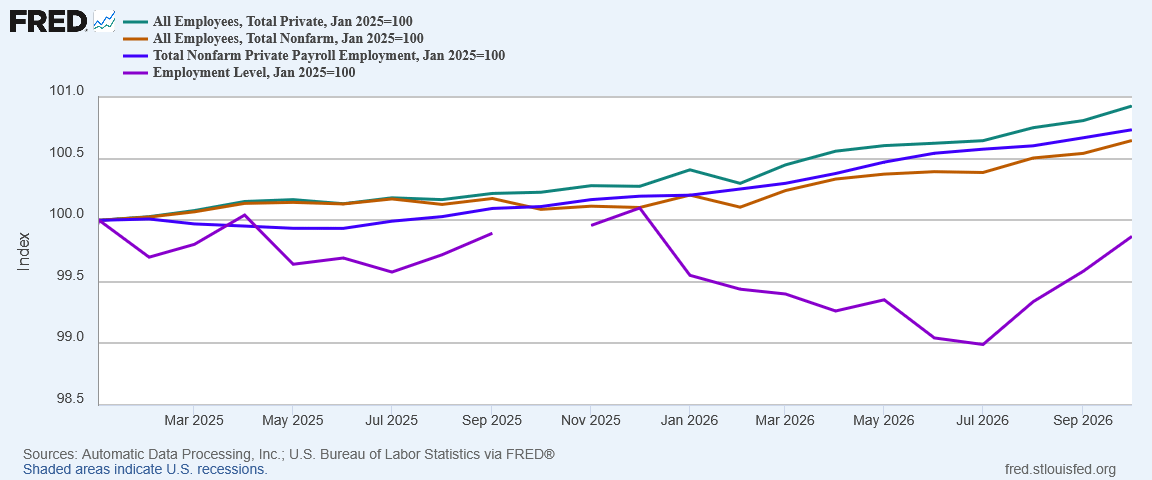
The magnitudes vary, and we should expect revisions, but both the Household and Establishment surveys within the ESS and the ADP National Employment Report show job growth in October.
We can get a further vote of confidence in the October jobs report from the fact the monthly revisions to the prior two months’ data were to the upside.
The change in total nonfarm payroll employment for August was revised up by 53,000, from +133,000 to +186,000, and the change for September was revised up by 31,000, from +29,000 to +60,000. With these revisions, employment in August and September combined is 84,000 higher than previously reported.
For 2026, the total of all revisions thus far has been a net reduction of 32,000 jobs from initial reporting.
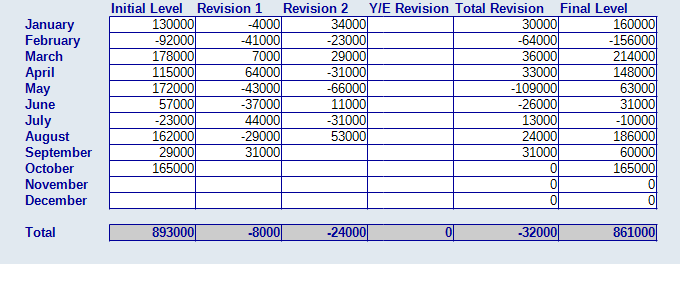
As I assessed when reviewing the September JOLTS report, upward revisions were highly likely.
Will we see the September jobs numbers revised up when the ESS report comes out on Friday? That is a real possibility, especially in Trade, Transportation, and Utilities, given by how much the JOLTS data surpassed the ESS data.
We should not conclude from these signals that the October ESS is highly accurate. We can conclude that the October ESS is plausible, is reasonable, and is likely not the result of Lou Costello Labor Math.
A Strong But Mixed Jobs Report
Even with upward revisions of previous months, the October jobs number of 165,000 jobs is a considerable increase over September.
The private sector jobs number of 159,000 jobs is likewise a dramatic surge after September’s data.
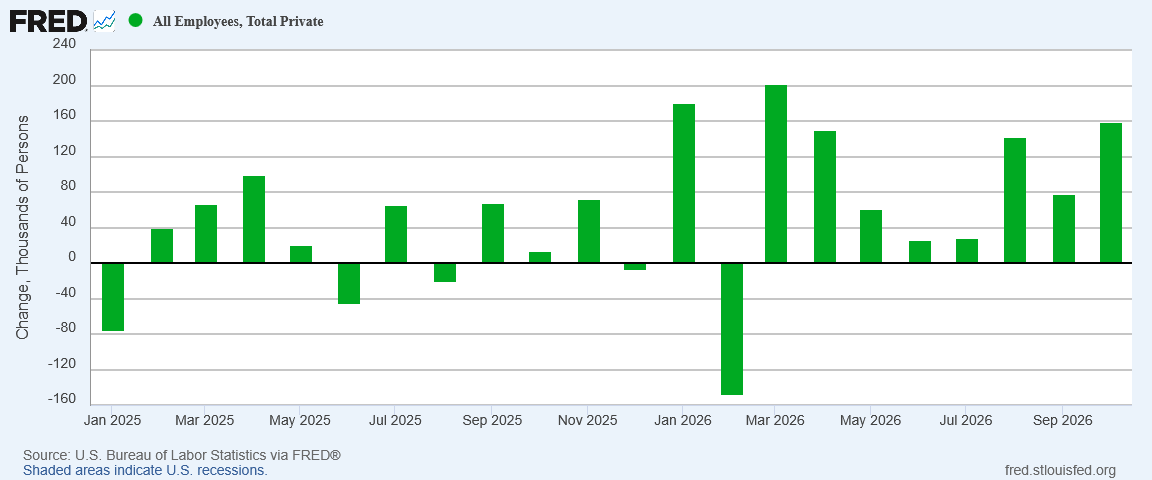
October was even an improvement over August for the private sector.
Yet we should not overlook that there were still sectors which posted job losses for the month. As good as the report is, it is not an across the board success.
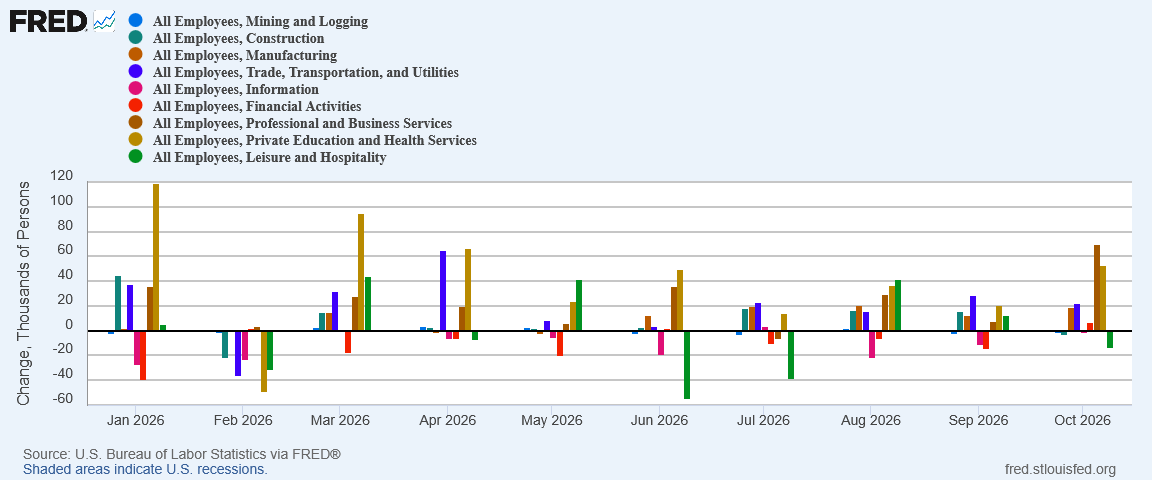
The surprise job growth leader for October was Professional and Business Services, at 70,000 jobs.
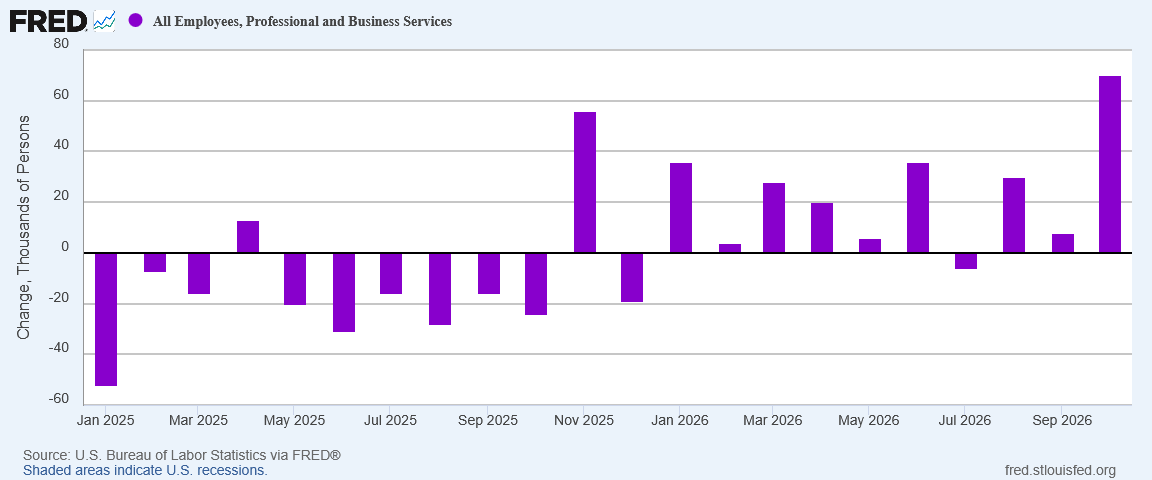
This marked the first time all year that sector led the way in job creation.
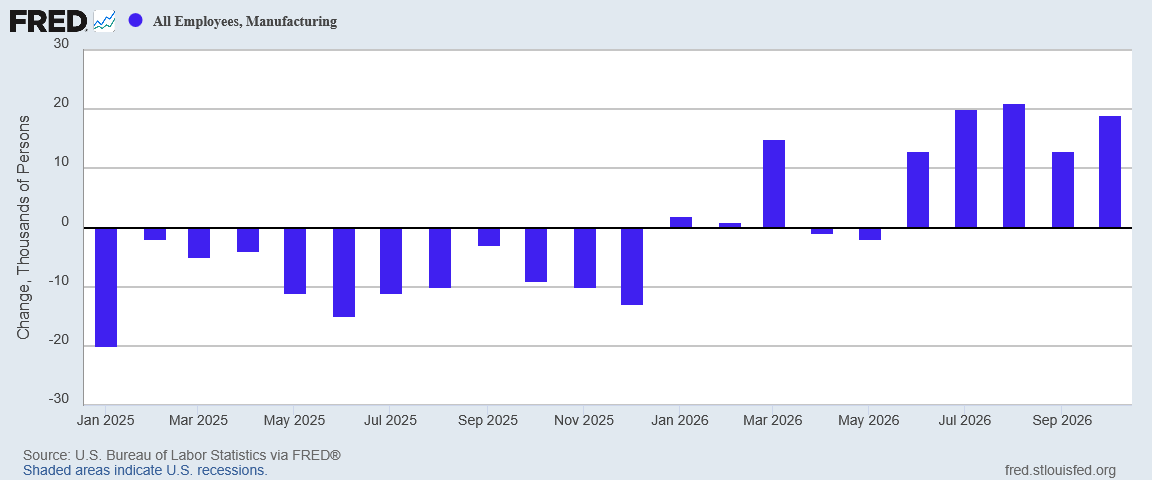
Manufacturing continued its recent trend of modest job gains at 19,000 jobs.
Healthcare returned to strong job growth as well at 53,000 jobs.
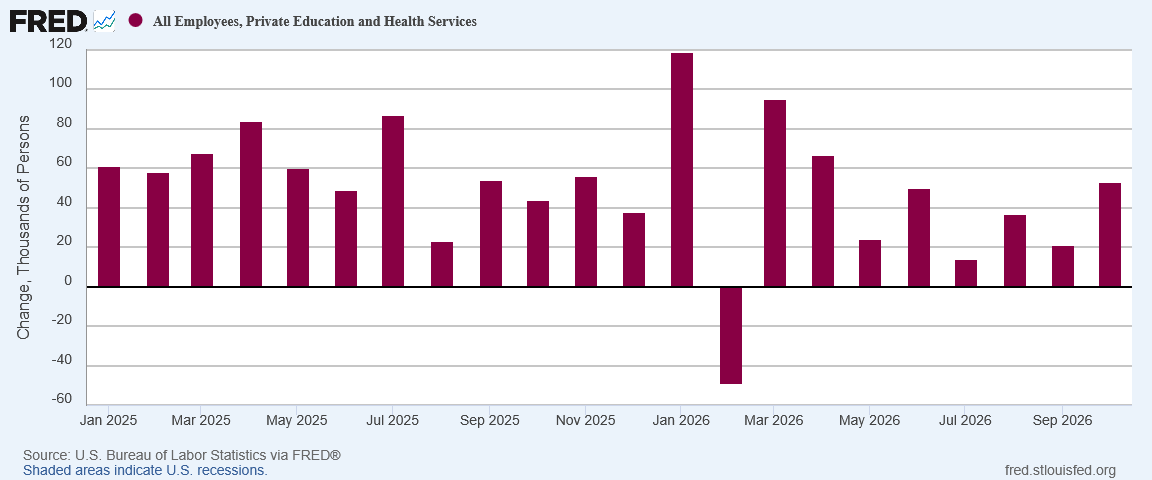
After a summer of relatively weaker job growth, October was very much a return to form for Healthcare.
Both Finance and Trade Transportation and Utilities contributed incrementally to job growth, at 7,000 and 22,000 jobs respectively.


By comparison, the losing sectors had relatively mild job losses. Mining (-1,000 jobs), Construction (-3,000 jobs), and Information (-1,000 jobs) showed only marginal decreases. Only Leisure showed job loss of any significance with 13,000 jobs gone.


As the overall numbers attest, the job losses were very small next to the job gains. Nevertheless, there were job losses. The rising tide did not lift all ships. That is a cautionary that economic growth in the US is likewise not across the board. Some sectors are doing well, others not so much.
ADP and ESS Numbers Do Not Align By Sector
While both the ADP and the ESS jobs numbers for October are unquestionably strong, one grain of salt we must take with both reports is that the sector level numbers do not align at all well.


Theoretically, the ADP and ESS jobs numbers are sampling the same broad data set. Theoretically, we should expect to see similar trends in both reports.
While the trends are broadly similar, the Employment Situation Summary still shows 0.2pp greater private job growth than the ADP National Employment Report since January 2025.
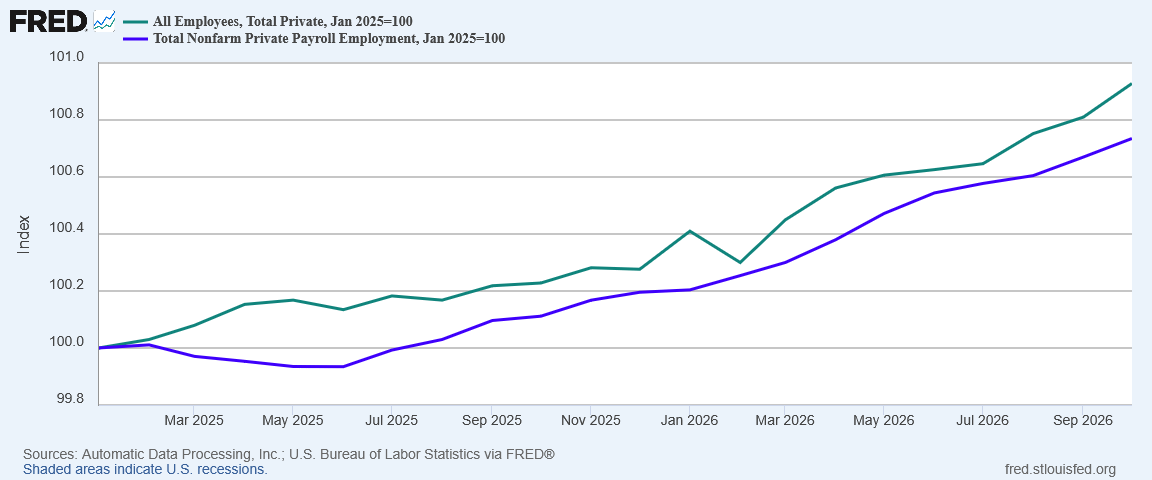
ADP is consistently the more conservative of the two. Given the history at the BLS of garbage reporting, we are not unreasonable in taking this an indication the BLS is still overoptimistic in its data modeling.
Still, the variances are primarily that of magnitude. The caveat is not whether there are job gains, but how much job gains there are.
Real Unemployment Rose
Another caveat to the ESS data is that the number of people not in the labor force but who want a job now rose in October, even as the unemployment level fell.
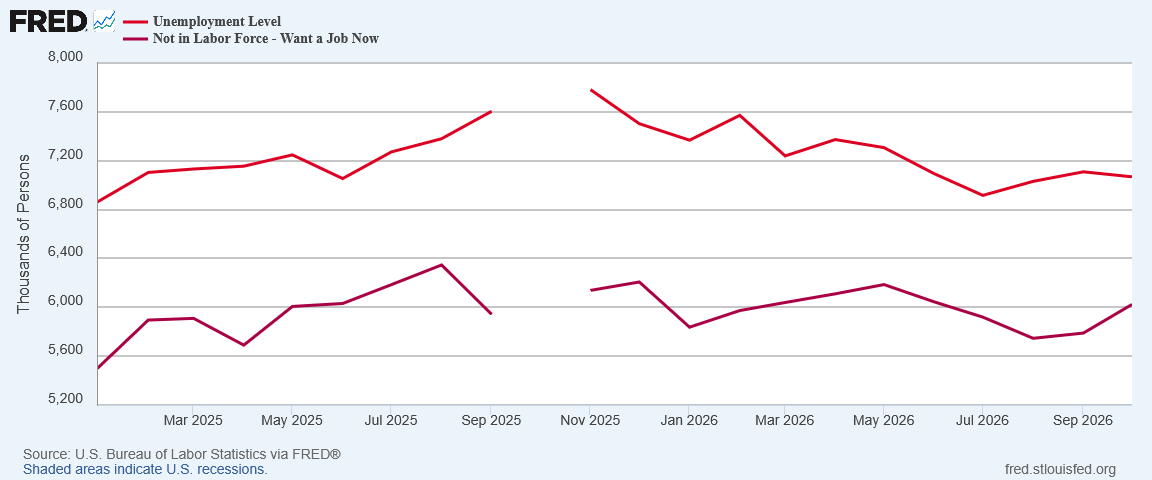
The net effect of this is a slight increase in the real unemployment rate from 7.3% to 7.4% even as the official unemployment rate fell to 4.1%.
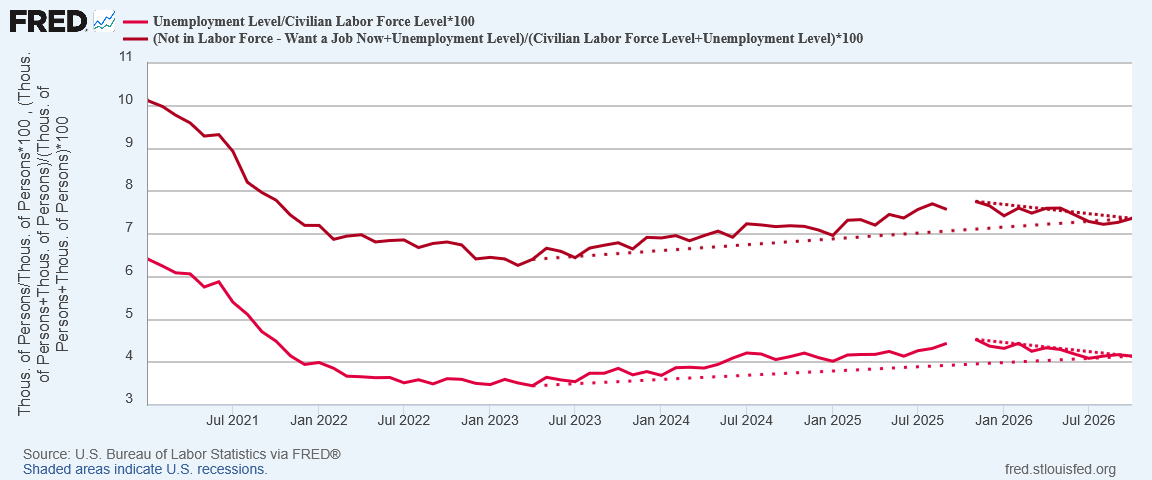
The trend in the real unemployment rate over 2026 is still a decline, although October marks the second month that rate ticked up.
At the same time, the overall employment level in the US rose to 163,615,000 in October.
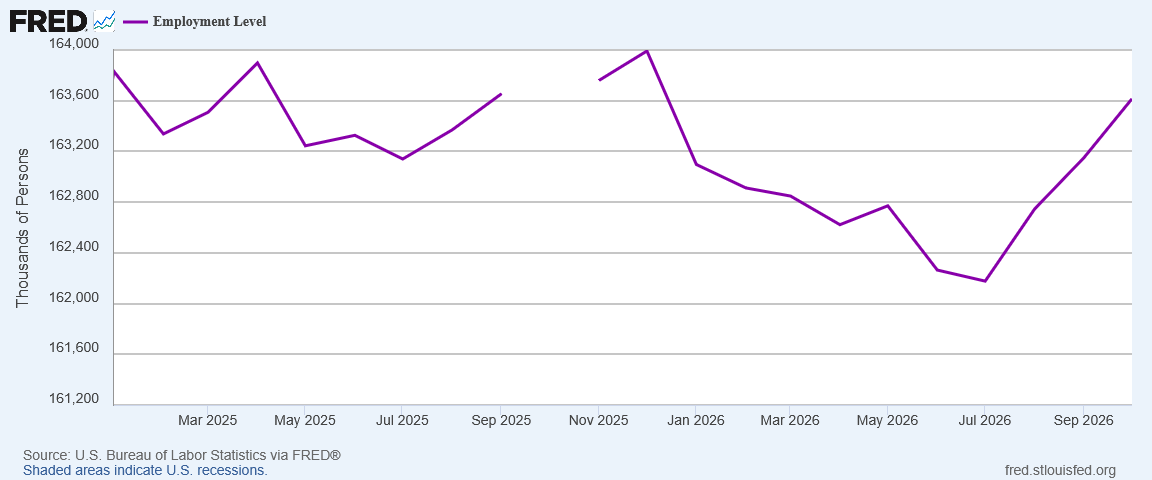
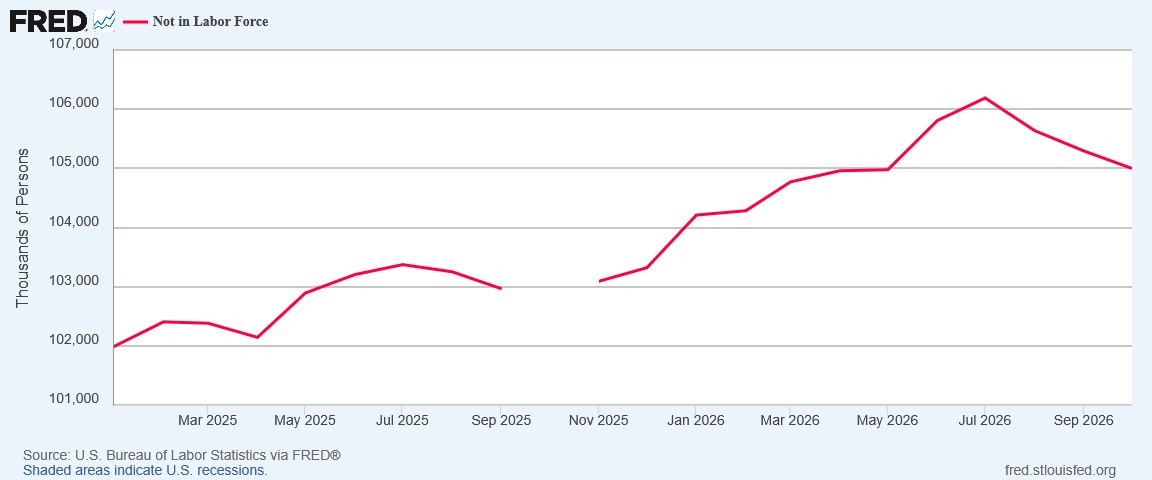
The number persons not in the labor force overall posted its third consecutive decline, dropping to 104,999,000.
The net effect of these changes is another welcome increase in the Employment-Population ratio, to 59.3%.
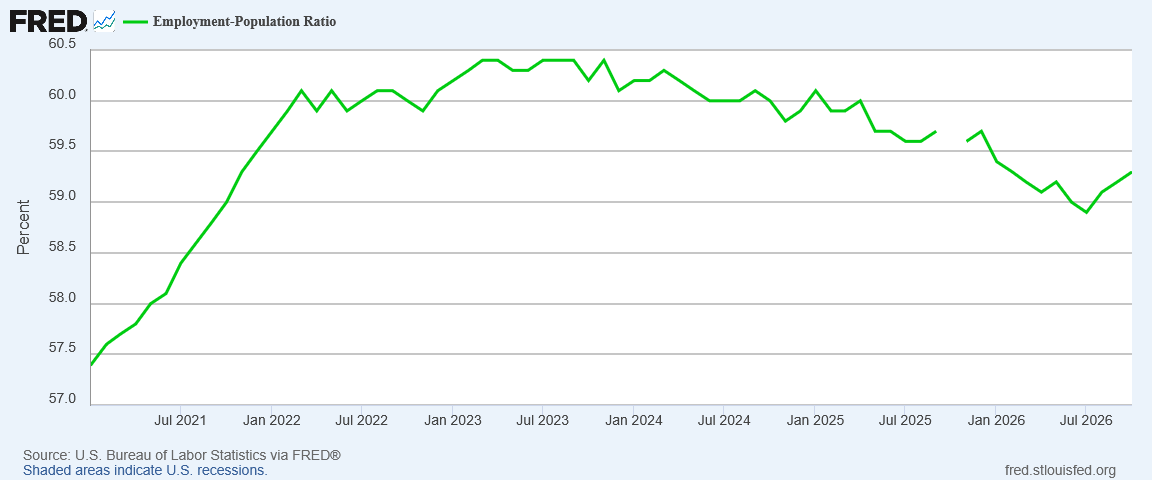
After dropping steadily since late 2023, the past few months of increase is a welcome trend reversal for at least the near term. Hopefully it will become a trend for the longer term as well.
Real unemployment rose in October, but the overall trend since the summer is still one of increasing employment rather than increasing unemployment. That trend more than anything else signifies that the jobs recovery is still ongoing.
Weekly Earnings Cooled. Service Sector Earnings Fell
One place where the jobs report does not give cause for celebration is in earnings.
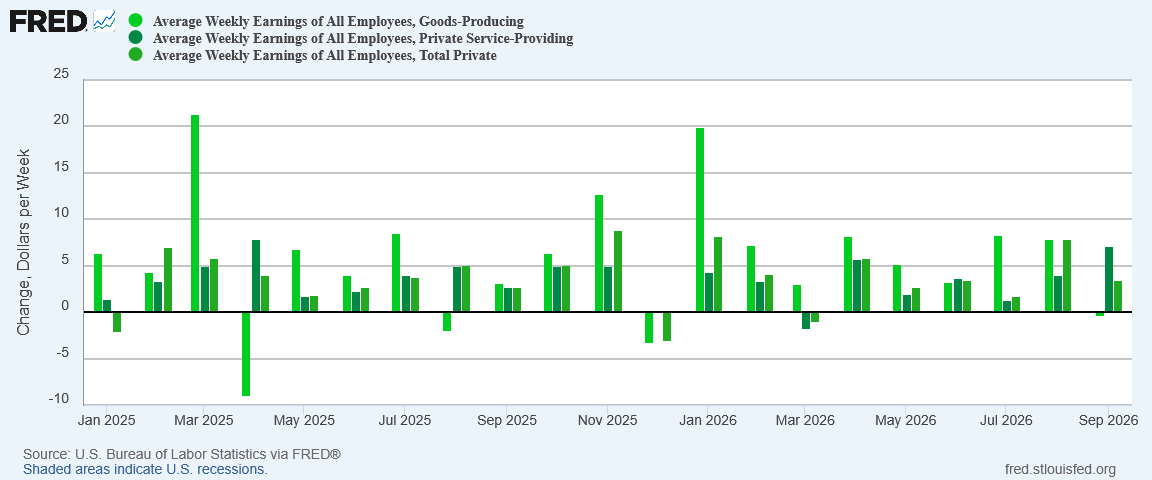
While goods producing jobs saw a weekly earnings bump of $7.08, service providing jobs saw their weekly paychecks trimmed by $0.27. Earnings overall rose $3.44, less than half the $7.89 reported for September.
Relative to overall price inflation since January 2025, while goods producing wages are gaining on inflation, service providing wages are in danger of losing ground to inflation.
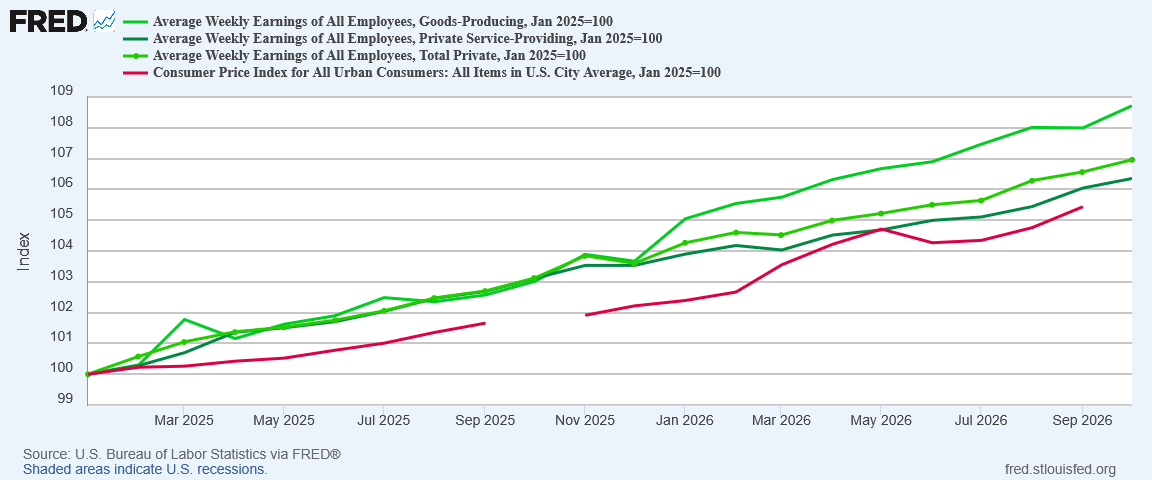
Only goods producing earnings have overcome the real wage reductions of the 2022 hyperinflation cycle. Overall private-sector earnings and service providing earnings are still playing catchup to inflation since 2021, and recently have even lost some ground.
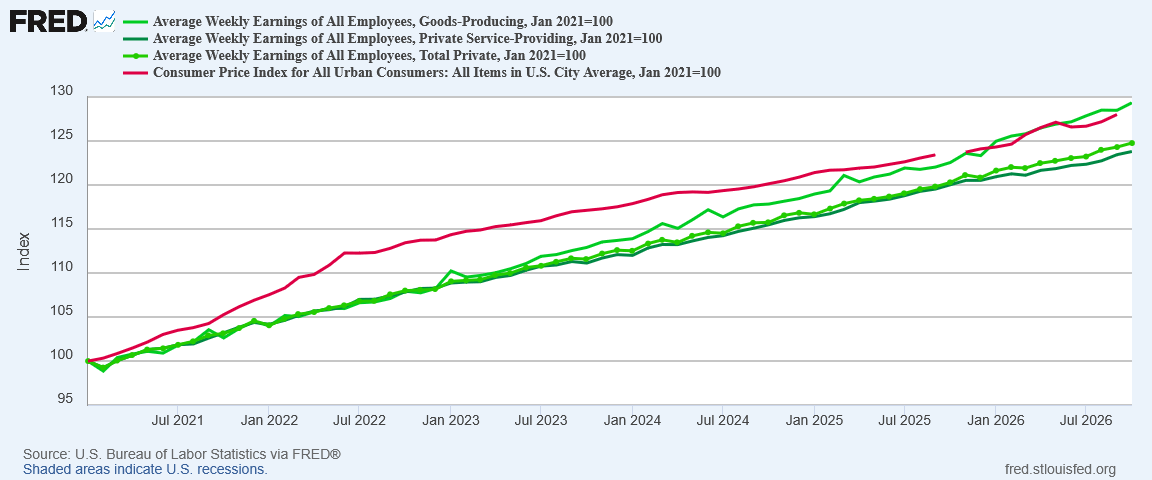
As there are far more service providing jobs than goods producing jobs, this disparity in earnings growth relative to inflation continues to impact a good many household budgets. Paychecks are increasing, but many paychecks are not increasing enough.
We Already Know The Job Growth Is Real
Between the September JOLTS report and the October ADP report, we have already seen multiple confirming signals supporting the assessment of real job growth in October. The PMI and Industrial Production data have not changed, and the confirming signals we saw for those earlier reports we still have for the October ESS report.
We do not need to wonder if the job growth is real. We have ample confirmation of real job growth and real economic growth in October. Magnitudes will vary, and we should expect some downward revisions to the October jobs numbers, just as we saw for the August blowout numbers. Even with those anticipated downward revisions, however, October is likely to remain a banner month for job growth.
Can that job growth be sustained? That is the overarching question, and it is the one question that remains frustratingly unanswerable. What will transpire next with the war in Ukraine and the war with Iran is something which has stubbornly defied prediction.
At present we see no sign the oilpocalypse catalyzed by both wars is going to abate, but we see little sign that it will impact the US worse than Europe. What will happen with the EU given the current political crisis in Poland is a story yet to be fully told. Both geopolitical events are going to have economic reverberations into the United States. Whether those reverberations increase or decrease job growth is impossible to say at this time; there are geopolitical scenarios leading to both outcomes.
The jobs impact of the midterm elections will not be fully felt until sometime next year. Suffice it to say, the Democrats have an excellent opportunity to facilitate continue job growth when they take power January 3—but that also means they have an excellent opportunity to derail job growth as well. The reader will have to assess for themselves which is the more likely scenario.
The October Employment Situation Report is a strong report. The jobs report shows labor rebounding bigly yet again. There are cautions and caveats, but overall the US economy produced a sizable number of jobs for the month.
Will the jobs recovery continue? For the next month or so, we have no reason yet to suspect it won’t. What 2027 will bring is a question we will have to wait until 2027 to answer.
Jobs growth is the best news of the day, and I’m not going to quibble over revisions. After last week’s disastrous and frustrating election results, I needed to hear that economic growth is still on track. Thank you as always, Peter, for your reliably objective and grounded analysis of data. You’re the best at this!