


The war between Iran and the US has been functionally reduced to a simple question: will the Strait of Hormuz be reopened as a freely navigable international waterway?
As of this writing, the Strait has not been reopened. Iran has declared the Strait closed, while the US Navy is blockading all Iranian shipping.
With the Strait of Hormuz closed, Persian Gulf oil is effectively removed from the global oil marketplace—approximately 20% of global supply is not currently accessible.
If Persian Gulf oil remains barred from the global marketplace, there is no denying what must follow: an “oilpocalypse”, the inevitable supply shock in all the world’s economies when, 20% of global oil supply having been removed from oil markets, all buffers mitigating that shortfall are finally exhausted.
With neither Iran nor the US much inclined to seek a peaceful resolution to the conflict, we are left to wonder when that supply shock will finally crash over the world’s economies?
Can the oilpocalypse be avoided even if peace is not found between Iran and the US?
The outlook is not encouraging.
Why The Oilpocalypse?
The underlying math driving the grim forecast of a major oil supply shock is simple:
Before the war, global oil demand was estimated at 103.4mbpd, and global supply (with Persian Gulf oil flows included) was at 103.6mbpd.
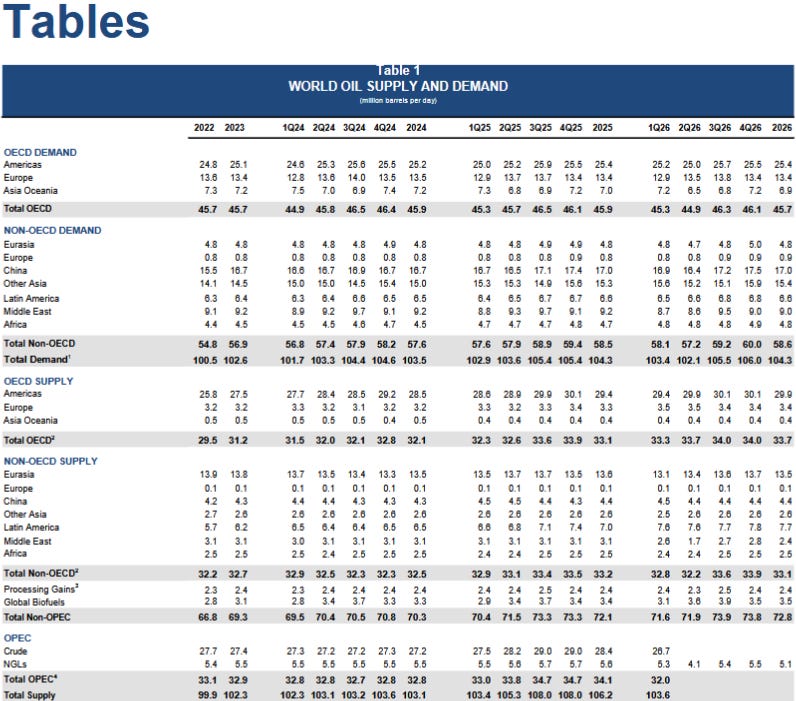
OPEC output accounted for approximately 32mbpd of global supply.
Of OPEC's output, 22.4mpbd was produced by Saudi Arabia, Iraq, the United Arab Emirates, Kuwait, and Iran.
The war with Iran has disrupted the oil production of all five countries, and only one—the UAE—has in July managed to surpass pre-war production levels.
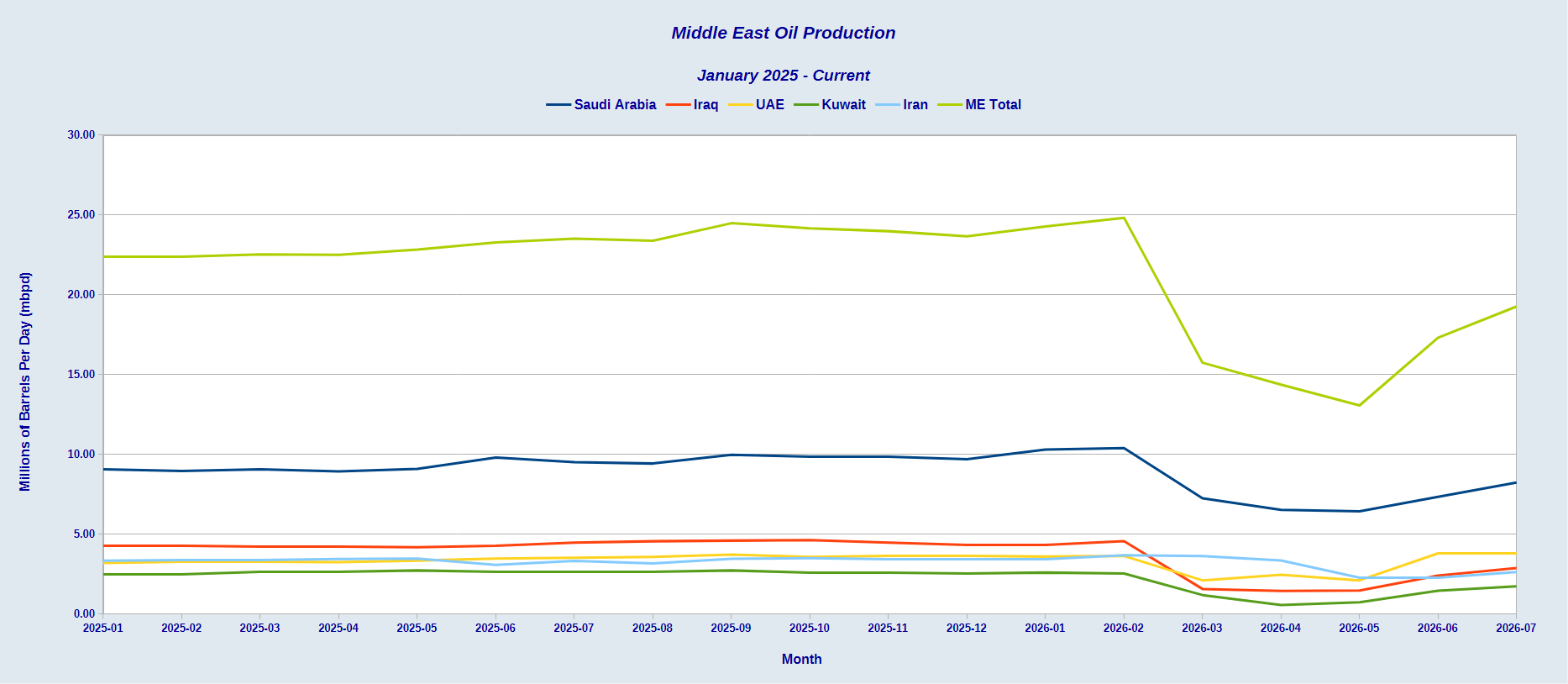
Across all five countries, aggregate July production is 5.6mbpd, or 13.9%, below pre-war levels.
In the August Oil Market Report, the International Energy Agency (IEA) assesses total Persian Gulf oil production as 8.3mbpd below pre-war levels, this after production recovery of 3.7mbpd in June and 2.5mbpd in July.
Moreover, regardless of oil production levels, since the start of the war almost no oil has moved through the Strait of Hormuz.
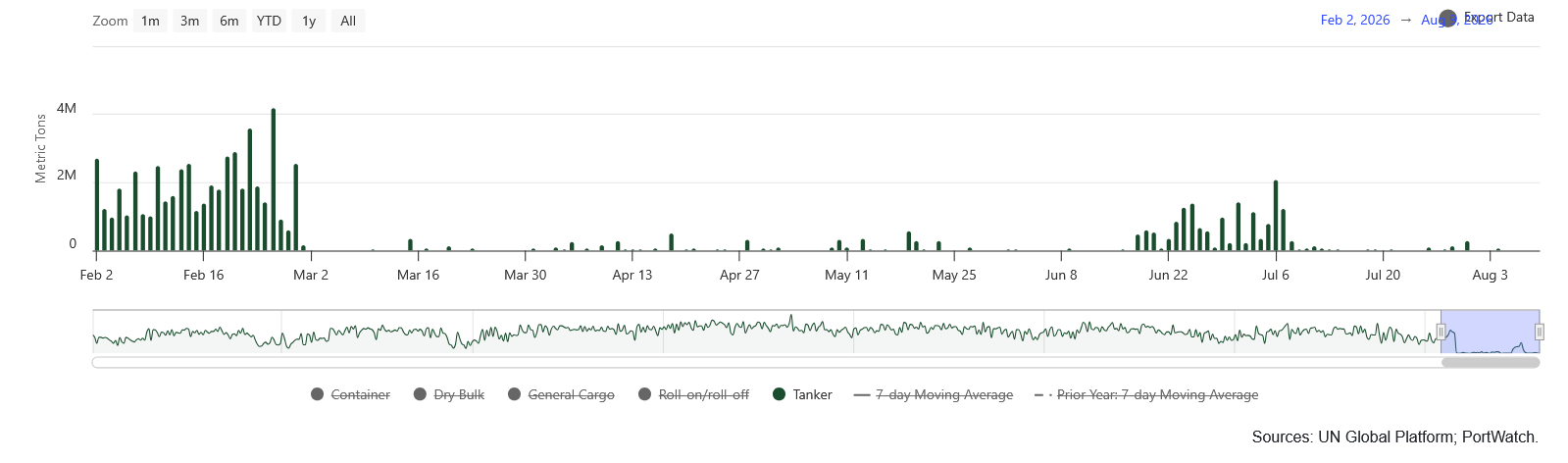
Bear in mind that in 2025 some 15mpbd of crude oil and another 5mbpd of refined products transited the Strait.
Even if we take into account some tankers are “running dark” by turning off their transponder beacons so as to be mostly indetectable, and so might have transited the Strait without being recorded, oil has not been moving through the Strait since March in significant volumes, except for the brief interlude of the Memorandum of Understanding. Persian Gulf oil flows have literally fallen from 15mbpd to 0mbpd, just since March.
The removal of between 8mbpd and 15mbpd of crude oil from global supply is no small deficit, given that at the end of 2025 global supply was only marginally higher than global demand. With pre-war oil supply and oil demand in near exact equilibrium, the consequence of the imposed production deficits from the Persian Gulf is both obvious and inevitable: Global demand now exceeds global supply.
Global demand is likely to continue to exceed global supply for at least the short term. The IEA projects an oil supply deficit in the third quarter which will average 1.8mbpd. This is more than double the deficit forecast in July’s Oil Market Report.
If the war between Iran and the United States continues to drag on, we should expect that deficit to only increase.
Irreplaceable Supply?
When a supply of any economic good is disrupted, the market’s inherent reaction is first to seek out replacement sources of that good. With Persian Gulf oil abruptly removed in large measure from the global oil market, the global oil market naturally is looking first to replace that oil.
To that end, seven countries belonging to the Organization of Petroleum Exporting Countries (OPEC) have committed to boosting oil production to offset the loss of Persian Gulf oil.
The Organization of the Petroleum Exporting Countries and its allies — collectively known as OPEC+ — announced on Sunday that seven countries would expand oil production by a combined total of 188,000 barrels per day in August. It was the fifth consecutive month OPEC+ agreed to raise oil outputs.
The participating countries in Sunday’s decision are Saudi Arabia, Russia, Iraq, Kuwait, Kazakhstan, Algeria and Oman
Note, however, which countries are committing to the production increases. Three of them are Persian Gulf countries, countries whose ability to export oil is precisely what is being disrupted by the war between Iran and the United States.
A fourth—Oman—sits opposite Iran on the Strait of Hormuz. While not constrained by the Strait of Hormuz, the country remains vulnerable to Iranian missile and drone attacks. It has already been attacked multiple times by Iran.
Moreover, Oman has sustainable oil output of 800,000bpd, per the latest report from the IEA. The IEA also has Oman producing, as of July, 830,000bpd. Based on IAE estimates and data, Oman has no spare capacity it can use to quickly ramp up oil production.
Algeria, with July production of 970,000bpd and sustainable capacity of 1,000,000bpd, likewise has little spare capacity with which to offset the blocked Persian Gulf oil flows.
The same IEA report assesses Kazakhstan’s sustainable oil production at 1.8mpbd. With July production at 1.55mpbd, Kazakhstan can contribute at most 250,000bpd to replace lost oil production from the Persian Gulf.
Even Russia has limitations on how much more oil it can produce. Per IEA assessment, Russia can increase its crude oil production by 640,000bpd.
Of the seven countries pledging to increase crude oil production, the four not within the Persian Gulf cannot add even 1 Million bpd to global supply. Unless the IEA assessments are wildly off-base, that is the best case scenario for replacing lost Persian Gulf oil. With a minimum loss of 8mbpd and as much as 15mbpd, the commitments made by non-Persian Gulf countries to boost production do not come at all close to replacing the lost supply.
With present known oil reserves and production infrastructure, very little of Persian Gulf oil supply can be replaced in the near term. For the remainder of 2026 at least, there are no alternatives to Persian Gulf oil, and every barrel of Persian Gulf oil prevented from making it to market is a barrel withdrawn from global supply.
Russia Has Its Own Problems
While the natural framing for an “oilpocalypse” scenario is the war between Iran and the US, we should take note of Russia’s own production dilemmas in recent months. Despite committing to increasing production, Russia’s crude oil production has actually fallen by over 400,000bpd since January, 2025.
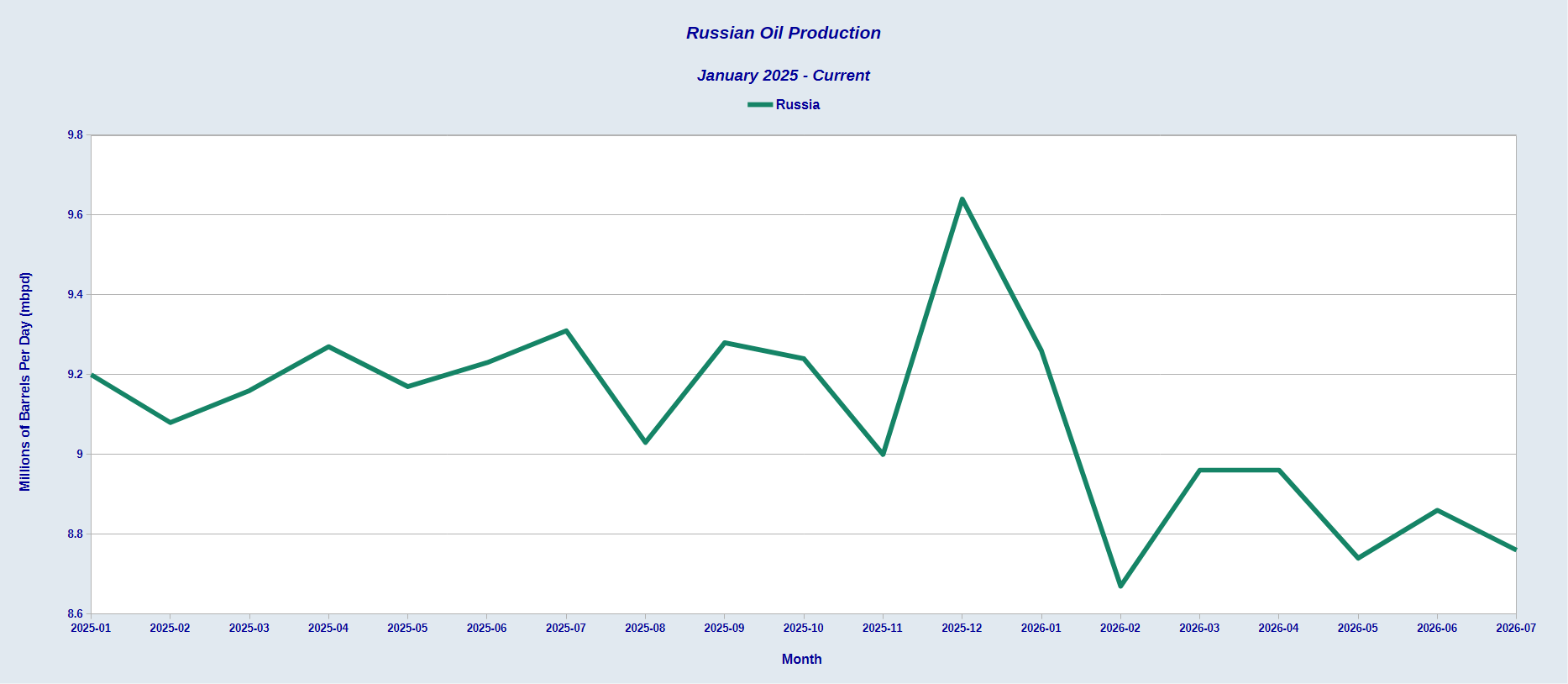
There is no mystery as to the cause of Russia’s oil production failures: Ukraine has been notching consistent strategic wins with their deep-penetration drone strikes, in particular against Russia’s oil infrastructure, typified by last week’s drone strike on the Sheskharis oil terminal at Novorosssiysk, which resulted in complete suspension of oil loading.
Crude oil exports from Russia’s Sheskharis terminal at the Black Sea port of Novorossiysk were suspended on Friday following a drone attack, three sources familiar with the matter said, adding to disruptions at one of the country’s key export outlets.
The Sheskharis terminal, which handles around 700,000 barrels per day (bpd) of crude oil, is Russia’s main oil export facility on the Black Sea. Its shutdown adds to pressure on Russian energy infrastructure, which has come under repeated attack in recent months.
The administration of Novorossiysk issued a fresh drone alert for residents on Friday, indicating a continued threat to the port area.
Ukraine has also had success in oil refining, impacting domestic gasoline supply especially, with a separate drone strike last week shutting down a refinery near Orsk for at least six months.
"Shrapnel damaged key infrastructure that cannot currently be repaired. The equipment is imported, and due to sanctions, repairs could take up to six months. The plant has completely shut down," Yevgeny Solntsev, governor of the surrounding Orenburg region, posted on social media.
For Russia, the consequence of these drone strikes is to bring home to the average Russian civilian the impact of the war in Ukraine. Solntsev has responded to the damage done to the Orsk refinery by rationing gasoline within the oblast.
The last terrorist attack of the enemy has created certain problems for us. We have to change the logistics of delivery of fuel. Work began quickly, it is impossible to delay here. A number of negotiations were held. But this forces us to introduce certain measures. In order to preserve at the same level the work of emergency services: medical care, fire protection, law enforcement and other structures, as well as public transport, the operational headquarters of the region decided to impose restrictions on the release of fuel for individuals and legal entities.
Nor are the disruptions limited to a few areas within the Russian Federation. Sochi, Krasnoyarsk, and Bashkortostan are all regions where fuel rationing has been implemented. Additionally, Long gas lines are being reported across Russia as well as those portions of eastern Ukraine under Russian control.
FAS continues to monitor prices: in the Saratov and Bryansk regions they were reduced after warnings. The service opened cases against gas station operators in the Krasnodar Territory and the Zaporizhzhia region.
In some Russian regions, a second wave of fuel shortages has begun. About this Business FM told subscribers in social networks. Difficulties are observed from the Krasnodar Territory to Primorye.
With falling production and increasing shortages of refined products across the country, Russia is hardly a credible alternative buffer to oil flows out of the Middle East. It is having enough trouble simply by producing at the levels it has been.
Demand Must Fall To Match Supply
The ironclad governing rule of all systems, including markets, is that they must always trend towards an equilibrium position. Everything must balance. Force pulling one way must be offset by forces pushing another.
In oil markets, that means that if Persian Gulf oil cannot be replaced in global supply, oil markets will only achieve that equilibrium position by demand falling in proportion to the lost supply.
Shrinking demand is a popular government response to the oil supply shock catalyzed by temporary loss of access to Persian Gulf oil: Governments around the world are encouraging people to drive less, reduce the use of air-conditioning system, reduce travel, and reduce fuel purchases, among other measures.
Note that measures such as reducing travel and reducing fuel purchases are outright reductions in economic activity. Broadly implemented, they amount to the decision by governments to mandate economic contraction.
With or without government interventions, the IEA’s August Oil Market Report projects that global oil demand will drop by 1.6mbpd this year, a far greater decline than previously forecast. In addition to government inducements and mandates to reduce oil consumption, the price increases which have already occurred in the marketplace will naturally curtail demand—and prices have increased.
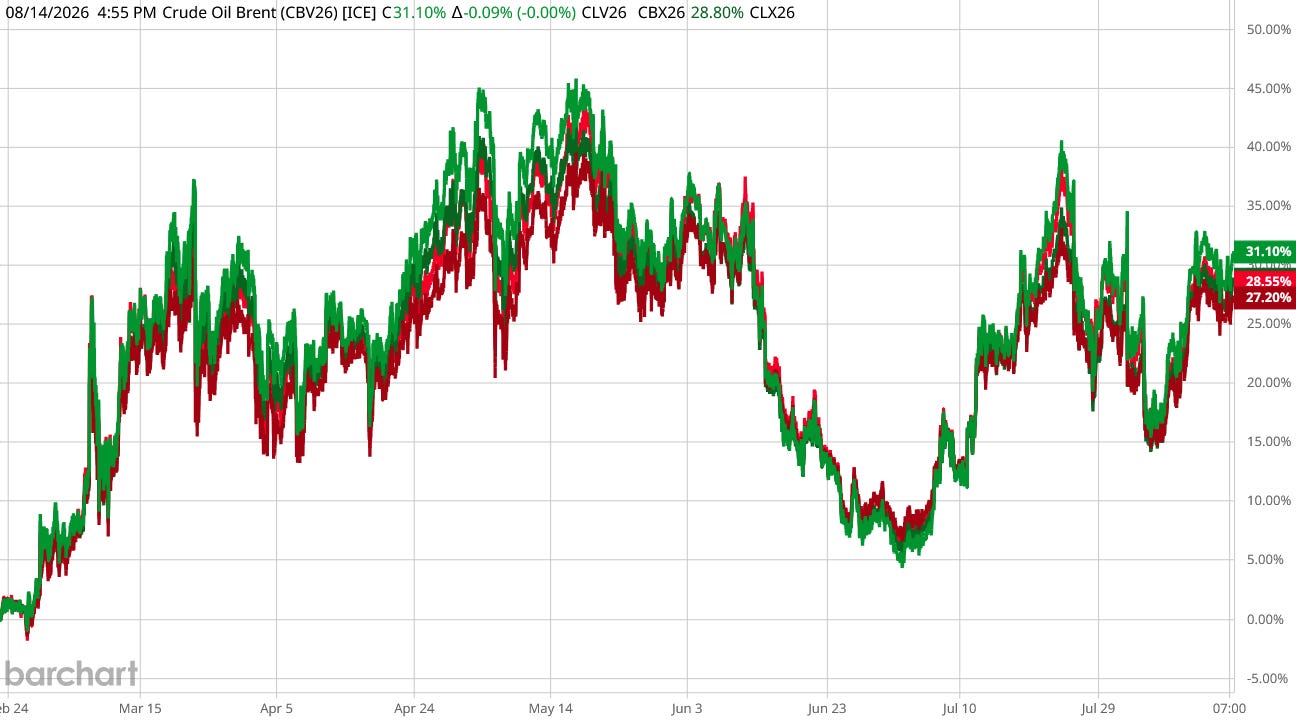
Starting from benchmark crude prices as of the last week in February, both Brent Crude and West Texas Intermediate are up between 27% and 31% for October and November delivery over pre-war prices..
We see similar movements for pricing within specific Middle East crudes and blends.
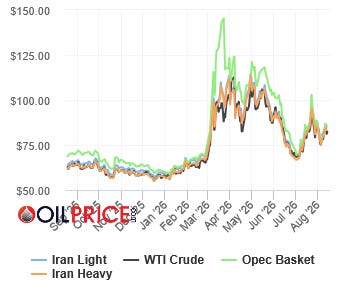
A 30% overall price increase in six months is a steep hike in every economic scenario. Basic economics tells us that, all else being equal, a rise in oil prices will, over time, result in less oil being consumed. Basic economics also tells us that reductions in oil demand is economic contraction by definition.
Just on the basis of the existing price increases for crude oil, the IEA is projecting global oil demand will reduce by 1.6 mbpd.
Global economic projections are likewise being revised downward. In its July World Economic Outlook, the International Monetary Fund lowered its expectations for global economic growth for 3% this year and 3.4% in 2027, a slowdown from the economic growth the IMF reported for 2024 and 2025.
Pipelines Not Enough
With so much economic significance hinging on the status of the Strait of Hormuz, an obvious strategic question emerges: why do Persian Gulf states not send their oil to market via an alternative route?
In fact there are a few pipelines which allow Saudi Arabia and the United Arab Emirates in particular to bypass the Strait of Hormuz for at least some oil production.
Saudi Arabia’s East-West pipeline, terminating at the Red Sea port of Yanbu, has the capacity to move approximately 5mbpd of crude oil to a port not constrained by the Strait of Hormuz. With the Strait effectively closed, Saudi Arabia has been moving as much oil as it can through the pipeline, pushing it to its operational limits.
The UAE has a pipeline which directly bypasses the Strait of Hormuz, the Habshan–Fujairah pipeline, capable of transporting 1.5 mbpd of oil from the UAE’s main production nexus at Habshan on the Persian Gulf to an oil terminal at the port of Fujairah, on the Gulf of Oman.
These are the only two pipelines in the region which have been in production throughout the war.
Iraq has access to pipelines running through Turkey, but that infrastructure had been largely idled in recent years, owing to region’s endemic chaos and instability. Still, in mid-March, soon after Iran closed the Strait of Hormuz, Iraq reached an agreement with Turkey to transport 250,000bpd via the Kirkuk–Ceyhan pipeline to the Turkish port of Ceyhan. Separately, Iraq is preparing to expand access to the pipeline route to Ceyhan by reactivating the Baiji-Fishkhabour pipeline, which has been inactive since 2013 during the height of the ISIS insurgency.
The Kirkuk-Ceyhan pipeline is an extension of pipelines from the Kurdistan region to Ceyhan, which, after several disruptions, resumed moving approximately 240,000bpd in late 2025.
How much actual capacity these pipelines will provide is problematic. The Kirkuk-Ceyhan pipeline was originally built to provide some 1.5mpbd of capacity, but damage to the infrastructure by ISIS and other Islamist militia groups has greatly reduced actual operational capacity. Turkey is getting behind restoring and/or rebuilding the pipelines, however, having expanded the initial transport agreement with Iraq to move a total of 750,000bpd to the Mediterranean port.
These pipelines are making a difference in how much Persian Gulf crude reaches the global market place. As of June the pipelines were transporting the bulk of Persian Gulf oil production, far exceeding the minimal traffic moving through the Strait of Hormuz.
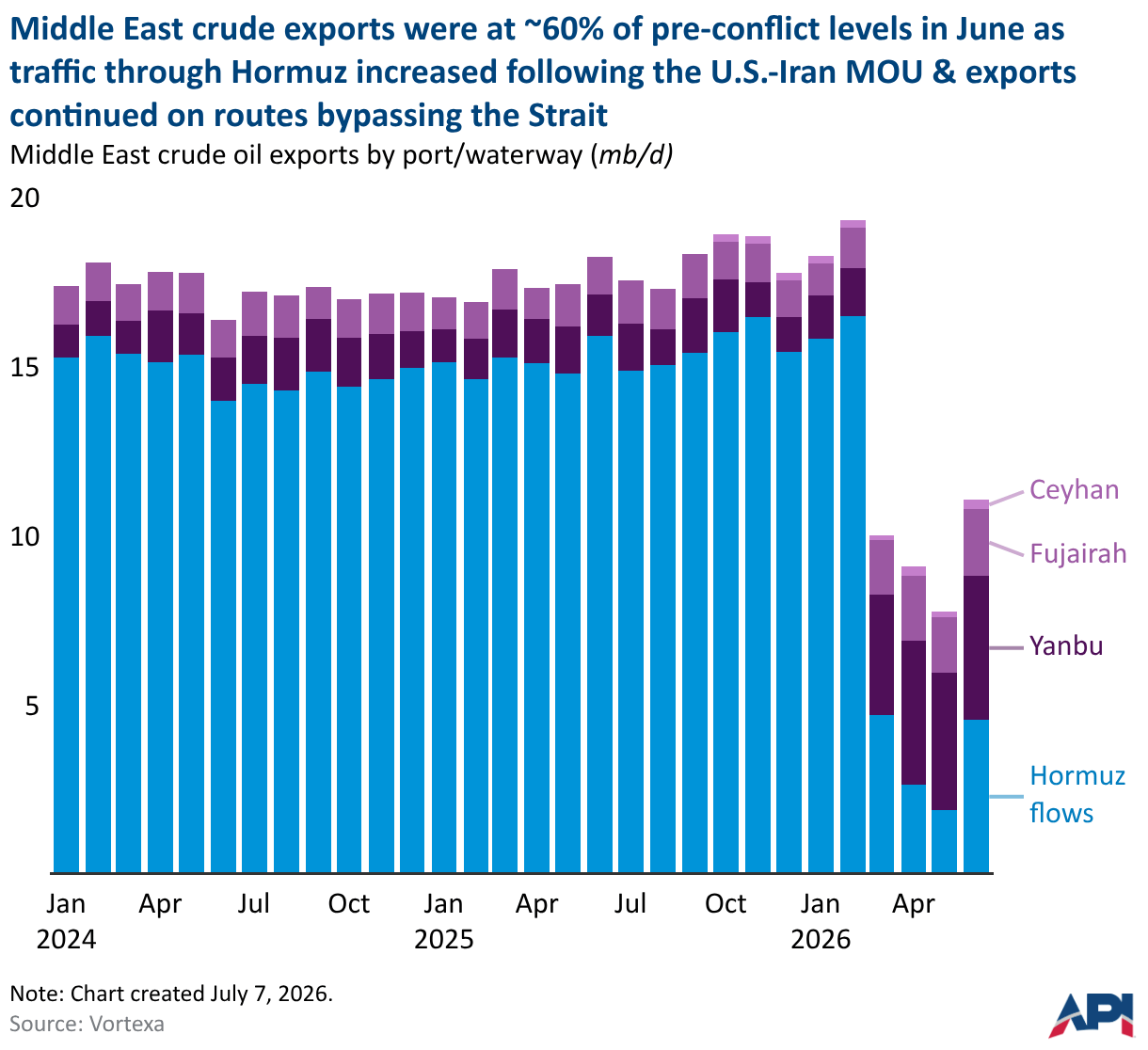
US Treasury Secretary Scott Bessent sees the pipelines as the key to the future of Middle Eastern Oil:
The strait is never going back to the way it was because the Iranians have tried to use it as a choke point. What we are going to see over the next two years, the strait’s going to become irrelevant. It is going to become just another body of water. And I would say that more than 50 or 70 percent of the energy that moves through the strait now is going to go through underground pipelines.
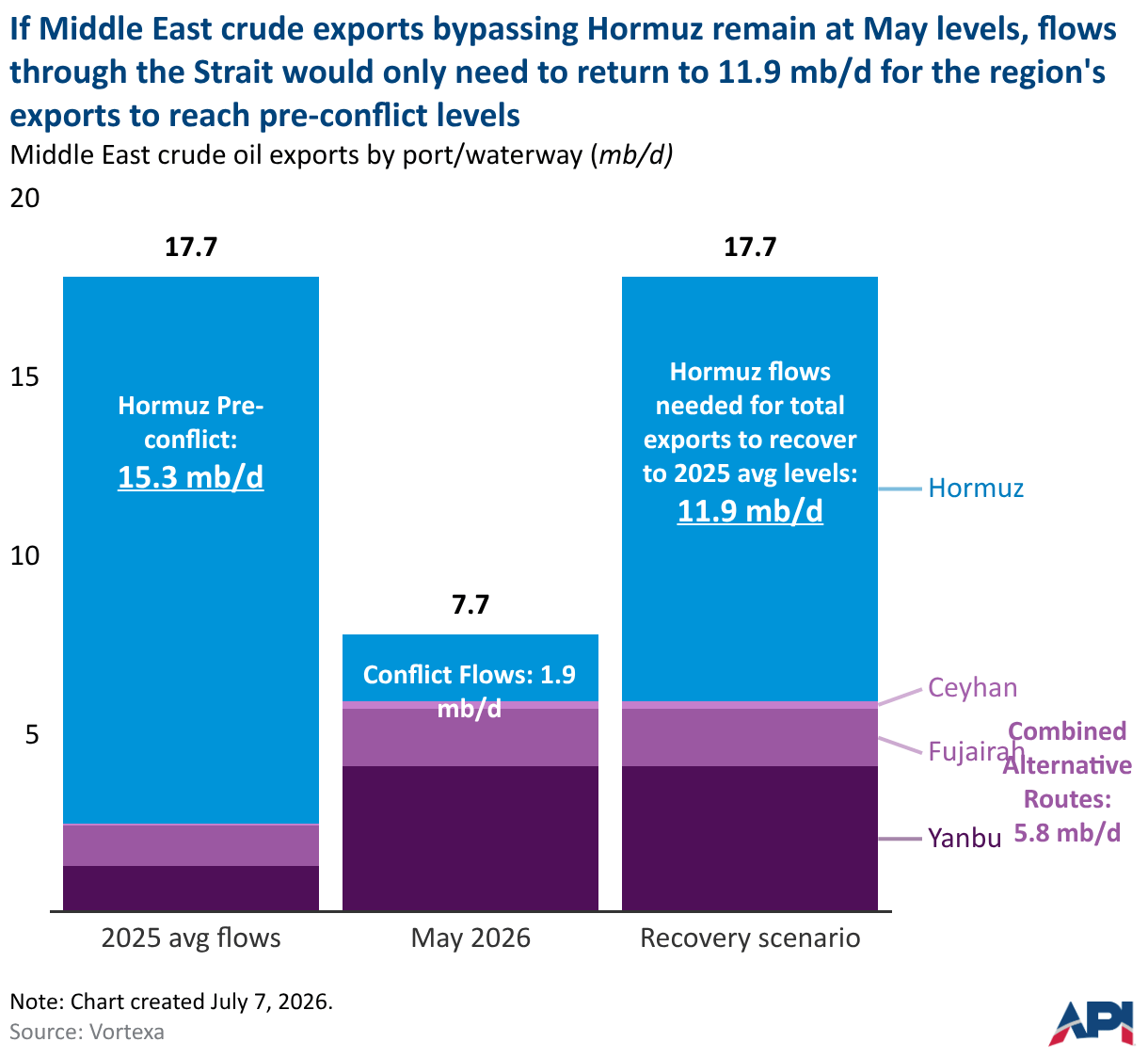
Even if Bessent is correct, however, he is speaking of the long-term, not the present situation or even the short-term situation. It is instructive to note that none of these pipelines as they stand today can carry 100% of their respective countries’ 2025 production volume. In an ideal scenario, the total combined capacity of the Saudi East-West Pipeline, the Habshan–Fujairah pipeline, and the Kirkuk-Ceyhan/Turkey-Kurdistan pipeline network is approximately 8mbpd, while the combined February 2026 production of Saudi Arabia, the United Arab Emirates, and Iraq was approximately 18.61mbpd pre-war.
Even in a best case scenario with the existing pipelines operating at full capacity, restoring pre-war Persian Gulf oil flows requires that nearly 12mbpd of crude move via the Strait.
As Secretary Bessent noted, pipelines are being built, and they will alter the strategic calculus of the Strait of Hormuz when they are completed. At present a number of pipeline projects have been approved and are presumably being “rushed” to completion:
The UAE is preparing an expansion of the Habshan–Fujairah Pipeline, increasing its capacity to 3.6mbpd.
Saudi Arabia is expanding the East-West oil pipeline to carry up to 9mbpd.
Iraq is building out the Basra-Haditha pipeline which, when finished, will deliver up to 2.5 mpbd.
Even when these projects are completed and online, however, they will only offset between 60% and 80% of Persian Gulf oil production. The rest will have to use the Strait.
Why Not Oilpocalypse Now?
Since Persian Gulf oil flows are greatly reduced if not eliminated, the question naturally arises: why has the oilpocalypse not already happened?
The answer is simple: The markets have been consuming commercial and government oil inventories, drawing down oil already bought and paid for.
Starting in late March, the United States began steadily releasing oil from the Strategic Petroleum Reserve, buffering the oil supply shock which emerged when Iran first closed the Strait of Hormuz and precluding market prices from rising too high.
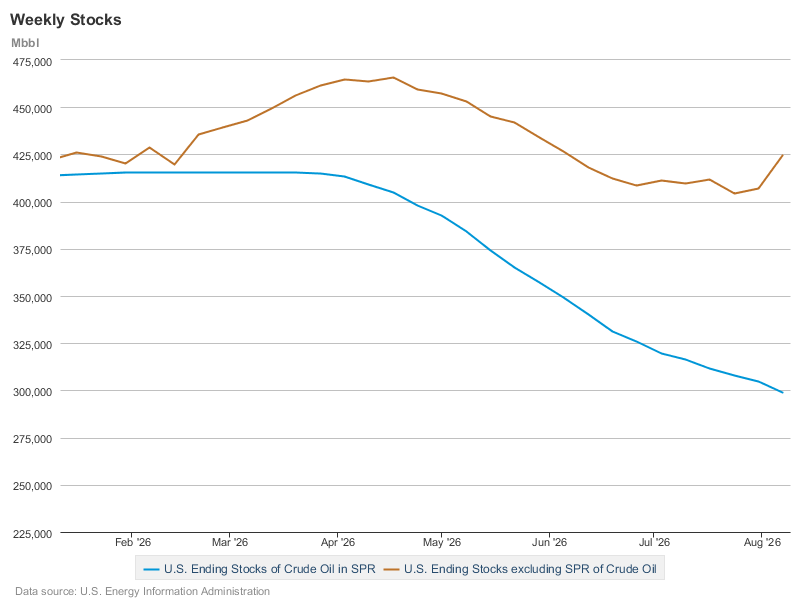
Ironically, US commercial inventories, which were being drawn down as well, have been replenished in recent weeks.
The United States was not the only country to call upon its oil reserves. Other countries have done likewise, with global observed oil inventories dropping below 7.9 billion barrels for the first time in years, suggesting a drawdown rate globally of 2.7mbpd.
A major influence in this has been China’s reserve drawdown. China is believed to have one of the world’s largest petroleum stockpiles, and has presumably been relying on since the war began.
Industry watchers estimate China was drawing down its reserves at a pace of 487,000bpd in May and 940,000bpd in June as a substitute for suddenly pricier imported oil. Some industry analysts project China has literally years of petroleum reserves it can draw down while it waits out the war.
It has been drawing down crude inventories at a rate of around 600,000-700,000 barrels a day since May, Emma Li, an analyst at the energy tracker Vortexa, told Newsweek.
“Even if the drawdown rate accelerates to 1 [million barrels per day], the current 1.2 billion barrels of crude held in above-ground tanks alone would be sufficient to sustain withdrawals for more than three years,” Li said.
Goldman Sachs has a somewhat more conservative estimate, projecting that China’s reserves would support 117 days of pre-war demand.
China’s ability to “wait out” the conflict in the Persian Gulf automatically makes it the likely flashpoint for the next-wave oil supply shock, when strategic reserve releases are exhausted and more oil is purchased on the open market. When China resumes pre-war levels of oil purchases, we will know the world’s strategic petroleum reserves have been drained.
There is no denying that China’s role in postponing a global oilpocalypse has been significant. China has been the world’s largest oil importer, but then reduced its oil imports by 40% almost immediately after Iran closed the Strait.
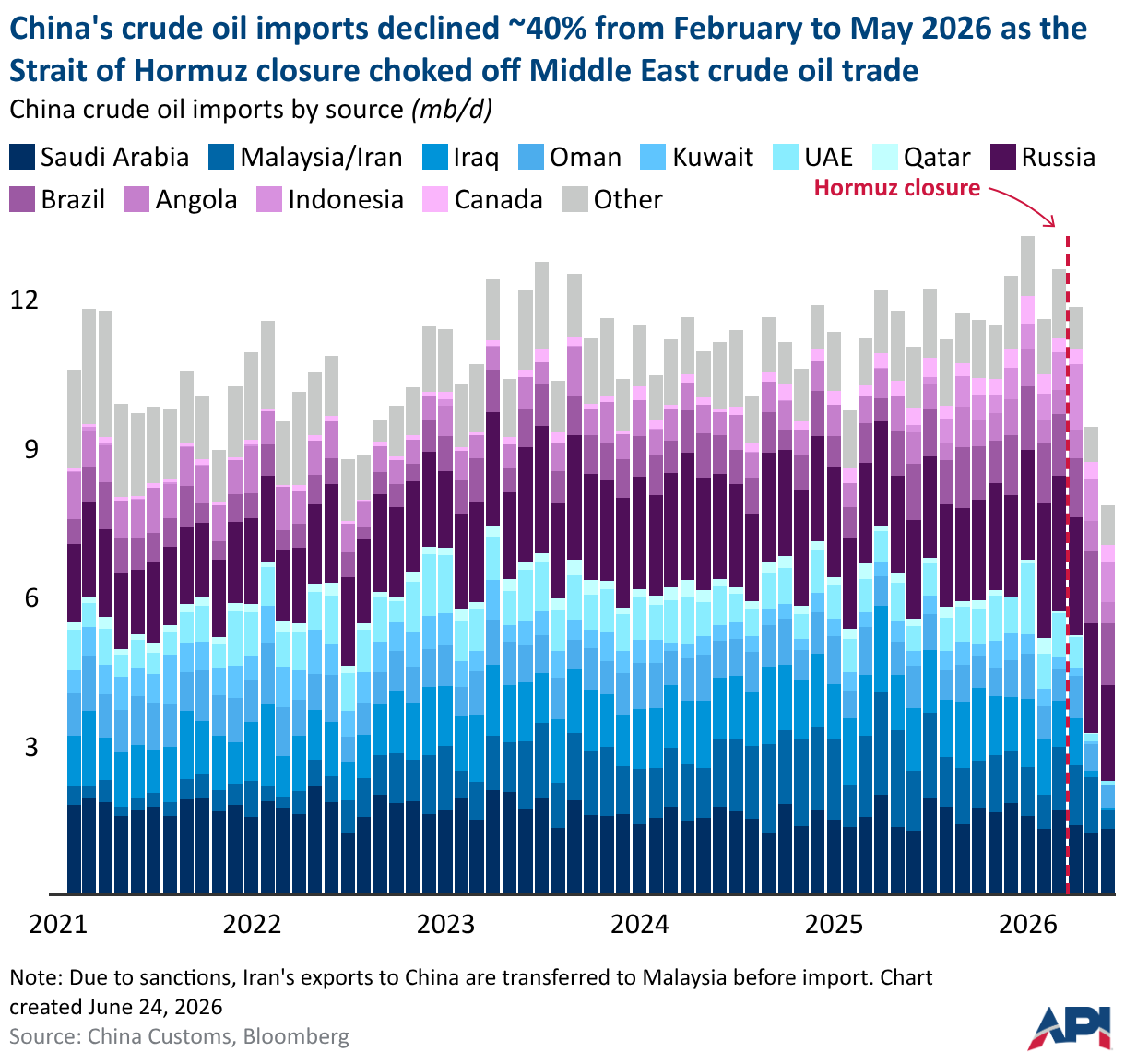
That reduction in oil-imports—which is to say reduction in oil purchases—has allowed oil markets to find equilibrium prices at much lower levels than if China were still buying oil at previous levels.
As is true of the United States, China is substituting reserves for oil purchased on the open market, easing supply pressures by reducing immediate market demand. If (when?) China resumes purchasing oil on the open market, if there is still a supply deficit, prices will surge dramatically. There is no guesswork in that projection, as that is basic market mechanics at work.
All reserves are necessarily finite. They will eventually either be exhausted or reach a statutory limit which limits their further drawdowns. In either situation, when strategic petroleum reserves are exhausted, the open-market purchases which had been up to then postponed will start to take place.
When buying increases relative to supply, prices rise. When buying increases and supply has decreased, prices will rise relative to the initial pricing state quite a lot.
China’s massive reduction in oil imports tells us that when China resumes prior levels of oil imports, oil prices will surge. That is a scenario which takes from “oilpocalypse maybe” to “oilpocalypse now.”
China Already Experiencing The Oilpocalypse?
Because China’s steep drop in oil imports has played a pivotal role in preventing higher oil prices, the usual bevy of economic “experts” ascribe a measure of market power to China, that China can effectively set global oil prices because of their tremendous reserve stockpile.
China’s massive crude reserves allowed it to adapt its energy policy to insulate itself amid the Iran war. Its flexible demand has had a direct impact on global markets and will dictate swings in this and future oil shocks, according to experts.
The assumption that is being made is that China has acquired the magical ability to turn oil demand on and off like a switch:
This ability to turn oil demand on and off, ostensibly at low economic cost, allows the world’s biggest oil importer to move prices just as the Organisation of the Petroleum Exporting Countries (OPEC) and its allies have long done through their control of half of global output. And as the cartel is weakened by the recent departure of the United Arab Emirates and strained production capacity of its remaining Gulf members, China’s market power is growing. As one oil-trading boss puts it, “China is the new OPEC.”
However, this assumption inverts the market dynamic. China’s influence over global oil prices comes from a decision not to buy—in effect, China’s contribution to global oilpocalypse prevention has been to withdraw from the market. When (not if) China re-enters oil markets and resumes pre-war levels of oil purchases, China will be powerless to prevent the rise in oil prices, and will be powerless to avoid paying those higher prices.
Moreover, the “experts” own analyses reveal that their math does not work out. The most favorable scenarios proposed still have China reducing imports by more than their inventory draws.
Add the 1m b/d no longer being stockpiled and 1.5m b/d in drawdowns, and stock management may account for 2.5m b/d of the 5.5m b/d fall in imports. China could keep this going for another four months before rulers in Beijing started to worry about uncomfortably low stock levels, reckons Emma Li of Vortexa
A closer look at China’s own data confirms that more than just reserve drawdowns are involved in China’s oil import reductions. Refinery output in China has also decreased, and not by a small amount.
Official data showed refinery throughput in June fell 17.7% from a year earlier to 51.24 million metric tons, or about 12.47 MMbpd, which was the lowest since March 2020, during the COVID pandemic.
The throughput drop has deepened every month since the Iran war began, with June throughput posting the sharpest year-on-year decline since at least March 2000, when the National Bureau of Statistics started publishing continuous monthly data.
This is a curious statistic, because a drop in refinery throughput is not a reduction in oil imports in favor of reserves, but outright demand destruction. If China were relying on reserves as a complete buffer against price instability, refinery throughput would have been unaffected.
Year on year, in June China’s refineries saw a 13% drop in capacity utilization, to just 58%. There are few if any plausible economic scenarios where that is not an economic contraction for at least the oil refining industry—and is of a piece with a raft of other economic data showing China’s economy is taking a hit because of war-driven supply chain dislocations.
If China is refining less oil, it is generating less revenue from refined products, and employing fewer people in oil and oil-related industries. Those are inevitable network effects when capacity utilization drops.
The “experts” even confirm this is the case, with the bizarre argument that China’s slashing of domestic oil demand somehow is a market-making flex.
However, ample stocks and restricted exports are not by themselves enough to explain the gargantuan reduction in Chinese imports. The Chinese government also pulled a third lever—curbing domestic demand. In June Chinese refineries processed 2.7m fewer b/d of crude than a year earlier. Production of petrol fell by 14%; output of diesel and jet fuel both shrunk by 21%.
“Curbing domestic demand” is what the Federal Reserve here in the United States calls reducing “revenge spending”. Different bits of word salad to describe the same thing: a deliberate contraction of the domestic economy.
That’s not an oil market flex by China. That’s China choosing oilpocalypse now over oilpocalypse later.
Oilpocalypse When?
The oil supply shock from the disruption of traffic through the Strait of Hormuz is real. The oil supply deficit from that disruption is real.
The buffering impacts of strategic reserve releases is also real.
The mitigating impacts of China dropping its oil imports by 40% is also real.
Given these realities, how inevitable is an “oilpocalypse”? How likely is it that we will see a significant surge in oil prices, an exhaustion of government abilities to buffer oil prices, and forced global demand destruction to push oil markets back into equilibrium?
Because strategic reserve releases are a short-term fix to a long-term supply dislocation, when those reserve releases are exhausted, whether by the US or by China, market oil prices will rise. That is basic market mechanics at work.
The more substantive question is by how much will oil prices rise? Are we facing a future of $200/bbl oil? $150/bbl oil? $130/bbl oil?
The most accurate and honest answer is, at this point, “I don’t know, and nobody else does either.”
China’s reduction in oil refinery output and deliberate contracting of the domestic economy suggests that, when China transitions away from oil inventory drawdowns, its resumption of open-market oil purchases will be less. With less demand there is less pressure to buy. That scenario makes $200/bbl oil less likely and $130/bbl oil more likely.
However, $130/bbl oil would be enough to trigger a significant uptick in consumer price inflation. $130/bbl oil would be enough to push gas and diesel pump prices quite a bit higher. $200/bbl oil would be very bad for the US economy, but that hardly makes $130/bbl good for any economy.
Moreover, whenever the price surge does come—and we must assume that it will come—it will come globally. All countries will be paying more, and paying more at the same time.
The surge in prices will be met with a drop in demand (in China with a further drop).
We do not know when that will happen, but we may be certain that it will happen.
What is uncertain is how big the price surge will be.
Unless the Strait of Hormuz is reopened, there will be an oilpocalypse. Unless the Strait of Hormuz is reopened, there will be stagflation, followed by recession.
Unless the Strait of Hormuz is reopened, the inevitable recession will be a synchronized one.
Can an oil supply crisis be avoided? Short of peace between Iran and the United States, no. That train has left the station.
All that’s left to determine is how big the crash will be when that train finally goes off the rails.
Peter, you are so resourceful! I am endlessly impressed by your ability to find excellent data, including the data that anticipates our “but what about…” questions. And your analysis is always irrefutable and genius-level. Magnificent!
So, this week Trump fully unleashes Bessent on Iran, with economic attacks at reportedly unprecedented levels. I know I can count on you to follow the market reactions, domestically, internationally, in stock markets and futures markets. I’m looking forward especially to reading whether you think the reactions are rational and proportionate or not.
The other day I saw a post claiming that Trump is going to make the Strait of Hormuz a U.S. territory. Whaaaaa? That’s international waters. Peter, can Trump do that, without the Gulf nations cancelling that plan?
🕯️ Remember our sons and daughters still in Harms Way with Central Command🇧🇭 and the ⚓ Fifth Fleet!