


As of this writing, on June 30, 2025, President Trump’s now (in)famous “One Big Beautiful Bill” to presumably cut taxes, raise and cut spending, and provide all the dollars and sunshine needed to Make America Great(ly Indebted) Again is headed towards an uncertain outcome on the floor of the US Senate.
The inside baseball is that the bill will have passed the Senate by the time this article is published, despite all manner of political machinations to derail it or slow it down.
Now the chamber is on track to pass the bill sometime Monday. Democrats are forcing Senate clerks to first read the legislation out loud, which is expected to happen overnight, before a maximum 20 hours of debate plus a marathon series of amendment votes.
“Fifty-three members will never agree on every detail of legislation, let’s face it. But Republicans are united in our commitment to what we’re doing in this bill,” Majority Leader John Thune said shortly before the vote. “It’s time to get this legislation across the finish line.”
As of this writing, the bill is in the “vote-a-rama” process within the Senate, where all manner of amendments can be brought to the floor for a vote ahead of the final vote on the bill itself.
Once the vote-a-rama is done, Republican Senators are confident the measure will pass.
Even before any amendments are tacked on, the Senate version of the bill is already 940 pages in length.

Outside the Senate, former DOGE darling Elon Musk signaled his bromance with Donald Trump is truly over as he tweeted still more opposition to the One Big Beautiful Bill.

The drama in the Senate has been in broad measure a replay of last month’s drama over the bill in the House, which passed the measure by a margin of one vote, 215-214.
Yet the bill is already a failure. It was a failure in its conception, it was a failure when it took shape, and it will be a failure when it emerges from the Senate. It will be a failure if it legislated into final form by Congress.
It is not possible for the One Big Beautiful Bill to be anything other than one big ugly failure, because it dispenses with any notion of sane, sober, or restrained governance, and abandons reality when it comes to government finance. Instead of fostering substantive and serious policy debate about how taxpayer dollars should be spent, the debate has so far largely centered on how many taxpayer dollars directed towards which bit of spending will it take for this or that Senator to vote “yes” on the bill.
The One Big Beautiful Bill merely doubles down on Congress’ dysfunctional status quo.
President Trump may tout the bill itself as a victory, and politically for him it may be a victory. For the Republic it will be anything but.
Contents
Politics Not Policy
As the reporting on the legislation makes clear, the Senate’s approach to the One Big Beautiful Bill has been to abandon all pretense of policy and focus solely on the politics, with Senate Majority Leader John Thune cajoling the more diffident members of the GOP caucus to fall in line behind the legislation.
Republicans are using their majorities in Congress to push aside Democratic opposition, but they have run into a series of political and policy setbacks. Not all GOP lawmakers are on board with proposals to reduce spending on Medicaid, food stamps and other programs as a way to help cover the cost of extending some $3.8 trillion in Trump tax breaks.
“It’s time to get this legislation across the finish line,” said Senate Majority Leader John Thune, R-S.D.
While this sort of horse-trading is how legislation invariably gets passed, it speaks to the overreach and excess of American Government in the 21st century that Congress is arrogating to itself the power to pick and choose winners among various economic actors and business sectors, as Senator Wyden’s lament for the likely future of American wind and solar power companies illustrates.
But the cutbacks to Medicaid, food stamps and green energy investments, which a top Democrat, Sen. Ron Wyden of Oregon said would be a “death sentence” for America’s wind and solar industries, are also causing dissent within GOP ranks.
If wind and solar companies make good products, provide good and valuable services, and are well-run, why do they require government assistance and corporate welfare to survive? If America is to maintain a truly free marketplace, there should be no government subsidies favoring any industry or business. The more government spends taxpayer dollars propping up (“investing”) in any business or industry, the less free America’s markets become. That has always been the relationship between government and free enterprise going back to Adam Smith.
Yet the debate within the Senate has not been on how to correct the political and economic travesty of government subsidizing a “green” industry, but how to trim somewhat the number of taxpayer dollars shoveled to apparently prop up that industry. That even one taxpayer dollar spent in this way is too much never emerges within the Senate debate.
Even the Republican efforts to get the bill through have focused largely on the political sausage-making of getting the more diffident Senators to vote for the legislation.
Republicans suffered a series of setbacks after several proposals, including shifting food stamp costs from the federal government to the states or gutting the funding structure of the Consumer Financial Protection Bureau, were deemed out of compliance with the rules.
But over the past days, Republicans have quickly revised those proposals and reinstated them.
There has been no public airing of whether or not certain government programs should be funded at all. All government spending begins with a presumption of legitimacy, which is eternally a prescription for more spending—and more wasteful and illegitimate spending—rather than less.
Does Congress even remember the cost-cutting efforts of DOGE, as led by Elon Musk, just a few months ago?
Did any GOP member even attempt to force debate over Congressman Thomas Massie’s perennial bill to shutter the Department of Education?

What has become of the rescission bill passed earlier this month by the House? Was its future in the Senate considered during “negotiations” over the One Big Beautiful Bill? Will the Senate claw back that spending as requested?
People and politicians will always have differing ideas about what constitutes proper use of the public fisc. That is the entire point of debating such policies. That Congress is focused almost entirely on what inducements are needed to get this or that Senator or Congressman to vote for legislation means there is zero debate taking place over what public spending is even proper.
Even supposed fiscal hawk Chip Roy has failed utterly to define what he considers to be proper public spending by Congress. In a lengthy tweet prior to the bill’s vote in the House he could only complain that the amount of spending was simply too high.
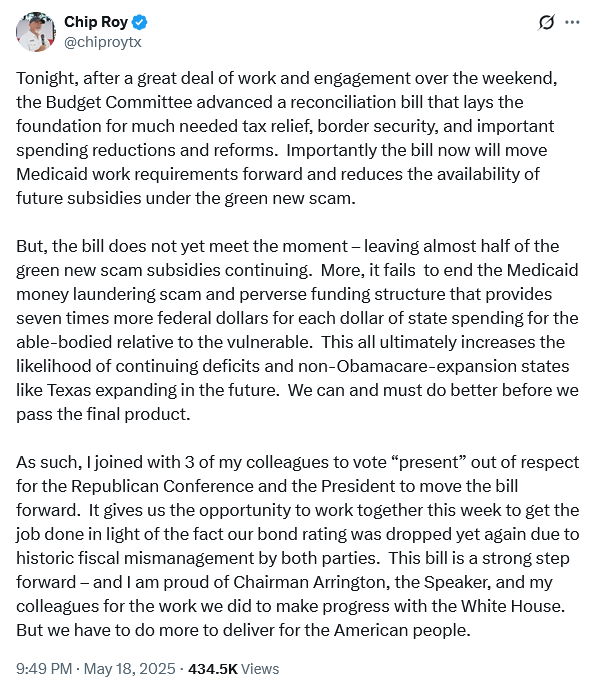
Simply cutting amounts spent, however, misses the point of the debate entirely.
If Medicaid is an inappropriate expenditure then no money should be spent on it. If Medicaid is appropriate then the money needed to deliver the requisite services should be allocated, and funding sources found.
Likewise, if the “Green New Deal” spending are appropriate government expenditures, they should be maintained. If they are not, there should not be even one dollar allocated.
Chip Roy misses the legitimacy mark by a country mile—and he’s a supposed fiscal and deficit “hawk”!
In a sensible budget, the government will spend every dollar that it must to achieve credible and Constitutional policy objectives, and spend no dollars whatsoever on non-credible and un-Constitutional items. It is fair to say the One Big Beautiful Bill has been the antithesis of a sensible budget.
Institutionalized Deficits
The consequences of this dereliction of legislative duty by Congress is already widely known and easily seen in the ever-growing federal spending deficit.
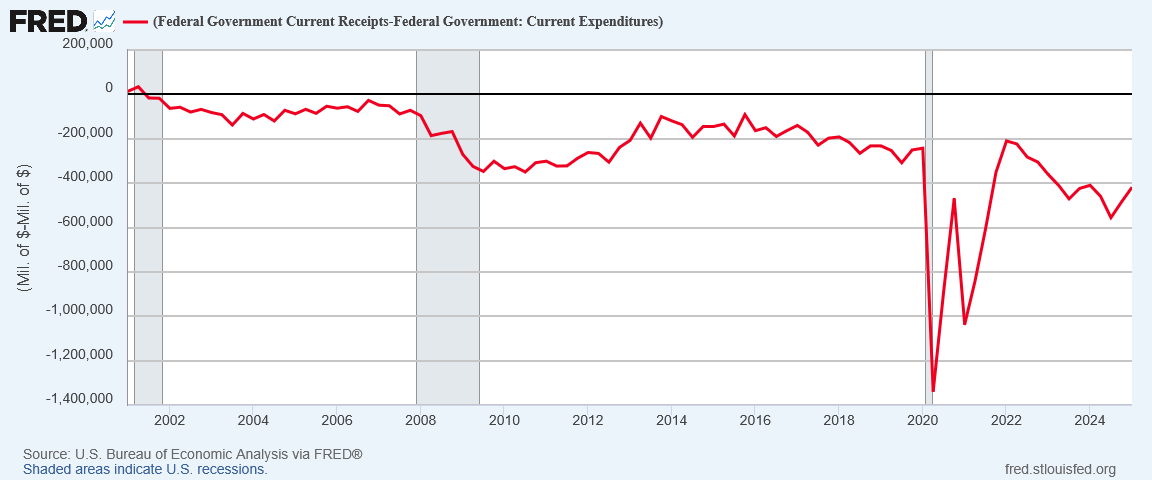
For at least the past quarter-century, through both Republican and Democrat Administrations and Congresses, the deficit has steadily grown (the issue dates back even further, but the point is sufficiently made if we start the data analysis with President George W. Bush’ term of office).
This was even true of Donald Trump’s first term of office even before the COVID Pandemic Panic lunacies.
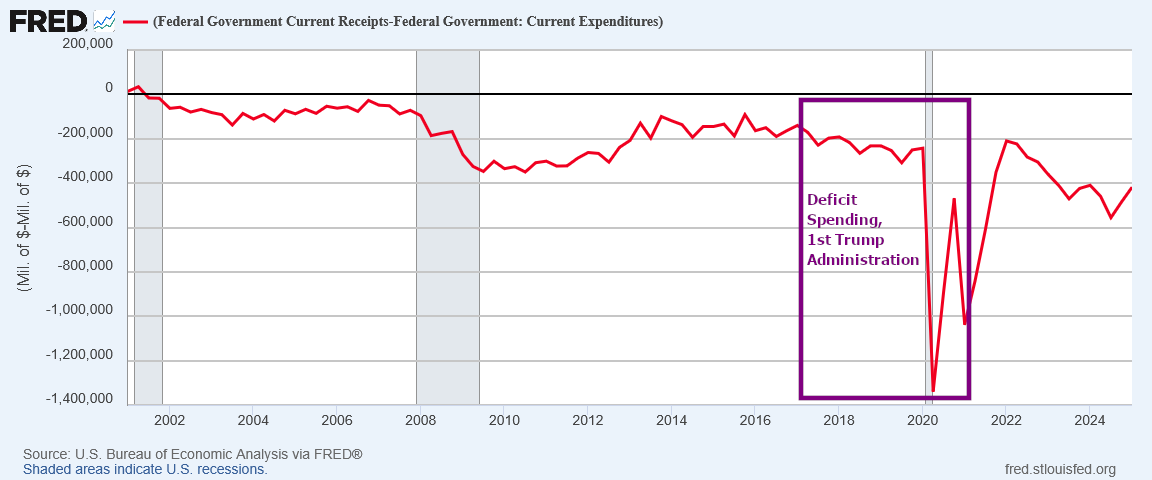
In fairness, we should note that Donald Trump particularly in his current term of office did not promise a balanced budget or an end to deficit spending. Such items are not found on the list of commitments he made to the American people within his Agenda 47.
Donald Trump did promise to end “wasteful” government spending. That was the impetus behind the reorganization of the US Digital Service as the Department Of Government Efficiency, aka “DOGE”. However, within Agenda 47 are other commitments that involve government spending. Reducing government spending overall or instituting a balanced federal budget limiting spending to what the government receives in tax revenues was not something Trump has ever promised.
Whether President Trump should have made such a commitment, or whether such a commitment should be understood as an inherent obligation of the Oval Office is a policy question I shall leave for another time.
Tax cuts are something else which he did promise—and those are part of the One Big Beautiful Bill. Making spending cuts in order to avoid increasing the federal spending deficit as a result of those tax cuts was never a stated commitment by President Trump, even though a great many critics of the One Big Beautiful Bill have said loudly and often that it will add to the deficit.
Thus we have the logic by which President Trump is able to consider the One Big Beautiful Bill a good thing: it delivers the priorities he wants it to deliver. That it ignores or undercuts other priorities is not a part of that rationale.
Given the federal government’s history of growing deficit spending just over the past quarter-century, those claims are almost intuitively credible. Everything government does seems to increase the federal deficit.
The consequences of deficit spending are of course equally widely known: ever rising indebtedness by the federal government.
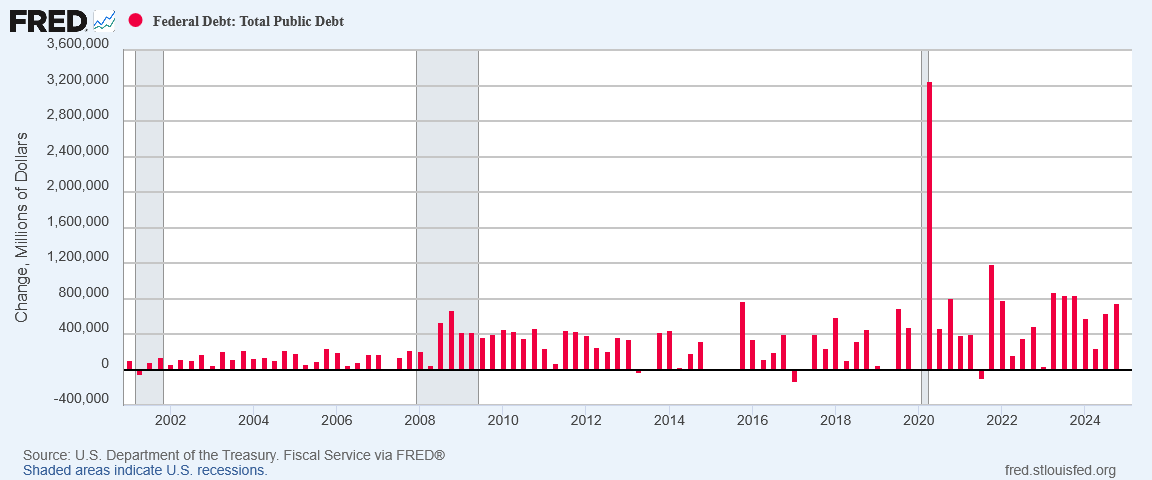
Each quarter, the US Treasury sells progressively greater amounts of debt, pushing the total federal debt to $37 Trillion and beyond.
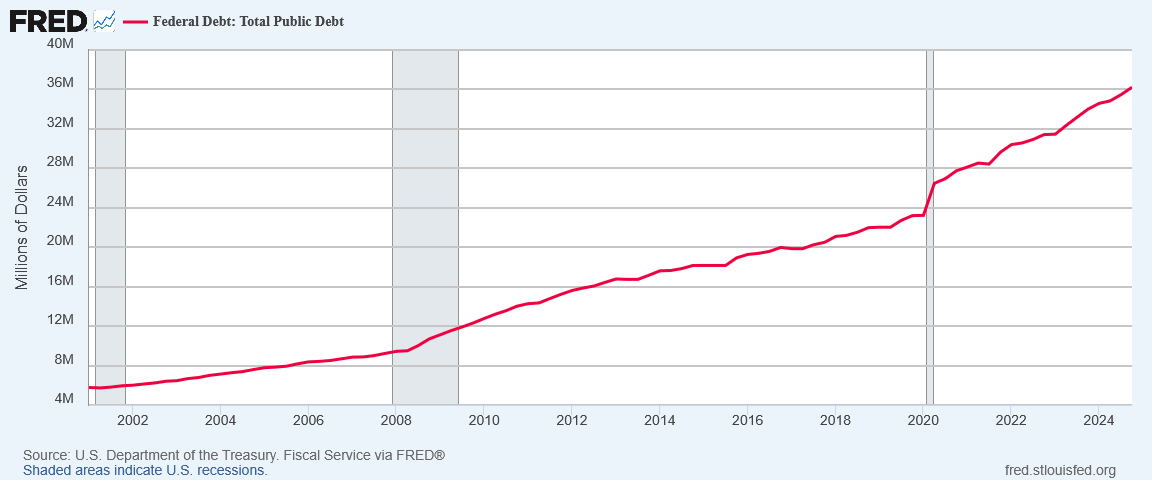
Let there be no misunderstanding here: none of this is news. None of this is new information. No one should be shocked or appalled by this. The state of government spending has been known and tolerated for every one of the 25 years charted here, and more.
We know all of this. We have known all of this all along. Just as we have known about the fraud, waste, and abuse of government spending publicized by DOGE earlier this year.

Congress has known all of this. Congress has complained loudly about all of this. Voters have complained loudly about all of this. Yet the federal spending deficit has only increased.
If the reporting is even partially accurate, with passage of the One Big Beautiful Bill, the federal spending deficit will increase yet again.
Deficit Reduction?
That the deficits keep rising year over year is especially perverse, given the repeated representations by the allegedly non-partisan Congressional Budget Office that Congressional spending chicanery in fact reduces the deficit.
That was the clear and explicit representation of the CBO to Brett Guthrie, Chairman of the House Committee on Energy and Commerce.
CBO estimates that the Committee’s reconciliation recommendations would reduce deficits by more than $880 billion over the 2025-2034 period and would not increase on-budget deficits in any year after 2034
The CBO made a similar clear and explicit representation to Tim Walberg, Chairman of the House Committee on Education and Workforce.
CBO estimates that the Committee’s reconciliation recommendations would reduce deficits by more than $330 billion over the 2025-2034 period and would not increase on-budget deficits in any year after 2034.
Over $1.1 Trillion in claimed deficit reduction by the CBO and yet the reporting now is that the One Big Beautiful Bill increases deficit spending by as much as $3.3 Trillion? That’s a level of mathematical incompetence that surpasses even the Bureau of Labor Statistics.
Apparently “non-partisan” in Washington, DC, also means “non-competent”. The Congressional Budget Office certainly seems to live down to that interpretation.
What is certain is that, despite the CBO affirmations to the contrary, government spending deficits keep rising, year in and year out. For all the deficit “reductions” identified by the CBO, Congress manages to find still more ways to increase the deficit.
There has not been any reduction in federal spending deficits in the past 25 years, and the data makes that painfully clear.
Neither will there be any meaningful reduction in federal spending deficits from the One Big Beautiful Bill.
Finite Funds
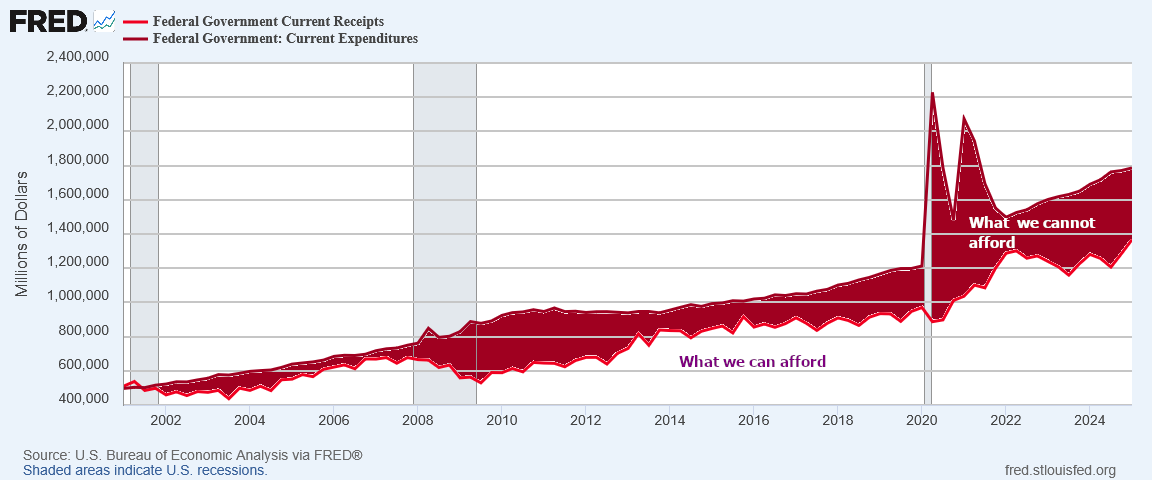
The lunacy of federal spending is especially perverse given the established reality that, in any given year, there is a finite amount of tax revenue received by the federal government.
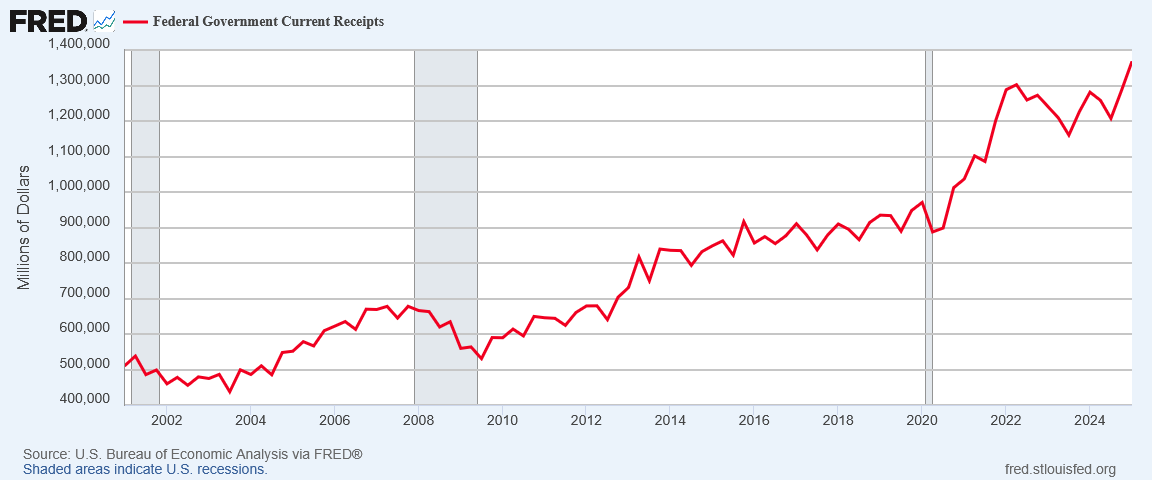
Since the end of the Great Recession in 2009, that tax revenue has steadily grown each year. It has grown even faster in the wake of the COVID Pandemic Panic. The federal government takes in literally trillions in tax revenue every year—yet it never is enough.
As is painfully clear from the rise of deficit spending, the federal government manages to grow its spending even faster every year.
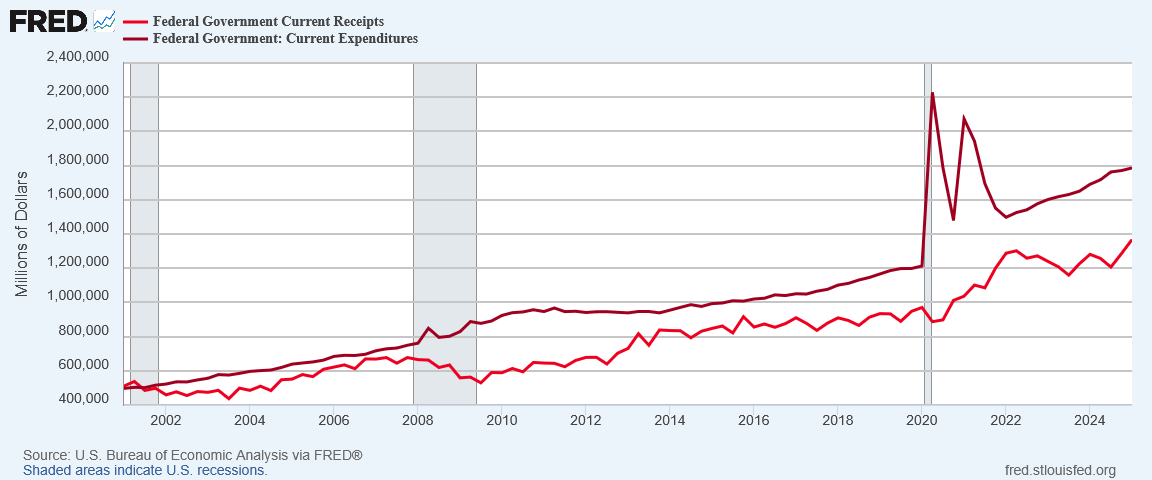
There are no budgetary mysteries here. The difference between the two lines on this graph is the degree to which the Congress willfully and deliberately lives beyond its means each and every year.
As for the so-called “deficit hawks” such as Rand Paul, Thomas Massie, and Chip Roy…suffice it to say they have been uniformly ineffective in altering the trajectory of government spending throughout their legislative careers.
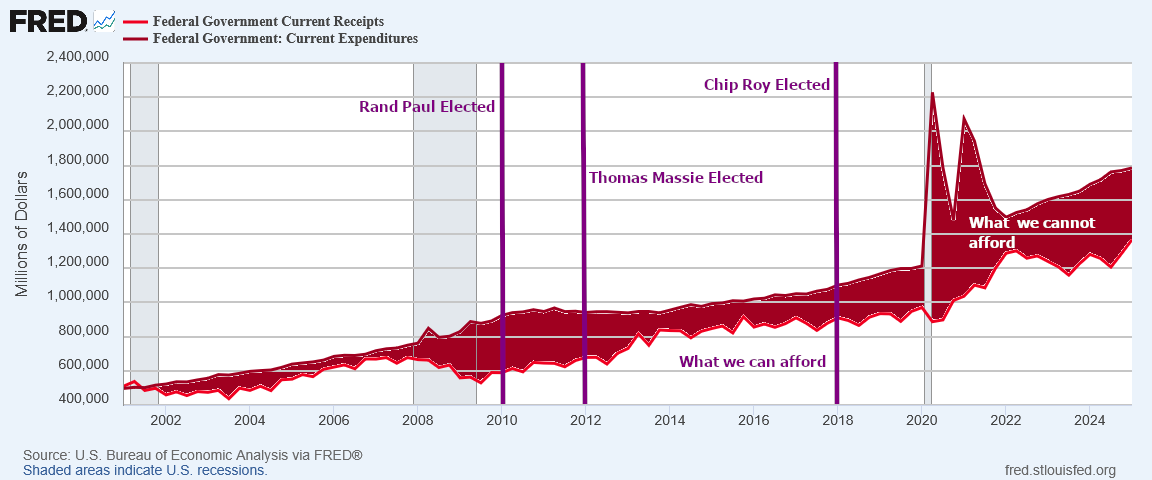
For all their talk about reducing government spending, they have not even managed to slow down the increase in deficit spending over the past fifteen years. As presumptive deficit hawks they are collectively a bigger legislative failure than the One Big Beautiful Bill.
The Freedom Caucus has a whole can only be described as a legislative failure, and for the same reason.
I shall repeat myself: All of this is known. I am not mentioning anything here that even remotely qualifies as “news”.
That is the problem.
Zero-Based Budgeting
If the One Big Beautiful Bill is already a complete and total failure, what should the government be doing?
Amazingly enough, we already know the answer to that as well. Vivek Ramaswamy, during the 2024 GOP Presidential Primary, gave America the answer: Zero-Based Budgeting1.
Zero-Based Budgeting is exactly what its name suggests: when building out an organizational budget, start with a budget level of zero dollars, and add in only the amounts that will be needed to implement desired projects and achieve desired organizational goals.
That was Ramaswamy’s signature economic proposal during the primaries.
“Start from zero for every department and ask what (if any) spending is required instead of just taking last year’s budget as the default,” the 38-year-old entrepreneur argued in a policy proposal shared with The Post.
Unsurprisingly, corporate media panned the idea, noting that it had been tried unsuccessfully during the Carter Administration in the 1970s.
Regardless, when the Carter administration decided to implement ZBB in 1977, the immediate impact was a surge in spending on special management classes to teach mid-level bureaucrats how to do it. Over the long term, the effect was minimal, because the president is not the “boss” of the federal government in the way that a CEO is the boss of a company. It doesn’t matter whether the person running some grant program can make a compelling case to the president for expanding or continuing it, because the president does not have the legal authority to spend more or less than Congress appropriates.
Bloomberg somewhat fatuously tried to argue that Congress already does Zero-Based Budgeting.
In fact, the appropriations process itself is kind of a ZBB exercise, in which the government literally ceases to operate unless the relevant actors in Congress can reach an agreement on how much to spend. But what it takes to get an appropriation approved is a political bargain — typically a bipartisan one. Sometimes this means one side gets what they want even if the other side doesn’t think they’re right.
This is, of course, complete nonsense. As the politicking and legislative sausage-making described at the top illustrates, Congress hardly questions spending items at all. There is zero debate within the Congress about what programs and initiatives should receive government support. The debate is entirely about what programs and initiatives are necessary to secure a Congressman’s support.
Zero debate is not Zero-Based Budgeting.
Outside of President Trump’s Executive Orders attempting to shutter and reduce various government agencies and departments, there is no political debate or discussion about what government should be doing, nor is there any reflection about whether various government programs, agencies, and departments are even Constitutionally permissible
While alternative and independent media do sustain a broad national discourse on these issues, we do not see that debate within the Congress itself. The one place where it absolutely needs to happen is the one place where it never happens.
The dynamics of legislative politics may make a formal Zero-Based Budgeting approach impracticable for government budgets, but the guiding philosophy behind it, that of rigorously justifying each and every item within a budget, and discarding items which cannot be justified, is the sober, sane, and sensible approach to managing the public fisc.
In the federal budget, there should be the added prerequisite that the spending must be explicitly justified within the powers assigned to Congress by Article I Section 8 of the Constitution. If there is no explicit justification for the spending within that section of the Constitution, the federal government is not authorized to spend money in that way—that needs to be the beginning, middle, and end of the Constitutional debate regarding spending.
(Mr. President, if you should happen to read this, consider declaring wasteful spending unconstitutional and therefore illegal. Force Congress to debate the Constitutionality of their largess).
The spending constraint should not be the federal debt limit, but the amount of tax revenue that is being collected. Deficits should be explicitly justified—taxpayers deserve to be told exactly what is so crucial in various spending items that Americans must go deeper into debt because of it.
The default proposition for every government spending item needs to be that it is not justified until it is explicitly justified. That is the essence of Zero-Based Budgeting. That was the core of what Vivek Ramaswamy wanted to see put into practice within the federal government. That is applying the rigors of common sense to the burdens of government.
At no point in the construction of the One Big Beautiful Bill has this approach been utilized. At no point has the One Big Beautiful Bill been the product of common sense and prudential analysis of how best to use taxpayer dollars.
Instead, the One Big Beautiful Bill has been all about the politics. President Trump is focused on how he can get his priorities funded. Various members of Congress are focused on getting taxpayer spending directed towards their state or district.
Instead of being radical and disruptive change from the status quo by imposing common sense on the budget process, the One Big Beautiful Bill is the apotheosis of the status quo. The One Big Beautiful Bill is the same bloated legislative mess budgets have been for at least the last quarter-century.
In my estimation, that makes the One Big Beautiful Bill One Big Ugly Failure.
Kagan, J. “Zero-Based Budgeting: What It Is and How to Use It.” Investopedia, 2024, https://www.investopedia.com/terms/z/zbb.asp.
While I do not look at all favorably on the One Big Beautiful Bill, I will give President Trump credit for putting in the work to get the bill passed.
A live update on Politico earlier today reported that President Trump has been "working the phones" all day to shepherd the bill across the finish line.
https://archive.ph/Tv01Q#selection-1085.0-1089.185
After four years of the non-entity that was Joe Biden, and recalling Obama's studied disinterest in the logistical and political realities of getting a legislative agenda through Congress, one has to acknowledge Trump's willingness to get engaged in making the bill happen and not just imperiously waiting for the Republicans to deliver it to the Resolute Desk.
Yes, I want Congress to engage in a much more substantive and Constitutionally framed debate over the budget, and yes I want President Trump to be at the forefront of driving that Constitutionally framed debate. Obviously, I'm not going to get what I want.
Still, a President who works the phones to get his signature piece of legislation through Congress is definitionally NOT an authoritarian. Corporate media would do well to admit that much and back off the "authoritarian" hogwash and horse hockey.
Authoritarians (e.g., Putin) do not cajole legislators into doing their bidding, but simply expect it.
That's not happening here. That much is a definite plus no matter what the outcome of the One Big Beautiful Bill is.
Speaking of Vivek Ramaswamy. Haven't heard all that much about him lately in the alternative news as well as the MSM, even though he is running for Governor in Ohio. Wonder why that is