


As the US/Israeli war with Iran, dubbed “Operation Epic Fury” by the United States War Department, wraps up its second week, the fog surrounding this war has not lifted in the slightest. As I observed in my last assessment, the overarching answer to most questions regarding the war, the strategies, and the probable outcomes is in nearly every instance “We do not know”.
The fog of war has not stopped elements of the chattering class across both corporate and alternative media from posturing and pontificating about the significance of this or that aspect of Operation Epic Fury. The fog of war has stopped those elements of having anything more substantive than their own opinions—all of which combined are not worth enough to make a down payment on a free hot dog.
Wars are messy, unpredictable things. The only rational basis for analyzing a war as it unfolds is the often-maligned but timeless observation of former Secretary of Defense Donald Rumsfeld:
Reports that say that something hasn’t happened are always interesting to me, because as we know, there are known knowns; there are things we know we know. We also know there are known unknowns; that is to say we know there are some things we do not know. But there are also unknown unknowns -- the ones we don’t know we don’t know. And if one looks throughout the history of our country and other free countries, it is the latter category that tend to be the difficult ones.
Any “analysis” which is not grounded in Rumsfeld’s epistemological humility is, regardless of who is spewing it forth, little more than arrant nonsense, and should be dismissed as such.
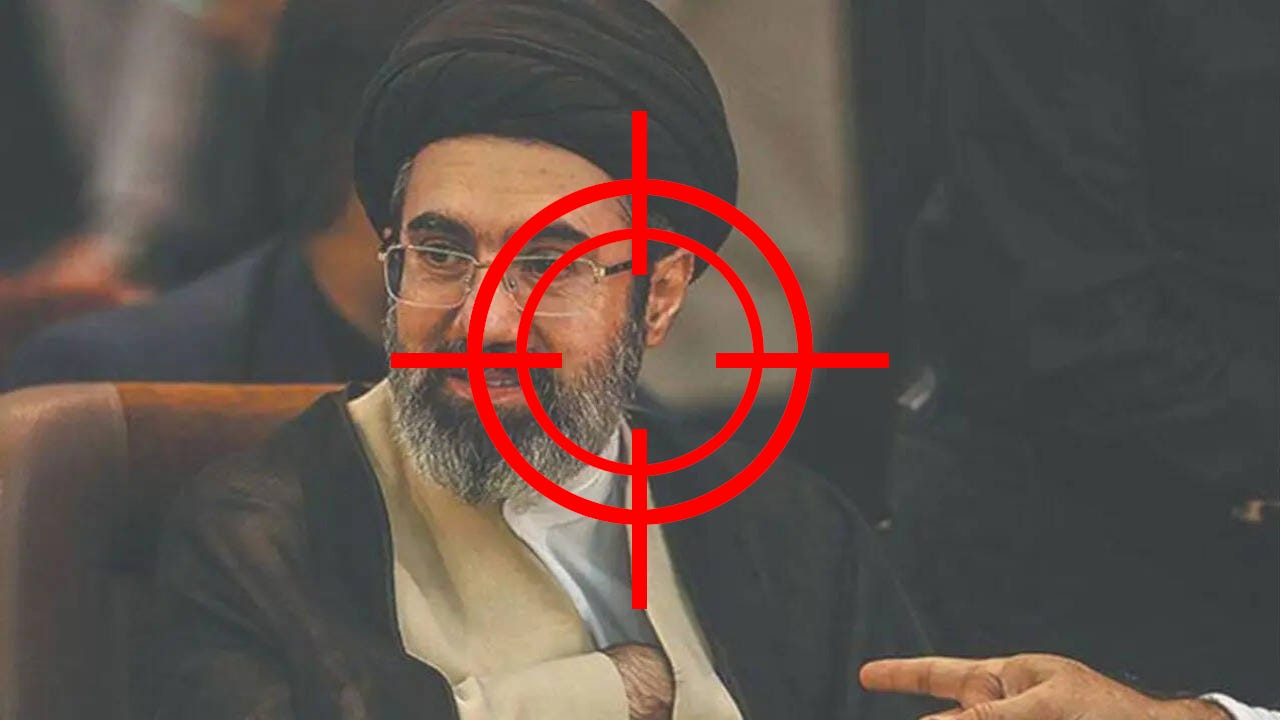
When we look at the “known knowns” of this war, we see that the US and Israel are continuing to bomb Iranian targets, Iran is continuing to launch retaliatory strikes in nearly every direction, not discriminating between Arab states and US/Israeli forces, and the Strait of Hormuz is very much a contested waterway. We know that the Iranian people have not risen up against the regime—yet. We know that the Assembly of Experts has selected former Supreme Leader Ayatollah Ali Khamenei’s son Mojtaba to succeed him—but has as of this writing not been seen in public nor even on television. We know that the IRGC in particular remains defiant and bellicose.
As for the “known unknowns”, we do not know with certainty the logistical limits of the United States and Israel. We do not know if Mojtaba Khamenei is severely injured, or if he is even alive. We do not know if Iran is holding back a reserve of missiles and drones for a particular attack on either the US or Israel. We do not know if the Arab states will attack Iran.
As for the unknown unknowns, they remain the impenetrable fog of war which surrounds every conflict. We cannot assess them because we cannot, by definition, even identify them.
Where does that leave any understanding of the war thus far? At present, we can say little more than “it’s not over yet.”
The Battle For The Strait Of Hormuz
While it might be a stretch militarily to classify the contest taking place for control over the Strait of Hormuz a “battle”, that maritime choke point remains a primary combat zone, and the one which presents the greatest geopolitical ramifications.
What we know is that Iranian drones are continuing to attack oil tankers in an around the Persian Gulf, with a US-owned oil tanker being hit by a sea drone two nights ago.
In the preceding 24-hour period, as many as six vessels were hit by Iranian kamikaze drones.
What may be even more significant than the attacks on civilian shipping, however, are the drone attacks on Arab oil infrastructure around the Persian Gulf. At the same time Iranian drones were attacking six civilian ships, a drone strike was observed against the storage tank farm at MINA Petroleum Facility on the Port of Salalh in Oman.
Attacks such as that are a continuation of a pattern of Iranian aggression against Arab nations that commenced as soon as Iran began retaliating against US and Israeli air strikes, launching major missile barrages against the United Arab Emirates while also targeting Qatari and Saudi natural gas and oil refining facilities.
In the first public statement attributed to newly-installed Supreme Leader Mojtaba Khamenei, Iran intriguingly denies attacking civilian infrastructures, insisting that its attacks are limited to US bases only:
In the recent assault, some of these military bases were utilised; naturally, as we had clearly warned in advance, and without committing any act of aggression against those regional countries themselves, we have only targeted the US bases there. After this, we will have no choice but to continue this course of action. Though, we remain committed to the necessity of friendship with our neighbors.
Arab energy production facilities are not “US bases”, and there has not been any evidence Arab states are persuaded by either the attacks or the regime’s rhetoric to push US forces out of the region.
In that same address, Mojtaba Khamenei explicitly called for Iran to continue exerting control over the Strait of Hormuz and blocking oil traffic from leaving the Persian Gulf.
Iran’s declared position is indisputable: they mean to use the interdiction of maritime traffic through the Strait of Hormuz as a pressure tactic to compel the United States to stand down its forces and cease Operation Epic Fury.
President Trump’s position is equally indisputable: Iran’s efforts to blockade the vial waterway will be met with force. If necessary, the US Navy will soon begin escorting vessels through the passage to ensure oil cargoes are able to be delivered.
The disruption has led President Trump to consider offering naval escorts to ships passing through the Strait of Hormuz, in the hopes that military protection could clear up the gridlock.
“When the time comes, the U.S. Navy and its partners will escort tankers through the Strait if needed,” the president told reporters Monday. “I hope it’s not going to be needed, but if it’s needed, we’ll escort them right through.”
But administration officials have suggested they aren’t prepared to start carrying out naval escorts just yet. Energy Secretary Christopher Wright said this week “it’ll happen relatively soon, but it can’t happen now,” and pointed to the end of the month as a possible timeline.
Thus far, President Trump’s reassurances have helped restrain the rise of benchmark crude oil prices, but were not able to keep Brent Crude from once again breaching the $100/bbl threshold on Friday.
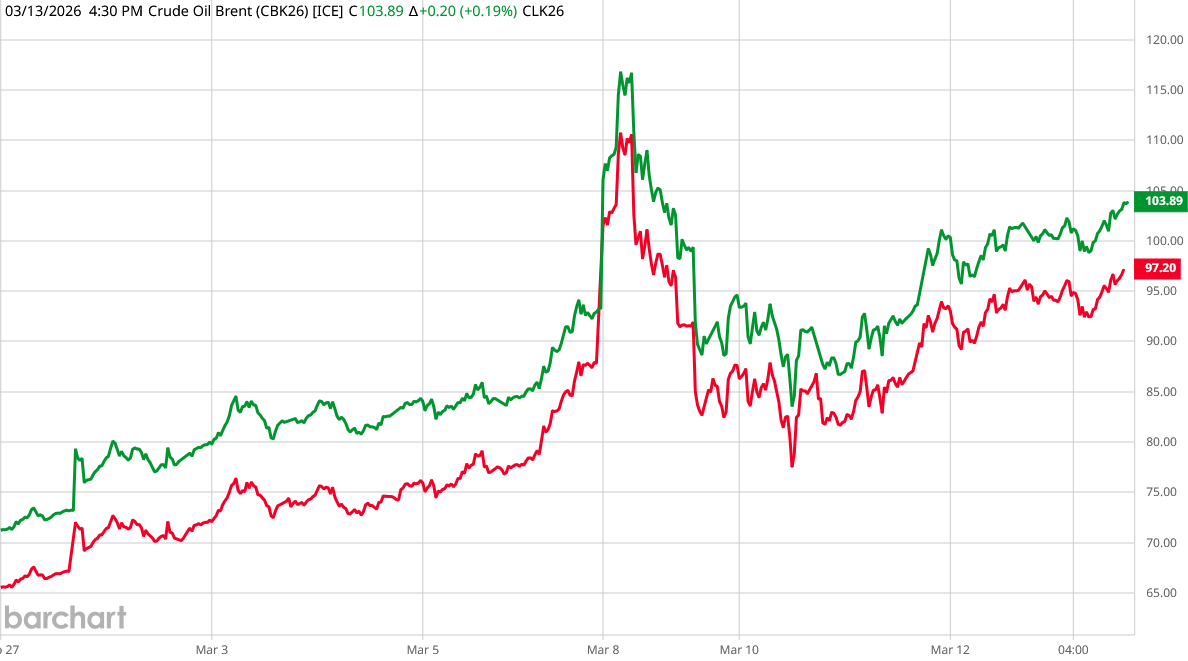
Iran’s efforts to disrupt Persian Gulf oil production have indisputably succeeded in raising global oil prices. As I have observed multiple times, we are going to have a pronounced inflationary surge in March.
Because of that inflationary surge, Iran’s regional pressure tactics in this war—and indeed the war itself—are catalyzing global consequences.
The Chinese Connection
The global scope of Operation Epic Fury’s ultimate impact is made unmistakable by last week’s emergence of lengthy gas lines in China, where the people are facing significant gasoline price increases.
The price rises are not illusory, as the gas lines are being occasioned by official announcements from Beijing raising retail price caps on gasoline and diesel fuel. China has bluntly told its citizens that energy prices are going to rise dramatically, producing an oil shock akin to the ones infamously experienced by the United States during the 1970s, even though Iran has gone to some lengths to keep oil flowing to the Middle Kingdom.
Remarkably, Beijing’s efforts to stockpile oil over the years are proving an incomplete buffer to Persian Gulf oil disruptions. China has the largest onshore crude stockpiles in the world, but that amount provides only approximately 2-3 months of refinery demand. Japan and South Korea, two other nations greatly exposed to Persian Gulf oil production, have crude stockpiles for over six months of refinery demand.
Much of China’s vulnerability comes from scale. China is the largest oil importer in the world by far, and has made a point of buying as much sanctioned oil from Iran, Venezuela, and Russia as it can. Consequently, China has been Iran’s principal customer over the years, accounting for as much as 90% of Iran’s total oil exports.
China’s interest in Iranian crude has been a driving force behind China’s efforts to build power and influence in the Persian Gulf, including agreeing to help Iran rebuild its air defenses after last year’s Twelve Day War with Israel.
China’s interests in Iranian crude may also have been one of the motivating factors behind President Trump’s decision yesterday to attack presumptively “military” targets on Iran’s Kharg Island, where 90% of its oil export operations take place.
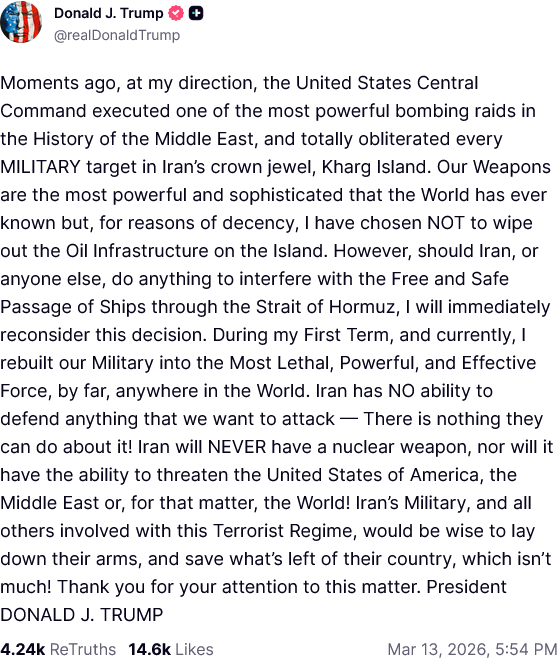
The decision to strike at Kharg Island illustrates the risk many pundits invite with interpretations of unfolding events, as a number of pro-Trump commentators pointed to a lack of strikes there as demonstrative of President Trump’s strategic finesse and tactical granularity in prosecuting Operation Epic Fury.
Many folks are deeply confused about the significance of yesterday’s refinery strike. It didn’t damage Iran’s ability to export oil, since the refinery strike on Tondgouyan didn’t affect the country’s export facilities like Kharg Island (more on that in a moment). It was a refinery for domestic fuel. Hitting Tondgouyan hit the IRGC’s ability to keep its trucks and war machinery running, and undermined the regime’s social compact— selling fuel to its own population
President Trump was not threatening Iran’s global oil exports—until he did.
The reality is that Kharg Island has always been a potential target, simply because of its pivotal role in Iran’s oil economy. The terminal’s vulnerability was something I specifically highlighted early on, when the media rumor mill was rife with speculation that Saudi Arabia was on the verge of joining the US and Israel in launching attacks on Iran.
More ominously, Saudi Arabia is reported to be weighing attack options against Iran’s oil infrastructure.
Saudi Arabia would target “Iranian oil facilities if Iran mounts a concerted attack on Aramco,” the source tells AFP, referring to the state oil giant.
We should note that Saudi Arabia does have attack options. Global Firepower ranks their air force as the 7th most powerful in the world—well ahead of Iran’s.
Moreover, Iran has several vulnerable facilities within easy reach of Saudi Arabia—not the least of which is the oil terminal at Kharg Island, which processes roughly 95% of Iran’s oil export volumes.
While Saudi Arabia has not (yet) launched any air strikes of its own against Iran, the vulnerability of Kharg Island to air strikes has always been part of the combat environment for this war. Until yesterday, prevailing wisdom was that disrupting Iran’s oil production to that degree carried too great a geopolitical risk to make strikes against the island worthwhile.
Analysts have said that the prospect of a U.S. move to seize Kharg Island, a strategically vital hub often referred to as Iran’s “oil lifeline,” is considered extremely high risk, both from a geopolitical and economic standpoint.
The five-mile-long coral island, which is located about 15 miles off the coast of mainland Iran in the waters of the northern Persian Gulf, has been left untouched through nearly two weeks of U.S. and Israeli-led strikes against Iran.
The Trump administration has discussed seizing the island, according to an Axios report on March 7, citing four unnamed sources with knowledge of the discussions.
Was Iran’s determination to keep supplying oil to China a factor in President Trump’s decision to launch air strikes against Kharg Island? There has been no public reporting saying that quiet part out loud, but the inference is obvious and even unavoidable.
However, we should also look at events outside of the Persian Gulf region which may have tipped the risk scales in favor of attacks on Kharg Island.
In yet another demonstration of its growing facility in drone warfare, as the US was launching Operation Epic Fury, Ukraine launched yet another drone strike on the Russian oil terminal at Novorossiysk, on the Black Sea. While Russia has been predictably tight-lipped about the extent of damage, Reuters has reported that the Sheskharis oil terminal suspended loading operations for at least a few days as a result of the attacks, and other media reports suggest that the damage inflicted on the terminal was significant.
Ukrainian outlet Exilenova Plus reported on Telegram that port infrastructure in Novorossiysk is on fire.
An analysis by Astra from videos posted by Exilenova and eyewitnesses on social media suggests that it is the Transneft Sheskharis loading terminal on the east side of the bay that is on fire.
This is not the first attack on the Sheskharis terminal—it was hit in November last year, along with Russian energy export infrastructure at the nearby Tuapse and Temryuk ports.
Remember, China is a principal buyer of sanctioned oil, which is to say it is a primary customer not just for Iran but also for Russia—and Russia’s own export operations are experiencing their own duress, courtesy of the war in Ukraine.
At the same time, yesterday Sweden has seized yet another “shadow fleet” tanker, ships upon which Iran and Russia depend to carry sanctioned oil to their customers—which is to say, to China. This was Sweden’s second such seizure this month, having earlier detained the cargo ship Caffa.
On March 1, Belgium seized the Ethera, a shadow fleet tanker presumably falsely flying the Guinean flag.
These are seizure operations which have occurred just since the start of Operation Epic Fury.
While we should not overstate the immediate impact of either the temporary disruption of loadings at the Sheshkaris terminal or the loss of a couple of shadow fleet tankers on China’s overall oil imports, these events are indicative of a measure of stress being imposed on sanctioned oil flows worldwide, oil flows which primarily go to China.
Have global efforts to curtail sanctioned oil flows put enough pressure on China’s oil consumption to where disrupting Kharg Island operations has a maximized impact on China? That is speculation, but what is not speculation is that China buys up most of the world’s sanctioned oil, that China buys virtually all of Iran’s oil production, and that having to buy that same volume of unsanctioned oil would be a substantial cost increase to China—at a time when China is already grappling with persistent deflation and an increasingly sclerotic export sector, and can ill afford the disruptive impacts of a major oil price shock.
Regardless of the reasons why, President Trump’s air strikes on Kharg Island appear to have come a time when they will have the greatest geopolitical reverberations worldwide.
Is Mojtaba Khamenei Even Alive?
The fog of surrounding this war with Iran is without a doubt the thickest where questions about Iran’s new Supreme Leader, Mojtaba Khamenei, are concerned.
Bizarrely, media sources cannot at this time even confirm if Mojtaba Khamenei is alive or dead. While orchestrated demonstrations of support for his accession have occurred in several cities, Mojtaba, the son of slain former Supreme Leader Ayatollah Ali Khamenei, has yet to be seen in public, or even to make a televised address.
Even those presumably within the government and close to the inner circles of power are not claiming to have seen or spoken with the younger Khamenei. The one consistent theme in what has been reported about his status is that he was injured in the initial attacks on February 28.
Iran’s new Supreme Leader Mojtaba Khamenei has been injured but is “safe and sound,” the son of President Masoud Pezeshkian said on Wednesday, offering one of the few official explanations for his absence from public view since being appointed last week.
Yousef Pezeshkian, who is also a government adviser, wrote on Telegram that he had asked contacts about reports of Khamenei’s injury and was told he was safe.
“I heard news that Mr. Mojtaba Khamenei had been injured. I have asked some friends who had connections. They told me that, thank God, he is safe and sound,” he said.
Even Mojtaba Khamenei’s recent remarks were a written statement actually read by presenters on state news media and not delivered by Khamenei himself.
That he is apparently severely injured or even dead begs the question of why he was chosen to be Supreme Leader.
There have also been persistent rumours that he was killed or left in a coma from the attack, which the written address has done little to alleviate.
Hossein Alizadeh, a former Iranian diplomat, put the question directly: “If his injuries are so severe that he cannot even record his voice, why was he chosen?”
That is not an idle question. Even as the Assembly of Experts was struggling to gather to elect a new Supreme Leader, criticisms of the younger Khamenei were in abundance, not the least of which has been his conspicuous lack of significant religious credentials.
These gaps in his resume have fueled speculation that Khamenei was the desired choice of the Islamic Revolutionary Guard Corps, who some believe effectively ordered the Assembly of Experts to elect the younger Khamenei.
Even if Khamenei is still alive and not in a coma, the manner in which he was tapped to be the Supreme Leader invites the speculation that he is little more than an IRGC puppet, and that his ability to rule hinges on his continued good relations with the IRGC leadership.
What those pledges have also made clear is that the IRGC is now the dominant power in Iran, regardless of whom formally holds the supreme leadership title – and that this would probably be true whether Mojtaba was healthy and present or wounded and absent.
“The supreme leader is no longer really supreme,” said Ali Vaez, an Iran expert at the Crisis Group think tank. “It is really the Revolutionary Guards who are running the show – and without whom Mojtaba would not be able to preserve his power.”
He added: “Both because he needs them to push back against his foreign enemies, and because he needs them to keep the population at bay.”
If that is indeed the case, the Iranian regime’s theocratic nature has been significantly diluted, with a more base (and more kleptocratic) authoritarianism dressed up as Islamofascism supplanting Shi’a conservatism.
However, if Mojtaba Khamenei is not alive, or is in a coma as some have speculated, the IRGC foisting him on the Assembly of Experts presents a conundrum for the IRGC leadership should that ruse be revealed to the Iranian people.
The existing power brokers in the regime besides Khamenei, men like Secretary to the Supreme National Security Council Ali Larijani, cannot become Supreme Leader because, both within Iran’s constitution and within the doctrines of Velâyat-e Faqih (ولایت فقیه in Persian) developed by the Islamic Republic’s founder Ayatollah Ruhollah Khomeini, the Supreme Leader must be a senior and substantive cleric. Mojtaba Khamenei was reportedly believed to have exceedingly thin religious credentials, but Larijani has no religious credentials.
The Supreme Leader might be dependent upon the IRGC infrastructure to prop up his rule, but the IRGC leadership needs a compliant Supreme Leader because they themselves cannot take on that role.
What becomes of IRGC political credibility even among Iran’s more conservative elements if they are found out to have so corruptly tainted the succession process by imposing either a coma patient or a corpse as Supreme Leader of the Islamic Republic?
In the Khomeini doctrine, the Supreme Leader is to be a sort of religious guardian, able to keep the government and the people moving along lines compliant with Islamic law and Shi’a religious doctrine. A Supreme Leader who is quite literally just a poster on a stage seems quite the blasphemous mockery of the role and the Islamic theology behind it.
The IRGC leadership may have imposed Mojtaba Khamenei on the Assembly of Experts in a bid for time, hopefully time enough for the US and Israel to exhaust their logistics and will to wage war, but if that time runs out, what becomes of the regime then?
Could that be the moment when the Iranian people decide the IRGC has got to go, no matter what? Could exposure of IRGC mendacity be the needed catalyst to fuel secular regime change in Iran?
We Still Do Not Know
As Operation Epic Fury proceeds into its third week, what is clear is that the “known unknowns” far exceed the “known knowns” regarding both the war and its proximate outcomes for the Middle East and for the world. After two weeks of war, rumors of war, and reporting on war, we still do not know how this war ends.
We still do not know if the regime will fall.
We still do not know who would take over if the regime does fall.
We still do not know how long the war will last.
We still do not know how long before the price of oil comes back down to prewar levels.
We still do not know if Saudi Arabia, the United Arab Emirates, and other Arab states will join the war against Iran.
We still do not know what will become of Iran once Operation Epic Fury finally ends.
As is eternally true of every event, we still do not know what are the “unknown unknowns.” Every question for which we do not have a clear answer is almost surely matched by multiple questions we have not yet thought to even ask.
Will the military victory President Trump has almost certainly already secured be overmatched by geopolitical defeat? We cannot know, and we cannot even plausibly gauge how likely that scenario might be. The counterfactual is also plausible, that President Trump secures not just military but geopolitical victory, and the outcome of this ginormous US and Israeli flex is an exponential expansion of US power and influence in the world.
It is plausible to believe that expanding US power and influence is at the core of why President Trump launched Operation Epic Fury, but having that as a goal is not of itself a guarantee that goal will be achieved.
Would geopolitical victory make Operation Epic Fury a right decision by President Trump? That will ultimately be a matter of individual opinion.
Those who desire America have a more isolationist foreign policy will not see the US achieving greater engagement with the world as a good thing.
Those who believe that any conflict in the Middle East is yet another illegal and endless foreign war will not see Operation Epic Fury as a good thing or even a necessary thing.
Those who desire to see the United States fit more comfortably into a globalist “rules based order” anchored by supranational institutions such as the EU and the United Nations will not see an accretion of power to the US as a good thing.
Russia's Vladimir Putin and China’s Xi Jinping, both of whom have hegomonic ambitions of their own, are almost certainly rooting for US failure in Iran.
Those who want to see America First in the world, either as an outright hegemon or as primus inter pares within a globalist rules based order, very likely view Operation Epic Fury favorably.
Yet these various perspectives do not change the realities of Operation Epic Fury itself, the immediate impacts it is having on Middle Eastern nations, or the ultimate impacts it will have on the world.
Whether the decision to launch this war was good or bad, righteous or wicked, it is a decision that has been made. Decisions having been made, and actions having been taken, reactions must now unfold, and consequences must emerge.
All that we really know about what those consequences will be is just this: This war is not over yet.
I like how you’ve structured this post in terms of known and unknowns, Peter. That’s a smart way to organize all of these foggy facts of war.
I remember a year or two ago I heard a military analyst say that if we ever went to war with Iran we might very well not win. That startled me - really, that ancient-minded regime could beat our modern, powerful military? Well, Trump is proving him wrong, as our military has been decimating Iran! As you say, now the main questions are regarding the geopolitical fallout. The Iranian regime seems to be so fragmented, uncoordinated, and leaderless that they have made seriously stupid blunders - like attacking pretty much everyone else. So I’m reassured that the U.S. side has the better leadership which will help us prevail. Trump’s expertise with the Art of the Deal gives me confidence that his combination of poker and 5D chess will outsmart the other players. We already see how he’s got several people backed into corners.
Peter, you have quite a bit of historical knowledge - is our arguably superior leadership likely to be the deciding factor here, or will other factors such as number of drones, or command of the shipping lanes, etc. be far more important?
Thanx Pete