An interesting development in the war with Iran occurred last week which went largely unnoticed by major media (including alternative media) outlets: Pakistan opened up six land routes into Iran, giving Iran a terrestrial alternative to the blockaded Strait of Hormuz for both its imports and exports (of everything except oil).
The “Transit of Goods through Territory of Pakistan Order 2026” took effect on April 25, formally designating six specific land corridors. These routes now allow third-country cargo destined for Iran to move securely across Pakistani soil, backed by strict customs safeguards.
Establishing land routes to move cargo out of Karachi and into Iran is undeniably good business for Pakistan. The cargo that has been languishing in Karachi will undoubtedly be welcomed in Iran. Yet after the backlog of containers is cleared, how much more cargo traffic Pakistan will move into Iran remains to be seen. The degree to which Pakistan will move Iranian exports also remains to be seen.
Can the overland importation of goods from Pakistan into Iran slow the latter country’s ongoing economic collapse? That seems unlikely.
Every article I publish takes time, care, and independence. A paid subscription fuels that work and shields it from outside pressure. If you’re able, join me today.
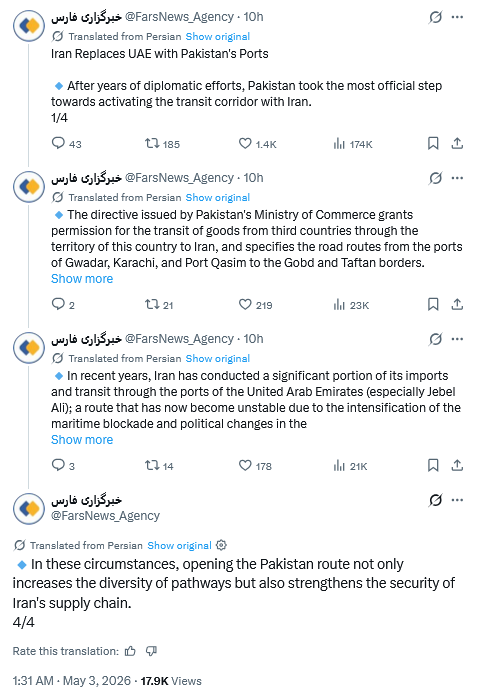
Iran Replacing UAE With Pakistan As Trading Partner
According to Fars, this arrangement has been the product of lengthy negotiations dating back well before Operation Epic Fury.
What is most remarkable about the Fars statement, however, is the third part:
In recent years, Iran has conducted a significant portion of its imports and transit through the ports of the United Arab Emirates (especially Jebel Ali); a route that has now become unstable due to the intensification of the maritime blockade and political changes in the region.
Prior to the US war with Iran, most Iranian imports, per Iranian sources, flowed through the United Arab Emirates.
Immediately after Operation Epic Fury began, however, Iran’s retaliatory strikes focused not on Israel, and not on US military assets, but on Iran’s Arab neighbors. Specifically, Iran focused on the United Arab Emirates.
The New Arab could not verify the numbers independently, but the figures purport that attacks on Gulf states and other Arab countries during the first four days of the war included 812 drones and 186 missiles directed at the UAE, 92 drones and 74 missiles towards Bahrain, 46 drones and 116 missiles towards Qatar, 36 drones and 13 missiles towards Jordan, five drones towards Oman, 384 drones and 178 missiles towards Kuwait, three drones and two missiles towards Cyprus, 13 drones and two missiles towards Saudi Arabia, in addition to 70 missiles and drones directed at Iraqi Kurdistan.
Not only did Iran decide to turn on one of its main trading partners in retaliation for Operation Epic Fury, it showed the Abraham Accords to have real diplomatic substance, as Israel took full advantage of the opportunity to step up and aid in the defense of an economic partner and ally.
Six weeks after burning an important economic bridge via the UAE, Iran is only just beginning to build up a new one via Pakistan.
Has Iran been simply using the United States’ war as a cover to shift its geopolitical focus away from the Persian Gulf, embracing its eastern neighbor instead? Certainly that is one plausible interpretation of these events.
It is, however, remarkable that the trade arrangements with Pakistan were not in place when Iran opted to force things by closing the Strait of Hormuz.
If the shift eastward was Iran’s intention from the start, its execution of that shift has been beyond shambolic.
What the Pakistani land routes will not resolve is Iran’s ability to export its crude oil.
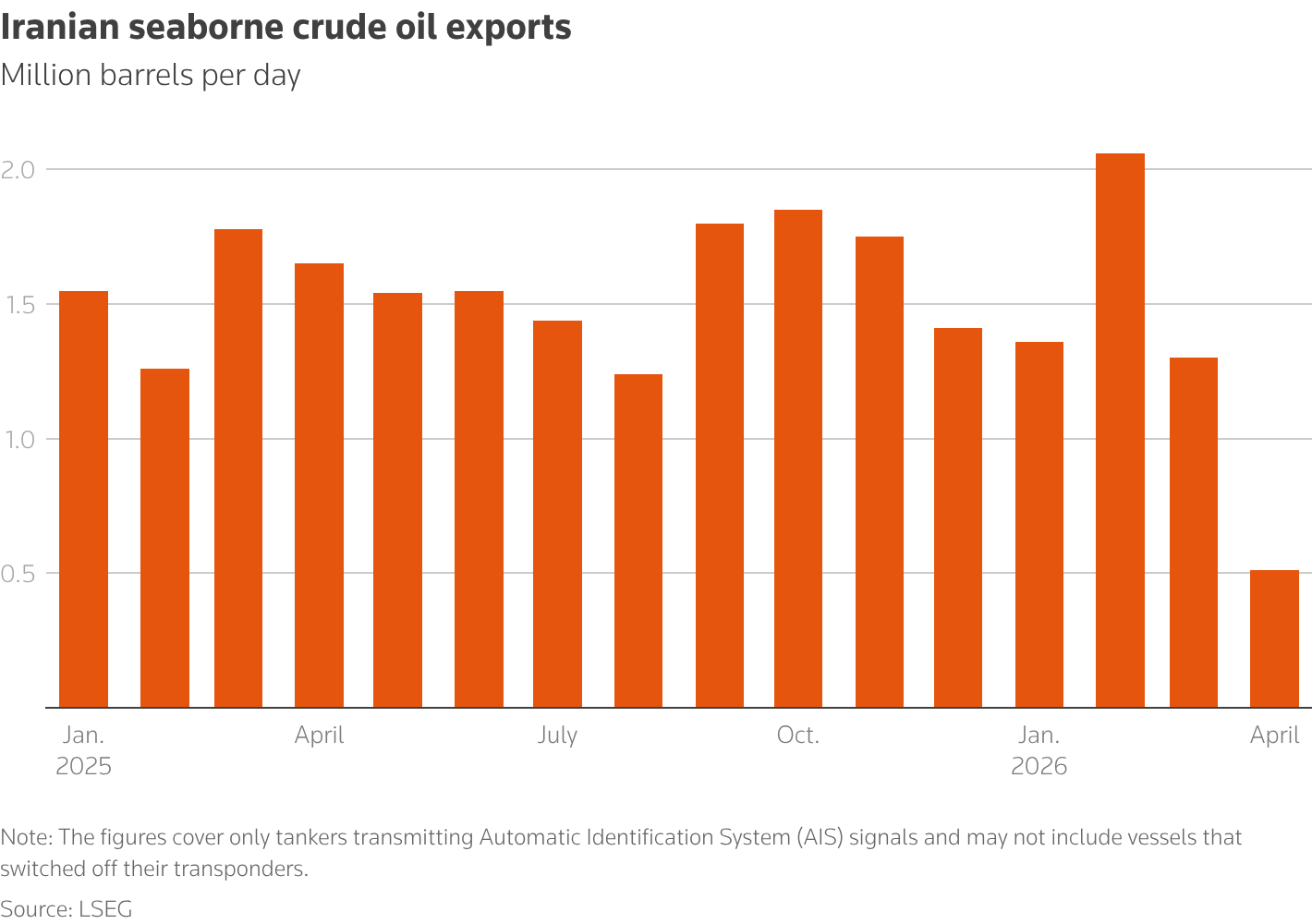
While we have to be cautious about taking any outside reporting about events in Iran at face value, media narratives both in the Middle East and in the West have consistently been reporting that the US Navy’s blockade of Iranian shipping has caused major disruptions to Iran’s oil exports.
“At this stage, we estimate that around 4 million barrels of Iranian crude has successfully moved out of the Gulf of Oman. We are not currently able to confirm whether any of those vessels have since been interdicted,” it said in an email to Reuters.
While a number of tankers are reportedly turning off their Automatic Identification System (AIS) transponders in order to slip past the US Navy cordons, making absolute measurements of the amount of interdicted oil impossible, the data that can be obtained indicates Iran’s oil exports are largely constrained.
If China is not able to receive shipments of Iranian oil—and China is the nation which has been the most aggressive in bypassing sanctions on Iranian oil—the presumption that Iran is unable to ship out oil is not at all unreasonable.
Tehran is proactively reducing crude output in a move to stay ahead of capacity limits rather than waiting for tanks to fill completely, according to the senior official, who asked not to be identified because the information is sensitive. And engineers have learned how to idle wells without lasting damage and restart them quickly, officials say, after years of sanctions and shutdowns pushed the country’s oil industry through cycles of disruption.
“We have enough expertise and experience,” said Hamid Hosseini, a spokesman for the Iranian Oil, Gas and Petrochemical Products Exporters’ Association. “We’re not worried.”
While we have to be cautious whenever reporting relies on unnamed sources, as the Bloomberg reporting does, that there is at least implied confirmation from a named source is an indication that the report is legitimate.
Certainly the Saudi-owned Al Arabiya outlet wants the reporting to be true, although given the attacks Iran has made on Saudi oil infrastructure since this war began, we should not ignore the obvious bias the Saudis would have in amplifying narratives of Iranian oil production in a chokehold because of the US Navy blockade.
Presumably, the Khamenei regime is not making any effort to curtail the fuel smugglers, as the more gasoline and diesel they smuggle out of the country, the more storage capacity is freed up for ongoing production.
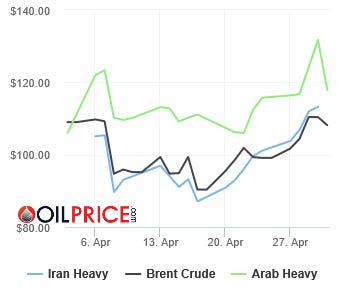
How accurate is this assessment? There is no way to tell at this time, although it does fit with other reporting on Iran’s oil infrastructure. Certainly the increases in futures prices for Iranian crude, which have tracked increases in global benchmark pricing, do not indicate a pre-war level of availability for Iranian oil.
While the precise timeline of Iran’s oil storage capacity filling up is extremely problematic, that Iran’s oil storage capacity is filling up is the best assessment of what is happening in Iran right now.
“What is going on in this country, Mr. Pezeshkian?” state TV anchor Elmira Sharifi asked earlier this week, staring directly into the camera after reporting that many Iranians can no longer afford basic staples such as rice, sugar, cooking oil, fruit, dairy products and medicine.
Had President Masoud Pezeshkian been watching, he might have been startled. State television rarely addresses officials so directly or publicly demands accountability. But he is no stranger to criticism. Calls for answers have become routine in the press and on social media.
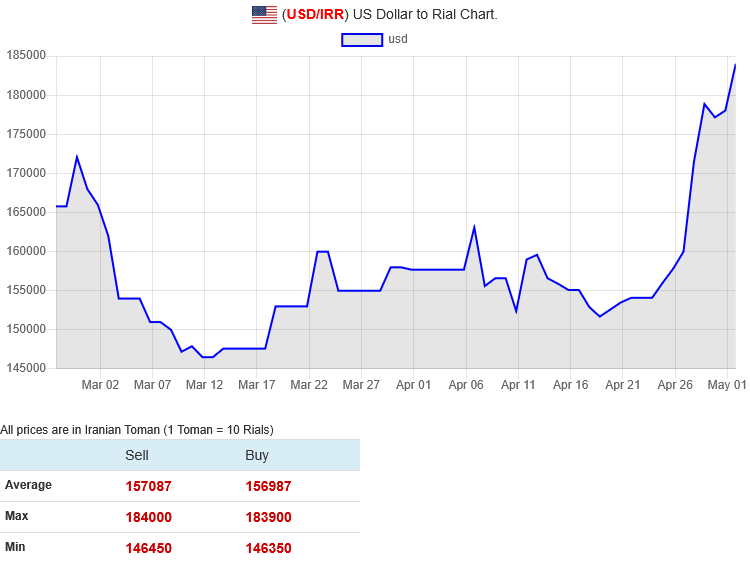
The pace of the collapse can be seen in the “free market” (which is to say, the black market) exchange rate of the Iranian rial against the dollar
Although the rial had strengthened considerably in the opening days and weeks of the war, shortly after the US Navy began its blockade on April 13, the rial went into free-fall, and, as of this writing, continues to do so.
The currency collapse is only the start of Iran’s problems. Spiraling unemployment is another.
Iran has lost at least 1 million jobs directly because of the war, Deputy Labor Minister Gholamhossein Mohammadi said, according to state media.
But the ripple effects put some 10 million to 12 million jobs at risk — half of Iran’s labor force — warns Hadi Kahalzadeh, an Iranian economist.
Israeli and US air strikes have reportedly damaged or destroyed some 20,000 factories, or 20% of Iran’s industrial plant capacity. Iran’s two biggest steel producers, Mobarakeh Steel and Khuzestan Steel, have halted production, as have numerous petrochemical refineries.
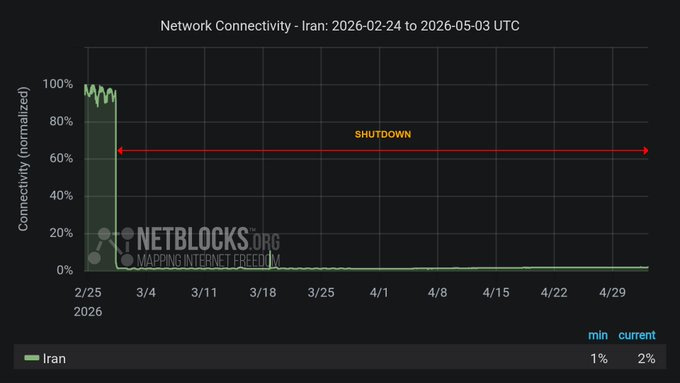
A toxic mix of local mismanagement, the bombardment of Iran’s infrastructure, US sanctions and a naval blockade, as well as a near-total internet shutdown imposed by the authorities in Tehran – now in its 64th day – is pummelling the economy in the country of more than 90 million people.
The monthly minimum wage in Iran is currently less than 170 million rials ($92), and that is after the government raised it by about 60 percent for the current Persian calendar year that started on March 21. The government is also offering subsidies towards food and essentials worth just less than $10 per month per person.
“You look at the prices and salaries, and you see the numbers don’t add up,” said one Tehran resident who asked not to be named.
“There’s not much you can do about it except to turn the little you have into something that is not depreciating or buying something you need that you might not be able to afford later.”
We should also consider that Gresham’s Law holds that people spend “bad money” before “good money”. That Iranians are looking to purchase items that don’t depreciate in value suggests one purpose of such purchases would be to trade them for needed items in the future. Spending rapidly depreciating rials (“bad money”) for assets capable of sustaining value (“good money”) is exactly the behavior Gresham’s Law says we should expect in such circumstances.
The head of Iran’s online businesses association said on Sunday that internet policy had no clear authority, leaving the digital economy unsure which body to negotiate with.
Reza Olfatnasab said some online businesses had seen sales drop by 40% to 50%, while others had sales near zero.
Across the media landscape, the reporting is largely the same: Iran’s economy is in a state of collapse, and the regime is powerless to turn it around. With even Arab and pro-Iranian media outlets carrying that narrative, there is little reason to dispute it.
While Pakistan will likely be able to move at least some of the 3,000 containers from the port at Karachi to their final destination in Iran as a result of the land routes being opened, how much those 3,000 containers will alleviate Iran’s economic distress is nothing if not extremely uncertain.
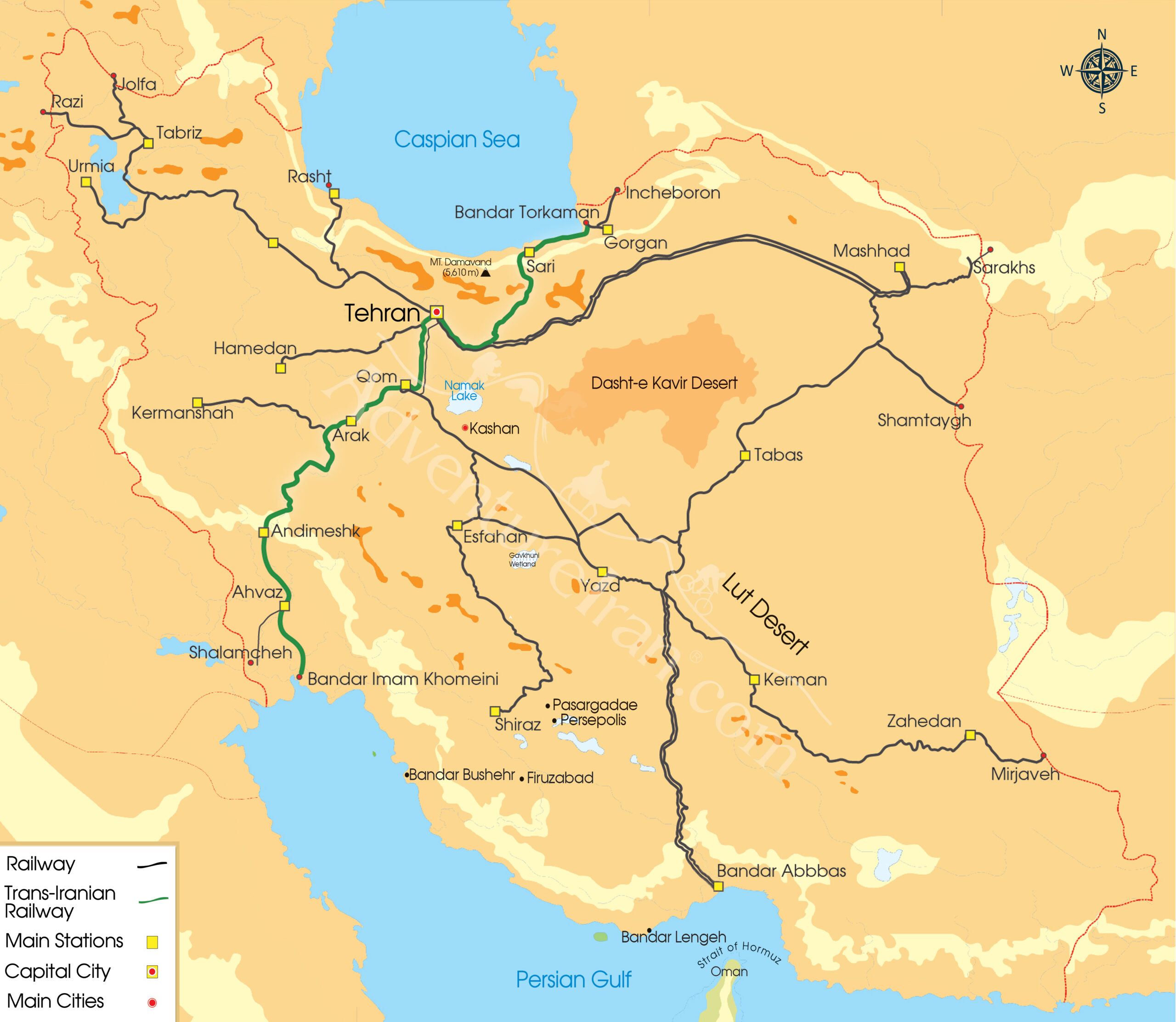
What the land routes will not do is help Iran export more oil. There are no oil pipelines running into Pakistan, or even close to the Pakistani border, and only one rail line, to Mirjaveh. Thousands of individual Iranians turning to fuel smuggling is not going to help the regime revive the economy, nor is it likely to delay for long the inevitable shutting in of production oil wells as storage supply becomes full.
With oil exports, and with non-oil export industries such as steel effectively shut down, the country’s ability to earn hard currency via exports in the form of dollars, euros, or even yuan is greatly diminished. Without that hard currency, paying for imports becomes increasingly problematic and increasingly inflationary.
With the regime disallowing internet access for all except those favored by the regime, an entire segment of the Iranian economy has, in effect, been completely shut down. Without vendors reselling imported goods, there will be fewer containers landing at Karachi en route to Iran.
Pakistan opening the land routes is arguably a humanitarian gesture, and is unquestionably good business for Pakistan, but it can have little practical long-term impact if there are not imports to be moved from Karachi to Iran. Without oil exports to generate the necessary cash, it is unlikely there will be much in the way of imports to move overland.
The best assessment of Pakistan’s move is that it offers Iran a band-aid when it needs a tourniquet to stop the bleeding. It is good for Pakistan as it clears cargo out of Karachi, but that is likely the most the land routes will accomplish.
If this story gave you real value, help me keep going. All Facts Matter is powered by readers who believe facts should stand on their own. Your subscription makes that possible.



What a clusterf— this will turn out to be. I can’t see the Persians being subservient to the Paks, unless there was substantial Chinese involvement
Wow, certain people are just determined to make everything worse:
https://www.theepochtimes.com/world/iran-strikes-uae-fujairah-oil-export-zone-with-drone-officials-say-6020919?utm_source=ref_share&utm_campaign=copy