


As I wrote last weekend, Chief Justice John Roberts’ ruling voiding President Trump’s Liberation Day tariffs is simply wrong:
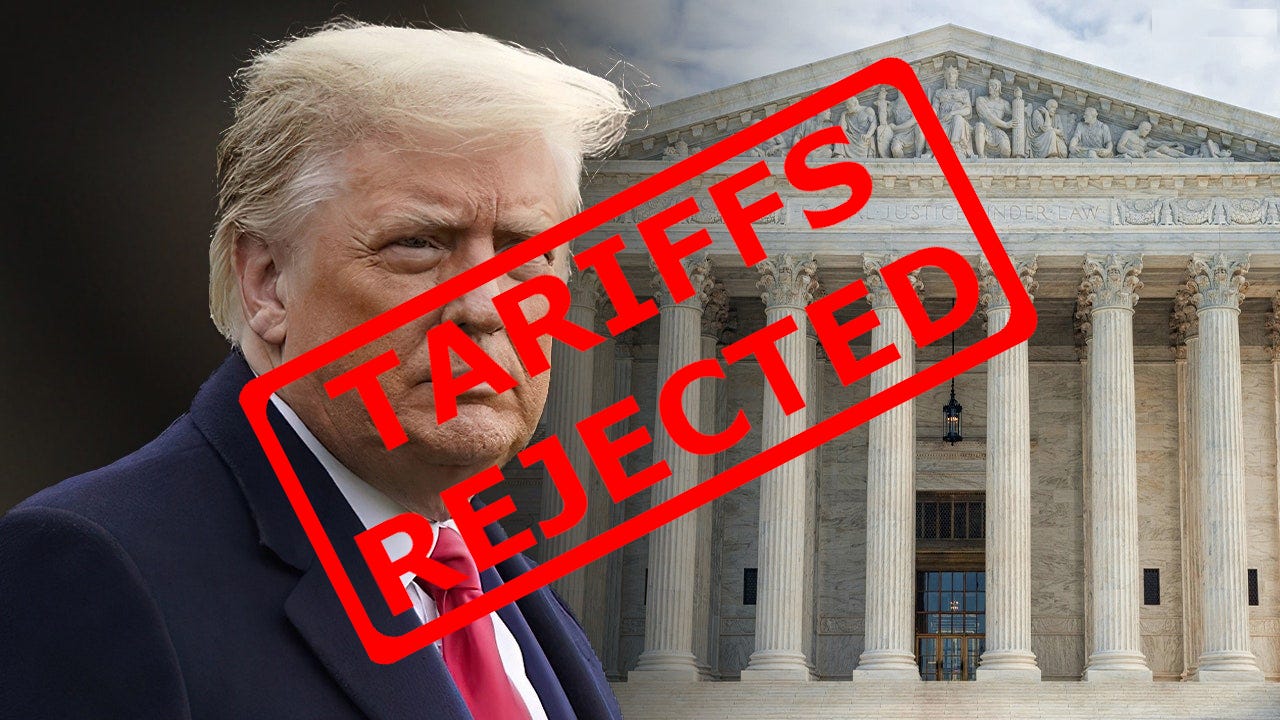
Chief Justice Roberts said Trump was wrong to secure this revenue for the United States.
Alas for Chief Justice Roberts, he is the one in the wrong. He is wrong in his opinion, he is wrong on the facts, and he is wrong on the law.
The internal contradictions and loops of illogic within Roberts’ majority opinion are more than sufficient to establish that the ruling is erroneous, that it is therefore repugnant to the Constitution, and thus it must be deemed null and void.
There is another aspect of this case that warrants our consideration, which I only touched on previously: the willingness of Supreme Court Justices to ignore and dismiss not just the letter of the law but also prior case law. The jurisprudential reality of this case is that the key facets of the case have been adjudicated before and found to sustain the Trump Administration’s position.
The disquieting response of Chief Justice Roberts and Associate Justice Neil Gorsuch can be summarized as “we don’t care.” Associate Justice Amy Coney Barrett simply ignored the precedents altogether.
How can any judge or justice adjudicate any matter according to the requirements of the rule of law when they feel free to cherry-pick the legal principles they will apply to a case?
How can any court remain credible when justice is meted out in such an arbitrary and capricious fashion?
Judges and justices cannot conform to the rule of law when they cherry-pick their legal principles. Courts cannot remain credible when they are arbitrary and capricious. There is neither dispute nor debate to be had on this point.
And so we must visit Learning Resources, Inc. v. Trump1 a second time, to understand how badly the six justices in the majority failed to apply the law as it stands.
Not Without Precedent
We begin with an important piece of Presidential history.
On August 15, 1971, President Richard Nixon issued Presidential Proclamation 4074, in which he unilaterally imposed a 10 percent tariff on virtually all imported goods coming into the United States, suspending or partially suspending any and all Executive Orders and Presidential Proclamations necessary to impose the tariffs without conflict:
B. (1) I hereby terminate in part for such period as may be necessary and modify prior Presidential Proclamations which carry out trade agreements insofar as such proclamations are inconsistent with, or proclaim duties different from, those made effective pursuant to the terms of this Proclamation.
(2) Such proclamations are suspended only insofar as is required to assess a surcharge in the form of a supplemental duty amounting to 10 percent ad valorem. Such supplemental duty shall be imposed on all dutiable articles imported into the customs territory of the United States from outside thereof, which are entered, or withdrawn from warehouse, for consumption after 12:01 a.m., August 16, 1971, provided, however, that if the imposition of an additional duty of 10 percent ad valorem would cause the total duty or charge payable to exceed the total duty or charge payable at the rate prescribed in column 2 of the Tariff Schedules of the United States, then the column 2 rate shall apply.
Nixon did not get specific approval from Congress to impose these tariffs. There was no intervening act of Congress. President Nixon decided he need to apply a 10% tariff on all imported goods, and so he applied a 10% tariff on all imported goods.
We should also note that Nixon’s tariffs were open ended, and were to remain in force until rescinded (emphasis mine).
2. Additional duties imposed—The duties provided for in this subpart are cumulative duties which apply in addition to the duties otherwise imposed on the articles involved. The provisions for these duties are effective with respect to articles entered on and after 12: 01 a.m., August 16, 1971, and shall continue in effect until modified or terminated by the President or by the Secretary of the Treasury (hereinafter referred to as the Secretary) in accordance with headnote 4 of this subpart.
Structurally, Nixon’s 1971 tariffs, unilaterally imposed without intervening act of Congress, are almost identical to the Liberation Day tariffs imposed by Donald Trump, also without intervening act of Congress.
More importantly, Nixon’s 1971 tariffs were challenged in court2—and upheld. Neither Roberts, nor Gorsuch, nor Barrett attempt to deny that the courts validated President Nixon’s tariffs.
Yet they do not consider Nixon’s tariffs as worthy precedent. Roberts and Gorsuch discuss them only to dismiss them, while Barrett does not discuss them at all.
United States v. Yoshida Intern., Inc.
President Nixon’s unilateral imposition of a 10% ad valorem tariff in 1971 was, to say the least, controversial. It is unsurprising that the tariff was quickly challenged in court. It will be somewhat surprising to some that the courts ultimately ruled in favor of the Nixon Administration and sustained the tariffs.
When Yoshida International first brought suit to overrule the Administration and rescind the tariffs, the Customs Court—the court with original jurisdiction in the case—ruled in favor of the plaintiffs and ordered the tariffs cancelled. However, the appellate court for customs cases, the United States Court of Customs and Patent Appeals, held to a different view of the applicable laws.
As even a cursory reading of Nixon’s proclamation shows, he cited numerous trade authorities as the basis for the tariffs. The Customs Court reviewed them all and found the two principal ones wanting.
We conclude that the authority granted by statute to “terminate, in whole or in part, any proclamation” does not include the power to determine and fix unilaterally a rate of duty which has not been previously legally established. On the contrary, the “termination” authority, as statutorily granted, merely provides the President with a mechanical procedure of supplanting or replacing existing rates with rates which have been established by prior proclamations or by statute.
The final authority on which the Nixon Administration relied when defending the Proclamation was the Trading With The Enemy Act (TWEA).
We must pause and note that the TWEA is a direct precursor to the IEEPA, which was passed after much debate in the House of Representatives on an overhaul of the TWEA legislation.
SUMMARY AND PURPOSE OF THE LEGISLATION
The purpose of the legislation is to redefine the power of the President to regulate international economic transactions in future times of war or national emergency. These powers are currently provided and defined in section 5(b) of the Trading With the Enemy Act. 1 The proposed bill, H.R. 7738, would separate war and nonwar authorities and procedures, preserving existing Presidential powers in time of war declared by Congress, and providing somewhat narrower powers subject to congressional review in times of “national emergency” short of war.
That the IEEPA is a lineal descendant of the TWEA is significant to a proper understanding of Learning Resources as it provides a basis for applying rulings involving the TWEA on cases involving the IEEPA. This was a major point in Justice Kavanaugh’s dissent3 in Learning Resources.
The plaintiffs argue and the Court concludes that the President lacks authority under IEEPA to impose tariffs. I disagree. In accord with Judge Taranto’s careful and persuasive opinion in the Federal Circuit, I would conclude that the President’s power under IEEPA to “regulate . . . importation” encompasses tariffs. As a matter of ordinary meaning, including dictionary definitions and historical usage, the broad power to “regulate . . . importation” includes the traditional and common means to do so—in particular, quotas, embargoes, and tariffs.
History and precedent confirm that conclusion. In 1971, President Nixon imposed 10 percent tariffs on almost all foreign imports. He levied the tariffs under IEEPA’s predecessor statute, the Trading with the Enemy Act, which similarly authorized the President to “regulate . . . importation.” The Nixon tariffs were upheld in court.
Nixon’s tariffs ultimately hinged on whether the TWEA delegates a unilateral tariff authority to the Executive Branch within the rubric of “regulate….importation” of property.
The Customs Court ruled that the TWEA does not, in fact, provide such a delegation of tariff authority. As recounted by the appeals court:
The President’s emergency power, as expressed in the Trading With the Enemy Act (TWEA), section 5(b), to “regulate * * * importation * * * of * * * any property in which any foreign country or a national thereof has any interest,” said the Customs Court,
* * * conveys to the President an authority consisting only of a specific mode of regulation, as distinguished from the full and all-inclusive power to regulate foreign commerce. The delegation of the specific regulatory authority, “by means of instructions, licenses, or otherwise,” manifestly is restrictive in scope and is but one branch of many attached to the trunk of the tree in which is lodged the all-inclusive substantive power to regulate foreign commerce, vested solely in the Congress.
We, therefore, conclude that section 5(b)(1) of the Act contains such restrictive standards and guidelines as to meet the test of constitutionality, but which, in turn, precludes the President from laying the supplemental duties provided by Presidential Proclamation 4074.
It was this part of the Customs Court ruling that the appeals court ultimately reversed.
The pertinent section of the TWEA has been amended several times since the Act’s initial passage in 1917, with the crucial amendment having taken place during World War 24
Sec . 301. The first sentence of subdivision (b) of section 5 of the Trading With the Enemy Act of October 6, 1917 (40 Stat. 411), as amended, is hereby amended to read as follows:
(1) During the time of war or during any other period of national emergency declared by the President, the President may, through any agency that he may designate, or otherwise, and under such rules and regulations as he may prescribe, by means of instructions, licenses, or otherwise—
(A) investigate, regulate, or prohibit, any transactions in foreign exchange, transfers of credit or payments between, by, through, or to any banking institution, and the importing, exporting, hoarding, melting, or earmarking of gold or silver coin or bullion, currency or securities, and
(B) investigate, regulate, direct and compel, nullify, void, prevent or prohibit, any acquisition holding, withholding, use, transfer, withdrawal, transportation, importation or exportation of, or dealing in, or exercising any right, power, or privilege with respect to, or transactions involving, any property in which any foreign country or a national thereof has any interest, by any person, or with respect to any property, subject to the jurisdiction of the United States; and any property or interest of any foreign country or national thereof shall vest, when, as, and upon the terms, directed by the President, in such agency or person as may be designated from time to time by the President, and upon such terms and conditions as the President may prescribe such interest or property shall be held, used, administered, liquidated, sold, or otherwise dealt with in the interest of and for the benefit of the United States, and such designated agency or person may perform any and all acts incident to the accomplishment or furtherance of these purposes; and the President shall, in the manner hereinabove provided, require any person to keep a full record of, and to furnish under oath, in the form of reports or otherwise, complete information relative to any act or transaction referred to in this subdivision either before, during, or after the completion thereof, or relative to any interest in foreign property, or relative to any property in which any foreign country or any national thereof has or has had any interest, or as may be otherwise necessary to enforce the provisions of this subdivision, and in any case in which a report could be required, the President may, in the manner hereinabove provided, require the production, or if necessary to the national security or defense, the seizure, of any books of account, records, contracts, letters, memoranda, or other papers, in the custody or control of such person; and the President may, in the manner hereinabove provided, take other and further measures not inconsistent herewith for the enforcement of this subdivision.
Note especially that the amended language has the same two words used in the same fashion as the IEEPA which Roberts viewed as the crux of the Trump Administration’s argument: “regulate…importation.”
The structural similarity did not go unnoticed in Kavanaugh’s dissent.
The Court of Customs and Patent Appeals structured its ruling very tightly around the validity and constitutionality of the various trade authorities upon which President Nixon based his claim of power to impose tariffs.
The sole issue before us is whether the Customs Court erred, as a matter of law, in holding that Proclamation 4074 was an ultra vires Presidential act. Resolution of the issue requires determination of whether the surcharge imposed by Presidential Proclamation 4074 was within the delegated authority to be found in either (1) the termination provisions of § 350(a)(6) of the Tariff Act of 1930, as amended (Tariff Act) (19 U.S.C. § 1351(a)(6)) and § 255(b) of the Trade Expansion Act of 1962 (TEA) (19 U.S.C. § 1885(b)), or (2) the emergency powers granted by § 5(b) of the Trading With the Enemy Act (TWEA), as amended (50 U.S.C. App. § 5(b)), and if so, whether such a delegation of authority was constitutional.
In an argument very similar to Roberts’ views in Learning Resources, the Customs Court held that “regulation” did not include imposing tariffs:
The words "instructions, licenses, or otherwise" contained in section 5(b)(1) define the nature and mode of the regulatory authority intended to be delegated to the President. These words conform to the phraseology used through the history of the Act in the establishment of a system of licenses and permits for the control of property during a time of war and crisis and which have come to be recognized as the hallmark and distinguishing feature of the Act. (Emphasis added.)
It was this reasoning that the Court of Appeals rejected.
Recognizing that to impose duties can be to "regulate," the Customs Court nonetheless interpreted the words "the President may * * * regulate * * * importation" as though they read, in effect, "the President may * * * license * * * importation." We cannot agree.
Where the Customs Court applied a narrow view of the TWEA language, the Court of Appeals held that a more expansive view of that same language was correct.
If the phrase “by means of instructions, licenses or otherwise” defines “the nature and mode of the regulatory authority intended to be delegated to the President,” it does so very broadly indeed. The phrase appears to us to be expansive, not restrictive. The words “or otherwise,” if they mean anything, must mean that Congress authorized the use of means which, though not identified, were different from, and additional to, “instructions” and “licenses.” Congress, by its use of “or otherwise,” signaled its intent not to bind the President into “instructions” or “licenses,” or into any other pre-specified means which might preclude his dealing with a national emergency and defeat the purpose of the legislation.
Demonstrably careful and extensive research into the history of § 5(b) led the author of the concurring opinion below to give weight to the lack of an indication that Congress “intended — or even considered — this section as a vehicle for delegating any of its tariff-making authority.” However, we do not find it surprising that Congress did not specify that the President could use a surcharge in a national emergency. Having left the battlefield, it would hardly do to dictate all the weapons to be used in the fight. Nor do we find anything in the inconclusive and hurried legislative history of § 5(b) which indicates an intent to prohibit action such as that reflected in Proclamation 4074.
Thus the Court of Appeals concluded that the TWEA language does extend an authority to unilaterally impose tariffs.
Does Yoshida Count?
While Roberts necessarily acknowledged Yoshida in his majority opinion for Learning Resources, he did so only to dismiss it out of hand.
This argument cannot bear the weight the Government places on it. While this Court sometimes assumes that Congress incorporates judicial definitions into legislation, we do so “only when [the] term’s meaning was ‘well-settled’ ” before the adoption. Kemp v. United States, 596 U.S. 528, 539 (2022) (quoting Neder v. United States, 527 U.S. 1, 22 (1999)); see also United States v. Kwai Fun Wong, 575 U.S. 402, 412–415 (2015). A single, expressly limited opinion from a specialized intermediate appellate court does not clear that hurdle. See BP p.l.c. v. Mayor and City Council of Baltimore, 593 U.S. 230, 244 (2021). The tariff authority asserted by President Nixon, moreover, was “far removed” from TWEA’s “original purposes” of sanctioning foreign belligerents. Cohen, Fundamentals of U. S. Foreign Trade Policy, at 178–179. We are therefore skeptical that Congress enacted IEEPA with an eye toward granting that novel power.
The inference Roberts makes is that Yoshida does not count because the Supreme Court did not rule on the case.
While Yoshida was not appealed to the Supreme Court, it nevertheless presents a valid precedent, albeit one from a lower court. The Court of Customs and Patent Appeals is indeed an “intermediate appellate court”, but it is a duly constituted tribunal inferior to the Supreme Court which Congress is explicitly authorized to create in Article 1 Section 8 of the Constitution. As such, the rulings of that court cannot be dismissed with a simple wave of a judicial hand.
The Supreme Court is at liberty to disagree with a ruling of the Court of Customs and Patent Appeals, just as it is with any other appellate tribunal. The Supreme Court is not at liberty to be disingenuous in its disagreement. The precedent Roberts cites5 as a basis for rejecting Yoshida is as facetious as it is irrelevant. In the BP p.l.c. ruling, Justice Gorsuch very explicitly tailored the ruling to a single narrow question of procedure.
The only question before us is one of civil procedure: Does 28 U. S. C. §1447(d) permit a court of appeals to review any issue in a district court order remanding a case to state court where the defendant premised removal in part on the federal officer removal statute, §1442, or the civil rights removal statute, §1443?
Yoshida was indisputably far broader and far more substantive in scope than BP p.l.c.
Moreover, the exploration performed by the court in Yoshida was whether or not Nixon’s “far removed” application of TWEA authority was nevertheless valid, and the court held that it was.
Roberts’ reasoning is nothing more than saying the Court of Customs and Patent Appeals does not matter. Coming from the Chief Justice of the United States that is itself a startling denial of legitimacy to an indisputably legitimate tribunal.
Roberts could have explored how Yoshida was wrongly decided. He did not do so.
Gorsuch’ concurrence6 is likewise a failure of judicial reasoning. Setting aside the first part of his opinion where he chides his concurring colleagues for their hypocrisy in ruling differently with respect to the Trump Administration than the Biden Administration, he then delves into an independent rationalization of why their hypocritical ruling is somehow the correct ruling. Unsurprisingly, he engages in a key piece of hypocrisy himself over President Trump’s “novel” application of the IEEPA.
First, is the President seeking to exercise an “unheralded” or “newfound” power based on a “long-extant” statute? Post, at 39 (internal quotation marks omitted). The dissent insists that is not the case here because President Nixon imposed a 10 percent tariff on most imports in 1971, and then defended that action in lower courts under a predecessor to IEEPA, the Trading with the Enemy Act (TWEA). Ibid. But the words “regulate . . . importation” were added to TWEA in 1941. §301(1)(B), 55Stat. 839. Congress used the same language in IEEPA in 1977. §203(a)(1)(B), 91Stat. 1626. And in the 85 years of TWEA’s existence with that language (and the 49 years of IEEPA’s), that is the only time either statute has been invoked to impose tariffs. Ante, at 10–11, 17–18. A single time, and one never tested in this Court. Nor are these statutes seldom used. “Each year since 1990, Presidents have issued roughly 4.5 executive orders . . . and declared 1.5 new national emergencies citing IEEPA.” Congressional Research Service, The International Emergency Economics Powers Act: Origins, Evolution, and Use 20 (Sept. 1, 2025). That is pretty strong evidence the President here seeks to “deploy an old statute” in a novel way. West Virginia, 597 U. S., at 747 (Gorsuch, J., concurring).
As discussed above regarding Roberts’ majority opinion, that Yoshida was not taken up by the Supreme Court is not relevant. What is relevant is that Yoshida is a precedent. If it is not a fitting precedent then it is on the Court—that is to say, Gorsuch—to articulate why it is not a fitting precedent. As with Roberts, Gorsuch is making the claim that Yoshida does not count, yet, as with Roberts, Gorsuch defends that claim solely by saying that the Supreme Court never ruled on it.
What Yoshida indisputably proves is that President Trump is not deploying “an old statute” in a novel way. The TWEA is the lineal ancestor to the IEEPA, and uses structurally similar language. Yoshida held that language sufficed to conclude tariff authority was included in the delegated authority to “regulate….importation” of foreign goods. As Yoshida has already laid down that precedent. it is factually false to claim that President Trump’s reliance on that same delegated authority is somehow “novel.” President Trump used an authority the courts have already conceded exists.
Gorsuch could have argued that Yoshida erred. He did not. Instead, he dismissed the ruling with less thought than Roberts applied.
However, by not arguing that Yoshida was wrongly decided Gorsuch is left with the same awkward reality as Roberts: A legitimate court has issued a legitimate ruling that the language of the TWEA is a legitimate delegation of regulatory authority over the importation of foreign goods which includes the authority to impose tariffs. With the IEEPA using structurally similar language, and with the IEEPA being explicitly crafted to provide a statutory basis for non-wartime Presidential exercise of the emergency powers delegated in the TWEA, the “novel” reasoning is that the language of the IEEPA should be construed differently than it was in the TWEA when both the statute and its legislative history are silent on that question. The IEEPA is explicitly crafted as the “peacetime” variant of the TWEA, and therefore the natural construction of the IEEPA is that it should follow that of the TWEA.
For her part, Justice Amy Coney Barrett apparently objects to that legislative and jurisprudential reality, so much so that she wrote a concurrence7 which begins by rejecting reality before wandering off into a thicket of judicial hand waving and irrelevance.
As the principal opinion demonstrates, the most natural reading of the International Emergency Economic Powers Act does not encompass the power to impose tariffs. I write only to address Justice Gorsuch’s concurrence regarding the major questions doctrine.
This introductory paragraph is simply not true. Roberts’ majority opinion makes no such demonstration. The convolutions and contradictions Roberts utilizes argue that his is a most unnatural reading of the IEEPA. The legislative history of the statute and the logic of Yoshida bear that out. Having thus rejected reality, her entire exploration of the Supreme Court's “major questions” doctrine is completely non sequitur and warrants no further examination.
The fatal flaw of Roberts’ majority opinion as well as Barrett's and Gorsuch's concurrences is simply this: if Yoshida is not wrong then President Trump’s assertion of tariff authority under the IEEPA cannot be wrong. At that point all other rationalizations and pontifications regarding “major questions” lose any claim of relevance. If Yoshida is not wrong all “major questions” have already been decided in this matter. If Yoshida is not wrong then all questions about what authorities Congress did and did not delegate have already been decided in this matter.
Neither Roberts nor Gorsuch nor Barrett argue that Yoshida is wrong. They simply “opt out” of considering its significance.
All Precedents Matter
Perversely, the one point on which all the opinions the Court issued in Learning Resources agree is that Yoshida is an existing precedent.
Justice Kavanaugh’s dissent makes the fairly straightforward argument that, as Yoshida has already covered this terrain, and as the Court declined to declare Yoshida wrongly decided, it enjoys status as a controlling precedent by default. This is a “common sense” application of the principle of stare decisis.
Under that principle, the Court should generally apply the law to similar facts in similar fashion. If the Court wishes to veer in a dissimilar direction, it carries the burden of explaining why precedent should not apply. Neither Roberts nor Gorsuch nor Barrett even pretend to do so. They simply dismiss precedent as inconsequential and proceed to construct entirely new judicial logic for matters substantively already adjudicated.
That cannot ever be considered sound jurisprudence. If the Court wishes to stray from the pathways established by precedent it must provide clear explication of its reasons for so doing. Derogation of the Court of Customs and Patent Appeals as somehow lacking in judicial relevance is not a clear explication of anything except the judicial hubris of Roberts and Gorsuch.
Was Yoshida fairly and correctly decided? We must presume that it was because no one on the Court is willing to argue that it was not.
Is Yoshida relevant? It absolutely must be, because the statutory language and context surrounding Nixon’s tariffs and Trump’s tariffs are so similar as to be nearly identical. Yoshida matters because it explores all the issues and questions raised by Learning Resources.
Because Yoshida is relevant, and because no one on the Court deigns to argue that Yoshida is wrong, it must be acknowledged as a controlling precedent. While it is not unreasonable to be troubled by a controlling precedent emerging from an inferior tribunal, the solution is to address the probity of that precedent. The Supreme Court had a perfect opportunity to address Yoshida directly, and declined to do so.
Precedents matter. Precedents are what give jurisprudence a measure of predictability and regularity. Precedents allow Presidents an private citizens alike to navigate the law with confidence. Precedents are what give form and substance to the concept of “the rule of law”, which has been a cornerstone of Constitutional governance since the founding of the Republic.
Precedents matter. Yoshida matters. Yoshida establishes beyond any an all doubt that President Trump has the authorities he claims under the IEEPA.
Because the six concurring justices in Learning Resources opted to ignore precedent, they opted to ignore the law. As their ruling ignores the law, the proper response is to ignore their ruling.
As their ruling ignores the law, it is repugnant to the Constitution and therefore null and void.
Learning Resources, Inc. v. Trump, 607 U.S. ___ (2026)
United States v. Yoshida Intern., Inc., 526 F. 2d 560 - Court of Customs and Patent Appeals 1975
Learning Resources, Inc. v. Trump, 607 U.S. ___ (2026) (Kavanaugh, J., dissenting)
BP p.l.c. v. Mayor and City Council of Baltimore, 593 U.S. ___ (2021)
Learning Resources, Inc. v. Trump, 607 U.S. ___ (2026) (Gorsuch, J., concurring)
Learning Resources, Inc. v. Trump, 607 U.S. ___ (2026) (Barrett, J., concurring)
I’ll bet that if you counted up all the times in the past three years I have called you “brilliant” it would be fifty or sixty times, Peter. If you looked up the word “brilliant “ in the dictionary, there would be a picture of you. What an amazing mind for analyzing legal matters!
I agree w Gbill…you are one smart cookie and I always appreciate your perspective.
It makes sense that you came down where you did. You’re right that presidents have used emergency powers and broad tariff language before, and cases like Yoshida show courts are willing to interpret that generously. Looking at Nixon’s 10% surcharge and the way the government defended it, it’s easy to see Trump’s move as part of a long line of strong‑executive trade actions, not some wild new overreach. If you start from the premise that emergencies justify flexible tools and that Yoshida approved that logic, then Roberts’ opinion can feel like the Court suddenly changing the rules.
Where I’d push back is on treating that earlier history as a permanent blank check. Yoshida was about a different statute, in a very specific, time‑limited situation, and Congress reacted afterward by writing more precise trade laws and narrowing peacetime emergency powers. That’s a big signal that broad, one‑off emergency readings are NOT supposed to silently carry over into every later statute. From a Madison‑leaning perspective (I am definitely in the Madisonian camp, here), the Court is doing something healthy (as I’ve stated before): itks self-correcting. It’s saying “tariffs and taxes are Congress’s lane, and if Congress wants to hand a president an open‑ended global tariff power, it has to say so clearly.”
So I respect the logic that got you to your conclusion—strong executive, real precedent, real emergencies—and also believe this decision is a needed course‑correction that puts trade and tax policy back where the Constitution parked them: in Congress.