The media lies. I venture to say most of my readers accept this as a proven truth. Probably a sizable cohort of first-time visitors to my Substack accept it as well, given the strength of the reception my latest jeremiad on media propaganda received.
We need to remember this, because it is not merely the media outlets themselves that lie, gaslight, dissemble, and deceive. Many of the pundits and social media mavens who think of themselves as economic “experts” (you decide if that category should include yours truly), both in corporate media and in the alternative media spaces, are no better.
This takes on particular relevance when we want to assess what to make of the Bureau of Labor Statistics and what the future might hold for their employment-related data sets.
We need to assess that because, regardless of how flawed the government economic data sets might be, they are a publicly accessible data store that at least attempts to provide a structured view of key economic trends such as job growth. For better or worse, the BLS provides the labor data which both Washington and Wall Street use to evaluate the state of the US economy. This data matters because it matters to significant economic actors.
In fact, the BLS has been producing objectively bad reports for decades, routinely exaggerating the good news during Democrat administrations and exaggerating the bad news during Republican administrations. They're always quietly adjusting the numbers weeks or months after the fact -- and it's funny, isn't it, how the adjustments always seem to favor the Democrats and hurt the GOP?
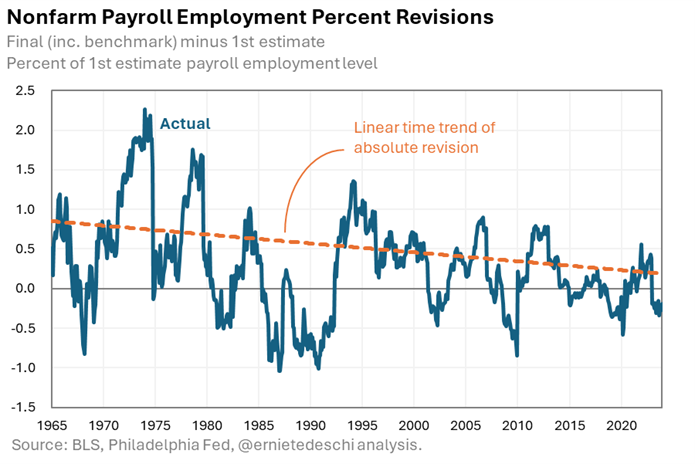
In fact, there’s strong evidence that the BLS has only gotten more accurate over time, not less. Ernie Tedeschi of The Yale Budget Lab and former chief economist for the White House Council of Economic Advisors released this analysis the trends of revisions:
After McEntarfer’s firing, government economic data can no longer be trusted or relied upon under this administration. Trump will not be able to appoint anyone with credibility to take over as BLS commissioner when it’s already clear that person could be fired for releasing accurate data. The same goes for other statistical agencies, too.
It matters, because all of these narratives are inaccurate. At best they are exaggerations, and at worst they are pathetic propaganda.
While McEntarfer clearly deserved to be fired for being incompetent, overall this is most likely one of those scenarios where stupidity is a better explanation than malice for her serial shortcomings as Commissioner. Political bias simply does not explain the error trends in BLS jobs data across both Republican and Democratic administrations.
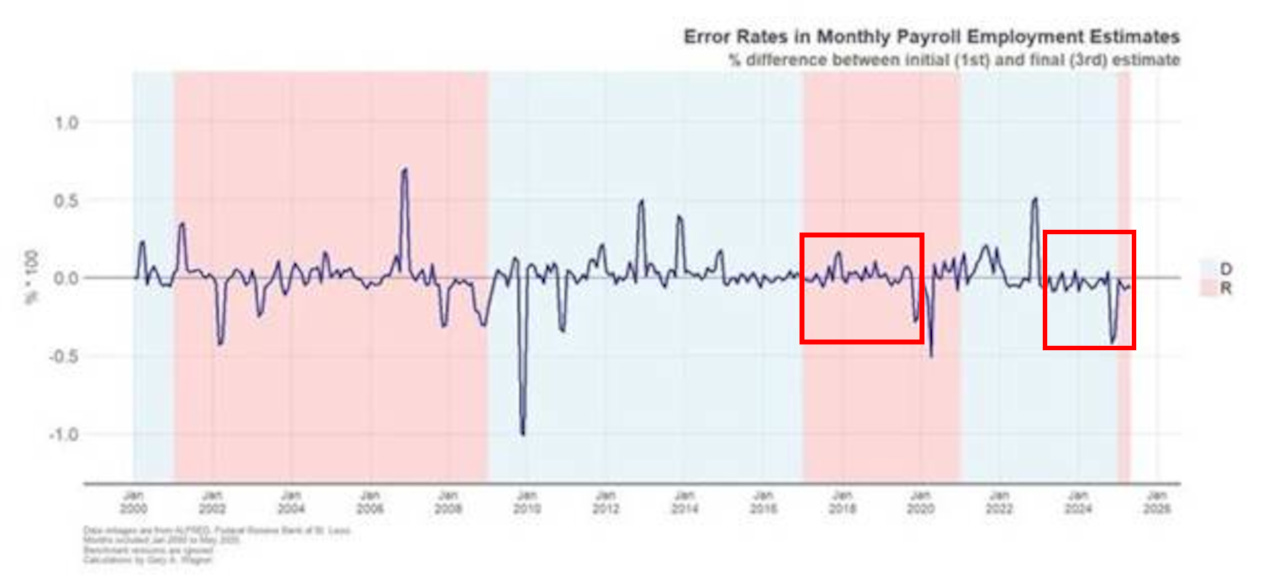
In the graph, the red and blue shaded areas represent the political party of the sitting US president. As can be seen, the errors don’t differ much by administration. The big spikes are what one could argue we should be looking at. Take the five instances where the difference is greater than ±0.5 percent. Two of those are clearly tied to economic shocks — the onset of a recession and the outbreak of COVID-19. Of the remaining three, one benefited a sitting Democratic president, one benefited a sitting Republican president, and one hurt a Republican president. Not particularly strong evidence of a “partisan” bias.
However, the same graphs which demonstrate a lack of clear political bias also highlight how McEntarfer screwed the pooch over the past few years, which we can begin to see if we look closely at the first years of President Trump’s first term of office in comparison to the data since approximately the start of 2023.
While this chart is too broad spectrum to make any detailed analysis, one thing that shows up quite visibly is that, during President Trump’s first term pre-COVID, revisions to the job numbers tended to be positive. Since 2023, the revisions have tended to be negative.
When Trump was first in office, the BLS data erred on the side of caution. Over the past few years, the data has erred on the side of recklessness.
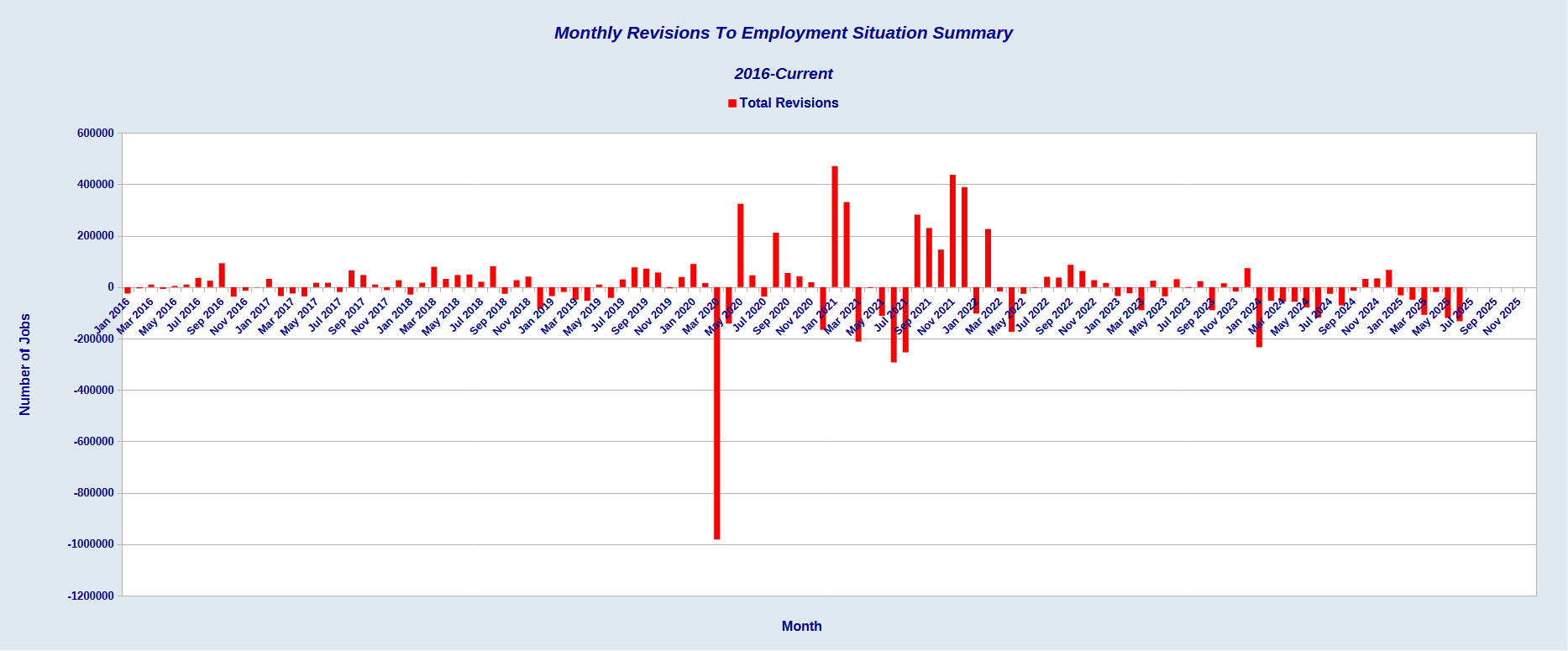
Moreover, because we have not just all the current BLS jobs data but also all of the revisions made both month-to-month and at year end1, we can chart precisely how much each month’s error has been overall. When we do that, the shift from a conservative jobs outlook to an extravagant one is not an artifact of one chart, but is what the data clearly shows.
Since before Donald Trump returned to the Oval Office, the BLS jobs data has more frequently been revised down than up.
(For every reader who has commented on the jobs numbers in recent months that they are sure to be reduced in the following months, this chart proves you were absolutely spot on with that assessment!)
The signature defect in the mainstream narrative of “nothing to see here, move along” regarding BLS revisions to the jobs data is that it looks back too far in time. If we are to evaluate how well or how poorly McEntarfer performed as BLS Commissioner, we need to focus on the data immediately before and during her tenure. A trend line stretching back to 1965 does not tell us anything about how the BLS performed on her watch vs that of her predecessor. It is true that even McEntarfer’s error rates are less than they were fifty years ago, but it is also true that her error rates are greater than during the first Trump Administration—and that is the reality that justifies her termination and substantiates charges that she was incompetent.
While both revisions down and revisions up are less than ideal, as a practical matter the data is probably more useful when the trend is a conservative one. If the revisions are primarily to the upside that means the revisions are most likely to improve the economic outlook. If revisions are primarily down they are most likely to impair the economic outlook.
When agencies such as the Federal reserve look to the BLS jobs data as part of their determination whether to raise or reduce the federal funds rate, an excessively liberal jobs report constantly revised down carries a significant risk of a delay in trimming the rate.
Did the overly optimistic jobs data mislead Jay Powell and the Federal Reserve into holding the line on the federal funds rate when they should have been trimming it? There is, of course, no way to know for certain, but we certainly cannot dismiss the possibility.
If that is the case, the Erika McEntarfer’s incompetence did real and demonstrable harm to the US economy.
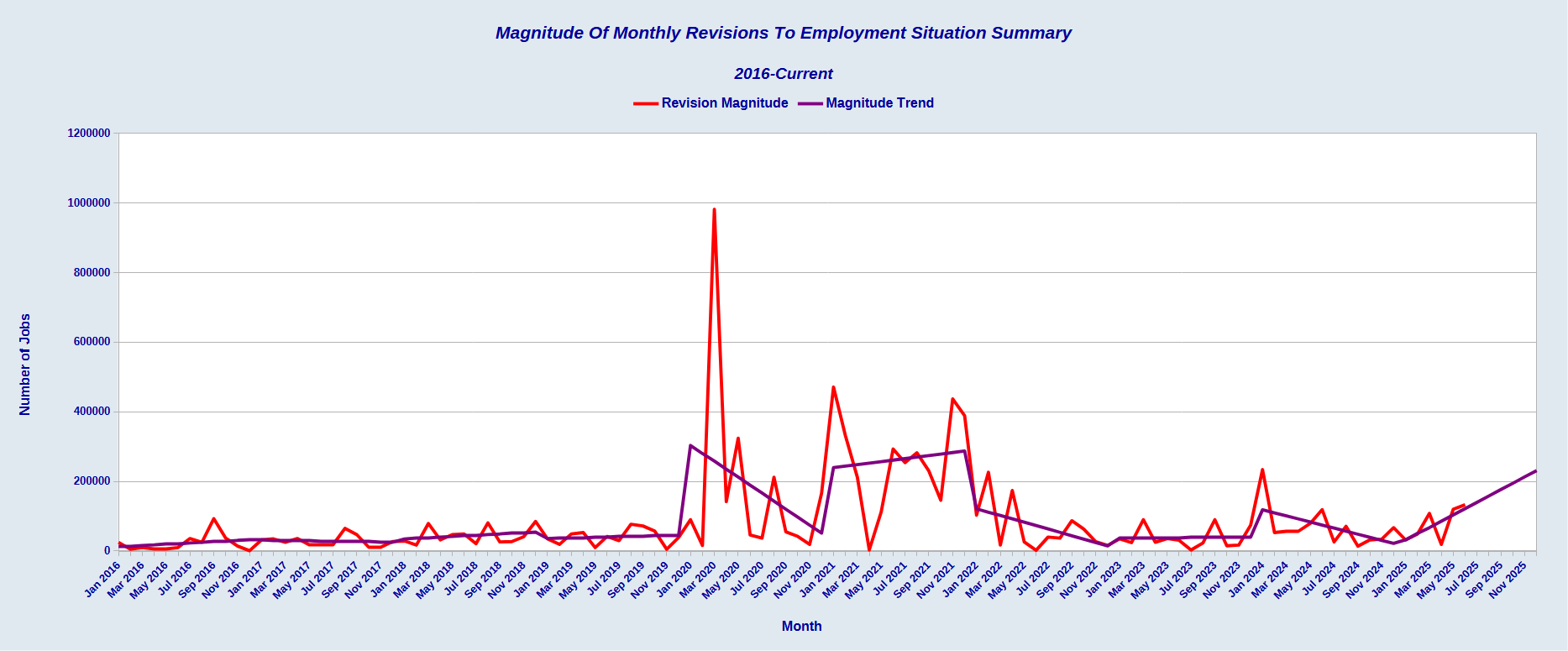
Beyond the shift from a pessimistic jobs outlook to an optimistic one, the post-COVID years show an absolute degradation in data quality, as demonstrated by an increase in revision volatility.
When we look at the absolute value of the monthly revisions—that is, the magnitude of the revision without regard to it being up or down—we see that pre-COVID, the revisions were largely stable even year to year.
All that ended with COVID. The year end revisions since 2020 have in multiple years been quite significant. In 2020 and 2021 the year end revisions—indicated by the sharp increases in January of each year—were more impactful than the monthly revisions.
While that aspect did more or less subside during 2023, in 2024 that phenomenon returned. As we of course do not have the year-end revisions for this year, we do not know how 2025 will turn out. We do know that, starting in January, the localized revision trend moved sharply up.
While this could be an example of political bias, we do not need to argue it as political bias when it is clearly a sign of degrading analytics, with or without bias.
This decay in the BLS jobs data happened on Erika McEntarfer’s watch. It was her job either to prevent this from happening, or to respond to it once it did happen. We can see from the data that she did neither.
This decay is also what the next BLS Commissioner needs to fix. This is not a political issue, but it is an issue of professional ethics and standards. The BLS Commissioner has to care deeply about putting out the best data possible, and be constantly looking to improve the data reporting with whatever tools are available.
At a minimum the negative trend in revisions since 2023 should be folded into the overall analysis, moving the reporting back towards a more conservative and pessimistic outlook.
Whether new survey methodologies are warranted or whether it is possible to improve overall response rates to the existing surveys, one outcome that absolutely must be achieved is better quality raw data.
While the casual reader of alternative media will get some discussion of this from writers extemporizing on the future of the BLS, there is no such discussion to be found within corporate media.
The BLS is fine as is, or so the narrative goes.
The data was never in doubt before, we are told, but it is now because of Donald Trump.
The data will remain in doubt, according to the narrative, so long as Donald Trump is President. Because Trump.
Unfortunately, the reality presented by the data itself is that the conclusions reached by corporate media especially have been in doubt for years. We can see that the reliability of the jobs data collapsed in 2020 during the COVID Pandemic Panic, and we can see from continued volatility that it has not ever recovered.
The reality presented by the data is that Donald Trump is just as wrong about the state of the economy as the media pundits and “experts”. A jobs recession is no indicator that the US economy is in a “golden age” of prosperity, while the lack of dramatic movement in that jobs recession means that the economy is also not on the brink of a major recession or even a depression.
An overall recession or depression could still happen, but at present it is more likely to come on slowly and incrementally. The jobs data lends no confidence to any theory of rapid economic collapse into depression.
The reality presented by the data is that everybody is wrong on both the economy broadly and labor markets specifically—and yes, that may very well include yours truly.
Unfortunately, that’s not a message any major media outlet, corporate or alternative, is willing to put out there.
When all media lies about all things, it’s a given all media will lie about things which really matter. The jobs data is the latest most glaring example of this.
Peter, you are so sharp at seeing the significant signals in the details, as well as in the big picture. It makes your Substack absolutely compelling!
“When all media lies about all things, it’s a given all media will lie about things which really matter. The jobs data is the latest…” THIS is the elephant in society that the elites are overlooking. Remember the days of “glasnost and perestroika” in the old USSR? Once the average Russian on the street grasped how completely it was all One.Big.Lie the Soviet Union started to unravel! Our American culture has now reached a point where half the nation doesn’t believe a single word written in the New York Times, or in the Washington Post, or on any of the nightly news channels. And meanwhile, the other half of the nation doesn’t believe a single word voiced by the Trump administration. It doesn’t take a PhD to see that this is leading to real trouble! The clueless elites better start working at regaining TRUST from us peasants or they will be in for serious shocks in coming elections. And Peter, I’ll bet you’ll be amongst the earliest analysts to see new warning signs. Thanks in advance!
Hey, Peter, if you’re hearing about the Minneapolis shooting today - yes, this is about a mile from me. Two children, ages 8 and 10, dead, along with the shooter (suicide). 17 others shot, including 14 children. The kids were in Wednesday morning Mass, at a private Catholic school, and the shooter just opened up with 50-100 rounds, shooting through the stained-glass windows. I can’t imagine what his motive was.
This is not in a poor part of town. Most of these kids live in million-dollar houses near Lake Harriet. Their parents are upper-middle-class two-career professionals, who put their kids in expensive private Catholic school to keep them safe, out of the public schools. What a shock to everyone here, for miles around. The library I frequent is a block from this school. I sure hope this shakes up a lot of clueless Democrats in this city - the ones who wanted to “defund the police”. Even President Trump has tweeted about today’s shooting. Just tragic!






Peter, you are so sharp at seeing the significant signals in the details, as well as in the big picture. It makes your Substack absolutely compelling!
“When all media lies about all things, it’s a given all media will lie about things which really matter. The jobs data is the latest…” THIS is the elephant in society that the elites are overlooking. Remember the days of “glasnost and perestroika” in the old USSR? Once the average Russian on the street grasped how completely it was all One.Big.Lie the Soviet Union started to unravel! Our American culture has now reached a point where half the nation doesn’t believe a single word written in the New York Times, or in the Washington Post, or on any of the nightly news channels. And meanwhile, the other half of the nation doesn’t believe a single word voiced by the Trump administration. It doesn’t take a PhD to see that this is leading to real trouble! The clueless elites better start working at regaining TRUST from us peasants or they will be in for serious shocks in coming elections. And Peter, I’ll bet you’ll be amongst the earliest analysts to see new warning signs. Thanks in advance!
Hey, Peter, if you’re hearing about the Minneapolis shooting today - yes, this is about a mile from me. Two children, ages 8 and 10, dead, along with the shooter (suicide). 17 others shot, including 14 children. The kids were in Wednesday morning Mass, at a private Catholic school, and the shooter just opened up with 50-100 rounds, shooting through the stained-glass windows. I can’t imagine what his motive was.
This is not in a poor part of town. Most of these kids live in million-dollar houses near Lake Harriet. Their parents are upper-middle-class two-career professionals, who put their kids in expensive private Catholic school to keep them safe, out of the public schools. What a shock to everyone here, for miles around. The library I frequent is a block from this school. I sure hope this shakes up a lot of clueless Democrats in this city - the ones who wanted to “defund the police”. Even President Trump has tweeted about today’s shooting. Just tragic!