


Narratives are seductive, and no one should consider themselves immune. Even alternative media outlets are at times guilty of peddling propaganda and not news.
Sadly, Breitbart has served up a telling example of this, with John Carney’s puff piece about how well labor markets are doing under Trump.

A viral statistic suggesting otherwise has drawn more than 600,000 views on X, creating a narrative of broad-based labor market collapse. But the data tells a different story.
No, it does not.
Labor market “collapse” is too strong a term, but the jobs recession is real and has been real since 2023. Arguing that the jobs recession is not real is either ignoring or misunderstanding the data, and is simply wrong.
It’s wrong when that argument appears in corporate media.
It’s wrong when that argument appears in alternative and independent media.
John Carney might be hoping to make a silk purse out of a sow’s ear over the January job numbers, but data is clear: the jobs recession is not going away just yet, and employment is not improving overall.

We know from that detail and from the annual benchmarking excercise that job growth in the United States has been considerably softer than most media outlets have reported, to the tune of roughly one million jobs that were reported but which never actually existed.
That is an important nuance to remember about the revisions. The reductions to payroll levels do not signify jobs that were lost. These reductions signify jobs that never existed. Economic narratives predicated on the jobs data showing positive growth at or above expectations are being proven false.
It does not matter which media outlet carries a narrative of optimistic job growth. Every such narrative is false, rejected and debunked by the data.
Where Carney goes off the rails is in the way he tries to deconstruct the so-called “viral narrative.”
The confusion partly stems from how the viral narrative constructs its argument. Charts typically start with total nonfarm payrolls, which include government employment, then subtract a broad health-related category. The result can make a policy-driven reduction in federal headcount look like private-sector weakness. This statistical shortcut obscures what’s actually happening in the private economy.
However, when we explore the impact of the BLS benchmark revisions published in the January Employment Situation Summary, it is clear that private employment (i.e., not including government jobs) had much softer growth over the past two years than previously reported.
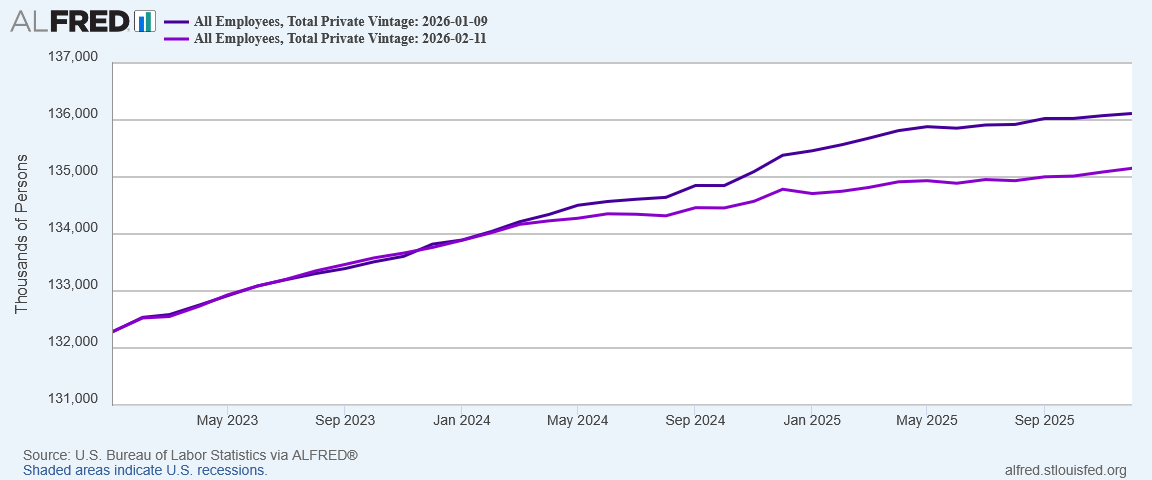
Moreover, when we do a sector by sector review, we see that Manufacturing and Information in particular were shedding jobs in 2025.


Glomming manufacturing in with other sectors that have better track records on job growth is committing the same methodological sin Carney calls out from the “viral narrative.”
The data is unambiguous on this point: Private Education and Health Services was by far the dominant sector for job growth in January, and through most of 2025.
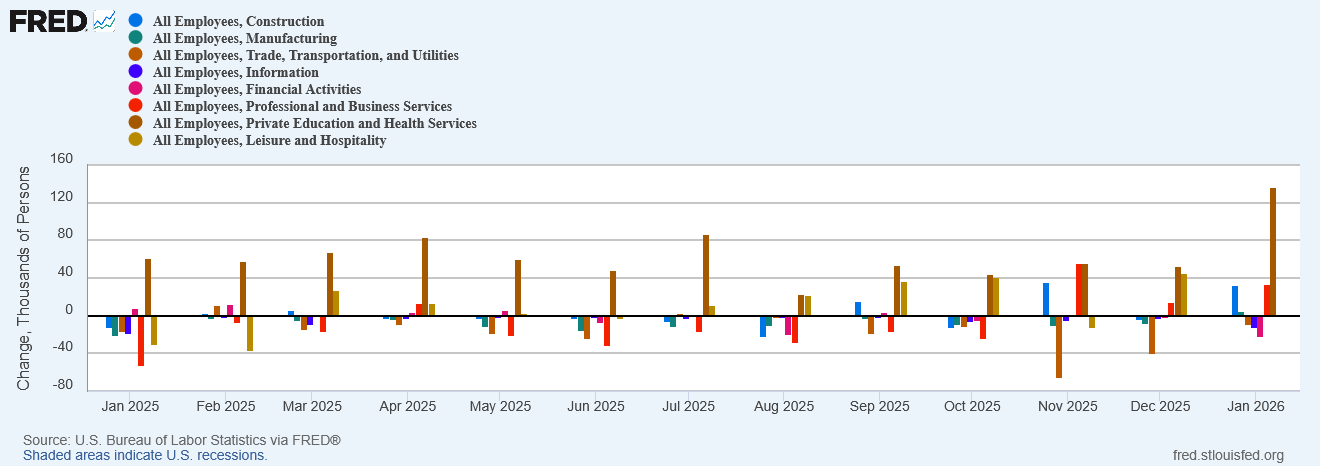
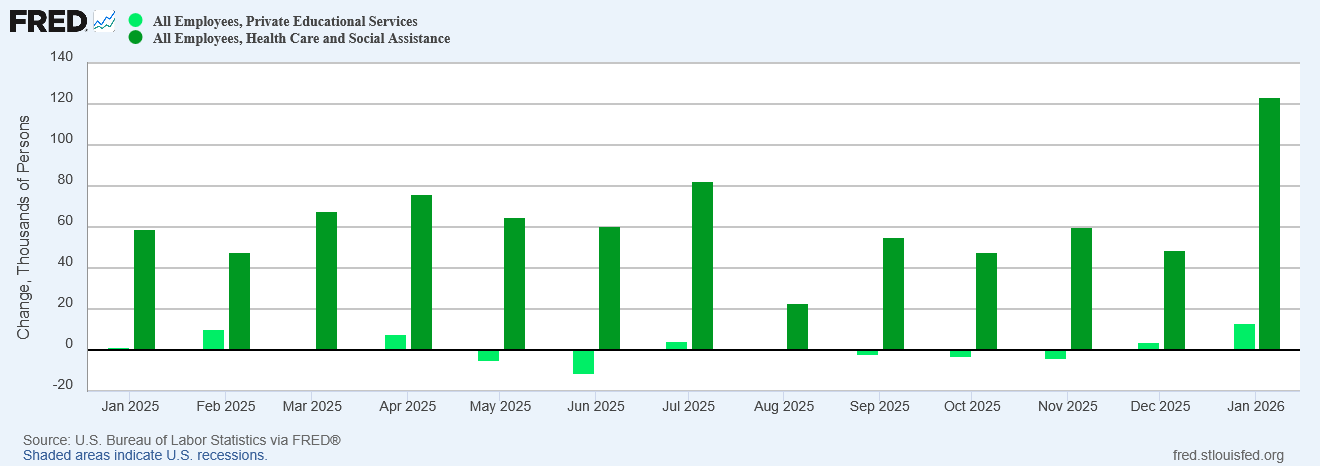
Within Private Education and Health Services, Healthcare and Social Assistance is by far the dominant sub-sector.
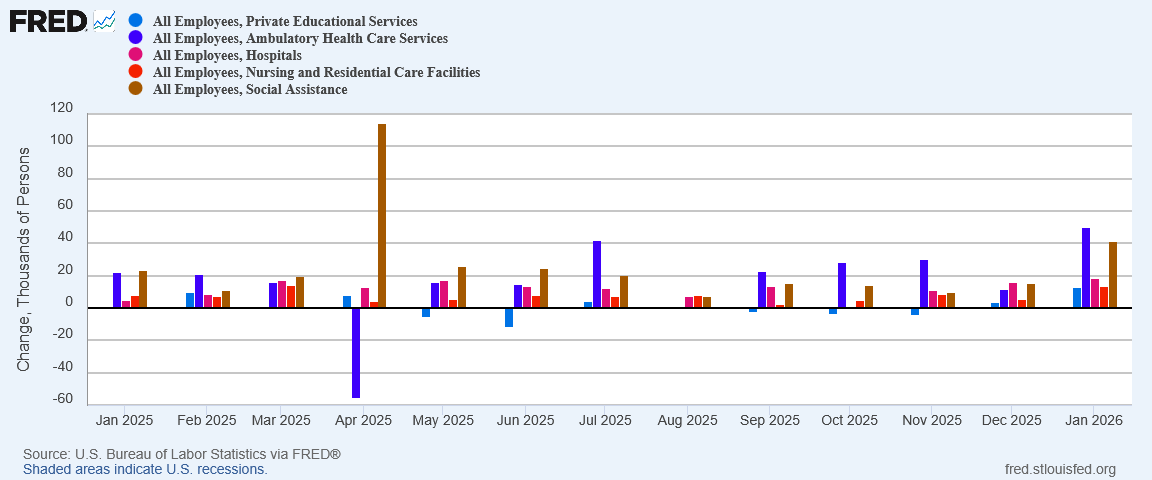
Breaking the sector down even further, we see that Ambulatory Health Care was the dominant job category for most of 2025.
If we gather the data on an annual basis, we see that Private Education and Health Services has been the dominant sector since 2023.
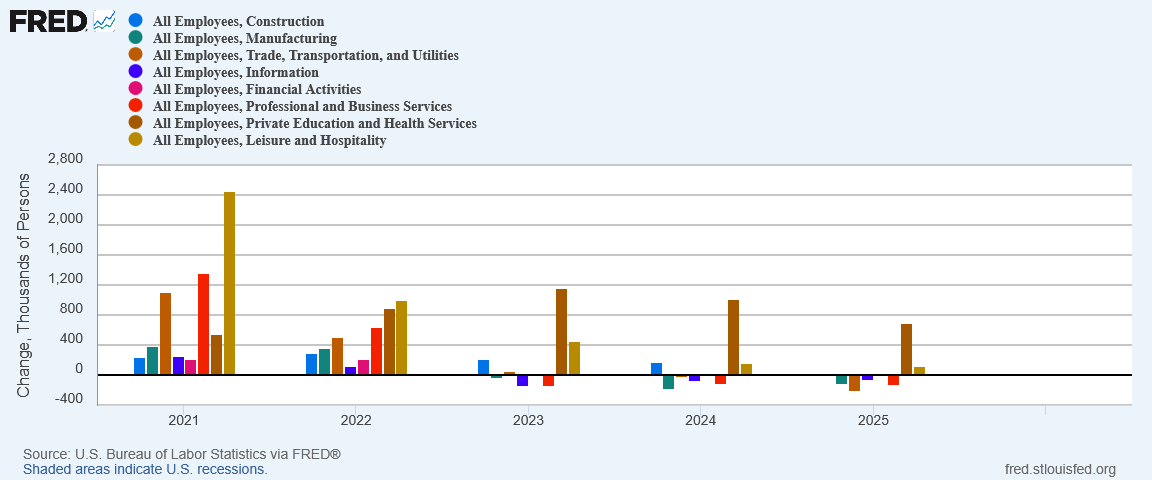
Looking at the data annually also shows where the “viral narrative” likely originated—job growth since 2023 has been literally nonexistent outside of Education and Healthcare.
If we index the subsectors, we can get a sense of how their relative growth rates have evolved. Indexing the jobs data to January 2021, we see that the sector with the most relative growth is Leisure.
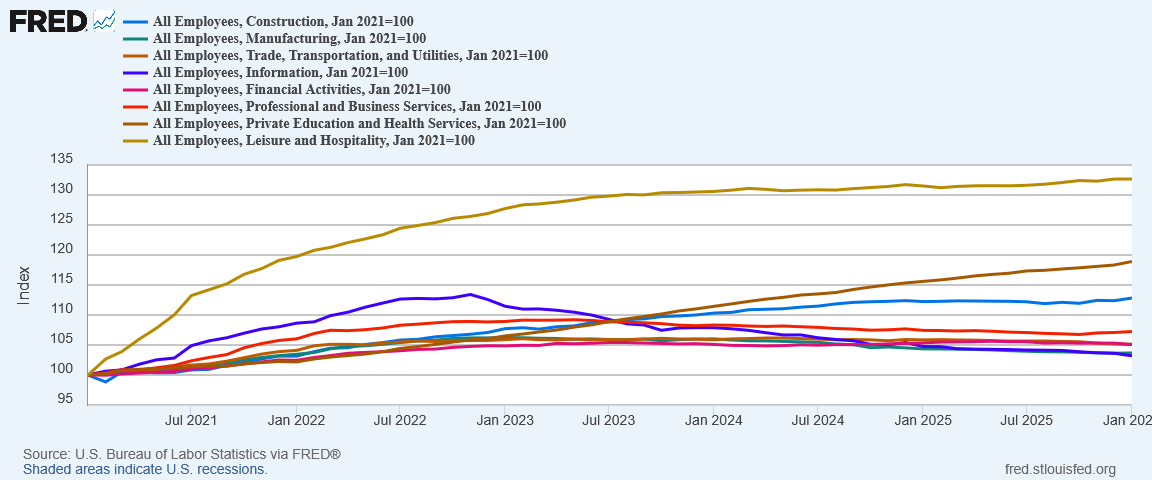
However, that same indexed presentation also shows that Leisure’s growth was largely in 2021 and 2022.
When we re-index the data to January, 2023, we see that the sector with the greatest relative growth rate over the past few years has been….wait for it…Private Education and Health Services.
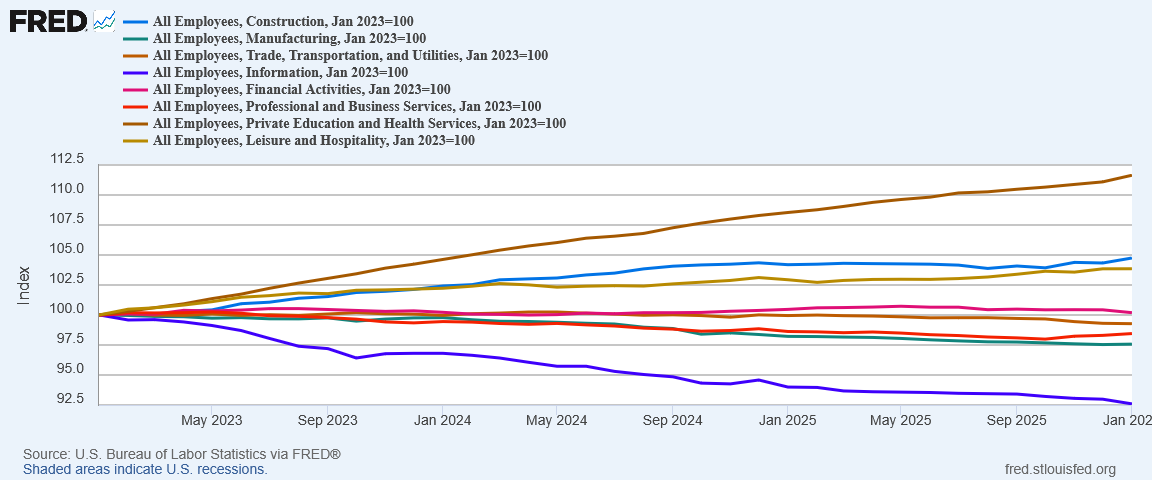
Since January 2023, Private Education and Health Services employment has grown by 11.6%. The next best performing sector, Construction, grew by 4.7%—less than the growth rate of healthcare. Leisure is right behind Construction at 3.9%.
All other economic sectors have lost employment since January 2023.
The data flatly rejects Carney’s conclusion:
None of this means the job market is booming. Hiring has become more concentrated in a handful of service industries, particularly health care. Job openings have cooled. But the sweeping conclusion — that “everything outside health care is shrinking” — relies on mixing government job cuts into an “ex-healthcare” calculation and then presenting the result as a verdict on the private economy.
The “sweeping conclusion” that upsets John Carney is a more accurate depiction of what has happened in US labor markets since 2023 than Carney’s own reimagining of the data. Since 2023 most economic sectors are experiencing shrinking employment.
I will reiterate a point I made earlier: Imbalanced job growth is not a positive economic signal.
Imbalanced job growth is what the data shows unambiguously. Pretending that it doesn’t, or ignoring that it does, is either disingenuous or dishonest. Either way, pretending that the US economy does not have imbalanced job growth is simply wrong.
That fundamental dishonesty is compounded when Carney commits a methodological sin that corporate media has committed time and again when looking at the BLS’ companion labor market report, the Job Openings and Labor Turnover Summary: he focuses on job openings while disregarding net hiring.
Yes, the job openings numbers have been large since 2021, although they have been steadily declining since 2022.
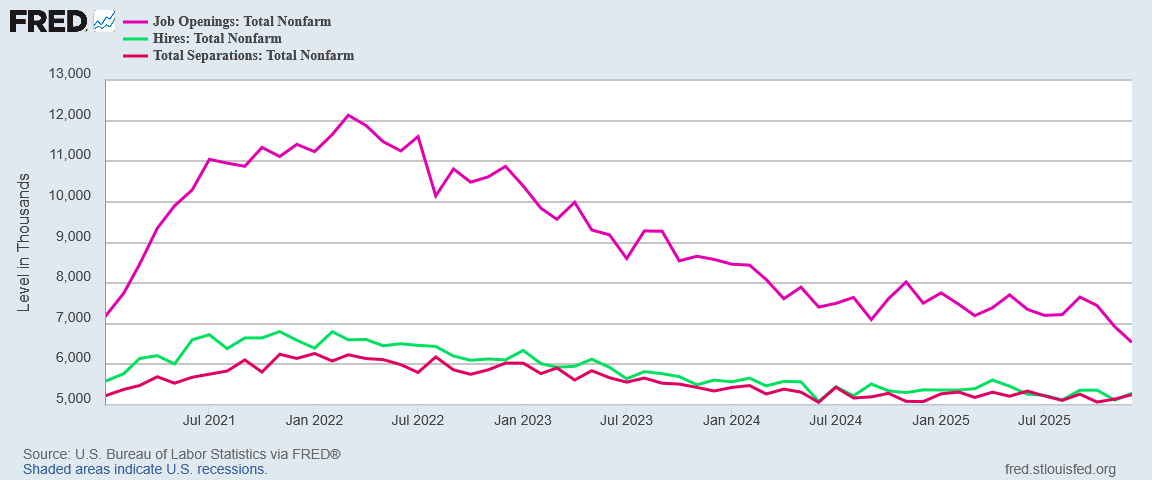
However, no matter how many job openings are advertised, net hiring—total hiring less total separations—has never risen in response to that apparent labor demand. Regardless of why that is the case, there is no denying that is the case.
Quite the contrary, since mid-2021, net hiring has been on the decline in this country.
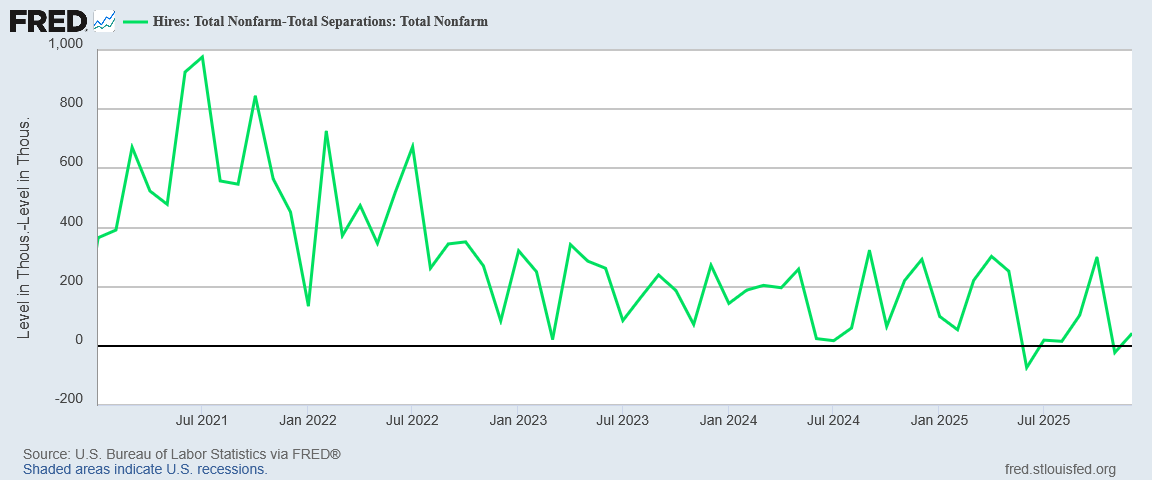
There is a subtle point that deserves emphasis here: net hiring began to decline roughly six months before the job openings began to decline. No matter how one describes the economic forces at play which produced that outcome, one fact is indisputable: the number of declared job openings created no hiring pressure, motivated no employer to add new hires.
Job openings that do not get filled provide zero economic benefit either to employer or employee. It is absurd to argue that job openings which do not lead to increased net hiring are a sign of economic and labor market health. If there is no economic benefit conferred there can be no sign of economic and labor market health.
Job openings are simply not economically relevant. Net hiring—actually putting people on payroll and taking them off payroll—is what is economically relevant.
The data is clear and unmistakable: the United States has been in a jobs recession since at least late 2023.

The data is also clear and unmistakable that manufacturing—a sector I consider to be of particular economic importance—has been hurting since at least 2023.

Recession is not collapse, and we should not argue that a jobs recession is the same as a complete labor market collapse.
Yet even before US jobs markets were in a demonstrable recession, the data was unambiguous that labor markets were increasingly toxic. They were not “tight” and job growth was not “robust”.

Labor markets in the United States are not doing well, and have not done well for years.
Labor markets were struggling in the United States throughout the Biden Reign of Error. Let us be clear about that: Donald Trump bears little responsibility for the toxic state of job markets during those years (although the extent to which current labor conditions are fallout from the COVID Pandemic Panic does come back on him and not on Joe Biden).
Labor markets are struggling in the United States even now. While it is fairly said that Donald Trump did not cause labor markets to struggle in the US, it is also fairly said that Donald Trump’s economic policies have not resulted in dramatically improved labor markets during the first year of his second term.
It may very well be that Trump’s policies will produce major jobs gains in 2026, that restoring labor market health was simply a task that had to be done on a longer timeline than one might wish. I hope that is the case. I want Donald Trump’s economic policies to succeed not because I am a fan of Donald Trump, but because successful economic policies mean economic health and prosperity for the country.
At the present time, however, that success has not happened. The jobs recession has not ended. The job growth imbalance that favors healthcare over manufacturing continues to distort the US labor force. The data makes this absolutely clear.
If we are going to apprehend the state of the US economy accurately, we have to be willing to look at the realities conveyed by labor market data. We have to be willing to acknowledge that Donald Trump has not succeeded (yet).
John Carney is not willing to acknowledge that, at least not at the moment, and that has left him peddling fake news.
Breitbart deserves better. Breitbart’s readers deserve better.
You’ve got the data, and your analytic ability has proven itself hundreds of times over. I trust your analysis, Peter.
There have been misleading aspects to “jobs postings” and “hiring” for several years now, ever since DEI and visa requirements altered Human Resources departments. We know that corporations having been posting job openings with no intention of filling them, just in order to meet certain government requirements regarding DEI. Someone with decades of experience in HR needs to expose the ways that data has been manipulated and changed over the past fifteen years or so. It would clear up some inaccurate pictures of the country’s labor situation. Peter, maybe you could keep your eyes open for an article written by a former HR head who wants to expose the bureaucratic nonsense, as this could help to refute inaccurate narratives. Thanks!